


Okakura Kakuzo

Encyclopedia
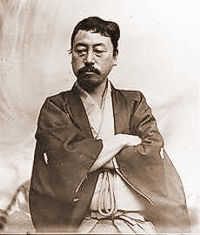
was a Japanese
Japanese people
The are an ethnic group originating in the Japanese archipelago and are the predominant ethnic group of Japan. Worldwide, approximately 130 million people are of Japanese descent; of these, approximately 127 million are residents of Japan. People of Japanese ancestry who live in other countries...
scholar who contributed to the development of arts
ARts
aRts, which stands for analog Real time synthesizer, is an audio framework that is no longer under development. It is best known for previously being used in KDE to simulate an analog synthesizer....
in Japan
Japan
Japan is an island nation in East Asia. Located in the Pacific Ocean, it lies to the east of the Sea of Japan, China, North Korea, South Korea and Russia, stretching from the Sea of Okhotsk in the north to the East China Sea and Taiwan in the south...
. Outside of Japan, he is chiefly remembered today as the author of The Book of Tea
The Book of Tea
The Book of Tea The Book of Tea by Okakura Kakuzō , is a long essay linking the role of tea to the aesthetic and cultural aspects of Japanese life....
.
Biography
Born in YokohamaYokohama
is the capital city of Kanagawa Prefecture and the second largest city in Japan by population after Tokyo and most populous municipality of Japan. It lies on Tokyo Bay, south of Tokyo, in the Kantō region of the main island of Honshu...
to parents originally from Fukui
Fukui
Fukui is a Japanese name meaning "fortunate" or it can mean "one who is from the Fukui prefecture". It may refer to:- Places :* Fukui Prefecture** Fukui, Fukui - the city of the same name in the prefecture...
, Kakuzo attended Tokyo Imperial University
University of Tokyo
, abbreviated as , is a major research university located in Tokyo, Japan. The University has 10 faculties with a total of around 30,000 students, 2,100 of whom are foreign. Its five campuses are in Hongō, Komaba, Kashiwa, Shirokane and Nakano. It is considered to be the most prestigious university...
, where he first met and studied under Ernest Fenollosa
Ernest Fenollosa
Ernest Francisco Fenollosa was an American professor of philosophy and political economy at Tokyo Imperial University...
. In 1890, Okakura was one of the principal founders of the first Japanese fine-arts academy, Tokyo Bijutsu Gakko (Tokyo School of Fine Arts) and a year later became the head, though he was later ousted from the school in an administrative struggle. Later, he also founded the Japan Art Institute with Hashimoto Gahō
Hashimoto Gaho
was a Japanese painter, one of the last to paint in the style of the Kanō school.Born in Edo, he studied painting under Kanō Shōsen'in, and was influenced as well by the work of Kanō Hōgai. He created many works in the traditional style of the Kanō school, using color & gold, or otherwise...
and Yokoyama Taikan
Yokoyama Taikan
was the pseudonym of a major figure in Meiji, Taishō and early Shōwa period Japanese painting. He is notable for helping create the Japanese painting technique of Nihonga. His real name was Yokoyama Hidemaro.-Early life:...
. He was invited by William Sturgis Bigelow
William Sturgis Bigelow
William Sturgis Bigelow was an American physician and collector of Japanese art. He was one of the first Americans to live in Japan , and to introduce the American public to Japanese art and culture...
to the Museum of Fine Arts, Boston
Museum of Fine Arts, Boston
The Museum of Fine Arts in Boston, Massachusetts, is one of the largest museums in the United States, attracting over one million visitors a year. It contains over 450,000 works of art, making it one of the most comprehensive collections in the Americas...
in 1904 and became the first head of the Asian art division in 1910.
Okakura was a high-profile urbanite who had an international sense of self. In the Meiji period
Meiji period
The , also known as the Meiji era, is a Japanese era which extended from September 1868 through July 1912. This period represents the first half of the Empire of Japan.- Meiji Restoration and the emperor :...
he was the first dean of the Tokyo Fine Arts School (now the Tokyo National University of Fine Arts and Music). He wrote all of his main works in English
English language
English is a West Germanic language that arose in the Anglo-Saxon kingdoms of England and spread into what was to become south-east Scotland under the influence of the Anglian medieval kingdom of Northumbria...
. Okakura researched Japan's traditional art and traveled to Europe
Europe
Europe is, by convention, one of the world's seven continents. Comprising the westernmost peninsula of Eurasia, Europe is generally 'divided' from Asia to its east by the watershed divides of the Ural and Caucasus Mountains, the Ural River, the Caspian and Black Seas, and the waterways connecting...
, the United States
United States
The United States of America is a federal constitutional republic comprising fifty states and a federal district...
, China
China
Chinese civilization may refer to:* China for more general discussion of the country.* Chinese culture* Greater China, the transnational community of ethnic Chinese.* History of China* Sinosphere, the area historically affected by Chinese culture...
and India
India
India , officially the Republic of India , is a country in South Asia. It is the seventh-largest country by geographical area, the second-most populous country with over 1.2 billion people, and the most populous democracy in the world...
. He emphasised the importance to the modern world of Asian culture
Eastern world
__FORCETOC__The term Eastern world refers very broadly to the various cultures or social structures and philosophical systems of Eastern Asia or geographically the Eastern Culture...
, helping to turn the tide against the Western
Western culture
Western culture, sometimes equated with Western civilization or European civilization, refers to cultures of European origin and is used very broadly to refer to a heritage of social norms, ethical values, traditional customs, religious beliefs, political systems, and specific artifacts and...
influences that had dominated art and literature across the globe throughout the nineteenth century.
His book, The Ideals of the East (1904), published on the eve of the Russo-Japanese War
Russo-Japanese War
The Russo-Japanese War was "the first great war of the 20th century." It grew out of rival imperial ambitions of the Russian Empire and Japanese Empire over Manchuria and Korea...
, is famous for its opening line, "Asia
Asia
Asia is the world's largest and most populous continent, located primarily in the eastern and northern hemispheres. It covers 8.7% of the Earth's total surface area and with approximately 3.879 billion people, it hosts 60% of the world's current human population...
is one." He argued that Asia is "one" in its humiliation, of falling behind in achieving modernization
Modernization
In the social sciences, modernization or modernisation refers to a model of an evolutionary transition from a 'pre-modern' or 'traditional' to a 'modern' society. The teleology of modernization is described in social evolutionism theories, existing as a template that has been generally followed by...
, and thus being colonized
Colonialism
Colonialism is the establishment, maintenance, acquisition and expansion of colonies in one territory by people from another territory. It is a process whereby the metropole claims sovereignty over the colony and the social structure, government, and economics of the colony are changed by...
by the Western powers. This was an early expression of Pan-Asianism
Pan-Asianism
Pan-Asianism is an ideology or a movement that Asian nations unite and solidify and create a continental identity to defeat the designs of the Western nations to perpetuate hegemony.-Japanese Asianism:...
. Later Okakura felt compelled to protest against a Japan that tried to catch up with the Western powers, but by sacrificing other Asian countries in the Russo-Japanese War.
In Japan, Okakura, along with Fenollosa, is credited with "saving" Nihonga
Nihonga
or literally "Japanese-style paintings" is a term used to describe paintings that have been made in accordance with traditional Japanese artistic conventions, techniques and materials...
, or painting done with traditional Japanese technique, as it was threatened with replacement by Western-style painting, or "Yōga", whose chief advocate was artist Kuroda Seiki
Kuroda Seiki
Viscount was the pseudonym of a Japanese painter and teacher, noted for bringing Western theories about art to a wide Japanese audience. He was among the leaders of the yōga movement in late 19th- and early 20th-century Japanese painting...
. Beyond this, he was instrumental in modernizing Japanese aesthetics, having recognized the need to preserve Japan's cultural heritage, and thus was one of the major reformers during Japan's period of modernization beginning with the Meiji Restoration
Meiji Restoration
The , also known as the Meiji Ishin, Revolution, Reform or Renewal, was a chain of events that restored imperial rule to Japan in 1868...
.
Outside of Japan, Okakura had an impact on a number of important figures, directly or indirectly, who include philosopher Martin Heidegger
Martin Heidegger
Martin Heidegger was a German philosopher known for his existential and phenomenological explorations of the "question of Being."...
, poet Ezra Pound
Ezra Pound
Ezra Weston Loomis Pound was an American expatriate poet and critic and a major figure in the early modernist movement in poetry...
, and especially poet Rabindranath Tagore
Rabindranath Tagore
Rabindranath Tagore , sobriquet Gurudev, was a Bengali polymath who reshaped his region's literature and music. Author of Gitanjali and its "profoundly sensitive, fresh and beautiful verse", he became the first non-European Nobel laureate by earning the 1913 Prize in Literature...
and heiress Isabella Stewart Gardner
Isabella Stewart Gardner
Isabella Stewart Gardner – founder of the Isabella Stewart Gardner Museum in Boston – was an American art collector, philanthropist, and one of the foremost female patrons of the arts....
, who were close personal friends of his. For more on this subject, see Benfey, below.
Works
- The Ideals of the East (London: J. Murray, 1903)
- The Awakening of Japan (New York: Century, 1904)
- The Book of Tea (New York: Putnam's, 1906) : http://www.sacred-texts.com/bud/tea.htm
See also
- The Book of TeaThe Book of TeaThe Book of Tea The Book of Tea by Okakura Kakuzō , is a long essay linking the role of tea to the aesthetic and cultural aspects of Japanese life....
- Teaism
- RokkakudōRokkakudō (Kitaibaraki), officially known as , was a hexagonal wooden retreat overlooking the sea along the Izura coast in Kitaibaraki, Ibaraki Prefecture, Japan. Dating to 1905, it was part of the Izura Institute of Arts & Culture, Ibaraki University...
- Tenshin Memorial Museum of Art, IbarakiTenshin Memorial Museum of Art, IbarakiThe opened in Kitaibaraki, Ibaraki Prefecture, Japan in 1997. It has a memorial room dedicated to Okakura Tenshin and his works and displays other items of Japanese art, especially by the artists of the Izura coast.-External links:...
External links
- "Japan as Museum" An essay by famous intellectual Kojin KarataniKojin Karataniis a Japanese philosopher and literary critic.-Biography:Karatani was educated at University of Tokyo where he took a BA degree in economics and an MA in English literature. The Gunzō Literary Prize, which he received at the age of 27 for an essay on Natsume Sōseki, was the first critical acclaim...
. - Kokka and the Early Neo-Bengal School Masters by Satyasri Ukil
- An Artist Remembered by Satyasri Ukil
- Forget Okakura by Niraj Kumar