
The
Ohlone people, also known as the
Costanoan, are a
Native AmericanNative Americans in the United States are the indigenous peoples in North America within the boundaries of the present-day continental United States, parts of Alaska, and the island state of Hawaii. They are composed of numerous, distinct tribes, states, and ethnic groups, many of which survive as...
people of the central
CaliforniaCalifornia is a state located on the West Coast of the United States. It is by far the most populous U.S. state, and the third-largest by land area...
coast. When
SpanishSpain , officially the Kingdom of Spain languages]] under the European Charter for Regional or Minority Languages. In each of these, Spain's official name is as follows:;;;;;;), is a country and member state of the European Union located in southwestern Europe on the Iberian Peninsula...
explorers and missionaries arrived in the late 18th century, the Ohlone inhabited the area along the coast from
San Francisco BaySan Francisco Bay is a shallow, productive estuary through which water draining from approximately forty percent of California, flowing in the Sacramento and San Joaquin rivers from the Sierra Nevada mountains, enters the Pacific Ocean...
through
Monterey BayMonterey Bay is a bay of the Pacific Ocean, along the central coast of California. The bay is south of San Francisco and San Jose, between the cities of Santa Cruz and Monterey....
to the lower
Salinas ValleyThe Salinas Valley lies south of San Francisco, California.The word "salina" is spanish for salt marsh, salt lake or salt pan.-Geography:The Salinas Valley runs approximately south-east from Salinas towards King City. The valley lends its name to the geologic province in which it's located, the...
. At that time they spoke a variety of languages, the
Ohlone languagesThe Ohlone language family also known as "Costanoan", is a family of languages of the San Francisco Bay Area spoken by the Ohlone peoples. It is a member of the hypothetical Penutian language phylum or stock, and the Utian language family...
, belonging to the Costanoan sub-family of the
Utian languageUtian is a family of indigenous languages spoken in the central and north portion of California, United States. The Miwok and Ohlone peoples both spoke languages in the Utian linguistic group...
family, which itself belongs to the proposed Penutian language phylum or stock. The term "Ohlone" has been used in place of "Costanoan" since the 1970s by some descendant groups and by most ethnographers, historians, and writers of popular literature.
Before the Spanish came, the Ohlone lived in more than 50
distinct landholding groups, and did not view themselves as a distinct group. They survived by hunting, fishing, and gathering, in the typical ethnographic California pattern. Originally, the Ohlone religion was
shamanismShamanism is an anthropological term referencing a range of beliefs and practices regarding communication with the spiritual world. To quote Eliade: "A first definition of this complex phenomenon, and perhaps the least hazardous, will be: shamanism = technique of ecstasy." Shamanism encompasses the...
, but in the years 1769 to 1833, the
Spanish missions in CaliforniaThe Spanish missions in California comprise a series of religious and military outposts established by Spanish Catholics of the Franciscan Order between 1769 and 1823 to spread the Christian faith among the local Native Americans. The missions represented the first major effort by Europeans to...
had a devastating effect on Ohlone culture. The Ohlone population declined steeply during this period.
The Ohlone living today belong to one or another of a number of geographically distinct groups, most, but not all, in their original home territory. The Muwekma Ohlone Tribe has members from around the San Francisco Bay Area, and is composed of descendents of the Ohlones/Costanoans from the San Jose, Santa Clara, and San Francisco missions. The Ohlone/Costanoan Esselen Nation, consisting of descendants of intermarried Rumsen Costanoan and
EsselenThe Esselen were a Native American linguistic group in the hypothetical Hokan language family, who resided on the Central California coast and the coastal mountains, including what is now known as the Big Sur region in Monterey County, California...
speakers of Mission San Carlos Borromeo, are centered at Monterey. The Amah-Mutsun Tribe are descendants of Mutsun Costanoan speakers of Mission San Juan Bautista, inland from Monterey Bay. Most members of another group of Rumsen language, descendants from Mission San Carlos, the Costanoan Rumsen Carmel Tribe Of Pomona/Chino, now live in southern California. These groups, and others with smaller memberships (see groups listed under the heading
Present Day below) are separately petitioning the federal government for tribal recognition.
Culture
The Ohlone inhabited fixed village locations, moving temporarily to gather seasonal foodstuffs like
acornThe acorn, or oak nut, is the nut of the oaks and their close relatives . It usually contains a single seed , enclosed in a tough, leathery shell, and borne in a cup-shaped cupule. Acorns vary from 1–6 cm long and 0.8–4 cm broad...
s and berries. The Ohlone people lived in Northern California from the northern tip of the
San Francisco PeninsulaThe San Francisco Peninsula is a peninsula in the San Francisco Bay Area that separates the San Francisco Bay from the Pacific Ocean. On its northern tip is the City and County of San Francisco. Its southern base is in Santa Clara County, including the cities of Palo Alto, Los Altos, and Mountain...
down to
Big SurBig Sur is a sparsely populated region of the Central Coast of California where the Santa Lucia Mountains rise abruptly from the Pacific Ocean. The name "Big Sur" is derived from the original Spanish-language "el sur grande", meaning "the big south", or from "el país grande del sur", "the big...
in the south, and from the
Pacific OceanThe Pacific Ocean is the largest of the Earth's oceanic divisions. It extends from the Arctic in the north to the Southern Ocean in the south, bounded by Asia and Australia in the west, and the Americas in the east.At 165.2 million square kilometres in area, this largest division of the World...
in the west to the
Diablo RangeThe Diablo Range is a mountain range in the California Coast Ranges subdivision of the Pacific Coast Ranges. It is located in the eastern San Francisco Bay area south to the Salinas Valley area of northern California, the United States.-Geography:...
in the east. Their vast region included the San Francisco Peninsula,
Santa Clara ValleyThe Santa Clara Valley is a valley just south of the San Francisco Bay in Northern California in the United States. Much of Santa Clara County and its county seat, San José, are in the Santa Clara Valley. The valley was originally known as the Valley of Heart’s Delight for its high concentration...
,
Santa Cruz MountainsThe Santa Cruz Mountains, part of the Pacific Coast Ranges, are a mountain range in central California, United States. They form a ridge along the San Francisco Peninsula, south of San Francisco, separating the Pacific Ocean from San Francisco Bay and the Santa Clara Valley, and continuing south,...
,
Monterey Bay areaMonterey Bay is a bay of the Pacific Ocean, along the central coast of California. The bay is south of San Francisco and San Jose, between the cities of Santa Cruz and Monterey....
, as well as present-day
Alameda CountyAlameda County is a county in the U.S. state of California. It occupies most of the East Bay region of the San Francisco Bay Area. As of the 2010 census it had a population of 1,510,271, making it the 7th most populous county in the state...
,
Contra Costa CountyContra Costa County is a primarily suburban county in the San Francisco Bay Area of the U.S. state of California. As of the 2010 census, it had a population of 1,049,025...
and the
Salinas ValleyThe Salinas Valley lies south of San Francisco, California.The word "salina" is spanish for salt marsh, salt lake or salt pan.-Geography:The Salinas Valley runs approximately south-east from Salinas towards King City. The valley lends its name to the geologic province in which it's located, the...
. Prior to Spanish contact, the Ohlone formed a complex association of approximately 50 different "nations or tribes" with about 50 to 500 members each, with an average of 200. Over 50 distinct Ohlone tribes and villages have been recorded. The Ohlone villages interacted through trade, intermarriage and ceremonial events, as well as some internecine conflict. Cultural arts included basket-weaving skills, seasonal ceremonial dancing events, female
tattooA tattoo is made by inserting indelible ink into the dermis layer of the skin to change the pigment. Tattoos on humans are a type of body modification, and tattoos on other animals are most commonly used for identification purposes...
s, ear and nose piercings, and other ornamentation.
The Ohlone subsisted mainly as
hunter-gathererA hunter-gatherer or forage society is one in which most or all food is obtained from wild plants and animals, in contrast to agricultural societies which rely mainly on domesticated species. Hunting and gathering was the ancestral subsistence mode of Homo, and all modern humans were...
s and in some ways
harvestHarvest is the process of gathering mature crops from the fields. Reaping is the cutting of grain or pulse for harvest, typically using a scythe, sickle, or reaper...
ers. "A rough husbandry of the land was practiced, mainly by annually setting of fires to burn-off the old growth in order to get a better yield of seeds – or so the Ohlone told early explorers in
San Mateo CountySan Mateo County is a county located in the San Francisco Bay Area of the U.S. state of California. It covers most of the San Francisco Peninsula just south of San Francisco, and north of Santa Clara County. San Francisco International Airport is located at the northern end of the county, and...
." Their staple diet consisted of crushed acorns,
nutsCorylus cornuta is a deciduous shrubby hazel found in most of North America, from southern Canada south to Georgia and California. It grows in dry woodlands and forest edges and can reach 4 – 8 m tall with stems 10 – 25 cm thick with smooth gray bark...
, grass seeds, and berries, although other vegetation, hunted and trapped game, fish and seafood (including
musselThe common name mussel is used for members of several families of clams or bivalvia mollusca, from saltwater and freshwater habitats. These groups have in common a shell whose outline is elongated and asymmetrical compared with other edible clams, which are often more or less rounded or oval.The...
s and
abaloneAbalone , from aulón, are small to very large-sized edible sea snails, marine gastropod molluscs in the family Haliotidae and the genus Haliotis...
from the
San Francisco BaySan Francisco Bay is a shallow, productive estuary through which water draining from approximately forty percent of California, flowing in the Sacramento and San Joaquin rivers from the Sierra Nevada mountains, enters the Pacific Ocean...
and Pacific Ocean), were also important to their diet. These food sources were abundant in earlier times and maintained by careful work (and spiritual respect), and through active management of all the natural resources at hand.
Animals in their mild climate included the
grizzly bearThe grizzly bear , also known as the silvertip bear, the grizzly, or the North American brown bear, is a subspecies of brown bear that generally lives in the uplands of western North America...
,
elkThe red deer is one of the largest deer species. Depending on taxonomy, the red deer inhabits most of Europe, the Caucasus Mountains region, Asia Minor, parts of western Asia, and central Asia. It also inhabits the Atlas Mountains region between Morocco and Tunisia in northwestern Africa, being...
(Cervus elaphus),
pronghornThe pronghorn is a species of artiodactyl mammal endemic to interior western and central North America. Though not an antelope, it is often known colloquially in North America as the prong buck, pronghorn antelope, or simply antelope, as it closely resembles the true antelopes of the Old World and...
, and
deerDeer are the ruminant mammals forming the family Cervidae. Species in the Cervidae family include white-tailed deer, elk, moose, red deer, reindeer, fallow deer, roe deer and chital. Male deer of all species and female reindeer grow and shed new antlers each year...
. The streams held
salmonSalmon is the common name for several species of fish in the family Salmonidae. Several other fish in the same family are called trout; the difference is often said to be that salmon migrate and trout are resident, but this distinction does not strictly hold true...
,
perchPerch is a common name for fish of the genus Perca, freshwater gamefish belonging to the family Percidae. The perch, of which there are three species in different geographical areas, lend their name to a large order of vertebrates: the Perciformes, from the Greek perke meaning spotted, and the...
, and
sticklebackThe Gasterosteidae are a family of fish including the sticklebacks. FishBase currently recognises sixteen species in the family, grouped in five genera. However several of the species have a number of recognised subspecies, and the taxonomy of the family is thought to be in need of revision...
. Birds included plentiful
ducksThe Mallard , or Wild Duck , is a dabbling duck which breeds throughout the temperate and subtropical Americas, Europe, Asia, and North Africa, and has been introduced to New Zealand and Australia....
,
geeseThe word goose is the English name for a group of waterfowl, belonging to the family Anatidae. This family also includes swans, most of which are larger than true geese, and ducks, which are smaller....
,
quailThe California Quail, Callipepla californica, also known as the California Valley Quail or Valley Quail, is a small ground-dwelling bird in the New World quail family...
,
great horned owlThe Great Horned Owl, , also known as the Tiger Owl, is a large owl native to the Americas. It is an adaptable bird with a vast range and is the most widely distributed true owl in the Americas.-Description:...
s, red-shafted flickers,
downy woodpeckerThe Downy Woodpecker is a species of woodpecker, the smallest in North America.- Description :Adult Downy Woodpeckers are mainly black on the upperparts and wings, with a white back, throat and belly and white spotting on the wings. There is a white bar above the eye and one below. They have a...
s,
goldfinchGoldfinch may refer to any of the following species of bird from the genus Carduelis:* American Goldfinch, Carduelis tristis* European Goldfinch, Carduelis carduelis* Lawrence's Goldfinch, Carduelis lawrencei...
es, and
yellow-billed magpieThe Yellow-billed Magpie, Pica nuttalli, is a large bird in the crow family found only in California. It inhabits the Central Valley and the adjacent chaparral foothills and mountains...
s. Waterfowl were the most important birds in the people's diet, which were captured with nets and decoys. The Chochenyo traditional narratives refer to ducks as food, and
Juan CrespiFather Juan Crespí was a Majorcan missionary and explorer of Las Californias. He entered the Franciscan order at the age of seventeen. He came to America in 1749, and accompanied explorers Francisco Palóu and Junípero Serra. In 1767 he went to the Baja Peninsula and was placed in charge of the...
observed in his journal that geese were stuffed and dried "to use as decoys in hunting others."
Along the ocean shore and bays, there were also
otterThe Otters are twelve species of semi-aquatic mammals which feed on fish and shellfish, and also other invertebrates, amphibians, birds and small mammals....
s,
whaleWhale is the common name for various marine mammals of the order Cetacea. The term whale sometimes refers to all cetaceans, but more often it excludes dolphins and porpoises, which belong to suborder Odontoceti . This suborder also includes the sperm whale, killer whale, pilot whale, and beluga...
s, and at one time thousands of
sea lionsThe California sea lion is a coastal sea lion of western North America. Their numbers are abundant , and the population continues to expand about 5% annually. They are quite intelligent and can adapt to man-made environments...
. In fact, there were so many sea lions that according to Crespi it "looked like a pavement" to the incoming Spanish.
In general, along the bayshore and valleys, the Ohlone constructed dome-shaped houses of woven or bundled mats of tules, 6 to 20 feet (1.8 to 6 m) in diameter. In hills where Redwood trees were accessible, they built conical houses from Redwood bark attached to a frame of wood. Redwood houses were remembered in Monterey. One of the main village buildings, the
sweat lodgeThe sweat lodge is a ceremonial sauna and is an important event in some North American First Nations or Native American cultures...
was low into the ground, its walls made of earth and roof of earth and brush. They built boats of tule to navigate on the bays propelled by double-bladed paddles.
Generally, men did not wear clothing in warm weather. In cold weather, they might don animal skin capes or feather capes. Women commonly wore deerskin aprons,
tuleSchoenoplectus acutus , called tule , common tule, hardstem tule, tule rush, hardstem bulrush, or viscid bulrush, is a giant species of sedge in the plant family Cyperaceae, native to freshwater marshes all over North America...
skirts, or shredded bark skirts. On cool days, they also wore animal skin capes. Both wore ornamentation of necklaces, shell beads and abalone pendants, and bone wood earrings with shells and beads. The ornamentation often indicated status within their community.
Religion
The pre-contact Ohlone practiced shamanism. They believed that spiritual doctors could heal and prevent illness, and they had a "probable belief in bear shamans". Their spiritual beliefs were not recorded in detail by missionaries. However, some of the villages probably learned and practiced Kuksu, a form of shamanism shared by many Central and Northern California tribes (although there is some question whether the Ohlone people learned Kuksu from other tribes while at the missions). Kuksu included elaborate acting and dancing ceremonies in traditional costume, an annual mourning ceremony, puberty
rites of passageRites of Passage is an African American History program sponsored by the Stamford, Connecticut US public schools. The program consists of an extra day of schooling on Saturday for 12 weeks, service projects, and a culminating educational trip to Gambia and Senegal. Gambia and Senegal are the...
, shamanic intervention with the
spirit worldThe English word spirit has many differing meanings and connotations, most of them relating to a non-corporeal substance contrasted with the material body.The spirit of a living thing usually refers to or explains its consciousness.The notions of a person's "spirit" and "soul" often also overlap,...
and an all-male society that met in subterranean dance rooms.
Kuksu was shared with other indigenous ethnic groups of Central California, such as their neighbors the
MiwokMiwok can refer to any one of four linguistically related groups of Native Americans, native to Northern California, who spoke one of the Miwokan languages in the Utian family...
and
EsselenThe Esselen were a Native American linguistic group in the hypothetical Hokan language family, who resided on the Central California coast and the coastal mountains, including what is now known as the Big Sur region in Monterey County, California...
, also
MaiduThe Maidu are a group of Native Americans who live in Northern California. They reside in the central Sierra Nevada, in the drainage area of the Feather and American Rivers...
,
PomoThe Pomo people are an indigenous peoples of California. The historic Pomo territory in northern California was large, bordered by the Pacific Coast to the west, extending inland to Clear Lake, and mainly between Cleone and Duncans Point...
, and northernmost Yokuts. However Kroeber observed less "specialized
cosmogonyCosmogony, or cosmogeny, is any scientific theory concerning the coming into existence or origin of the universe, or about how reality came to be. The word comes from the Greek κοσμογονία , from κόσμος "cosmos, the world", and the root of γίνομαι / γέγονα "to be born, come about"...
" in the Ohlone, which he termed one of the "southern Kuksu-dancing groups," in comparison to the
MaiduThe Maidu are a group of Native Americans who live in Northern California. They reside in the central Sierra Nevada, in the drainage area of the Feather and American Rivers...
and groups in the
Sacramento ValleyThe Sacramento Valley is the portion of the California Central Valley that lies to the north of the San Joaquin-Sacramento Delta in the U.S. state of California. It encompasses all or parts of ten counties.-Geography:...
; he noted "if, as seems probable, the southerly Kuksu tribes (the Miwok, Costanoans, Esselen, and northernmost Yokuts) had no real society in connection with their Kuksu ceremonies."
The conditions upon which the Ohlone joined the Spanish missions are subject to debate. Some have argued that they were forced to convert to
CatholicismCatholicism is a broad term for the body of the Catholic faith, its theologies and doctrines, its liturgical, ethical, spiritual, and behavioral characteristics, as well as a religious people as a whole....
, while others have insisted that forced baptism was not recognized by the Catholic Church. All who have looked into the matter agree, however, that baptized Indians who tried to leave mission communities were forced to return. The first conversions to Catholicism were at Mission San Carlos Borromeo, alias Carmel, in 1771. In the San Francisco Bay area the first baptisms occurred at Mission San Francisco in 1777. Many first-generation Mission Era conversions to Catholicism were debatably incomplete and "external."
Narratives and mythology
In
Ohlone mythologyThe mythology of the Ohlone Native American people of Northern California include creation myths as well as other ancient narratives that contain elements of their spiritual and philosophical belief systems, and their conception of the world order...
and
traditional legends, and folk talesOhlone traditional narratives include myths, legends, tales, and oral histories preserved by the Ohlone people of the central California coast.Ohlone oral literature formed part of the general cultural pattern of central California....
, the Ohlone participated in the general cultural pattern of Central and Northern California. Specifically, Kroeber noted that they "seem also to lean in their
mythologyThe term mythology can refer either to the study of myths, or to a body or collection of myths. As examples, comparative mythology is the study of connections between myths from different cultures, whereas Greek mythology is the body of myths from ancient Greece...
toward the Yokuts more than to the Sacramento Valley tribes."
Ohlone folklore and legend centered around the Californian
culture heroA culture hero is a mythological hero specific to some group who changes the world through invention or discovery...
es of the
CoyoteCoyote is a mythological character common to many Native American cultures, based on the coyote animal. This character is usually male and is generally anthropomorphic although he may have some coyote-like physical features such as fur, pointed ears, yellow eyes, a tail and claws...
trickster spirit, as well as Eagle and Hummingbird (and in the Chochenyo region, a falcon-like being named Kaknu). Coyote spirit was clever, wily, lustful, greedy, and irresponsible. He often competed with Hummingbird, who despite his small size regularly got the better of him.
Ohlone mythology creation stories mention the world was covered entirely in water, apart from a single peak
Pico Blanco near
Big SurBig Sur is a sparsely populated region of the Central Coast of California where the Santa Lucia Mountains rise abruptly from the Pacific Ocean. The name "Big Sur" is derived from the original Spanish-language "el sur grande", meaning "the big south", or from "el país grande del sur", "the big...
(or Mount Diablo in the northern Ohlone's version) on which Coyote, Hummingbird, and Eagle stood. Humans were the descendants of Coyote.
Before Spanish contact
Some archeologists and linguists hypothesize that these people migrated from the San Joaquin-Sacramento River system and arrived into the San Francisco and Monterey Bay Areas in about the 6th century AD, displacing or assimilating earlier Hokan-speaking populations of which the
EsselenThe Esselen were a Native American linguistic group in the hypothetical Hokan language family, who resided on the Central California coast and the coastal mountains, including what is now known as the Big Sur region in Monterey County, California...
in the south represent a remnant. Datings of ancient
shell moundsThe Emeryville Shellmound, in Emeryville, California, is a once-massive archaeological shell midden deposit...
in
NewarkNewark is a city in Alameda County, California, United States. It was incorporated as a city in September 1955. Newark is an enclave, completely surrounded by the city of Fremont. Its population was 42,573 at the 2010 census.-Geography:...
and
EmeryvilleThe Emeryville Shellmound, in Emeryville, California, is a once-massive archaeological shell midden deposit...
suggest the villages at those locations were established about 4000 BC.
Through shell mound dating, scholars noted three periods of ancient Bay Area history, as described by F.M. Stanger in
La Peninsula: "Careful study of artifacts found in central California mounds has resulted in the discovery of three distinguishable epochs or cultural 'horizons' in their history. In terms of our time-counting system, the first or 'Early Horizon' extends from about 4000 BC to 1000 BC in the Bay Area and to about 2000 BC in the Central Valley. The second or Middle Horizon was from these dates to 700 AD, while the third or Late Horizon was from 700 AD to the coming of the Spaniards in the 1770s."
Mission era (1769–1833)
The Ohlone culture was relatively stable until the first
SpanishSpain , officially the Kingdom of Spain languages]] under the European Charter for Regional or Minority Languages. In each of these, Spain's official name is as follows:;;;;;;), is a country and member state of the European Union located in southwestern Europe on the Iberian Peninsula...
soldiers and missionaries arrived with the double-purpose of Christianizing the Native Americans by building a series of
missionsThe Spanish missions in California comprise a series of religious and military outposts established by Spanish Catholics of the Franciscan Order between 1769 and 1823 to spread the Christian faith among the local Native Americans. The missions represented the first major effort by Europeans to...
and of expanding Spanish territorial claims. The Rumsen were the first Ohlone people to be encountered and documented in Spanish records when, in 1602, explorer
Sebastian VizcaínoSebastián Vizcaíno was a Spanish soldier, entrepreneur, explorer, and diplomat whose varied roles took him to New Spain, the Philippines, the Baja California peninsula, the California coast and Japan.-Early career:...
reached and named the area that is now
MontereyThe City of Monterey in Monterey County is located on Monterey Bay along the Pacific coast in Central California. Monterey lies at an elevation of 26 feet above sea level. As of the 2010 census, the city population was 27,810. Monterey is of historical importance because it was the capital of...
in December of that year. Despite Vizcaíno's positive reports, nothing further happened for more than 160 years. It was not until 1769 that the next Spanish expedition arrived in Monterey, led by
Gaspar de PortolàGaspar de Portolà i Rovira was a soldier, governor of Baja and Alta California , explorer and founder of San Diego and Monterey. He was born in Os de Balaguer, province of Lleida, in Catalonia, Spain, of Catalan nobility. Don Gaspar served as a soldier in the Spanish army in Italy and Portugal...
. This time, the military expedition was accompanied by
FranciscanMost Franciscans are members of Roman Catholic religious orders founded by Saint Francis of Assisi. Besides Roman Catholic communities, there are also Old Catholic, Anglican, Lutheran, ecumenical and Non-denominational Franciscan communities....
missionaries, whose purpose was to establish a chain of missions to bring Christianity to the native people. Under the leadership of Father
Junípero SerraBlessed Junípero Serra, O.F.M., , known as Fra Juníper Serra in Catalan, his mother tongue was a Majorcan Franciscan friar who founded the mission chain in Alta California of the Las Californias Province in New Spain—present day California, United States. Fr...
, the missions introduced Spanish religion and culture to the Ohlone.
Spanish mission culture soon disrupted and undermined the Ohlone social structures and way of life. Under Father Serra's leadership, the Spanish Franciscans erected seven missions inside the Ohlone region and brought most of the Ohlone into these missions to live and work. The missions erected within the Ohlone region were:
Mission San Carlos Borroméo de CarmeloMission San Carlos Borroméo del río Carmelo, also known as the Carmel Mission, is a Roman Catholic mission church in Carmel, California. It is on the National Register of Historic Places and a U.S...
(founded in 1770),
Mission San Francisco de AsísMission San Francisco de Asís, or Mission Dolores, is the oldest surviving structure in San Francisco and the sixth religious settlement established as part of the California chain of missions...
(founded in 1776),
Mission Santa Clara de AsísMission Santa Clara de Asís was founded on January 12, 1777 and named for Santa Clara de Asis , the foundress of the order of the Poor Clares. Although ruined and rebuilt six times, the settlement was never abandoned.-History:...
(founded in 1777),
Mission Santa CruzMission Santa Cruz was established in 1791 and named for the feast of the Exultation of the Cross, the name that the explorer Gaspar de Portolà gave to the area when he camped on the banks of the San Lorenzo River on October 17, 1769, and erected a wooden cross...
(founded in 1791),
Mission Nuestra Señora de la SoledadMission Nuestra Señora de la Soledad is in the Salinas Valley near Soledad, in central Monterey County, California. The mission was founded on October 9, 1791 for the increasing settlement of upper Las Californias Province of the Viceroyalty of New Spain, and for the Indian Reductions to convert...
(founded in 1791), Mission San José (founded in 1797), and
Mission San Juan BautistaMission San Juan Bautista was founded on June 24, 1797 in what is now the San Juan Bautista Historic District of San Juan Bautista, California. Barracks for the soldiers, a nunnery, the Jose Castro House, and other buildings were constructed around a large grassy plaza in front of the church and...
(founded in 1797). The Ohlone who went to live at the missions were called
Mission IndiansMission Indians is a term for many Native California tribes, primarily living in coastal plains, adjacent inland valleys and mountains, and on the Channel Islands in central and southern California, United States. The tribes had established comparatively peaceful cultures varying from 250 to 8,000...
, and also
neophytes. They were blended with other Native American ethnicities such as the
Coast MiwokThe Coast Miwok were the second largest group of Miwok Native American people. The Coast Miwok inhabited the general area of modern Marin County and southern Sonoma County in Northern California, from the Golden Gate north to Duncans Point and eastward to Sonoma Creek...
transported from the North Bay into the Mission San Francisco and Mission San José.
Spanish military presence was established at two Presidios, the
Presidio of MontereyThe Presidio of Monterey, located in Monterey, California, is an active US Army installation with historic ties to the Spanish colonial era. Currently it is the home of the Defense Language Institute Foreign Language Center .-Spanish fort:...
, and the
Presidio of San FranciscoThe Presidio of San Francisco is a park on the northern tip of the San Francisco Peninsula in San Francisco, California, within the Golden Gate National Recreation Area...
, and mission outposts, such as
San Pedro y San Pablo AsistenciaThe San Pedro y San Pablo Asistencia was established in 1786, as a "sub-mission" to Mission San Francisco de Asís in the San Pedro Valley at the Ohlone village of Pruristac...
founded in 1786. The Spanish soldiers traditionally escorted the Franciscans on missionary outreach daytrips but declined to camp overnight. For the first twenty years the missions accepted a few converts at a time, slowly gaining population. Between November 1794 and May 1795, a large wave of Bay Area Native Americans were
baptizedIn Christianity, baptism is for the majority the rite of admission , almost invariably with the use of water, into the Christian Church generally and also membership of a particular church tradition...
and moved into Mission Santa Clara and Mission San Francisco, including 360 people to Mission Santa Clara and the entire Huichun village populations of the East Bay to Mission San Francisco. In March 1795, this migration was followed almost immediately by the worst-seen epidemic, as well as food shortages, resulting in alarming statistics of death and escapes from the missions. In pursuing the runaways, the Franciscans sent neophytes first and (as a last resort) soldiers to go round up the runaway "Christians" from their relatives, and bring them back to the missions. Thus illness spread inside and outside of the missions.
For 60 years in the missions, the Ohlone population suffered greatly from cultural shock and disease; they were vulnerable to foreign diseases to which they had little resistance, in the restricted and crowded living conditions inside the mission compounds. Almost all moved to the missions. The practice of "monjeria", which was "isolating unmarried women in a separate locked room at night," was strictly enforced. In the poor and crowded conditions the women picked up illnesses; their pregnancies ended in many stillborns and infant deaths.
SyphilisSyphilis is a sexually transmitted infection caused by the spirochete bacterium Treponema pallidum subspecies pallidum. The primary route of transmission is through sexual contact; however, it may also be transmitted from mother to fetus during pregnancy or at birth, resulting in congenital syphilis...
has been identified, and it causes women who have it to miscarry fifty percent of the time, along with high infant mortality rates. One of the "worst epidemic(s) of the Spanish Era in California" was known to be the
measlesMeasles, also known as rubeola or morbilli, is an infection of the respiratory system caused by a virus, specifically a paramyxovirus of the genus Morbillivirus. Morbilliviruses, like other paramyxoviruses, are enveloped, single-stranded, negative-sense RNA viruses...
epidemic of 1806: "One quarter of the mission Indian population of the San Francisco Bay Area died of the measles or related complications between March and May of 1806."
Land and property disputes
Under Spanish rule, the intent for the future of the mission properties is difficult to ascertain. Property disputes arose over who owned the mission (and adjacent) lands, between the Spanish crown, the Catholic Church, the Natives and the Spanish settlers of
San JoseSan Jose is the third-largest city in California, the tenth-largest in the U.S., and the county seat of Santa Clara County which is located at the southern end of San Francisco Bay...
: There were "heated debates" between "the Spanish State and ecclesiastical bureaucracies" over the government authority of the missions. Setting the precedent, an interesting petition to the Governor in 1782, the Franciscan priests claimed the "Missions Indians" owned both land and cattle, and they represented the Natives in a petition against the San Jose settlers. The fathers mentioned the "Indians' crops" were being damaged by the San Jose settlers' livestock and also mentioned settlers "getting mixed up with the livestock belonging to the Indians from the mission." They also stated the Mission Indians had property and rights to defend it: "Indians are at liberty to slaughter such (San Jose pueblo) livestock as trespass unto their lands." "By law," the mission property was to pass to the Mission Indians after a period of about ten years, when they would become Spanish citizens. In the interim period, the Franciscans were mission administrators who held the land in trust for the Natives.
Secularization
In 1834, the Mexican government ordered all Californian missions to be secularized and all mission land and property (administered by the Franciscans) turned over to the government for redistribution. At this point, the Ohlone were supposed to receive land grants and property rights, but few did and most of the mission lands went to the secular administrators. In the end, even attempts by mission leaders to restore native lands were in vain. Before this time, 73 Spanish land grants had already been deeded in all of
Alta CaliforniaAlta California was a province and territory in the Viceroyalty of New Spain and later a territory and department in independent Mexico. The territory was created in 1769 out of the northern part of the former province of Las Californias, and consisted of the modern American states of California,...
, but with the new régime most lands were turned into Mexican-owned rancherias. The Ohlone became the laborers and
vaqueros (cowboys) of Mexican-owned rancherias.
Survival
The Ohlone eventually regathered in multi-ethnic rancherias, along with other Mission Indians from families that spoke the
Coast MiwokThe Coast Miwok were the second largest group of Miwok Native American people. The Coast Miwok inhabited the general area of modern Marin County and southern Sonoma County in Northern California, from the Golden Gate north to Duncans Point and eastward to Sonoma Creek...
,
Bay MiwokThe Bay Miwok were a cultural and linguistic group of Miwok, a Native American people in Northern California who lived in Contra Costa County. They joined the Franciscan mission system during the early nineteenth century, suffered a devastating population decline, and lost their language as they...
, Plains Miwok,
PatwinThe Patwin are a Wintun people native to the area of Northern California. The Patwin were a southern branch of the Wintun group and native inhabitants of California from 1,000 up to 4,000 years....
, Yokuts, and
EsselenThe Esselen were a Native American linguistic group in the hypothetical Hokan language family, who resided on the Central California coast and the coastal mountains, including what is now known as the Big Sur region in Monterey County, California...
languages. Many of the Ohlone that had survived the experience at Mission San Jose went to work at
Alisal Rancheria in
PleasantonPleasanton is a city in Alameda County, California, incorporated in 1894. It is a suburb in the San Francisco Bay Area located about east of Oakland, and west of Livermore. The population was 70,285 at the 2010 census. In 2005 and 2007, Pleasanton was ranked the wealthiest middle-sized city in...
, and
El Molino in Niles. Communities of mission survivors also formed in
SunolSunol is an unincorporated census-designated place in Alameda County, California, United States. The population was 913 at the 2010 census....
, Monterey and
San Juan BautistaSan Juan Bautista is a city in San Benito County, California, United States. The population was 1,862 at the 2010 census, up from 1,549 at the 2000 census. The city of San Juan Bautista was named after Mission San Juan Bautista...
. In the 1840s a wave of
U.S.The United States of America is a federal constitutional republic comprising fifty states and a federal district...
settlers encroached into the area, and California became annexed to the United States. The new settlers brought in new diseases to the Ohlone.
The Ohlone lost the vast majority of their population between 1780 and 1850, because of an abysmal birth rate, high infant mortality rate, diseases and social upheaval associated with European immigration into California. By all estimates, the Ohlone were reduced to less than ten percent of their original pre-mission era population. By 1852 the Ohlone population had shrunk to about 864–1,000, and was continuing to decline. By the early 1880s, the northern Ohlone were virtually extinct, and the southern Ohlone people were severely impacted and largely displaced from their communal land grant in the
Carmel ValleyCarmel Valley is a wealthy, master-planned coastal community in the north-western corner of San Diego, California, USA. The community is composed of commercial offices, residential units, hotels, and retail stores and restaurants...
. To call attention to the plight of the California Indians, Indian Agent, reformer, and popular novelist
Helen Hunt JacksonHelen Maria Hunt Jackson, born Helen Fiske , was a United States writer who became an activist on behalf of improved treatment of Native Americans by the U.S. government. She detailed the adverse effects of government actions in her history A Century of Dishonor...
published accounts of her travels among the Mission Indians of California in 1883.
Considered the last fluent speaker of an Ohlone language,
RumsienRumsen is one of eight language divisions of the Ohlone Native American people of Northern California...
-speaker Isabel Meadows died in 1939. Some of the people are attempting to revive Rumsen, Mutsun, and Chochenyo.
Etymology
Ohlone is a Miwok word meaning "western people." Costanoan is an externally applied name (exonym). The Spanish explorers and settlers referred to the native groups of this region collectively as the
Costeños (the "coastal people") circa 1769. Over time, the English-speaking settlers arriving later Anglicized the word
Costeños into the name of
Costanoans. (The suffix "-an" is English). For many years, the people were called the Costanoans in English language and records.
Since the 1960s, the name of Ohlone has been used by some of the members and the popular media to replace the name
Costanoan. Ohlone might have originally derived from a Spanish rancho called
Oljon, and referred to a single band who inhabited the Pacific Coast near
PescaderoPescadero is a census-designated place in San Mateo County, California two miles east of State Route 1 and Pescadero State Beach. The center of town, on Pescadero Creek Road, is located at latitude 37.255 and longitude 122.38028. The town is south of Half Moon Bay. The ZIP Code is 94060 and...
Creek. The name
Ohlone was traced by Teixeira through the mission records of Mission San Francisco, Bancroft's
Native Races, and Frederick Beechey's Journal regarding a visit to the Bay Area in 1826-27.
Oljone,
Olchones and
Alchones are spelling variations of
Ohlone found in Mission San Francisco records. However, because of its tribal origin, Ohlone is not universally accepted by the native people, and some members prefer to either to continue to use the name Costanoan or to revitalize and be known as the
Muwekma. Teixeira maintains Ohlone is the common usage since 1960, which has been traced back to the Rancho Oljon on the Pescadero Creek. Teixeira states in part: "A tribe that once existed along the San Mateo County coast." Milliken states the name came from: "A tribe on the lower drainages of San Gregorio Creek and Pescadero Creek on the Pacific Coast". The popularity of the name Ohlone is largely because of the book
The History of San Jose and Surroundings by Frederic Hall (1871), in which he noted that: "The tribe of Indians which roamed over this great [Santa Clara] valley, from San Francisco to near San Juan Bautista Mission...were the Ohlones or (Costanes)."
Two other names are growing in popularity and use by the tribes instead of Costanoan and Ohlone, notably Muwekma in the north, and Amah by the Mutsun.
Muwekma is the native people's word for the people in the language of Chochenyo and Tamyen.
Amah is the native people's word for the people in Mutsun.
Divisions
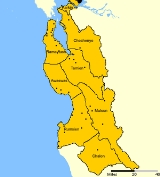
Linguists identified eight regional, linguistic divisions or subgroups of the Ohlone, listed below from north to south:
- Karkin (also called Carquin) - The Karkin resided on the south side of the Carquinez Strait
The Carquinez Strait is a narrow tidal strait in northern California. It is part of the tidal estuary of the Sacramento and the San Joaquin rivers as they drain into the San Francisco Bay...
. The name of the Carquinez StraitThe Carquinez Strait is a narrow tidal strait in northern California. It is part of the tidal estuary of the Sacramento and the San Joaquin rivers as they drain into the San Francisco Bay...
derives from their name. Karkin was a dialect quite divergent from the rest of the family.
- Chochenyo
The Chochenyo are one of the divisions of the indigenous Ohlone people of Northern California...
(also called Chocheño, Chocenyo and East Bay Costanoan) - The Chochenyo speaking tribal groups resided in the East Bay, primarily in what is now Alameda CountyAlameda County is a county in the U.S. state of California. It occupies most of the East Bay region of the San Francisco Bay Area. As of the 2010 census it had a population of 1,510,271, making it the 7th most populous county in the state...
and the western (bayshore) portion of Contra Costa County.
- Ramaytush
The Ramaytush are one of the linguistic subdivisions of the Ohlone Native Americans of Northern California. Historically, the Ramaytush inhabited the San Francisco Peninsula between San Francisco Bay and the Pacific Ocean in the area which is now San Francisco and San Mateo Counties.The Ramaytush...
(also called San Francisco Costanoan) - The Ramaytush resided between San Francisco Bay and the Pacific in the area which is now San Francisco and San Mateo Counties. The YelamuThe Yelamu were a Native American tribe of Ohlone people from the San Francisco Bay Area in Northern California.-History:The Yelamu lived on the northern tip of the San Francisco Peninsula in the region comprising the City and County of San Francisco before the arrival of Spanish missionaries in 1769...
grouping of the Ramaytush included the villages surrounding Mission Dolores, Sitlintac and Chutchui on Mission Creek, Amuctac and Tubsinte in Visitation Valley, Petlenuc from near the Presidio, and to the southwest, the villages of Timigtac on Calera Creek and Pruristac on San Pedro Creek in modern day Pacifica.
- Tamyen
The Tamyen are one of eight linguistic divisions of the Ohlone people groups of Native Americans who lived in Northern California. The Tamyen lived throughout the Santa Clara Valley...
(also called Tamien, Thamien, and Santa Clara Costanoan) - The Tamyen resided on Coyote Creek and Calaveras CreekCalaveras Reservoir is a lake located primarily in Santa Clara County, California with a small portion and its dam in Alameda County, California. The reservoir has a capacity of . In Spanish, Calaveras means "skulls."...
, and the language was spoken in the Santa Clara Valley. (Linguistically, Chochenyo, Tamyen and Ramaytush were very close, perhaps to the point of being dialects of a single language.) The Tamyen village was near the original site of the first Mission Santa Clara located on the Guadalupe RiverThe Guadalupe River is a short river in California whose headwater creeks originate in the Santa Cruz Mountains near the summit of Loma Prieta and Mount Umunhum. The river mainstem now begins on the Santa Clara Valley floor at the northern end of Lake Almaden, which is fed by Los Alamitos Creek and...
; Father Pena mentioned in a letter to Junípero Serra that the area around the mission was called Thamien by the Ohlone.
- Awaswas
The Awaswas people are one of eight divisions of the Ohlone Native Americans of Northern California...
(also called Santa Cruz Costanoan) - Local bands of Awaswas speakers resided on the Santa Cruz coast and adjacent Santa Cruz Mountains between Point Año Nuevo and the Pajaro RiverThe Pajaro River is a river in Northern California, forming part of the border between Santa Cruz County and Monterey County and between San Benito County and Santa Clara County.-History:...
s (Davenport and Aptos).
- Mutsun (also called Mutsen, San Juan Bautista Costanoan) - A number of distinct local territorial tribes of Mutsun speakers lived in the Hollister Valley (along the lower San Benito River
The San Benito River is a river on the Central Coast of California. From its headwaters near San Benito Mountain in the Diablo Range, it flows northwest between the Diablo Range and the Gabilan Range, traveling for about before its confluence with the Pajaro River, about upstream from the river's...
, middle Pajaro River, and San Felipe Creek) and along nearby creeks of the eastern Coast Range valleys (including San Luis and Ortigalita creeks).
- Rumsen
Rumsen is one of eight language divisions of the Ohlone Native American people of Northern California...
(also called Rumsien, Carmel or Carmeleno) - A few independent Rumsen-speaking local territorial tribes resided from the Pajaro RiverThe Pajaro River is a river in Northern California, forming part of the border between Santa Cruz County and Monterey County and between San Benito County and Santa Clara County.-History:...
to Point Sur, and the lower courses of the Pajaro, as well as the lower SalinasThe Salinas River is the largest river of the central coast of California, running and draining 4,160 square miles. It flows north-northwest and drains the Salinas Valley that slices through the Coast Range south from Monterey Bay...
, Sur and Carmel RiverThe Carmel River is a river on the Central Coast of California in Monterey County that originates in the Santa Lucia Mountains. The river flows northwest through the Carmel Valley with its mouth at the Pacific Ocean south of Carmel-by-the-Sea. It is often considered the northern boundary of Big Sur...
s (San Carlos, Carmel, and Monterey Counties).
- Chalon
The Chalon are one of eight divisions of the Ohlone people of Native Americans who lived in Northern California. Chalon is also the name of their spoken language, listed as one of the Ohlone languages of the Utian family...
(also called Soledad) - Local bands of Chalon speakers resided along the upper course of the San Benito River and farther east in the Coast Range valleys of Silver and Cantua creeks. Kroeber also mapped them on the middle course of the Salinas RiverThe Salinas River is the largest river of the central coast of California, running and draining 4,160 square miles. It flows north-northwest and drains the Salinas Valley that slices through the Coast Range south from Monterey Bay...
, but some recent studies give that area to the EsselenThe Esselen were a Native American linguistic group in the hypothetical Hokan language family, who resided on the Central California coast and the coastal mountains, including what is now known as the Big Sur region in Monterey County, California...
people.
These division designations are mostly derived from selected local tribe names. They were first offered in 1974 as direct substitutes for Kroeber’s earlier designations based upon the names of local Spanish missions. The spellings are anglicized from forms first written down (often with a variety of spellings) by Spanish missionaries and soldiers who were trying to capture the sounds of languages foreign to them.
Within the divisions there were over 50 Ohlone tribes and villages who spoke the Ohlone-Costanoan languages in 1769, before being absorbed into the Spanish Missions by 1806.
Present day
The Mutsun (of Hollister and Watsonville) and the Muwekma Ohlone Tribe (of the San Francisco Bay Area) are among the surviving groups of Ohlone today petitioning for tribal recognition. The
Esselen NationThe Esselen were a Native American linguistic group in the hypothetical Hokan language family, who resided on the Central California coast and the coastal mountains, including what is now known as the Big Sur region in Monterey County, California...
also describes itself as Ohlone/Costanoan, although they historically spoke both the southern Costanoan (Rumsen) and an entirely different
Hokan languageThe Hokan language family is a hypothetical grouping of a dozen small language families spoken in California, Arizona and Mexico. In nearly a century since Edward Sapir first proposed the "Hokan" hypothesis, little additional evidence has been found that these families were related to each other...
Esselen.
Contemporary Ohlone groups
Ohlone tribes with petitions for Federal Recognition pending with the
Bureau of Indian AffairsThe Bureau of Indian Affairs is an agency of the federal government of the United States within the US Department of the Interior. It is responsible for the administration and management of of land held in trust by the United States for Native Americans in the United States, Native American...
are:
- Muwekma Ohlone Tribe, San Francisco Bay Area:
- With 397 enrolled members in 2000, the Muwekma Ohlone Tribe comprises "all of the known surviving Native American lineages aboriginal to the San Francisco Bay region who trace their ancestry through the Missions Dolores, Santa Clara and San Jose" and who descend from members of the historic Federally Recognized Verona Band of Alameda County. On 21 September 2006, they received a favorable opinion from the U.S. District in Washington, D.C.
Washington, D.C., formally the District of Columbia and commonly referred to as Washington, "the District", or simply D.C., is the capital of the United States. On July 16, 1790, the United States Congress approved the creation of a permanent national capital as permitted by the U.S. Constitution....
, of their court case to expedite the reaffirmation of the tribe as a federally recognized tribe. The Advisory Council on California Indian Policy has assisted in their case.
- Amah-Mutsun Band of Ohlone/Costanoan Indians, Woodside:
- The Amah-Mutsun Band has over 500 enrolled members and comprises "various surviving lineages who spoke the Hoomontwash or Mutsun Ohlone language." The majority descend from the native people baptized at Mission San Juan Bautista.
- Ohlone/Costanoan Esselen Nation, Monterey and San Benito Counties:
- The Ohlone/Costanoan Esselen Nation has approximately 500 enrolled members. Their tribal council claims enrolled membership is currently at approximately 500 people from thirteen core lineages that trace direct descendancy to the Missions San Carlos and Soledad. The tribe was formerly federally recognized as the "Monterey Band of Monterey County" (1906-1908). Approximately 60% reside in Monterey and San Benito Counties.
- Costanoan Band of Carmel Mission Indians, Monrovia.
- Costanoan Ohlone Rumsen-Mutsen Tribe, Watsonville.
- Costanoan-Rumsen Carmel Tribe, Pomona/Chino
- Also visit their On-line Wellness Center on Facebook
- Indian Canyon Band of Costanoan, Mutsun Indians, near Hollister.
Population
Ohlone Population in year 1769: Various Expert Opinions |
| Population |
According to: |
| 7,000 |
Alfred Kroeber (1925) |
| 10,000 or more |
Richard Levy (1978) |
26,000 including Salinans "Northern Mission Area" |
Sherburne Cook (1976) |
Published estimates of the pre-contact Ohlone population in 1769 range between 7,000 and 26,000. Historians differ widely in their estimates, as they do with the entire
population of Native CaliforniaEstimates of the Native Californian population have varied substantially, both with respect to California's pre-contact count and for changes during subsequent periods. Pre-contact estimates range from 133,000 to 705,000 with some recent scholars concluding that these estimates are low...
. However, modern researchers believe that American anthropologist
Alfred L. KroeberAlfred Louis Kroeber was an American anthropologist. He was the first professor appointed to the Department of Anthropology at the University of California, Berkeley, and played an integral role in the early days of its Museum of Anthropology, where he served as director from 1909 through...
's projection of 7,000 Ohlone "Costanoans" was much too low. Later researchers such as Richard Levy estimated "10,000 or more" Ohlone.
The highest estimate comes from
Sherburne F. CookSherburne Friend Cook was a physiologist by training, and served as professor and chairman of the department of physiology at the University of California, Berkeley...
, who in later life concluded there were 26,000 Ohlone and Salinans in the "Northern Mission Area". Per Cook, the "Northern Mission Area" means "the region inhabited by the Costanoans and Salinans between San Francisco Bay and the headwaters of the Salinas River. To this may be added for convenience the local area under the jurisdiction of the San Luis Obispo even though there is an infringement of the Chumash." In this model, the Ohlone people's territory was one half of the "Northern Mission Area". It was however known to be more densely populated than the southern Salinan territory, per Cook: "The Costanoan density was nearly 1.8 persons per square mile with the maximum in the Bay region. The Esselen was approximately 1.3, the Salinan must have been still lower." We can estimate that Cook meant about 18,200 Ohlone based on his own statements (70% of "Northern Mission Area"), plus or minus a few thousand margin for error, but he does not give an exact number.
The Ohlone population after contact in 1769 with the Spaniards spiralled downwards. Cook describes rapidly declining indigenous populations in California between 1769 and 1900, in his posthumously published book,
The Population of the California Indians, 1769-1970. Cook states in part: "Not until the population figures are examined does the extent of the havoc become evident." In fact, the population had dropped to about 10% of its original numbers by 1848.
The population stabilized after 1900, and as of 2005 there were at least 1,400 on tribal membership rolls.
Language
The Ohlone language family is commonly called "Costanoan", sometimes "Ohlone". Costanoan is a member of the hypothetical
PenutianPenutian is a proposed grouping of language families that includes many Native American languages of western North America, predominantly spoken at one time in Washington, Oregon, and California. The existence of a Penutian stock or phylum has been the subject of debate among specialists. Even the...
language phylum or stock, and (along with the Miwok languages) the
UtianUtian is a family of indigenous languages spoken in the central and north portion of California, United States. The Miwok and Ohlone peoples both spoke languages in the Utian linguistic group...
language family. The most recent work suggests that Costanoan, Miwok, and Yokuts may all be sub-families within a single Yok-Utian language family.
Costanoan comprises eight dialects or separate languages: Awaswas, Chalon, Chochenyo (aka Chocheño), Karkin, Mutsun, Ramaytush, Rumsen, and Tamyen.
Salvaging records
The chroniclers, ethnohistorians, and linguists of the Ohlone population began with:
Alfred L. KroeberAlfred Louis Kroeber was an American anthropologist. He was the first professor appointed to the Department of Anthropology at the University of California, Berkeley, and played an integral role in the early days of its Museum of Anthropology, where he served as director from 1909 through...
who researched the California natives and authored a few publications on the Ohlone from 1904 to 1910, and
C. Hart MerriamClinton Hart Merriam was an American zoologist, ornithologist, entomologist and ethnographer.Known as "Hart" to his friends, Dr. Clinton Hart Merriam was born in New York City in 1855. His father, Clinton Levi Merriam, was a U.S. congressman. He studied biology and anatomy at Yale University and...
who researched the Ohlone in detail from 1902 to 1929. This was followed by
John P. HarringtonJohn Peabody Harrington was an American linguist and ethnologist and a specialist in the native peoples of California. Harrington is noted for the massive volume of his documentary output, most of which has remained unpublished: the shelf space in the Library of Congress dedicated to his work...
who researched the Ohlone languages from 1921 to 1939, and other aspects of Ohlone culture, leaving volumes of field notes at his death. Other research was added by Robert Cartier, Madison S. Beeler, and
Sherburne F. CookSherburne Friend Cook was a physiologist by training, and served as professor and chairman of the department of physiology at the University of California, Berkeley...
, to name a few. In many cases, the Ohlone names they used vary in spelling, translation and tribal boundaries, depending on the source. Each tried to
chronicleGenerally a chronicle is a historical account of facts and events ranged in chronological order, as in a time line. Typically, equal weight is given for historically important events and local events, the purpose being the recording of events that occurred, seen from the perspective of the...
and interpret this complex society and language(s) before the pieces vanished.
There was noticeable competition and some disagreement between the first scholars: Both Merriam and Harrington produced much in-depth Ohlone research in the shadow of the highly published Kroeber and competed in print with him. In the
Editor's Introduction to
Merriam (1979), Robert F. Heizer (as the protege of Kroeber and also the curator of Merriam's work) states "both men disliked A. L. Kroeber." Harrington, independently working for the Smithsonian Institution cornered most of the Ohlone research as his own specialty, was "not willing to share his findings with Kroeber ... Kroeber and his students neglected the Chumash and Costanoans, but this was done because Harrington made it quite clear that he would resent Kroeber's 'muscling in.
Recent Ohlone historians that have published new research are Lauren Teixeira, Randall Milliken and Lowell J. Bean. They all note the availability of mission records allow for continual research and understanding.
Notable Ohlone people
- 1777 – Xigmacse, chief of the local Yelamu tribe at the time of the establishment of the Mission San Francisco, and thus the earliest known San Francisco leader.
- 1779 – Baltazar, baptized from the Rumsen village of Ichxenta in 1775, he became the first Indian alcalde of Mission San Carlos in 1778. After his wife and child died, he fled to the Big Sur coast in 1780 to lead the first extensive Ohlone resistance to colonization.
- 1807 – Hilarion and George (their baptismal names) were two Ohlone men from the village Pruristac
Pacifica is a city in San Mateo County, California, on the coast of the Pacific Ocean between San Francisco and Half Moon Bay.-Overview:The City of Pacifica is spread along a six mile stretch of the north central California coastal beach and hills, nestled in several small valleys spanning between...
who served as alcaldes (mayors) of the Mission San Francisco in 1807. As such, they were at the beginning of a long line of Mayors of San Francisco.
- 1877 - Lorenzo Asisara was a Mission Santa Cruz man who provided three surviving narratives about life at the mission, primarily from stories told to him by his own father.
- 1913 – Barbara Solorsano died 1913, Mutsun linguistic consultant to C. Hart Merriam 1902-04, from San Juan Bautista.
- 1930 – Ascencion Solorsano de Cervantes, died 1930, renowned Mutsun doctor, principal linguistic and cultural informant to J. P. Harrington.
- 1934 – Jose Guzman died 1934, he was one of the principal Chochenyo linguistic and cultural consultants to J. P. Harrington.
- 1939 – Isabel Meadows
Isabel Meadows was the last fluent speaker of the Rumsen Ohlone language and a primary Rumsen consultant to J.P. Harrington.Her father, James Meadows, was a professional whaler and her mother, Loretta Onesimo, was Rumsen Ohlone....
, died 1939, the last fluent speaker of RumsenRumsen is one of eight language divisions of the Ohlone Native American people of Northern California...
and a primary Rumsen consultant to J.P. Harrington.
See also
- Ohlone mythology
The mythology of the Ohlone Native American people of Northern California include creation myths as well as other ancient narratives that contain elements of their spiritual and philosophical belief systems, and their conception of the world order...
- List of Ohlone villages
- Mission Dolores mural
The Mission Dolores mural is an 18th century work of art in the Mission San Francisco de Asís, the oldest surviving structure in San Francisco. In 1791, the Ohlone people, Native Americans of the San Francisco Bay and laborers for the church, painted the mural on the focal wall of the sanctuary...
Further reading
- Kroeber, Alfred L. (ed.). 1925. The Costanoans. Chapter 31. pp. 462–473 in Handbook of Indians of California. Also available as - Washington, D.C: Bureau of American Ethnology Bulletin No. 78, 1925.
External links
Tribal websites:
Other: