
All Topics  
Offset printing


   Email Print
   Bookmark   Link


Offset printing


Offset printing is a commonly used printing
Printing

Printing is a process for reproducing text and image, typically with ink on paper using a printing press. It is often carried out as a large-scale industrial process, and is an essential part of publishing and transaction printing....
 technique where the ink
Ink

An ink is a liquid containing various pigments and/or dyes used for coloring a surface to produce an , writing, or design. Ink is used for drawing and/or writing with a pen, brush or quill....
ed image is transferred (or "offset") from a plate to a rubber blanket, then to the printing surface. When used in combination with the lithographic
Lithography

Lithography is a method for printing using a stone or a metal plate with a completely smooth surface. By contrast, in intaglio a plate is engraving, etching or mezzotint to make cavities to contain the printing ink, and in woodblock printing and letterpress ink is applied to the raised surfaces of letters or images....
 process, which is based on the repulsion of oil and water, the offset technique employs a flat (planographic) image carrier on which the image to be printed obtains ink from ink rollers, while the non-printing area attracts a water-based film (called "fountain solution"), keeping the non-printing areas ink-free.

Ira Washington Rubel invented the first offset printing press in 1903.

g an offset printing press to print on paper was probably done first by Ira Washington Rubel, an American, in 1903.


Discussion
Ask a question about 'Offset printing'
Start a new discussion about 'Offset printing'
Answer questions from other users
Full Discussion Forum


Recent Posts


Encyclopedia


Offset printing is a commonly used printing
Printing

Printing is a process for reproducing text and image, typically with ink on paper using a printing press. It is often carried out as a large-scale industrial process, and is an essential part of publishing and transaction printing....
 technique where the ink
Ink

An ink is a liquid containing various pigments and/or dyes used for coloring a surface to produce an , writing, or design. Ink is used for drawing and/or writing with a pen, brush or quill....
ed image is transferred (or "offset") from a plate to a rubber blanket, then to the printing surface. When used in combination with the lithographic
Lithography

Lithography is a method for printing using a stone or a metal plate with a completely smooth surface. By contrast, in intaglio a plate is engraving, etching or mezzotint to make cavities to contain the printing ink, and in woodblock printing and letterpress ink is applied to the raised surfaces of letters or images....
 process, which is based on the repulsion of oil and water, the offset technique employs a flat (planographic) image carrier on which the image to be printed obtains ink from ink rollers, while the non-printing area attracts a water-based film (called "fountain solution"), keeping the non-printing areas ink-free.

Ira Washington Rubel invented the first offset printing press in 1903.

Offset printing history

Using an offset printing press to print on paper was probably done first by Ira Washington Rubel, an American, in 1903. The inspiration was an accident. While operating his lithographic press he noticed that if he failed to insert paper the stone plate would transfer its image onto the rubber impression cylinder. When he then placed paper into the machine it would have the image on two sides, one from the stone plate and one from the rubber impression cylinder. To Rubel’s amazement, the image from the rubber impression cylinder was much clearer; the soft rubber was able to give a sharper look than the hard stone litho plate. Soon he created a machine that repeated this original “error”. This process was also noted by two brothers, Charles and Albert Harris, at about the same time. They produced an offset press for the Harris Automatic Press Company not long after Rubel created his press.

The machine created by the Harris Automatic Press Company was based on a rotary letter press machine. A cylinder was wrapped with a metal plate that was pressed against ink and water rollers. Just below the metal plate cylinder was a blanket cylinder. Below that was an impression cylinder which fed the paper against the blanket cylinder so that the image could be transferred. While the basic process in offset printing has remained the same, some modern innovations include two sided printing and using large rolls of paper fed into the machines.

Offset printing became the most dominant form of commercial printing in the 1950’s. This was in part due to industry improvements in paper, inks, and plates. These improvements allowed for greater speed and plate durability. The majority of modern day printing is still done using the offset printing process. Even the high volume newspaper industry uses offset printing.

Although offset printing does the lion’s share of today’s business printing, some very limited editions of fine quality books are still produced using the letterpress, often in combination with offset methods. Some people still prefer the slightly embossed look that is only achieved with the direct contact of the plates with the printing medium. These specialty books are sometimes printed using individually set type pieces.

Present day

Offset printing is the most common form of high-volume commercial printing, due to advantages in quality and efficiency in high-volume jobs. The more you print, the less you pay per page, because most of the price goes into the preparation undergone before the first sheet of paper is printed and ready for distribution. Any additional paper print will only cost the client paper price (and ink), which is very minimal. While modern digital presses (Xerox iGen3
IGen3

iGen3 is a Xerox digital color production press that can print near offset printing quality prints in small or large runs. The most technologically advanced machine Xerox manufactures, it utilizes over 100 new patents held by Xerox Corporation in the field of Xerography and Digital Printing....
 Digital Production Press or the family of HP Indigo solutions or Kodak Nexpress solutions, for example) are getting closer to the cost/benefit of offset for high-quality work, they have not yet been able to compete with the sheer volume of product that an offset press can produce. Furthermore, many modern offset presses are using computer to plate
Computer to plate

Computer to plate is an imaging technology used in modern Printing. In this technology, an image created in a Desktop Publishing application is output directly to a lithography....
 systems as opposed to the older computer to film
Computer to film

Computer to Film is a print workflow involving the printing from a computer, straight to film. This film is then burned onto a lithographic plate, using a plate burner....
 workflows, which further increases their quality.

In the last two decades, flexography
Flexography

Flexography is a form of printing process which utilizes a flexible relief plate. It is basically an updated version of letterpress that can be used for printing on almost any type of substrate including plastic, metallic films, cellophane, and paper....
 has become the dominant form of printing in packaging due to lower quality expectations and the significantly lower costs in comparison to other forms of printing.

Offset printing advantages

Advantages of offset printing compared to other printing methods include:
  • Consistent high image quality. Offset printing produces sharp and clean images and type more easily than letterpress printing
    Letterpress printing

    Letterpress printing is a term for the 'relief' printing of text and image using a press with a "type-high bed", in which a reversed, raised surface is inked and then pressed into a sheet of paper to obtain a positive right-reading image....
     because the rubber blanket conforms to the texture of the printing surface.
  • Quick and easy production of printing plates.
  • Longer printing plate life than on direct litho presses because there is no direct contact between the plate and the printing surface. Properly developed plates running in conjunction with optimized inks and fountain solution may exceed run lengths of a million impressions.
  • Cost. Offset printing is the cheapest method to produce high quality printing in commercial printing quantities.


Offset printing disadvantages

Disadvantages of offset printing compared to other printing methods include:
  • Slightly inferior image quality compared to rotogravure
    Rotogravure

    Rotogravure is a type of intaglio printing process, in that it involves engraving the image onto an . In gravure printing, the image is engraved onto a copper cylinder because, like offset printing and flexography, it uses a rotary printing press....
     or photogravure
    Photogravure

    Photogravure is an Intaglio printmaking process in which photographic images are printed using forms of mechanised etching of plates....
     printing.
  • Propensity for anodized aluminum printing plates to become sensitive (due to chemical oxidation) and print in non-image/background areas when developed plates are not cared for properly.
  • Time and cost associated with producing plates and printing press setup. This makes smaller quantity printing jobs impractical. As a result, smaller printing jobs are now moving to digital offset machines.


Types of offset printing


Photo offset

Offset
The most common kind of offset printing is derived from the photo offset process, which involves using light-sensitive chemicals and photographic
Photography

Photography is the process, activity and art of creating still or moving by recording radiation on a sensitive medium, such as a photographic film, or an ....
 techniques to transfer images and type
Typography

Typography is the art and techniques of typesetting, type design, and modifying type glyphs. Type glyphs are created and modified using a variety of illustration techniques....
 from original materials to printing plates.

In current use, original materials may be an actual photographic print and typeset text. However, it is more common — with the prevalence of computers and digital
Digital

A digital system uses discrete values, usually but not always symbolized numerically to represent information for input, processing, transmission, storage, etc....
 images — that the source material exists only as data in a digital publishing system.

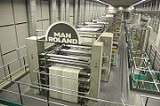
Offset litho printing on to a web (reel) of paper is commonly used for printing of newspapers and magazines for high speed production.

Types of paper feed


Sheet-fed litho
"Sheet-fed" refers to individual sheets of paper or paperboard being fed into a press. A lithographic ("litho" for short) press uses principles of lithography
Lithography

Lithography is a method for printing using a stone or a metal plate with a completely smooth surface. By contrast, in intaglio a plate is engraving, etching or mezzotint to make cavities to contain the printing ink, and in woodblock printing and letterpress ink is applied to the raised surfaces of letters or images....
 to apply ink to a printing plate, as explained previously. Sheet-fed litho is commonly used for printing of short-run magazines, brochures, letter headings, and general commercial (jobbing) printing.

Web-fed litho
"Web-fed" refers to the use of rolls (or "webs") of paper supplied to the printing press. Offset web printing is generally used for runs in excess of 10 or 20 thousand impressions. Typical examples of web printing include newspapers, newspaper inserts/ads, magazines, catalogs, and books. Web-fed presses are divided into two general classes: "Cold" or "Non-Heatset," and "Heatset" offset web presses, the difference being how the inks that are used dry. Cold web offset printing is air dried, while heatset utilizes drying lamps or heaters to cure or "set" the inks. Heatset presses can print on both coated (slick) and uncoated papers, while coldset presses are restricted to uncoated paper stock, such as newsprint. Some coldset web presses can be fitted with heat dryers, or ultraviolet lamps (for use with uv-curing inks). There is also another possibility of adding a drier in a cold-set press and making it as a semi-commercial press. It is a concept where, a newspaper can print colour pages in heatset and BW pages in coldset

Types of chemicals used


Paste inks for offset litho
There are many types of paste inks available for employment in offset lithographic printing and each have their own advantages and disadvantages. These include heat-set, cold-set, and energy-curable (or EC), such as ultraviolet- (or UV-) curable, and electron beam- (or EB-) curable. Heat-set inks are the most common variety and are "set" by applying heat and then rapid cooling to catalyze the curing process. They are used in magazines, catalogs, and inserts. Cold-set inks are set simply by absorption into non-coated stocks and are generally used for newspapers and books but are also found in insert printing and are the most cost-conscious option. Energy-curable inks are the highest-quality offset litho inks and are set by application of light energy. They require specialized equipment are usually the most expensive type of offset litho ink.

Fountain solution
Fountain solution is the water-based (or "aqueous") component in the lithographic process that cleans the background area of the plate in order to keep ink from depositing (and thus printing) in the non-image (or "white") areas of the paper. Historically, fountain solutions were acid-based and comprised of gum arabic
Gum arabic

Gum arabic, also known as gum acacia, chaar gund or char goond, is a natural gum made of hardened sap taken from two species of the acacia tree; Acacia senegal and Acacia seyal....
, chromates and/or phosphates, and magnesium nitrate
Magnesium nitrate

Magnesium nitrate is a hygroscopic salt with the formula Mg2. In air, it quickly forms the hexahydrate with the formula Mg2?6H2O ....
.

While the acid fountain solution has come a long way in the last several decades, neutral and alkaline fountain solutions have also been developed. Both of these chemistries rely heavily on surfactants/emulsifiers
Emulsion

An emulsion is a mixture of two immiscible liquids. One liquid is dispersion in the other . Many emulsions are oil/water emulsions, with dietary fats being one common type of oil encountered in everyday life....
 and phosphates and/or silicates to provide adequate cleaning and desensitizing, respectively. Since about 2000, alkaline-based fountain solutions have started becoming less common due to the inherent health hazards of high pH
PH

pH is a measure of the Acid or Base of a solution. It is defined as the cologarithm of the Activity of dissolved hydrogen ions . Hydrogen ion activity coefficients cannot be measured experimentally, so they are based on theoretical calculations....
 and the objectionable odor of the necessary microbiogical additives.

Acid-based fountain solutions are still the most common variety and yield the best quality results by means of superior protection of the printing plate, lower dot gains
Dot gain

Dot gain is a phenomenon in printing and graphic arts whereby printed dots are perceived and actually printed bigger than intended. This causes a darkening of the screened images or textures, especially in the mid tones and shadows....
, and longer plate life. Acids are also the most versatile, capable of running with all types of offset litho inks. However, because these products require more active ingredients to run well than do neutrals and alkalines, they are also the most expensive to produce. That said, neutrals and, to a lesser degree, alkalines are still an industry staple and will continue to be used for most newspapers and many lower-quality inserts.

In recent years alternatives have been developed which do not use fountain solutions at all (waterless printing
Waterless printing

Waterless printing is a method of offset printing which is less environmentally damaging than conventional lithographic printing. Traditionally, printing is a huge consumer of resources, including chemicals, water and energy....
).

External links

  • , . International Paper.