


Office of National Drug Control Policy

Encyclopedia

Executive Office of the President of the United States
The Executive Office of the President consists of the immediate staff of the President of the United States, as well as multiple levels of support staff reporting to the President. The EOP is headed by the White House Chief of Staff, currently William M. Daley...
, was established in 1989 by the Anti-Drug Abuse Act of 1988
Anti-Drug Abuse Act of 1988
The Anti-Drug Abuse Act of 1988, , , established the creation of a drug-free America as a policy goal and established the Office of National Drug Control Policy. The media campaign mentioned in the act later became the National Youth Anti-Drug Media Campaign....
. Its stated goal is to establish policies, priorities, and objectives to eradicate illicit drug use
Recreational drug use
Recreational drug use is the use of a drug, usually psychoactive, with the intention of creating or enhancing recreational experience. Such use is controversial, however, often being considered to be also drug abuse, and it is often illegal...
, manufacturing, and trafficking, drug-related crime
Drug-Related Crime
In the United States, Illegal drugs are related to crime in multiple ways. Most directly, it is a crime to use, possess, manufacture, or distribute drugs classified as having a potential for abuse...
and violence, and drug-related health consequences in the U.S.
The Director of National Drug Control Policy, colloquially known as the Drug Czar, heads the office. "Drug Czar" was a term first used in the media by then-Senator Joe Biden
Joe Biden
Joseph Robinette "Joe" Biden, Jr. is the 47th and current Vice President of the United States, serving under President Barack Obama...
in October 1982. In addition to running the ONDCP, the director evaluates, coordinates, and oversees both the international and domestic anti-drug efforts of executive branch agencies and ensures that such efforts sustain and complement State and local anti-drug activities. The Director advises the President regarding changes in the organization, management, budgeting, and personnel of federal agencies that effect U.S. anti-drug efforts; and regarding federal agency compliance with their obligations under the National Drug Control Strategy, an annual report required by law. The current director is Gil Kerlikowske
Gil Kerlikowske
Richard Gil Kerlikowske is the current Director of the Office of National Drug Control Policy, a position generally referred to as the United States "Drug Czar". He assumed office on May 7, 2009....
, who assumed the office on May 7, 2009. The Fiscal Year 2011 National Drug Control Budget proposed by the Obama Administration would devote significant new resources to the prevention and treatment of drug abuse. These resources are complemented by an aggressive effort to enhance domestic law enforcement, interdiction, and supply control programs. New resources, $340 Million, are added to the prevention and treatment of drug use.
As of 2011, the ONDCP is requesting funding for 98 full time employees, 64 (65.31%) of whom would be paid at either GS-15, GS-14, or SES pay grades, or more than $105,211.00 yearly, being adjusted for Washington, D.C. cost of living expenses.
Programs
The programs directed by the ONDCP include:- the High Intensity Drug Trafficking AreaHigh Intensity Drug Trafficking AreaThe High Intensity Drug Trafficking Area program is a drug-prohibition enforcement program run by the United States Office of National Drug Control Policy...
s (HIDTA) program - the National Youth Anti-Drug Media CampaignNational Youth Anti-Drug Media CampaignThe National Youth Anti-Drug Media Campaign is a current domestic government propaganda campaign in the United States conducted by the Office of National Drug Control Policy within the Executive Office of the President of the United States with the goal to "influence the attitudes of the public...
, a current domestic government propagandaPropagandaPropaganda is a form of communication that is aimed at influencing the attitude of a community toward some cause or position so as to benefit oneself or one's group....
campaign in the US - the Drug Free Communities Program
- Anti-Doping Activities
- World Anti-Doping AgencyWorld Anti-Doping AgencyThe World Anti-Doping Agency , , is an independent foundation created through a collective initiative led by the International Olympic Committee . It was set up on November 10, 1999 in Lausanne, Switzerland, as a result of what was called the "Declaration of Lausanne", to promote, coordinate and...
(WADA) dues
Bi-partisan support for Drug Czar
The Anti-Drug Abuse Act of 1988Anti-Drug Abuse Act of 1988
The Anti-Drug Abuse Act of 1988, , , established the creation of a drug-free America as a policy goal and established the Office of National Drug Control Policy. The media campaign mentioned in the act later became the National Youth Anti-Drug Media Campaign....
, which created the Office of National Drug Control Policy, was the product of bi-partisan support. It was co-sponsored in the House of Representatives by parties' leaders, Tom Foley
Tom Foley
Thomas Stephen Foley was the 57th Speaker of the United States House of Representatives, serving from 1989 to 1995. He represented Washington's 5th congressional district for 30 years as a Democratic member from 1965 to 1995....
and Robert Michel, and it passed by margins of 346–11 and 87–3 in the House and Senate, respectively. Upon signing the law, Ronald Reagan
Ronald Reagan
Ronald Wilson Reagan was the 40th President of the United States , the 33rd Governor of California and, prior to that, a radio, film and television actor....
said, "This bill is the product of a bipartisan effort."
Funding
In September 2002, the Senate Appropriations Committee recommended that salaries and expenses at ONDCP be reduced from $26.6 million in fiscal 2006 to $11.5 million in fiscal 2007, to "more closely reflect actual performance." Committee members said they would request funding for a study of ONDCP by the National Academy of Public AdministrationNational Academy of Public Administration (United States)
The National Academy of Public Administration was founded by James E. Webb, then-administrator of NASA, and other leading public administration practitioners in 1967 and chartered under Title 36 of the United States Code in 1984 under Public Law 98-257. The Academy is a nonprofit, nonpartisan...
. They also ordered a Government Accountability Office
Government Accountability Office
The Government Accountability Office is the audit, evaluation, and investigative arm of the United States Congress. It is located in the legislative branch of the United States government.-History:...
study on the distribution of grants. Plus, they directed the Director to provide quarterly updates on travel expenditures, staffing levels and plans for future hirings.
High-Intensity Drug Trafficking Program
In 2005, the Bush Administration proposed transferring the $225 million High-Intensity Drug Trafficking Program from ONDCP to the Department of Justice. The program gives additional money to communities with chronic illicit drug sales. According to the Washington Post, "Many lawmakers oppose the transfer for fear the program would become less of a priority."Anti-legalization Policy
By law, the drug czar must oppose any attempt to legalize the use (in any form) of illicit drugs. According to the "Office of National Drug Control Policy Reauthorization Act of 1998" the director of the ONDCP(12) shall ensure that no Federal funds appropriated to the Office of National Drug Control Policy shall be expended for any study or contract relating to the legalization (for a medical use or any other use) of a substance listed in schedule I of section 202 of the Controlled Substances Act (21 U.S.C. 812) and take such actions as necessary to oppose any attempt to legalize the use of a substance (in any form) that --
1. is listed in schedule I of section 202 of the Controlled Substances Act (21 U.S.C. 812); and
2. has not been approved for use for medical purposes by the Food and Drug Administration;
The Government Accountability Office has found that this law authorizes the ONDCP to disseminate misleading information (lie) in order to oppose legalization:
Finally, apart from considerations of whether any particular law has been violated, you have asked whether the Deputy Director's letter disseminated misleading information in connection with statements relating to the debate over legalization of marijuana. Clearly, the Deputy Director's statements reflect one perspective regarding marijuana - a perspective that is disputed by others with different viewpoints. However, ONDCP is specifically charged with the responsibility for "taking such actions as necessary to oppose any attempt to legalize the use" of certain controlled substances such as marijuana - a responsibility which logically could include the making of advocacy statements in opposition to legalization efforts. The Deputy Director's statements about marijuana are thus within the statutory role assigned to ONDCP. Given this role, we do not see a need to examine the accuracy of the Deputy Director's individual statements in detail.
Extent of drug use in the U.S.
In September 2006, the office reported that the 2005 survey of 67,500 people found that 8.1 percent reported using an illicit drug in the 30 days prior to being asked about their drug use, which equates to 19.7 million people nationwide (age 12 and older). The percentage was up slightly compared to 2004. Youth drug use declined for the third year in a row. While the ONDCP measures their efficacy against prior use statistics within the U.S., they do not publicize how these statistics compare against other countries at the time in their communications to the press. In 2008, ONDCP reported that actual youth drug use, as measured as the percent reporting past month use, has declined from 19.4% to 14.8% among middle and high school students between 2001 and 2007.Anti-marijuana advertising
In August 2001, the office told a Congressional committee that its National Youth Anti-Drug Media CampaignNational Youth Anti-Drug Media Campaign
The National Youth Anti-Drug Media Campaign is a current domestic government propaganda campaign in the United States conducted by the Office of National Drug Control Policy within the Executive Office of the President of the United States with the goal to "influence the attitudes of the public...
"has been the most visible symbol of the federal government's commitment to drug prevention," and that the office was "investing $7 million a year in performance measurement to determine the effectiveness" of the campaign. The statement by said "We believe there is a strong body of evidence that indicates the campaign is working, as planned, to change drug attitudes, intentions and use."
In 2002, according to a multiyear study by the research firm hired by the office, teenagers exposed to federal anti-drug ads were no less likely to use drugs for having viewed them, and some young girls said they were even more likely to give drugs a try. Walters blamed poor ads that weren't resonating with teenagers. Walters promised in Senate testimony in 2002 that he would show results within a year or admit failure, and Congress agreed to extend the campaign through 2003 while cutting funding for the ads from $170 million in 2002 to $150 million in 2003. An entirely new advertising campaign was created.
In February 2005, a research company hired by the office and the National Institute on Drug Abuse
National Institute on Drug Abuse
The National Institute on Drug Abuse is a United States federal-government research institute whose mission is to "lead the Nation in bringing the power of science to bear on drug abuse and addiction."-History:...
reported that the government's ad campaign aimed at dissuading teens from using marijuana, a campaign that cost $1.4 billion between 1998 and 2006, did not work: "greater exposure to the campaign was associated with weaker anti-drug norms and increases in the perceptions that others use marijuana." The research company was paid $42.7 million for the five-year study. After the February 2005 report was received, the office continued the ad campaign, spending $220 million on the anti-marijuana ads in fiscal years 2005 and 2006.
Other
According to the University of MichiganUniversity of Michigan
The University of Michigan is a public research university located in Ann Arbor, Michigan in the United States. It is the state's oldest university and the flagship campus of the University of Michigan...
's annual Monitoring the Future report, the number of young people using drugs in the U.S. declined by 7 percent between 2001 and 2006, though there is no evidence to suggest that government anti-drug programs that were started at the turn of the millennium helped cause this drop.
While cocaine production in Colombia
Colombia
Colombia, officially the Republic of Colombia , is a unitary constitutional republic comprising thirty-two departments. The country is located in northwestern South America, bordered to the east by Venezuela and Brazil; to the south by Ecuador and Peru; to the north by the Caribbean Sea; to the...
initially decreased with the onset of Plan Colombia, the United Nations
United Nations
The United Nations is an international organization whose stated aims are facilitating cooperation in international law, international security, economic development, social progress, human rights, and achievement of world peace...
declared that in 2005, despite record levels of eradication by the U.S., coca production increased to about 330 square miles (854.7 km²).
Paying for embedded anti-drug messages in television shows
In 2000, the Federal Communications CommissionFederal Communications Commission
The Federal Communications Commission is an independent agency of the United States government, created, Congressional statute , and with the majority of its commissioners appointed by the current President. The FCC works towards six goals in the areas of broadband, competition, the spectrum, the...
, in response to a complaint by the National Organization for the Reform of Marijuana Laws, sent inquiries to five major television networks about ONDCP's practice of offering millions of additional advertising dollars to networks that embedded anti-drug messages in their programming. The House Committee on Government Reform's Subcommittee on Criminal Justice, Drug Policy and Human Resources held hearings on the matter on July 11, 2000. In December of that year, the FCC ruled that the networks should have identified the Office of National Drug Control Policy as the sponsor of the television programs.
Government as Scriptwriter
In the spring of 1998, the ONDCP began to develop an accounting system to decide which network shows would be valued and for how much. Receiving advance copies of scripts, they assigned financial value to each show's anti-drug message. Then they would suggest ways that the networks could increase the payments they would get. The WBThe WB Television Network
The WB Television Network is a former television network in the United States that was launched on January 11, 1995 as a joint venture between Warner Bros. and Tribune Broadcasting. On January 24, 2006, CBS Corporation and Warner Bros...
network's senior vice president for broadcast standards Rick Mater admitted, "The White House did view scripts. They did sign off on them -- they read scripts, yes."
Running the campaign for the ONDCP was Alan Levitt, who estimated that between 1998 and 2000 the networks received nearly $25 million in benefits.
One example was with Warner Brothers' show, Smart Guy
Smart Guy
Smart Guy is an American sitcom created by Danny Kallis. The series ran on The WB for three seasons from April 2, 1997 to May 16, 1999.-Premise:The show centers on the misadventures of boy genius T.J...
. The original script portrayed two young people using drugs at a party. Originally depicted as cool and popular, after input from the drug office, "We showed that they were losers and put them [hidden away to indulge in shamed secrecy] in a utility room. That was not in the original script."
Other shows including ER
ER (TV series)
ER is an American medical drama television series created by novelist Michael Crichton that aired on NBC from September 19, 1994 to April 2, 2009. It was produced by Constant c Productions and Amblin Entertainment, in association with Warner Bros. Television...
, Beverly Hills, 90210
Beverly Hills, 90210
Beverly Hills, 90210 is an American drama series that originally aired from October 4, 1990 to May 17, 2000 on Fox and was produced by Spelling Television in the United States, and subsequently on various networks around the world. It is the first series in the Beverly Hills, 90210 franchise...
, Chicago Hope
Chicago Hope
Chicago Hope is an American medical drama series created by David E. Kelley that ran from September 18, 1994, to May 5, 2000. It takes place in a fictional private charity hospital.-Premise:The show stars Mandy Patinkin as Dr...
, The Drew Carey Show
The Drew Carey Show
The Drew Carey Show is an American sitcom that aired on ABC from 1995 to 2004. The show was set in Cleveland, Ohio, and revolved around the retail office and home life of "everyman" Drew Carey, a fictionalized version of the actor....
and 7th Heaven
7th Heaven
7th Heaven is an American family drama television series, created and produced by Brenda Hampton. The series premiered on August 26, 1996, on the WB, the first time that the network aired Monday night programming, and was originally broadcast from August 26, 1996 to May 13, 2007...
also put anti-drug messages into their stories.
State and local decriminalization ballot measures
In December 2002, the Marijuana Policy ProjectMarijuana Policy Project
The Marijuana Policy Project, or MPP, is the largest organization working solely on marijuana policy reform in the United States in terms of its budget, number of members, and staff...
, filed a complaint with the Nevada Secretary of State accusing the Drug Czar John Walters of illegally campaigning against its 2002 ballot initiative to decriminalize possession of up to 3 ounces of cannabis
Cannabis
Cannabis is a genus of flowering plants that includes three putative species, Cannabis sativa, Cannabis indica, and Cannabis ruderalis. These three taxa are indigenous to Central Asia, and South Asia. Cannabis has long been used for fibre , for seed and seed oils, for medicinal purposes, and as a...
in that state. Specifically, MPP argued that Nevada campaign finance
Campaign finance
Campaign finance refers to all funds that are raised and spent in order to promote candidates, parties or policies in some sort of electoral contest. In modern democracies such funds are not necessarily devoted to election campaigns. Issue campaigns in referendums, party activities and party...
laws required the Drug Czar to reveal how much taxpayer money he had spent to defeat the initiative. In April 2003, the Nevada Attorney General
Nevada Attorney General
The Nevada Attorney General is the top legal officer for the state of Nevada. The functions of the office are set forth in Nevada Revised Statutes, Chapter 228. The Attorney General represents the people of Nevada in civil and criminal matters before trial, appellate and the supreme courts of...
concluded that the Drug Czar was not required to comply with Nevada's campaign finance laws. MPP filed a writ of mandamus as an appeal of the decision. The Nevada Supreme Court issued an order declaring that MPP had "set forth issues of arguable merit" in its writ; however, on August 18, 2004, the Court declared that it was "not satisfied that [the] court's intervention by way of extraordinary relief is warranted".
A February 24, 2005 MPP press release announced that the group had filed similar complaints in Montana
Montana
Montana is a state in the Western United States. The western third of Montana contains numerous mountain ranges. Smaller, "island ranges" are found in the central third of the state, for a total of 77 named ranges of the Rocky Mountains. This geographical fact is reflected in the state's name,...
, Oregon
Oregon
Oregon is a state in the Pacific Northwest region of the United States. It is located on the Pacific coast, with Washington to the north, California to the south, Nevada on the southeast and Idaho to the east. The Columbia and Snake rivers delineate much of Oregon's northern and eastern...
, and Alaska
Alaska
Alaska is the largest state in the United States by area. It is situated in the northwest extremity of the North American continent, with Canada to the east, the Arctic Ocean to the north, and the Pacific Ocean to the west and south, with Russia further west across the Bering Strait...
, accusing the Drug Czar of failing to make legally required campaign expense disclosures:
- On October 5, 2004, the drug czar traveled to Oregon for the purpose of opposing Measure 33, a ballot measure designed to expand the state's medical marijuana program. On October 6, ONDCP Deputy Director Scott Burns traveled to Montana to campaign against Initiative 148, the medical marijuana measure passed by voters in November. And on October 13 and 14, Burns traveled to Alaska to oppose Measure 2, a measure to allow the state to tax and regulate the sale of marijuana. All of these trips were widely reported in the local press as being campaign stops in opposition to the reform initiatives.
Use of video news releases
In 2005, the Government Accountability OfficeGovernment Accountability Office
The Government Accountability Office is the audit, evaluation, and investigative arm of the United States Congress. It is located in the legislative branch of the United States government.-History:...
found that the ONDCP had violated domestic propaganda
Propaganda
Propaganda is a form of communication that is aimed at influencing the attitude of a community toward some cause or position so as to benefit oneself or one's group....
and publicity prohibitions by preparing prepackaged news stories that did not disclose to television viewers that the government had produced them, had illegally spent appropriations to develop, produce and distribute the covert propaganda but use of the term "Drug Czar" in the "Video News Releases" had not constituted unlawful self-aggrandizement.
ONDCP supporters such as Representatives Tom Davis
Thomas M. Davis
Thomas Milburn "Tom" Davis III was a Republican member of the United States House of Representatives, representing Virginia's 11th congressional district in Northern Virginia. Davis was considering a run for the U.S. Senate seat being vacated by five-term incumbent and fellow Republican John...
and Mark Edward Souder have dismissed such criticism on the grounds that the ONDCP is expressly authorized by law to conduct anti-drug media campaigns. According to Susan A. Poling, managing associate general counsel at the GAO, "What is objectionable about these is the fact the viewer has no idea their tax dollars are being used to write and produce this video segment.".
Blocking viewer responses to ONDCP ads on YouTube
In September 2006, the ONDCP began running anti-drug messages through the YouTubeYouTube
YouTube is a video-sharing website, created by three former PayPal employees in February 2005, on which users can upload, view and share videos....
System. In response, many YouTube users began uploading rebuttals and "low-rating" the public service announcement
Public service announcement
A public service announcement or public service ad is a type of advertisement featured on television, radio, print or other media...
s. Consequently, since mid-September 2006, the ONDCP has removed the ability to directly evaluate, rate or comment on any of their messages. Users still post their own responses separately however.
List of Directors
The title of Director, as well as the office, was created by the Anti-Drug Abuse Act of 1988Anti-Drug Abuse Act of 1988
The Anti-Drug Abuse Act of 1988, , , established the creation of a drug-free America as a policy goal and established the Office of National Drug Control Policy. The media campaign mentioned in the act later became the National Youth Anti-Drug Media Campaign....
. The position had cabinet-level
United States Cabinet
The Cabinet of the United States is composed of the most senior appointed officers of the executive branch of the federal government of the United States, which are generally the heads of the federal executive departments...
status from 1993 to 2009.
| No. | Name | Portrait | Term of Office | President(s) President of the United States The President of the United States of America is the head of state and head of government of the United States. The president leads the executive branch of the federal government and is the commander-in-chief of the United States Armed Forces.... served under |
|---|---|---|---|---|
| 1 | William Bennett William Bennett William John "Bill" Bennett is an American conservative pundit, politician, and political theorist. He served as United States Secretary of Education from 1985 to 1988. He also held the post of Director of the Office of National Drug Control Policy under George H. W... |
1989 – 1991 | George H. W. Bush George H. W. Bush George Herbert Walker Bush is an American politician who served as the 41st President of the United States . He had previously served as the 43rd Vice President of the United States , a congressman, an ambassador, and Director of Central Intelligence.Bush was born in Milton, Massachusetts, to... |
|
| 2 | Bob Martinez Bob Martinez Robert Martinez was the 40th Governor of Florida from 1987 to 1991. Prior to that, he was the mayor of Tampa from 1979 to 1986.- Education and early career :... |
 |
March 28, 1991 - January 20, 1993 | |
| 3 | Lee P. Brown Lee P. Brown Lee Patrick Brown had a long-time career in law enforcement, leading police departments in Atlanta, Houston and New York over the course of nearly four decades. During this time he helped to implement a number of techniques in community policing that appeared to result in substantial decreases in... |
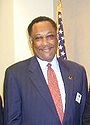 |
January 1993 – December 12, 1995 | Bill Clinton Bill Clinton William Jefferson "Bill" Clinton is an American politician who served as the 42nd President of the United States from 1993 to 2001. Inaugurated at age 46, he was the third-youngest president. He took office at the end of the Cold War, and was the first president of the baby boomer generation... |
| 4 | Barry McCaffrey Barry McCaffrey Barry Richard McCaffrey is a retired United States Army general, former U.S. Drug Czar, news commentator, and business consultant.... |
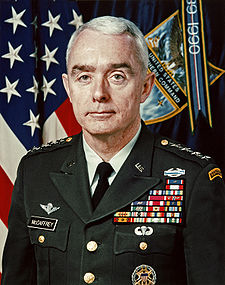 |
February 29, 1996 – January 4, 2001 | |
| 5 | John P. Walters John P. Walters John P. Walters is the former Director of the White House Office of National Drug Control Policy . He held that position from December 7, 2001 to January 20, 2009. As the nation's "Drug Czar," Mr... |
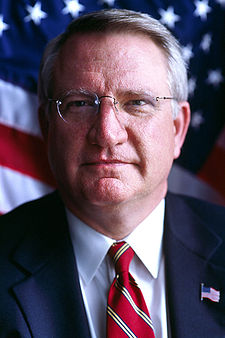 |
December 7, 2001 – January 19, 2009 | George W. Bush George W. Bush George Walker Bush is an American politician who served as the 43rd President of the United States, from 2001 to 2009. Before that, he was the 46th Governor of Texas, having served from 1995 to 2000.... |
| 6 | Gil Kerlikowske Gil Kerlikowske Richard Gil Kerlikowske is the current Director of the Office of National Drug Control Policy, a position generally referred to as the United States "Drug Czar". He assumed office on May 7, 2009.... |
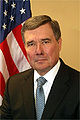 |
May 7, 2009 – present | Barack Obama Barack Obama Barack Hussein Obama II is the 44th and current President of the United States. He is the first African American to hold the office. Obama previously served as a United States Senator from Illinois, from January 2005 until he resigned following his victory in the 2008 presidential election.Born in... |
Legislation and executive orders
- 1988 Anti-Drug Abuse ActAnti-Drug Abuse Act of 1988The Anti-Drug Abuse Act of 1988, , , established the creation of a drug-free America as a policy goal and established the Office of National Drug Control Policy. The media campaign mentioned in the act later became the National Youth Anti-Drug Media Campaign....
- 1993 Executive Order 12880
- 1994 Violent Crime Control and Law Enforcement ActViolent Crime Control and Law Enforcement ActThe Violent Crime Control and Law Enforcement Act, , , was an act of Congress dealing with crime and law enforcement that became law in 1994. It is the largest crime bill in the history of the US at 356 pages and will provide for 100,000 new police officers, $9.7 billion in funding for prisons and...
- 1996 Executive Order 12992
- 1996 Executive Order 13023
- 1997 Drug-Free Communities Act
- 1998 Media Campaign Act
- 1998 ONDCP Reauthorization Act
- 2000 Executive Order 13165
See also
- Cognitive libertyCognitive libertyCognitive liberty is the freedom of sovereign control over one's own consciousness. It is an extension of the concepts of freedom of thought and self-ownership....
- Drug Enforcement AdministrationDrug Enforcement AdministrationThe Drug Enforcement Administration is a federal law enforcement agency under the United States Department of Justice, tasked with combating drug smuggling and use within the United States...
- Drug policy of the United StatesDrug policy of the United StatesDrug use has increased in all categories since prohibition except that opium use is at a fraction of its peak level. The big decline in use of opium started already after the Harrison Act of 1914. Use of heroin peaked between 1969 and 1971, cocaine, between 1987 and 1989 and marijuana between 1978...
- Gary WebbGary WebbGary Webb was a Pulitzer prize-winning American investigative journalist.Webb was best known for his 1996 "Dark Alliance" series of articles written for the San Jose Mercury News and later published as a book...
- Legal issues of cannabisLegal issues of cannabisThe legality of cannabis has been the subject of debate and controversy for decades. Cannabis is illegal to consume, use, possess, cultivate, transfer or trade in most countries...
- Medical cannabisMedical cannabisMedical cannabis refers to the use of parts of the herb cannabis as a physician-recommended form of medicine or herbal therapy, or to synthetic forms of specific cannabinoids such as THC as a physician-recommended form of medicine...
- National Institute on Drug AbuseNational Institute on Drug AbuseThe National Institute on Drug Abuse is a United States federal-government research institute whose mission is to "lead the Nation in bringing the power of science to bear on drug abuse and addiction."-History:...
- War on DrugsWar on DrugsThe War on Drugs is a campaign of prohibition and foreign military aid and military intervention being undertaken by the United States government, with the assistance of participating countries, intended to both define and reduce the illegal drug trade...
External links
- White House Office of National Drug Control Policy (ONDCP)
- "ONDCP's Fiscal year 2011 National Drug Control Budget: Are We Still Funding a War on Drugs?", hearing of the Domestic Policy Subcommittee, Committee on Oversight and Government Reform, US House of Representatives (14 April 2010) - chaired by Rep. Dennis KucinichDennis KucinichDennis John Kucinich is the U.S. Representative for , serving since 1997. He was furthermore a candidate for the Democratic nomination for President of the United States in the 2004 and 2008 presidential elections....
, testimony from Ethan NadelmannEthan NadelmannEthan Nadelmann is the founder and executive director of the Drug Policy Alliance, a New York City-based non-profit organization working to end the War on Drugs. Described by Rolling Stone as, "the point man for drug-policy-reform efforts," Ethan Nadelmann is known as a high profile critic and...
, director Drug Policy AllianceDrug Policy AllianceThe Drug Policy Alliance is a New York City-based non-profit organization, led by executive director Ethan Nadelmann, with the principal goal of ending the American "War on Drugs"...
, and Gil KerlikowskeGil KerlikowskeRichard Gil Kerlikowske is the current Director of the Office of National Drug Control Policy, a position generally referred to as the United States "Drug Czar". He assumed office on May 7, 2009....
, director ONDCP