

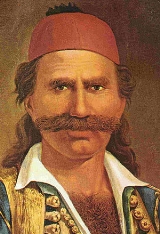
Odysseas Androutsos

Encyclopedia
Odysseas Androutsos; (1788–1825) was a hero of the Greek War of Independence
.
in 1788, however his family was from the village of Livanates
in Phthiotis
prefecture. His father was Andreas Androutsos, a klepht
and his mother was from Preveza
.
After losing his father, Androutsos joined the Turkish army of Ali Pasha
and became an officer, however, in 1818 he joined the Friendly Society (Filiki Eteria
) which was planning the liberation of Greece from the Ottoman Empire
.
, the commander of the Ottoman army, advanced with 8,000 men, after crushing the resistance of the Greeks at the river of Alamana
and putting Athanasios Diakos
to death, headed south into the Peloponnese
to crush the Greek uprising.
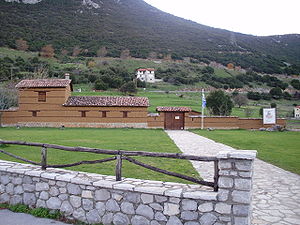 Odysseas Androutsos with a band of 100 or so men took up a defensive position at an inn near Gravia
, supported by Panourgias
and Diovouniotis and their men. Vrioni attacked the inn but was repulsed with heavy casualties (over 400 dead). Finally, he was forced to ask for reinforcements and artillery but the Greeks managed to slip out before the reinforcements arrived. Androutsos lost two men in the battle and earned the title of Commander in Chief of the Greek forces in Roumeli.
of being in contact with the Turks and was stripped of his command. Finally, in 1825, the revolutionary government placed him under arrest in a cave at the Acropolis
in Athens
. The new commander, Yiannis Gouras, who once was Androutsos' second in command, had him executed on June 5, 1825.
Greek War of Independence
The Greek War of Independence, also known as the Greek Revolution was a successful war of independence waged by the Greek revolutionaries between...
.
Early life
He was born in IthacaIthaca
Ithaca or Ithaka is an island located in the Ionian Sea, in Greece, with an area of and a little more than three thousand inhabitants. It is also a separate regional unit of the Ionian Islands region, and the only municipality of the regional unit. It lies off the northeast coast of Kefalonia and...
in 1788, however his family was from the village of Livanates
Livanates
Livanates is a seaside town in Phthiotis, central Greece. It is located 68km southeast of Lamia and it was the seat of the municipality of Dafnousia.-History:...
in Phthiotis
Phthiotis
Phthiotis is one of the regional units of Greece. It is part of the administrative region of Central Greece. The capital is the city of Lamia. It is bordered by the Malian Gulf to the east, Boeotia in the south, Phocis in the south, Aetolia-Acarnania in the southwest, Evrytania in the west,...
prefecture. His father was Andreas Androutsos, a klepht
Klepht
Klephts were self-appointed armatoloi, anti-Ottoman insurgents, and warlike mountain-folk who lived in the countryside when Greece was a part of the Ottoman Empire...
and his mother was from Preveza
Preveza
Preveza is a town in the region of Epirus, northwestern Greece, located at the mouth of the Ambracian Gulf. It is the capital of the regional unit of Preveza, which is part of the region of Epirus. An immersed tunnel, completed in 2002 which runs between Preveza and Actium, connects the town...
.
After losing his father, Androutsos joined the Turkish army of Ali Pasha
Ali Pasha
Ali Pasha of Tepelena or of Yannina, surnamed Aslan, "the Lion", or the "Lion of Yannina", Ali Pashë Tepelena was an Ottoman Albanian ruler of the western part of Rumelia, the Ottoman Empire's European territory which was also called Pashalik of Yanina. His court was in Ioannina...
and became an officer, however, in 1818 he joined the Friendly Society (Filiki Eteria
Filiki Eteria
thumb|right|200px|The flag of the Filiki Eteria.Filiki Eteria or Society of Friends was a secret 19th century organization, whose purpose was to overthrow Ottoman rule over Greece and to establish an independent Greek state. Society members were mainly young Phanariot Greeks from Russia and local...
) which was planning the liberation of Greece from the Ottoman Empire
Ottoman Empire
The Ottoman EmpireIt was usually referred to as the "Ottoman Empire", the "Turkish Empire", the "Ottoman Caliphate" or more commonly "Turkey" by its contemporaries...
.
Greek Revolution
In May 1821, Omer VryonisOmer Vryonis
Omer Vrioni was a leading Ottoman figure in the Greek War of Independence.-Early life:Omer Vrioni was an Albanian from the village of Vrioni near Berat, with a distinguished record in the battles in Egypt against Napoleon. When Ali Pasha revolted against the Porte, Omer was his treasurer...
, the commander of the Ottoman army, advanced with 8,000 men, after crushing the resistance of the Greeks at the river of Alamana
Battle of Alamana
The Battle of Alamana was fought between the Greeks and the Ottoman Empire during the Greek War of Independence on April 22nd, 1821.-Battle:...
and putting Athanasios Diakos
Athanasios Diakos
Athanasios Diakos , a Greek military commander during the Greek War of Independence and a national hero, was born Athanasios Nikolaos Massavetas in the village of Ano Mousounitsa, Phocis.-Early life:...
to death, headed south into the Peloponnese
Peloponnese
The Peloponnese, Peloponnesos or Peloponnesus , is a large peninsula , located in a region of southern Greece, forming the part of the country south of the Gulf of Corinth...
to crush the Greek uprising.
Battle of Gravia
Gravia
Gravia is a village and a former municipality in the northeastern part of Phocis, Greece. Since the 2011 local government reform it is part of the municipality Delphi, of which it is a municipal unit. Its 2001 population was 897 for the village and 2,975 for the municipality. The municipal unit...
, supported by Panourgias
Dimitrios Panourgias
Dimitrios Panourgias , a Greek military commander during the Greek War of Independence, was born Dimitrios Xiros in the village of Dremissa, Phocis.- Early life :...
and Diovouniotis and their men. Vrioni attacked the inn but was repulsed with heavy casualties (over 400 dead). Finally, he was forced to ask for reinforcements and artillery but the Greeks managed to slip out before the reinforcements arrived. Androutsos lost two men in the battle and earned the title of Commander in Chief of the Greek forces in Roumeli.
Downfall
Androutsos' glory did not last long. In the following year, 1822, he was accused by political opponent Ioannis KolettisIoannis Kolettis
Ioannis Kolettis was a Greek politician who played a significant role in Greek affairs from the Greek War of Independence through the early years of the Greek Kingdom, including as Minister to France and serving twice as Prime Minister....
of being in contact with the Turks and was stripped of his command. Finally, in 1825, the revolutionary government placed him under arrest in a cave at the Acropolis
Acropolis
Acropolis means "high city" in Greek, literally city on the extremity and is usually translated into English as Citadel . For purposes of defense, early people naturally chose elevated ground to build a new settlement, frequently a hill with precipitous sides...
in Athens
Athens
Athens , is the capital and largest city of Greece. Athens dominates the Attica region and is one of the world's oldest cities, as its recorded history spans around 3,400 years. Classical Athens was a powerful city-state...
. The new commander, Yiannis Gouras, who once was Androutsos' second in command, had him executed on June 5, 1825.
See also
- Battle of GraviaBattle of GraviaThe Battle of Gravia Inn was fought between Greek revolutionaries and the Ottoman Empire during the Greek War of Independence. The Greek leader, Odysseas Androutsos with a group of 120 men defeated a Ottoman army numbering 9,000 men and artillery under the command of Omer Vrioni.Following his...