

Oboe da caccia

Encyclopedia
Double reed
A double reed is a type of reed used to produce sound in various wind instruments. The term double reed comes from the fact that there are two pieces of cane vibrating against each other. A single reed consists of one piece of cane which vibrates against a mouthpiece made of metal, hardened...
woodwind instrument
Woodwind instrument
A woodwind instrument is a musical instrument which produces sound when the player blows air against a sharp edge or through a reed, causing the air within its resonator to vibrate...
in the oboe
Oboe
The oboe is a double reed musical instrument of the woodwind family. In English, prior to 1770, the instrument was called "hautbois" , "hoboy", or "French hoboy". The spelling "oboe" was adopted into English ca...
family, pitch
Pitch (music)
Pitch is an auditory perceptual property that allows the ordering of sounds on a frequency-related scale.Pitches are compared as "higher" and "lower" in the sense associated with musical melodies,...
ed a fifth below the oboe and used primarily in the Baroque
Baroque music
Baroque music describes a style of Western Classical music approximately extending from 1600 to 1760. This era follows the Renaissance and was followed in turn by the Classical era...
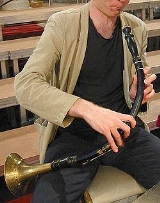
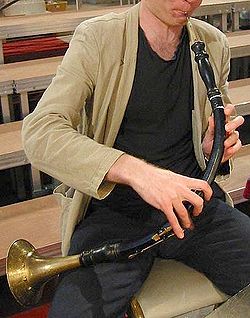
period of European classical music. It has a curved tube and a brass bell, unusual for an oboe.
Its range is close to that of the English horn—that is, from the F below middle C (notated C4 but sounding F3) to the G above the treble staff (notated D6 but sounding G5). The oboe da caccia is thus a transposing instrument
Transposing instrument
A transposing instrument is a musical instrument for which written notes are read at a pitch different from the corresponding concert pitch, which a non-transposing instrument, such as a piano, would play. Playing a written C on a transposing instrument will produce a note other than concert C...
in F. The notated range is identical to that of the soprano baroque oboe, and with a good reed, all registers speak very easily. Bach tended to favor the middle and lowest registers, however, perhaps because they are the most characteristic ones for this instrument.
Development
The instrument was likely invented by J.H. Eichentopf of LeipzigLeipzig
Leipzig Leipzig has always been a trade city, situated during the time of the Holy Roman Empire at the intersection of the Via Regia and Via Imperii, two important trade routes. At one time, Leipzig was one of the major European centres of learning and culture in fields such as music and publishing...
, Germany. The first dated reference to the oboe da caccia is 1722, when composer Johann Friedrich Fasch
Johann Friedrich Fasch
Johann Friedrich Fasch was a German violinist and composer.Fasch was born in Buttelstedt, was a choirboy in Weissenfels and studied under Johann Kuhnau at the famous St. Thomas School in Leipzig and later founded a Collegium Musicum in that city...
ordered "Waldhautbois" from Leipzig for the court at Zerbst
Zerbst
Zerbst is a town in the district of Anhalt-Bitterfeld, in Saxony-Anhalt, Germany. Until the administrative reform of 2007, Zerbst was the capital of the Anhalt-Zerbst district. Since the 1 January 2010 local government reform, Zerbst has about 24,000 inhabitants.It is not clear when was it founded;...
. The first recorded use of the instrument is on 24 June 1723, when the Bach aria BWV 167/3, "Gottes Wort, das trüget nicht," from the cantata Ihr Menschen, rühmet Gottes Liebe, BWV 167
Ihr Menschen, rühmet Gottes Liebe, BWV 167
Ihr Menschen, rühmet Gottes Liebe , BWV 167, is a church cantata by Johann Sebastian Bach. Bach composed the cantata in Leipzig for the Feast of St. John the Baptist and first performed it on 24 June 1723.-History and words:Bach composed the cantata in his first year in Leipzig for St...
, was performed. As Bach had arrived in Leipzig just a month before, it seems hardly possible that he had been involved in developing the new instrument, even if one were to question the identity of the Waldhautbois a year earlier. But Bach was certainly the most prolific and most important composer for oboe da caccia, often using them in pairs. In 1723 alone, Bach wrote four cantatas using this instrument, the others being Schauet doch und sehet, ob irgend ein Schmerz sei, BWV 46
Schauet doch und sehet, ob irgend ein Schmerz sei, BWV 46
Schauet doch und sehet, ob irgend ein Schmerz sei , BWV 46, is a church cantata of Johann Sebastian Bach, written for the 10th Sunday after Trinity, first performed on 1 August 1723 in Bach's first year in Leipzig....
, 1 August, Siehe zu, daß deine Gottesfurcht nicht Heuchelei sei, BWV 179
Siehe zu, daß deine Gottesfurcht nicht Heuchelei sei, BWV 179
Siehe zu, daß deine Gottesfurcht nicht Heuchelei sei , BWV 179, is a church cantata written by Johann Sebastian Bach in 1723 in Leipzig for the eleventh Sunday after Trinity, first performed on 8 August 1723.-History and words:Bach wrote the cantata in his first year in Leipzig, which he had...
, 8 August), and Ich elender Mensch, wer wird mich erlösen, BWV 48
Ich elender Mensch, wer wird mich erlösen, BWV 48
Ich elender Mensch, wer wird mich erlösen , BWV 48, is a church cantata written by Johann Sebastian Bach in 1723 in Leipzig for the 19th Sunday after Trinity.-History and words:...
, 3 October. Bach wrote extensively for the oboe da caccia in the years 1723–27. There are also significant parts for the oboe da caccia in his Christmas Oratorio
Christmas Oratorio
The Christmas Oratorio BWV 248, is an oratorio by Johann Sebastian Bach intended for performance in church during the Christmas season. It was written for the Christmas season of 1734 incorporating music from earlier compositions, including three secular cantatas written during 1733 and 1734 and a...
(BWV 248, 1734), the Passions
Passions (Bach)
According to his obituary, Johann Sebastian Bach wrote "five passions, of which one is for double chorus". Two works have survived: the St John Passion and the St Matthew Passion , this last using double chorus...
(St John Passion, 1724, and St Matthew Passion, c. 1727), and the cantatas
Bach cantata
Bach cantata became a term for a cantata of the German Baroque composer Johann Sebastian Bach who was a prolific writer of the genre. Although many of his works are lost, around 200 cantatas survived....
, especially in cantata Wachet auf, ruft uns die Stimme, BWV 140.
The other known compositions for the oboe da caccia are by Fasch. The oboe da caccia was used only in the late Baroque
Baroque music
Baroque music describes a style of Western Classical music approximately extending from 1600 to 1760. This era follows the Renaissance and was followed in turn by the Classical era...
period, after which it fell out of use until interest in authentic performance in the 20th century caused it to be revived. During the period c. 1780–1820, roughly the Classical period
Classical period (music)
The dates of the Classical Period in Western music are generally accepted as being between about 1750 and 1830. However, the term classical music is used colloquially to describe a variety of Western musical styles from the ninth century to the present, and especially from the sixteenth or...
, centering on Vienna
Vienna
Vienna is the capital and largest city of the Republic of Austria and one of the nine states of Austria. Vienna is Austria's primary city, with a population of about 1.723 million , and is by far the largest city in Austria, as well as its cultural, economic, and political centre...
, the soprano oboe underwent major changes first in bore and then in keywork. It is therefore understandable that the oboe da caccia, with its bizarre brass bell and difficult means of construction, was not selected for the same evolutionary "treatment." The prototypical English horn
Cor anglais
The cor anglais , or English horn , is a double-reed woodwind instrument in the oboe family....
(corno inglese, cor anglais, cor anglé) was no doubt more suitable. Innovation was the watchword of the day, and antiquated instruments such as the oboe da caccia stood little chance of surviving (cf. the way in which the piano supplanted the harpsichord). A curious note: according to Cecil Forsyth in his famous book on orchestration, Beethoven
Ludwig van Beethoven
Ludwig van Beethoven was a German composer and pianist. A crucial figure in the transition between the Classical and Romantic eras in Western art music, he remains one of the most famous and influential composers of all time.Born in Bonn, then the capital of the Electorate of Cologne and part of...
was the last composer to write a part for the oboe da caccia until modern times. However, Forsyth wrote during a period when organology (the study of musical instruments) was in its infancy. Many of his statements, including the one about Beethoven, are questionable and in need of revision in light of modern research—in this case, Beethoven—in his Trios for two oboes and a deeper instrument in F —clearly labeled this deeper part "corno inglese" (English horn).
Construction
The oboe da caccia has a leather-covered wooden body terminating in a brass bell similar to a horn bell. There are typically two brass keys, E-flat and C. The E-flat key is typically repeated for the left hand. There are usually two "doubled" fingerholes, G/A-flat and F/F#, similar to the soprano baroque oboe. The construction differs from that of all other woodwinds. The bore and outward profiles are first created on the lathe, then a series of saw kerfs are made through the bore from the side, which become the inner curve. Then the instrument is bent over steam and a slat glued onto the inside curve to fix it. Any remaining lacunae in the kerfs are filled and the curved section is covered with leather. The da caccia is played with a double reed; the sound is very mellow and supple.The oboe da caccia stands in a rather unusual relationship to the rest of the oboe family. It cannot rightly be called the precursor of the English horn (the predominant name in North America and German-speaking countries) or cor anglais
Cor anglais
The cor anglais , or English horn , is a double-reed woodwind instrument in the oboe family....
(the name used in England and France), because it has nothing to do with this instrument except its register. The English horn has an egg-shaped bell, whereas the da caccia has a flared brass one. The evolution of the English horn is complex and more likely traceable through the taille (see above) and the oboe d'amore
Oboe d'amore
The oboe d'amore , less commonly oboe d'amour, is a double reed woodwind musical instrument in the oboe family. Slightly larger than the oboe, it has a less assertive and more tranquil and serene tone, and is considered the mezzo-soprano of the oboe family, between the oboe itself and the cor...
, both of which had bulbous bells. The da caccia sounds like none of the foregoing, per se, and no other instrument may legitimately substitute for it—although the English horn is routinely substituted for both the oboe d'amore and oboe da caccia in performances with modern instruments.
The oboe da caccia after Bach and modern reconstruction
After Bach, the oboe da caccia quickly fell out of use. The knowledge of its exact sound and construction was lost, and instruments once believed to be oboes da caccia have proven not to be this instrument at all or to consist only of parts of one. The consensus amongst scholars during the first half of the 20th century was that no known instruments from Bach's time had survived to the present day. Curt Sachs, in his Real-Lexicon der Musikinstrumente (1913), for example, included a crude and rather speculative drawing of an oboe da caccia. Interest in the da caccia was revived in the early 1970s, in part due to the ongoing Telefunken Records project to record the complete cantatas of J.S. Bach, conducted by Nikolaus HarnoncourtNikolaus Harnoncourt
Nikolaus Harnoncourt is an Austrian conductor, particularly known for his historically informed performances of music from the Classical era and earlier. Starting out as a classical cellist, he founded his own period instrument ensemble in the 1950s, and became a pioneer of the Early Music movement...
and Gustav Leonhardt
Gustav Leonhardt
Gustav Leonhardt is a highly renowned Dutch keyboard player, conductor, musicologist, teacher and editor. Leonhardt has been a leading figure in the movement to perform music on period instruments...
. The taille, a straight two-key oboe pitched in F, had previously been used for the da caccia parts in period-instrument recordings, with mixed results.
It fell to Cary Karp
Cary Karp
Cary Karp, a museum curator based in Sweden, has been instrumental in developing online facilities for museums in the context of the International Council of Museums . In particular, he was central in promoting and establishing the .museum top-level domain as President of the international Museum...
, a curator at the Music Museum in Stockholm
Stockholm
Stockholm is the capital and the largest city of Sweden and constitutes the most populated urban area in Scandinavia. Stockholm is the most populous city in Sweden, with a population of 851,155 in the municipality , 1.37 million in the urban area , and around 2.1 million in the metropolitan area...
, Sweden
Sweden
Sweden , officially the Kingdom of Sweden , is a Nordic country on the Scandinavian Peninsula in Northern Europe. Sweden borders with Norway and Finland and is connected to Denmark by a bridge-tunnel across the Öresund....
, to make the discovery that in fact two well-preserved (but unplayable) Eichentopf da caccias existed in museums in Scandinavia: one of them in his own museum, and another in a museum in Copenhagen
Copenhagen
Copenhagen is the capital and largest city of Denmark, with an urban population of 1,199,224 and a metropolitan population of 1,930,260 . With the completion of the transnational Øresund Bridge in 2000, Copenhagen has become the centre of the increasingly integrating Øresund Region...
. The results of his research were published in the Galpin Society Journal article. Using measurements taken from the two instruments, oboist and instrument maker Paul Hailperin of Zell im Wiesental
Zell im Wiesental
Zell im Wiesental is a town in the district of Lörrach in Baden-Württemberg, Germany. It is situated in the Black Forest, on the river Wiese, 26 km northeast of Basel, and 32 km south of Freiburg....
, Germany made the first modern-day copies, and these were used in the Harnoncourt recording of the Weihnachtsoratorium
Christmas Oratorio
The Christmas Oratorio BWV 248, is an oratorio by Johann Sebastian Bach intended for performance in church during the Christmas season. It was written for the Christmas season of 1734 incorporating music from earlier compositions, including three secular cantatas written during 1733 and 1734 and a...
that appeared in late 1973.
Modern-day makers of oboes da caccia include Sand Dalton of Lopez Island, Washington, United Stateshttp://www.baroqueoboes.com/index.html; Richard Earle in the UK; Marcel Ponseele in France; Henri Gohin in France; and Joel Robinson in New York City http://robinsonwoodwinds.com/.