
Home      Discussion      Topics      Dictionary      Almanac
Signup       Login
Oblique projection

Oblique projection

Overview
Oblique projection is a simple type of graphical projection
Graphical projection
Graphical projection is a protocol by which an image of a three-dimensional object is projected onto a planar surface without the aid of mathematical calculation, used in technical drawing.- Overview :...

 used for producing pictorial, two-dimensional image
Image
An image is an artifact, for example a two-dimensional picture, that has a similar appearance to some subject—usually a physical object or a person.-Characteristics:...

s of three-dimensional objects.
Discussion
Ask a question about 'Oblique projection'
Start a new discussion about 'Oblique projection'
Answer questions from other users
Full Discussion Forum
 
Unanswered Questions
Encyclopedia
Oblique projection is a simple type of graphical projection
Graphical projection
Graphical projection is a protocol by which an image of a three-dimensional object is projected onto a planar surface without the aid of mathematical calculation, used in technical drawing.- Overview :...

 used for producing pictorial, two-dimensional image
Image
An image is an artifact, for example a two-dimensional picture, that has a similar appearance to some subject—usually a physical object or a person.-Characteristics:...

s of three-dimensional objects.

Overview


Oblique projection is a type of parallel projection
Parallel projection
Parallel projections have lines of projection that are parallel both in reality and in the projection plane.Parallel projection corresponds to a perspective projection with an infinite focal length , or "zoom".Within parallel projection there is an ancillary category known as "pictorials"...

:
  • it projects an image by intersecting parallel rays (projectors)
  • from the three-dimensional source object with the drawing surface (projection plane).

In both oblique projection and orthographic projection
Orthographic projection
Orthographic projection is a means of representing a three-dimensional object in two dimensions. It is a form of parallel projection, where all the projection lines are orthogonal to the projection plane, resulting in every plane of the scene appearing in affine transformation on the viewing surface...

, parallel lines of the source object produce parallel lines in the projected image. The projectors in oblique projection intersect the projection plane at an oblique angle to produce the projected image, as opposed to the perpendicular angle used in orthographic projection.

Mathematically, the parallel projection of the point on the -plane gives . The constants and uniquely specify a parallel projection. When , the projection is said to be "orthographic" or "orthogonal". Otherwise, it is "oblique".
The constants and are not necessarily less than 1, and as a consequence lengths measured on an oblique projection may be either larger or shorter than they were in space. In a general oblique projection, spheres of the space are projected as ellipses on the drawing plane, and not as circles as you would expect them from an orthogonal projection.

Oblique drawing is also the crudest "3D" drawing method but the easiest to master. Oblique is not really a 3D system but a 2 dimensional view of an object with 'forced depth'. One way to draw using an oblique view is to draw the side of the object you are looking at in two dimensions, i.e. flat, and then draw the other sides at an angle of 45 degrees, but instead of drawing the sides full size they are only drawn with half the depth creating 'forced depth' - adding an element of realism to the object. Even with this 'forced depth', oblique drawings look very unconvincing to the eye. For this reason oblique is rarely used by professional designers and engineers.

Oblique pictorial


In an oblique pictorial drawing, the angles displayed among the axes, as well as the foreshortening factors (scale) are arbitrary.
More precisely, any given set of three coplanar segments originating from the same point may be construed as forming some oblique perspective of three sides of a cube. This result is known as Pohlke's theorem, from the German mathematician Pohlke, who published it in the early 19th century.

The resulting distortions make the technique unsuitable for formal, working drawings. Nevertheless, the distortions are partially overcome by aligning one plane of the image parallel to the plane of projection. Doing so creates a true shape image of the chosen plane.
This specific category of oblique projections, whereby lengths along the directions and are preserved, but lengths along direction are drawn at angle using a reduction factor is very much in use for industrial drawings.
  • Cavalier projection is the name of such a projection, where the length along the axis remains unscaled.

  • Cabinet projection, popular in furniture illustrations, is an example of such a technique, wherein the receding axis is scaled to half-size (sometimes also two thirds the original).

Cavalier projections


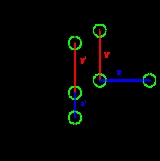
In cavalier projection (sometimes cavalier perspective or high view point) a point of the object is represented by three coordinates, x, y and z. On the drawing, it is represented by only two coordinates, x" and y". On the flat drawing, two axes, x and z on the figure, are perpendicular
Perpendicular
In geometry, two lines or planes are considered perpendicular to each other if they form congruent adjacent angles . The term may be used as a noun or adjective...

 and the length on these axes are drawn with a 1:1 scale; it is thus similar to the dimetric projections, although it is not an orthographic projection
Orthographic projection
Orthographic projection is a means of representing a three-dimensional object in two dimensions. It is a form of parallel projection, where all the projection lines are orthogonal to the projection plane, resulting in every plane of the scene appearing in affine transformation on the viewing surface...

, as the third axis, here y, is drawn in diagonal, making an arbitrary angle with the x" axis, usually 30 or 45°. The length of the third axis is not scaled.
It is very easy to draw, especially with pen and paper. It is thus often used when a figure must be drawn by hand, e.g. on a black board (lesson, oral examination).

The representation was initially used for military fortification
Fortification
Fortifications are military constructions and buildings designed for defence in warfare and military bases. Humans have constructed defensive works for many thousands of years, in a variety of increasingly complex designs...

s. In French, the « cavalier » (literally rider, horseman, see Cavalry
Cavalry
Cavalry or horsemen were soldiers or warriors who fought mounted on horseback. Cavalry were historically the third oldest and the most mobile of the combat arms...

) is an artificial hill behind the walls that allows to see the enemy above the walls. The cavalier perspective was the way the things were seen from this high point. Some also explain the name by the fact that it was the way a rider could see a small object on the ground from his horseback.

Cabinet projection


The term cabinet projection (sometimes cabinet perspective) stems from its use in illustrations by the furniture industry. Like cavalier perspective, one face of the projected object is parallel to the viewing plane, and the third axis is projected as going off in an angle (typical 30° or 45°). Unlike cavalier projection, where the third axis keeps its length, with cabinet projection the length of the receding lines is cut in half.

Mathematical formula


As formula, if the plane facing the viewer is , and the receding axis is , then a point is projected like this:
Where is the mentioned angle.

The transformation matrix is:

Examples


Besides technical drawing and illustrations, video games (especially those preceding the advent of 3D games) also often use a form of oblique projection. Examples include SimCity
SimCity
SimCity is a critically acclaimed city-building simulation video game, first released in 1989, and designed by Will Wright. SimCity was Maxis' first product, which has since been ported into various personal computers and game consoles, and spawned several sequels including SimCity 2000 in 1994,...

, Ultima VII
Ultima VII
Ultima VII: The Black Gate is the seventh installment of the Ultima series of computer role-playing games. It was released in 1992.The Black Gate was critically and commercially successful, being widely lauded as a high point in the series and as one of the best isometric RPGs ever created...

, EarthBound
EarthBound
EarthBound, also known as EarthBound: The War Against Giygas! and released as in Japan, is a role-playing video game co-developed by Ape and HAL Laboratory and published by Nintendo for the Super Nintendo Entertainment System video game console...

, and Paperboy
Paperboy (video game)
Paperboy is a 1984 arcade game by Atari Games. The players take the role of a paperboy who delivers newspapers along a suburban street on his bicycle. This game was innovative for its theme and novel controls.-Gameplay:...

.

See also


  • Orthographic projection
    Orthographic projection
    Orthographic projection is a means of representing a three-dimensional object in two dimensions. It is a form of parallel projection, where all the projection lines are orthogonal to the projection plane, resulting in every plane of the scene appearing in affine transformation on the viewing surface...

  • Plans (drawings)
    Plans (drawings)
    Plans are a set of drawings or two-dimensional diagrams used to describe a place or object, or to communicate building or fabrication instructions. Usually plans are drawn or printed on paper, but they can take the form of a digital file.- Overview :...

  • Graphical projection
    Graphical projection
    Graphical projection is a protocol by which an image of a three-dimensional object is projected onto a planar surface without the aid of mathematical calculation, used in technical drawing.- Overview :...


  • Projection (linear algebra)
    Projection (linear algebra)
    In linear algebra and functional analysis, a projection is a linear transformation P from a vector space to itself such that P2 = P. It leaves its image unchanged....

  • Parallel (geometry)
    Parallel (geometry)
    Parallelism is a term in geometry and in everyday life that refers to a property in Euclidean space of two or more lines or planes, or a combination of these. The assumed existence and properties of parallel lines are the basis of Euclid's parallel postulate. Two lines in a plane that do not...

  • Space-oblique Mercator projection
    Space-oblique Mercator projection
    Space-oblique Mercator projection is a map projection.-History:The space-oblique Mercator projection was developed by John P. Snyder, Alden Partridge Colvocoresses and John L. Junkins in 1976. Snyder had an interest in maps, originating back to his childhood and he regularly attended cartography...


Further reading


  • Ingrid Carlbom, Joseph Paciorek, Planar Geometric Projections and Viewing Transformations, ACM Computing Surveys
    ACM Computing Surveys
    ACM Computing Surveys is a peer reviewed scientific journal published by the Association for Computing Machinery. The journal publishes survey articles and tutorials related to computer science and computing. It was founded in 1969; the first editor-in-chief was William S...

    , v.10 n.4, p. 465-502, Dec. 1978

External links