

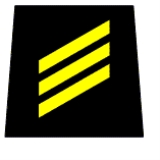
Obergefreiter

Encyclopedia
Obergefreiter is a rank of the German
and Swiss
militaries which dates from the 19th century.
The rank was only used in the German army's heavy artillery branch (Fußartillerie) before 1919 and commonly established with the founding of the Reichswehr
. Translated as "Senior Lance-Corporal", in World War II
the rank was normally given to soldiers who had command over small squads or to those soldiers who held the rank of Gefreiter
and had performed a significant feat of achievement. An Obergefreiter was not considered a non-commissioned officer (Unteroffizier).
In today's Bundeswehr
, every Gefreiter is normally promoted Obergefreiter after six months. The NATO-Code is OR-3 which would make Obergefreiter the equivalent to Private
/ Airman
/ Seaman First Class in most forces or, e.g., Lance Corporal
in the Australian
/New Zealand
Forces. Like all enlisted personnel in the German Bundeswehr, soldiers of this rank have no military authority over lower ranking enlisted personnel (for instance Schütze
or Gefreiter), except given by a higher rank.
 In the Swiss Army the rank of Obergefreiter (short: Obgfr) was introduced after a long debate on 1 January 2004. They are specialists, who take over tasks of responsibility or hold the position of a group commander.
In the Bundeswehr the lower rank is Gefreiter while the next rank is Hauptgefreiter. The lower rank in the Swiss Army is also Gefreiter, the next rank is Korporal
.
Germany
Germany , officially the Federal Republic of Germany , is a federal parliamentary republic in Europe. The country consists of 16 states while the capital and largest city is Berlin. Germany covers an area of 357,021 km2 and has a largely temperate seasonal climate...
and Swiss
Switzerland
Switzerland name of one of the Swiss cantons. ; ; ; or ), in its full name the Swiss Confederation , is a federal republic consisting of 26 cantons, with Bern as the seat of the federal authorities. The country is situated in Western Europe,Or Central Europe depending on the definition....
militaries which dates from the 19th century.
The rank was only used in the German army's heavy artillery branch (Fußartillerie) before 1919 and commonly established with the founding of the Reichswehr
Reichswehr
The Reichswehr formed the military organisation of Germany from 1919 until 1935, when it was renamed the Wehrmacht ....
. Translated as "Senior Lance-Corporal", in World War II
World War II
World War II, or the Second World War , was a global conflict lasting from 1939 to 1945, involving most of the world's nations—including all of the great powers—eventually forming two opposing military alliances: the Allies and the Axis...
the rank was normally given to soldiers who had command over small squads or to those soldiers who held the rank of Gefreiter
Gefreiter
Gefreiter is the German, Swiss and Austrian equivalent for the military rank Private . Gefreiter was the lowest rank to which an ordinary soldier could be promoted. As a military rank it has existed since at least the 16th century...
and had performed a significant feat of achievement. An Obergefreiter was not considered a non-commissioned officer (Unteroffizier).
In today's Bundeswehr
Bundeswehr
The Bundeswehr consists of the unified armed forces of Germany and their civil administration and procurement authorities...
, every Gefreiter is normally promoted Obergefreiter after six months. The NATO-Code is OR-3 which would make Obergefreiter the equivalent to Private
Private (rank)
A Private is a soldier of the lowest military rank .In modern military parlance, 'Private' is shortened to 'Pte' in the United Kingdom and other Commonwealth countries and to 'Pvt.' in the United States.Notably both Sir Fitzroy MacLean and Enoch Powell are examples of, rare, rapid career...
/ Airman
Airman
An airman is a member of the air component of a nation's armed service. In the United States Air Force and the Royal Air Force , it can also refer to a specific enlisted rank...
/ Seaman First Class in most forces or, e.g., Lance Corporal
Lance Corporal
Lance corporal is a military rank, used by many armed forces worldwide, and also by some police forces and other uniformed organizations. It is below the rank of corporal, and is typically the lowest non-commissioned officer, usually equivalent to the NATO Rank Grade OR-3.- Etymology :The presumed...
in the Australian
Australian Defence Force
The Australian Defence Force is the military organisation responsible for the defence of Australia. It consists of the Royal Australian Navy , Australian Army, Royal Australian Air Force and a number of 'tri-service' units...
/New Zealand
New Zealand Defence Force
The New Zealand Defence Force consists of three services: the Royal New Zealand Navy; the New Zealand Army; and the Royal New Zealand Air Force. The Commander-in-Chief of the NZDF is His Excellency Rt. Hon...
Forces. Like all enlisted personnel in the German Bundeswehr, soldiers of this rank have no military authority over lower ranking enlisted personnel (for instance Schütze
Schütze
Schütze in German means "shooter" or "rifleman". It also occasionally occurs as a surname, as Schütz, as in the opera Der Freischütz. The word itself is derived from the German word schützen, meaning to protect, or to guard...
or Gefreiter), except given by a higher rank.
In the Bundeswehr the lower rank is Gefreiter while the next rank is Hauptgefreiter. The lower rank in the Swiss Army is also Gefreiter, the next rank is Korporal
Korporal
Korporal is a rank in the Norwegian army, air force and the Swiss army. It is the equivalent of corporal.There are three categories of korporal:# Utskrevet befalskorporal, a conscript who has completed a training course and serves as befal ....
.