

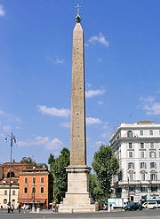
Obelisks in Rome

Encyclopedia
Rome
Rome is the capital of Italy and the country's largest and most populated city and comune, with over 2.7 million residents in . The city is located in the central-western portion of the Italian Peninsula, on the Tiber River within the Lazio region of Italy.Rome's history spans two and a half...
harbours the most obelisk
Obelisk
An obelisk is a tall, four-sided, narrow tapering monument which ends in a pyramid-like shape at the top, and is said to resemble a petrified ray of the sun-disk. A pair of obelisks usually stood in front of a pylon...
s in the world. There are eight ancient Egypt
Ancient Egypt
Ancient Egypt was an ancient civilization of Northeastern Africa, concentrated along the lower reaches of the Nile River in what is now the modern country of Egypt. Egyptian civilization coalesced around 3150 BC with the political unification of Upper and Lower Egypt under the first pharaoh...
ian and five ancient Roman
Ancient Rome
Ancient Rome was a thriving civilization that grew on the Italian Peninsula as early as the 8th century BC. Located along the Mediterranean Sea and centered on the city of Rome, it expanded to one of the largest empires in the ancient world....
obelisks in Rome, together with a number of more modern obelisks; there was also formerly (until 2005) an ancient Ethiopian obelisk in Rome
Rome
Rome is the capital of Italy and the country's largest and most populated city and comune, with over 2.7 million residents in . The city is located in the central-western portion of the Italian Peninsula, on the Tiber River within the Lazio region of Italy.Rome's history spans two and a half...
.
For transport down the Nile
Nile
The Nile is a major north-flowing river in North Africa, generally regarded as the longest river in the world. It is long. It runs through the ten countries of Sudan, South Sudan, Burundi, Rwanda, Democratic Republic of the Congo, Tanzania, Kenya, Ethiopia, Uganda and Egypt.The Nile has two major...
to Alexandria
Alexandria
Alexandria is the second-largest city of Egypt, with a population of 4.1 million, extending about along the coast of the Mediterranean Sea in the north central part of the country; it is also the largest city lying directly on the Mediterranean coast. It is Egypt's largest seaport, serving...
and from there across the Mediterranean Sea
Mediterranean Sea
The Mediterranean Sea is a sea connected to the Atlantic Ocean surrounded by the Mediterranean region and almost completely enclosed by land: on the north by Anatolia and Europe, on the south by North Africa, and on the east by the Levant...
to the capital Rome, special heavy cargo carriers, the Obelisk ships
Obelisk ships
Obelisk ships were ships used to transport obelisks.Today, eight Ancient Egyptian obelisks stand in Rome, though not in their original places. The first of the obelisks, the 263 ton Flaminian obelisk, was transported from Heliopolis – modern-day Cairo - in 10 B.C...
, were used by the Romans. On site, large Roman cranes were employed to erect the monolith
Monolith
A monolith is a geological feature such as a mountain, consisting of a single massive stone or rock, or a single piece of rock placed as, or within, a monument...
s.
Ancient Egyptian obelisks
At least eight obelisks created in antiquity by the Egyptians were taken from EgyptEgypt
Egypt , officially the Arab Republic of Egypt, Arabic: , is a country mainly in North Africa, with the Sinai Peninsula forming a land bridge in Southwest Asia. Egypt is thus a transcontinental country, and a major power in Africa, the Mediterranean Basin, the Middle East and the Muslim world...
after the Roman conquest and brought to Rome.
| Image | Height (with base) |
Name | Builder | Location | Notes |
|---|---|---|---|---|---|
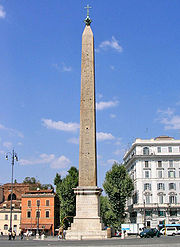 |
32.18 m (45.70 m) |
Lateranense | Tuthmosis III / Tuthmosis IV | > 41°53′12.6"N 12°30′17.2"E |
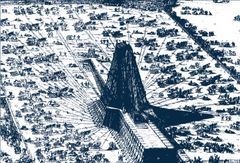
Tallest obelisk in Rome, and the largest standing ancient Egyptian obelisk in the world, weighing over 230 ton Ton The ton is a unit of measure. It has a long history and has acquired a number of meanings and uses over the years. It is used principally as a unit of weight, and as a unit of volume. It can also be used as a measure of energy, for truck classification, or as a colloquial term.It is derived from... s. Originally from the temple of Amun Amun Amun, reconstructed Egyptian Yamānu , was a god in Egyptian mythology who in the form of Amun-Ra became the focus of the most complex system of theology in Ancient Egypt... in Karnak Karnak The Karnak Temple Complex—usually called Karnak—comprises a vast mix of decayed temples, chapels, pylons, and other buildings, notably the Great Temple of Amun and a massive structure begun by Pharaoh Ramses II . Sacred Lake is part of the site as well. It is located near Luxor, some... . Brought to Alexandria Alexandria Alexandria is the second-largest city of Egypt, with a population of 4.1 million, extending about along the coast of the Mediterranean Sea in the north central part of the country; it is also the largest city lying directly on the Mediterranean coast. It is Egypt's largest seaport, serving... with another obelisk Obelisk of Theodosius The Obelisk of Theodosius is the Ancient Egyptian obelisk of Pharaoh Tutmoses III re-erected in the Hippodrome of Constantinople by the Roman emperor Theodosius I in the 4th century AD.-History:The obelisk was first set up by Tutmoses III to the south of the seventh pylon... by Constantius II Constantius II Constantius II , was Roman Emperor from 337 to 361. The second son of Constantine I and Fausta, he ascended to the throne with his brothers Constantine II and Constans upon their father's death.... , and brought on its own from there to Rome in 357 to decorate the spina of the Circus Maximus Circus Maximus The Circus Maximus is an ancient Roman chariot racing stadium and mass entertainment venue located in Rome, Italy. Situated in the valley between the Aventine and Palatine hills, it was the first and largest stadium in ancient Rome and its later Empire... . Found in three pieces in 1587, restored approximately 4 m shorter by Pope Sixtus V Pope Sixtus V Pope Sixtus V , born Felice Peretti di Montalto, was Pope from 1585 to 1590.-Early life:The chronicler Andrija Zmajević states that Felice's family originated from modern-day Montenegro... , and erected near the Lateran Palace Lateran Palace The Lateran Palace , formally the Apostolic Palace of the Lateran , is an ancient palace of the Roman Empire and later the main Papal residence.... and basilica of San Giovanni in Laterano Basilica of St. John Lateran The Papal Archbasilica of St. John Lateran , commonly known as St. John Lateran's Archbasilica and St. John Lateran's Basilica, is the cathedral of the Diocese of Rome and the official ecclesiastical seat of the Bishop of Rome, who is the Pope... in 1588 in the place of the equestrian statue Equestrian Statue of Marcus Aurelius The Equestrian Statue of Marcus Aurelius is an ancient Roman statue in the Campidoglio, Rome, Italy. It is made of bronze and stands 3.5 m tall. Although the emperor is mounted, it exhibits many similarities to standing statues of Augustus... of Marcus Aurelius, which was moved to the Capitoline Hill Capitoline Hill The Capitoline Hill , between the Forum and the Campus Martius, is one of the seven hills of Rome. It was the citadel of the earliest Romans. By the 16th century, Capitolinus had become Capitolino in Italian, with the alternative Campidoglio stemming from Capitolium. The English word capitol... . |
| 25.5 m (41 m)Supported on bronze lions and surmounted by the Chigi Chigi Chigi may refer to:* Chigi , a crossbreed between a Welsh Corgi and a chihuahua * House of Chigi, a Roman princely family* Chigi , an element in Japanese architecture... arms in bronze, in all 41 m to the cross on its top |
Vaticano | Unknown | Saint Peter's Square Saint Peter's Square Saint Peter's Square is located directly in front of St. Peter's Basilica in Vatican City, the papal enclave within Rome .-History of St... > 41°54′8.1"N 12°27′26.1"E |
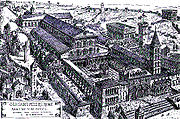 Cornelius Gallus Gaius Cornelius Gallus , Roman poet, orator and politician, was born of humble parents at Forum Livii in Italy.At an early age he moved to Rome, where he was taught by the same master as Virgil and Varius Rufus. Virgil, who dedicated one of his eclogues to him, was in great measure indebted to... on Augustus's orders around 30–28 BC. No hieroglyphs. Brought to Rome by Caligula Caligula Caligula , also known as Gaius, was Roman Emperor from 37 AD to 41 AD. Caligula was a member of the house of rulers conventionally known as the Julio-Claudian dynasty. Caligula's father Germanicus, the nephew and adopted son of Emperor Tiberius, was a very successful general and one of Rome's most... in 37 for the spina of the Vatican Circus. Relocated by Pope Sixtus V Pope Sixtus V Pope Sixtus V , born Felice Peretti di Montalto, was Pope from 1585 to 1590.-Early life:The chronicler Andrija Zmajević states that Felice's family originated from modern-day Montenegro... in 1586 using a method devised by Domenico Fontana Domenico Fontana Domenico Fontana was a Swiss-born Italian architect of the late Renaissance.-Biography:200px|thumb|Fountain of Moses in Rome.... ; the first monumental obelisk raised in the modern period, it is the only obelisk in Rome that has not toppled since Roman times. During the Middle Ages, the gilt ball on top of the obelisk was believed to contain the ashes of Julius Caesar Julius Caesar Gaius Julius Caesar was a Roman general and statesman and a distinguished writer of Latin prose. He played a critical role in the gradual transformation of the Roman Republic into the Roman Empire.... . Fontana later removed the ancient metal ball, now in a Rome museum, that stood atop the obelisk and found only dust. Pedro Tafur Pedro Tafur Pedro Tafur was a Spanish traveler and writer. Born in Córdoba, to a branch of the noble house of Guzmán, Tafur traveled across three continents during the years 1436 to 1439. During the voyage, he participated in various battles, visited shrines, and rendered diplomatic services for Juan II of... in his Andanças (circa 1440) mentions that many passed between the ground and the "tower" basis "thinking it a saintly thing". |
|
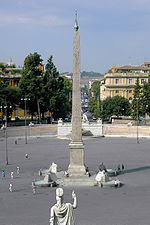 |
24 m (36.50 m) |
Flaminio | Seti I Seti I Menmaatre Seti I was a Pharaoh of Ancient Egypt , the son of Ramesses I and Queen Sitre, and the father of Ramesses II... / Ramses II |
Piazza del Popolo Piazza del Popolo Piazza del Popolo is a large urban square in Rome. The name in modern Italian literally means "People's Square", but historically it derives from the poplars after which the church of Santa Maria del Popolo, in the northeast corner of the piazza, takes its name.The piazza lies inside the northern... > 41°54′38.6"N 12°28′34.8"E |
Originally from Heliopolis Heliopolis (ancient) Heliopolis was one of the oldest cities of ancient Egypt, the capital of the 13th Lower Egyptian nome that was located five miles east of the Nile to the north of the apex of the Nile Delta... . Brought to Rome by Augustus Augustus Augustus ;23 September 63 BC – 19 August AD 14) is considered the first emperor of the Roman Empire, which he ruled alone from 27 BC until his death in 14 AD.The dates of his rule are contemporary dates; Augustus lived under two calendars, the Roman Republican until 45 BC, and the Julian... in 10 BC with the Solare obelisk and erected on the spina of the Circus Maximus Circus Maximus The Circus Maximus is an ancient Roman chariot racing stadium and mass entertainment venue located in Rome, Italy. Situated in the valley between the Aventine and Palatine hills, it was the first and largest stadium in ancient Rome and its later Empire... . Found with the Lateranense obelisk in 1587 in two pieces and erected by Pope Sixtus V Pope Sixtus V Pope Sixtus V , born Felice Peretti di Montalto, was Pope from 1585 to 1590.-Early life:The chronicler Andrija Zmajević states that Felice's family originated from modern-day Montenegro... in 1589. Sculptures with lion fountains were added to the base in 1818. |
| 21.79 m (33.97 m) |
Solare | Psammetichus II Psammetichus II Psamtik II was a king of the Saite based Twenty-sixth dynasty of Egypt... |
> 41°54′2.5"N 12°28′43.2"E |
Originally from Heliopolis Heliopolis (ancient) Heliopolis was one of the oldest cities of ancient Egypt, the capital of the 13th Lower Egyptian nome that was located five miles east of the Nile to the north of the apex of the Nile Delta... . Brought to Rome by Augustus Augustus Augustus ;23 September 63 BC – 19 August AD 14) is considered the first emperor of the Roman Empire, which he ruled alone from 27 BC until his death in 14 AD.The dates of his rule are contemporary dates; Augustus lived under two calendars, the Roman Republican until 45 BC, and the Julian... in 10 BC with the Flaminio obelisk to form the gnomon Gnomon The gnomon is the part of a sundial that casts the shadow. Gnomon is an ancient Greek word meaning "indicator", "one who discerns," or "that which reveals."It has come to be used for a variety of purposes in mathematics and other fields.... of a sundial Sundial A sundial is a device that measures time by the position of the Sun. In common designs such as the horizontal sundial, the sun casts a shadow from its style onto a surface marked with lines indicating the hours of the day. The style is the time-telling edge of the gnomon, often a thin rod or a... on the Campus Martius Campus Martius The Campus Martius , was a publicly owned area of ancient Rome about in extent. In the Middle Ages, it was the most populous area of Rome... . Found in 16th century but reburied. Rediscovered and erected by Pope Pius VI Pope Pius VI Pope Pius VI , born Count Giovanni Angelo Braschi, was Pope from 1775 to 1799.-Early years:Braschi was born in Cesena... in front of the Palazzo Montecitorio Palazzo Montecitorio The Palazzo Montecitorio is a palace in Rome and the seat of the Italian Chamber of Deputies.- History :The building was originally designed by Gian Lorenzo Bernini for the young Cardinal Ludovico Ludovisi, nephew of Pope Gregory XV... in 1792. |
|
 |
6.34 m (14.52 m) |
Macuteo | Ramses II | Piazza della Rotonda Piazza della Rotonda The Piazza della Rotonda is a piazza in Rome, Italy, to the south of which is located the Pantheon. The square gets its name from the Pantheon's informal title as the church of Santa Maria Rotonda.- History :... > 41°53′57.6"N 12°28′36.3"E |
Originally one of a pair at the Temple of Ra Ra Ra is the ancient Egyptian sun god. By the Fifth Dynasty he had become a major deity in ancient Egyptian religion, identified primarily with the mid-day sun... in Heliopolis Heliopolis (ancient) Heliopolis was one of the oldest cities of ancient Egypt, the capital of the 13th Lower Egyptian nome that was located five miles east of the Nile to the north of the apex of the Nile Delta... , the other being the now much shorter Matteiano. Moved to the Temple of Isis Isis Isis or in original more likely Aset is a goddess in Ancient Egyptian religious beliefs, whose worship spread throughout the Greco-Roman world. She was worshipped as the ideal mother and wife as well as the matron of nature and magic... near Santa Maria sopra Minerva Santa Maria sopra Minerva The Basilica of Saint Mary Above Minerva is a titular minor basilica and one of the most important churches of the Roman Catholic Dominican order in Rome, Italy. The church, located in the Piazza della Minerva in the Campus Martius region, is considered the only Gothic church in Rome. It houses... . Found in 1373 near San Macuto Church of San Macuto The church of San Macuto is a church on piazza di San Macuto in the Colonna rione of Rome, next to the Jesuit Collegio San Roberto Bellarmino in the Palazzo Gabrielli-Borromeo. It is the only church in Italy dedicated to the Breton saint Malo.-Architecture:... and erected east of Santa Maria in Aracoeli Santa Maria in Aracoeli The Basilica of St. Mary of the Altar of Heaven is a titular basilica in Rome, located on the highest summit of the Campidoglio. It is still the designated Church of the city council of Rome, which uses the ancient title of Senatus Populusque Romanus... on the Capitoline. Moved to the front of the Pantheon Pantheon, Rome The Pantheon ,Rarely Pantheum. This appears in Pliny's Natural History in describing this edifice: Agrippae Pantheum decoravit Diogenes Atheniensis; in columnis templi eius Caryatides probantur inter pauca operum, sicut in fastigio posita signa, sed propter altitudinem loci minus celebrata.from ,... by Pope Clement XI Pope Clement XI Pope Clement XI , born Giovanni Francesco Albani, was Pope from 1700 until his death in 1721.-Early life:... in 1711 over a fountain by Filippo Barigioni Filippo Barigioni Filippo Barigioni was an Italian sculptor and architect working in the Late Baroque tradition.Bariogioni was born in Rome. His career was spent largely on papal commissions, including aqueducts and fountains, in and around Rome... . |
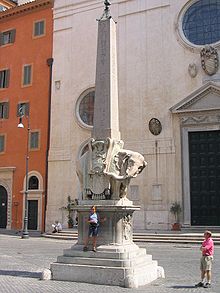 |
5.47 m (12.69 m) |
Minerveo | Apries Apries Apries is the name by which Herodotus and Diodorus designate Wahibre Haaibre, Ουαφρης , a pharaoh of Egypt , the fourth king of the Twenty-sixth dynasty of Egypt. He was equated with the Waphres of Manetho, who correctly records that he reigned for 19 years... |
Santa Maria sopra Minerva Santa Maria sopra Minerva The Basilica of Saint Mary Above Minerva is a titular minor basilica and one of the most important churches of the Roman Catholic Dominican order in Rome, Italy. The church, located in the Piazza della Minerva in the Campus Martius region, is considered the only Gothic church in Rome. It houses... > 41°53′52.7"N 12°28′39.2"E |
Originally one of a pair from Sais SAIS SAIS can refer to:* Paul H. Nitze School of Advanced International Studies, part of The Johns Hopkins University.* Sharjah American International School* Southern Association of Independent Schools... . Brought to Rome by Diocletian Diocletian Diocletian |latinized]] upon his accession to Diocletian . c. 22 December 244 – 3 December 311), was a Roman Emperor from 284 to 305.... for the nearby Temple of Isis Isis Isis or in original more likely Aset is a goddess in Ancient Egyptian religious beliefs, whose worship spread throughout the Greco-Roman world. She was worshipped as the ideal mother and wife as well as the matron of nature and magic... . Found in 1655 and erected in 1667 by Pope Alexander VII Pope Alexander VII Pope Alexander VII , born Fabio Chigi, was Pope from 7 April 1655, until his death.- Early life :Born in Siena, a member of the illustrious banking family of Chigi and a great-nephew of Pope Paul V , he was privately tutored and eventually received doctorates of philosophy, law, and theology from... on an Elephant Elephant Elephants are large land mammals in two extant genera of the family Elephantidae: Elephas and Loxodonta, with the third genus Mammuthus extinct... base by Bernini, behind the Pantheon Pantheon, Rome The Pantheon ,Rarely Pantheum. This appears in Pliny's Natural History in describing this edifice: Agrippae Pantheum decoravit Diogenes Atheniensis; in columnis templi eius Caryatides probantur inter pauca operum, sicut in fastigio posita signa, sed propter altitudinem loci minus celebrata.from ,... in Piazza della Minerva Piazza della Minerva Piazza della Minerva is a piazza in Rome, Italy, near the Pantheon. Its name derives from the existence of a temple built on the site by Pompey dedicated to Minerva Calcidica, whose statue is now in the Vatican Museums.-Features:Facing this piazza are:... . The other of the pair is in Urbino Urbino Urbino is a walled city in the Marche region of Italy, south-west of Pesaro, a World Heritage Site notable for a remarkable historical legacy of independent Renaissance culture, especially under the patronage of Federico da Montefeltro, duke of Urbino from 1444 to 1482... . |
 |
? (6.34 m) |
Dogali | Ramses II | Baths of Diocletian Baths of Diocletian The Baths of Diocletian in Rome were the grandest of the public baths, or thermae built by successive emperors. Diocletian's Baths, dedicated in 306, were the largest and most sumptuous of the imperial baths. The baths were built between the years 298 AD and 306 AD... > 41°54′7.8"N 12°29′50.9"E |
Originally one of a pair from Heliopolis Heliopolis (ancient) Heliopolis was one of the oldest cities of ancient Egypt, the capital of the 13th Lower Egyptian nome that was located five miles east of the Nile to the north of the apex of the Nile Delta... , the other now in the Boboli Gardens Boboli Gardens The Boboli Gardens are a park in Florence, Italy, that is home to a collection of sculptures dating from the 16th through the 18th centuries, with some Roman antiquities.-History and layout:... in Florence Florence Florence is the capital city of the Italian region of Tuscany and of the province of Florence. It is the most populous city in Tuscany, with approximately 370,000 inhabitants, expanding to over 1.5 million in the metropolitan area.... . Moved to the Temple of Isis in Rome. Found in 1883 by Rodolfo Lanciani Rodolfo Lanciani Rodolfo Amedeo Lanciani was an Italian archaeologist, a pioneering student of ancient Roman topography, and among his many excavations was that of the House of the Vestals in the Roman Forum.... near Santa Maria sopra Minerva Santa Maria sopra Minerva The Basilica of Saint Mary Above Minerva is a titular minor basilica and one of the most important churches of the Roman Catholic Dominican order in Rome, Italy. The church, located in the Piazza della Minerva in the Campus Martius region, is considered the only Gothic church in Rome. It houses... . Now commemorates the Battle of Dogali Battle of Dogali The Battle of Dogali was fought on 26 January 1887 between Italy and Ethiopia in Dogali near Massawa, in present-day Eritrea.On his own initiative, Ras Alula Engida, then governor of Emperor Yohannes IV, had attacked the Italian-controlled town of Sahati on the day prior... , originally in front of Near Termini Station and moved to its present site in 1924. |
| 2.68 m (12.23 m) |
Matteiano | Ramses II | > 41°53′0.2"N 12°29′43.2"E |
Originally one of a pair at the Temple of Ra Ra Ra is the ancient Egyptian sun god. By the Fifth Dynasty he had become a major deity in ancient Egyptian religion, identified primarily with the mid-day sun... in Heliopolis Heliopolis (ancient) Heliopolis was one of the oldest cities of ancient Egypt, the capital of the 13th Lower Egyptian nome that was located five miles east of the Nile to the north of the apex of the Nile Delta... , the other being the Macuteo which retains much more of its original height. Moved to the Temple of Isis near Santa Maria sopra Minerva Santa Maria sopra Minerva The Basilica of Saint Mary Above Minerva is a titular minor basilica and one of the most important churches of the Roman Catholic Dominican order in Rome, Italy. The church, located in the Piazza della Minerva in the Campus Martius region, is considered the only Gothic church in Rome. It houses... . Found in the 14th century and erected east of Santa Maria in Aracoeli Santa Maria in Aracoeli The Basilica of St. Mary of the Altar of Heaven is a titular basilica in Rome, located on the highest summit of the Campidoglio. It is still the designated Church of the city council of Rome, which uses the ancient title of Senatus Populusque Romanus... on the Capitoline. Moved to Villa Celimontana after Michelangelo Michelangelo Michelangelo di Lodovico Buonarroti Simoni , commonly known as Michelangelo, was an Italian Renaissance painter, sculptor, architect, poet, and engineer who exerted an unparalleled influence on the development of Western art... redesigned the square in the late 16th century. Lost again; fragments rediscovered and re-erected in 1820. Smallest obelisk in Rome. |
|
Ancient Roman obelisks
At least five obelisks were manufactured in Egypt in the Roman period at the request of the wealthy Romans, or made in Rome as copies of ancient Egyptian originals.| Image | Height (with base) |
Name | Location | Notes |
|---|---|---|---|---|
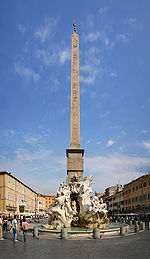 |
16.53 m (30+ m) |
Agonalis | Piazza Navona Piazza Navona Piazza Navona is a city square in Rome, Italy. It is built on the site of the Stadium of Domitian, built in 1st century AD, and follows the form of the open space of the stadium. The ancient Romans came there to watch the agones , and hence it was known as 'Circus Agonalis'... 41°53′56.3"N 12°28′23.1"E |
A copy commissioned by Domitian Domitian Domitian was Roman Emperor from 81 to 96. Domitian was the third and last emperor of the Flavian dynasty.Domitian's youth and early career were largely spent in the shadow of his brother Titus, who gained military renown during the First Jewish-Roman War... and erected at the Temple of Serapis Serapis Serapis or Sarapis is a Graeco-Egyptian name of God. Serapis was devised during the 3rd century BC on the orders of Ptolemy I of Egypt as a means to unify the Greeks and Egyptians in his realm. The god was depicted as Greek in appearance, but with Egyptian trappings, and combined iconography... . Moved to the Circus of Maxentius Circus of Maxentius The Circus of Maxentius is an ancient structure in Rome, Italy; it is part of a complex of buildings erected by emperor Maxentius on the Via Appia between AD 306 and 312... by Maxentius Maxentius Maxentius was a Roman Emperor from 306 to 312. He was the son of former Emperor Maximian, and the son-in-law of Emperor Galerius.-Birth and early life:Maxentius' exact date of birth is unknown; it was probably around 278... . The Earl of Arundel paid a deposit and attempted to ship the four pieces to London in the late 1630s but Urban VIII disallowed its export. Erected on top of the Fontana dei Quattro Fiumi Fontana dei Quattro Fiumi The Fontana dei Quattro Fiumi or "Fountain of the Four Rivers" is a fountain in Rome, Italy, located in the urban square of the Piazza Navona... by Bernini in 1651. |
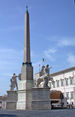 |
14.63 m (28.94 m) |
Quirinale | Piazza del Quirinale 41°53′56.7"N 12°29′11.9"E |
Originally erected on the eastern flank of the Mausoleum of Augustus Mausoleum of Augustus The Mausoleum of Augustus is a large tomb built by the Roman Emperor Augustus in 28 BC on the Campus Martius in Rome, Italy. The Mausoleum, now located on the Piazza Augusto Imperatore, is no longer open to tourists, and the ravages of time and carelessness have stripped the ruins bare... , paired with the Esquiline obelisk. Found in 1527. Erected by Pope Pius VI Pope Pius VI Pope Pius VI , born Count Giovanni Angelo Braschi, was Pope from 1775 to 1799.-Early years:Braschi was born in Cesena... in 1786 on the Quirinal Hill Quirinal Hill The Quirinal Hill is one of the Seven Hills of Rome, at the north-east of the city center. It is the location of the official residence of the Italian Head of State, who resides in the Quirinal Palace; by metonymy "the Quirinal" has come to stand for the Italian President.- History :It was... next to statues of the Dioscuri (called the 'Horse Tamers Horse Tamers The colossal pair of marble "Horse Tamers", often identified as Castor and Pollux, have stood since Antiquity near the site of the Baths of Constantine on the Quirinal Hill, Rome, too large to be buried or to be moved very far, though Napoleon's agents wanted to include them among the classical... ') from the Baths of Constantine Baths of Constantine (Rome) Baths of Constantine was a public bathing complex built on the Quirinal Hill in Rome by Constantine I, probably before 315.-Construction and plan:... . |
 |
14.75 m (25.53 m) |
Esquiline | Piazza dell'Esquilino 41°53′53.4"N 12°29′51"E |
Originally erected on the western flank of the Mausoleum of Augustus Mausoleum of Augustus The Mausoleum of Augustus is a large tomb built by the Roman Emperor Augustus in 28 BC on the Campus Martius in Rome, Italy. The Mausoleum, now located on the Piazza Augusto Imperatore, is no longer open to tourists, and the ravages of time and carelessness have stripped the ruins bare... , paired with the Quirinale obelisk. Found in 1527 and erected in 1587 by Pope Sixtus V Pope Sixtus V Pope Sixtus V , born Felice Peretti di Montalto, was Pope from 1585 to 1590.-Early life:The chronicler Andrija Zmajević states that Felice's family originated from modern-day Montenegro... behind Santa Maria Maggiore. |
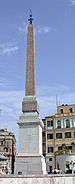 |
13.91 m (30.45 m) |
Sallustiano | Trinità dei Monti Trinità dei Monti The church of the Santissima Trinità dei Monti is a late Renaissance titular church in Rome, central Italy. It is best known for its commanding position above the Spanish Steps which lead down to the Piazza di Spagna... 41°54′22.1"N 12°28′59.6"E |
Above the Spanish Steps Spanish Steps The Spanish Steps are a set of steps in Rome, Italy, climbing a steep slope between the Piazza di Spagna at the base and Piazza Trinità dei Monti, dominated by the Trinità dei Monti church at the top. The Scalinata is the widest staircase in Europe... . An Aurelian Aurelian Aurelian , was Roman Emperor from 270 to 275. During his reign, he defeated the Alamanni after a devastating war. He also defeated the Goths, Vandals, Juthungi, Sarmatians, and Carpi. Aurelian restored the Empire's eastern provinces after his conquest of the Palmyrene Empire in 273. The following... copy, although smaller, of the Flaminio obelisk of Ramses II in the Piazza del Popolo Piazza del Popolo Piazza del Popolo is a large urban square in Rome. The name in modern Italian literally means "People's Square", but historically it derives from the poplars after which the church of Santa Maria del Popolo, in the northeast corner of the piazza, takes its name.The piazza lies inside the northern... , for the Gardens of Sallust Gardens of Sallust The Gardens of Sallust were Roman gardens developed by the Roman historian Sallust in the 1st century BC. The landscaped pleasure gardens occupied a large area in the northwestern sector of Rome, in what would become Region VI, between the Pincian and Quirinal hills, near the Via Salaria and later... . Found by the Ludovisi Ludovisi Ludovisi can refer to:*Ludovisi , a noble Italian family*Ludovisi, Lazio, a rione in the City of Rome* Alberico Boncompagni Ludovisi, prince of Venosa and proprietor of Latium wine estate Fiorano... and moved to the Piazza di San Giovanni in Laterano in 1734, but kept horizontal. Erected in 1789 by Pope Pius VI Pope Pius VI Pope Pius VI , born Count Giovanni Angelo Braschi, was Pope from 1775 to 1799.-Early years:Braschi was born in Cesena... . |
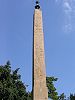 |
9.24 m (17.26 m) |
Pinciano | Pincian Hill Pincian Hill The Pincian Hill is a hill in the northeast quadrant of the historical center of Rome. The hill lies to the north of the Quirinal, overlooking the Campus Martius... 41°54′38.9"N 12°28′47.1"E |
Commissioned by Hadrian Hadrian Hadrian , was Roman Emperor from 117 to 138. He is best known for building Hadrian's Wall, which marked the northern limit of Roman Britain. In Rome, he re-built the Pantheon and constructed the Temple of Venus and Roma. In addition to being emperor, Hadrian was a humanist and was philhellene in... and erected in Tivoli for the tomb of Antinous Antinous Antinoüs or Antinoös was a beautiful Bithynian youth and the favourite of the Roman emperor Hadrian... . Moved to Rome by Elagabalus Elagabalus Elagabalus , also known as Heliogabalus, was Roman Emperor from 218 to 222. A member of the Severan Dynasty, he was Syrian on his mother's side, the son of Julia Soaemias and Sextus Varius Marcellus. Early in his youth he served as a priest of the god El-Gabal at his hometown, Emesa... to decorate the spina of the Circus Varianus. Found in the 16th century near the Porta Maggiore Porta Maggiore The Porta Maggiore , or Porta Prenestina, is one of the eastern gates in the ancient but well-preserved 3rd-century Aurelian Walls of Rome.... . Moved to the Palazzo Barberini Palazzo Barberini Palazzo Barberini is a palace in Rome, facing the piazza of the same name in Rione Trevi and is home to the Galleria Nazionale d'Arte Antica.-History:... , then moved to the Vatican Vatican City Vatican City , or Vatican City State, in Italian officially Stato della Città del Vaticano , which translates literally as State of the City of the Vatican, is a landlocked sovereign city-state whose territory consists of a walled enclave within the city of Rome, Italy. It has an area of... by Pope Clement XIV Pope Clement XIV Pope Clement XIV , born Giovanni Vincenzo Antonio Ganganelli, was Pope from 1769 to 1774. At the time of his election, he was the only Franciscan friar in the College of Cardinals.-Early life:... ; finally erected on the Pincian by Pope Pius VII Pope Pius VII Pope Pius VII , born Barnaba Niccolò Maria Luigi Chiaramonti, was a monk, theologian and bishop, who reigned as Pope from 14 March 1800 to 20 August 1823.-Early life:... in 1822. |
Obelisk of Axum
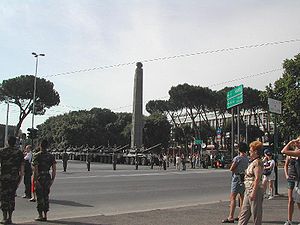
Obelisk of Axum
The Obelisk of Axum is a 1,700-year-old, 24-metres tall granite stele/obelisk, weighing 160 tonnes, in the city of Axum in Ethiopia. It is decorated with two false doors at the base, and decorations resembling windows on all sides...
, 24 m, placed in the Piazza di Porta Capena
Porta Capena
The Porta Capena was a gate in the Servian Wall near the Caelian Hill, in Rome, Italy according to Roman tradition the sacred grove where Numa Pompilius and the nymph Egeria used to meet. It was one of the main entries to the city of Rome, since it opened on the Appian Way...
. It had been taken from Axum
Axum
Axum or Aksum is a city in northern Ethiopia which was the original capital of the eponymous kingdom of Axum. Population 56,500 . Axum was a naval and trading power that ruled the region from ca. 400 BC into the 10th century...
by the Italian Army
Italian Army
The Italian Army is the ground defence force of the Italian Armed Forces. It is all-volunteer force of active-duty personnel, numbering 108,355 in 2010. Its best-known combat vehicles are the Dardo infantry fighting vehicle, the Centauro tank destroyer and the Ariete tank, and among its aircraft...
during the Italian occupation of Ethiopia in 1937. It was struck by lightning
Lightning
Lightning is an atmospheric electrostatic discharge accompanied by thunder, which typically occurs during thunderstorms, and sometimes during volcanic eruptions or dust storms...
in May 2002. After being restored, it was disassembled and returned to Ethiopia
Ethiopia
Ethiopia , officially known as the Federal Democratic Republic of Ethiopia, is a country located in the Horn of Africa. It is the second-most populous nation in Africa, with over 82 million inhabitants, and the tenth-largest by area, occupying 1,100,000 km2...
in April 2005.
Modern obelisks

- Villa MediciVilla MediciThe Villa Medici is a mannerist villa and an architectural complex with a garden contiguous with the larger Borghese gardens, on the Pincian Hill next to Trinità dei Monti in Rome, Italy. The Villa Medici, founded by Ferdinando I de' Medici, Grand Duke of Tuscany and now property of the French...
, 19th century copy of the original, found in the gardens and taken to FlorenceFlorenceFlorence is the capital city of the Italian region of Tuscany and of the province of Florence. It is the most populous city in Tuscany, with approximately 370,000 inhabitants, expanding to over 1.5 million in the metropolitan area....
. - Two obelisks in the Villa TorloniaVilla Torlonia (Rome)Villa Torlonia is a villa and surrounding gardens in Rome, Italy, formerly belonging to the Torlonia family. It is entered from via Nomentana....
, 1842, BavenoBavenoBaveno is a town and comune in the province of Verbano-Cusio-Ossola, part of Piedmont, northern Italy. It is located on the west shore of Lago Maggiore, 13 miles North West of Arona by rail....
graniteGraniteGranite is a common and widely occurring type of intrusive, felsic, igneous rock. Granite usually has a medium- to coarse-grained texture. Occasionally some individual crystals are larger than the groundmass, in which case the texture is known as porphyritic. A granitic rock with a porphyritic... - Foro Italico, 1932, 17.5 m, Carrara marble, originally dedicated to Benito MussoliniBenito MussoliniBenito Amilcare Andrea Mussolini was an Italian politician who led the National Fascist Party and is credited with being one of the key figures in the creation of Fascism....
, and inscribed Mussolini Dux - Marconi, 1959, 45 m, in the centre of the EUR district, dedicated to Guglielmo MarconiGuglielmo MarconiGuglielmo Marconi was an Italian inventor, known as the father of long distance radio transmission and for his development of Marconi's law and a radio telegraph system. Marconi is often credited as the inventor of radio, and indeed he shared the 1909 Nobel Prize in Physics with Karl Ferdinand...
, built for the 1960 Summer Olympics1960 Summer OlympicsThe 1960 Summer Olympics, officially known as the Games of the XVII Olympiad, was an international multi-sport event held from August 25 to September 11, 1960 in Rome, Italy...
. 92 panels in white marble contain illustrations of Marconi's career and allegorical scenes.
Former locations of some obelisks
Lateranense at Karnak, Egypt: 25°43′7.46"N 32°39′26.64"E Lateranense at Circus Maximus in Rome: 41°53′6.31"N 12°29′14.45"EVaticano at Forum Iulium in Alexandria, Egypt: 31°11′52.8"N 29°55′9.12"E Vaticano at Vatican Circus in Rome: 41°54′5.82"N 12°27′14.94"E
Flaminio at Heliopolis, Egypt: 30°07′46.3"N 31°17′20"E Flaminio at Circus Maximus in Rome: 41°53′12.73"N 12°29′3.4"E
Solare at Heliopolis, Egypt: 30°07′46.3"N 31°17′20"E Solare at Campus Martius in Rome: 41.902842°N 12.477733°E
See also
Monoliths- Cleopatra's NeedleCleopatra's NeedleCleopatra's Needle is the popular name for each of three Ancient Egyptian obelisks re-erected in London, Paris, and New York City during the nineteenth century. The London and New York ones are a pair, while the Paris one comes from a different original site where its twin remains...
- List of Roman monoliths
- List of largest monoliths in the world
Roman triumphal monuments
- List of Roman triumphal arches
- List of Roman victory columns
External links
- Chasing Obelisks in Rome
- Obelisks in Rome (Andrea Pollett)
- Obelisks of Rome (series of articles in Platner's Topographical Dictionary of Ancient Rome)
- Obelischi di Roma
- Obelisk of Psametik II and Augustus, erected by Pope Pius VI in Piazza Montecitorio
- Romeartlover.it: Obeliks of Rome