

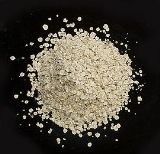
Oatmeal

Encyclopedia
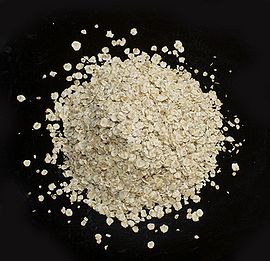
Oat
The common oat is a species of cereal grain grown for its seed, which is known by the same name . While oats are suitable for human consumption as oatmeal and rolled oats, one of the most common uses is as livestock feed...
groats
Groats
Groats are the hulled grains of various cereals, such as oats, wheat, barley or buckwheat . Groats are whole grains that include the cereal germ and fiber-rich bran portion of the grain as well as the endosperm...
(i.e., oat-meal, cf. cornmeal
Cornmeal
Cornmeal is flour ground from dried maize or American corn. It is a common staple food, and is ground to fine, medium, and coarse consistencies. In the United States, the finely ground cornmeal is also referred to as cornflour. However, the word cornflour denotes cornstarch in recipes from the...
, peasemeal
Peasemeal
Peasemeal is a flour produced from yellow field peas that have been roasted. The roasting enables greater access to protein and starch thus increasing nutritive value. Traditionally the peas would be ground three times using water powered stone mills...
, etc.), or a porridge
Porridge
Porridge is a dish made by boiling oats or other cereal meals in water, milk, or both. It is usually served hot in a bowl or dish...
made from oats (also called oatmeal cereal or stirabout, in Ireland). Oatmeal can also be ground oat
Oat
The common oat is a species of cereal grain grown for its seed, which is known by the same name . While oats are suitable for human consumption as oatmeal and rolled oats, one of the most common uses is as livestock feed...
, steel-cut oats
Steel-cut oats
Steel-cut oats are whole grain groats which have been cut into only two or three pieces by steel rather than being rolled.-Overview:...
, crushed oats, or rolled oats
Rolled oats
Rolled oats are traditionally oat groats that have been rolled into flat flakes under heavy rollers and then steamed and lightly toasted. The oat, like the other cereals, has a hard, inedible outer husk that must be removed before the grain can be eaten. After the outer husk has been removed from...
.
Use
The oat grains are de-husked by impact, then warmed and cooled to stabilize the "Oat groats", the seed inside the husk. The process of heating produces a nutty flavour to the oats. These oat groats may be milled to produce fine, medium or coarse oatmeal. Rolled oats are steamed and flattened whole oat groats. Steel cut oats may be small and broken groats from the de-husking process, these may be steamed and flattened to produce smaller rolled oats. Quick-cooking rolled oats (quick oats) are cut into small pieces before being steamed and rolled. Instant oatmeal is pre-cooked and dried, usually with sweetener and flavouring added. Both types of rolled oats may be eaten uncooked as in muesliMuesli
Muesli is a popular breakfast cereal based on uncooked rolled oats, fruit and nuts. It was developed around 1900 by Swiss physician Maximilian Bircher-Benner for patients in his hospital...
or may be cooked to make porridge
Porridge
Porridge is a dish made by boiling oats or other cereal meals in water, milk, or both. It is usually served hot in a bowl or dish...
. It is also used as an ingredient in oatmeal cookies and oat cakes, or as an accent, as in the topping on many oat bran breads and the coating on Caboc
Caboc
Caboc is a Scottish cream cheese, made with double cream or cream-enriched milk. This rennet-free cheese is formed into a log shape and rolled in toasted pinhead oatmeal, to be served with oatcakes or dry toast. The texture is smooth, slightly thicker and grainier than clotted cream, while the...
cheese. Oatmeal is also sometimes porridge with the bran or fibrous husk as well as the oat kernel or groat. In some countries rolled oats are eaten raw with milk and sugar or raisins. Oatmeal is also used as a thickening agent in savoury Arabic/Egyptian thick meat plus vegetable soups.
"Oatmeal baths" are also commonly used to ease discomfort associated with chickenpox
Chickenpox
Chickenpox or chicken pox is a highly contagious illness caused by primary infection with varicella zoster virus . It usually starts with vesicular skin rash mainly on the body and head rather than at the periphery and becomes itchy, raw pockmarks, which mostly heal without scarring...
.
Breakfast cereal health benefits
There has been increasing interest in oatmeal in recent years because of its health benefits. Daily consumption of a bowl of oatmeal can lower blood cholesterolCholesterol
Cholesterol is a complex isoprenoid. Specifically, it is a waxy steroid of fat that is produced in the liver or intestines. It is used to produce hormones and cell membranes and is transported in the blood plasma of all mammals. It is an essential structural component of mammalian cell membranes...
, because of its soluble fibre content. After it was reported that oats can help lower cholesterol, an "oat bran craze" swept the U.S. in the late 1980s, peaking in 1989. The food craze was short-lived and faded by the early 1990s. The popularity of oatmeal and other oat products increased again after the January 1997 decision by the Food and Drug Administration
Food and Drug Administration
The Food and Drug Administration is an agency of the United States Department of Health and Human Services, one of the United States federal executive departments...
that food with a lot of oat bran or rolled oats can carry a label claiming it may reduce the risk of heart disease
Heart disease
Heart disease, cardiac disease or cardiopathy is an umbrella term for a variety of diseases affecting the heart. , it is the leading cause of death in the United States, England, Canada and Wales, accounting for 25.4% of the total deaths in the United States.-Types:-Coronary heart disease:Coronary...
when combined with a low-fat diet. This is because of the beta-glucan
Beta-glucan
β-Glucans are polysaccharides of D-glucose monomers linked by β-glycosidic bonds. β-glucans are a diverse group of molecules that can vary with respect to molecular mass, solubility, viscosity, and three-dimensional configuration...
in the oats. Rolled oats have long been a staple of many athletes' diets, especially weight trainers; given oatmeal's high content of complex carbohydrates and water-soluble fibre
Dietary fiber
Dietary fiber, dietary fibre, or sometimes roughage is the indigestible portion of plant foods having two main components:* soluble fiber that is readily fermented in the colon into gases and physiologically active byproducts, and* insoluble fiber that is metabolically inert, absorbing water as it...
that encourages slow digestion and stabilizes blood-glucose levels. Oatmeal porridge also contains more B vitamins and calories than other kinds of porridges.
Scotland
Oatmeal has a long history in Scottish culinary tradition because oatOat
The common oat is a species of cereal grain grown for its seed, which is known by the same name . While oats are suitable for human consumption as oatmeal and rolled oats, one of the most common uses is as livestock feed...
s are better suited than wheat
Wheat
Wheat is a cereal grain, originally from the Levant region of the Near East, but now cultivated worldwide. In 2007 world production of wheat was 607 million tons, making it the third most-produced cereal after maize and rice...
to Scotland's short, wet growing season. Oats became the staple grain of that country. The Ancient universities of Scotland
Ancient universities of Scotland
The ancient universities of Scotland are medieval and renaissance universities which continue to exist until the present day. The majority of the ancient universities of the British Isles are located within Scotland, and have a number of distinctive features in common, being governed by a series of...
had a holiday called Meal Monday
Meal Monday
Meal Monday was a traditional holiday observed by the ancient universities of Scotland on the second Monday of February....
to permit students to return to their farms and collect more oats for food.
Samuel Johnson
Samuel Johnson
Samuel Johnson , often referred to as Dr. Johnson, was an English author who made lasting contributions to English literature as a poet, essayist, moralist, literary critic, biographer, editor and lexicographer...
referred, disparagingly, to this in his dictionary
A Dictionary of the English Language
Published on 15 April 1755 and written by Samuel Johnson, A Dictionary of the English Language, sometimes published as Johnson's Dictionary, is among the most influential dictionaries in the history of the English language....
definition for oats: "A grain
GRAIN
GRAIN is a small international non-profit organisation that works to support small farmers and social movements in their struggles for community-controlled and biodiversity-based food systems. Our support takes the form of independent research and analysis, networking at local, regional and...
, which in England is generally given to horses, but in Scotland supports the people." His biographer, James Boswell
James Boswell
James Boswell, 9th Laird of Auchinleck was a lawyer, diarist, and author born in Edinburgh, Scotland; he is best known for the biography he wrote of one of his contemporaries, the English literary figure Samuel Johnson....
, noted that Lord Elibank
Patrick Murray, 5th Lord Elibank
Patrick Murray, 5th Lord Elibank . Son of Alexander Murray, 4th Lord Elibank and Elizabeth Stirling. An author and economist much respected in his own time. Member of the Cocoa Tree Club and The Poker Club. Uncle of Major Patrick Ferguson killed at the Battle of King's Mountain in 1780.In 1722...
was said by Sir Walter Scott
Walter Scott
Sir Walter Scott, 1st Baronet was a Scottish historical novelist, playwright, and poet, popular throughout much of the world during his time....
to have retorted, "Yes, and where else will you see such horses and such men?"
A common method of cooking oatmeal in Scotland
Scotland
Scotland is a country that is part of the United Kingdom. Occupying the northern third of the island of Great Britain, it shares a border with England to the south and is bounded by the North Sea to the east, the Atlantic Ocean to the north and west, and the North Channel and Irish Sea to the...
is to soak it overnight in salted water and cook on a low heat in the morning for a few minutes until the mixture thickens.
In Scotland, oatmeal is created by grinding oats into a coarse powder. Various grades are available depending on the thoroughness of the grinding, including Coarse, Pin(head) and Fine oatmeal. The main uses are:
- Traditional porridgePorridgePorridge is a dish made by boiling oats or other cereal meals in water, milk, or both. It is usually served hot in a bowl or dish...
- BroseBroseBrose is a Scots word for an uncooked form of porridge: oatmeal is mixed with boiling water and allowed to stand for a short time. It is eaten with salt and butter, milk or buttermilk...
: a thick mixture made with uncooked oatmeal (or medium oatmeal that has been dry toasted by stirring it around in a dry pot over heat until it turns a slightly darker shade and emits a sweet, nutty fragrance) and then adding butter or cream. Brose is eaten like porridgePorridgePorridge is a dish made by boiling oats or other cereal meals in water, milk, or both. It is usually served hot in a bowl or dish...
but much more filling. - Rolled oatsRolled oatsRolled oats are traditionally oat groats that have been rolled into flat flakes under heavy rollers and then steamed and lightly toasted. The oat, like the other cereals, has a hard, inedible outer husk that must be removed before the grain can be eaten. After the outer husk has been removed from...
, crushed oats, and other "instant" variations are often used for this purpose nowadays, because they are quicker to prepare. - GruelGruelGruel is a food preparation consisting of some type of cereal—oat, wheat or rye flour, or rice—boiled in water or milk. It is a thinner version of porridge that may be more often drunk than eaten and need not even be cooked...
, made by mixing oatmeal with cold water that is strained and heated for the benefit of infants and people recovering from illness. - as an ingredient in baking
- in the manufacture of bannockBannock (food)Bannock is a variety of flat quick bread. The word can also be applied to any large, round article baked or cooked from grain. When a round bannock is cut into wedges, the wedges are often called scones. But in Scotland, the words bannock and scone are often used interchangeably.-Scottish:"Bannock"...
s or oatcakeOatcakeAn oatcake is a type of cracker or pancake, made from oatmeal, and sometimes flour as well. Oatcakes are cooked on a griddle or baked in an oven.- Scottish oatcakes :...
s - as a stuffing for poultryPoultryPoultry are domesticated birds kept by humans for the purpose of producing eggs, meat, and/or feathers. These most typically are members of the superorder Galloanserae , especially the order Galliformes and the family Anatidae , commonly known as "waterfowl"...
- as a coating for CabocCabocCaboc is a Scottish cream cheese, made with double cream or cream-enriched milk. This rennet-free cheese is formed into a log shape and rolled in toasted pinhead oatmeal, to be served with oatcakes or dry toast. The texture is smooth, slightly thicker and grainier than clotted cream, while the...
cheese - as the main ingredient of the ScottishScotlandScotland is a country that is part of the United Kingdom. Occupying the northern third of the island of Great Britain, it shares a border with England to the south and is bounded by the North Sea to the east, the Atlantic Ocean to the north and west, and the North Channel and Irish Sea to the...
dish skirlieSkirlieSkirlie is a Scottish dish, made from oatmeal fried with onions and seasonings. Most commonly served as a side-dish, it also used as the basis of White Puddings, or used as a stuffing for chicken or other fowl....
, or its chip-shop counterpart, the deep-fried thickly-battered mealy puddingWhite puddingWhite pudding or oatmeal pudding is a meat dish popular in Scotland, Ireland, Northumberland, Nova Scotia, and Newfoundland. White pudding is very similar to black pudding, but does not include blood. Consequently, it consists of pork meat and fat, suet, bread, and oatmeal formed into the shape of... - mixed with sheep's blood, salt, and pepper to make Highland black pudding (marag dubh).
- mixed with fat, water, onions and seasoning, and boiled in a sheep's intestine to make "marag geal"' Outer Hebridean white puddingWhite puddingWhite pudding or oatmeal pudding is a meat dish popular in Scotland, Ireland, Northumberland, Nova Scotia, and Newfoundland. White pudding is very similar to black pudding, but does not include blood. Consequently, it consists of pork meat and fat, suet, bread, and oatmeal formed into the shape of...
, served sliced with fried eggs at breakfast. A sweeter version with dried fruit is also known. - as a major component of haggisHaggisHaggis is a dish containing sheep's 'pluck' , minced with onion, oatmeal, suet, spices, and salt, mixed with stock, and traditionally simmered in the animal's stomach for approximately three hours. Most modern commercial haggis is prepared in a casing rather than an actual stomach.Haggis is a kind...
. - in sowansSowansSowans or sowens is a Scottish dish made using the starch remaining on the inner husks of oats after milling. The husks are allowed to soak in water and ferment for a few days. The liquor is strained off and allowed to stand for a day to allow the starchy matter therein to settle. The liquid part,...
, not strictly made from the meal itself but a porridge-like dish made from the fermented inner husks of oats
Germany/Switzerland
The Germans and Swiss prepare a cold oatmeal called Bircher MuesliMuesli
Muesli is a popular breakfast cereal based on uncooked rolled oats, fruit and nuts. It was developed around 1900 by Swiss physician Maximilian Bircher-Benner for patients in his hospital...
as a breakfast cereal based on uncooked oats, fruit and nuts. The oats are combined with milk, honey and spices (e.g. cinnamon), mixed and soaked in the refrigerator overnight to soften (unnecessary with already softened rolled oats). In the morning before eating, nuts and fruit are added. The dish is not cooked.
Vermont
In the U.S. state of VermontVermont
Vermont is a state in the New England region of the northeastern United States of America. The state ranks 43rd in land area, , and 45th in total area. Its population according to the 2010 census, 630,337, is the second smallest in the country, larger only than Wyoming. It is the only New England...
, oatmeal making has a long tradition originating with the Scottish settlement of the state. While there are variations, most begin with heavy steel cut oats. The oats are soaked overnight in cold water, salt, and maple syrup
Maple syrup
Maple syrup is a syrup usually made from the xylem sap of sugar maple, red maple, or black maple trees, although it can also be made from other maple species such as the bigleaf maple. In cold climates, these trees store starch in their trunks and roots before the winter; the starch is then...
. Early the next morning, before beginning farm chores the cook will add ground nutmeg
Nutmeg
The nutmeg tree is any of several species of trees in genus Myristica. The most important commercial species is Myristica fragrans, an evergreen tree indigenous to the Banda Islands in the Moluccas of Indonesia...
, ground cinnamon
Cinnamon
Cinnamon is a spice obtained from the inner bark of several trees from the genus Cinnamomum that is used in both sweet and savoury foods...
, and sometimes ground ginger
Ginger
Ginger is the rhizome of the plant Zingiber officinale, consumed as a delicacy, medicine, or spice. It lends its name to its genus and family . Other notable members of this plant family are turmeric, cardamom, and galangal....
. The pot is placed over heat and cooks for upwards of 90 minutes, being served after the chores with cream, milk, or butter. As most contemporary Vermonters no longer have farm chores, the recipe is simplified to a briefer 10 to 30 minute cooking at a higher heat. Vermont leads the U.S. in per capita consumption of cooked oatmeal cereal.
Sweden
The havregrynsgröt – porridge made from rolled oats, water and often added raisins – is a traditional breakfast staple in Sweden. Traditionally, porridge made from ryeRye
Rye is a grass grown extensively as a grain and as a forage crop. It is a member of the wheat tribe and is closely related to barley and wheat. Rye grain is used for flour, rye bread, rye beer, some whiskeys, some vodkas, and animal fodder...
(vassgröt) or barley
Barley
Barley is a major cereal grain, a member of the grass family. It serves as a major animal fodder, as a base malt for beer and certain distilled beverages, and as a component of various health foods...
(bjuggröt) was more common, at least during the Middle Ages.