
Home      Discussion      Topics      Dictionary      Almanac
Signup       Login
Nursing in the United Kingdom

Nursing in the United Kingdom

Overview
Nursing in the United Kingdom
United Kingdom
The United Kingdom of Great Britain and Northern Ireland is a sovereign state located off the northwestern coast of continental Europe. It is an island country, spanning an archipelago including Great Britain, the northeastern part of Ireland, and many small islands...

 has a long history, but in its current form probably dates back to the era of Florence Nightingale
Florence Nightingale
Florence Nightingale, OM, RRC was an English nurse, writer and statistician. She came to prominence during the Crimean War for her pioneering work in nursing, and was dubbed "The Lady with the Lamp" after her habit of making rounds at night to tend injured soldiers...

, who initiated schools of nursing in the latter part of the 19th and early 20th centuries. During the latter part of the 20th century, increases in autonomy and professional status changed the nursing role from "handmaiden" to the doctor to independent practitioners.

The profession has gone through many changes in role and regulation.
Discussion
Ask a question about 'Nursing in the United Kingdom'
Start a new discussion about 'Nursing in the United Kingdom'
Answer questions from other users
Full Discussion Forum
 
Encyclopedia
Nursing in the United Kingdom
United Kingdom
The United Kingdom of Great Britain and Northern Ireland is a sovereign state located off the northwestern coast of continental Europe. It is an island country, spanning an archipelago including Great Britain, the northeastern part of Ireland, and many small islands...

 has a long history, but in its current form probably dates back to the era of Florence Nightingale
Florence Nightingale
Florence Nightingale, OM, RRC was an English nurse, writer and statistician. She came to prominence during the Crimean War for her pioneering work in nursing, and was dubbed "The Lady with the Lamp" after her habit of making rounds at night to tend injured soldiers...

, who initiated schools of nursing in the latter part of the 19th and early 20th centuries. During the latter part of the 20th century, increases in autonomy and professional status changed the nursing role from "handmaiden" to the doctor to independent practitioners.

The profession has gone through many changes in role and regulation. Nurses now work in a variety of settings in hospitals, health centres
Clinic
A clinic is a small private or public health facility that is devoted to the care of outpatients, often in a community, in contrast to larger hospitals, which also treat inpatients. Some grow to be institutions as large as major hospitals, whilst retaining the name clinic...

, nursing homes and in the patients' own homes. Nearly 400,000 nurses in the United Kingdom work for the National Health Service
National Health Service
The National Health Service is the name commonly used to refer to the publicly-funded health care services in Great Britain. In England the name National Health Service is used without further qualification whereas the services in Scotland and Wales are known as NHS Scotland and NHS Wales...

 (NHS), which is the vast majority of nurses registered with the Nursing and Midwifery Council
Nursing and Midwifery Council
Established in 2002, the Nursing & Midwifery Council is a statutory body set up by the Parliament of the United Kingdom through the . The NMC is the UK regulator for nursing and midwifery professions with a stated aim to safeguard the health and wellbeing of the public...

 (NMC).

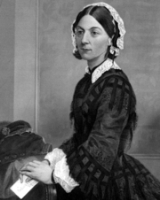
Florence Nightingale


Florence Nightingale is regarded as the founder of modern nursing
Nursing
Nursing is a healthcare profession focused on the care of individuals, families, and communities so they may attain, maintain, or recover optimal health and quality of life from birth to the end of life....

. There was no real hospital training school for nurses until one was established in Kaiserwerth
Düsseldorf-Kaiserswerth
Kaiserswerth is one of the oldest parts of the City of Düsseldorf. It is in the north of the city and next to the river Rhine. Kaiserswerth has 7,712 inhabitants and an area of 4.71 km².-History:...

, Germany
Germany
Germany , officially the Federal Republic of Germany , is a country in Central Europe. It is bordered to the north by the North Sea, Denmark, and the Baltic Sea; to the east by Poland and the Czech Republic; to the south by Austria and Switzerland; and to the west by France, Luxembourg, Belgium,...

, in 1846. There, Nightingale received the training that later enabled her to establish, at St Thomas' Hospital
St Thomas' Hospital
St Thomas' Hospital is a large NHS hospital in London, England. It is administratively a part of Guy’s & St Thomas' NHS Foundation Trust. It has provided health care freely or under charitable auspices since the 12th century and was originally located in Southwark.St Thomas' Hospital is accessible...

 in London
London
[]London is the capital of England and the United Kingdom. It has been a major settlement for two millennia, and the history of London goes back to its founding by the Romans, when it was named Londinium. London's core, the ancient City of London, the 'square mile', retains its medieval boundaries...

, the first school designed primarily to train nurses rather than to provide nursing service for the hospital.

In March 1854 Britain, France
France
France , officially the French Republic , is a country located in Western Europe, with several overseas islands and territories located on other continents. Metropolitan France extends from the Mediterranean Sea to the English Channel and the North Sea, and from the Rhine to the Atlantic Ocean...

 and Turkey
Turkey
Turkey , known officially as the Republic of Turkey , is a Eurasian country that stretches across the Anatolian peninsula in Western Asia and Thrace in the Balkan region of southeastern Europe...

 declared war on Russia
Russia
Russia , officially known as both Russia and the Russian Federation , is a country in northern Eurasia . It is a semi-presidential republic, comprising 83 federal subjects...

. Nightingale was appointed to oversee the introduction of female nurses into the military hospitals in Turkey due to criticisms in the British press. On 4 November 1854, Nightingale arrived at the Barrack Hospital in Scutari
Üsküdar
Üsküdar is a large and densely populated municipality of Istanbul on the Anatolian shore of the Bosphorus. It is bordered on the north by Beykoz, on the east by Ümraniye, on the southeast by Ataşehir, on the south by Kadıköy, and on the west by the Bosphorus, with the areas of Beşiktaş, Beyoğlu,...

, a suburb on the Asia
Asia
Asia is the world's largest and most populous continent, located in the eastern and northern hemispheres. It covers 8.6% of the earth's total surface area and with approximately 4 billion people, it hosts 60% of the world's current human population.Asia is traditionally defined as part of the...

n side of Constantinople
Constantinople
Constantinople was the imperial capital of the Roman Empire , the Byzantine/Eastern Roman Empire , the Latin Empire , and the Ottoman Empire...

, with a party of thirty-eight nurses. Initially the doctors
Doctor (title)
Doctor, as a title, originates from the Latin word which means teacher. The word is originally an agentive noun of the verb docēre . It has been used as an honored academic title for over a millennium in Europe, where it dates back to the rise of the university...

 did not want the nurses there and did not ask for their help, but within ten days fresh casualties
Casualty (person)
A casualty is a person who is the victim of an accident, injury, or trauma. The word casualties is most often used by the news media to describe deaths and injuries resulting from wars or disasters...

 arrived from the Battle of Inkermann and the nurses were fully stretched.

When Nightingale returned from the Crimean War
Crimean War
The Crimean War was fought between the Russian Empire on one side and an alliance of the British Empire, France, the Ottoman Empire and the Kingdom of Sardinia on the other. The war was part of a long-running contest between the major European powers for influence over territories of the declining...

 in August 1856, four months after the peace treaty
Peace treaty
A peace treaty is an agreement between two hostile parties, usually countries or governments, that formally ends an armed conflict. It is different from an armistice, which is an agreement to cease hostilities, or a surrender, in which an army agrees to give up arms.-Elements of treaties:There are...

 was signed, she hid herself away from the public's attention. For her contribution to Army statistics
Statistics
Statistics is a branch of mathematics concerned with collecting and interpreting data. According to other definitions, it is a mathematical science pertaining to the collection, analysis, interpretation or explanation, and presentation of data. Statisticians improve the quality of data with the...

 and comparative hospital statistics in 1860, Nightingale became the first woman to be elected a fellow of the Statistical Society
Royal Statistical Society
The Royal Statistical Society is a learned society for statistics and a professional body for statisticians in the UK. It was founded in 1834 as the Statistical Society of London . At that time there were many provincial statistics societies throughout Britain, but most have not survived...

. In 1865 she settled at 10 South Street, Mayfair
Mayfair
Mayfair is an area of central London, England, within the City of Westminster.-History:Mayfair is named after the annual fortnight-long May Fair that took place on the site that is Shepherd Market today...

, in the West End of London
West End of London
The West End of London is an area of Central London, England, containing many of the city's major tourist attractions, businesses, headquarters and the commercial West End theatres. Use of the term began in the early 19th century to describe fashionable areas to the west of Charing Cross...

 and apart from occasional visits to Embley Park
Embley Park
Embley Park is a school and former country house close to the New Forest and the town of Romsey in Hampshire, which was one of the childhood homes of Florence Nightingale. In 1946 it was made into a boarding school and taught boys from the ages of 11-18...

, Lea Hurst
Dethick, Lea and Holloway
Dethick, Lea and Holloway is a civil parish , in the Amber Valley borough of the English county of Derbyshire....

 and to her sister at Claydon House
Claydon House
thumb|Claydon HouseClaydon House is a country house in the Aylesbury Vale, Buckinghamshire, England, close to the village of Middle Claydon. It is owned by the National Trust....

 she lived there until her death.

History


The history of nursing dates back to ancient times, where medical
Medicine
Medicine is the art and science of healing. It encompasses a range of health care practices evolved to maintain and restore health by the prevention and treatment of illness....

 lore
Lore
Lore may refer to:* Lore, all the facts and traditions about a particular subject that have been accumulated over time through education or experience.** Folklore, acquired knowledge or traditional beliefs...

 was associated with good or evil spirit
Spirit
The English word "spirit" has many differing meanings and connotations, but commonly refers to a supernatural being or essence — transcendent and therefore metaphysical in its nature: the Concise Oxford Dictionary defines it as "the non-physical part of a person"...

s, the sick were usually cared for in temples and houses of worship. In the early Christian
Christian
A Christian is a person who adheres to Christianity, an Abrahamic, monotheistic, religion based on the life and teachings of Jesus of Nazareth, who Christians believe was the Messiah prophesied in the Old Testament/Hebrew Bible, and the Son of God.The term "Christian" is also used adjectivally to...

 era nursing duties were undertaken by certain women in the church
Christian Church
Christian Church and church Christian Church and church Christian Church and church (Greek kyriakon, "thing belonging to the Lord"; also ekklesia (Latinized as ecclesia, "assembly") are used to denote both a Christian association of people and a place of worship. In the phenomenological sense there...

, their services being extended to patients in their homes. These women had no real training by today's standards, but experience taught them valuable skills, especially in the use of herbs and drugs, and some gained fame as the physicians of their era. Remnants of the religious nature of nurses remains in Britain today, especially with the retention of the term "Sister" for a senior female
Female
Female is the sex of an organism, or a part of an organism, which produces mobile ova .- Defining Characteristics :The ova are defined as the larger gametes in a heterogamous reproduction system, while the smaller, usually motile gamete, the spermatozoon, is produced by the male...

 nurse.

1858-1902


When state registration of the medical profession had begun in 1858, many observers pointed to the need for a similar system for nursing. That year, the Nursing Record (re-named the British Journal of Nursing in 1902), a nursing journal called for;

"... the whole question of the Registration of trained nurses to be set forth in a succinct form before the profession and the public".

Support for the regulation of nursing began to become more widespread following the establishment of organised nurse training in 1860.

By the 1880s, the Hospitals Association (an early version of the NHS Confederation
NHS Confederation
The NHS Confederation is the independent membership body for the full range of organisations that make up today's National Health Service.It represents 99 per cent of NHS organisations and a growing number of independent healthcare providers....

) was committed to the principle of registration for nurses. The Matrons' Committee, comprising the matron
Matron
Matron is the job title of a very senior nurse in several countries, including the United Kingdom and the Republic of Ireland, although the title Clinical Nurse Manager is now often used instead.-History:The matron was the most senior nurse in a hospital...

s of the leading hospitals, agreed but differed in their views of the required length of training, arguing for three years as opposed to the one supported by the Hospitals Association. In 1887, the Hospitals Association over-ruled the matrons and established a non-statutory voluntary register. At this the Matrons' Committee split, between one group which supported the Hospitals Association and another faction, led by Ethel Bedford-Fenwick
Ethel Bedford-Fenwick
Ethel Bedford-Fenwick was a British nurse who campaigned to procure a nationally recognised certificate for nursing, to safeguard the title "Nurse", and lobbied Parliament to introduce a law to control nursing and limit it to "registered" nurses only.She was born in the Morayshire town of Elgin in...

, which opposed the new register and sought to align themselves more closely with the medical profession. Florence Nightingale, incidentally, supported neither group and was opposed to any form of regulation for nursing, believing that the essential qualities of the nurse could neither be taught, examined nor regulated.

In 1887, the group of nurses associated with Ethel Bedford-Fenwick formed the British Nurses' Association (BNA), which sought

"... to unite all British nurses in membership of a recognised profession and to provide for their registration on terms, satisfactory to physicians and surgeons, as evidence of their having received systematic training".

Therefore two separate voluntary registers now existed. Whereas that maintained by the Hospitals Association was purely an administrative list, the register established by the BNA had a more explicit public protection remit.

1905-1920

  • National Council of Nurses formed.
  • The First World War
    World War I
    World War I , also known as the First World War, the Great War, and the War to End All Wars, was a global military conflict which involved most of the world's great powers, assembled in two opposing alliances: the Triple Entente and the Triple Alliance...

     results in large numbers of unmarried women, many of whom devote their lives to nursing.
  • College of Nursing founded in 1915.
  • 1919 sees the Nurses Registration Act and the establishment of the Ministry of Health
    Department of Health (United Kingdom)
    The Department of Health is a department of the United Kingdom government but with responsibility for government policy for England alone on health, social care and the National Health Service...

    .

The pressure for state registration grew throughout the 1890s but was undermined by disagreements within the profession over the desired form and purpose of the regulatory system. In 1902, the Midwives Registration Act
Act of Parliament
An act of Parliament is a statute enacted as primary legislation by a national or sub-national parliament....

 established the state regulation of midwives and, two years later, a House of Commons
British House of Commons
The House of Commons is the lower house of the Parliament of the United Kingdom, which also comprises the Sovereign and the House of Lords . Both Commons and Lords meet in the Palace of Westminster. The Commons is a democratically elected body, consisting of 646 members, who are known as "Members...

 Select Committee was established to consider the registration of nurses.

The committee reported in 1904 and set out a detailed and persuasive case for registration. However, the government sat on the report and took no action. Over the next decade, a number of private member's bills
Private Member's Bill
A private member's bill or a legislative motion is a proposed law introduced by a backbencher, a so-called private member of parliament...

 to establish regulation were introduced but all failed to achieve significant support in Parliament
Parliament of the United Kingdom
The Parliament of the United Kingdom of Great Britain and Northern Ireland is the supreme legislative body in the United Kingdom and British overseas territories. It alone has parliamentary sovereignty, conferring upon it ultimate power over all other political bodies in the UK and its territories...

.

The First World War provided the final impetus to the establishment of nursing regulation, partly because of the specific contribution made by nurses to the war effort and also as a reflection of the increased contribution of women more generally in society. The College of Nursing (later the Royal College of Nursing
Royal College of Nursing
The Royal College of Nursing is a membership organisation with over 395,000 members in the United Kingdom. It was founded in 1916, receiving its Royal Charter in 1928, Queen Elizabeth II is the patron...

) was established in 1916 and three years later persuaded a backbench Member of Parliament
Member of Parliament
A Member of Parliament is a representative of the voters to a parliament. In many countries the term applies specifically to members of the lower house, as upper houses often have a unique title, such as senate, and thus also have unique titles for its members, such as senators. Members of...

 (MP), Major Barnett, to introduce a private members bill to establish a regulatory system. The bill was finally passed in December 1919 and separate Nurses Registration Acts were passed for England/Wales, Scotland and Ireland, which was still part of the United Kingdom at the time. These acts established the General Nursing Council for England and Wales and the other bodies which survived intact until the legislative changes in 1979 which were to create the UKCC
Nursing and Midwifery Council
Established in 2002, the Nursing & Midwifery Council is a statutory body set up by the Parliament of the United Kingdom through the . The NMC is the UK regulator for nursing and midwifery professions with a stated aim to safeguard the health and wellbeing of the public...

 and the National Boards of Nursing. Ethel Bedford-Fenwick was the first nurse on the English register.

1920s

  • Role of sister tutor created.
  • Examinations introduced to join the nurse register; first diploma of nursing
    Diploma in Nursing
    A Diploma in Nursing or Nursing Diploma is an entry-level tertiary education nursing degree.In the United States, this type of degree is usually awarded by hospital-based nursing schools. Students awarded a Diploma in Nursing are qualified to sit for the NCLEX-RN and apply for licensure as a...

     examination.
  • Alexander Fleming
    Alexander Fleming
    Sir Alexander Fleming was a Scottish biologist and pharmacologist. Fleming published many articles on bacteriology, immunology and chemotherapy...

     observes the antibacterial effects of penicillin
    Penicillin
    Penicillin is a group of antibiotics derived from Penicillium fungi. Penicillin antibiotics are historically significant because they are the first drugs that were effective against many previously serious diseases such as syphilis and Staphylococcus infections...

     in 1928.

1930s

  • Foundation of the National Society of Male Nurses.
  • The Royal College of Nursing gains its royal charter
    Royal Charter
    In medieval Europe, royal charters were used to create cities . The date that such a charter was granted is considered to be when a city was "founded", regardless of when the locality originally began to be settled.At one time a royal charter was the only way in which an incorporated body could be...

    .

1940s

  • Role of state enrolled nurse
    Licensed Practical Nurse
    Licensed practical nurses are also known as licensed vocational nurses in California and Texas and as registered practical nurses in Ontario, Canada. They are called enrolled nurses in Australia and New Zealand and as state enrolled nurses in the United Kingdom.-United States:LPNs work in a...

     formally recognised, with two years' training instead of three.
  • Horder Committee recommends fewer nursing school
    Nursing school
    A Nursing school is a type of educational institution, or part thereof, providing education and training to become a fully-qualified nurse. The nature of nursing education and nursing qualifications varies considerably across the world.-United Kingdom:...

    s and the introduction of inspection.
  • Penicillin
    Penicillin
    Penicillin is a group of antibiotics derived from Penicillium fungi. Penicillin antibiotics are historically significant because they are the first drugs that were effective against many previously serious diseases such as syphilis and Staphylococcus infections...

     becomes available for civilian use.
  • Numbers of male nurses increase as demobilised service men with medical experience join the profession.
  • The National Health Service
    National Health Service
    The National Health Service is the name commonly used to refer to the publicly-funded health care services in Great Britain. In England the name National Health Service is used without further qualification whereas the services in Scotland and Wales are known as NHS Scotland and NHS Wales...

     (NHS) is launched, offering comprehensive health care for all, free at the point of delivery, but paid for through taxation.

1950s

  • Large influx of Caribbean
    Caribbean
    The Caribbean is a region consisting of the Caribbean Sea, its islands , and the surrounding coasts...

     entrants into British nurse training.
  • Introduction of tranquillisers
    Sedative
    A sedative is a substance that induces sedation by reducing irritability or excitement.At higher doses it may result in slurred speech, staggering gait, poor judgment, and slow, uncertain reflexes...

     transforms mental health nursing.
  • Male nurses join the main nursing register in 1951.
  • University of Edinburgh
    University of Edinburgh
    The University of Edinburgh founded in 1582, is an internationally renowned centre for teaching and research in Edinburgh, Scotland, UK. It is the sixth university to be established in the British Isles, making it one of the ancient universities of the United Kingdom.The university is amongst the...

     runs the first course for clinical nurse teachers.
  • The Mental Health Act 1958
    Mental Health Act 1983
    The Mental Health Act 1983 is an Act of the Parliament of the United Kingdom but applies only to people in England and Wales. It covers the reception, care and treatment of mentally disordered persons, the management of their property and other related matters...

     abolishes the legal separation of psychiatric hospitals, allowing those patients to be admitted to any hospital.

1960s

  • Availability of sterile
    Sterilization (microbiology)
    Sterilization refers to any process that effectively kills or eliminates transmissible agents from a surface, equipment, article of food or medication, or biological culture medium. Sterilization does not, however, remove prions...

     supplies brings an end to washing and sterilization
    Sterilization (microbiology)
    Sterilization refers to any process that effectively kills or eliminates transmissible agents from a surface, equipment, article of food or medication, or biological culture medium. Sterilization does not, however, remove prions...

     of equipment such as dressings
    Dressing (medical)
    A dressing is an adjunct used by a person for application to a wound to promote healing and/or prevent further harm. A dressing is designed to be in direct contact with the wound, which makes it different from a bandage, which is primarily used to hold a dressing in place...

     and syringes
  • Edinburgh
    Edinburgh
    Edinburgh is the capital city of Scotland. It is the second largest Scottish city, after Glasgow, and the seventh-most populous in the United Kingdom. The City of Edinburgh Council is one of Scotland's 32 local government council areas....

     initiates the first degree in nursing
    Nurse education
    Nurse education consists in the theorical and practical training provided to nurses with the purpose to prepare them for their duties as nursing care professionals. This education is provided to nursing students by experienced nurses and other medical professionals who have qualified or...

    .
  • The Nursing Homes Act 1963
    Nursing home
    A nursing home, convalescent home, Skilled Nursing Unit , care home or rest home provides a type of care of residents: it is a place of residence for people who require constant nursing care and have significant deficiencies with activities of daily living. Residents include the elderly and younger...

     brings registration and greater control by local authorities
    Local government
    Local governments are administrative office that are smaller than a state. The term is used to contrast with offices at nation-state level, which are referred to as the central government, national government, or federal government....

    .
  • The Salmon report calls for reform to nurse grading, initiating the end of matrons.
  • Nurse Dame Cicely Saunders
    Cicely Saunders
    Dame Cicely Mary Saunders, OM, DBE was a prominent Anglican nurse, physician and writer, involved with many international universities...

     sets up the first hospice in 1967.
  • Termination of pregnancy
    Abortion
    An abortion is the termination of a pregnancy by the removal or expulsion from the uterus of a fetus or embryo. An abortion can occur spontaneously due to complications during pregnancy or can be induced, in humans and other species...

     becomes legal under the Abortion Act 1967
    Abortion Act 1967
    The Abortion Act 1967 is an Act of the Parliament of the United Kingdom legalizing abortion by registered practitioners, and regulating the free provision of such medical practices through the National Health Service ....

    .

1970s

  • Nurses march to Downing Street
    Downing Street
    Downing Street is the street in London, England, which for over two hundred years has contained the official residences of two of the most senior British cabinet ministers: the First Lord of the Treasury, an office held by the Prime Minister of the United Kingdom, and the Second Lord of the...

     demanding better pay, and win increases of up to 58 per cent.
  • Manchester University appoints the first professor
    Professor
    The meaning of the word professor varies. In some English-speaking countries, it refers to a senior academic who holds a departmental chair, especially as head of the department, or a personal chair awarded specifically to that individual...

     of nursing.
  • The Royal College of Nursing (RCN) becomes a trade union
    Trade union
    A trade union is an organization of workers who have banded together to achieve common goals in key areas, such as working conditions. The trade union, through its leadership, bargains with the employer on behalf of union members and negotiates labor contracts with employers...

    .
  • The Nursing Process
    Nursing process
    The nursing process is a process by which nurses deliver care to patients, supported by nursing models or philosophies. The nursing process was originally an adapted form of problem-solving and is classified as a deductive theory....

     establishes an ethos based on assessment, planning, implementation and evaluation.
  • Reform of shift patterns begins

The Briggs Committee was established in 1970 due to pressure from the RCN to consider issues around the quality and nature of nurse training and the place of nursing within the NHS, rather than regulation per se. It reported in 1972 and recommended a number of changes to professional education. Almost as an afterthought, Briggs also recommended the replacement of the existing regulatory structure (involving nine separate bodies across the United Kingdom) with a unified central council and separate boards in each of the four countries with specific responsibility for education. Six years of debate and delay followed before the modified Briggs proposals formed the basis of the Nurses, Midwives and Health Visitors Act 1979. This was due to the need to take account of devolution
Devolution
Devolution is the statutory granting of powers from the central government of a Sovereign state to government at a subnational level, such as a regional, local, or state level...

, Treasury misgivings, lack of consensus within the professions (especially from midwives), and a lack of government will to find the parliamentary time to enact the legislation.

1980s

  • Mass meetings are held over pay, the state of the NHS, clinical grading and the abolition of the enrolled nurse.
  • United Kingdom Central Council for Nursing, Midwifery and Health Visiting (UKCC) becomes the profession's new regulatory body in 1983.

In 1983, the UKCC was set up. Its core functions were to maintain a register of UK nurses, midwives and health visitor
Health visitor
Health visitors are UK registered nurses who have undertaken further training to work as part of a primary health care team. As their name suggests, their role is to promote mental, physical and social well-being in the community by giving advice and support to families in all age groups...

s, provide guidance to registrants, and handle professional misconduct complaints. At the same time, National Boards were created for each of the UK countries. Their main functions were to monitor the quality of nursing and midwifery education courses, and to maintain the training records of students on these courses.

This structure survived with minor modifications until April 2002, when the UKCC ceased to exist and its functions were taken over by a new Nursing and Midwifery Council
Nursing and Midwifery Council
Established in 2002, the Nursing & Midwifery Council is a statutory body set up by the Parliament of the United Kingdom through the . The NMC is the UK regulator for nursing and midwifery professions with a stated aim to safeguard the health and wellbeing of the public...

 (NMC). The English National Board was also abolished and its quality assurance function was taken on board by the NMC. The other National Boards were also abolished, but new bodies were created in each country to take over their functions, for example, NES in Scotland.

1990s

  • Reforms to training under Project 2000 begin to be implemented.
  • Post-registration education is introduced.
  • Nurse-led helpline NHS Direct
    NHS Direct
    NHS Direct is a 24 hour health advice and information service provided by the National Health Service in England.NHS Direct provides confidential access to medical information, guidance and reassurance through a range of interactive services...

     is founded.

2000-2005

  • Health care reforms set out in The NHS Plan.
  • The Nursing and Midwifery Council takes over from the UKCC in 2002.
  • Agenda for Change
    Agenda for Change
    Agenda for Change is the current NHS grading and pay system for all NHS staff, with the exception of doctors, dentists and some senior managers...

     paves the way for a new pay structure for nurses.
  • Nurse employers inspected for staff-friendly policies under Improving Working Lives and Investors in People
    Investors in People
    Launched in 1990 Investors in People is a business improvement tool administered by Investors in People UK and supported by the Department for Business, Innovation and Skills ....

    .
  • In 2005 nurse numbers hit 397,500 - an all-time high.

The Nursing and Midwifery Council


The core function of the NMC is to establish and improve standards of nursing and midwifery care in order to serve and protect the public. Its key tasks are to:
  • maintain a register listing all nurses and midwives;
  • set standards and guidelines for nursing and midwifery conduct, performance and ethics;

provide advice for registrants on professional standards;
  • quality assure nursing and midwifery education;
  • set standards and provide guidance for local supervising authorities for midwives;

consider allegations of misconduct, lack of competence or unfitness to practice due to ill health.

The powers of the NMC are set out in the The Nursing and Midwifery Order 2001.

The council consists of twelve registrant members, twelve alternate registrant members and eleven lay members. The registrant members consist of equal numbers of nurses, midwives and specialist community public health nurses. The lay members include people from education, employment and consumer groups (who are appointed by the Privy Council
Privy council
A privy council is a body that advises the head of state of a nation on how to exercise their executive authority, typically, but not always, in the context of a monarchic government...

. The former president and vice-president were Sir Jonathon Asbridge and Mary Hanratty respectively.

The NMC held its first elections of registrants for its governing council, with all members. The new council came into being in July, 2006. The first elected President of the council is Sandra Arthur, with the vice-president position vacant.

Regulation


To practise lawfully as a registered nurse in the United Kingdom, the practitioner must hold a current and valid registration with the Nursing and Midwifery Council. The title "registered nurse" can only be granted to those holding such registration, this protected title is laid down in the Nurses, Midwives and Health Visitors Act 1997.

The register


As of August 2005, the NMC register split into three parts: nurses, midwives and specialist public health nurses. Previously, it only contained 15 "sub-parts", a list of which can be viewed here

According to the NMC, there are 672,897 registered nurses on the register, as of 2005. Of these:
  • Over 10% of registrants are male.
  • Over 53% are on part 1 of the register (Adult).
  • Over 60% are under the age of 40.
  • There are only two male school nurses registered with the NMC.

Employment of nurses


The National Health Service is the provider of almost all healthcare in the United Kingdom, and employs the vast majority of UK nurses and midwives which number 386,000 according to the Department of Health.

The nursing staff is split into two main groups:
  • Non-registered staff
- e.g. auxiliary nurses and healthcare assistants.
  • Registered staff (split into four further groups)
- First level nurses.
- Second level nurses.
- Specialist nurses.
- Managers.

Non-registered staff


These staff can be found carrying out a number of roles, attracting various titles such as auxiliary nurse, healthcare assistant (HCA), clinical support worker, care assistant and nursing assistant. These titles all describe workers who work in direct patient care (often on wards), performing tasks such as personal care (washing and dressing), social care (feeding, talking to patients and generally spending time with them) and recording observations (such as measuring blood pressure
Blood pressure
Blood pressure is the pressure exerted by circulating blood on the walls of blood vessels, and is one of the principal vital signs. During each heartbeat, BP varies between a maximum and a minimum pressure...

).

Some unregistered staff can work in more specialised roles, for example as phlebotomist
Phlebotomist
A phlebotomist is an individual trained to draw blood, either for laboratory tests or for blood donations. They are also responsible for performing Phlebotomies.-Their role:...

s (taking blood samples) and ECG technicians (recording ECGs). Others can expand their ward-based role to include these tasks and others. Technically, there are few areas of nursing practice that cannot be legally performed by suitably trained non-registered staff, although they cannot fully replace them, as they legally must be supervised (either directly or indirectly) by a fully qualified registered nurse.

First level nurses


First level nurses make up the bulk of the registered nurses in the UK. They were previously known by titles such as RGN (registered general nurse), RSCN (registered sick children's nurse), RMN (registered mental nurse) and SRN (state registered nurse) etc.
Sub-part Level Branch Title Country
1 First General RGN UK-Wide
2 Second General EN(G) England and Wales
3 First Mental illness RMN UK-wide
4 Second Mental illness EN(M) England and Wales
5 First Learning disabilities RNLD UK-wide
6 Second Learning disabilities EN(LD) England and Wales
7 Second General SEN Scotland and NI
Northern Ireland
Northern Ireland is a part of the United Kingdom of Great Britain and Northern Ireland and it is situated in the north-east of the island of Ireland. It shares a border with the Republic of Ireland to the south and west...

8 First Children RSCN UK-wide
9 First Fever (obsolete) RFN UK-wide
10 N/A Midwife RM UK-wide
11 N/A Health visitor
Health visitor
Health visitors are UK registered nurses who have undertaken further training to work as part of a primary health care team. As their name suggests, their role is to promote mental, physical and social well-being in the community by giving advice and support to families in all age groups...

HV UK-wide
12 First Adult RN/RNA UK-wide
13 First Mental health RN/RNMH UK-wide
14 First Learning disabilities RN/RNLD UK-wide
15 First Child RN/RNC UK-wide


The majority of first level nurses are employed as staff nurses with the minority in management and specialised roles.

Second level nurses


Second level nurse training is no longer provided, however they are still legally able to practice in the United Kingdom as a nurse. Many have now either retired or undertaken conversion courses to become first level nurses.

Specialist nurses


The NHS employs a huge variety of specialist nurses. These nurses have many years of experience in their field, in addition to extra education and training (see below).

They split into several major groups:
  • Nurse practitioners - these nurses carry out care at an advanced practice level. They often perform roles similar to those of doctors
    Physician
    A physician — also known as medical practitioner, doctor of medicine, medical doctor, or simply doctor — practices the ancient profession of medicine, which is concerned with maintaining or restoring human health through the study, diagnosis, and treatment of disease or injury...

    . They commonly work in primary care
    Primary care
    Primary care is a term used for the activity of a health care provider who acts as a first point of consultation for all patients. Continuity of care is also a key characteristic of primary care....

     (e.g., GP surgeries) or A&E departments
    Emergency department
    The emergency department , sometimes termed the emergency room , emergency ward , accident & emergency department or casualty department is a hospital or primary care department that provides initial treatment to patients with a broad spectrum of illnesses and injuries, some of which may be...

    , although they are increasingly being seen in other areas of practice.
  • Specialist community public health nurses - traditionally district nurse
    District nurse
    District Nurses are senior nurses who manage care within the community, leading teams of community nurses and support workers. Typically much of their work involves visiting house-bound patients to provide advice and care, for example, palliative care, wound management, catheter and continence...

    s and health visitors, this group of practitioners now includes many school nurses and occupational health nurses.
  • Clinical nurse specialists - nurses undertaking these roles commonly provide clinical leadership and education for the staff nurses working in their department, and may also have special skills or knowledge which ward nurses can draw upon.
  • Nurse consultants - these nurses are similar in many ways to the clinical nurse specialist, but at a higher level. These practitioners are responsible for clinical education and training of those in their department, and many also have active research and publication activities.
  • Lecturer-practitioners - these nurses work both in the NHS, and in universities
    University
    A university is an institution of higher education and research, which grants academic degrees in a variety of subjects. A university provides both undergraduate education and postgraduate education...

    . They typically work for 2-3 days per week in each setting. In university, they train pre-registration student nurses (see below), and often teach on specialist courses for post-registration nurses (e.g. a Lecturer-practitioner in critical care may teach on a Masters degree in critical care nursing).
  • Lecturers - these nurses are not employed by the NHS. Instead they work full time in universities, both teaching and performing research.

Managers


Many nurses who have worked in clinical settings for a long time choose to leave clinical nursing and join the ranks of the NHS management. This used to be seen as a natural career progression for those who had reached ward management positions, however with the advent of specialist nursing roles (see above), this has become a less attractive option.

Nonetheless, many nurses fill positions in the senior management structure of NHS organisations, some even as board members. Others choose to stay a little closer to their clinical routes by becoming clinical nurse managers or modern matrons
Matron
Matron is the job title of a very senior nurse in several countries, including the United Kingdom and the Republic of Ireland, although the title Clinical Nurse Manager is now often used instead.-History:The matron was the most senior nurse in a hospital...

.

Non-registered staff


There is no mandatory training for persons undertaking these roles. The majority of NHS employers, however, have created "in-house" training for these members of staff, both in the form of induction programmes and ongoing education. Some work collaboratively with local further education college
College
College is a term most often used today to denote degree awarding tertiary educational institution. More broadly, it can be the name of any group of colleagues, for example, an electoral college, a College of Arms or the College of Cardinals...

s to provide theoretical input, and may award an award, for example, an S/NVQ in healthcare.

Many trusts and health boards create opportunities for these staff members to become qualified nurses, this is known as secondment (whereby the trust/health board continues to pay them for the duration of their training, and often guarantees employment as qualified nurses following the completion of their training).

Pre-registration


In order to become a registered nurse, and work as such in the NHS, one must complete a programme recognised by the Nursing and Midwifery Council. Currently, this involves completing a degree
Academic degree
A degree is any of a wide range of status levels conferred by institutions of higher education, such as universities, normally as the result of successfully completing a program of study.- History :...

 or diploma
Diploma
A diploma is a certificate or deed issued by an educational institution, such as a university, that testifies that the recipient has successfully completed a particular course of study, or confers an academic degree...

, available from a range of universities offering these courses, in the chosen branch speciality (see below), leading to both an academic award and professional registration as a 1st level registered nurse. Such a course is a 50/50 split of learning in university (i.e. through lectures, essays and examinations) and in practice (i.e., supervised patient care within a hospital or community setting).

These courses are three (occasionally four) years long and must be 4600 hours in length to meet the requirements of the NMC. The first year is known as the common foundation programme (CFP), and teaches the basic knowledge and skills required of all nurses. The remainder of the programme consists of training specific to the student's chosen branch of nursing. These are:
  • Adult nursing.
  • Child nursing.
  • Mental health nursing.
  • Learning disabilities nursing.


Midwifery
Midwifery
Midwifery is an allied health care profession in which providers give prenatal care to expecting mothers, attend the birth of the infant, and provide postpartum care to the mother and her infant. A practitioner of midwifery is known as a midwife, a term used in reference to both women and men...

 training is similar in length and structure, but is sufficiently different that it is not considered a branch of nursing. There are shortened (18 month) programmes to allow nurses already qualified in the adult branch to hold dual registration as a nurse and a midwife. Shortened courses lasting two years also exist for graduates of other disciplines to train as nurses. This is achieved by more intense study and a shortening of the common foundation programme.

Student nurses currently receive a bursary
Bursary
A bursary is strictly an office for a bursar and his or her staff in a school or college.In modern English usage, the term has become synonymous with "bursary award", a monetary award made by an institution to an individual or a group to assist the development of their education.According to the...

 from the government to support them during their nurse training. Diploma students in England receive a non-means-tested bursary of around £6000 per year (with additional allowances for mature students or those with dependant children), whereas degree students have their bursary means tested (and so often receive less). Degree students are, however, eligible for a proportion of the government's student loan
Student loan
Student loans are loans offered to students to assist in payment of the costs of professional education. These loans usually carry a lower interest rate than other loans and are usually issued by the government...

, unlike diploma students. In Scotland
Scotland
Scotland is a country that is part of the United Kingdom. Occupying the northern third of the island of Great Britain, it shares a border with England to the south and is bounded by the North Sea to the east, the Atlantic Ocean to the north and west, and the North Channel and Irish Sea to the...

 and Wales, however, all student nurses regardless of which course they are undertaking, receive the same bursary in line with the English diploma course. All student nurses in Wales study, initally, for a degree, but may chose to remain at Level 2 for their third year, therefore achieving a diploma in place of a degree.

Before Project 2000, nurse education was the responsibility of hospitals and was not based in universities; hence many nurses who qualified prior to these reforms do not hold an academic award.

Post-registration


After the point of initial registration, there is an expectation that all qualified nurses will continue to update their skills and knowledge. The Nursing and Midwifery Council insists on a minimum of 35 hours of education every three years, as part of its post-registration education and practice (PREP) requirements.

There are also opportunities for many nurses to gain additional clinical skills after qualification. Cannulation, venepuncture, intravenous drug therapy
Intravenous therapy
Intravenous therapy or IV therapy is the giving of liquid substances directly into a vein. It can be intermittent or continuous; continuous administration is called an intravenous drip. The word intravenous simply means "within a vein", but is most commonly used to refer to IV therapy...

 and male catheterisation
Urinary catheterization
In urinary catheterization, or "cathing" for short, a plastic tube known as a urinary catheter is inserted into a patient's bladder via their urethra. Catheterization allows the patient's urine to drain freely from the bladder for collection, or to inject liquids used for treatment or diagnosis of...

 are the most common, although there are many others (such as advanced life support
Advanced Life Support
Advanced life support implies that an emergency medical technician is capable of performing advanced life support skills as either an EMT-A , EMT-I or an EMT-P , commonly referred to simply as a paramedic or medic...

) which some nurses will undertake.

Many nurses who qualified with a diploma can choose to upgrade their qualification to a degree by studying part time. Many nurses prefer this option to gaining a degree initially, as there is often an opportunity to study in a specialist field as a part of this upgrading. Financially, in England, it is also much more lucrative, as diploma students get the full bursary during their initial training, and employers often pay for the degree course as well as the nurse's salary.

In order to become specialist nurses (such as nurse consultants, nurse practitioners, etc.) or nurse educators, some nurses undertake further training above bachelors degree level. Masters degrees exist in various healthcare related topics, and some nurses choose to study for PhD
PHD
PHD may refer to:* Parisada Hindu Dharma, an Indonesian reform organization* PHD, a track on The Crystal Method album Tweekend* PHD finger, a protein sequence* PHD Mountain Software, an outdoor clothing and equipment company...

s or other higher academic awards. District nurse
District nurse
District Nurses are senior nurses who manage care within the community, leading teams of community nurses and support workers. Typically much of their work involves visiting house-bound patients to provide advice and care, for example, palliative care, wound management, catheter and continence...

s and health visitors are also considered specialist nurses, and in order to become such they must undertake specialist training (often in the form of a top up degree (see above) or post graduate diploma).

All newly qualifying district nurses and health visitors are trained to prescribe from the Nurse Prescribers' Formulary, a list of medications and dressings typically useful to those carrying out these roles. Many of these (and other) nurses will also undertake training in independent and supplementary prescribing, which allows them (as of May 1 2006) to prescribe almost any drug in the British National Formulary
British National Formulary
The British National Formulary contains a wide spectrum of information on prescribing and pharmacology, among others indications, side effects and costs of the prescription of all medications available on the National Health Service...

. This has been the cause of a great deal of debate in both medical and nursing circles.

Hierarchy and roles


Traditionally, on completion of training, nurses would be employed on a hospital ward, and work as staff nurses. The ward hierarchy consists of:
  • Healthcare assistants etc. (see above for other titles) - Unregistered staff responsible for providing direct patient care, under the supervision of qualified nurses (often staff nurses). Under clinical grading (see below), these staff usually attracted A or B grades, and are now employed in Bands 2-3 under Agenda for Change
    Agenda for Change
    Agenda for Change is the current NHS grading and pay system for all NHS staff, with the exception of doctors, dentists and some senior managers...

     (see below)
  • Staff nurses - the basic grade of qualified nursing staff. These nurses are responsible for a set group of patients (e.g. one bay of a ward) or tasks (e.g. administering medications). In clinical grading, these nurses were usually employed at D grade, under Agenda for Change they are most likely to attract a band 5 salary. Level two nurses often hold positions anywhere between C and E grades, but are now banded exactly the same as first level staff nurses.
  • Senior staff nurses - these nurses carry out many of the same tasks, but are more senior to the staff nurses. This difference is usually academic, although it is evident occasionally when a senior staff nurse is in charge of the ward or department area during a shift. Employed at E or F grade under clinical grading, and may be assigned band 5 or 6 under Agenda for Change.
  • Junior/deputy sister; charge nurse; ward manager - responsible for the day-to-day running of the ward, and may also carry specific responsibilities for the overall running of the ward (e.g., rostering) in accordance with the wishes of the ward manager. These nurses were usually employed at F grade under clinical grading, and now are most likely to be assigned band 6, although some have attracted a band 7 salary.
  • Sister; charge nurse; ward manager - this nurse is responsible for running a ward or unit, and usually has budgetary control. He/she will employ staff, and be responsible for all the local management (e.g., rostering, approving pay claims, purchasing equipment, assigning tasks). These nurses were previously employed at G grade, and now usually attract a band 7 salary (occasionally band 6, e.g. in the case of a small ward, or if responsibility is shared).
  • Senior sister; charge nurse; senior ward manager - if there is a need to employ several nurses at a ward manager level (e.g. in A&E), then one of them often acts as the senior ward manager. These nurses were previously graded G or H, and now attract a banding anywhere between 6 and 8c.


There are also positions which exist above the ward level:
  • Clinical nurse manager - A nurse who is responsible for an entire department, or at least more than one ward, is often referred to as a clinical nurse manager. Depending on both the inclination of the trust and themselves, they may be more or less involved in actual clinical nursing or management on a clinical level. Often employed at H grade, these nurses now attract band 7 (or occasionally 8a/8b) under Agenda for Change.
  • Modern matrons - brought in in response to patients' perceived detachment of nursing from its vocational history, the modern matron is responsible for overseeing all nursing within a department or directorate. Modern matrons used to be employed at H or I grades, and are now most commonly employed on bands 8a/8b/8c, occasionally on band 7. See Matron
    Matron
    Matron is the job title of a very senior nurse in several countries, including the United Kingdom and the Republic of Ireland, although the title Clinical Nurse Manager is now often used instead.-History:The matron was the most senior nurse in a hospital...

     for more details of this role and its historical roots. Modern matrons were poorly received by the majority of nursing staff and their imposition was not called for by any professional group within the health service leading to many seeing the role as a waste of money and a professional step backwards especially as there is no clear role for them across the health service.


The status in the hierarchy of specialist nurses is variable, as each specialist nurse has a slightly different role within their respective NHS organisation. They are generally experienced nurses, however, and are employed at least on band 6 (previously F grade).

Pay scales


Until very recently, all nurses in the NHS were employed on a scale known as clinical grading (see below). Agenda for Change was developed by the NHS in response to criticisms that the old scale reflected length of service more than knowledge, responsibility and skills.

Whilst developed by the NHS for its own use, both of these systems are in widespread use throughout the private sector.

Clinical grading


Also known as the Whitley system. This placed nurses (and some other hospital staff) on "grades" between A and I (with A being the most junior, and I the most senior).

Unregistered staff were employed on grades A and B (and occasionally C). Second level nurses were employed on various grades (usually between C and E), with first level nurses taking up grades D-I.

This system is still very popular amongst nurses, who will often refer to themselves by their old clinical grade than their Agenda for Change band (see below).

Agenda for Change


This system puts nurses (and most other non-medical/dental staff) on "bands" between 2 and 9. Unregistered staff take up bands 2-4, with qualified staff taking bands 5-8. Band 9 posts are for the most senior members of NHS management, currently there are no such positions in existence for nurses.

The idea of this system is "equal pay for work of equal value". There was a perceived discrepancy, under clinical grading, between ones grade (and therefore pay) and the work which one actually did, which Agenda for Change aimed to fix.

As of summer 2008, pay for nurses on each of the bands is as follows:
  • Band 2: £12,577 - £15,523
  • Band 3: £14,437 - £17,257
  • Band 4: £16,853 - £20,261
  • Band 5: £19,683 - £25,424
  • Band 6: £23,458 - £31,779
  • Band 7: £28,313 - £37,236
  • Band 8a: £36,112 - £43,335
  • Band 8b: £42,064 - £52,002
  • Band 8c: £50,616 - £62,402
  • Band 8d: £60,669 - £75,114


Most nurses in England and Wales are now employed under Agenda for Change terms, however there are some still employed on clinical grades, especially in Scotland where only 9% of the workforce has been assimilated. The government has set numerous targets for the transition to be complete (all now passed), but a full transition is yet to take effect.

There have recently been complaints of Agenda for Change being a sexist system, as nurses, who are mostly female, claim that, as a profession, they are under-valued using this system.

See also


:Category:British nurses
  • Matron
    Matron
    Matron is the job title of a very senior nurse in several countries, including the United Kingdom and the Republic of Ireland, although the title Clinical Nurse Manager is now often used instead.-History:The matron was the most senior nurse in a hospital...

  • National Health Service
    National Health Service
    The National Health Service is the name commonly used to refer to the publicly-funded health care services in Great Britain. In England the name National Health Service is used without further qualification whereas the services in Scotland and Wales are known as NHS Scotland and NHS Wales...

  • Nurse
    Nurse
    A nurse is a healthcare professional who, in collaboration with other members of a health care team, is responsible for: treatment, safety, and recovery of acutely or chronically ill individuals; health promotion and maintenance within families, communities and populations; and, treatment of...

  • Nursing and Midwifery Council
    Nursing and Midwifery Council
    Established in 2002, the Nursing & Midwifery Council is a statutory body set up by the Parliament of the United Kingdom through the . The NMC is the UK regulator for nursing and midwifery professions with a stated aim to safeguard the health and wellbeing of the public...

  • Royal College of Nursing
    Royal College of Nursing
    The Royal College of Nursing is a membership organisation with over 395,000 members in the United Kingdom. It was founded in 1916, receiving its Royal Charter in 1928, Queen Elizabeth II is the patron...

  • State Enrolled Nurse