
All Topics  
Nurse sharks

 
Nurse Sharks

   Email Print
   Bookmark   Link


Nurse sharks


Nurse sharks are cosmopolitan
Cosmopolitan distribution

In biogeography, a biological category of living things is said to have cosmopolitan distribution if this category can be found almost anywhere around the world....
 carpet shark
Carpet shark

The order Orectolobiformes, also collectively known as the carpet sharks because many members have carpet-like patterned markings, includes a number of familiar types of sharks, such as the nurse sharks and whale shark, as well as some unusual species, such as the blind shark....
s belonging to the family Ginglymostomatidae. Common in shallow, tropical and subtropical waters of the western Atlantic
Atlantic Ocean

The Atlantic Ocean is the second-largest of the world's oceanic divisions; with a total area of about 106.4 million square kilometres . It covers approximately one-fifth of the Earth's surface....
 and eastern Pacific
Pacific Ocean

The Pacific Ocean is the largest of the Earth's oceanic divisions. Its name is derived from the Latin name Mare Pacificum, "peaceful sea", bestowed upon it by the Portugal explorer Ferdinand Magellan....
, the family comprises three genera each with one species. They are benthic sharks, characterised as being sluggish and docile. Nurse sharks typically attack humans only if directly threatened.

The name nurse shark is thought to be a corruption of nusse, a name which once referred to the catshark
Catshark

The cat sharks or catsharks are a family of sharks, with over 110 species recorded. Paradoxically perhaps, while the group is called the cat shark family, many species are commonly called dogfish....
s of the family Scyliorhinidae.


Discussion
Ask a question about 'Nurse sharks'
Start a new discussion about 'Nurse sharks'
Answer questions from other users
Full Discussion Forum


Encyclopedia


Nurse sharks are cosmopolitan
Cosmopolitan distribution

In biogeography, a biological category of living things is said to have cosmopolitan distribution if this category can be found almost anywhere around the world....
 carpet shark
Carpet shark

The order Orectolobiformes, also collectively known as the carpet sharks because many members have carpet-like patterned markings, includes a number of familiar types of sharks, such as the nurse sharks and whale shark, as well as some unusual species, such as the blind shark....
s belonging to the family Ginglymostomatidae. Common in shallow, tropical and subtropical waters of the western Atlantic
Atlantic Ocean

The Atlantic Ocean is the second-largest of the world's oceanic divisions; with a total area of about 106.4 million square kilometres . It covers approximately one-fifth of the Earth's surface....
 and eastern Pacific
Pacific Ocean

The Pacific Ocean is the largest of the Earth's oceanic divisions. Its name is derived from the Latin name Mare Pacificum, "peaceful sea", bestowed upon it by the Portugal explorer Ferdinand Magellan....
, the family comprises three genera each with one species. They are benthic sharks, characterised as being sluggish and docile. Nurse sharks typically attack humans only if directly threatened.

The name nurse shark is thought to be a corruption of nusse, a name which once referred to the catshark
Catshark

The cat sharks or catsharks are a family of sharks, with over 110 species recorded. Paradoxically perhaps, while the group is called the cat shark family, many species are commonly called dogfish....
s of the family Scyliorhinidae. The nurse shark family name, Ginglymostomatidae, derives from the Greek
Greek language

Greek is an Indo-European languages native to the southern Balkan peninsula, the language of the Greek people. It forms an independent branch within Indo-European....
: from gynglimos meaning "hinge" and stoma meaning "mouth".

Description

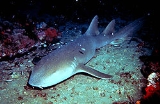
The largest species, called simply the nurse shark
Nurse shark

The nurse shark, Ginglymostoma cirratum, is a shark in the nurse sharks family, the only member of its genus Ginglymostoma. Nurse sharks can reach a length of 4.3 m and a weight of 330 lbs ....
 Ginglymostoma cirratum, may reach a length of ; the tawny nurse shark Nebrius ferrugineus is somewhat smaller at , and the short-tailed nurse shark Pseudoginglymostoma brevicaudatum is by far the smallest at just in length. The first of the three species may reach a weight of 110 kg. Yellowish to dark brown in colour, nurse sharks have muscular pectoral fins, two spineless dorsal fin
Dorsal fin

A wikt:dorsal fin is a fin located on the backs of some fish, whales, dolphins, and porpoises, as well as the ichthyosaurs. Its main purpose is to stabilize the animal against rolling and assist in sudden turns....
s (the second of which is smaller) in line with the pelvic and anal fins, and a tail exceeding one quarter the shark's body length.

The mouths of nurse sharks are most distinctive; it is far ahead of the eyes and before the snout (sub-terminal), an indication of the bottom-dwelling (benthic) nature of these sharks. Also present on the lower jaw are two fleshy barbels
Barbel (anatomy)

A barbel on a fish is a slender, whiskerlike tactile organ near the mouth. Fish that have barbels include the catfish, the carp, the goatfish, sturgeon, and some species of shark....
, chemosensory organs which help the nurse sharks find prey hidden in the sediments. Behind each eye is a very small circular opening called a spiracle
Spiracle

Spiracles are small openings on the surface of some animals that usually lead to respiratory systems.In elasmobranchs , a spiracle is found behind each eye, and is often used to pump water through the gills while the animal is at rest ....
, part of the shark's respiratory system. The serrated teeth are fan-shaped and independent; like other sharks, the teeth are continually replaced throughout the animal's life.

Habits


Nurse sharks are nocturnal animals, spending the day in large inactive groups of up to 40 individuals. Hidden under submerged ledges or in crevices within the reef
Reef

In nautical terminology, a reef is a Rock , bar , or other feature lying beneath the surface of the water .Many reefs result from abiotic processes?deposition of sand, wave erosion planning down rock outcrops, and other natural processes?but the best-known reefs are the coral reefs of tropical waters developed through biotic processes do...
, the nurse sharks seem to prefer specific haunts and will return to them every day. By night, the sharks are largely solitary; they spend most of their time rifling through the bottom sediments in search of food. Their diet consists primarily of crustacean
Crustacean

Crustaceans are a large group of arthropods, comprising almost 52,000 described species , and are usually treated as a subphylum . They include various familiar animals, such as crabs, lobsters, crayfish, shrimp, krill and barnacles....
s, molluscs, tunicate
Tunicate

Tunicate, also known as urochordata, tunicata is the subphylum of a group of underwater saclike filter feeders with incurrent and excurrent Siphon s, that are members of the phylum Chordata....
s, and other fish
Fish

A fish is any marine biology vertebrate animal that is typically ectothermic , covered with scale , and equipped with two sets of paired fins and several unpaired fins....
, particularly stingray
Stingray

The stingrays are a family, Dasyatidae of batoidea, cartilaginous fishes related to sharks. They are common in coastal tropical marine waters throughout the world, and several species are known to enter fresh water....
s.

Nurse sharks are thought to take advantage of dormant fish which would otherwise be too fast for the sharks to catch; although their small mouths limit the size of prey items, the sharks have large throat cavities which are used as a sort of bellows valve. In this way nurse sharks are able to suck in their prey. Nurse sharks are also known to graze algae
Algae

Algae are a large and diverse group of simple, typically autotrophic organisms, ranging from unicellular to multicellular forms. The largest and most complex marine forms are called seaweeds....
 and coral
Coral

Corals are marine organisms from the class Anthozoa and exist as small sea anemone?like polyps, typically in colonies of many identical individuals....
.

Reproduction

The mating season runs from late June to the end of July. Most nurse sharks are ovoviviparous
Ovoviviparity

Ovoviviparous, also known as oviviparous, animals develop within Egg s that remain within the mother's body up until they hatch or are about to hatch....
, meaning the eggs develop and hatch within the body of the female, where the hatchlings develop further until live birth occurs. The gestation
Gestation

Gestation is the carrying of an embryo or fetus inside a female viviparous animal. Mammals during mammalian pregnancy can have one or more gestations at the same time ....
 period is six months, with a typical litter of 30-40 pups. The mating cycle is biennial, as it takes 18 months for the female's ovaries to produce another batch of eggs. The young nurse sharks are born fully developed at about 30 cm long in Ginglymostoma cirratum. They possess a spotted coloration which fades with age. The mating process can be very painful for female nurse sharks. The male will cling on to the female by biteing on to the females fins.

Genera and species

  • Genus Ginglymostoma
    • Nurse shark
      Nurse shark

      The nurse shark, Ginglymostoma cirratum, is a shark in the nurse sharks family, the only member of its genus Ginglymostoma. Nurse sharks can reach a length of 4.3 m and a weight of 330 lbs ....
      , Ginglymostoma cirratum Bonnaterre
      Pierre Joseph Bonnaterre

      Abb? Pierre Joseph Bonnaterre was a France natural history who contributed sections on cetaceans, mammals, birds, reptiles, amphibians, and insects to the Tableau encyclop?dique et m?thodique....
      , 1788
  • Genus Nebrius
    • Tawny nurse shark
      Tawny nurse shark

      The tawny nurse shark or giant sleepy shark, Nebrius ferrugineus, is a nurse shark in the family Ginglymostomatidae, the only member of the genus Nebrius....
      , Nebrius ferrugineus Lesson, 1831
  • Genus Pseudoginglymostoma (proposed family Pseudoginglymostomatidae)
    • Short-tail nurse shark, Pseudoginglymostoma brevicaudatum Günther
      Albert C. L. G. Günther

      Albrecht Karl Ludwig Gotthilf G?nther Fellow of the Royal Society October 3, 1830 ? February 1 1914, was a Germany-born British zoologist.G?nther was born in Esslingen in Swabia ....
      , 1867


See also

  • List of sharks
    List of sharks

    Shark classificationSharks belong to the superorder Selachimorpha in the subclass Elasmobranchii in the class Chondrichthyes. It is a fish. The Elasmobranchii also include batoidea and skate s; the Chondrichthyes also include Chimaeras....


External links