
All Topics  
Norway Maple

 
Norway Maple

   Email Print
   Bookmark   Link


Norway Maple


Acer platanoides (Norway Maple) is a species of maple
Maple

Acer is a genus of trees or shrubs commonly known as Maple. Maples are variously classified in a family of their own, the Aceraceae, or included in the family Sapindaceae....
 native to eastern and central Europe
Europe

Europe is, conventionally, one of the world's seven continents. Comprising the westernmost peninsula of Eurasia, Europe is generally divided from Asia to its east by the water divide of the Ural Mountains, the Ural , the Caspian Sea, and by the Caucasus Mountains to the southeast....
 and southwest Asia
Asia

Asia is the world's largest and most populous continent. It covers 8.6% of the Earth's total surface area and, with over 4 billion people, it contains more than 60% of the world's current human population....
, from France
France

France , officially the French Republic , is a country whose Metropolitan France is located in Western Europe and that also comprises various Overseas departments and territories of France....
 east to Russia
Russia

Russia , or the Russian Federation , is a list of countries spanning more than one continent country extending over much of northern Eurasia....
, north to southern Scandinavia
Scandinavia

Scandinavia is a historical and geographical subregion in northern Europe that includes the Scandinavian Peninsula. It consists of the kingdoms of Norway, Sweden, and Denmark; some authorities also include Finland and some might even include Iceland....
 and southeast to northern Iran
Iran

Iran , officially the Islamic Republic of Iran and formerly known internationally as Persian Empire until 1935, is a country in Central Eurasia, located on the northeastern shore of the Persian Gulf and the southern shore of the Caspian Sea....
.

It is a deciduous
Deciduous

Deciduous means falling off at maturity or tending to fall off and is typically used in reference to trees or shrubs that lose their leaves seasonally and to the shedding of other plant structures such as petals after flowering or fruit when ripe....
 tree
TREE

TREE was a Boston hardcore punk band formed in the summer of 1990. They were active in the Boston music scene until disbanding in 2002....
 growing to 20–30 m tall with a trunk up to 1.5 m diameter, and a broad, rounded crown.


Discussion
Ask a question about 'Norway Maple'
Start a new discussion about 'Norway Maple'
Answer questions from other users
Full Discussion Forum


Recent Posts


Encyclopedia


Acer platanoides (Norway Maple) is a species of maple
Maple

Acer is a genus of trees or shrubs commonly known as Maple. Maples are variously classified in a family of their own, the Aceraceae, or included in the family Sapindaceae....
 native to eastern and central Europe
Europe

Europe is, conventionally, one of the world's seven continents. Comprising the westernmost peninsula of Eurasia, Europe is generally divided from Asia to its east by the water divide of the Ural Mountains, the Ural , the Caspian Sea, and by the Caucasus Mountains to the southeast....
 and southwest Asia
Asia

Asia is the world's largest and most populous continent. It covers 8.6% of the Earth's total surface area and, with over 4 billion people, it contains more than 60% of the world's current human population....
, from France
France

France , officially the French Republic , is a country whose Metropolitan France is located in Western Europe and that also comprises various Overseas departments and territories of France....
 east to Russia
Russia

Russia , or the Russian Federation , is a list of countries spanning more than one continent country extending over much of northern Eurasia....
, north to southern Scandinavia
Scandinavia

Scandinavia is a historical and geographical subregion in northern Europe that includes the Scandinavian Peninsula. It consists of the kingdoms of Norway, Sweden, and Denmark; some authorities also include Finland and some might even include Iceland....
 and southeast to northern Iran
Iran

Iran , officially the Islamic Republic of Iran and formerly known internationally as Persian Empire until 1935, is a country in Central Eurasia, located on the northeastern shore of the Persian Gulf and the southern shore of the Caspian Sea....
.

Klevo Vaisiai
It is a deciduous
Deciduous

Deciduous means falling off at maturity or tending to fall off and is typically used in reference to trees or shrubs that lose their leaves seasonally and to the shedding of other plant structures such as petals after flowering or fruit when ripe....
 tree
TREE

TREE was a Boston hardcore punk band formed in the summer of 1990. They were active in the Boston music scene until disbanding in 2002....
 growing to 20–30 m tall with a trunk up to 1.5 m diameter, and a broad, rounded crown. The bark
BARK

BARK was an early Electromechanics. BARK was built using standard phone relays, implementing a 32-bit binary machine and could perform addition in 150 ms and multiplication in 250 ms....
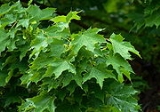
 is grey-brown and shallowly grooved; unlike many other maples, mature trees do not tend to develop a shaggy bark. The shoots are green at first, soon becoming pale brown; the winter buds are shiny red-brown. The leaves
Leaf

In botany, a leaf is an above-ground plant Organ specialized for photosynthesis. For this purpose, a leaf is typically flat and thin, to expose the cells containing chloroplast to light over a broad area, and to allow light to penetrate fully into the tissues....
 are opposite, palmately
Leaf shape

In botany, the following terms are used to describe the shape of plant leaf:* Acicular : Slender and pointed, needle-like* Acuminate : Tapering to a long point...
 lobed with five lobes, 7–14 cm long and 8–20 cm (rarely 25 cm) across; the lobes each bear one to three side teeth, and an otherwise smooth margin. The leaf petiole
Petiole (botany)

In botany, the petiole is the small stalk attaching the leaf blade to the Plant stem. The petiole usually has the same internal structure as the stem....
 is 8–20 cm long, and secretes a milky juice when broken. The autumn colour is usually yellow, occasionally orange-red. The flower
Flower

A flower, sometimes known as a bloom or blossom, is the reproduction structure found in flowering plants . The biological function of a flower is to mediate the union of male sperm with female ovum in order to produce seeds....
s are in corymbs of 15–30 together, yellow to yellow-green with five sepals and five petals 3–4 mm long; flowering occurs in early spring before the new leaves emerge. The fruit
Fruit

The term fruit has different meanings dependent on context, and the term is not synonymous in food preparation and biology. In botany, which is the scientific study of plants, fruits are the ripened Ovary of flowering plants....
 is a double samara
Samara (fruit)

A samara is a type of fruit in which a flattened wing of fibrous, papery tissue develops from the ovary wall. A samara is a simple dry fruit and indehiscent ....
 with two winged seed
Seed

A seed is a small Plant embryogenesis plant enclosed in a covering called the seed coat, usually with some Food storage. It is the product of the ripened ovule of gymnosperm and angiosperm plants which occurs after fertilization and some growth within the mother plant....
s, the seeds are disc-shaped, strongly flattened, 10–15 mm across and 3 mm thick. The wings are 3–5 cm long, widely spread, approaching a 180° angle. It typically produces a large quantity of viable seeds. It is not particularly a long-lived tree, with a maximum age of around 250 years.

Classification and identification

Norway Maple Bark
Norway Maple is a member (and is the type species
Type species

In taxonomy, a type species is the species that originally defined a genus . It is an individual specimen that fixes the name of a genus . Two different definitions are used interchangeably, in a general term and a botanical term....
) of the section Platanoidea Pax, characterised by flattened, disc-shaped seeds and the shoots and leaves containing milky sap. Other related species in this section include Acer campestre (Field Maple), Acer cappadocicum (Cappadocian Maple), Acer lobelii
Acer lobelii

Acer lobelii is a rare maple native to southern Italy and the western Balkans. Synonym include Acer platanoides subsp. lobelii Gams and Acer cappadocicum subsp....
 (Lobel's Maple), and Acer truncatum
Acer truncatum

Acer truncatum is a maple native to northern China, in the provinces of Gansu, Hebei, Henan, Jiangsu, Jilin, Liaoning, Nei Mongol, Shaanxi, Shandong, Shanxi, and also Korea....
 (Shandong Maple). From Field Maple, Norway Maple is distinguished by its larger leaves with pointed, not blunt, lobes, and from the other species by the presence of one or more teeth on all of the lobes.

It is also frequently confused with the more distantly related Acer saccharum (Sugar Maple). Sugar Maple is easy to identify by clear sap in the petiole
Petiole (botany)

In botany, the petiole is the small stalk attaching the leaf blade to the Plant stem. The petiole usually has the same internal structure as the stem....
 (Norway Maple has white sap). The tips of the points on Norway Maple leaves reduce to a fine "hair", while the tips of the points on Sugar Maple leaves are on close inspection rounded. On mature trees, Sugar Maple bark is more shaggy, while Norway Maple bark has small, often criss-crossing grooves. While the shape and angle of leaf lobes vary somewhat within all Maple species, the leaf lobes of Norway Maple tend to have a more triangular shape, in contrast to the more squarish lobes often seen on Sugar Maples. The seeds of Sugar Maple are globose, while Norway Maple seeds are flattened. Sugar Maple usually has a brighter orange autumn color, where Norway Maple is usually yellow, although some of the red-leaved cultivars appear more orange. The tree tends to leaf out earlier than most maples and holds its leaves somewhat longer in autumn.

Cultivation and uses

The wood
Wood

Wood is an organic material; in the strict sense wood is produced as secondary xylem in the stems of woody plants, notably trees but also shrubs, etc....
 is hard, yellowish-white to pale reddish, with the heartwood not distinct; it is used for furniture
Furniture

Furniture is the mass noun for the movable objects which may support the human body , provide storage, or hold objects on horizontal surfaces above the ground....
 and turnery
Woodturning

Woodturning is a form of woodworking that is used to create wooden objects on a Lathe . Woodturning differs from most other forms of woodworking in that the wood is moving while a stationary tool is used to cut and shape it....
.

Many cultivar
Cultivar

A cultivar is a cultivated plant that has been selected and given a unique name because of its decorative or useful characteristics; it is usually distinct from similar plants and when Plant propagation it retains those characteristics....
s have been selected, with distinctive leaf shape or coloration such as the dark purple of 'Crimson King' and 'Schwedleri', the variegated leaves of 'Drummondii' and 'Emerald Queen', and the deeply divided, feathery leaves of 'Dissectum' and 'Lorbergii'. The purple-foliage cultivars have orange to red autumn colour. 'Columnare' is selected for its narrow upright growth.

It has been widely introduced into cultivation in other areas, including western Europe northwest of its native range. It grows north of the Arctic Circle
Arctic Circle

The Arctic Circle is one of the five major circle of latitude that mark maps of the Earth. It is the parallel of latitude that runs 66degree 33'39? north of the Equator....
 at Tromsø
Tromsø

is a List of cities in Norway and Municipalities of Norway in Troms Counties of Norway, Norway. The administrative centre of the municipality is the city of Troms?....
, Norway
Norway

Norway , officially the Kingdom of Norway, is a constitutional monarchy in Northern Europe that occupies the western portion of the Scandinavian Peninsula....
. In North America
North America

North America is the northern continent of the Americas, situated in the Earth's northern hemisphere and almost totally in the western hemisphere....
, it is grown as a street and shade tree. It is favoured due to its tolerance of poor, compacted soil
Soil

Soil is the naturally occurring, unconsolidated or loose covering on the Earth's surface. Soil is composed of particles of broken rock that have been altered by chemical and environmental processes including weathering and erosion....
s and urban pollution
Pollution

Pollution is the introduction of contaminants into an environment that causes instability, disorder, harm or discomfort to the ecosystem i.e. physical systems or living organisms ....
. As a result of these characteristics, Norway Maple is displacing locally native hardwoods in some parts of North America and is considered invasive
Invasive species

Invasive species is a phrase with several definitions. The first definition expresses the phrase in terms of non-indigenous species that adversely affect the habitats they invade economically, environmentally or ecologically....
 in some states, but is still widely used for urban plantings in many areas.

Norway Maple itself is threatened in a few areas by the Asian long-horned beetle
Asian long-horned beetle

The Asian longhorned beetle is native to China and other areas of eastern Asia, where it causes widespread mortality of poplar, willow, elm, and maple trees....
, which eats through the trunk of trees, often killing them.

A number of species of Lepidoptera
Lepidoptera

Lepidoptera is an order of insect that includes moths and butterfly. It is one of the most speciose orders in the class Insecta, encompassing moths and the three superfamilies of butterfly, skipper , and Hedylidae....
 feed on Norway Maple foliage; see Lepidoptera that feed on maples. Norway Maple is generally free of serious diseases, though can be attacked by the powdery mildew
Powdery mildew

Powdery mildew is a fungus disease that affects a wide range of plants. Powdery mildew diseases are caused by many different species of fungi in the order Erysiphales....
 Uncinula bicornis, and verticillium wilt
Verticillium

Verticillium is a genus of fungi in the division Ascomycota. Within the genus, diverse groups are formed comprising saprotrophs and parasites of higher plants, insects, nematodes, mollusc eggs and other fungi thus it can be seen that the genus is a wide ranging group of taxa characterised by simple but ill-defined characters....
 disease caused by Verticillium spp.

External links