
Home      Discussion      Topics      Dictionary      Almanac
Signup       Login
Northern Flicker

Northern Flicker

Overview
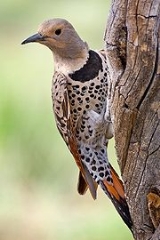
The Northern Flicker is a medium-sized member of the woodpecker
Woodpecker
Woodpeckers are near passerine birds of the order Piciformes. They are one subfamily in the family Picidae, which also includes the piculets and wrynecks. They are found worldwide and include about 180 species....

 family. It is native to most of North America
North America
North America is a continent wholly within the Northern Hemisphere and almost wholly within the Western Hemisphere. It is also considered a northern subcontinent of the Americas...

, parts of Central America
Central America
Central America is the central geographic region of the Americas. It is the southernmost, isthmian portion of the North American continent, which connects with South America on the southeast. When considered part of the unified continental model, it is considered a subcontinent...

, Cuba
Cuba
The Republic of Cuba is an island nation in the Caribbean. The nation of Cuba consists of the main island of Cuba, the Isla de la Juventud, and several archipelagos. Havana is the largest city in Cuba and the country's capital. Santiago de Cuba is the second largest city...

, the Cayman Islands
Cayman Islands
The Cayman Islands is a British Overseas Territory and overseas territory of the European Union located in the western Caribbean Sea. The territory comprises the three islands of Grand Cayman, Cayman Brac, and Little Cayman, located south of Cuba and northwest of Jamaica...

, and is one of the few woodpecker species that migrate. There are over 100 common names for the Northern Flicker. Among them are: Yellowhammer, clape, gaffer woodpecker, harry-wicket, heigh-ho, wake-up, walk-up, wick-up, yarrup, and gawker bird. Many of these names are attempts at imitating some of its calls.
Discussion
Ask a question about 'Northern Flicker'
Start a new discussion about 'Northern Flicker'
Answer questions from other users
Full Discussion Forum
 
Unanswered Questions
Encyclopedia
The Northern Flicker is a medium-sized member of the woodpecker
Woodpecker
Woodpeckers are near passerine birds of the order Piciformes. They are one subfamily in the family Picidae, which also includes the piculets and wrynecks. They are found worldwide and include about 180 species....

 family. It is native to most of North America
North America
North America is a continent wholly within the Northern Hemisphere and almost wholly within the Western Hemisphere. It is also considered a northern subcontinent of the Americas...

, parts of Central America
Central America
Central America is the central geographic region of the Americas. It is the southernmost, isthmian portion of the North American continent, which connects with South America on the southeast. When considered part of the unified continental model, it is considered a subcontinent...

, Cuba
Cuba
The Republic of Cuba is an island nation in the Caribbean. The nation of Cuba consists of the main island of Cuba, the Isla de la Juventud, and several archipelagos. Havana is the largest city in Cuba and the country's capital. Santiago de Cuba is the second largest city...

, the Cayman Islands
Cayman Islands
The Cayman Islands is a British Overseas Territory and overseas territory of the European Union located in the western Caribbean Sea. The territory comprises the three islands of Grand Cayman, Cayman Brac, and Little Cayman, located south of Cuba and northwest of Jamaica...

, and is one of the few woodpecker species that migrate. There are over 100 common names for the Northern Flicker. Among them are: Yellowhammer, clape, gaffer woodpecker, harry-wicket, heigh-ho, wake-up, walk-up, wick-up, yarrup, and gawker bird. Many of these names are attempts at imitating some of its calls.

Taxonomy


The Northern Flicker is part of the genus Colaptes
Colaptes
Colaptes is the genus of woodpeckers which contains the flickers. The scientific name means "the pecker", Latinized from the Greek verb kolápto , "to peck"....

 which encompasses 12 New-World woodpeckers. There are two living and one extinct subspecies of C. auratus species. The existing sub-species were at one time considered separate species but they commonly interbreed where ranges overlap and are now considered one species by the American Ornithologists Union. Whether or not they are separate species is a well-known example of the species problem
Species problem
The species problem or species concept is a mixture of difficult, related questions that often come up when biologists identify species and when they define the word "species"....

.
  • The Yellow-shafted Flicker Colaptes auratus resides in eastern North America
    North America
    North America is a continent wholly within the Northern Hemisphere and almost wholly within the Western Hemisphere. It is also considered a northern subcontinent of the Americas...

    . They are yellow under the tail and underwings and have yellow shafts on their primaries. They have a grey cap, a beige face and a red bar at the nape
    Nape
    The nape is the back of the neck. In technical anatomical/medical terminology, the nape is referred to by the word nucha, which also gives the adjective corresponding to "nape" in English, "nuchal"....

      of their neck. Males have a black moustache. Colaptes comes from the Greek verb colapt, to peck. Auratus is from the Latin root aurat, meaning "gold" or "golden" and refers to the bird's underwing.

Under the name "Yellowhammer" it is the state bird of Alabama
Alabama
Alabama is a state located in the southeastern region of the United States. It is bordered by Tennessee to the north, Georgia to the east, Florida and the Gulf of Mexico to the south, and Mississippi to the west. Alabama ranks 30th in total land area and ranks second in the size of its inland...

.

  • The Red-shafted Flicker Colaptes auratus cafer resides in western North America
    North America
    North America is a continent wholly within the Northern Hemisphere and almost wholly within the Western Hemisphere. It is also considered a northern subcontinent of the Americas...

    . They are red under the tail and underwings and have red shafts on their primaries. They have a beige cap and a grey face. Males have a red moustache. The scientific name, Colaptes auratus cafer, is the result of an error made in 1788 by the German systematist, Johann Gmelin, who believed that its original habitat was in South Africa
    South Africa
    The Republic of South Africa is a country in southern Africa. Located at the southern tip of Africa, it is divided into nine provinces, with of coastline on the Atlantic and Indian oceans...

     among the Xhosa people, then known as the "Kaffir" people. (The term "Kaffir"
    Kaffir (ethnic slur)
    The word kaffir, sometimes spelled kaffer or kafir, is an offensive term for a black person, most common in South Africa and other African countries...

     is now considered an extreme ethnic slur in South Africa.)
  • The Guadalupe Flicker Colaptes auratus/cafer rufipileus extinct c. 1910.

Description


Adults are brown with black bars on the back and wings. A mid-to-large-sized woodpecker, it measures 28–36 cm (11–14.2 in) in length and 42–54 cm (16.5–21.3 in) in wingspan. The body mass can vary from 92 to 167 g (3.2 to 5.9 oz). A necklace
Necklace
A necklace is an article of jewellery which is worn around the neck. Necklaces are frequently formed from a metal jewellery chain. Others are woven or manufactured from cloth using string or twine....

-like black patch occupies the upper breast, while the lower breast and belly are beige
Beige
Beige may be described as an off tan color or an extremely pale brown color.The term originates from beige cloth, a cotton fabric left undyed in its natural color...

 with black spots. Males can be identified by a black or red moustachial
Moustache
A moustache is facial hair grown on the outer surface of the upper lip. It may or may not be accompanied by a type of beard, a facial hair style grown and cropped to cover most of the lower half of the face.-Etymology:...

 stripe at the base of the beak
Beak
The beak, bill or rostrum is an external anatomical structure of birds which is used for eating and for grooming, manipulating objects, killing prey, fighting, probing for food, courtship and feeding young...

. The tail is dark on top, transitioning to a white rump
Bird anatomy
Bird anatomy, or the physiological structure of birds' bodies, shows many unique adaptations, mostly aiding flight. Birds have a light skeletal system and light but powerful musculature which, along with circulatory and respiratory systems capable of very high metabolic rates and oxygen supply,...

 which is conspicuous in flight.

The subspecies plumage varies as described in Taxonomy section.

Call and flight


This bird's call is a sustained laugh, ki ki ki ki ..., more congenial than that of the Pileated Woodpecker
Pileated Woodpecker
The Pileated Woodpecker is a very large North American woodpecker, almost crow-sized, inhabiting deciduous forests in eastern North America, the Great Lakes, the boreal forests of Canada, and parts of the Pacific coast. It is also the largest woodpecker in America.Adults are long, and weigh...

. One may also hear a constant knocking as they often drum on trees or even metal objects to declare territory. Like most woodpeckers, Northern Flickers drum on objects as a form of communication and territory defense. In such cases, the object is to make as loud a noise as possible, and that’s why woodpeckers sometimes drum on metal objects. One Northern Flicker in Wyoming could be heard drumming on an abandoned tractor from a half-mile away.
Like many woodpeckers, its flight is undulating. The repeated cycle of a quick succession of flaps followed by a pause creates an effect comparable to a rollercoaster.

Diet


According to the Audubon guide, "flickers are the only woodpeckers that frequently feed on the ground", probing with their beak, also sometimes catching insect
Insect
Insects are a class of living creatures within the arthropods that have a chitinous exoskeleton, a three-part body , three pairs of jointed legs, compound eyes, and two antennae...

s in flight. Although they eat fruit
Fruit
In broad terms, a fruit is a structure of a plant that contains its seeds.The term has different meanings dependent on context. In non-technical usage, such as food preparation, fruit normally means the fleshy seed-associated structures of certain plants that are sweet and edible in the raw state,...

s, berries, seeds and nuts, their primary food is insects. Ants alone can make up 45% of their diet. They have a behavior called anting
Anting (bird activity)
In the behavior called anting, birds rub insects on their feathers, usually ants, which secrete liquids containing chemicals such as formic acid, that can act as an insecticide, miticide, fungicide, bactericide, or to make them edible by removing the distasteful acid. It possibly also supplements...

, during which they use the acid
Formic acid
Formic acid is the simplest carboxylic acid. Its chemical formula is HCOOH or HCO2H. It is an important intermediate in chemical synthesis and occurs naturally, most notably in the venom of bee and ant stings. In fact, its name comes from the Latin word for ant, formica, referring to its early...

 from the ants to assist in preening, as it is useful in keeping them free of parasites. Northern Flickers eat mainly insects, especially ants and beetles that they gather from the ground. They also eat fruits and seeds
SEEDS
SEEDS is a voluntary organisation registered under the Societies Act of India....

, especially in winter. Flickers often go after ants underground (where the nutritious larvae live), hammering at the soil the way other woodpeckers drill into wood. They’ve been seen breaking into cow patties to eat insects living within. Their tongues can dart out 2 inches beyond the end of the bill to snare prey. Other invertebrates eaten include flies, butterflies, moths, and snails. Flickers also eat berries and seeds, especially in winter, including poison oak and ivy, dogwood, sumac, wild cherry and grape, bayberries, hackberries, and elderberries, and sunflower and thistle seeds.

Habitat


Look for flickers in open habitats near trees, including woodlands, edges, yards, and parks. In the West you can find them in mountain forests all the way up to treeline. Northern Flickers generally nest in holes in trees like other woodpeckers. Occasionally, they’ve been found nesting in old, earthen burrows vacated by Belted Kingfisher
Belted Kingfisher
The Belted Kingfisher is a large, conspicuous water kingfisher, the only member of that group commonly found in the northern United States and Canada. It is depicted on the 1986 series Canadian $5 note. All kingfishers were formerly placed in one family, Alcedinidae, but recent research suggests...

s or Bank Swallows
Sand Martin
The Sand Martin is a migratory passerine bird in the swallow family. It has a wide range in summer, embracing practically the whole of Europe and the Mediterranean countries, part of northern Asia and also North America. It winters in eastern and southern Africa, South America and South Asia...

. Both sexes help with nest excavation. The entrance hole is about 3 inches in diameter, and the cavity is 13-16 inches deep. The cavity widens at bottom to make room for eggs and the incubating adult. Inside, the cavity is bare except for a bed of wood chips for the eggs and chicks to rest on. Once nestlings are about 17 days old, they begin clinging to the cavity wall rather than lying on the floor.

Lifespan


The oldest known "yellow-shafted" Northern Flicker lived to be at least 9 years 2 months old, and the oldest “red-shafted” Northern Flicker lived to be at least 8 years 9 months old.

Reproduction


Their breeding habitat consists of forested areas across North America and as far south as Central America
Central America
Central America is the central geographic region of the Americas. It is the southernmost, isthmian portion of the North American continent, which connects with South America on the southeast. When considered part of the unified continental model, it is considered a subcontinent...

. They are cavity nesters who typically nest in trees though they will also use posts and birdhouses if sized and situated appropriately. They prefer to excavate their own home though they will reuse and repair damaged or abandoned nests. Abandoned flicker nests create habitat for other cavity nesters. Flickers are sometimes driven from nesting sites by another cavity nester, European starlings
European Starling
The Common Starling , also known as the European Starling or just Starling, is a passerine bird in the family Sturnidae.This species of starling is native to most of temperate Europe and western Asia...

.

It takes about 1 to 2 weeks to build the nest which is built by both sexes of the mating pairs. The entrance hole is roughly 5 cm to 10 cm wide.


A typical clutch
Clutch (eggs)
A clutch of eggs refers to all the eggs produced by birds or reptiles, often at a single time, particularly those laid in a nest.In birds, destruction of a clutch by predators, , results in double-clutching...

 consists of 6 to 8 eggs whose shells are pure white with a smooth surface and high gloss. The eggs are the second largest of the North American woodpecker species, exceeded only by the Pileated Woodpecker's. Incubation is by both sexes for approximately 11 to 12 days. The young are fed by regurgitation and fledge
Fledge
Fledge is the stage in a young bird's life when the feathers and wing muscles are sufficiently developed for flight. It also describes the act of a chick's parents raising it to a fully grown state...

 about 25 to 28 days after hatching.

Wintering and migration


Northern birds migrate
Bird migration
Bird migration is the regular seasonal journey undertaken by many species of birds. Bird movements include those made in response to changes in food availability, habitat or weather. Sometimes, journeys are not termed "true migration" because they are irregular or in only one direction...

 to the southern parts of the range; southern birds are often permanent residents.

External links