
Encyclopedia
- For films named Northanger Abbey, see Northanger Abbey was the first of Jane Austen [i]'s novels to be completed for publication, though s ...
.
Northanger Abbey was the first of
Jane Austen's novels to be completed for publication, though she had previously made a start on
Sense and Sensibility and
Pride and Prejudice. According to Cassandra Austen's Memorandum,
Susan was written about the years 1798-1799.
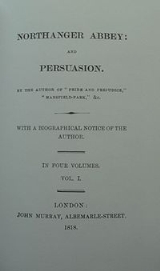
Northanger Abbey was written by Austen in 1798, revised for the press in 1803, and sold in the same year for £10 to a Bath bookseller, who after allowing it to remain for many years on his shelves, was content to sell it back to the novelist's brother, Henry Austen, for the exact sum that he had paid for it at the beginning, not knowing that the writer was already the author of four popular novels. The novel was brought out posthumously in late December 1817 , as the first two of a four-volume set with
Persuasion.
Plot introduction
Northanger Abbey follows Catherine Morland and family friends Mr. and Mrs. Allen as they visit
Bath,
England. Seventeen year-old Catherine spends her time visiting newly made friends, like Isabella Thorpe, and going to balls. Catherine finds herself pursued by Isabella's brother John Thorpe , and by Henry Tilney. She also becomes friends with Eleanor Tilney, Henry's younger sister. Mr. Henry Tilney captivates her with his view on novels and knowledge of history and the world. The Tilneys invite Catherine to visit their father's estate, Northanger Abbey, which, because she has been reading Ann Radcliffe's
gothic novel,
The Mysteries of Udolpho, Catherine expects to be dark, ancient and full of fantastical mystery.
Plot summary
The Allens, family friends to the Morlands, invite Catherine Morland to travel with them to Bath, England. Catherine and the Mrs. Allen spend their time visiting shops and walking around, being seen.
During one of the "walk and be seen" sessions, Catherine has an interesting conversation with a young clergyman named Henry Tilney. Catherine is intrigued by Henry, but he seemingly disappears from her view. While waiting for him to turn up again, Cathrine and Mrs. Allen run into Mrs. Thorpe, an old friend of Mrs. Allen, and her three daughters. Catherine strikes up a quick friendship with the eldest daughter, Isabella.
Shortly thereafter Catherine's brother James turns up with Isabella's brother John. Isabella matches Catherine up with John and John expects Catherine to be willing to be his. Complicating matters, though, is the return of Henry Tilney and his sister Eleanor.
Catherine tries to strike up a friendly relationship with both the Thorpes and the Tilneys, but her desires are met with strange occurrences and misunderstandings.
After being invited on a walk with the Tilneys, Catherine is dismayed to wake up to a dreary, rainy morning. Soon afterwards, the Thorpes arrive with James in tow, and John assures Catherine that the Tilneys are no longer upholding their engagement, and Catherine is pressured into going on a ride with the Thorpes, much to her dismay; James paired with Isabella, and John with herself. She is immediately put off by his arrogance and thoughtless choice of conversation.
They then pass the Tilneys, walking down the street. Catherine begs John Thorpe to stop the carriage and let her join the Tilneys, thus permitting her to apologise for the misunderstanding, and accompany them on their walk. However, John refuses to stop, and this blatant rudeness annoys Catherine.
The ride is dull; once home, she tries to see Eleanor to explain the mistake, but she is told Eleanor is 'out', only to see the same Eleanor quit the house a few minutes later. Mortified at being 'cut', she attempts her apologies once more at the theatre, where she sees them, and the misunderstandings are cleared up, and a new date scheduled. Meanwhile, John Thorpe, who believes that he and Catherine are an item, boasts of her prodigious wealth, as well as the future wealth she will acquire from the Allens to General Tilney, much exaggerated.
Meanwhile, her brother, John Thorpe, and Isabella have already hatched a new plan of riding out to see a castle they missed the last time, and they want Catherine to go with them. John Thorpe again attempts to prevent Catherine from walking with the Tilneys and tells Eleanor that Catherine had cancelled. But as soon as Catherine discovers this subterfuge, she runs off to set the misunderstanding caused by John Thorpe straight once more. She meets General Tilney, who is most courteous to her.
The walk is finally taken, and Catherine finds herself more and more pleased with the Tilneys.
Meanwhile, Catherine learns that Isabella and her brother are to be married. However, Isabella is not too pleased when she learns of the extent of James' property, but convinces all that her dissatisfaction is a result of the need to wait two years to wed. At a ball, while James is away, she meets Henry's older brother, Captain Tilney, a dashing, charming man about town, and dances with him. This evolves into a large-scale flirtation that Catherine, believing the best of her best friend and soon-to-be sister-in-law finds hard to comprehend; Henry Tilney, with a better understanding of both, understands but too well. The flirtation continues even while James is present, but Catherine is much too happy herself to take much notice.
This happiness is almost brought to an end by learning the Tilneys were to leave Bath; but infinitely increased just then by a kind invitation from Eleanor, instigated by her father, for her to accompany them to their residence, Northanger Abbey.
Catherine, who has had her head in Gothic novels, is expecting Northanger Abbey to be a large, somewhat frightening abode. While driving to Northanger, Henry begins to describe what Catherine will find in her room, and proceeds to slightly scare her. That night, it is very stormy, and Catherine notices a wardrobe in the corner of the room. She finds all of the drawers empty, and feels relieved, as everything is too similar to what Henry had jokingly told her earlier. She then finds a roll of manuscripts, but before reading them, her candle is snuffed. The next morning, she reads the papers and discovers they are only laundry lists.
Later, General Tilney and Eleanor take Catherine on a tour of the house, and Catherine is disappointed at how pleasant and positively un-Gothic it is. During the tour, they enter a new wing, and Eleanor goes to open a set of doors. The General sharply reprimands her, and the rooms are unentered. Catherine is soon told the rooms were Mrs. Tilney's, who died nine years before. Catherine, with her overactive imagination, begins to think that since General Tilney does not seem affected by the death now, must have been indifferent or even perhaps hostile toward his wife. The speculation goes farther as Catherine imagines that he had murdered his wife--as Eleanor stated that they were away when she became sick and died--or that she is still alive and imprisoned in the house.
Having persuaded Eleanor to show her the chambers on another day, the girls are startled by General Tilney's sudden appearance as they are about to enter the room. Catherine flees to her room, and is certain that she will soon be summoned and berated. When she emerges, however, Eleanor tells Catherine that her father merely wanted her to answer a note. Later, Catherine leaves early to dress for dinner, and instead goes to investigate the rooms. She is soon startled by Henry, who has returned from Woodston, the village where his parsonage is located, earlier than anticipated, and who is going to his room.
In a moment of panic, she admits to him her speculation about his father. He is horrified, and corrects her wild notions, although his own view in praise of England's impeccable society reveals his own conservative distortion of the world. She leaves crying and is now afraid that Henry will want nothing to do with her. The next day, she is a much changed woman, but is pleasantly surprised when General Tilney later decides that he and the girls will visit Henry while he is at Woodston. Catherine is thoroughly enchanted by the village and the parsonage, but is hesitant to vocalize her interest. The General, however, persuades her, and she waxes ecstatic about the unfinished parlor.
Catherine receives a letter from her brother James stating that he has been deceived by Isabella, and that he has broken off their engagement because of her behavior toward Captain Tilney. The young Tilneys are shocked, but Henry asserts that his brother could not have actually felt any real affection for Isabella. Catherine is disenchanted with Isabella, and is distraught because of her intimate relationship with Isabella.
General Tilney leaves the young people at Northanger while he goes to London, and Catherine is amazed at the complete change in Eleanor's behavior, as apparently she has been suppressed by her father's presence. After several enjoyable days, Henry leaves them for Woodston. That night, General Tilney returns abruptly, and Eleanor reveals to Catherine that there has been an engagement for the whole family that prevents Catherine from staying with them longer. Catherine is to be sent home early the very next morning, in a shocking and inhospitable move.
When she returns home, Catherine's family is happy she has returned, as she has been gone nearly three months, but Catherine remains distracted and unhappy. Several days later, Henry comes to Fullerton and while they walk to the Allens' house, he explains to Catherine what had occurred. General Tilney had been enchanted with Catherine, and desired that she wed Henry. However, it was because of misinformation that he had decided thus. He had asked John Thorpe who Catherine was and her situation upon seeing Catherine and Henry talking. John, who was at the time enthralled with Catherine, proceeded to exaggerate her wealth and her familial situation, going so far to say that the Allens would also give a great deal of money to her. However, when the General was in London, he had run into Thorpe again, who, at this point, was completely dissatisfied with Catherine because of her rejection of him. The General, who had heard an account of the Morlands as impoverished, fled home to remove Catherine from his house.
Henry asserts that he still wants to marry Catherine, regardless of his father's attempts to get his son to strike her from his mind. The Morlands are agreeable to the match, as long as General Tilney acquiesces. The General eventually agrees, as Eleanor has wed a man who has recently come into a great deal of money and a title--ironically, it is revealed that this man's servant was the one who left the manuscripts behind--and he discovers that the Morlands are not as bad off as Thorpe had described the second time.
Characters in "Northanger Abbey"
Catherine Morland: A young 17 year old woman who really enjoys reading
Gothic novels. She is something of a tomboy in her childhood, and is wrongly worried that she isn't beautiful enough, until men take an interest in her at the dance hall. Catherine lacks experience and sees her life as if she were a heroine in a
Gothic novel. She sees the best in people, and to begin with always seems ignorant of other people's malign intentions. She is the sister to James Morland, her brother, whom she loves exceedingly. She is good-natured and frank, and often makes insightful comments on the inconsistencies and insincerities of people around her, usually to Tilney, and is thus, unintentionally, sarcastic and funny.
She is also seen as a humble and modest character, as she becomes exceedingly happy when she receives the smallest compliment. Catherine is growing throughout the novel, and she is gradually becoming a real heroine, as she learns from her mistakes and when she is exposed to the outside world in Bath. She sometimes makes the mistake of applying Gothic novels to real life situation, for example later in the novel she begins to accuse General Tilney of murdering his dead wife, Catherine soon learns that Gothic novels are really just fiction and do not apply to all real life situations.
Henry Tilney: A young, well read clergyman and youngest son of the well-to-do Tilney family. He is Catherine's romantic interest throughout the novel, and throughout the course of the plot he grows to reciprocate her feelings. He is sarcastic, intiutive, and clever, but he also has a sympathetic nature that lends him to take an immediate liking to Catherine's naivity.
Isabella Thorpe: In danger of spinsterhood as she is nearing her twenties and lacking a substantial dowry, Isabella is manipulative and self-serving in her quest to obtain a wealthy husband. Upon her arrival in Bath she is entirely without acquintance, lending her to immediately latch unto Catherine's side. Additionally, when she learns that Catherine is the sister to James Moreland, whom Isabella suspects to be worth more than he is in reality, she goes to every length to ensure a connection between the two families.
General Tilney: A stern and rigid general with an obessive nature, General Tilney is the sole surviving parent to his three children Fredrick, Henry, and Eleanor.
Eleanor Tilney: Henry's sister, she plays little part in Bath, but takes on more importance in Northanger Abbey. A convenient chaperon for Catherine and Henry's times together. Obedient daughter, warm friend, sweet sister, but lonely under the father's tyranny.
Mr. Allen: A nervous, though kindly, type of man who hides from his wife behind newspapers and in gambling.
Mrs. Allen: As one-sided as her husband, she is wont to repeat things endlessly, and is preoccupied with little more than petty fashion.
Major themes
- The Intricacies and tedium of high society, particularly partner selection
- The conflicts of marriage for love, and marriage for property
- Life lived as if in a Gothic novel, one filled with danger and intrigue.
- The maturation of the young into sceptical adulthood, the loss of imagination, innocence and good faith
Allusions/references to other works
Several Gothic novels are mentioned in the book, including work by Ann Radcliffe . She also satirizes
Clermont, a Gothic novel by Regina Maria Roche. Austen herself lists a number of works explicitly, some of which have become known as the 'Northanger horrid novels'. Originally assumed to be her own coinage, later researches discovered the original novels and there have been various attempts to republish them .
Literary significance & criticism
Northanger Abbey is fundamentally a parody of Gothic fiction. Austen turns the conventions of eighteenth-century novels on their head, by making her heroine a plain and undistinguished girl from a middle-class family, allowing the heroine to fall in love with the hero before he has a serious thought of her, and exposing the heroine's romantic fears and curiosities as groundless. Austen biographer Claire Tomalin speculates that Austen may have begun this book, which is more explicitly comic than her other works and contains many literary allusions that her parents and siblings would have enjoyed, as a family entertainment-- a piece of lighthearted parody to be read aloud by the fireside.
Northanger Abbey exposes the difference between reality and fantasy and questions who can be trusted as a true companion and who might actually be a shallow, false friend. It is considered to be the most light-hearted of her novels.
Film, TV or theatrical adaptations
...
and the BBC released the television adaptation
Northanger Abbey was the first of Jane Austen [i]'s novels to be completed for publication, though s ...
in 1986.
- An adaptation of Northanger Abbey is being developed by Andrew Davies for ITV television network's 2007 'Season of Jane Austen'.
Notes
External links
- Chronology/Calendar for Northanger Abbey http://www.jimandellen.org/austen/na.calendar.html
The text is now in the
public domain.* - free downloadable audio book .