

North Ossetia-Alania

Encyclopedia
The Republic of North Ossetia–Alania is a federal subject
of Russia
(a republic
). Its population according to the 2010 Census was 712,877.
, as nationalist movements swept throughout the Caucasus, many intellectuals in the North Ossetian ASSR called for the revival of the name of Alania
, a medieval kingdom of the Alans
, ancestors of the modern-day Ossetians
. The term of "Alania" quickly became popular in Ossetian daily life through the names of various enterprises, a TV channel, political and civic organizations, publishing house, soccer team, etc. In November 1994, the name of "Alania" was officially added to the republican title (Republic of North Ossetia–Alania).
ic Alans
settled in the region in the 7th century, forming the kingdom of Alania
. It was converted to Christianity
by missionaries from Byzantium. Alania greatly profited from the Silk Road
which passed through its territory.
After the Middle Ages
, the Mongols
' and Tartars' repeated invasions decimated the population, now known as the Ossetians
. Islam
was introduced to the region in the 17th century by Kabard
ians. Conflicts between the Khanate of Crimea and the Ottoman Empire
eventually pushed Ossetia into an alliance with Imperial Russia in the 18th century. Soon, Russia established a military base in the capital, Vladikavkaz
, making it the first Russian-controlled area in the northern Caucasus. By 1806, Ossetia was under complete Russian control.
The Russian Revolution of 1917 resulted in North Ossetia being merged into the Soviet Mountain Republic
in 1921. It then became the North Ossetian Autonomous Oblast
on 7 July 1924, then merged into the North Ossetian Autonomous Soviet Socialist Republic
on 5 December 1936. In World War II
, it was subject to a number of attacks by Nazi German invaders
unsuccessfully trying to seize Vladikavkaz
in 1942.
The North Ossetian SSR declared itself the autonomous republic of the Soviet Union on June 20, 1990. Its name was changed to Republic of North Ossetia–Alania in 1991.
, part of the Georgian SSR. In December 1990 the Supreme Soviet of Georgia abolished the autonomous Ossetian enclave amid the rising ethnic tensions in the region
, and much of the population fled across the border to North Ossetia or Georgia proper. Some 70,000 South Ossetian refugees were resettled in North Ossetia, sparking clashes with the predominantly Ingush population in the Prigorodny District. That led to the Ossetian–Ingush conflict.
As well as dealing with the effects of the conflict in South Ossetia, North Ossetia has had to deal with refugees and the occasional spillover of fighting from the war in neighboring Chechnya
. The bloodiest incident by far was the September 2004 Beslan hostage crisis, in which Chechen
insurgents attributed to Shamil Basayev
(who alternatingly denied and claimed responsibility) seized control of a school. In the firefight between the terrorists and Russian forces that ended the crisis, 335 civilians, the majority of them children, died.
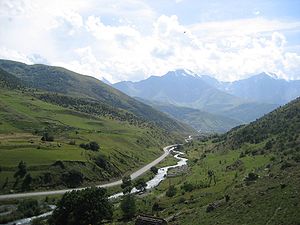 The republic is in the northern Caucasus
. The northern part of the republic is situated in the Stavropol Plain. 22% of the republic's territory is covered by forests.
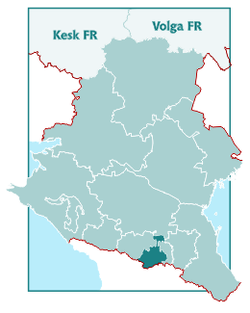
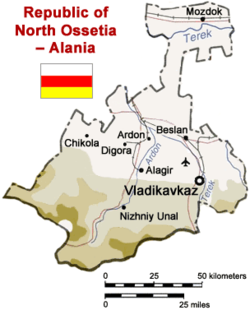 All of the mountains located on the territory of the republic are a part of the Caucasus. Mount Kazbek is the highest point (5,033 m), with Mount Dzhimara
being the second highest (4,780 m).
, silver
, zinc
), timber
, mineral water
s, hydroelectric power, and untapped reserves of oil
and gas
.
.
The Ossetian population of North Ossetia is predominantly Christian
with a Muslim minority, speaking Ossetic
and Russian
.
According to the 2002 Census
, Ossetians
make up 62.7% of the republic's population. Other groups include Russians
(23.2%), Ingush
(3.0%), Armenians
(2.4%), Kumyks
(12,659, or 1.8%), Georgians
(10,803, or 1.5%), Ukrainians
(0.7%), Chechens
(3,383, or 0.5%), and a host of smaller groups, each accounting for less than 0.5% of the total population. 3,283 people (0.5%) did not indicate their nationalities during the Census.
, who voluntarily quit his post on May 31, 2005.
pro capita of the region in 2006 was 61,000 rubles ($2,596), and increased 30% in the 2005-2007 time period. GRP pro capita in 2007 was 76 455 rubles. In 2005-2007, the average monthly wage in North Ossetia–Alania doubled, with the actual cash earnings increased by 42.5 percent. In terms of the average monthly wage growth, the republic ranks first in the North Caucasus.
The regional government's economic priorities include industrial growth, development of small enterprise, spas, and resorts, and strengthening the budgetary and tax discipline.
- and lead
-containing complex ores. There are deposits of limestone
, dolomites
, marble
and touchstone. There is also a large availability of construction materials, such as clay
, sand
and gravel
. The local oil
deposit reserves are estimated at
10 million metric tons.
Agricultural sector is varied and specializes in the cultivation of wheat, corn, and sunflowers; horticulture; viticulture; and cattle and sheep breeding.
North Ossetia's industry is mainly concentrated in Vladikavkaz
. Major companies located here include Elektrotsink, Gazoapparat, an instrument-making plant, Elektrokontraktor, a factory producing automotive electrical equipment, a large-panel construction complex, and companies in the food industry. The Sadonsky industrial center has grown around the mining and forest industries.
and 10th in the nation. The republic has some of the most extensive telecommunication networks in the North Caucasus region
and in Russia
. It ranks first in terms of its telecom network installations in the Southern Federal District.
The republic ranks fourth in Russia in terms of its paved roads, and its expanding transport and logistics complex provides communication networks between Russia and the South Caucasus, as well as Central Asia. The complex includes two federal highways (Georgian Military Road
connects Vladikavkaz with Transcaucasia) running across the Greater Caucasus Range, two customs checkpoints for cars, a developed railway network, Vladikavkaz international airport, and well-equipped transport terminals.
, followed by Islam. Many of the native rituals predate both faiths.
Federal subjects of Russia
Russia is a federation which, since March 1, 2008, consists of 83 federal subjects . In 1993, when the Constitution was adopted, there were 89 federal subjects listed...
of Russia
Russia
Russia or , officially known as both Russia and the Russian Federation , is a country in northern Eurasia. It is a federal semi-presidential republic, comprising 83 federal subjects...
(a republic
Republics of Russia
The Russian Federation is divided into 83 federal subjects , 21 of which are republics. The republics represent areas of non-Russian ethnicity. The indigenous ethnic group of a republic that gives it its name is referred to as the "titular nationality"...
). Its population according to the 2010 Census was 712,877.
Name
In the last years of the Soviet UnionSoviet Union
The Soviet Union , officially the Union of Soviet Socialist Republics , was a constitutionally socialist state that existed in Eurasia between 1922 and 1991....
, as nationalist movements swept throughout the Caucasus, many intellectuals in the North Ossetian ASSR called for the revival of the name of Alania
Alania
Alania may refer to:*Alania, the medieval state of the Alans or Alani people in the North Caucasus*The short name of the modern North Ossetia-Alania, one of the Caucasian republics in the Russian Federation...
, a medieval kingdom of the Alans
Alans
The Alans, or the Alani, occasionally termed Alauni or Halani, were a group of Sarmatian tribes, nomadic pastoralists of the 1st millennium AD who spoke an Eastern Iranian language which derived from Scytho-Sarmatian and which in turn evolved into modern Ossetian.-Name:The various forms of Alan —...
, ancestors of the modern-day Ossetians
Ossetians
The Ossetians are an Iranic ethnic group of the Caucasus Mountains, eponymous of the region known as Ossetia.They speak Ossetic, an Iranian language of the Eastern branch, with most also fluent in Russian as a second language....
. The term of "Alania" quickly became popular in Ossetian daily life through the names of various enterprises, a TV channel, political and civic organizations, publishing house, soccer team, etc. In November 1994, the name of "Alania" was officially added to the republican title (Republic of North Ossetia–Alania).
Early history
The territory of North Ossetia was first inhabited by Caucasian tribes. Some NomadNomad
Nomadic people , commonly known as itinerants in modern-day contexts, are communities of people who move from one place to another, rather than settling permanently in one location. There are an estimated 30-40 million nomads in the world. Many cultures have traditionally been nomadic, but...
ic Alans
Alans
The Alans, or the Alani, occasionally termed Alauni or Halani, were a group of Sarmatian tribes, nomadic pastoralists of the 1st millennium AD who spoke an Eastern Iranian language which derived from Scytho-Sarmatian and which in turn evolved into modern Ossetian.-Name:The various forms of Alan —...
settled in the region in the 7th century, forming the kingdom of Alania
Alania
Alania may refer to:*Alania, the medieval state of the Alans or Alani people in the North Caucasus*The short name of the modern North Ossetia-Alania, one of the Caucasian republics in the Russian Federation...
. It was converted to Christianity
Christianity
Christianity is a monotheistic religion based on the life and teachings of Jesus as presented in canonical gospels and other New Testament writings...
by missionaries from Byzantium. Alania greatly profited from the Silk Road
Silk Road
The Silk Road or Silk Route refers to a historical network of interlinking trade routes across the Afro-Eurasian landmass that connected East, South, and Western Asia with the Mediterranean and European world, as well as parts of North and East Africa...
which passed through its territory.
After the Middle Ages
Middle Ages
The Middle Ages is a periodization of European history from the 5th century to the 15th century. The Middle Ages follows the fall of the Western Roman Empire in 476 and precedes the Early Modern Era. It is the middle period of a three-period division of Western history: Classic, Medieval and Modern...
, the Mongols
Mongols
Mongols ) are a Central-East Asian ethnic group that lives mainly in the countries of Mongolia, China, and Russia. In China, ethnic Mongols can be found mainly in the central north region of China such as Inner Mongolia...
' and Tartars' repeated invasions decimated the population, now known as the Ossetians
Ossetians
The Ossetians are an Iranic ethnic group of the Caucasus Mountains, eponymous of the region known as Ossetia.They speak Ossetic, an Iranian language of the Eastern branch, with most also fluent in Russian as a second language....
. Islam
Islam
Islam . The most common are and . : Arabic pronunciation varies regionally. The first vowel ranges from ~~. The second vowel ranges from ~~~...
was introduced to the region in the 17th century by Kabard
Kabard
Kabarda or Kabard ; are terms referring to a people of the northern Caucasus more commonly known by the plural term Kabardin . Originally they Kabarda or Kabard ; are terms referring to a people of the northern Caucasus more commonly known by the plural term Kabardin (or Kebertei as they term...
ians. Conflicts between the Khanate of Crimea and the Ottoman Empire
Ottoman Empire
The Ottoman EmpireIt was usually referred to as the "Ottoman Empire", the "Turkish Empire", the "Ottoman Caliphate" or more commonly "Turkey" by its contemporaries...
eventually pushed Ossetia into an alliance with Imperial Russia in the 18th century. Soon, Russia established a military base in the capital, Vladikavkaz
Vladikavkaz
-Notable structures:In Vladikavkaz, there is a guyed TV mast, tall, built in 1961, which has six crossbars with gangways in two levels running from the mast structure to the guys.-Twin towns/sister cities:...
, making it the first Russian-controlled area in the northern Caucasus. By 1806, Ossetia was under complete Russian control.
Russian/Soviet rule
The Russians' rule led to rapid development of industry and railways which overcame its isolation. The first books from the area came during the late 18th century, and became part of the Terskaya Region of Russia in the mid-19th century.The Russian Revolution of 1917 resulted in North Ossetia being merged into the Soviet Mountain Republic
Soviet Mountain Republic
Mountain Autonomous Soviet Socialist Republic or Mountain ASSR was a short-lived autonomous republic within the Russian SFSR in the Northern Caucasus that existed from January 20, 1921 to July 7, 1924....
in 1921. It then became the North Ossetian Autonomous Oblast
North Ossetian Autonomous Oblast
The North Ossetian Autonomous Oblast was created 1924-07-07....
on 7 July 1924, then merged into the North Ossetian Autonomous Soviet Socialist Republic
North Ossetian Autonomous Soviet Socialist Republic
The North Ossetian Autonomous Soviet Socialist Republic was an autonomous republic of the Soviet Union. Currently it is known as North Ossetia-Alania, a federal subject of Russia....
on 5 December 1936. In World War II
World War II
World War II, or the Second World War , was a global conflict lasting from 1939 to 1945, involving most of the world's nations—including all of the great powers—eventually forming two opposing military alliances: the Allies and the Axis...
, it was subject to a number of attacks by Nazi German invaders
Nazi Germany
Nazi Germany , also known as the Third Reich , but officially called German Reich from 1933 to 1943 and Greater German Reich from 26 June 1943 onward, is the name commonly used to refer to the state of Germany from 1933 to 1945, when it was a totalitarian dictatorship ruled by...
unsuccessfully trying to seize Vladikavkaz
Vladikavkaz
-Notable structures:In Vladikavkaz, there is a guyed TV mast, tall, built in 1961, which has six crossbars with gangways in two levels running from the mast structure to the guys.-Twin towns/sister cities:...
in 1942.
The North Ossetian SSR declared itself the autonomous republic of the Soviet Union on June 20, 1990. Its name was changed to Republic of North Ossetia–Alania in 1991.
Post-Soviet rule
The Soviet Union's collapse posed particular problems for the Ossetian people, who were divided between North Ossetia, which was part of the Russian SFSR, and South OssetiaSouth Ossetia
South Ossetia or Tskhinvali Region is a disputed region and partly recognized state in the South Caucasus, located in the territory of the South Ossetian Autonomous Oblast within the former Georgian Soviet Socialist Republic....
, part of the Georgian SSR. In December 1990 the Supreme Soviet of Georgia abolished the autonomous Ossetian enclave amid the rising ethnic tensions in the region
Georgian-Ossetian conflict
The Georgian–Ossetian conflict refers to the ethno-political conflict in Georgia's autonomous region of South Ossetia, which evolved in 1989 and developed into a 1991–1992 South Ossetia War. Despite a declared ceasefire and numerous peace efforts, the conflict remains unresolved, and minor armed...
, and much of the population fled across the border to North Ossetia or Georgia proper. Some 70,000 South Ossetian refugees were resettled in North Ossetia, sparking clashes with the predominantly Ingush population in the Prigorodny District. That led to the Ossetian–Ingush conflict.
As well as dealing with the effects of the conflict in South Ossetia, North Ossetia has had to deal with refugees and the occasional spillover of fighting from the war in neighboring Chechnya
Chechnya
The Chechen Republic , commonly referred to as Chechnya , also spelled Chechnia or Chechenia, sometimes referred to as Ichkeria , is a federal subject of Russia . It is located in the southeastern part of Europe in the Northern Caucasus mountains. The capital of the republic is the city of Grozny...
. The bloodiest incident by far was the September 2004 Beslan hostage crisis, in which Chechen
Chechen people
Chechens constitute the largest native ethnic group originating in the North Caucasus region. They refer to themselves as Noxçi . Also known as Sadiks , Gargareans, Malkhs...
insurgents attributed to Shamil Basayev
Shamil Basayev
Shamil Salmanovich Basayev was a Chechen militant Islamist and a leader of the Chechen rebel movement.Starting as a field commander in the Transcaucasus, Basayev led guerrilla campaigns against the Russian troops for years, as well as launching mass-hostage takings of civilians, with his goal...
(who alternatingly denied and claimed responsibility) seized control of a school. In the firefight between the terrorists and Russian forces that ended the crisis, 335 civilians, the majority of them children, died.
Geography
Caucasus
The Caucasus, also Caucas or Caucasia , is a geopolitical region at the border of Europe and Asia, and situated between the Black and the Caspian sea...
. The northern part of the republic is situated in the Stavropol Plain. 22% of the republic's territory is covered by forests.
- Area: 8000 km² (3,088.8 sq mi)
- Borders:
- internal: Kabardino-Balkar RepublicKabardino-BalkariaThe Kabardino-Balkar Republic , or Kabardino-Balkaria , is a federal subject of Russia located in the North Caucasus. Population: -Geography:The republic is situated in the North Caucasus mountains, with plains in the northern part....
(W/NW/N), Stavropol KraiStavropol KraiStavropol Krai is a federal subject of Russia . Its administrative center is the city of Stavropol. Population: -Geography:Stavropol Krai encompasses the central part of the Fore-Caucasus and most of the northern slopes of Caucasus Major...
(N), Chechen RepublicChechnyaThe Chechen Republic , commonly referred to as Chechnya , also spelled Chechnia or Chechenia, sometimes referred to as Ichkeria , is a federal subject of Russia . It is located in the southeastern part of Europe in the Northern Caucasus mountains. The capital of the republic is the city of Grozny...
(NE/E), Republic of IngushetiaIngushetiaThe Republic of Ingushetia is a federal subject of Russia , located in the North Caucasus region with its capital at Magas. In terms of area, the republic is the smallest of Russia's federal subjects except for the two federal cities, Moscow and Saint Petersburg...
(E/SE) - international: GeorgiaGeorgia (country)Georgia is a sovereign state in the Caucasus region of Eurasia. Located at the crossroads of Western Asia and Eastern Europe, it is bounded to the west by the Black Sea, to the north by Russia, to the southwest by Turkey, to the south by Armenia, and to the southeast by Azerbaijan. The capital of...
(including South OssetiaSouth OssetiaSouth Ossetia or Tskhinvali Region is a disputed region and partly recognized state in the South Caucasus, located in the territory of the South Ossetian Autonomous Oblast within the former Georgian Soviet Socialist Republic....
) (SE/S/SW)
- internal: Kabardino-Balkar Republic
- Highest point: Mount Kazbek (5033 m (16,512.5 ft))
- Maximum N->S distance: 130 km (80.8 mi)
- Maximum E->W distance: 120 km (74.6 mi)
Rivers
All of the republic's rivers belong to the basin of the Terek River. Major rivers include:- Terek River (~600 km)
- Urukh RiverUrukh RiverUrukh River, known as Kharves in its upper reaches |Digor]]: Ирæф, Iræf), is a river in North Ossetia-Alania and Kabardino-Balkaria , a left tributary of the Terek River. The length of the Urukh is 104 km, the area of its drainage basin is 1280 km². The Urukh originates in the glaciers of the...
(104 km) - Ardon RiverArdon RiverArdon River is a river in North Ossetia-Alania in Russia, a left tributary of the Terek River. The length of the Ardon is 102 km, the area of its drainage basin is 2700 km². The Ardon originates in the glaciers of the Greater Caucasus. The Ossetian Military Road crosses the valley of the Ardon...
(101 km) - Kambileyevka River (99 km)
- Gizeldon River (81 km)
- Fiagdon RiverFiagdon RiverFiagdon is a river in North Ossetia-Alania , a left tributary of the Terek River. The length of the Fiagdon is 74 km. Verkhny Fiagdon and Dzuarikau are one of the major villages that lie on Fiagdon River....
- Sunzha RiverSunzha RiverThe Sunzha is a river in North Ossetia, Ingushetia and Chechnya, Russia, a right tributary of Terek River. It is 278 km long. The Sunzha rises on the Northern slope of the Caucasus Major. Its major tributaries are the Assa River and Argun River. With a turbidity of 3,800 g/m³, it carries 12,2...
(278 km)
Mountains
Mount Dzhimara
Mount Dzhimara or Jimara is the second highest point of North Ossetia-Alania, a Russian republic, with an altitude of . It is located on the border between Russia and Georgia....
being the second highest (4,780 m).
Natural resources
Natural resources include minerals (copperCopper
Copper is a chemical element with the symbol Cu and atomic number 29. It is a ductile metal with very high thermal and electrical conductivity. Pure copper is soft and malleable; an exposed surface has a reddish-orange tarnish...
, silver
Silver
Silver is a metallic chemical element with the chemical symbol Ag and atomic number 47. A soft, white, lustrous transition metal, it has the highest electrical conductivity of any element and the highest thermal conductivity of any metal...
, zinc
Zinc
Zinc , or spelter , is a metallic chemical element; it has the symbol Zn and atomic number 30. It is the first element in group 12 of the periodic table. Zinc is, in some respects, chemically similar to magnesium, because its ion is of similar size and its only common oxidation state is +2...
), timber
Timber
Timber may refer to:* Timber, a term common in the United Kingdom and Australia for wood materials * Timber, Oregon, an unincorporated community in the U.S...
, mineral water
Mineral water
Mineral water is water containing minerals or other dissolved substances that alter its taste or give it therapeutic value, generally obtained from a naturally occurring mineral spring or source. Dissolved substances in the water may include various salts and sulfur compounds...
s, hydroelectric power, and untapped reserves of oil
Petroleum
Petroleum or crude oil is a naturally occurring, flammable liquid consisting of a complex mixture of hydrocarbons of various molecular weights and other liquid organic compounds, that are found in geologic formations beneath the Earth's surface. Petroleum is recovered mostly through oil drilling...
and gas
Gas
Gas is one of the three classical states of matter . Near absolute zero, a substance exists as a solid. As heat is added to this substance it melts into a liquid at its melting point , boils into a gas at its boiling point, and if heated high enough would enter a plasma state in which the electrons...
.
Climate
Climate is moderately continentalContinental climate
Continental climate is a climate characterized by important annual variation in temperature due to the lack of significant bodies of water nearby...
.
- Average January temperature: −5 °C
- Average July temperature: 24 °C (75.2 °F)
- Average annual precipitationPrecipitation (meteorology)In meteorology, precipitation In meteorology, precipitation In meteorology, precipitation (also known as one of the classes of hydrometeors, which are atmospheric water phenomena is any product of the condensation of atmospheric water vapor that falls under gravity. The main forms of precipitation...
: 400–700 mm in the plains, over 1,000 mm in the mountains.
Demographics
- Population:
- Population:
- Urban: 464,875 (65.5%)
- Rural: 245,400 (34.5%)
- Male: 336,035 (47.3%)
- Female: 374,240 (52.7%)
- Females per 1000 males: 1,114
- Average age: 33.8 years
- Urban: 34.2 years
- Rural: 32.9 years
- Male: 30.4 years
- Female: 36.9 years
- Number of households: 200,191 (with 690,806 people)
- Urban: 143,397 (with 447,884 people)
- Rural: 56,794 (with 242,922 people)
- Vital statistics
- Source: Russian Federal State Statistics Service
| Births | Deaths | Birth rate | Death rate | |
|---|---|---|---|---|
| 1970 | 9,731 | 3,964 | 17.6 | 7.2 |
| 1975 | 10,368 | 4,664 | 18.0 | 8.1 |
| 1980 | 10,135 | 5,821 | 16.9 | 9.7 |
| 1985 | 11,598 | 6,047 | 18.8 | 9.8 |
| 1990 | 10,967 | 6,166 | 16.9 | 9.5 |
| 1991 | 10,985 | 6,694 | 16.2 | 9.9 |
| 1992 | 10,048 | 7,125 | 14.7 | 10.4 |
| 1993 | 8,251 | 7,872 | 12.5 | 11.9 |
| 1994 | 8,806 | 8,329 | 13.2 | 12.5 |
| 1995 | 8,781 | 8,574 | 13.0 | 12.7 |
| 1996 | 8,043 | 8,514 | 11.8 | 12.5 |
| 1997 | 7,758 | 8,378 | 11.4 | 12.3 |
| 1998 | 7,767 | 8,188 | 11.4 | 12.0 |
| 1999 | 7,195 | 8,412 | 10.4 | 12.2 |
| 2000 | 7,179 | 8,626 | 10.3 | 12.3 |
| 2001 | 7,317 | 8,205 | 10.3 | 11.6 |
| 2002 | 7,874 | 8,753 | 11.1 | 12.3 |
| 2003 | 7,978 | 8,952 | 11.3 | 12.6 |
| 2004 | 7,893 | 8,663 | 11.2 | 12.3 |
| 2005 | 7,894 | 8,654 | 11.2 | 12.3 |
| 2006 | 8,308 | 8,138 | 11.8 | 11.6 |
| 2007 | 9,556 | 7,806 | 13.6 | 11.1 |
| 2008 | 9,981 | 7,975 | 14.2 | 11.4 |
- Ethnic groups
The Ossetian population of North Ossetia is predominantly Christian
Christian
A Christian is a person who adheres to Christianity, an Abrahamic, monotheistic religion based on the life and teachings of Jesus of Nazareth as recorded in the Canonical gospels and the letters of the New Testament...
with a Muslim minority, speaking Ossetic
Ossetic language
Ossetian , also sometimes called Ossete, is an East Iranian language spoken in Ossetia, a region on the slopes of the Caucasus Mountains....
and Russian
Russian language
Russian is a Slavic language used primarily in Russia, Belarus, Uzbekistan, Kazakhstan, Tajikistan and Kyrgyzstan. It is an unofficial but widely spoken language in Ukraine, Moldova, Latvia, Turkmenistan and Estonia and, to a lesser extent, the other countries that were once constituent republics...
.
According to the 2002 Census
Russian Census (2002)
Russian Census of 2002 was the first census of the Russian Federation carried out on October 9 through October 16, 2002. It was carried out by the Russian Federal Service of State Statistics .-Resident population:...
, Ossetians
Ossetians
The Ossetians are an Iranic ethnic group of the Caucasus Mountains, eponymous of the region known as Ossetia.They speak Ossetic, an Iranian language of the Eastern branch, with most also fluent in Russian as a second language....
make up 62.7% of the republic's population. Other groups include Russians
Russians
The Russian people are an East Slavic ethnic group native to Russia, speaking the Russian language and primarily living in Russia and neighboring countries....
(23.2%), Ingush
Ingush people
The Ingush are a native ethnic group of the North Caucasus, mostly inhabiting the Russian republic of Ingushetia. They refer to themselves as Ghalghai . The Ingush are predominantly Sunni Muslims and speak the Ingush language...
(3.0%), Armenians
Armenians
Armenian people or Armenians are a nation and ethnic group native to the Armenian Highland.The largest concentration is in Armenia having a nearly-homogeneous population with 97.9% or 3,145,354 being ethnic Armenian....
(2.4%), Kumyks
Kumyks
Kumyks are a Turkic people occupying the Kumyk plateau in north Dagestan and south Terek, and the lands bordering the Caspian Sea. They comprise 14% of the population of the Russian republic of Dagestan. They speak the Kumyk language...
(12,659, or 1.8%), Georgians
Georgian people
The Georgians are an ethnic group that have originated in Georgia, where they constitute a majority of the population. Large Georgian communities are also present throughout Russia, European Union, United States, and South America....
(10,803, or 1.5%), Ukrainians
Ukrainians
Ukrainians are an East Slavic ethnic group native to Ukraine, which is the sixth-largest nation in Europe. The Constitution of Ukraine applies the term 'Ukrainians' to all its citizens...
(0.7%), Chechens
Chechen people
Chechens constitute the largest native ethnic group originating in the North Caucasus region. They refer to themselves as Noxçi . Also known as Sadiks , Gargareans, Malkhs...
(3,383, or 0.5%), and a host of smaller groups, each accounting for less than 0.5% of the total population. 3,283 people (0.5%) did not indicate their nationalities during the Census.
| census 1926 | census 1939 | census 1959 | census 1970 | census 1979 | census 1989 | census 2002 | |
|---|---|---|---|---|---|---|---|
| Ossetians Ossetians The Ossetians are an Iranic ethnic group of the Caucasus Mountains, eponymous of the region known as Ossetia.They speak Ossetic, an Iranian language of the Eastern branch, with most also fluent in Russian as a second language.... |
139,120 (60.3%) | 165,616 (50.3%) | 215,463 (47.8%) | 269,326 (48.7%) | 299,022 (50.5%) | 334,876 (53.0%) | 445,310 (62.7%) |
| Russians Russians The Russian people are an East Slavic ethnic group native to Russia, speaking the Russian language and primarily living in Russia and neighboring countries.... |
50,272 (21.8%) | 122,614 (37.2%) | 178,654 (39.6%) | 202,367 (36.6%) | 200,692 (33.9%) | 189,159 (29.9%) | 164,734 (23.2%) |
| Ingush Ingush people The Ingush are a native ethnic group of the North Caucasus, mostly inhabiting the Russian republic of Ingushetia. They refer to themselves as Ghalghai . The Ingush are predominantly Sunni Muslims and speak the Ingush language... |
1,540 (0.7%) | 6,106 (1.9%) | 6,071 (1.3%) | 18,387 (3.3%) | 23,663 (4.0%) | 32,783 (5.2%) | 21,442 (3.0%) |
| Armenians Armenians Armenian people or Armenians are a nation and ethnic group native to the Armenian Highland.The largest concentration is in Armenia having a nearly-homogeneous population with 97.9% or 3,145,354 being ethnic Armenian.... |
6,921 (3.0%) | 8,932 (2.7%) | 12,012 (2.7%) | 13,355 (2.4%) | 12,912 (2.2%) | 13,619 (2.2%) | 17,147 (2.4%) |
| Ukrainians Ukrainians Ukrainians are an East Slavic ethnic group native to Ukraine, which is the sixth-largest nation in Europe. The Constitution of Ukraine applies the term 'Ukrainians' to all its citizens... |
14,282 (6.2%) | 7,063 (2.1%) | 9,362 (2.1%) | 9,250 (1.7%) | 10,574 (1.8%) | 10,088 (1.6%) | 5,198 (0.7%) |
| Others | 18,646 (8.1%) | 18,874 (5.7%) | 29,019 (6.4%) | 39,896 (7.2%) | 45,139 (7.6%) | 51,903 (8.2%) | 56,444 (7.9%) |
- Number of Refugees: 12,570
Politics
The head of government in the Republic of North Ossetia–Alania is the Head of the Republic. As of 2008, the head of the republic is Taymuraz Mamsurov. Mamsurov succeeded Alexander DzasokhovAlexander Dzasokhov
Alexander Dzasokhov is the former head of the Republic of North Ossetia-Alania.He was born April 3, 1934 in Vladikavkaz, graduated in 1957 from the North Caucasus Mining Metallurgical Institute and holds a doctorate in politics. From 1992 - 1993, he was a people's deputy of Russian Federation and...
, who voluntarily quit his post on May 31, 2005.
Economy
In recent years, North Ossetia–Alania's economic development has been successful; the indicators of the republic's social and economic development in 2005-2007 revealed a stable growth of all sectors of the economy and major social parameters. The nature and climatic conditions of the republic contribute to the successful development of various economic sectors, which is compounded by the abundance of natural resources. Gross regional productGross Regional Product
A metropolitan area's gross regional product, i.e. GMP or GRP, is one of several measures of the size of its economy. Similar to GDP, GRP is defined as the market value of all final goods and services produced within a metropolitan area in a given period of time.-See also:*List of European...
pro capita of the region in 2006 was 61,000 rubles ($2,596), and increased 30% in the 2005-2007 time period. GRP pro capita in 2007 was 76 455 rubles. In 2005-2007, the average monthly wage in North Ossetia–Alania doubled, with the actual cash earnings increased by 42.5 percent. In terms of the average monthly wage growth, the republic ranks first in the North Caucasus.
The regional government's economic priorities include industrial growth, development of small enterprise, spas, and resorts, and strengthening the budgetary and tax discipline.
Natural resources, agriculture, and industry
The most widespread resources are zincZinc
Zinc , or spelter , is a metallic chemical element; it has the symbol Zn and atomic number 30. It is the first element in group 12 of the periodic table. Zinc is, in some respects, chemically similar to magnesium, because its ion is of similar size and its only common oxidation state is +2...
- and lead
Lead
Lead is a main-group element in the carbon group with the symbol Pb and atomic number 82. Lead is a soft, malleable poor metal. It is also counted as one of the heavy metals. Metallic lead has a bluish-white color after being freshly cut, but it soon tarnishes to a dull grayish color when exposed...
-containing complex ores. There are deposits of limestone
Limestone
Limestone is a sedimentary rock composed largely of the minerals calcite and aragonite, which are different crystal forms of calcium carbonate . Many limestones are composed from skeletal fragments of marine organisms such as coral or foraminifera....
, dolomites
Dolomites
The Dolomites are a mountain range located in north-eastern Italy. It is a part of Southern Limestone Alps and extends from the River Adige in the west to the Piave Valley in the east. The northern and southern borders are defined by the Puster Valley and the Sugana Valley...
, marble
Marble
Marble is a metamorphic rock composed of recrystallized carbonate minerals, most commonly calcite or dolomite.Geologists use the term "marble" to refer to metamorphosed limestone; however stonemasons use the term more broadly to encompass unmetamorphosed limestone.Marble is commonly used for...
and touchstone. There is also a large availability of construction materials, such as clay
Clay
Clay is a general term including many combinations of one or more clay minerals with traces of metal oxides and organic matter. Geologic clay deposits are mostly composed of phyllosilicate minerals containing variable amounts of water trapped in the mineral structure.- Formation :Clay minerals...
, sand
Sand
Sand is a naturally occurring granular material composed of finely divided rock and mineral particles.The composition of sand is highly variable, depending on the local rock sources and conditions, but the most common constituent of sand in inland continental settings and non-tropical coastal...
and gravel
Gravel
Gravel is composed of unconsolidated rock fragments that have a general particle size range and include size classes from granule- to boulder-sized fragments. Gravel can be sub-categorized into granule and cobble...
. The local oil
Oil
An oil is any substance that is liquid at ambient temperatures and does not mix with water but may mix with other oils and organic solvents. This general definition includes vegetable oils, volatile essential oils, petrochemical oils, and synthetic oils....
deposit reserves are estimated at
10 million metric tons.
Agricultural sector is varied and specializes in the cultivation of wheat, corn, and sunflowers; horticulture; viticulture; and cattle and sheep breeding.
North Ossetia's industry is mainly concentrated in Vladikavkaz
Vladikavkaz
-Notable structures:In Vladikavkaz, there is a guyed TV mast, tall, built in 1961, which has six crossbars with gangways in two levels running from the mast structure to the guys.-Twin towns/sister cities:...
. Major companies located here include Elektrotsink, Gazoapparat, an instrument-making plant, Elektrokontraktor, a factory producing automotive electrical equipment, a large-panel construction complex, and companies in the food industry. The Sadonsky industrial center has grown around the mining and forest industries.
Tourism
Despite the proximity to Chechnya, North Ossetia is making efforts to develop its tourist industry. Projects under a program for spa, resort, and tourism development have been successfully implemented in the mountainous part of the republic, according to the head of the regional government. There are nearly 3000 historical monuments in the republic and more than half of the its area is occupied bv Alania National Park, the North Ossetia National Preserve, and game preserves. There are more than 250 therapeutic, mineral, and freshwater springs in the republic with estimated daily reserves of 15,000 cubic meters. Besides providing the basis for health spas, these mineral waters also have the potential to be bottled and sold. North Ossetian mineral waters are known for their unique qualities, as well as special mineral composition.Infrastructure
In terms of its infrastructure, North Ossetia–Alania ranks second in the Southern Federal DistrictSouthern Federal District
Southern Federal District is one of the eight federal districts of Russia. Its territory lies mostly on the Pontic-Caspian steppe. Its population was 13,856,700 according to the 2010 Census, living on an area of...
and 10th in the nation. The republic has some of the most extensive telecommunication networks in the North Caucasus region
North Caucasus
The North Caucasus is the northern part of the Caucasus region between the Black and Caspian Seas and within European Russia. The term is also used as a synonym for the North Caucasus economic region of Russia....
and in Russia
Russia
Russia or , officially known as both Russia and the Russian Federation , is a country in northern Eurasia. It is a federal semi-presidential republic, comprising 83 federal subjects...
. It ranks first in terms of its telecom network installations in the Southern Federal District.
The republic ranks fourth in Russia in terms of its paved roads, and its expanding transport and logistics complex provides communication networks between Russia and the South Caucasus, as well as Central Asia. The complex includes two federal highways (Georgian Military Road
Georgian Military Road
The Georgian Military Road is the historic name for a major route through the Caucasus from Georgia to Russia. Alternative routes across the mountains include the Ossetian Military Road and the Transkam.-Route:...
connects Vladikavkaz with Transcaucasia) running across the Greater Caucasus Range, two customs checkpoints for cars, a developed railway network, Vladikavkaz international airport, and well-equipped transport terminals.
Culture
There are six professional theaters in North Ossetia–Alania, as well as Ossetian State Philarmonia.Education
The most important facilities of higher education include North Caucasus State Technological University, North Ossetian State University, North Ossetian State Medical Academy, and Mountain State Agrarian University; all in Vladikavkaz.Religion
The predominant religion in the republic is Russian Orthodox ChristianityRussian Orthodox Church
The Russian Orthodox Church or, alternatively, the Moscow Patriarchate The ROC is often said to be the largest of the Eastern Orthodox churches in the world; including all the autocephalous churches under its umbrella, its adherents number over 150 million worldwide—about half of the 300 million...
, followed by Islam. Many of the native rituals predate both faiths.