


Norte Chico civilization

Encyclopedia
The Norte Chico civilization ( dated from 9210 BCE -1800 BCE, also Caral or Caral-Supe civilization) was a complex pre-Columbian
society that included as many as 30 major population centers in what is now the Norte Chico region of north-central coastal Peru
. It is the oldest known civilization in the Americas and one of the six sites
where civilization separately originated in the ancient world. It flourished between the 30th century BC and the 18th century BC. The alternative name, Caral-Supe, is derived from the Sacred City of Caral in the Supe Valley, a large and well-studied Norte Chico site. Complex society in Norte Chico arose a millennium after Sumer
in Mesopotamia
, was contemporaneous with the Egyptian pyramids
, and predated the Mesoamerican Olmec
by nearly two millennia.
In archaeological nomenclature, Norte Chico is a pre-ceramic culture of the pre-Columbian Late Archaic
; it completely lacked ceramic
s and apparently had almost no art. The most impressive achievement of the civilization was its monumental architecture, including large earthwork
platform mound
s and sunken circular plaza
s. Archaeological evidence suggests use of textile
technology and, possibly, the worship of common god symbols, both of which recur in pre-Columbian Andean cultures. Sophisticated government is assumed to have been required to manage the ancient Norte Chico. Questions remain over its organization, particularly the impact of food resources on politics.
Archaeologists have been aware of ancient sites in the area since at least the 1940s; early work occurred at Aspero
on the coast, a site identified as early as 1905, and later at Caral further inland.
It was not until the late 1990s that Peruvian archaeologists, led by Ruth Shady Solís, provided the first extensive documentation of the civilization with work at Caral. A 2001 paper in Science
, providing a survey of the Caral research, and a 2004 article in Nature, describing fieldwork and radiocarbon dating
across a wider area, revealed Norte Chico's full significance and led to widespread interest.
, in the Western Hemisphere. Norte Chico has pushed back the horizon for complex societies in the Peruvian region by more than one thousand years. The Chavín culture
, circa 900 BC, had long been considered the first civilization of the area. It is still regularly cited as such in general works.
The discovery of Norte Chico has also shifted the focus of research away from the highland areas of the Andes and lowlands adjacent to the mountains (where the Chavín, and later Inca, had their major centers) to the Peruvian littoral
, or coastal regions. Norte Chico is located in a north-central area of the coast, approximately 150 to 200 km
north of Lima
, roughly bounded by the Lurín Valley on the south and the Casma Valley
on the north. It comprises four coastal valleys: the Huaura, Supe, Pativilca, and Fortaleza; known sites are concentrated in the latter three, which share a common coastal plain. The three principal valleys cover only 1,800 km², and research has emphasized the density of the population centers.
The Peruvian littoral appears an "improbable, even aberrant" candidate for the "pristine" development of civilization, compared to other world centers. It is extremely arid, bounded by two rain shadow
s (caused by the Andes to the east, and the Pacific trade wind
s to the west). The region is punctuated by more than 50 rivers that carry Andean snowmelt. The development of widespread irrigation
from these water sources is seen as decisive in the emergence of Norte Chico; all of the monumental architecture at various sites has been found close to irrigation channels.
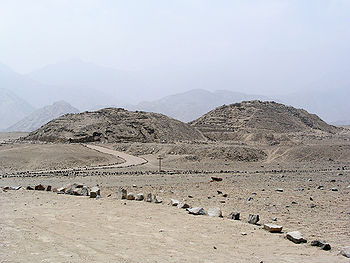 The radiocarbon work
of Jonathan Haas et al., found that 10 of 95 samples taken in the Pativilca and Fortaleza areas dated from before 3500 BC; the oldest, dating from 9210 BC, provides "limited indication" of human settlement during the Pre-Columbian Early Archaic era. Two dates of 3700 BC are associated with communal architecture, but are likely to be anomalous. It is from 3200 BC onward that large-scale human settlement and communal construction are clearly apparent. Mann, in a survey of the literature in 2005, suggests "sometime before 3200 BC, and possibly before 3500 BC" as the beginning date of the Norte Chico formative period. He notes that the earliest date securely associated with a city is 3500 BC, at Huaricanga, in the Fortaleza area of the north, based on Haas' dates.
Haas' early third millennium dates suggest that the development of coastal and inland sites occurred in parallel. But, from 2500 to 2000 BC, during the period of greatest expansion, the population and development decisively shifted toward the inland sites. All development apparently occurred at large interior sites such as Caral, though they remained dependent on fish and shellfish from the coast. The peak in dates is in keeping with Shady's dates at Caral, which show habitation from 2627 BC to 2020 BC. That coastal and inland sites developed in tandem remains disputed, however (see next section).
Circa 1800 BC, the Norte Chico civilization began to decline, with more powerful centers appearing to the south and north along the coast, and to the east inside the belt of the Andes. Norte Chico's success at irrigation-based agriculture may have contributed to its being eclipsed. One researcher notes that "when this civilization is in decline, we begin to find extensive canals farther north. People were moving to more fertile ground and taking their knowledge of irrigation with them." It would be a thousand years before the rise of the next great Peruvian culture, the Chavín
.
s noted by Shady are squash, beans, lucuma
, guava
, pacay
, and camote. Haas et al. noted the same foods in their survey further north, while adding avocado
and achira
. There was also a significant seafood
component, at both coastal and inland sites. Shady notes that "animal remains are almost exclusively marine" at Caral, including clam
s and mussel
s, and large amounts of anchovies
and sardine
s. That the anchovy fish reached inland is clear, although Haas suggests that "shellfish
[which would include clams and mussels], sea mammals, and seaweed
do not appear to have been significant portions of the diet in the inland, non-maritime sites".
confirmed a previously observed lack of ceramics at Aspero, and deduced that "hummock
s" on the site constituted the remains of artificial platform mounds. Most provocatively, he contended that a maritime subsistence (seafood) economy had been the basis of the society and its remarkably early flourishing, a theory later elaborated as a "maritime foundation of Andean civilization" (MFAC). This thesis of a maritime foundation was out of keeping with the general scholarly consensus that the rise of civilization was based on intensive agriculture, particularly of at least one cereal
. This had long been seen as essential in the emergence of complex society. Moseley's ideas would be debated and challenged (that maritime remains and their caloric contribution were overestimated, for example) but have been treated as plausible as late as Mann's summary in 2005.
Concomitant to the maritime subsistence hypothesis, was an implied dominance of sites immediately adjacent to the coast over other centers. This idea was shaken by the realization of the magnitude of Caral, an inland site. Supplemental to Shady's 1997 article dating Caral, a 2001 Science
news article emphasized the dominance of agriculture and also suggested that Caral was the oldest urban center
in Peru (and the entire Americas). It deprecated the idea that civilization might have begun adjacent to the coast and then moved inland. One archaeologist was quoted as suggesting that "rather than coastal antecedents to monumental inland sites, what we have now are coastal satellite villages to monumental inland sites."
These assertions were quickly challenged by Sandweiss and Moseley, who observed that Caral, though the largest and most complex Preceramic site, is not the oldest; the importance of agriculture to industry and to augment diet was admitted, while "the formative role of marine resources in early Andean civilization" was still broadly affirmed. Scholars now agree that the inland sites did have significantly greater populations, and that there were "so many more people along the four rivers than on the shore that they had to have been dominant." The question is which of the areas developed first and created a template for subsequent development. Haas rejects suggestions that maritime development at sites immediately adjacent to the coast was initial, pointing to contemporaneous development based on his dating; Moseley remains convinced that coastal Aspero is the oldest site, and that its maritime subsistence served as a basis for the civilization.
(of the species Gossypium barbadense
) likely provided the basis of the dominance of inland over coast (whether development was earlier, later, or contemporaneous). Though not edible, it was the most important product of irrigation in the Norte Chico, vital to the production of fishing net
s (that in turn provided maritime resources) as well as to textile
s and textile technology. Haas notes that "control over cotton allows a ruling elite to provide the benefit of cloth for clothing
, bags, wraps, and adornment." He is willing to admit to a mutual dependency dilemma: "The prehistoric residents of the Norte Chico needed the fish resources for their protein
and the fishermen needed the cotton to make the nets to catch the fish." Thus, identifying cotton as a vital resource produced in the inland does not by itself resolve the issue of whether the inland centers were a progenitor for the coast or vice versa—Moseley argues, for instance, that successful maritime centers would have moved inland to find cotton. The exact relationship between food resources and political organization remains unresolved.
Regardless of the status of maritime food resources, Norte Chico's development is still remarkable for the apparent absence of a staple
cereal
. Maize
formed the dietary backbone of later pre-Columbian American civilizations. There is no evidence of its widespread cultivation in Norte Chico. Moseley found a small number of maize cobs in 1973 at Aspero (also seen in site work in the 1940s and 50s) but has since called the find "problematic". Other researchers have suggested no evidence of the crop.
, though not brutally so," according to Mann. Construction areas show possible evidence of feasting, which would have included music and likely alcohol, suggesting an elite able to both mobilize and reward the population. The degree of centralized authority is difficult to ascertain, but architectural construction patterns are indicative of an elite that, at least in certain places at certain times, wielded considerable power: while some of the monumental architecture was constructed incrementally, other buildings, such as the two main platform mounds at Caral, appear to have been constructed in one or two intense construction phases. As further evidence of centralized control, Haas points to remains of large stone warehouse
s found at Upaca, on the Pativilca, as emblematic of authorities able to control vital resources such as cotton.
Haas suggests that the labour mobilization patterns revealed by the archaeological evidence point to a unique emergence of human government, one of two alongside Sumer
(or three, if Mesoamerica
is included as a separate case). While in other cases, the idea of government would have been borrowed or copied, in this small group, government was invented. Other archaeologists have rejected such claims as hyperbolic.
In further exploring the basis of possible government, Haas suggests three broad bases of power for early complex societies:
) and possibly two more, but cotton fishing nets and domesticated plants have been found up and down the Peruvian coast. It is possible that the major inland centers of Norte Chico were at the center of a broad regional trade network centered on these resources. Discover
magazine, citing Shady, suggests a rich and varied trade life: "[Caral] exported its own products and those of Aspero to distant communities in exchange for exotic imports: Spondylus
shells from the coast of Ecuador
, rich dyes from the Andean highlands, hallucinogenic
snuff
from the Amazon
." (Given the still limited extent of Norte Chico research, such claims should be treated circumspectly.) Other reports on Shady's work indicate Caral traded with communities in the jungle farther inland and, possibly, with people from the mountains.
. Evidence regarding Norte Chico religion is limited: an image of the Staff God
, a leering figure with a hood and fangs, has been found on a gourd
dated to 2250 BC. The Staff God is a major deity of later Andean cultures, and Winifred Creamer suggests the find points to worship of common symbols of gods. As with much other research at Norte Chico, the nature and significance of the find has been disputed by other researchers.
The act of architectural construction and maintenance may also have been a spiritual or religious experience: a process of communal exaltation and ceremony. Shady has called Caral "the sacred city" ("La ciudad sagrada"): socio-economic and political focus was on the temples, which were periodically remodeled, with major burnt offerings associated with the remodeling.
" for mutual defense of often scarce resources. A vital resource was present: arable land
generally, and the cotton crop specifically, but the move to greater complexity was apparently not driven by the need for defense or warfare.
The Supe, Pativilca, and Fortaleza Valleys each have large clusters of sites, with a single site found on the Huaura River. The ground-breaking work of 1973 at Aspero at the mouth of the Supe Valley suggested a site of approximately 13 hectares (32.1 acre). Surveying of the midden
suggested extensive prehistoric construction activity. Small-scale terracing
is noted, along with more sophisticated platform mound masonry
. As many as eleven artificial mounds "could be" present. Moseley calls these "Corporate Labor Platforms", given that their size, layout, and construction materials and techniques would have required an organized workforce.
The survey of the northern rivers found sites between 10 hectare; between one and seven large platform mound
s—rectangular, terraced
pyramid
s—were discovered, ranging in size from 3000 m³ (105,944 cu ft) to over 100000 m³ (3,531,466.6 cu ft). Shady notes that the central zone of Caral, with monumental architecture, covers an area of just over 65 ha. Six platform mounds, numerous smaller mounds, two sunken circular plazas, and a variety of residential architecture were also discovered at this site.
The monumental architecture was constructed with quarried
stone and river cobbles. Using reed
"shicra-bags", some of which have been preserved, laborers would have hauled the material to sites by hand. Roger Atwood of Archaeology magazine
describes the process:"Armies of workers would gather a long, durable grass known as shicra in the highlands above the city, tie the grass strands into loosely meshed bags, fill the bags with boulders, and then pack the trenches behind each successive retaining wall
of the step pyramid
s with the stone-filled bags."
In this way, the people of Norte Chico achieved formidable architectural success. The largest of the platforms mounds at Caral, the Piramide Mayor, measures 160 by and rises 18 m (59.1 ft) high. In its summation of the 2001 Shady paper, the BBC
suggests workers would have been "paid or compelled" to work on centralized projects of this sort, with dried anchovies possibly serving as a form of currency. Mann points to "ideology, charisma, and skilfully timed reinforcement" from leaders.
 When compared to the common Eurasia
n models of the development of civilization, Norte Chico's differences are striking. A total lack of ceramics persists across the period. The BBC observes that Norte Chico's people would have roasted their various crops, with no pots to boil them. The lack of pottery was accompanied by a lack of archaeologically apparent art. In conversation with Mann, Alvaro Ruiz observes: "In the Norte Chico we see almost no visual arts. No sculpture, no carving or bas-relief, almost no painting or drawing—the interiors are completely bare. What we do see are these huge mounds—and textiles."
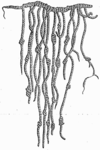
While the absence of ceramics appears anomalous, the presence of textiles is intriguing. As quipu
(or khipu), string-based recording devices, have been found at Caral, this suggests a writing, or "proto-writing", system at Norte Chico. (The discovery was reported by Mann in Science in 2005, but has not been formally published or described by Shady.) The exact use of quipu in this and later Andean cultures has been widely debated. Originally it was believed to be simply a mnemonic
used to record numeric information, such as a count of items bought and sold. Evidence has emerged that the quipu may also have recorded logographic information in the same way writing does. Research has focused on the much larger sample of a few hundred quipu dating to Inca times; the Norte Chico discovery remains singular and undeciphered.
Other finds at Norte Chico have proved suggestive. While visual arts appear absent, the people may have played instrumental music: thirty-two flutes, crafted from pelican
bone, have been discovered. The leering face of the Staff God is another artifact that awaits explanation. While still fragmentary, such archaeological evidence corresponds to the patterns of later Andean civilization and may indicate that Norte Chico served as a template. Along with the specific finds, Mann highlights "the primacy of exchange over a wide area, the penchant for collective, festive civic work projects, [and] the high valuation of textiles and textile technology" within Norte Chico as patterns that would recur later in the Peruvian cradle of civilization.
, has included "public insults, a charge of plagiarism, ethics inquiries in both Peru and the United States, and complaints by Peruvian officials to the U.S. government." The lead author of the seminal paper of April 2001 was Peruvian Ruth Shady
, with co-authors Jonathan Haas and Winifred Creamer, a married United States team; the coauthoring was reportedly suggested by Haas, in the hopes that the involvement of United States researchers would help secure funds for carbon dating as well as future research funding. Later, Shady charged the couple with plagiarism
and insufficient attribution, suggesting the pair had received credit for her research, which had been going on since 1994.
At issue is credit for the discovery of the civilization, naming it, and developing the theoretical models to explain it. That Shady was describing a civilization is clear in 1997: ("los albores de la civilización en el Perú."). While locating it on the Supe River, with Caral at its center, she suggested a larger geographic base for the society:
In 2004, Haas et al. wrote: "Our recent work in the neighboring Pativilca and Fortaleza has revealed that Caral and Aspero were but two of a much larger number of major Late Archaic sites in the Norte Chico," while only noting Shady in footnotes. Attribution of this type is what has angered Shady and her supporters. Shady's position has been hampered by a lack of funding for archeological research in her native Peru, as well as the media advantages of North American researchers in disputes of this type.
Haas and Creamer were cleared of the plagiarism charge by their institutions. The Chicago Field Museum’s science advisory council rebuked Haas for press releases and web pages that gave too little credit to Shady and inflated the couple’s role as discoverers. The dispute remains heated. Scholars have concerns that it could make it more difficult for United States archaeologists to gain permission to work in Peru.
Pre-Columbian
The pre-Columbian era incorporates all period subdivisions in the history and prehistory of the Americas before the appearance of significant European influences on the American continents, spanning the time of the original settlement in the Upper Paleolithic period to European colonization during...
society that included as many as 30 major population centers in what is now the Norte Chico region of north-central coastal Peru
Peru
Peru , officially the Republic of Peru , is a country in western South America. It is bordered on the north by Ecuador and Colombia, on the east by Brazil, on the southeast by Bolivia, on the south by Chile, and on the west by the Pacific Ocean....
. It is the oldest known civilization in the Americas and one of the six sites
Cradle of Civilization
The cradle of civilization is a term referring to any of the possible locations for the emergence of civilization.It is usually applied to the Ancient Near Eastern Chalcolithic , especially in the Fertile Crescent , but also extended to sites in Armenia, and the Persian Plateau, besides other Asian...
where civilization separately originated in the ancient world. It flourished between the 30th century BC and the 18th century BC. The alternative name, Caral-Supe, is derived from the Sacred City of Caral in the Supe Valley, a large and well-studied Norte Chico site. Complex society in Norte Chico arose a millennium after Sumer
Sumer
Sumer was a civilization and historical region in southern Mesopotamia, modern Iraq during the Chalcolithic and Early Bronze Age....
in Mesopotamia
Mesopotamia
Mesopotamia is a toponym for the area of the Tigris–Euphrates river system, largely corresponding to modern-day Iraq, northeastern Syria, southeastern Turkey and southwestern Iran.Widely considered to be the cradle of civilization, Bronze Age Mesopotamia included Sumer and the...
, was contemporaneous with the Egyptian pyramids
Egyptian pyramids
The Egyptian pyramids are ancient pyramid-shaped masonry structures located in Egypt.There are 138 pyramids discovered in Egypt as of 2008. Most were built as tombs for the country's Pharaohs and their consorts during the Old and Middle Kingdom periods.The earliest known Egyptian pyramids are found...
, and predated the Mesoamerican Olmec
Olmec
The Olmec were the first major Pre-Columbian civilization in Mexico. They lived in the tropical lowlands of south-central Mexico, in the modern-day states of Veracruz and Tabasco....
by nearly two millennia.
In archaeological nomenclature, Norte Chico is a pre-ceramic culture of the pre-Columbian Late Archaic
Cultural periods of Peru
This is a chart of cultural periods of Peru and the Andean Region developed by Edward Lanning and used by some archaeologists studying the area...
; it completely lacked ceramic
Ceramic
A ceramic is an inorganic, nonmetallic solid prepared by the action of heat and subsequent cooling. Ceramic materials may have a crystalline or partly crystalline structure, or may be amorphous...
s and apparently had almost no art. The most impressive achievement of the civilization was its monumental architecture, including large earthwork
Earthworks (archaeology)
In archaeology, earthwork is a general term to describe artificial changes in land level. Earthworks are often known colloquially as 'lumps and bumps'. Earthworks can themselves be archaeological features or they can show features beneath the surface...
platform mound
Platform mound
A platform mound is any earthwork or mound intended to support a structure or activity.-Eastern North America:The indigenous peoples of North America built substructure mounds for well over a thousand years starting in the Archaic period and continuing through the Woodland period...
s and sunken circular plaza
Plaza
Plaza is a Spanish word related to "field" which describes an open urban public space, such as a city square. All through Spanish America, the plaza mayor of each center of administration held three closely related institutions: the cathedral, the cabildo or administrative center, which might be...
s. Archaeological evidence suggests use of textile
Textile
A textile or cloth is a flexible woven material consisting of a network of natural or artificial fibres often referred to as thread or yarn. Yarn is produced by spinning raw fibres of wool, flax, cotton, or other material to produce long strands...
technology and, possibly, the worship of common god symbols, both of which recur in pre-Columbian Andean cultures. Sophisticated government is assumed to have been required to manage the ancient Norte Chico. Questions remain over its organization, particularly the impact of food resources on politics.
Archaeologists have been aware of ancient sites in the area since at least the 1940s; early work occurred at Aspero
Aspero
Aspero is a well-studied site of the ancient Norte Chico civilization, located at the mouth of the Supe river on the north-central Peruvian coast. Monumental architecture, including large platform mounds have been discovered at the site; their significance was first determined in 1973, though...
on the coast, a site identified as early as 1905, and later at Caral further inland.
It was not until the late 1990s that Peruvian archaeologists, led by Ruth Shady Solís, provided the first extensive documentation of the civilization with work at Caral. A 2001 paper in Science
Science (journal)
Science is the academic journal of the American Association for the Advancement of Science and is one of the world's top scientific journals....
, providing a survey of the Caral research, and a 2004 article in Nature, describing fieldwork and radiocarbon dating
Radiocarbon dating
Radiocarbon dating is a radiometric dating method that uses the naturally occurring radioisotope carbon-14 to estimate the age of carbon-bearing materials up to about 58,000 to 62,000 years. Raw, i.e. uncalibrated, radiocarbon ages are usually reported in radiocarbon years "Before Present" ,...
across a wider area, revealed Norte Chico's full significance and led to widespread interest.
History and geography
Andean Peru has been recognized as one of six global areas where there was independent, indigenous development of civilization, and as one of two, along with MesoamericaMesoamerica
Mesoamerica is a region and culture area in the Americas, extending approximately from central Mexico to Belize, Guatemala, El Salvador, Honduras, Nicaragua, and Costa Rica, within which a number of pre-Columbian societies flourished before the Spanish colonization of the Americas in the 15th and...
, in the Western Hemisphere. Norte Chico has pushed back the horizon for complex societies in the Peruvian region by more than one thousand years. The Chavín culture
Chavín culture
The Chavín were a civilization that developed in the northern Andean highlands of Peru from 900 BC to 200 BC. They extended their influence to other civilizations along the coast. The Chavín were located in the Mosna Valley where the Mosna and Huachecsa rivers merge...
, circa 900 BC, had long been considered the first civilization of the area. It is still regularly cited as such in general works.
The discovery of Norte Chico has also shifted the focus of research away from the highland areas of the Andes and lowlands adjacent to the mountains (where the Chavín, and later Inca, had their major centers) to the Peruvian littoral
Littoral
The littoral zone is that part of a sea, lake or river that is close to the shore. In coastal environments the littoral zone extends from the high water mark, which is rarely inundated, to shoreline areas that are permanently submerged. It always includes this intertidal zone and is often used to...
, or coastal regions. Norte Chico is located in a north-central area of the coast, approximately 150 to 200 km
KM
KM, Km, or km may stand for:*Kilometre *Kernel methods*Kettle Moraine High School*Khmer language *Kuomintang , a centre-right political party in the Republic of China on Taiwan...
north of Lima
Lima
Lima is the capital and the largest city of Peru. It is located in the valleys of the Chillón, Rímac and Lurín rivers, in the central part of the country, on a desert coast overlooking the Pacific Ocean. Together with the seaport of Callao, it forms a contiguous urban area known as the Lima...
, roughly bounded by the Lurín Valley on the south and the Casma Valley
Casma Valley
The Casma Valley, a coastal valley situated about north of Lima, Peru, lies between the towns of Chimbote and Huarmey. It is notable for the grand scale of numerous archaeological sites, including stone-faced pyramids and the Thirteen Towers of Chankillo. Sechin Alto is the largest American...
on the north. It comprises four coastal valleys: the Huaura, Supe, Pativilca, and Fortaleza; known sites are concentrated in the latter three, which share a common coastal plain. The three principal valleys cover only 1,800 km², and research has emphasized the density of the population centers.
The Peruvian littoral appears an "improbable, even aberrant" candidate for the "pristine" development of civilization, compared to other world centers. It is extremely arid, bounded by two rain shadow
Rain shadow
A rain shadow is a dry area on the lee side of a mountainous area. The mountains block the passage of rain-producing weather systems, casting a "shadow" of dryness behind them. As shown by the diagram to the right, the warm moist air is "pulled" by the prevailing winds over a mountain...
s (caused by the Andes to the east, and the Pacific trade wind
Trade wind
The trade winds are the prevailing pattern of easterly surface winds found in the tropics, within the lower portion of the Earth's atmosphere, in the lower section of the troposphere near the Earth's equator...
s to the west). The region is punctuated by more than 50 rivers that carry Andean snowmelt. The development of widespread irrigation
Irrigation
Irrigation may be defined as the science of artificial application of water to the land or soil. It is used to assist in the growing of agricultural crops, maintenance of landscapes, and revegetation of disturbed soils in dry areas and during periods of inadequate rainfall...
from these water sources is seen as decisive in the emergence of Norte Chico; all of the monumental architecture at various sites has been found close to irrigation channels.
Radiocarbon dating
Radiocarbon dating is a radiometric dating method that uses the naturally occurring radioisotope carbon-14 to estimate the age of carbon-bearing materials up to about 58,000 to 62,000 years. Raw, i.e. uncalibrated, radiocarbon ages are usually reported in radiocarbon years "Before Present" ,...
of Jonathan Haas et al., found that 10 of 95 samples taken in the Pativilca and Fortaleza areas dated from before 3500 BC; the oldest, dating from 9210 BC, provides "limited indication" of human settlement during the Pre-Columbian Early Archaic era. Two dates of 3700 BC are associated with communal architecture, but are likely to be anomalous. It is from 3200 BC onward that large-scale human settlement and communal construction are clearly apparent. Mann, in a survey of the literature in 2005, suggests "sometime before 3200 BC, and possibly before 3500 BC" as the beginning date of the Norte Chico formative period. He notes that the earliest date securely associated with a city is 3500 BC, at Huaricanga, in the Fortaleza area of the north, based on Haas' dates.
Haas' early third millennium dates suggest that the development of coastal and inland sites occurred in parallel. But, from 2500 to 2000 BC, during the period of greatest expansion, the population and development decisively shifted toward the inland sites. All development apparently occurred at large interior sites such as Caral, though they remained dependent on fish and shellfish from the coast. The peak in dates is in keeping with Shady's dates at Caral, which show habitation from 2627 BC to 2020 BC. That coastal and inland sites developed in tandem remains disputed, however (see next section).
Circa 1800 BC, the Norte Chico civilization began to decline, with more powerful centers appearing to the south and north along the coast, and to the east inside the belt of the Andes. Norte Chico's success at irrigation-based agriculture may have contributed to its being eclipsed. One researcher notes that "when this civilization is in decline, we begin to find extensive canals farther north. People were moving to more fertile ground and taking their knowledge of irrigation with them." It would be a thousand years before the rise of the next great Peruvian culture, the Chavín
Chavín culture
The Chavín were a civilization that developed in the northern Andean highlands of Peru from 900 BC to 200 BC. They extended their influence to other civilizations along the coast. The Chavín were located in the Mosna Valley where the Mosna and Huachecsa rivers merge...
.
Maritime coast and agricultural interior
Research into Norte Chico continues, with many unsettled questions. Debate is ongoing over two related questions: the degree to which the flourishing of the Norte Chico was based on maritime food resources, and the exact relationship this implies between the coastal and inland sites.Confirmed diet
A broad outline of the Norte Chico diet has been suggested. At Caral, the edible domesticated plantPlant
Plants are living organisms belonging to the kingdom Plantae. Precise definitions of the kingdom vary, but as the term is used here, plants include familiar organisms such as trees, flowers, herbs, bushes, grasses, vines, ferns, mosses, and green algae. The group is also called green plants or...
s noted by Shady are squash, beans, lucuma
Lúcuma
The lúcuma is a subtropical fruit native to the Peru's Andean region. Lucuma has been found on ceramics at burial sites of the indigenous people of coastal Peru...
, guava
Guava
Guavas are plants in the myrtle family genus Psidium , which contains about 100 species of tropical shrubs and small trees. They are native to Mexico, Central America, and northern South America...
, pacay
Pacay
Inga feuilleei , commonly known as pacay or ice-cream bean, is a perennial tree that contains a podded fruit cultivated often for its edible white pulp surrounding large seeds. It is a legume tree native to Central and South America. All legumes have their seed encased in pods, a few of which are...
, and camote. Haas et al. noted the same foods in their survey further north, while adding avocado
Avocado
The avocado is a tree native to Central Mexico, classified in the flowering plant family Lauraceae along with cinnamon, camphor and bay laurel...
and achira
Canna (plant)
Canna is a genus of nineteen species of flowering plants. The closest living relations to cannas are the other plant families of the order Zingiberales, that is the gingers, bananas, marantas, heliconias, strelitzias, etc.Canna is the only genus in the family Cannaceae...
. There was also a significant seafood
Seafood
Seafood is any form of marine life regarded as food by humans. Seafoods include fish, molluscs , crustaceans , echinoderms . Edible sea plants, such as some seaweeds and microalgae, are also seafood, and are widely eaten around the world, especially in Asia...
component, at both coastal and inland sites. Shady notes that "animal remains are almost exclusively marine" at Caral, including clam
Clam
The word "clam" can be applied to freshwater mussels, and other freshwater bivalves, as well as marine bivalves.In the United States, "clam" can be used in several different ways: one, as a general term covering all bivalve molluscs...
s and mussel
Mussel
The common name mussel is used for members of several families of clams or bivalvia mollusca, from saltwater and freshwater habitats. These groups have in common a shell whose outline is elongated and asymmetrical compared with other edible clams, which are often more or less rounded or oval.The...
s, and large amounts of anchovies
Anchovy
Anchovies are a family of small, common salt-water forage fish. There are 144 species in 17 genera, found in the Atlantic, Indian, and Pacific Oceans. Anchovies are usually classified as an oily fish.-Description:...
and sardine
Sardine
Sardines, or pilchards, are several types of small, oily fish related to herrings, family Clupeidae. Sardines are named after the Mediterranean island of Sardinia, around which they were once abundant....
s. That the anchovy fish reached inland is clear, although Haas suggests that "shellfish
Shellfish
Shellfish is a culinary and fisheries term for exoskeleton-bearing aquatic invertebrates used as food, including various species of molluscs, crustaceans, and echinoderms. Although most kinds of shellfish are harvested from saltwater environments, some kinds are found only in freshwater...
[which would include clams and mussels], sea mammals, and seaweed
Seaweed
Seaweed is a loose, colloquial term encompassing macroscopic, multicellular, benthic marine algae. The term includes some members of the red, brown and green algae...
do not appear to have been significant portions of the diet in the inland, non-maritime sites".
Maritime foundation of Andean civilization
The role of seafood in the Norte Chico diet has aroused debate. Much early fieldwork was done in the region of Aspero on the coast, before the full scope and inter-connectedness of the civilization was realized. In a 1973 paper, Michael E. MoseleyMichael E. Moseley
Michael Edward Moseley is an American anthropologist at the University of Florida.Moseley received his Bachelor of Arts in anthropology from the University of California, Berkeley in 1963, and his Master of Arts and Ph.D. in anthropology from Harvard University in 1965 and 1968, respectively...
confirmed a previously observed lack of ceramics at Aspero, and deduced that "hummock
Hummock
A hummock is a boss or rounded knoll of ice rising above the general level of an ice-field, making sledge travelling in the Arctic and Antarctic region extremely difficult and unpleasant....
s" on the site constituted the remains of artificial platform mounds. Most provocatively, he contended that a maritime subsistence (seafood) economy had been the basis of the society and its remarkably early flourishing, a theory later elaborated as a "maritime foundation of Andean civilization" (MFAC). This thesis of a maritime foundation was out of keeping with the general scholarly consensus that the rise of civilization was based on intensive agriculture, particularly of at least one cereal
Cereal
Cereals are grasses cultivated for the edible components of their grain , composed of the endosperm, germ, and bran...
. This had long been seen as essential in the emergence of complex society. Moseley's ideas would be debated and challenged (that maritime remains and their caloric contribution were overestimated, for example) but have been treated as plausible as late as Mann's summary in 2005.
Concomitant to the maritime subsistence hypothesis, was an implied dominance of sites immediately adjacent to the coast over other centers. This idea was shaken by the realization of the magnitude of Caral, an inland site. Supplemental to Shady's 1997 article dating Caral, a 2001 Science
Science (magazine)
Science was a general science magazine published by the American Association for the Advancement of Science . It was intended to "bridge the distance between science and citizen", aimed at a technically literate audience who may not work professionally in the sciences...
news article emphasized the dominance of agriculture and also suggested that Caral was the oldest urban center
Urban Center
The Urban Center is a gallery on Madison Avenue in New York City , which is run by the Municipal Art Society . The gallery serves to champion the fields of urban planning and design in New York, and is also the site of MAS' community development workshops, seminars, lectures, and other educational...
in Peru (and the entire Americas). It deprecated the idea that civilization might have begun adjacent to the coast and then moved inland. One archaeologist was quoted as suggesting that "rather than coastal antecedents to monumental inland sites, what we have now are coastal satellite villages to monumental inland sites."
These assertions were quickly challenged by Sandweiss and Moseley, who observed that Caral, though the largest and most complex Preceramic site, is not the oldest; the importance of agriculture to industry and to augment diet was admitted, while "the formative role of marine resources in early Andean civilization" was still broadly affirmed. Scholars now agree that the inland sites did have significantly greater populations, and that there were "so many more people along the four rivers than on the shore that they had to have been dominant." The question is which of the areas developed first and created a template for subsequent development. Haas rejects suggestions that maritime development at sites immediately adjacent to the coast was initial, pointing to contemporaneous development based on his dating; Moseley remains convinced that coastal Aspero is the oldest site, and that its maritime subsistence served as a basis for the civilization.
Cotton and politics
CottonCotton
Cotton is a soft, fluffy staple fiber that grows in a boll, or protective capsule, around the seeds of cotton plants of the genus Gossypium. The fiber is almost pure cellulose. The botanical purpose of cotton fiber is to aid in seed dispersal....
(of the species Gossypium barbadense
Gossypium barbadense
Gossypium barbadense, also known as extra long staple cotton as it generally has a staple of at least 1 3/8" or longer, is a species of cotton plant. Some types of ELS cotton are American Pima, Egyptian Giza, Indian Suvin, Chinese Xiniang, Sudanese Barakat, and Russian Tonkovoloknistyi...
) likely provided the basis of the dominance of inland over coast (whether development was earlier, later, or contemporaneous). Though not edible, it was the most important product of irrigation in the Norte Chico, vital to the production of fishing net
Fishing net
A fishing net or fishnet is a net that is used for fishing. Fishing nets are meshes usually formed by knotting a relatively thin thread. Modern nets are usually made of artificial polyamides like nylon, although nets of organic polyamides such as wool or silk thread were common until recently and...
s (that in turn provided maritime resources) as well as to textile
Textile
A textile or cloth is a flexible woven material consisting of a network of natural or artificial fibres often referred to as thread or yarn. Yarn is produced by spinning raw fibres of wool, flax, cotton, or other material to produce long strands...
s and textile technology. Haas notes that "control over cotton allows a ruling elite to provide the benefit of cloth for clothing
Clothing
Clothing refers to any covering for the human body that is worn. The wearing of clothing is exclusively a human characteristic and is a feature of nearly all human societies...
, bags, wraps, and adornment." He is willing to admit to a mutual dependency dilemma: "The prehistoric residents of the Norte Chico needed the fish resources for their protein
Protein
Proteins are biochemical compounds consisting of one or more polypeptides typically folded into a globular or fibrous form, facilitating a biological function. A polypeptide is a single linear polymer chain of amino acids bonded together by peptide bonds between the carboxyl and amino groups of...
and the fishermen needed the cotton to make the nets to catch the fish." Thus, identifying cotton as a vital resource produced in the inland does not by itself resolve the issue of whether the inland centers were a progenitor for the coast or vice versa—Moseley argues, for instance, that successful maritime centers would have moved inland to find cotton. The exact relationship between food resources and political organization remains unresolved.
Regardless of the status of maritime food resources, Norte Chico's development is still remarkable for the apparent absence of a staple
Staple food
A staple food is one that is eaten regularly and in such quantities that it constitutes a dominant portion of a diet, and that supplies a high proportion of energy and nutrient needs. Most people live on a diet based on one or more staples...
cereal
Cereal
Cereals are grasses cultivated for the edible components of their grain , composed of the endosperm, germ, and bran...
. Maize
Maize
Maize known in many English-speaking countries as corn or mielie/mealie, is a grain domesticated by indigenous peoples in Mesoamerica in prehistoric times. The leafy stalk produces ears which contain seeds called kernels. Though technically a grain, maize kernels are used in cooking as a vegetable...
formed the dietary backbone of later pre-Columbian American civilizations. There is no evidence of its widespread cultivation in Norte Chico. Moseley found a small number of maize cobs in 1973 at Aspero (also seen in site work in the 1940s and 50s) but has since called the find "problematic". Other researchers have suggested no evidence of the crop.
Government
The Norte Chico chiefdoms were "almost certainly theocraticTheocracy
Theocracy is a form of organization in which the official policy is to be governed by immediate divine guidance or by officials who are regarded as divinely guided, or simply pursuant to the doctrine of a particular religious sect or religion....
, though not brutally so," according to Mann. Construction areas show possible evidence of feasting, which would have included music and likely alcohol, suggesting an elite able to both mobilize and reward the population. The degree of centralized authority is difficult to ascertain, but architectural construction patterns are indicative of an elite that, at least in certain places at certain times, wielded considerable power: while some of the monumental architecture was constructed incrementally, other buildings, such as the two main platform mounds at Caral, appear to have been constructed in one or two intense construction phases. As further evidence of centralized control, Haas points to remains of large stone warehouse
Warehouse
A warehouse is a commercial building for storage of goods. Warehouses are used by manufacturers, importers, exporters, wholesalers, transport businesses, customs, etc. They are usually large plain buildings in industrial areas of cities and towns. They usually have loading docks to load and unload...
s found at Upaca, on the Pativilca, as emblematic of authorities able to control vital resources such as cotton.
Haas suggests that the labour mobilization patterns revealed by the archaeological evidence point to a unique emergence of human government, one of two alongside Sumer
Sumer
Sumer was a civilization and historical region in southern Mesopotamia, modern Iraq during the Chalcolithic and Early Bronze Age....
(or three, if Mesoamerica
Mesoamerica
Mesoamerica is a region and culture area in the Americas, extending approximately from central Mexico to Belize, Guatemala, El Salvador, Honduras, Nicaragua, and Costa Rica, within which a number of pre-Columbian societies flourished before the Spanish colonization of the Americas in the 15th and...
is included as a separate case). While in other cases, the idea of government would have been borrowed or copied, in this small group, government was invented. Other archaeologists have rejected such claims as hyperbolic.
In further exploring the basis of possible government, Haas suggests three broad bases of power for early complex societies:
- economic,
- ideology, and
- physical. He finds the first two present in ancient Norte Chico.
Economic
Economic authority would have rested on the control of cotton and edible plants and associated trade relationships, with power centered on the inland sites. Haas tentatively suggests that the scope of this economic power base may have extended widely: there are only two confirmed shore sites in the Norte Chico (Aspero and BandurriaBandurria
The bandurria is a plectrum chordophone from Spain, similar to the cittern and the mandolin, primarily used in Spanish folk music.Prior to the 18th century, the bandurria had with a round back, similar or related to the mandore. It had become a flat-backed instrument by the 18th century, with five...
) and possibly two more, but cotton fishing nets and domesticated plants have been found up and down the Peruvian coast. It is possible that the major inland centers of Norte Chico were at the center of a broad regional trade network centered on these resources. Discover
Discover (magazine)
Discover is an American science magazine that publishes articles about science for a general audience. The monthly magazine was launched in October 1980 by Time Inc. It was sold to Family Media, the owners of Health, in 1987. Walt Disney Company bought the magazine when Family Media went out of...
magazine, citing Shady, suggests a rich and varied trade life: "[Caral] exported its own products and those of Aspero to distant communities in exchange for exotic imports: Spondylus
Spondylus
Spondylus is a genus of bivalve molluscs, the only genus in the family Spondylidae. As well as being the systematic or scientific name, Spondylus is also the most often used common name for these animals, though they are also known as thorny oysters or spiny oysters.There are many species of...
shells from the coast of Ecuador
Ecuador
Ecuador , officially the Republic of Ecuador is a representative democratic republic in South America, bordered by Colombia on the north, Peru on the east and south, and by the Pacific Ocean to the west. It is one of only two countries in South America, along with Chile, that do not have a border...
, rich dyes from the Andean highlands, hallucinogenic
Psychedelics, dissociatives and deliriants
This general group of pharmacological agents can be divided into three broad categories: psychedelics, dissociatives, and deliriants. These classes of psychoactive drugs have in common that they can cause subjective changes in perception, thought, emotion and consciousness...
snuff
Snuff
Snuff is a product made from ground or pulverised tobacco leaves. It is an example of smokeless tobacco. It originated in the Americas and was in common use in Europe by the 17th century...
from the Amazon
Amazon Basin
The Amazon Basin is the part of South America drained by the Amazon River and its tributaries that drains an area of about , or roughly 40 percent of South America. The basin is located in the countries of Bolivia, Brazil, Colombia, Ecuador, Guyana, Peru, and Venezuela...
." (Given the still limited extent of Norte Chico research, such claims should be treated circumspectly.) Other reports on Shady's work indicate Caral traded with communities in the jungle farther inland and, possibly, with people from the mountains.
Ideology
Leaders' ideological power was based on apparent access to deities and the supernaturalSupernatural
The supernatural or is that which is not subject to the laws of nature, or more figuratively, that which is said to exist above and beyond nature...
. Evidence regarding Norte Chico religion is limited: an image of the Staff God
Staff God
The Staff God is a major deity in Andean cultures. Usually pictured holding a staff in each hand, with fanged teeth and splayed and clawed feet, his other characteristics are unknown, although he is often pictured with snakes in his headdress or clothes....
, a leering figure with a hood and fangs, has been found on a gourd
Gourd
A gourd is a plant of the family Cucurbitaceae. Gourd is occasionally used to describe crops like cucumbers, squash, luffas, and melons. The term 'gourd' however, can more specifically, refer to the plants of the two Cucurbitaceae genera Lagenaria and Cucurbita or also to their hollow dried out shell...
dated to 2250 BC. The Staff God is a major deity of later Andean cultures, and Winifred Creamer suggests the find points to worship of common symbols of gods. As with much other research at Norte Chico, the nature and significance of the find has been disputed by other researchers.
The act of architectural construction and maintenance may also have been a spiritual or religious experience: a process of communal exaltation and ceremony. Shady has called Caral "the sacred city" ("La ciudad sagrada"): socio-economic and political focus was on the temples, which were periodically remodeled, with major burnt offerings associated with the remodeling.
Physical
Haas notes the absence of any suggestion of physical bases of power, that is, defensive construction. There is no evidence of warfare "of any kind or at any level during the Preceramic Period." Mutilated bodies, burned buildings, and other tell-tale signs of violence are absent, and settlement patterns are completely non-defensive. The evidence of the development of complex government in the absence of warfare is in marked contrast to archaeological theory, which suggests that human beings move away from kin-based groups to larger units resembling "statesSovereign state
A sovereign state, or simply, state, is a state with a defined territory on which it exercises internal and external sovereignty, a permanent population, a government, and the capacity to enter into relations with other sovereign states. It is also normally understood to be a state which is neither...
" for mutual defense of often scarce resources. A vital resource was present: arable land
Arable land
In geography and agriculture, arable land is land that can be used for growing crops. It includes all land under temporary crops , temporary meadows for mowing or pasture, land under market and kitchen gardens and land temporarily fallow...
generally, and the cotton crop specifically, but the move to greater complexity was apparently not driven by the need for defense or warfare.
Sites and architecture
Norte Chico sites are notable for exceptional collective density, as well as individual size. Haas argues that the density of sites in such a small area is globally unique for a nascent civilization. During the third millennium BC, Norte Chico may have been the most densely populated area of the world (excepting, possibly, northern China).The Supe, Pativilca, and Fortaleza Valleys each have large clusters of sites, with a single site found on the Huaura River. The ground-breaking work of 1973 at Aspero at the mouth of the Supe Valley suggested a site of approximately 13 hectares (32.1 acre). Surveying of the midden
Midden
A midden, is an old dump for domestic waste which may consist of animal bone, human excrement, botanical material, vermin, shells, sherds, lithics , and other artifacts and ecofacts associated with past human occupation...
suggested extensive prehistoric construction activity. Small-scale terracing
Terrace (agriculture)
Terraces are used in farming to cultivate sloped land. Graduated terrace steps are commonly used to farm on hilly or mountainous terrain. Terraced fields decrease erosion and surface runoff, and are effective for growing crops requiring much water, such as rice...
is noted, along with more sophisticated platform mound masonry
Masonry
Masonry is the building of structures from individual units laid in and bound together by mortar; the term masonry can also refer to the units themselves. The common materials of masonry construction are brick, stone, marble, granite, travertine, limestone; concrete block, glass block, stucco, and...
. As many as eleven artificial mounds "could be" present. Moseley calls these "Corporate Labor Platforms", given that their size, layout, and construction materials and techniques would have required an organized workforce.
The survey of the northern rivers found sites between 10 hectare; between one and seven large platform mound
Platform mound
A platform mound is any earthwork or mound intended to support a structure or activity.-Eastern North America:The indigenous peoples of North America built substructure mounds for well over a thousand years starting in the Archaic period and continuing through the Woodland period...
s—rectangular, terraced
Terrace (building)
A terrace is an outdoor, occupiable extension of a building above ground level. Although its physical characteristics may vary to a great degree, a terrace will generally be larger than a balcony and will have an "open-top" facing the sky...
pyramid
Pyramid
A pyramid is a structure whose outer surfaces are triangular and converge at a single point. The base of a pyramid can be trilateral, quadrilateral, or any polygon shape, meaning that a pyramid has at least three triangular surfaces...
s—were discovered, ranging in size from 3000 m³ (105,944 cu ft) to over 100000 m³ (3,531,466.6 cu ft). Shady notes that the central zone of Caral, with monumental architecture, covers an area of just over 65 ha. Six platform mounds, numerous smaller mounds, two sunken circular plazas, and a variety of residential architecture were also discovered at this site.
The monumental architecture was constructed with quarried
Quarry
A quarry is a type of open-pit mine from which rock or minerals are extracted. Quarries are generally used for extracting building materials, such as dimension stone, construction aggregate, riprap, sand, and gravel. They are often collocated with concrete and asphalt plants due to the requirement...
stone and river cobbles. Using reed
Phragmites
Phragmites, the Common reed, is a large perennial grass found in wetlands throughout temperate and tropical regions of the world. Phragmites australis is sometimes regarded as the sole species of the genus Phragmites, though some botanists divide Phragmites australis into three or four species...
"shicra-bags", some of which have been preserved, laborers would have hauled the material to sites by hand. Roger Atwood of Archaeology magazine
Archaeology (magazine)
Archaeology is a bimonthly mainstream magazine about archaeology, published by the Archaeological Institute of America. Its focus is both for archaeologists and non-specialists alike. The magazine was launched in 1948, and is published six times a year....
describes the process:"Armies of workers would gather a long, durable grass known as shicra in the highlands above the city, tie the grass strands into loosely meshed bags, fill the bags with boulders, and then pack the trenches behind each successive retaining wall
Retaining wall
Retaining walls are built in order to hold back earth which would otherwise move downwards. Their purpose is to stabilize slopes and provide useful areas at different elevations, e.g...
of the step pyramid
Step pyramid
Step pyramids are structures which characterized several cultures throughout history, in several locations throughout the world. These pyramids typically are large and made of several layers of stone...
s with the stone-filled bags."
In this way, the people of Norte Chico achieved formidable architectural success. The largest of the platforms mounds at Caral, the Piramide Mayor, measures 160 by and rises 18 m (59.1 ft) high. In its summation of the 2001 Shady paper, the BBC
BBC
The British Broadcasting Corporation is a British public service broadcaster. Its headquarters is at Broadcasting House in the City of Westminster, London. It is the largest broadcaster in the world, with about 23,000 staff...
suggests workers would have been "paid or compelled" to work on centralized projects of this sort, with dried anchovies possibly serving as a form of currency. Mann points to "ideology, charisma, and skilfully timed reinforcement" from leaders.
Development and its absence
Eurasia
Eurasia is a continent or supercontinent comprising the traditional continents of Europe and Asia ; covering about 52,990,000 km2 or about 10.6% of the Earth's surface located primarily in the eastern and northern hemispheres...
n models of the development of civilization, Norte Chico's differences are striking. A total lack of ceramics persists across the period. The BBC observes that Norte Chico's people would have roasted their various crops, with no pots to boil them. The lack of pottery was accompanied by a lack of archaeologically apparent art. In conversation with Mann, Alvaro Ruiz observes: "In the Norte Chico we see almost no visual arts. No sculpture, no carving or bas-relief, almost no painting or drawing—the interiors are completely bare. What we do see are these huge mounds—and textiles."
While the absence of ceramics appears anomalous, the presence of textiles is intriguing. As quipu
Quipu
Quipus or khipus were recording devices used in the Inca Empire and its predecessor societies in the Andean region. A quipu usually consisted of colored, spun, and plied thread or strings from llama or alpaca hair. It could also be made of cotton cords...
(or khipu), string-based recording devices, have been found at Caral, this suggests a writing, or "proto-writing", system at Norte Chico. (The discovery was reported by Mann in Science in 2005, but has not been formally published or described by Shady.) The exact use of quipu in this and later Andean cultures has been widely debated. Originally it was believed to be simply a mnemonic
Mnemonic
A mnemonic , or mnemonic device, is any learning technique that aids memory. To improve long term memory, mnemonic systems are used to make memorization easier. Commonly encountered mnemonics are often verbal, such as a very short poem or a special word used to help a person remember something,...
used to record numeric information, such as a count of items bought and sold. Evidence has emerged that the quipu may also have recorded logographic information in the same way writing does. Research has focused on the much larger sample of a few hundred quipu dating to Inca times; the Norte Chico discovery remains singular and undeciphered.
Other finds at Norte Chico have proved suggestive. While visual arts appear absent, the people may have played instrumental music: thirty-two flutes, crafted from pelican
Pelican
A pelican, derived from the Greek word πελεκυς pelekys is a large water bird with a large throat pouch, belonging to the bird family Pelecanidae....
bone, have been discovered. The leering face of the Staff God is another artifact that awaits explanation. While still fragmentary, such archaeological evidence corresponds to the patterns of later Andean civilization and may indicate that Norte Chico served as a template. Along with the specific finds, Mann highlights "the primacy of exchange over a wide area, the penchant for collective, festive civic work projects, [and] the high valuation of textiles and textile technology" within Norte Chico as patterns that would recur later in the Peruvian cradle of civilization.
Research controversies
The magnitude of the Norte Chico discovery has brought academic controversy in its wake. The "monumental feud", as described by ArchaeologyArchaeology (magazine)
Archaeology is a bimonthly mainstream magazine about archaeology, published by the Archaeological Institute of America. Its focus is both for archaeologists and non-specialists alike. The magazine was launched in 1948, and is published six times a year....
, has included "public insults, a charge of plagiarism, ethics inquiries in both Peru and the United States, and complaints by Peruvian officials to the U.S. government." The lead author of the seminal paper of April 2001 was Peruvian Ruth Shady
Ruth Shady
Ruth Martha Shady Solís is a Peruvian anthropologist and archaeologist. She is also the founder and director of the archaeological project at Caral....
, with co-authors Jonathan Haas and Winifred Creamer, a married United States team; the coauthoring was reportedly suggested by Haas, in the hopes that the involvement of United States researchers would help secure funds for carbon dating as well as future research funding. Later, Shady charged the couple with plagiarism
Plagiarism
Plagiarism is defined in dictionaries as the "wrongful appropriation," "close imitation," or "purloining and publication" of another author's "language, thoughts, ideas, or expressions," and the representation of them as one's own original work, but the notion remains problematic with nebulous...
and insufficient attribution, suggesting the pair had received credit for her research, which had been going on since 1994.
At issue is credit for the discovery of the civilization, naming it, and developing the theoretical models to explain it. That Shady was describing a civilization is clear in 1997: ("los albores de la civilización en el Perú."). While locating it on the Supe River, with Caral at its center, she suggested a larger geographic base for the society:
In 2004, Haas et al. wrote: "Our recent work in the neighboring Pativilca and Fortaleza has revealed that Caral and Aspero were but two of a much larger number of major Late Archaic sites in the Norte Chico," while only noting Shady in footnotes. Attribution of this type is what has angered Shady and her supporters. Shady's position has been hampered by a lack of funding for archeological research in her native Peru, as well as the media advantages of North American researchers in disputes of this type.
Haas and Creamer were cleared of the plagiarism charge by their institutions. The Chicago Field Museum’s science advisory council rebuked Haas for press releases and web pages that gave too little credit to Shady and inflated the couple’s role as discoverers. The dispute remains heated. Scholars have concerns that it could make it more difficult for United States archaeologists to gain permission to work in Peru.
See also
- List of Norte Chico sites
- Supe PuertoSupe PuertoPuerto Supe, officially known as Supe Puerto , is as small harbor town located in the province of Barranca, in the Lima Provincias region, on the coast of Peru...
- Iperu, tourist information and assistanceIperu, tourist information and assistanceIperú, Tourist Information and Assistance, or simply iperú is the free tourism office provided by the Peruvian government through the Commission for the Promotion of Export and Tourism Peru and the National Institute for Defense Competition and Protection of...