

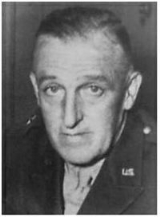
Norman Cota

Encyclopedia
Norman Daniel "Dutch" Cota, Sr. (May 30, 1893 - October 4, 1971) was a United States Army
general during World War II
. Cota was heavily involved in the planning and execution of the invasion of France, codenamed Operation Neptune
, and the subsequent Battle of Normandy
.
, the son of George William Cota, a former railroad telegrapher (later a local store merchant), and Jessie H. Mason, a local New England school teacher who came from Croatia. Working at his father's store in Chelsea, he got the name "Dutch" from his gang friends from Chelsea Square. This nickname would stay with him for the rest of his life.
In the fall of 1910, he attended Worcester Academy
.
at West Point, New York
. He and the rest of his class graduated two months ahead of schedule in April 1917 because of America's entry into World War I
.
Cota (class of 1917) and Dwight D. Eisenhower
(class of 1915) got to know one another while playing football at West Point. They became and remained good friends.
of infantry, Cota was quickly promoted to first lieutenant, then captain after only a few months. By the time he had accumulated 18 months of active duty, he was a major. He was assigned to become an instructor at the Academy shortly before the end of the war in 1918, serving there until 1920.
He later served in Hawaii (1924–28) and graduated from the United States Army Command and General Staff College (CGSC) at Fort Leavenworth, Kansas in June 1931. He was an instructor at the Infantry School (1932–33) and graduated from the Army War College in 1936. He was an instructor at the Command and General Staff School (July 1938-November 1940). He then became the executive officer for the 1st Infantry Division's 16th Infantry Regiment at Fort Jay
, Governors Island
, New York.
, under the command of Major General Terry de la Mesa Allen, Sr.
, he proposed a report of an assault division on what would become part of Operation Husky, the Allied invasion of Sicily
. He was promoted to the rank of brigadier general and was quickly sent to the United Kingdom
, where he served as the United States advisor to the Combined Operations
Division of the European Theater of Operations
. In that capacity, he helped to observe and supervise in the training for landing operations.
, he was made Assistant Division Commander of the 29th Infantry Division, which was designated to land at Omaha Beach
during the Battle of Normandy. During D-Day
planning, he opposed daylight landings, believing a pre-dawn assault would stand a better chance of success. A year before the invasion, at the Conference on Landing Assaults, Cota had argued in favor of striving for tactical surprise:
Cota was not alone in his opposition. General Leonard T. Gerow
, commander of V Corps, and Admiral John L. Hall, Jr.
, commander of Amphibious Force "O" (the naval force responsible for delivery of the US 1st Infantry Division to the beach), both fought to change the Operation Overlord plan, pleading for a nighttime assault.
However, the high command decided otherwise, concluding that naval and air bombardment would hopefully neutralize, or in the best case, eradicate, enemy opposition. The plan for Omaha essentially called for hurling infantry directly at a prepared enemy position, a position that was enhanced by the concave shape of the beach (effectively promoting enemy crossfire into the "basin" of the concavity), natural and man-made obstacles, bad weather and other factors.
Most D-Day commanders assured their men that the Germans would be annihilated by the Allies' pre-invasion firepower, and that the defenders were, in any case, outnumbered, inexperienced and demoralized. All of these beliefs were to be proved woefully inaccurate. On the afternoon of June 5, Cota gave an accurate assessment to the staff of the 29th Infantry Division:
While Cota had a far less optimistic view of the plan than the high command, even he underrated the extent of the near-catastrophe that awaited V Corps (composed of the 29th Infantry Division and the famous "Big Red One" 1st Infantry Division) on Omaha beach and the 4th Infantry Division on Utah beach.
Cota landed with a part of the 116th Infantry Regiment, 29th Division, in the second wave, approximately one hour after H-Hour on the Omaha sector known as Dog White. His LCVP
landing craft came under heavy machine gun fire as well as mortar and light artillery fire; three soldiers (including most likely at least one officer) were killed immediately upon leading the disembarkation.
Cota was one of the highest ranking officers on the beach that day. He is famous for personally rallying the shell-shocked, pinned-down survivors and opening one of the first vehicle exits off the beach. Two famous quotes are attributed to him during this time:
 With the coast of Normandy eventually secured, Allied forces advanced toward Paris
. Cota was given command of the 28th Infantry Division on August 14, 1944, in part to remedy the unit's unsatisfactory performance. After attempting to trap the retreating Germans at Le Neuborg and Elbeuf on the Seine River, Cota and the 28th Division were assigned to represent the U.S. Army in the parade celebrating the liberation of Paris. Later that year, while in the field, he was promoted to major general.
, conceived by General Omar Bradley
as a direct assault on established German positions in the heavily forested region, positions which significantly favored the defenders. Cota was not pleased with the operations order he was given. It required him to send three regiments on diverging paths to three different objectives. Further, his division would be the only unit attacking on a 150 miles (241.4 km) front. His complaints were given little weight by his immediate superior, V Corps commander Major General Leonard Gerow.
The northern and southern thrusts achieved little. The center regiment, the 112th, captured two villages and a town, but was eventually driven back by German counterattacks. In an article written for the United States Army Combined Arms Center, Lieutenant Colonel (ret) Thomas Bradbeer identified "three crucial mistakes" that Cota made. First, neither he nor his staff ordered reconnaissance patrols. Second, he selected, sight unseen, an extremely narrow trail as the division's main supply route. Finally, he chose not to employ the extra armor units he was given in support of his infantry, believing the terrain and road system to be unsuitable for their use, whereas much of the forest was in fact accessible. Instead, the tanks were used as supplementary artillery. Further, Bradbeer criticized Cota for remaining in his command post, visiting the front only once late in the fighting, by which time he had already lost control of the situation.
Cota's "Pennsylvania's Bloody Bucket" Division sustained heavy losses and failed to secure its objectives. The 28th Division and its attached units suffered an appalling 6184 casualties; the 112th Infantry Regiment alone had 2316 casualties out of a total strength of 3100. While Cota retained command of the division to the end of the war, he had lost his sterling military reputation and the confidence of his superiors.
. Cota said that the execution, the only U.S. soldier to be executed for desertion since the American Civil War
, was the "toughest 15 minutes of my life".
In the late 1950s he was the civil defense director for Montgomery County, Pennsylvania
.
He died in Wichita, Kansas
, on 4 October 1971, and is buried with his wife Connie at the West Point Cemetery
, United States Military Academy, West Point, New York.
(DSC), Distinguished Service Order
(DSO) and Silver Star
for his heroism on Omaha Beach. Field Marshal Bernard Law Montgomery
pinned the DSO on Cota. He received a Purple Heart
and a second Silver Star in the attack at Saint-Lô
.
She was a writer-teacher and distant cousin of Eleanore Butler Alexander, the wife of Theodore Roosevelt, Jr.
. Both Cota and Roosevelt were also distantly related and interacted with one another during World War II.
Norman and Connie had two children, Ann (23 October 1920-31 August 1996-; the first female born at the cadet hospital at West Point-; married Thomas J. "Tom" Morris, in June 1940-; died in Wichita, Kansas.-) and Norman Daniel "Dan" Cota, Jr. (15 December 1921-18 March 1988-; born at Walter Reed Hospital, Washington, D.C.-; died in Fort Lauderdale, Florida.-).
After the death of Connie in May 1969, he married Alice Weeks-McCutcheon, also a widower, in October 1970.
Cota's son, U.S. Army Air Corps fighter pilot Lieutenant Colonel Norman Cota, Jr., provided reconnaissance for his father's division at Huertgen Forest.
in the film The Longest Day
.
United States Army
The United States Army is the main branch of the United States Armed Forces responsible for land-based military operations. It is the largest and oldest established branch of the U.S. military, and is one of seven U.S. uniformed services...
general during World War II
World War II
World War II, or the Second World War , was a global conflict lasting from 1939 to 1945, involving most of the world's nations—including all of the great powers—eventually forming two opposing military alliances: the Allies and the Axis...
. Cota was heavily involved in the planning and execution of the invasion of France, codenamed Operation Neptune
Operation Neptune
The Normandy landings, codenamed Operation Neptune, were the landing operations of the Allied invasion of Normandy, in Operation Overlord, during World War II. The landings commenced on Tuesday, 6 June 1944 , beginning at 6:30 AM British Double Summer Time...
, and the subsequent Battle of Normandy
Operation Overlord
Operation Overlord was the code name for the Battle of Normandy, the operation that launched the invasion of German-occupied western Europe during World War II by Allied forces. The operation commenced on 6 June 1944 with the Normandy landings...
.
Early life
Cota was born in Chelsea, MassachusettsChelsea, Massachusetts
Chelsea is a city in Suffolk County, Massachusetts, United States directly across the Mystic River from the city of Boston. It is the smallest city in Massachusetts in land area, and the 26th most densely populated incorporated place in the country.-History:...
, the son of George William Cota, a former railroad telegrapher (later a local store merchant), and Jessie H. Mason, a local New England school teacher who came from Croatia. Working at his father's store in Chelsea, he got the name "Dutch" from his gang friends from Chelsea Square. This nickname would stay with him for the rest of his life.
In the fall of 1910, he attended Worcester Academy
Worcester Academy
Worcester Academy is an independent coeducational preparatory school spread over in Worcester, Massachusetts in the United States. The school is divided into a middle school, serving approximately 150 students in grades six to eight, and an upper school, serving approximately 500 students in...
.
West Point
In June 1913, he was accepted to the United States Military AcademyUnited States Military Academy
The United States Military Academy at West Point is a four-year coeducational federal service academy located at West Point, New York. The academy sits on scenic high ground overlooking the Hudson River, north of New York City...
at West Point, New York
West Point, New York
West Point is a federal military reservation established by President of the United States Thomas Jefferson in 1802. It is a census-designated place located in Town of Highlands in Orange County, New York, United States. The population was 7,138 at the 2000 census...
. He and the rest of his class graduated two months ahead of schedule in April 1917 because of America's entry into World War I
World War I
World War I , which was predominantly called the World War or the Great War from its occurrence until 1939, and the First World War or World War I thereafter, was a major war centred in Europe that began on 28 July 1914 and lasted until 11 November 1918...
.
Cota (class of 1917) and Dwight D. Eisenhower
Dwight D. Eisenhower
Dwight David "Ike" Eisenhower was the 34th President of the United States, from 1953 until 1961. He was a five-star general in the United States Army...
(class of 1915) got to know one another while playing football at West Point. They became and remained good friends.
World War I
Commissioned a second lieutenantSecond Lieutenant
Second lieutenant is a junior commissioned officer military rank in many armed forces.- United Kingdom and Commonwealth :The rank second lieutenant was introduced throughout the British Army in 1871 to replace the rank of ensign , although it had long been used in the Royal Artillery, Royal...
of infantry, Cota was quickly promoted to first lieutenant, then captain after only a few months. By the time he had accumulated 18 months of active duty, he was a major. He was assigned to become an instructor at the Academy shortly before the end of the war in 1918, serving there until 1920.
Inter-war years
In 1919, the now peacetime army underwent "massive downsizing" and he was reduced in rank to captain. While Post Financial Officer at Langley Field, Virginia, in 1922, he was held personally responsible when the post was robbed of $43,000. It took an appeal to Congress for him to be absolved of having to make good the loss.He later served in Hawaii (1924–28) and graduated from the United States Army Command and General Staff College (CGSC) at Fort Leavenworth, Kansas in June 1931. He was an instructor at the Infantry School (1932–33) and graduated from the Army War College in 1936. He was an instructor at the Command and General Staff School (July 1938-November 1940). He then became the executive officer for the 1st Infantry Division's 16th Infantry Regiment at Fort Jay
Fort Jay
Fort Jay is a harbor fortification and the name of the former Army post located on Governors Island in New York Harbor. Fort Jay is the oldest defensive structure on the island, built to defend Upper New York Bay, but has served other purposes...
, Governors Island
Governors Island
Governors Island is a island in Upper New York Bay, approximately one-half mile from the southern tip of Manhattan Island and separated from Brooklyn by Buttermilk Channel. It is legally part of the borough of Manhattan in New York City...
, New York.
World War II
At the outbreak of World War II, he was the G-2 Officer (Intelligence) and then G-3 Officer (Plans and Training) of the 1st Infantry Division from March 1941 until June 1942. In June, he was promoted to Chief of Staff of the division, a position he held until February 1943. In February 1943, right after his involvement in the invasion of North AfricaOperation Torch
Operation Torch was the British-American invasion of French North Africa in World War II during the North African Campaign, started on 8 November 1942....
, under the command of Major General Terry de la Mesa Allen, Sr.
Terry de la Mesa Allen, Sr.
Major General Terry de la Mesa Allen, Sr. was a division-level United States Army officer during World War II. Allen was a decorated World War I veteran who commanded the First Infantry Division in North Africa and Sicily during 1942-43...
, he proposed a report of an assault division on what would become part of Operation Husky, the Allied invasion of Sicily
Allied invasion of Sicily
The Allied invasion of Sicily, codenamed Operation Husky, was a major World War II campaign, in which the Allies took Sicily from the Axis . It was a large scale amphibious and airborne operation, followed by six weeks of land combat. It launched the Italian Campaign.Husky began on the night of...
. He was promoted to the rank of brigadier general and was quickly sent to the United Kingdom
United Kingdom
The United Kingdom of Great Britain and Northern IrelandIn the United Kingdom and Dependencies, other languages have been officially recognised as legitimate autochthonous languages under the European Charter for Regional or Minority Languages...
, where he served as the United States advisor to the Combined Operations
Combined Operations
Combined Operations Headquarters was a department of the British War Office set up during World War II to harass the Germans on the European continent by means of raids carried out by use of combined naval and army forces...
Division of the European Theater of Operations
European Theater of Operations
The European Theater of Operations, United States Army was a United States Army formation which directed U.S. Army operations in parts of Europe from 1942 to 1945. It referred to Army Ground Forces, United States Army Air Forces, and Army Service Forces operations north of Italy and the...
. In that capacity, he helped to observe and supervise in the training for landing operations.
D-Day
As a major advisor in Operation OverlordOperation Overlord
Operation Overlord was the code name for the Battle of Normandy, the operation that launched the invasion of German-occupied western Europe during World War II by Allied forces. The operation commenced on 6 June 1944 with the Normandy landings...
, he was made Assistant Division Commander of the 29th Infantry Division, which was designated to land at Omaha Beach
Omaha Beach
Omaha Beach is the code name for one of the five sectors of the Allied invasion of German-occupied France in the Normandy landings on 6 June 1944, during World War II...
during the Battle of Normandy. During D-Day
D-Day
D-Day is a term often used in military parlance to denote the day on which a combat attack or operation is to be initiated. "D-Day" often represents a variable, designating the day upon which some significant event will occur or has occurred; see Military designation of days and hours for similar...
planning, he opposed daylight landings, believing a pre-dawn assault would stand a better chance of success. A year before the invasion, at the Conference on Landing Assaults, Cota had argued in favor of striving for tactical surprise:
. . . It is granted that strategical surprise will be impossible to attain. Tactical surprise is another thing however... . tactical surprise is one of the most powerful factors in determining success. I therefore, favor the night landing. I do not believe the daylight assault can succeed.
Cota was not alone in his opposition. General Leonard T. Gerow
Leonard T. Gerow
Leonard Townsend Gerow was a United States Army general.-Early life:Gerow was born in Petersburg, Virginia. The name Gerow is derived from the French name "Giraud". Gerow attended high school in Petersburg and then attended the Virginia Military Institute. He was three times elected class...
, commander of V Corps, and Admiral John L. Hall, Jr.
John L. Hall, Jr.
John Lesslie Hall, Jr. was an admiral of the United States Navy, who served during World War II.-Education:...
, commander of Amphibious Force "O" (the naval force responsible for delivery of the US 1st Infantry Division to the beach), both fought to change the Operation Overlord plan, pleading for a nighttime assault.
However, the high command decided otherwise, concluding that naval and air bombardment would hopefully neutralize, or in the best case, eradicate, enemy opposition. The plan for Omaha essentially called for hurling infantry directly at a prepared enemy position, a position that was enhanced by the concave shape of the beach (effectively promoting enemy crossfire into the "basin" of the concavity), natural and man-made obstacles, bad weather and other factors.
Most D-Day commanders assured their men that the Germans would be annihilated by the Allies' pre-invasion firepower, and that the defenders were, in any case, outnumbered, inexperienced and demoralized. All of these beliefs were to be proved woefully inaccurate. On the afternoon of June 5, Cota gave an accurate assessment to the staff of the 29th Infantry Division:
This is different from any of the other exercises that you’ve had so far. The little discrepancies that we tried to correct on Slapton Sands are going to be magnified and are going to give way to incidents that you might at first view as chaotic . . . You're going to find confusion. The landing craft aren't going in on schedule and people are going to be landed in the wrong place. Some won't be landed at all . . . We must improvise, carry on, not lose our heads.
While Cota had a far less optimistic view of the plan than the high command, even he underrated the extent of the near-catastrophe that awaited V Corps (composed of the 29th Infantry Division and the famous "Big Red One" 1st Infantry Division) on Omaha beach and the 4th Infantry Division on Utah beach.
Cota landed with a part of the 116th Infantry Regiment, 29th Division, in the second wave, approximately one hour after H-Hour on the Omaha sector known as Dog White. His LCVP
LCVP
The Landing Craft, Vehicle, Personnel or Higgins boat was a landing craft used extensively in amphibious landings in World War II. The craft was designed by Andrew Higgins of Louisiana, United States, based on boats made for operating in swamps and marshes...
landing craft came under heavy machine gun fire as well as mortar and light artillery fire; three soldiers (including most likely at least one officer) were killed immediately upon leading the disembarkation.
Cota was one of the highest ranking officers on the beach that day. He is famous for personally rallying the shell-shocked, pinned-down survivors and opening one of the first vehicle exits off the beach. Two famous quotes are attributed to him during this time:
- In a meeting with Max Schneider, commander of the 5th Ranger Battalion5th Ranger BattalionThe Fifth Ranger Infantry Battalion was a World War II Ranger battalion activated on 1 September 1943 at Camp Forrest, Tennessee. By this time, while in maneuvers on the United States, they were commanded by the Major Owen Carter...
, Cota asked "What outfit is this?" Someone yelled "5th Rangers!" To this, Cota replied "Well, God damn it then, Rangers, lead the way!" "Rangers lead the way" became the motto of the Rangers.
- He is also quoted as saying to his troops, "Gentlemen, we are being killed on the beaches. Let us go inland and be killed." In the film The Longest DayThe Longest Day (film)The Longest Day is a 1962 war film based on the 1959 history book The Longest Day by Cornelius Ryan, about "D-Day", the Normandy landings on 6 June 1944, during World War II....
, Cota (played by Robert MitchumRobert MitchumRobert Charles Durman Mitchum was an American film actor, author, composer and singer and is #23 on the American Film Institute's list of the greatest male American screen legends of all time...
) actually delivers another famous quotation attributed to Colonel George A. TaylorGeorge A. TaylorGeorge A. Taylor was an officer in the U.S. 1st Infantry Division during World War II. Graduate of the United States Military Academy, class of 1922.His famous quote from Omaha Beach:...
: "There are only two kinds of people who are staying on this beach: those who are already dead and those that are gonna die. Now get off your butts, you're the fightin' 29th."
Liberation of Paris
Paris
Paris is the capital and largest city in France, situated on the river Seine, in northern France, at the heart of the Île-de-France region...
. Cota was given command of the 28th Infantry Division on August 14, 1944, in part to remedy the unit's unsatisfactory performance. After attempting to trap the retreating Germans at Le Neuborg and Elbeuf on the Seine River, Cota and the 28th Division were assigned to represent the U.S. Army in the parade celebrating the liberation of Paris. Later that year, while in the field, he was promoted to major general.
Hurtgen Forest
As the commander of the 28th Infantry Division, Major General Cota was involved in the Battle of Hurtgen ForestBattle of Hurtgen Forest
The Battle of Hürtgen Forest is the name given to the series of fierce battles fought between U.S. and German forces during World War II in the Hürtgen Forest, which became the longest battle on German ground during World War II, and the longest single battle the U.S. Army has ever fought...
, conceived by General Omar Bradley
Omar Bradley
Omar Nelson Bradley was a senior U.S. Army field commander in North Africa and Europe during World War II, and a General of the Army in the United States Army...
as a direct assault on established German positions in the heavily forested region, positions which significantly favored the defenders. Cota was not pleased with the operations order he was given. It required him to send three regiments on diverging paths to three different objectives. Further, his division would be the only unit attacking on a 150 miles (241.4 km) front. His complaints were given little weight by his immediate superior, V Corps commander Major General Leonard Gerow.
The northern and southern thrusts achieved little. The center regiment, the 112th, captured two villages and a town, but was eventually driven back by German counterattacks. In an article written for the United States Army Combined Arms Center, Lieutenant Colonel (ret) Thomas Bradbeer identified "three crucial mistakes" that Cota made. First, neither he nor his staff ordered reconnaissance patrols. Second, he selected, sight unseen, an extremely narrow trail as the division's main supply route. Finally, he chose not to employ the extra armor units he was given in support of his infantry, believing the terrain and road system to be unsuitable for their use, whereas much of the forest was in fact accessible. Instead, the tanks were used as supplementary artillery. Further, Bradbeer criticized Cota for remaining in his command post, visiting the front only once late in the fighting, by which time he had already lost control of the situation.
Cota's "Pennsylvania's Bloody Bucket" Division sustained heavy losses and failed to secure its objectives. The 28th Division and its attached units suffered an appalling 6184 casualties; the 112th Infantry Regiment alone had 2316 casualties out of a total strength of 3100. While Cota retained command of the division to the end of the war, he had lost his sterling military reputation and the confidence of his superiors.
Court martial and execution of Eddie Slovik
Cota also reviewed and approved the death sentence handed down by a court martial on Eddie SlovikEddie Slovik
Edward Donald Slovik was a private in the United States Army during World War II and the only American soldier to be court-martialled and executed for desertion since the American Civil War....
. Cota said that the execution, the only U.S. soldier to be executed for desertion since the American Civil War
American Civil War
The American Civil War was a civil war fought in the United States of America. In response to the election of Abraham Lincoln as President of the United States, 11 southern slave states declared their secession from the United States and formed the Confederate States of America ; the other 25...
, was the "toughest 15 minutes of my life".
Post-war
Cota retired from the Army on 30 June 1946 as a major general.In the late 1950s he was the civil defense director for Montgomery County, Pennsylvania
Montgomery County, Pennsylvania
Montgomery County is a county located in the U.S. state of Pennsylvania, in the United States. As of 2010, the population was 799,874, making it the third most populous county in Pennsylvania . The county seat is Norristown.The county was created on September 10, 1784, out of land originally part...
.
He died in Wichita, Kansas
Wichita, Kansas
Wichita is the largest city in the U.S. state of Kansas.As of the 2010 census, the city population was 382,368. Located in south-central Kansas on the Arkansas River, Wichita is the county seat of Sedgwick County and the principal city of the Wichita metropolitan area...
, on 4 October 1971, and is buried with his wife Connie at the West Point Cemetery
West Point Cemetery
West Point Cemetery is a historic cemetery on the grounds of the United States Military Academy in West Point, New York. It overlooks the Hudson River, and served as a burial ground for American Revolutionary War soldiers and early West Point inhabitants long before 1817 when it was officially...
, United States Military Academy, West Point, New York.
Awards and decorations
Cota was awarded the Distinguished Service CrossDistinguished Service Cross (United States)
The Distinguished Service Cross is the second highest military decoration that can be awarded to a member of the United States Army, for extreme gallantry and risk of life in actual combat with an armed enemy force. Actions that merit the Distinguished Service Cross must be of such a high degree...
(DSC), Distinguished Service Order
Distinguished Service Order
The Distinguished Service Order is a military decoration of the United Kingdom, and formerly of other parts of the British Commonwealth and Empire, awarded for meritorious or distinguished service by officers of the armed forces during wartime, typically in actual combat.Instituted on 6 September...
(DSO) and Silver Star
Silver Star
The Silver Star is the third-highest combat military decoration that can be awarded to a member of any branch of the United States armed forces for valor in the face of the enemy....
for his heroism on Omaha Beach. Field Marshal Bernard Law Montgomery
Bernard Montgomery, 1st Viscount Montgomery of Alamein
Field Marshal Bernard Law Montgomery, 1st Viscount Montgomery of Alamein, KG, GCB, DSO, PC , nicknamed "Monty" and the "Spartan General" was a British Army officer. He saw action in the First World War, when he was seriously wounded, and during the Second World War he commanded the 8th Army from...
pinned the DSO on Cota. He received a Purple Heart
Purple Heart
The Purple Heart is a United States military decoration awarded in the name of the President to those who have been wounded or killed while serving on or after April 5, 1917 with the U.S. military. The National Purple Heart Hall of Honor is located in New Windsor, New York...
and a second Silver Star in the attack at Saint-Lô
Saint-Lô
Saint-Lô is a commune in north-western France, the capital of the Manche department in Normandy.-History:Originally called Briovère , the town is built on and around ramparts. Originally it was a Gaul fortified settlement...
.
Personal life
Cota married Constance Martha "Connie" Alexander, at the Episcopal Church of the Incarnation (Madison Avenue and 35th Street) in New York City, on November 1, 1919.She was a writer-teacher and distant cousin of Eleanore Butler Alexander, the wife of Theodore Roosevelt, Jr.
Theodore Roosevelt, Jr.
Theodore D. Roosevelt, Jr. , was an American political and business leader, a Medal of Honor recipient who fought in both of the 20th century's world wars. He was the eldest son of President Theodore Roosevelt from his second wife Edith Roosevelt...
. Both Cota and Roosevelt were also distantly related and interacted with one another during World War II.
Norman and Connie had two children, Ann (23 October 1920-31 August 1996-; the first female born at the cadet hospital at West Point-; married Thomas J. "Tom" Morris, in June 1940-; died in Wichita, Kansas.-) and Norman Daniel "Dan" Cota, Jr. (15 December 1921-18 March 1988-; born at Walter Reed Hospital, Washington, D.C.-; died in Fort Lauderdale, Florida.-).
After the death of Connie in May 1969, he married Alice Weeks-McCutcheon, also a widower, in October 1970.
Cota's son, U.S. Army Air Corps fighter pilot Lieutenant Colonel Norman Cota, Jr., provided reconnaissance for his father's division at Huertgen Forest.
Portrayals
General Cota was portrayed by actor Robert MitchumRobert Mitchum
Robert Charles Durman Mitchum was an American film actor, author, composer and singer and is #23 on the American Film Institute's list of the greatest male American screen legends of all time...
in the film The Longest Day
The Longest Day (film)
The Longest Day is a 1962 war film based on the 1959 history book The Longest Day by Cornelius Ryan, about "D-Day", the Normandy landings on 6 June 1944, during World War II....
.