

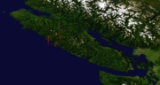
Nootka Sound

Encyclopedia
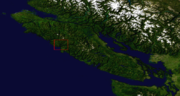
Sound (geography)
In geography a sound or seaway is a large sea or ocean inlet larger than a bay, deeper than a bight and wider than a fjord; or it may be defined as a narrow sea or ocean channel between two bodies of land ....
of the Pacific Ocean
Pacific Ocean
The Pacific Ocean is the largest of the Earth's oceanic divisions. It extends from the Arctic in the north to the Southern Ocean in the south, bounded by Asia and Australia in the west, and the Americas in the east.At 165.2 million square kilometres in area, this largest division of the World...
on the rugged west coast of Vancouver Island
Vancouver Island
Vancouver Island is a large island in British Columbia, Canada. It is one of several North American locations named after George Vancouver, the British Royal Navy officer who explored the Pacific Northwest coast of North America between 1791 and 1794...
, in the Canadian
Canada
Canada is a North American country consisting of ten provinces and three territories. Located in the northern part of the continent, it extends from the Atlantic Ocean in the east to the Pacific Ocean in the west, and northward into the Arctic Ocean...
province
Provinces and territories of Canada
The provinces and territories of Canada combine to make up the world's second-largest country by area. There are ten provinces and three territories...
of British Columbia
British Columbia
British Columbia is the westernmost of Canada's provinces and is known for its natural beauty, as reflected in its Latin motto, Splendor sine occasu . Its name was chosen by Queen Victoria in 1858...
. Historically also known as King George's Sound, as a strait
Strait
A strait or straits is a narrow, typically navigable channel of water that connects two larger, navigable bodies of water. It most commonly refers to a channel of water that lies between two land masses, but it may also refer to a navigable channel through a body of water that is otherwise not...
it separates Vancouver Island
Vancouver Island
Vancouver Island is a large island in British Columbia, Canada. It is one of several North American locations named after George Vancouver, the British Royal Navy officer who explored the Pacific Northwest coast of North America between 1791 and 1794...
and Nootka Island
Nootka Island
Nootka Island is an island near Vancouver Island in British Columbia, Canada. It contains 534 km² of area. It is separated from Vancouver Island by Nootka Sound and its side-inlets....
.
History
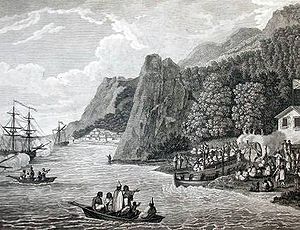
John R. Jewitt
John Rodgers Jewitt was an armourer who entered the historical record with his memoirs about the 28 months he spent as a captive of Maquinna of the Nuu-chah-nulth people on the Pacific Northwest Coast of what is now Canada...
, an Englishman who wrote a memoir about his years as a captive of chief Maquinna
Maquinna
Maquinna was the chief of the Nuu-chah-nulth people of Nootka Sound, during the heyday of the maritime fur trade in the 1780s and 1790s on the Pacific Northwest Coast...
in 1802–1805, describes the area in some detail.
European exploration and trade
On August 8, 1774, the Spanish NavySpanish Navy
The Spanish Navy is the maritime branch of the Spanish Armed Forces, one of the oldest active naval forces in the world. The Armada is responsible for notable achievements in world history such as the discovery of Americas, the first world circumnavigation, and the discovery of a maritime path...
ship Santiago, under Juan Pérez
Juan José Pérez Hernández
Juan José Pérez Hernández , often simply Juan Pérez, was an 18th century Spanish explorer. He was the first European to sight, examine, name, and record the islands near present-day British Columbia, Canada...
, entered and anchored in the inlet. Although the Spanish did not land, natives paddled to the ship to trade fur
Fur
Fur is a synonym for hair, used more in reference to non-human animals, usually mammals; particularly those with extensives body hair coverage. The term is sometimes used to refer to the body hair of an animal as a complete coat, also known as the "pelage". Fur is also used to refer to animal...
s for abalone
Abalone
Abalone , from aulón, are small to very large-sized edible sea snails, marine gastropod molluscs in the family Haliotidae and the genus Haliotis...
shells from California
California
California is a state located on the West Coast of the United States. It is by far the most populous U.S. state, and the third-largest by land area...
. Pérez named the entrance to Nootka Sound Surgidero de San Lorenzo. The word surgidero means "anchorage". When Esteban José Martinez arrived in 1789 he gave Nootka Sound the name Puerto de San Lorenzo de Nuca. The Spanish establishment established at Friendly Cove he gave the name Santa Cruz de Nuca.
In March 1778, Captain James Cook
James Cook
Captain James Cook, FRS, RN was a British explorer, navigator and cartographer who ultimately rose to the rank of captain in the Royal Navy...
of the Royal Navy
Royal Navy
The Royal Navy is the naval warfare service branch of the British Armed Forces. Founded in the 16th century, it is the oldest service branch and is known as the Senior Service...
landed on Bligh Island and named the inlet "King George's Sound". He recorded that the native name was Nutka or Nootka, apparently misunderstanding his conversations at Friendly Cove/Yuquot
Yuquot, British Columbia
Yuquot or Friendly Cove is a small settlement of less than 25 on Nootka Island in Nootka Sound, just west of Vancouver Island, British Columbia, Canada...
; his informant may have been explaining that he was on an island (itchme nutka, a place you can "go around"). There may also have been confusion with Nuu-chah-nulth, the natives' autonym (name for themselves). It may also have simply been based on Cook’s mis-pronunciation Yuquot, the native name of the place. The earlier Spanish and British names for the Sound swiftly went out of use.
At the time, the Spanish monopolized the trade between Asia
Asia
Asia is the world's largest and most populous continent, located primarily in the eastern and northern hemispheres. It covers 8.7% of the Earth's total surface area and with approximately 3.879 billion people, it hosts 60% of the world's current human population...
and North America, and had granted limited licenses to the Portuguese
Portugal
Portugal , officially the Portuguese Republic is a country situated in southwestern Europe on the Iberian Peninsula. Portugal is the westernmost country of Europe, and is bordered by the Atlantic Ocean to the West and South and by Spain to the North and East. The Atlantic archipelagos of the...
. The Russians
Russians
The Russian people are an East Slavic ethnic group native to Russia, speaking the Russian language and primarily living in Russia and neighboring countries....
had established a growing fur trading system in Alaska
Alaska
Alaska is the largest state in the United States by area. It is situated in the northwest extremity of the North American continent, with Canada to the east, the Arctic Ocean to the north, and the Pacific Ocean to the west and south, with Russia further west across the Bering Strait...
. The Spanish began to challenge the Russians, with Pérez's voyage being the first of many to the Pacific Northwest
Pacific Northwest
The Pacific Northwest is a region in northwestern North America, bounded by the Pacific Ocean to the west and, loosely, by the Rocky Mountains on the east. Definitions of the region vary and there is no commonly agreed upon boundary, even among Pacific Northwesterners. A common concept of the...
. The British also became increasingly active in the region.
The next European to visit Nootka Sound after James Cook was the British trader James Hanna
James Hanna
James Hanna was the first European to sail to the Pacific northwest to trade in furs. This Maritime fur trade was an important factor in the early history of the Pacific Northwest and the westward expansion of the United States and Canada....
in August 1785. Hanna traded iron
Iron
Iron is a chemical element with the symbol Fe and atomic number 26. It is a metal in the first transition series. It is the most common element forming the planet Earth as a whole, forming much of Earth's outer and inner core. It is the fourth most common element in the Earth's crust...
bars for furs. He sold the furs in China for a handsome profit, beginning an era of the Maritime Fur Trade
Maritime Fur Trade
The Maritime Fur Trade was a ship-based fur trade system that focused on acquiring furs of sea otters and other animals from the indigenous peoples of the Pacific Northwest Coast and natives of Alaska. The furs were mostly sold in China in exchange for tea, silks, porcelain, and other Chinese...
.
Nootka Crisis
Starting in 1774 Spain sent several expeditions to Alaska to assert its long-held claim over the Pacific Northwest which dated back to the 16th century. In 1788 an English colony in New South Wales was set up to support an attempt to use the furs of the North West coast of America to open trade with Japan. During the decade 1785–1795 British merchants, encouraged by Sir Joseph Banks and supported by their government, made a sustained attempt to develop this trade despite Spain's claims and navigation rights. The endeavours of these merchants did not last long in the face of Spain's opposition. The challenge was also opposed by a Japan holding obdurately to national seclusion. In 1789 Spain sent Sub-Lieutenant Esteban José Martinez, commanding the Princesa and the San Carlos, to enforce Spanish sovereignty and defend its claims. He arrived in February 1789 and established a settlement and built Fort San MiguelFort San Miguel
For Angola fort, see Fortaleza de São MiguelFort San Miguel was a Spanish fortification at Friendly Cove in Nootka Sound , Vancouver Island....
. The holding and ship, the Efigenia Nubiana, of John Meares
John Meares
John Meares was a navigator, explorer, and maritime fur trader, best known for his role in the Nootka Crisis, which brought Britain and Spain to the brink of war.- Career :...
, a British navigator and fur trader who had settled in the area, were impounded and two other British ships, including the Princess Royal
Princess Royal (sloop)
Princess Royal was a British merchant ship that sailed on fur trading ventures in the late 1780s, and was captured at Nootka Sound by Esteban José Martínez of Spain during the Nootka Crisis of 1789...
, were seized by the Spanish Navy
Spanish Navy
The Spanish Navy is the maritime branch of the Spanish Armed Forces, one of the oldest active naval forces in the world. The Armada is responsible for notable achievements in world history such as the discovery of Americas, the first world circumnavigation, and the discovery of a maritime path...
. Two American ships in the area were allowed to sail as the United States was Spain's ally (Spain had helped the US in its War of Independence
American Revolutionary War
The American Revolutionary War , the American War of Independence, or simply the Revolutionary War, began as a war between the Kingdom of Great Britain and thirteen British colonies in North America, and ended in a global war between several European great powers.The war was the result of the...
). However, the American ship Fair American was seized and taken to San Blas
San Blas, Nayarit
San Blas is both a municipality and municipal seat located on the Pacific coast of Mexico in the state of Nayarit.-City:San Blas is a port and a popular tourist destination, located about 100 miles north of Puerto Vallarta, and 40 miles west of the state capital Tepic. The town has a population of...
, before being released. The capture of the British ships led to the Nootka Crisis
Nootka Crisis
The Nootka Crisis was an international incident and political dispute between the Kingdom of Great Britain and the Kingdom of Spain, triggered by a series of events that took place during the summer of 1789 at Nootka Sound...
and near war between Britain and Spain. The British challenged Spanish claims to allegedly "un-colonized" land on the Pacific coast
Pacific Coast
A country's Pacific coast is the part of its coast bordering the Pacific Ocean.-The Americas:Countries on the western side of the Americas have a Pacific coast as their western border.* Geography of Canada* Geography of Chile* Geography of Colombia...
s of North and South America. The first Nootka Convention
Nootka Convention
The Nootka Conventions were a series of three agreements between the Kingdom of Spain and the Kingdom of Great Britain, signed in the 1790s which averted a war between the two empires over overlapping claims to portions of the Pacific Northwest coast of North America.The claims of Spain dated back...
(1790) gave both countries the right to settle along the Pacific coasts, interrupting the Spanish monopoly for the first time in over two centuries. The British quickly sponsored the Vancouver Expedition
Vancouver Expedition
The Vancouver Expedition was a four-and-a-half-year voyage of exploration and diplomacy, commanded by Captain George Vancouver. The expedition circumnavigated the globe, touched five continents and changed the course of history for the indigenous nations and several European empires and their...
of exploration. Difficulties in implementing the terms led to a second, and then a third Nootka Convention (1794).
The Nootka Sound controversy also played a part in the French Revolution
French Revolution
The French Revolution , sometimes distinguished as the 'Great French Revolution' , was a period of radical social and political upheaval in France and Europe. The absolute monarchy that had ruled France for centuries collapsed in three years...
. The Spanish
Spain
Spain , officially the Kingdom of Spain languages]] under the European Charter for Regional or Minority Languages. In each of these, Spain's official name is as follows:;;;;;;), is a country and member state of the European Union located in southwestern Europe on the Iberian Peninsula...
Bourbon
House of Bourbon
The House of Bourbon is a European royal house, a branch of the Capetian dynasty . Bourbon kings first ruled Navarre and France in the 16th century. By the 18th century, members of the Bourbon dynasty also held thrones in Spain, Naples, Sicily, and Parma...
monarchy asked for French support in the dispute in the event that it led to war between Spain and Great Britain. The French
France
The French Republic , The French Republic , The French Republic , (commonly known as France , is a unitary semi-presidential republic in Western Europe with several overseas territories and islands located on other continents and in the Indian, Pacific, and Atlantic oceans. Metropolitan France...
Bourbon king Louis XVI
Louis XVI of France
Louis XVI was a Bourbon monarch who ruled as King of France and Navarre until 1791, and then as King of the French from 1791 to 1792, before being executed in 1793....
wanted to back Spain against Great Britain, but his right to enter France into an alliance on his own prerogative was disputed by the National Assembly
National Assembly (French Revolution)
During the French Revolution, the National Assembly , which existed from June 17 to July 9, 1789, was a transitional body between the Estates-General and the National Constituent Assembly.-Background:...
. The Assembly maintained that the King's right to determine foreign policy
Foreign policy
A country's foreign policy, also called the foreign relations policy, consists of self-interest strategies chosen by the state to safeguard its national interests and to achieve its goals within international relations milieu. The approaches are strategically employed to interact with other countries...
and declare war was subject to the sovereignty of the people. Eventually the Assembly ruled that a proposal for a declaration of war
Declaration of war
A declaration of war is a formal act by which one nation goes to war against another. The declaration is a performative speech act by an authorized party of a national government in order to create a state of war between two or more states.The legality of who is competent to declare war varies...
could be initiated by the king, but had to be ratified by the Assembly; this was a major blow to the monarchy.
Thomas Muir
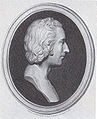
The Scottish political reformer Thomas Muir had been banished to Port Jackson
Port Jackson
Port Jackson, containing Sydney Harbour, is the natural harbour of Sydney, Australia. It is known for its beauty, and in particular, as the location of the Sydney Opera House and Sydney Harbour Bridge...
in Botany Bay
Botany Bay
Botany Bay is a bay in Sydney, New South Wales, a few kilometres south of the Sydney central business district. The Cooks River and the Georges River are the two major tributaries that flow into the bay...
in Australia for 14 years for the crime of Sedition in 1793. He managed to escape having only spent 13 months there, on board the American merchant ship Otter
Otter (ship)
The Otter was a maritime fur trading vessel which was most famous for the rescue, under command of Capt. Ebenezer Dorr , of Thomas Muir, a famous Scottish political exile....
. After a highly adventurous voyage across the as yet largely uncharted Pacific Ocean to Vancouver Island, the Otter finally dropped anchor in Nootka Sound on 22 June 1796.
In conversation with José Tovar, the piloto (master
Master (naval)
The master, or sailing master, was a historic term for a naval officer trained in and responsible for the navigation of a sailing vessel...
) of the Sutil
Sutil (ship)
The Sutil was a brig-rigged schooner built in 1791 by the Spanish Navy at San Blas, New Spain. It was nearly identical to the Mexicana, also built at San Blas in 1791...
, a Spanish vessel at anchor in the Nootka Sound, Muir learned to his dismay of the presence in neighbouring waters of the , the British sloop-of-war
Sloop-of-war
In the 18th and most of the 19th centuries, a sloop-of-war was a warship with a single gun deck that carried up to eighteen guns. As the rating system covered all vessels with 20 guns and above, this meant that the term sloop-of-war actually encompassed all the unrated combat vessels including the...
under William Robert Broughton
William Robert Broughton
William Robert Broughton was a British naval officer in the late 18th century. As a Lieutenant in the Royal Navy, he commanded HMS Chatham as part of the Vancouver Expedition, a voyage of exploration through the Pacific Ocean led by Captain George Vancouver in the early 1790s.-With Vancouver:In...
. This vessel had visited Port Jackson in Australia shortly before Muir’s escape and, since Broughton had almost certainly become acquainted with the captain or members of the crew, his life was now in real danger. To be captured while under sentence of transportation meant immediate execution. Once again Muir’s extraordinary luck held out. While a student at Glasgow, he had acquired a fluent command of Spanish and he was now able to persuade Tovar to break his regulations regarding the admission of foreigners into Spanish territory. Changing vessels he sailed with Tovar down the Pacific West Coast
West Coast of the United States
West Coast or Pacific Coast are terms for the westernmost coastal states of the United States. The term most often refers to the states of California, Oregon, and Washington. Although not part of the contiguous United States, Alaska and Hawaii do border the Pacific Ocean but can't be included in...
to the port of Monterey
Monterey, California
The City of Monterey in Monterey County is located on Monterey Bay along the Pacific coast in Central California. Monterey lies at an elevation of 26 feet above sea level. As of the 2010 census, the city population was 27,810. Monterey is of historical importance because it was the capital of...
in Spanish Las Californias
Las Californias
The Californias, or in — - was the name given by the Spanish to their northwestern territory of New Spain, comprising the present day states of Baja California and Baja California Sur on the Baja California Peninsula in Mexico; and the present day U.S. state of California in the United States of...
.
The chronicles of Pierre François Péron
Pierre François Péron
French Captain Pierre François Péron, born in 1769 at Lambézellec, near Brest, was a French sailor and trading captain who sailed to many different locations in the late 18th century...
describe Muir's escape from Australia and the voyage across the Pacific to Nootka Sound, and then as far as Monterey, California.
Today
For 20 years, Nootka Sound was a centre of world events. For the most part since these past events, the sound has not been has the scene of major international disagreements. It is mentioned in the former unofficial national anthemNational anthem
A national anthem is a generally patriotic musical composition that evokes and eulogizes the history, traditions and struggles of its people, recognized either by a nation's government as the official national song, or by convention through use by the people.- History :Anthems rose to prominence...
of English-speaking Canada, "The Maple Leaf Forever
The Maple Leaf Forever
"The Maple Leaf Forever" is a Canadian song written by Alexander Muir in 1867, the year of Canada's Confederation. He wrote the work after serving with The Queen's Own Rifles of Canada in the Battle of Ridgeway against the Fenians in 1866....
", to represent the western extent of Canada's "fair dominion".
Climate
See also
- History of the west coast of North AmericaHistory of the west coast of North AmericaThe human history of the west coast of North America is believed to stretch back to the arrival of the earliest people over the Bering Strait, or alternately along a now-submerged coastal plain, through the development of significant pre-Columbian cultures and population densities, to the arrival...
- Spanish expeditions to the Pacific Northwest
- Vancouver ExpeditionVancouver ExpeditionThe Vancouver Expedition was a four-and-a-half-year voyage of exploration and diplomacy, commanded by Captain George Vancouver. The expedition circumnavigated the globe, touched five continents and changed the course of history for the indigenous nations and several European empires and their...