

No. 43 Squadron RAF

Encyclopedia
No. 43 Squadron was a Royal Air Force
aircraft squadron originally formed in 1916 as part of the Royal Flying Corps
. It last operated the Panavia Tornado F3
from RAF Leuchars
, Scotland
in the air defence role until disbanded in July 2009.
on 15 April 1916, from No. 18 Reserve Squadron as a unit of the Royal Flying Corps
, equipped with various types, which it used for training until December 1916 when Sopwith 1½ Strutter
s arrived. These were taken to the Western Front
the following month, where it operated as an Army squadron carrying out fighter reconnaissance duties. In September 1917, Sopwith Camel
s arrived, and ground attack replaced reconnaissance duties; the squadron continued in this vein until the end of the war. Snipes
began to be received in August 1918 and conversion was completed in October but the Armistice
prevented these playing a major part in the conflict, instead they were taken to Germany for occupation duties until August 1919 when the squadron moved to RAF Spitalgate
where it disbanded on 31 December 1919. During the course of the war, ten aces served in the squadron, including Henry Woollett,
Cecil Frederick King
,
John Lightfoot Trollope
,
Geoffrey Bailey
,
Harold Balfour,
Charles C. Banks
,
Hector Daniel
,
George Lingham
, and
John Womersley
.
on 1 July 1925 (or 1 July 1923), again with Snipes
. In 1926 the Squadron converted to Gamecocks
, thus inspiring the Squadron badge and the nickname 'The Fighting Cocks'. The black and white checkered markings also date from this era. The Squadron flew Siskins
from 1928 and received the first production Hawker Fury Mk.I
in May 1931.
 Prior to the outbreak of World War II the squadron re-equipped with Hurricanes
, it was with these aircraft that the squadron covered the Dunkirk
retreat and fought in the Battle of Britain
.
In November 1942, 43 Squadron moved to North Africa
, now flying Spitfires
. In 1944, as the tide of war turned in favour of the Allies, the squadron moved to France
, where it was known by the local French population as "les coqs Anglais". By now the squadron's main role was ground attack, strafing and occasionally dive bombing enemy targets. On September 9, 1944 Barrie Heath
, now no324 Wing Commander and flying Spitfire IX MJ628, led a formation on the squadron's first sortie into German territory, strafing motor transport and railway communications.
The squadron ended the war in Austria
and was disbanded in 1947.
was renumbered to No. 43 Squadron, now flying Gloster Meteor
s from RAF Tangmere
. The squadron moved to RAF Leuchars
in 1950 and in 1954 began to receive the Hawker Hunter
. During much of the 1960s the Squadron operated from Aden
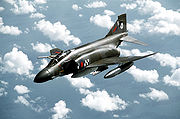
and was disbanded on 7 November 1967. 43 Squadron reformed at Leuchars on 1 September 1969 with the McDonnell Douglas Phantom
which it flew until its replacement by the Tornado F.3 in September 1989.
and maintained a presence in the Iraqi no-fly zones
. 43 Sqn crew and personnel are tasked with the duty of QRA, both in Fife, and in the Falklands as part of 1435 Flight
and participated in Operation Telic
. When the squadron are not on operational taskings they fly daily training sorties through the week, all year round. In April 2008 the squadron absorbed 56 (Reserve) Squadron
to perform the role of Tornado F3 Operational Conversion Unit
, 56 Squadron having reformed in the ISTAR
role.
 The Squadron was awarded the "Freedom of the city" of Stirling
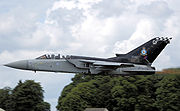
in 2005, the squadron being Stirling's home squadron in the past. The squadron flagship, ZG757, had a gloss black spine and tail and 90th anniversary emblem on the tail.
squadron, probably at RAF Leuchars
.
Royal Air Force
The Royal Air Force is the aerial warfare service branch of the British Armed Forces. Formed on 1 April 1918, it is the oldest independent air force in the world...
aircraft squadron originally formed in 1916 as part of the Royal Flying Corps
Royal Flying Corps
The Royal Flying Corps was the over-land air arm of the British military during most of the First World War. During the early part of the war, the RFC's responsibilities were centred on support of the British Army, via artillery co-operation and photographic reconnaissance...
. It last operated the Panavia Tornado F3
Panavia Tornado ADV
The Panavia Tornado Air Defence Variant is a long-range, twin-engine interceptor version of the swing-wing Panavia Tornado. The aircraft's first flight was on 27 October 1979, and it entered service in 1986. It was retired on 22 March 2011 by the Royal Air Forceand is now only in service with the...
from RAF Leuchars
RAF Leuchars
RAF Leuchars is the most northerly air defence station in the United Kingdom. It is located in Leuchars, Fife, on the east coast of Scotland, near to the university town of St Andrews.-Operations:...
, Scotland
Scotland
Scotland is a country that is part of the United Kingdom. Occupying the northern third of the island of Great Britain, it shares a border with England to the south and is bounded by the North Sea to the east, the Atlantic Ocean to the north and west, and the North Channel and Irish Sea to the...
in the air defence role until disbanded in July 2009.
In World War I
The Squadron was formed at StirlingStirling
Stirling is a city and former ancient burgh in Scotland, and is at the heart of the wider Stirling council area. The city is clustered around a large fortress and medieval old-town beside the River Forth...
on 15 April 1916, from No. 18 Reserve Squadron as a unit of the Royal Flying Corps
Royal Air Force
The Royal Air Force is the aerial warfare service branch of the British Armed Forces. Formed on 1 April 1918, it is the oldest independent air force in the world...
, equipped with various types, which it used for training until December 1916 when Sopwith 1½ Strutter
Sopwith 1½ Strutter
The Sopwith 1½ Strutter was a British one or two-seat biplane multi-role aircraft of the First World War. It is significant as the first British-designed two seater tractor fighter, and the first British aircraft to enter service with a synchronised machine gun...
s arrived. These were taken to the Western Front
Western Front (World War I)
Following the outbreak of World War I in 1914, the German Army opened the Western Front by first invading Luxembourg and Belgium, then gaining military control of important industrial regions in France. The tide of the advance was dramatically turned with the Battle of the Marne...
the following month, where it operated as an Army squadron carrying out fighter reconnaissance duties. In September 1917, Sopwith Camel
Sopwith Camel
The Sopwith Camel was a British First World War single-seat biplane fighter introduced on the Western Front in 1917. Manufactured by Sopwith Aviation Company, it had a short-coupled fuselage, heavy, powerful rotary engine, and concentrated fire from twin synchronized machine guns. Though difficult...
s arrived, and ground attack replaced reconnaissance duties; the squadron continued in this vein until the end of the war. Snipes
Sopwith Snipe
The Sopwith 7F.1 Snipe was a British single-seat biplane fighter of the Royal Air Force . It was designed and built by the Sopwith Aviation Company during the First World War, and came into squadron service a few weeks before the end of that conflict, in late 1918.The Snipe was not a fast aircraft...
began to be received in August 1918 and conversion was completed in October but the Armistice
Armistice with Germany (Compiègne)
The armistice between the Allies and Germany was an agreement that ended the fighting in the First World War. It was signed in a railway carriage in Compiègne Forest on 11 November 1918 and marked a victory for the Allies and a complete defeat for Germany, although not technically a surrender...
prevented these playing a major part in the conflict, instead they were taken to Germany for occupation duties until August 1919 when the squadron moved to RAF Spitalgate
RAF Spitalgate
RAF Spitalgate formerly known as RFCS Grantham and RAF Grantham was a Royal Flying Corps and Royal Air Force station, located south east of the centre of Grantham, Lincolnshire, England fronting onto the main A52 road.-History:...
where it disbanded on 31 December 1919. During the course of the war, ten aces served in the squadron, including Henry Woollett,
Cecil Frederick King
Cecil Frederick King
Captain Cecil Frederick King , Military Cross, Distinguished Flying Cross, French Croix de Guerre was a World War I fighter ace credited with 22 aerial victories.-Early life:...
,
John Lightfoot Trollope
John Lightfoot Trollope
Captain John Lightfoot Trollope, MC & Bar, was a British First World War flying ace, who was the first British pilot to shoot down 7 enemy aircraft in one day, on 24 March 1918. Four days later, he claimed his last 3 kills of the war , before being shot down by German ace Paul Billik...
,
Geoffrey Bailey
Geoffrey Bailey
Lieutenant Geoffrey Grierson Bailey was an English World War I flying ace credited with eight aerial victories. Although well connected in English society of the time, he faded into obscurity postwar.-Early life:...
,
Harold Balfour,
Charles C. Banks
Charles C. Banks
Captain Charles Chaplin Banks DFC MC was a World War I flying ace credited with thirteen aerial victories. He scored a pioneering night fighter victory on 31 May 1918, when he shot down a German Friedrichshafen G bomber.-Early life and service:...
,
Hector Daniel
Hector Daniel
Brigadier Hector Daniel CBE MC AFC was a South African military commander. He served in the Royal Air Force in World War I, becoming an ace with nine aerial victories, and joined the South African Air Force in 1923....
,
George Lingham
George Lingham
Lieutenant George Alexander Lingham was a World War I flying ace credited with six confirmed aerial victories....
, and
John Womersley
John Womersley
Captain John Herbert Greenwood Womersley was a World War I flying ace credited with five aerial victories....
.
Between the wars
The squadron was re-formed at RAF HenlowRAF Henlow
RAF Henlow is a Royal Air Force station in Bedfordshire, England, equidistant from Bedford, Luton and Stevenage. It houses the RAF Centre of Aviation Medicine, the RAF Signals Museum and 616 Volunteer Gliding Squadron.- History :...
on 1 July 1925 (or 1 July 1923), again with Snipes
Sopwith Snipe
The Sopwith 7F.1 Snipe was a British single-seat biplane fighter of the Royal Air Force . It was designed and built by the Sopwith Aviation Company during the First World War, and came into squadron service a few weeks before the end of that conflict, in late 1918.The Snipe was not a fast aircraft...
. In 1926 the Squadron converted to Gamecocks
Gloster Gamecock
|-See also:-Bibliography:* Green, William and Swanborough, Gordon. "The Era-Ending Gamecock". Air Enthusiast, Number 21, April-July 1983.Bromley, Kent:Pilot Press. p. 1-8, 58-62. ISSN 0143-5450....
, thus inspiring the Squadron badge and the nickname 'The Fighting Cocks'. The black and white checkered markings also date from this era. The Squadron flew Siskins
Armstrong Whitworth Siskin
The Armstrong Whitworth Siskin was a British biplane single-seat fighter aircraft of the 1920s produced by Armstrong Whitworth Aircraft. The Siskin was one of the first new RAF fighters to enter service after the First World War; it was noted for its aerobatic qualities.-Design and development:The...
from 1928 and received the first production Hawker Fury Mk.I
Hawker Fury
The Hawker Fury was a British biplane fighter aircraft used by the Royal Air Force in the 1930s. It was originally named the Hornet and was the counterpart to the Hawker Hart light bomber.-Design and development:...
in May 1931.
In World War II
Hawker Hurricane
The Hawker Hurricane is a British single-seat fighter aircraft that was designed and predominantly built by Hawker Aircraft Ltd for the Royal Air Force...
, it was with these aircraft that the squadron covered the Dunkirk
Battle of Dunkirk
The Battle of Dunkirk was a battle in the Second World War between the Allies and Germany. A part of the Battle of France on the Western Front, the Battle of Dunkirk was the defence and evacuation of British and allied forces in Europe from 26 May–4 June 1940.After the Phoney War, the Battle of...
retreat and fought in the Battle of Britain
Battle of Britain
The Battle of Britain is the name given to the World War II air campaign waged by the German Air Force against the United Kingdom during the summer and autumn of 1940...
.
In November 1942, 43 Squadron moved to North Africa
North Africa
North Africa or Northern Africa is the northernmost region of the African continent, linked by the Sahara to Sub-Saharan Africa. Geopolitically, the United Nations definition of Northern Africa includes eight countries or territories; Algeria, Egypt, Libya, Morocco, South Sudan, Sudan, Tunisia, and...
, now flying Spitfires
Supermarine Spitfire
The Supermarine Spitfire is a British single-seat fighter aircraft that was used by the Royal Air Force and many other Allied countries throughout the Second World War. The Spitfire continued to be used as a front line fighter and in secondary roles into the 1950s...
. In 1944, as the tide of war turned in favour of the Allies, the squadron moved to France
France
The French Republic , The French Republic , The French Republic , (commonly known as France , is a unitary semi-presidential republic in Western Europe with several overseas territories and islands located on other continents and in the Indian, Pacific, and Atlantic oceans. Metropolitan France...
, where it was known by the local French population as "les coqs Anglais". By now the squadron's main role was ground attack, strafing and occasionally dive bombing enemy targets. On September 9, 1944 Barrie Heath
Barrie Heath
- Bibliography :*Saunders, Andy. . No 43 Squadron Osprey Publishing. ISBN 978-1-84176-439-9- External links :* Retrieved: February 16, 2010.* Retrieved: February 16, 2010.* Retrieved: February 16, 2010....
, now no324 Wing Commander and flying Spitfire IX MJ628, led a formation on the squadron's first sortie into German territory, strafing motor transport and railway communications.
The squadron ended the war in Austria
Austria
Austria , officially the Republic of Austria , is a landlocked country of roughly 8.4 million people in Central Europe. It is bordered by the Czech Republic and Germany to the north, Slovakia and Hungary to the east, Slovenia and Italy to the south, and Switzerland and Liechtenstein to the...
and was disbanded in 1947.
Entering the jet age
In February 1949 No. 266 SquadronNo. 266 Squadron RAF
-World War I:The squadron was formed from No's 437 and 438 Flights at Mudros, Greece on 27 September 1918 to carry out anti-submarine patrols in that area, flying Short 184s and 320s along with Felixtowe F.3s. In February 1919 it was transferred to the Caucasus on HMS Engadine. It operated from...
was renumbered to No. 43 Squadron, now flying Gloster Meteor
Gloster Meteor
The Gloster Meteor was the first British jet fighter and the Allies' first operational jet. It first flew in 1943 and commenced operations on 27 July 1944 with 616 Squadron of the Royal Air Force...
s from RAF Tangmere
RAF Tangmere
RAF Tangmere was a Royal Air Force station famous for its role in the Battle of Britain, located at Tangmere village about 3 miles east of Chichester in West Sussex, England. American RAF pilot Billy Fiske died at Tangmere and was the first American aviator to die during World War II...
. The squadron moved to RAF Leuchars
RAF Leuchars
RAF Leuchars is the most northerly air defence station in the United Kingdom. It is located in Leuchars, Fife, on the east coast of Scotland, near to the university town of St Andrews.-Operations:...
in 1950 and in 1954 began to receive the Hawker Hunter
Hawker Hunter
The Hawker Hunter is a subsonic British jet aircraft developed in the 1950s. The single-seat Hunter entered service as a manoeuvrable fighter aircraft, and later operated in fighter-bomber and reconnaissance roles in numerous conflicts. Two-seat variants remained in use for training and secondary...
. During much of the 1960s the Squadron operated from Aden
Aden
Aden is a seaport city in Yemen, located by the eastern approach to the Red Sea , some 170 kilometres east of Bab-el-Mandeb. Its population is approximately 800,000. Aden's ancient, natural harbour lies in the crater of an extinct volcano which now forms a peninsula, joined to the mainland by a...
and was disbanded on 7 November 1967. 43 Squadron reformed at Leuchars on 1 September 1969 with the McDonnell Douglas Phantom
F-4 Phantom II
The McDonnell Douglas F-4 Phantom II is a tandem two-seat, twin-engined, all-weather, long-range supersonic jet interceptor fighter/fighter-bomber originally developed for the United States Navy by McDonnell Aircraft. It first entered service in 1960 with the U.S. Navy. Proving highly adaptable,...
which it flew until its replacement by the Tornado F.3 in September 1989.
The Tornado Years
With the F3 the squadron participated in the 1991 Gulf WarGulf War
The Persian Gulf War , commonly referred to as simply the Gulf War, was a war waged by a U.N.-authorized coalition force from 34 nations led by the United States, against Iraq in response to Iraq's invasion and annexation of Kuwait.The war is also known under other names, such as the First Gulf...
and maintained a presence in the Iraqi no-fly zones
Iraqi no-fly zones
The Iraqi no-fly zones were a set of two separate no-fly zones , and were proclaimed by the United States, United Kingdom and France after the Gulf War of 1991 to protect the Kurdish people in northern Iraq and Shiite Muslims in the south. Iraqi aircraft were forbidden from flying inside the zones...
. 43 Sqn crew and personnel are tasked with the duty of QRA, both in Fife, and in the Falklands as part of 1435 Flight
No. 1435 Flight RAF
No. 1435 Flight is a Eurofighter Typhoon unit of the Royal Air Force, based at RAF Mount Pleasant, providing air defence for the Falkland Islands, South Georgia and the South Sandwich Islands.During the Second World War, No...
and participated in Operation Telic
Operation Telic
Operation TELIC was the codename under which all British military operations in Iraq were conducted between the start of the Invasion of Iraq on 19 March 2003 and the withdrawal of the last remaining British forces on 22 May 2011...
. When the squadron are not on operational taskings they fly daily training sorties through the week, all year round. In April 2008 the squadron absorbed 56 (Reserve) Squadron
No. 56 Squadron RAF
Number 56 Squadron is one of the oldest and most successful squadrons of the Royal Air Force, with battle honours from many of the significant air campaigns of both World War I and World War II...
to perform the role of Tornado F3 Operational Conversion Unit
Operational Conversion Unit
An Operational Conversion Unit is a unit within an air force whose role is to support preparation for the operational missions of a specific aircraft type by providing trained personnel. OCUs teach pilots how to fly an aircraft and which tactics best exploit the performance of their aircraft and...
, 56 Squadron having reformed in the ISTAR
ISTAR
ISTAR stands for Intelligence, Surveillance, Target Acquisition, and Reconnaissance. In its macroscopic sense, ISTAR is a practice that links several battlefield functions together to assist a combat force in employing its sensors and managing the information they gather.Information is collected on...
role.
Stirling
Stirling is a city and former ancient burgh in Scotland, and is at the heart of the wider Stirling council area. The city is clustered around a large fortress and medieval old-town beside the River Forth...
in 2005, the squadron being Stirling's home squadron in the past. The squadron flagship, ZG757, had a gloss black spine and tail and 90th anniversary emblem on the tail.
Disbandment
No. 43F Sqn stood down on 13 July 2009 for the fourth time in its history. It has been earmarked to reform as a Eurofighter TyphoonEurofighter Typhoon
The Eurofighter Typhoon is a twin-engine, canard-delta wing, multirole combat aircraft, designed and built by a consortium of three companies: EADS, Alenia Aeronautica and BAE Systems; working through a holding company, Eurofighter GmbH, which was formed in 1986...
squadron, probably at RAF Leuchars
RAF Leuchars
RAF Leuchars is the most northerly air defence station in the United Kingdom. It is located in Leuchars, Fife, on the east coast of Scotland, near to the university town of St Andrews.-Operations:...
.
Notable Pilots
- Barrie HeathBarrie Heath- Bibliography :*Saunders, Andy. . No 43 Squadron Osprey Publishing. ISBN 978-1-84176-439-9- External links :* Retrieved: February 16, 2010.* Retrieved: February 16, 2010.* Retrieved: February 16, 2010....
. Heath shot down four German aircraft between 1940 and 1941. After the war he went on to become the chairman of the engineering giant GKNGKNGKN plc is a multinational automotive and aerospace components company headquartered in Redditch, United Kingdom. The company was formerly known as Guest, Keen and Nettlefolds and can trace its origins back to 1759 and the birth of the Industrial Revolution.GKN is listed on the London Stock...
.