
All Topics  
Nitrogen narcosis


   Email Print
   Bookmark   Link


Nitrogen narcosis


Narcosis while diving, commonly called nitrogen narcosis, inert gas narcosis or rapture of the deep, is a reversible alteration in consciousness
Consciousness

Consciousness is a difficult term to define, because the word is used and understood in a wide variety of ways, so that it frequently happens that what one person sees as a definition of consciousness is seen by others as about something else altogether....
 in scuba divers
Scuba diving

SCUBA diving is Underwater diving, or taking part in another activity, while using a scuba set. By carrying a source of breathing gas , the scuba diver is able to stay underwater longer than with the simple breath-holding techniques used in snorkeling and free-diving, and is not hindered by air lines to a remote air source....
 at depth. It produces a state similar to alcohol
Alcohol

In chemistry, an alcohol is any organic compound in which a hydroxyl Functional group is bound to a carbon atom of an alkyl or substituted alkyl group....
 intoxication or nitrous oxide
Nitrous oxide

Nitrous oxide, commonly known as "laughing gas", is a chemical compound with the chemical formula Nitrogen2Oxygen. At room temperature, it is a colorless Flammability gas, with a pleasant, slightly sweet odor and taste....
 inhalation. It occurs to some small extent at any depth, but in most cases does not become noticeable until greater depths, usually from 30 to 40 meters (100 to 130 feet).

Apart from helium
Helium

Helium is a colorless, odorless, tasteless, non-toxic, inert monatomic chemical element that heads the noble gas group in the periodic table and whose atomic number is 2....
, all gases that can be breathed
Breathing gas

Air is the most common and only natural breathing gas. Other artificial gases, either pure gases or mixtures of gases, are used in breathing equipment and enclosed habitats such as Scuba set, surface supplied diving equipment, recompression chambers, submarines, space suits, spacecraft and anaesthetic machines....
 have a narcotic effect, which is greater as the lipid solubility of the gas increases.


Discussion
Ask a question about 'Nitrogen narcosis'
Start a new discussion about 'Nitrogen narcosis'
Answer questions from other users
Full Discussion Forum


Encyclopedia


Narcosis while diving, commonly called nitrogen narcosis, inert gas narcosis or rapture of the deep, is a reversible alteration in consciousness
Consciousness

Consciousness is a difficult term to define, because the word is used and understood in a wide variety of ways, so that it frequently happens that what one person sees as a definition of consciousness is seen by others as about something else altogether....
 in scuba divers
Scuba diving

SCUBA diving is Underwater diving, or taking part in another activity, while using a scuba set. By carrying a source of breathing gas , the scuba diver is able to stay underwater longer than with the simple breath-holding techniques used in snorkeling and free-diving, and is not hindered by air lines to a remote air source....
 at depth. It produces a state similar to alcohol
Alcohol

In chemistry, an alcohol is any organic compound in which a hydroxyl Functional group is bound to a carbon atom of an alkyl or substituted alkyl group....
 intoxication or nitrous oxide
Nitrous oxide

Nitrous oxide, commonly known as "laughing gas", is a chemical compound with the chemical formula Nitrogen2Oxygen. At room temperature, it is a colorless Flammability gas, with a pleasant, slightly sweet odor and taste....
 inhalation. It occurs to some small extent at any depth, but in most cases does not become noticeable until greater depths, usually from 30 to 40 meters (100 to 130 feet).

Apart from helium
Helium

Helium is a colorless, odorless, tasteless, non-toxic, inert monatomic chemical element that heads the noble gas group in the periodic table and whose atomic number is 2....
, all gases that can be breathed
Breathing gas

Air is the most common and only natural breathing gas. Other artificial gases, either pure gases or mixtures of gases, are used in breathing equipment and enclosed habitats such as Scuba set, surface supplied diving equipment, recompression chambers, submarines, space suits, spacecraft and anaesthetic machines....
 have a narcotic effect, which is greater as the lipid solubility of the gas increases. As the depth increases, the effects of narcosis may become hazardous as the diver becomes increasingly impaired. Although divers can learn to cope with this impairment, it is not possible to develop a tolerance. Predicting the depth at which narcosis will affect a diver is difficult as susceptibility varies widely from dive to dive and amongst individuals.

Narcosis is completely reversed by ascending to a shallower depth and produces no after effects. For this reason, narcosis while diving in open water rarely develops into a serious problem as long as the diver is aware of its symptoms and ascends to manage it. Diving beyond requires extra training and the use of a gas mixture containing helium is recommended.

Classification

Narcosis results from breathing gases under elevated pressure and may be classified by the principal gas involved. All of the noble gases, except helium, as well as nitrogen
Nitrogen

Nitrogen is a chemical element that has the symbol N and atomic number 7 and atomic mass 14.00674?. Elemental nitrogen is a colorless, odorless, tasteless and mostly inert diatomic gas at standard conditions, constituting 78% by volume of Earth's atmosphere....
, oxygen
Oxygen

Oxygen no O2 produced; 2) O2 produced, but absorbed in oceans & seabed rock; 3) O2 starts to gas out of the oceans, but is absorbed by land surfaces and formation of ozone layer; 4-5) O2 sinks filled and the gas accumulates]]...
 and hydrogen
Hydrogen

Hydrogen is the chemical element with atomic number 1. It is represented by the chemical symbol H. At standard temperature and pressure, hydrogen is a colorless, odorless, nonmetallic, tasteless, highly combustion and explosive Diatomic molecule gas with the molecular formula H2....
 cause a decrement in mental function, but their effect on psychomotor function (processes affecting the coordination of sensory or cognitive processes and motor activity) varies widely, while the effects of carbon dioxide
Carbon dioxide

Carbon dioxide is a chemical compound composed of two oxygen atoms covalent bond to a single carbon atom. It is a gas at standard temperature and pressure and exists in Earth's atmosphere in this state....
 consistently result in decreased mental and psychomotor function. The noble gases argon
Argon

Argon is a chemical element designated by the symbol Ar. Argon has atomic number 18 and is the third element in group 18 of the periodic table ....
, krypton
KRYPTON

KRYPTON is a frame language computer programming language."An Essential Hybrid Reasoning System: Knowledge and Symbol Level Accounts of KRYPTON", R.J. Brachman et al, Proc IJCAI-85, 1985....
, and xenon
Xenon

Xenon is a chemical element represented by the chemical symbol Xe. Its atomic number is 54. A colorless, heavy, odorless noble gas, xenon occurs in the Earth's atmosphere in trace amounts....
 are more narcotic than nitrogen at a given pressure, and xenon has so much anesthetic activity that it is actually a usable anaesthetic at 80% concentration and normal atmospheric pressure. Xenon has historically been too expensive to be used very much in practice, but it has been successfully used for surgical operations, and xenon anesthesia systems are still being proposed and designed.

Signs and symptoms

Due to its perception-altering effects, the onset of narcosis may be hard to recognize. At its most benign, narcosis results in relief of anxiety and a feeling of tranquillity and mastery of the environment. These effects are similar to both alcohol and familiar benzodiazepine drugs such as Valium (diazepam) and Xanax (alprazolam). Such effects are not harmful unless they cause some immediate danger to not be recognized and addressed. An early effect may be loss of near-visual accommodation, causing increased difficulty in close-accommodation reading of small numbers in middle-aged or older divers who already have any degree of presbyopia
Presbyopia

Presbyopia describes the condition where the eye exhibits a progressively diminished ability to focus on near objects with age. Presbyopia's exact mechanisms are not known with certainty, however, the research evidence most strongly supports a loss of elasticity of the Lens , although changes in the lens's curvature from continual growth and...
.

The most dangerous aspects of narcosis are the loss of decision-making ability, loss of focus, impaired judgement and multi-tasking and coordination. Other effects include vertigo
Vertigo (medical)

Vertigo is a specific type of dizziness, a major symptom of a balance disorder. It is the sensation of spinning or swaying while the body is actually stationary with respect to the surroundings....
, tingling and numbness of the lips, mouth and fingers, and exhaustion. The syndrome may cause exhilaration, giddiness, extreme anxiety, depression, or paranoia
Paranoia

Paranoia is a thought process characterized by excessive anxiety or fear, often to the point of irrationality and delusion. Paranoid thinking typically includes persecutory beliefs concerning a perceived threat towards oneself....
, depending on the individual diver and the diver's medical or personal history. When more serious the diver may begin to feel invulnerable, disregarding normal safe diving practices. Paradoxically, badly affected divers may panic, sometimes remaining on the bottom, too exhausted to ascend.

The relation of depth to narcosis is sometimes informally known as "Martini's law". This is the idea that narcosis results in the feeling of one martini for every 10 meters below 20 meters depth. This is a very rough guide, and not a substitute for an individual diver's known susceptibility, or for standard diving safety guides. Professional divers use such a calculation only as a rough guide to give new divers a metaphor for a situation they may be more familiar with.

Causes

The cause of narcosis is related to the increased solubility of gases in body tissues, occurring at elevated pressures (Henry's law
Henry's law

In chemistry, Henry's law is one of the gas laws, formulated by William Henry in 1803. It states that:An equivalent way of stating the law is that the solubility of a gas in a liquid is proportional to the pressure of that gas above the liquid....
). More recently, researchers have been looking at neurotransmitter receptor protein mechanisms as a possible cause of the narcosis. The breathing gas mix entering the diver's lung
Lung

The lung is the essential respiration organ in air-breathing animals, including most tetrapods, a few fish and a few snails. In mammals and the more complex life forms, the two lungs are located in the chest on either side of the heart....
s will have the same pressure as the surrounding water, known as the ambient pressure. For any given depth, the pressure of gases in the blood passing through the brain catches up with ambient pressure within a minute or two and this produces a delay in narcotic effect after coming to a new depth. Rapid compression potentiates narcosis.

Although narcosis is most commonly reported below 30 metres, the divers' cognition is affected before that, but they are usually unaware of the changes. Even so there is no reliable method to predict the severity of the effect on an individual diver, as the effect may vary from dive to dive (even on the same day).

Significant impairment due to narcosis is an increasing risk below depths of about or an ambient pressure
Pressure

Pressure is the force per unit area applied to an object in a direction surface normal to the surface. Gauge pressure is the pressure relative to the local atmospheric or ambient pressure....
 of about . Most sport scuba training organizations recommend depths of no more than because of risk of narcosis. When breathing air at depths of - an ambient pressure of about 10 bar - narcosis in most divers leads to hallucinations, loss of memory, and unconsciousness. A number of divers have died in attempts to set air depth records below ; because of these incidents the Guinness Book of World Records no longer reports on this figure.

Narcosis has been compared with altitude sickness
Altitude sickness

Altitude sickness, also known as acute mountain sickness , altitude illness, or soroche, is a pathological condition that is caused by acute exposure to low air pressure ....
 insofar as its variability (though not its symptoms); its effects depend on many factors, with variations between individuals. Excellent cardiovascular health is no protection and poor health is not necessarily a predictor. Thermal cold, stress
Stress (medicine)

Stress is a biological term which refers to the consequences of the failure of a human or animal body to respond appropriately to emotional or body threats to the organism, whether actual or imagined....
, heavy work, fatigue, and carbon dioxide retention all increase the risk and severity of nitrogen narcosis.

Narcosis is known to be additive to even minimal alcohol intoxication, and also to the effects of other drugs such as marijuana
Cannabis (drug)

Cannabis, also known as Marijuana or marihuana, or ganja , is a psychoactive drug extracted from the plant Cannabis sativa, or more often, Cannabis sativa subsp....
 (which is more likely than alcohol to have effects which last into a day of abstinence from use). Other sedative and analgesic drugs, such as opiate narcotics and benzodiazepines, add to narcosis.

Mechanism

The precise mechanism is not well understood, but it appears to be a direct effect of gas dissolving into nerve membranes and causing temporary disruption in nerve transmissions. While the effect was first observed with nitrogen (in air), other gases including argon
Argon

Argon is a chemical element designated by the symbol Ar. Argon has atomic number 18 and is the third element in group 18 of the periodic table ....
, krypton
KRYPTON

KRYPTON is a frame language computer programming language."An Essential Hybrid Reasoning System: Knowledge and Symbol Level Accounts of KRYPTON", R.J. Brachman et al, Proc IJCAI-85, 1985....
, and hydrogen
Hydrogen

Hydrogen is the chemical element with atomic number 1. It is represented by the chemical symbol H. At standard temperature and pressure, hydrogen is a colorless, odorless, nonmetallic, tasteless, highly combustion and explosive Diatomic molecule gas with the molecular formula H2....
 also cause very similar effects under higher than atmospheric pressure. Some of these effects have been suggested as due to antagonism at NMDA
NMDA

NMDA is an amino acid derivative acting as a specific agonist at the NMDA receptor, and therefore mimics the action of the neurotransmitter glutamate on that receptor....
 receptors and potentiation of GABAA receptors, similar to the mechanism of nonpolar anesthetics such diethyl ether
Diethyl ether

Diethyl ether, also known as ether and ethoxyethane, is a clear, colorless, and highly flammable liquid with a low boiling point and a characteristic odor....
 or ethylene
Ethylene

Ethylene is the chemical compound with the formula C2H4. It is the simplest alkene. Because it contains a carbon-carbon double bond, ethylene is called an unsaturated hydrocarbon or an olefin....
. However, their reproduction by the very chemically inactive gas argon makes them unlikely to be a strictly "chemical" bonding to receptors in the usual sense of a chemical bond
Chemical bond

A chemical bond is the physical process responsible for the attractive interactions between atoms and molecules, and that which confers stability to diatomic and polyatomic chemical compounds....
. An indirect physical effect (such as a change in membrane volume) would therefore be needed in some cases for a chemical effect on nerve cell ligand-gated ion channel
Ligand-gated ion channel

Ligand-gated ion channels , also referred to as ionotropic receptors or channel-linked receptors, are a group of transmembrane ion channels that are opened or closed in response to the binding of a chemical messenger , such as a neurotransmitter....
s. Trudell et al have suggested non-chemical binding due to the attractive van der Waals force
Van der Waals force

In physical chemistry, the van der Waals force , named after The Netherlands scientist Johannes Diderik van der Waals, is the attractive or repulsive force between molecules other than those due to covalent bonds or to the electrostatic interaction of ions with one another or with neutral molecules....
 between proteins and inert gases.

Similar to the mechanism of ethanol
Ethanol

Ethanol, also called ethyl alcohol, pure alcohol, grain alcohol, or drinking alcohol, is a volatility , flammable, colorless liquid....
's effect, the increase of gas solubility in the nerve cell membrane may cause altered ion permeability properties of the neural cell's lipid
Lipid

Lipids are broadly defined as any fat-soluble , naturally-occurring molecule, such as fats, oils, waxes, cholesterol, sterols, fat-soluble vitamins , monoglycerides, diglycerides, phospholipids, and others....
 bilayers. It has been found that the partial pressure of a gas required to cause a measured degree of impairment correlates well with the lipid solubility of the gas: the greater the solubility, the less partial pressure needed.

An early theory, the Meyer-Overton hypothesis
Minimum alveolar concentration

Minimum alveolar concentration or MAC is a concept used to compare the strengths of anaesthetic Volatile anaesthetic; in simple terms, it is defined as the concentration of the vapour in the lungs that is needed to prevent movement in 50% of subjects in response to surgical stimulus....
 suggested that narcosis happens when the gas penetrates the lipid
Lipid

Lipids are broadly defined as any fat-soluble , naturally-occurring molecule, such as fats, oils, waxes, cholesterol, sterols, fat-soluble vitamins , monoglycerides, diglycerides, phospholipids, and others....
s of the brain's nerve cells, causing direct mechanical interference with the transmission of signals from one nerve cell to another. More recently, specific types of chemically-gated receptors in nerve cells have been identified as being involved with anesthesia and narcosis, but the basic and most general underlying idea that nerve transmission is altered in many diffuse areas of the brain, as a result of presence of gas molecules dissolved in the nerve cell's fatty membranes, remains largely unchallenged.

Diagnosis

The symptoms described may be caused by other factors during a dive: ear problems causing disorientation or nausea; early signs of oxygen toxicity causing visual disturbances; hypothermia causing rapid breathing and shivering. Nevertheless the presence of any of these symptoms should imply narcosis. Alleviation of the effects upon ascending to a shallower depth will confirm the diagnosis. Given the setting, it is unlikely that other conditions would produce the reversible effects. In the rare event of misdiagnosis with another condition causing the symptoms, the initial management - ascending - is still required.

Prevention

Formal dive training stresses that deep dives can be made only after a gradual training to gradually test the individual diver's sensitivity to increasing depths, with careful supervision and logging of reactions. Diving organizations such as Global Underwater Explorers
Global Underwater Explorers

Global Underwater Explorers is a scuba diving organization that provides education within recreational diving, technical diving and cave diving diving....
 (GUE) are careful to emphasize that such sessions are for the purpose of gaining experience in recognizing the onset symptoms of narcosis for a given diver (which tend to be somewhat more repeatable than for the average group of divers, just as is the case with symptoms of intoxication with alcohol). At the same time, GUE stresses that there is little scientific evidence that a diver can "train" to overcome any measure of narcosis at a given depth or become tolerant of it.

While the individual diver cannot predict exactly at what depth the onset of narcosis will occur on a given day, the first symptoms of narcosis for any given diver are often more predictable and personal. For example, one diver may have trouble with eye focus (close accommodation for middle-aged divers), another may experience feelings of euphoria, and another feelings of claustrophobia. Some divers report that they have hearing changes, and that the sound which their exhaled bubbles make becomes different. Specialist training may help divers in identifying these personal onset signs, and these may then be used as a signal to ascend to shallower depths. Although it is sometimes true that narcosis interferes with judgement to prevent such decisions, this is by no means always the case.

The most straightforward way to avoid nitrogen narcosis is for a diver to limit the depth of dives. If narcosis does occur, the effects disappear almost immediately upon ascending to a shallower depth. As narcosis gets worse with increasing depth, a diver keeping to shallower depths can avoid serious narcosis. Most recreational dive schools will only certify basic divers to depths of , and at these depths narcosis does not present a large risk.

Further training is normally required for certification up to on air, and this training should include a discussion of narcosis, its effects, and cure. Some diver training agencies
List of diver training organizations

This page lists Scuba diving diver training organizations....
 offer speciality training to prepare recreational divers to go to depths of , often consisting of further theory and some practice in deep dives with close supervision.A number of technical diving agencies, such as TDI
Technical Diving International

Technical Diving International is the largest Technical_diving Diver training in the world. TDI specializes in more advanced Scuba diving techniques, such as diving with Rebreather and mixed Breathing_gas, such as Heliox....
 and IANTD
International Association of Nitrox and Technical Divers

International Association of Nitrox and Technical Divers is a SCUBA diving organization concerned with certification and training in Nitrox diving, Technical diving and Free diving....
 teach "extended range" or "deep air" courses which teach diving to depths of up to 180 feet (55 metres) without helium.


Some diving organizations teach their divers to frequently check their mental state while immersed using the "thumbs test". The two companions regularly show each other their fingers. One shows a number of fingers (e.g. 2), and then the other must respond by showing back one more or one less (i.e. 3 or 1), depending on previous agreement. If either of them botches the arithmetic, they should suspect narcosis.

Scuba organizations which train for depths beyond recreational depths, commonly considered depths greater than , tend to simply ban diving with gases that cause too high narcosis levels at depth in the average diver, and instead, to strongly encourage the use of other breathing gas
Breathing gas

Air is the most common and only natural breathing gas. Other artificial gases, either pure gases or mixtures of gases, are used in breathing equipment and enclosed habitats such as Scuba set, surface supplied diving equipment, recompression chambers, submarines, space suits, spacecraft and anaesthetic machines....
 mixes containing helium in place of some or all of the nitrogen in air, such as trimix and heliox
Heliox

Heliox is a breathing gas composed of a mixture of helium and oxygen .Heliox has been used medically since the 1930s, and although the medical community adopted it initially to alleviate symptoms of upper airway obstruction, its range of medical uses has since expanded greatly, mostly because of the low density of the gas....
 because helium has no narcotic potential. The use of these gases forms part of technical diving
Technical diving

Technical diving is a form of scuba diving that exceeds the scope of recreational diving . Technical divers require advanced training, extensive experience, specialized equipment and often breathe breathing gases other than air or standard nitrox....
 and requires further training and certification.

Equivalent narcotic depth

In technical diving, the equivalent narcotic depth is a way of expressing the nitrogen narcosis effect of specific breathing gas mixtures, for example heliox and trimix ....
 (END) is a commonly used way of expressing the narcotic effect of different breathing gases.

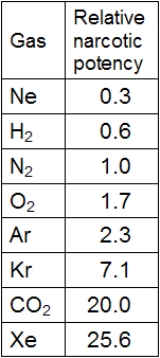
Standard tables, based on relative lipid solubilities, list conversion factors for narcotic effect. For example, neon
Neon

Neon is the chemical element that has the symbol Ne and atomic number 10. Although a very common element in the universe, it is rare on Earth....
 at a given pressure has a narcotic effect equivalent to nitrogen at 0.28 times that pressure, so in principle it should be usable at nearly four times the depth. Argon
Argon

Argon is a chemical element designated by the symbol Ar. Argon has atomic number 18 and is the third element in group 18 of the periodic table ....
, on the other hand, has 2.33 times the narcotic effect of nitrogen, and is not suitable as a breathing gas for diving (it is used as a drysuit inflation gas, owing to its low thermal conductivity). Some gases have other dangerous effects when breathed at pressure; for example, high-pressure oxygen
Oxygen

Oxygen no O2 produced; 2) O2 produced, but absorbed in oceans & seabed rock; 3) O2 starts to gas out of the oceans, but is absorbed by land surfaces and formation of ozone layer; 4-5) O2 sinks filled and the gas accumulates]]...
 can lead to oxygen toxicity
Oxygen toxicity

Oxygen toxicity is a condition resulting from the harmful effects of breathing molecular oxygen at elevated partial pressures. It is also known as oxygen toxicity syndrome, oxygen intoxication, hyperoxia, or the Paul Bert effect and Lorrain Smith effect, after the researchers who pioneered its discovery and desc...
. Although Helium
Helium

Helium is a colorless, odorless, tasteless, non-toxic, inert monatomic chemical element that heads the noble gas group in the periodic table and whose atomic number is 2....
 is the least intoxicating of the breathing gases, at greater depths it can cause high pressure nervous syndrome
High pressure nervous syndrome

High pressure nervous syndrome is a neurological and physiological diving disorders that results when a SCUBA diving spends too much time breathing a high-pressure mixture of helium and oxygen ....
, a still-mysterious but apparently unrelated phenomenon. Inert gas narcosis is only one factor which influences the choice of gas mixture; the risk of decompression sickness
Decompression sickness

'Decompression sickness' , 'the diver?s disease', 'the bends', 'caisson disease' is the name given to a variety of symptoms suffered by a person exposed to a decrease in the pressure around the body....
 and oxygen toxicity
Oxygen toxicity

Oxygen toxicity is a condition resulting from the harmful effects of breathing molecular oxygen at elevated partial pressures. It is also known as oxygen toxicity syndrome, oxygen intoxication, hyperoxia, or the Paul Bert effect and Lorrain Smith effect, after the researchers who pioneered its discovery and desc...
, cost, and other factors are also important.

Because of similar and additive effects, divers should avoid sedating medications and drugs, such as marijuana
Cannabis (drug)

Cannabis, also known as Marijuana or marihuana, or ganja , is a psychoactive drug extracted from the plant Cannabis sativa, or more often, Cannabis sativa subsp....
 and alcohol
Alcohol

In chemistry, an alcohol is any organic compound in which a hydroxyl Functional group is bound to a carbon atom of an alkyl or substituted alkyl group....
 before any dive. A hangover, combined with the reduced physical capacity that goes with it, makes nitrogen narcosis more likely. Experts recommend total abstinence from alcohol at least 24 hours before diving, and longer for heavy drinking. Abstinence time needed for marijuana
Cannabis (drug)

Cannabis, also known as Marijuana or marihuana, or ganja , is a psychoactive drug extracted from the plant Cannabis sativa, or more often, Cannabis sativa subsp....
 is unknown, but due to the much longer half-life of the active agent of this drug in the body, it is likely to be longer than for alcohol.

Management

The management of narcosis is to ascend to shallower depths; the effects then disappear within minutes. In the event of complications or other conditions being present, ascending is always the correct initial response. Should problems remain, then it is necessary to abort the dive. The decompression schedule can still be followed unless complications beyond the narcosis require emergency assistance.

Prognosis

Narcosis is potentially one of the most dangerous conditions to affect the scuba diver at depth. The effects of narcosis are entirely reversible by ascending and therefore pose no problem in themselves, even for repeated, chronic or acute exposure. Nevertheless, the severity of narcosis is unpredictable and it can be fatal while diving, as the result of illogical behaviour in a dangerous environment.

Epidemiology

Tests have shown that all divers are affected by nitrogen narcosis, though some are less affected than others. Even though it is possible that some divers can manage better than others because of training (learning
Learning

Learning is acquiring new knowledge, behaviors, skills, Value s, preferences or understanding, and may involve synthesizing different types of information....
) to cope with impairment, the underlying effects remain. These effects are particularly dangerous because even for the same diver, they are not perfectly reproducible at the same depth.

History

French researcher Victor T. Junod was the first to describe symptoms of narcosis in 1834, noting "the functions of the brain are activated, imagination is lively, thoughts have a peculiar charm and, in some persons, symptoms of intoxication are present."

The first report of anaesthetic potency being related to lipid solubility was published by H. H. Meyer in 1899, entitled "Zur Theorie der Alkoholnarkose". Two years later a similar theory was published independently by Charles Ernest Overton.

Originally thought to be caused by nitrogen, it was found that other gases could cause the same effects. For the inert gases the narcotic potency was found to be proportional to its lipid solubility. As hydrogen has only 0.55 the solubility of nitrogen, deep diving experiments using hydrox
Hydrox (breathing gas)

Hydrox, a gas mixture of hydrogen and oxygen is used as a breathing gas in very deep diving. It allows divers to descend several hundred metres....
 were conducted by Arne Zetterström
Arne Zetterström

Arne Zetterstr?m is best known for his research with the breathing mixture Hydrox for the Swedish Navy.Zetterstr?m first described the use of hydrogen as a breathing gas in 1943....
 between 1943 and 1945.

Jacques Cousteau
Jacques-Yves Cousteau

Jacques-Yves Cousteau was a France naval officer, exploration, ecologist, filmmaker, innovator, scientist, photographer, author and researcher who studied the sea and all forms of life in water....
 in 1953 famously described it as "l’ivresse des grandes profondeurs" or the "rapture of the deep".

Further research into the possible mechanisms of narcosis by anesthetic action led to the "minimum alveolar concentration
Minimum alveolar concentration

Minimum alveolar concentration or MAC is a concept used to compare the strengths of anaesthetic Volatile anaesthetic; in simple terms, it is defined as the concentration of the vapour in the lungs that is needed to prevent movement in 50% of subjects in response to surgical stimulus....
" concept in 1965. This measures the relative concentration of different gases required to prevent motor response in 50% of subjects in response to stimulus, and shows similar results for anesthetic potency as the measurements of lipid solubility.

The National Oceanic and Atmospheric Administration
National Oceanic and Atmospheric Administration

The National Oceanic and Atmospheric Administration is a scientific agency within the United States Department of Commerce focused on the conditions of the oceans and the Earth's atmosphere....
 (NOAA) Diving Manual was revised to recommend treating oxygen as if it were as narcotic as nitrogen, following research by Lambersten et al. in 1977 and 1978.

Society and culture

-- e.g., stigma, economics, religious aspects, awareness, legal issues

Research directions


In other animals


See also

-- avoid if possible, use wikilinks in the main article

Bibliography


Footnotes


External links

  • Scientific body, publications about Nitrogen Narcosis
  • from Diving with deep-six by George D. Campbell, III. (viewed 10 April 2005)
  • by Matti Anttila. (viewed 10 April 2005)