


Nicolas Fouquet

Encyclopedia
Nicolas Fouquet, marquis de Belle-Île, vicomte de Melun et Vaux (January 27, 1615 – March 23, 1680) was the Superintendent of Finances
in France
from 1653 until 1661 under King Louis XIV
. He fell out of favor with the young king, probably because of his extravagant displays of wealth, and the king had him imprisoned from 1661 until his death in 1680.
, he belonged to an influential family of the noblesse de robe and, after some preliminary schooling with the Jesuits
at the age of thirteen, was admitted as avocat at the Parlement of Paris
. While still in his teens, he held several responsible posts, and, in 1636, when just twenty, he was able to buy the post of maître des requêtes
. In 1640 he married the rich Louise Fourché, who died a year later.
From 1642 to 1650, he held various intendancies
, at first in the provinces and then with the army of chief minister Cardinal Mazarin and, coming thus in touch with the court, was permitted in 1650 to buy the important position of procureur général to the parlement of Paris. During Mazarin's exile, Fouquet remained loyal to him, protecting his property and keeping him informed of the situation at court.
Upon Mazarin's return, Fouquet demanded and received as reward the office of superintendent of the finances (1653), a position which, in the unsettled condition of the government, threw into his hands not merely the decision as to which funds should be applied to meet the demands of the state's creditors, but also the negotiations with the great financiers who lent money to the king. The appointment was a popular one with the moneyed class, for Fouquet's great wealth had been largely augmented by his marriage in 1651 with Marie de Castille, who also belonged to a wealthy family of the legal nobility in Spain.
His own credit, and above all his unfailing confidence in himself, strengthened the credit of the government, while his high position at the parlement (he still remained procureur général) secured financial transactions from investigation. As minister of finance, he soon had Mazarin almost in the position of a suppliant. The long wars, and the greed of the courtiers, who followed the example of Mazarin, made it necessary at times for Fouquet to meet the demands upon him by borrowing upon his own credit, but he soon turned this confusion of the public purse with his own to good account.
The disorder in the accounts became hopeless; fraudulent operations were entered into with impunity, and the financiers were kept in the position of clients by official favours and by generous aid whenever they needed it. Fouquet's fortune now surpassed even Mazarin's, but the latter was too deeply implicated in similar operations to interfere, and was obliged to leave the day of reckoning to his agent and successor Jean-Baptiste Colbert
.
His closest friend and, maybe, mistress, was Suzanne de Rougé
, the Marquise du Plessis-Bellière.
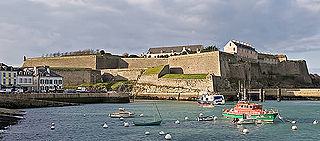
 Upon Mazarin's death Fouquet expected to be made head of the government; but Louis XIV was suspicious of his poorly dissembled ambition, and it was with Fouquet in mind that he made the well-known statement, upon assuming the government, that Louis would be his own chief minister. Colbert, perhaps seeking to succeed Fouquet fed the king's displeasure with adverse reports upon the deficit, and made the worst of the case against Fouquet. The extravagant expenditure and personal display of the superintendent served to intensify the ill-will of the king. Fouquet had bought the port of Belle-Île-en-Mer and strengthened the fortifications, with a view to taking refuge there in case of disgrace.
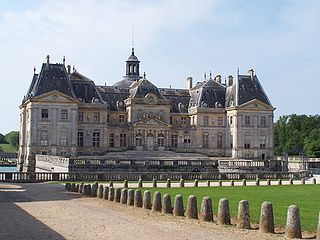
He had spent enormous sums in building a magnificent château
on his estate of Vaux-le-Vicomte
, which in extent, magnificence, and splendour of decoration was a forecast of Versailles
, and where he brought together three artists that the King would later take up for Versailles: the architect Louis Le Vau
, the painter Charles Le Brun
, and the garden designer André le Nôtre
. Here he gathered the rarest manuscripts, paintings, jewels and antiques in profusion, and above all surrounded himself with artists and authors. The table was open to all people of quality, and the kitchen was presided over by François Vatel
. Jean de La Fontaine
, Corneille
, and Paul Scarron
were a few of the many artists who enjoyed his patronage.
The coat of arms of Fouquet's family traditionally showed a squirrel and bore the motto "Quo non ascendet ?" ("How far could it climb?"). This symbol can be found in many rooms and decorations at Vaux-le-Vicomte
. The choice of this animal derives from the name foucquet, which in the dialect of Angers (area in the west of France) means squirrel.
 In August 1661 Louis XIV, already set upon his destruction (his disgrace was secretly decided upon on May 4), was entertained at Vaux with a fête rivaled in magnificence by only one or two in French history, at which Molière
's Les Fâcheux was produced for the first time. The splendour of the entertainment sealed Fouquet's fate. The king, then only 22 years old, was however afraid to act openly against so powerful a minister. As Superintendent, Fouquet headed the enormously wealthy and influential corps of partisans (tax farmers) who, if challenged as a group, could have caused the king serious trouble. By crafty devices Fouquet was induced to sell his office of procureur général, thus losing the protection of its privileges, and he paid the price of it into the treasury.
Three weeks after his visit to Vaux the king withdrew to Nantes
, taking Fouquet with him. When he was leaving the presence chamber, flattered with the assurance of the king's esteem, Fouquet was arrested by a captain of musketeers named d'Artagnan
. The trial lasted almost three years, and its violation of the forms of justice is still the subject of frequent monographs by members of the French bar. Louis acted throughout "as though he were conducting a campaign," evidently fearing that Fouquet would play the part of a Richelieu. A report of his trial was published in the Netherlands, in 15 volumes, in 1665—1667, in spite of the remonstrances which Colbert addressed to the States-General
. A second edition under the title of Oeuvres de M. Fouquet appeared in 1696.
During the course of the trial, French public sympathy was strongly with Fouquet, and La Fontaine, Madame de Sévigné and many others wrote on his behalf; but when Fouquet was sentenced to banishment, the king, disappointed, "commuted" the sentence to imprisonment for life. In early 1665 Fouquet was transferred to the fortress of Pignerol
. There, Eustache Dauger, the man identified in contemporary official correspondence as the Man in the Iron Mask
, served as Fouquet's manservant. His wife was not allowed to write to him until 1672; she was allowed to visit him only once, in 1679. The former minister bore his imprisonment with manly fortitude, and composed several mediocre translations in prison. The devotional works bearing his name are apocryphal.
According to official records, Fouquet died in Pignerol on March 23, 1680.
, who is often identified as the true king or even as an identical twin brother of Louis XIV. As such, he is a pivotal character in Alexandre Dumas' novel The Vicomte de Bragelonne
, where he is depicted sympathetically. Aramis
, an ally of Fouquet, tries to seize power by replacing Louis XIV with his identical twin brother. It is Fouquet who, out of sheer loyalty for the crown, foils Aramis' plot and saves Louis. This does not, however, prevent his downfall.
James Whale
's film The Man in the Iron Mask
is very loosely adapted from Dumas' novel and, on the contrary, depicts Fouquet as the story's main villain, who tries to keep the existence of the King's twin brother a secret. Fouquet is portrayed by Joseph Schildkraut
. In a departure from history, he dies when his coach plunges off a cliff. In the 1977 version
, Fouquet is portrayed by Patrick McGoohan
.
He was also portrayed by Robert Lindsay in Nick Dear's play Power. This debuted at the national theatre in 2003.
Fouquet's life (and his rivalry with Colbert) is also one of the background plots/histories in the historical novel Imprimatur
by Rita Monaldi
and Francesco Sorti
.
----
Superintendent of Finances
The Superintendent of Finances was the name of the minister in charge of finances in France from 1561 to 1661. The position was abolished in 1661 with the downfall of Nicolas Fouquet, and a new position was created, the Controller-General of Finances....
in France
France
The French Republic , The French Republic , The French Republic , (commonly known as France , is a unitary semi-presidential republic in Western Europe with several overseas territories and islands located on other continents and in the Indian, Pacific, and Atlantic oceans. Metropolitan France...
from 1653 until 1661 under King Louis XIV
Louis XIV of France
Louis XIV , known as Louis the Great or the Sun King , was a Bourbon monarch who ruled as King of France and Navarre. His reign, from 1643 to his death in 1715, began at the age of four and lasted seventy-two years, three months, and eighteen days...
. He fell out of favor with the young king, probably because of his extravagant displays of wealth, and the king had him imprisoned from 1661 until his death in 1680.
Minister of finance
Born in ParisParis
Paris is the capital and largest city in France, situated on the river Seine, in northern France, at the heart of the Île-de-France region...
, he belonged to an influential family of the noblesse de robe and, after some preliminary schooling with the Jesuits
Society of Jesus
The Society of Jesus is a Catholic male religious order that follows the teachings of the Catholic Church. The members are called Jesuits, and are also known colloquially as "God's Army" and as "The Company," these being references to founder Ignatius of Loyola's military background and a...
at the age of thirteen, was admitted as avocat at the Parlement of Paris
Parlement
Parlements were regional legislative bodies in Ancien Régime France.The political institutions of the Parlement in Ancien Régime France developed out of the previous council of the king, the Conseil du roi or curia regis, and consequently had ancient and customary rights of consultation and...
. While still in his teens, he held several responsible posts, and, in 1636, when just twenty, he was able to buy the post of maître des requêtes
Maître des requêtes
Masters of Requests are high-level judicial officers of administrative law in France and other European countries that have existed in one form or another since the Middle Ages.-Old Regime France:...
. In 1640 he married the rich Louise Fourché, who died a year later.
From 1642 to 1650, he held various intendancies
Intendant
The title of intendant has been used in several countries through history. Traditionally, it refers to the holder of a public administrative office...
, at first in the provinces and then with the army of chief minister Cardinal Mazarin and, coming thus in touch with the court, was permitted in 1650 to buy the important position of procureur général to the parlement of Paris. During Mazarin's exile, Fouquet remained loyal to him, protecting his property and keeping him informed of the situation at court.
Upon Mazarin's return, Fouquet demanded and received as reward the office of superintendent of the finances (1653), a position which, in the unsettled condition of the government, threw into his hands not merely the decision as to which funds should be applied to meet the demands of the state's creditors, but also the negotiations with the great financiers who lent money to the king. The appointment was a popular one with the moneyed class, for Fouquet's great wealth had been largely augmented by his marriage in 1651 with Marie de Castille, who also belonged to a wealthy family of the legal nobility in Spain.
His own credit, and above all his unfailing confidence in himself, strengthened the credit of the government, while his high position at the parlement (he still remained procureur général) secured financial transactions from investigation. As minister of finance, he soon had Mazarin almost in the position of a suppliant. The long wars, and the greed of the courtiers, who followed the example of Mazarin, made it necessary at times for Fouquet to meet the demands upon him by borrowing upon his own credit, but he soon turned this confusion of the public purse with his own to good account.
The disorder in the accounts became hopeless; fraudulent operations were entered into with impunity, and the financiers were kept in the position of clients by official favours and by generous aid whenever they needed it. Fouquet's fortune now surpassed even Mazarin's, but the latter was too deeply implicated in similar operations to interfere, and was obliged to leave the day of reckoning to his agent and successor Jean-Baptiste Colbert
Jean-Baptiste Colbert
Jean-Baptiste Colbert was a French politician who served as the Minister of Finances of France from 1665 to 1683 under the rule of King Louis XIV. His relentless hard work and thrift made him an esteemed minister. He achieved a reputation for his work of improving the state of French manufacturing...
.
His closest friend and, maybe, mistress, was Suzanne de Rougé
Rougé
Rougé is a commune in the Loire-Atlantique department in western France.It lies near Rennes.The name "Rougé" comes from the Latin "Rubiacus", means the red place...
, the Marquise du Plessis-Bellière.
Vaux-le-Vicomte
He had spent enormous sums in building a magnificent château
Château
A château is a manor house or residence of the lord of the manor or a country house of nobility or gentry, with or without fortifications, originally—and still most frequently—in French-speaking regions...
on his estate of Vaux-le-Vicomte
Vaux-le-Vicomte
The Château de Vaux-le-Vicomte is a baroque French château located in Maincy, near Melun, 55 km southeast of Paris in the Seine-et-Marne département of France...
, which in extent, magnificence, and splendour of decoration was a forecast of Versailles
Palace of Versailles
The Palace of Versailles , or simply Versailles, is a royal château in Versailles in the Île-de-France region of France. In French it is the Château de Versailles....
, and where he brought together three artists that the King would later take up for Versailles: the architect Louis Le Vau
Louis Le Vau
Louis Le Vau was a French Classical architect who worked for Louis XIV of France. He was born and died in Paris.He was responsible, with André Le Nôtre and Charles Le Brun, for the redesign of the château of Vaux-le-Vicomte. His later works included the Palace of Versailles and his collaboration...
, the painter Charles Le Brun
Charles Le Brun
Charles Le Brun , a French painter and art theorist, became the all-powerful, peerless master of 17th-century French art.-Biography:-Early life and training:...
, and the garden designer André le Nôtre
André Le Nôtre
André Le Nôtre was a French landscape architect and the principal gardener of King Louis XIV of France...
. Here he gathered the rarest manuscripts, paintings, jewels and antiques in profusion, and above all surrounded himself with artists and authors. The table was open to all people of quality, and the kitchen was presided over by François Vatel
François Vatel
François Vatel was the maître d'hôtel of Nicolas Fouquet and prince Louis II de Bourbon-Condé.He is widely, but incorrectly, credited with creating crème Chantilly , a sweet, vanilla-flavoured whipped cream, for an extravagant banquet for 2,000 people hosted in honour of Louis XIV by Louis, the...
. Jean de La Fontaine
Jean de La Fontaine
Jean de La Fontaine was the most famous French fabulist and one of the most widely read French poets of the 17th century. He is known above all for his Fables, which provided a model for subsequent fabulists across Europe and numerous alternative versions in France, and in French regional...
, Corneille
Pierre Corneille
Pierre Corneille was a French tragedian who was one of the three great seventeenth-century French dramatists, along with Molière and Racine...
, and Paul Scarron
Paul Scarron
Paul Scarron was a French poet, dramatist, and novelist. His precise birthdate is unknown, but he was baptized on July 4, 1610...
were a few of the many artists who enjoyed his patronage.
The coat of arms of Fouquet's family traditionally showed a squirrel and bore the motto "Quo non ascendet ?" ("How far could it climb?"). This symbol can be found in many rooms and decorations at Vaux-le-Vicomte
Vaux-le-Vicomte
The Château de Vaux-le-Vicomte is a baroque French château located in Maincy, near Melun, 55 km southeast of Paris in the Seine-et-Marne département of France...
. The choice of this animal derives from the name foucquet, which in the dialect of Angers (area in the west of France) means squirrel.
Arrest, trial, and life imprisonment
Molière
Jean-Baptiste Poquelin, known by his stage name Molière, was a French playwright and actor who is considered to be one of the greatest masters of comedy in Western literature...
's Les Fâcheux was produced for the first time. The splendour of the entertainment sealed Fouquet's fate. The king, then only 22 years old, was however afraid to act openly against so powerful a minister. As Superintendent, Fouquet headed the enormously wealthy and influential corps of partisans (tax farmers) who, if challenged as a group, could have caused the king serious trouble. By crafty devices Fouquet was induced to sell his office of procureur général, thus losing the protection of its privileges, and he paid the price of it into the treasury.
Three weeks after his visit to Vaux the king withdrew to Nantes
Nantes
Nantes is a city in western France, located on the Loire River, from the Atlantic coast. The city is the 6th largest in France, while its metropolitan area ranks 8th with over 800,000 inhabitants....
, taking Fouquet with him. When he was leaving the presence chamber, flattered with the assurance of the king's esteem, Fouquet was arrested by a captain of musketeers named d'Artagnan
Charles de Batz-Castelmore d'Artagnan
Charles Ogier de Batz de Castelmore, Comte d'Artagnan served Louis XIV as captain of the Musketeers of the Guard and died at the Siege of Maastricht in the Franco-Dutch War. A fictionalized account of his life by Gatien de Courtilz de Sandras formed the basis for the d'Artagnan Romances of...
. The trial lasted almost three years, and its violation of the forms of justice is still the subject of frequent monographs by members of the French bar. Louis acted throughout "as though he were conducting a campaign," evidently fearing that Fouquet would play the part of a Richelieu. A report of his trial was published in the Netherlands, in 15 volumes, in 1665—1667, in spite of the remonstrances which Colbert addressed to the States-General
French States-General
In France under the Old Regime, the States-General or Estates-General , was a legislative assembly of the different classes of French subjects. It had a separate assembly for each of the three estates, which were called and dismissed by the king...
. A second edition under the title of Oeuvres de M. Fouquet appeared in 1696.
During the course of the trial, French public sympathy was strongly with Fouquet, and La Fontaine, Madame de Sévigné and many others wrote on his behalf; but when Fouquet was sentenced to banishment, the king, disappointed, "commuted" the sentence to imprisonment for life. In early 1665 Fouquet was transferred to the fortress of Pignerol
Pinerolo
Pinerolo is a town and comune in north-western Italy, 40 kilometres southwest of Turin on the river Chisone.-History:In the Middle Ages, the town of Pinerolo was one of the main crossroads in Italy, and was therefore one of the principal fortresses of the dukes of Savoy. Its military importance...
. There, Eustache Dauger, the man identified in contemporary official correspondence as the Man in the Iron Mask
Man in the Iron Mask
The Man in the Iron Mask is a name given to a prisoner arrested as Eustache Dauger in 1669 or 1670, and held in a number of jails, including the Bastille and the Fortress of Pignerol . He was held in the custody of the same jailer, Bénigne Dauvergne de Saint-Mars, for a period of 34 years...
, served as Fouquet's manservant. His wife was not allowed to write to him until 1672; she was allowed to visit him only once, in 1679. The former minister bore his imprisonment with manly fortitude, and composed several mediocre translations in prison. The devotional works bearing his name are apocryphal.
According to official records, Fouquet died in Pignerol on March 23, 1680.
In fiction
Fouquet's story is often entwined together with the Man in the Iron MaskMan in the Iron Mask
The Man in the Iron Mask is a name given to a prisoner arrested as Eustache Dauger in 1669 or 1670, and held in a number of jails, including the Bastille and the Fortress of Pignerol . He was held in the custody of the same jailer, Bénigne Dauvergne de Saint-Mars, for a period of 34 years...
, who is often identified as the true king or even as an identical twin brother of Louis XIV. As such, he is a pivotal character in Alexandre Dumas' novel The Vicomte de Bragelonne
The Vicomte de Bragelonne
The Vicomte of Bragelonne: Ten Years Later is a novel by Alexandre Dumas. It is the third and last of the d'Artagnan Romances, following The Three Musketeers and Twenty Years After. It appeared first in serial form between 1847 and 1850...
, where he is depicted sympathetically. Aramis
Aramis
C. René d'Aramis de Vannes is a fictional character in the novels The Three Musketeers, Twenty Years After and The Vicomte de Bragelonne by Alexandre Dumas, père...
, an ally of Fouquet, tries to seize power by replacing Louis XIV with his identical twin brother. It is Fouquet who, out of sheer loyalty for the crown, foils Aramis' plot and saves Louis. This does not, however, prevent his downfall.
James Whale
James Whale
James Whale was an English film director, theatre director and actor. He is best remembered for his work in the horror film genre, having directed such classics as Frankenstein , The Old Dark House , The Invisible Man and Bride of Frankenstein...
's film The Man in the Iron Mask
The Man in the Iron Mask (1939 film)
The Man in the Iron Mask is a 1939 American film very loosely adapted from the last section of the novel The Vicomte de Bragelonne by Alexandre Dumas, père, which is itself based on the French legend of the Man in the Iron Mask....
is very loosely adapted from Dumas' novel and, on the contrary, depicts Fouquet as the story's main villain, who tries to keep the existence of the King's twin brother a secret. Fouquet is portrayed by Joseph Schildkraut
Joseph Schildkraut
Joseph Schildkraut was an Austrian stage and film actor.-Early life:Born in Vienna, Austria, Schildkraut was the son of stage actor Rudolph Schildkraut. The younger Schildkraut moved to the United States in the early 1900s. He appeared in many Broadway productions...
. In a departure from history, he dies when his coach plunges off a cliff. In the 1977 version
The Man in the Iron Mask (1977 film)
The Man in the Iron Mask is a 1977 television film loosely adapted from The Vicomte de Bragelonne by Alexandre Dumas and presenting several plot similarities with the 1939 film version...
, Fouquet is portrayed by Patrick McGoohan
Patrick McGoohan
Patrick Joseph McGoohan was an American-born actor, raised in Ireland and England, with an extensive stage and film career, most notably in the 1960s television series Danger Man , and The Prisoner, which he co-created...
.
He was also portrayed by Robert Lindsay in Nick Dear's play Power. This debuted at the national theatre in 2003.
Fouquet's life (and his rivalry with Colbert) is also one of the background plots/histories in the historical novel Imprimatur
Imprimatur
An imprimatur is, in the proper sense, a declaration authorizing publication of a book. The term is also applied loosely to any mark of approval or endorsement.-Catholic Church:...
by Rita Monaldi
Rita Monaldi
Rita Monaldi is an Italian journalist and writer who, in collaboration with her husband, Francesco Sorti, wrote a series of literary-historical books called Imprimatur, Secretum and Veritas, with Atto Melani as a central character. She majored in classical philology and specialized in the history...
and Francesco Sorti
Francesco Sorti
Francesco Sorti is an Italian journalist who, in collaboration with his wife Rita Monaldi, wrote a series of literary-historical books called Imprimatur, Secretum and Veritas, with Atto Melani as a central character. They both live in Vienna....
.
----