

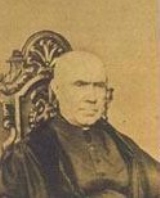
Nicholas Callan

Encyclopedia
Father Nicholas Joseph Callan (1799 – 1864) was an Irish
priest and scientist from Darver, Co. Louth
, Ireland
. He was Professor of Natural Philosophy in Maynooth College
near Dublin from 1834, and is best known for his work on the induction coil
.
. His local parish priest, Father Andrew Levins, then took him in hand as an altar boy and Mass server, and saw him start the priesthood at Navan
seminary. He entered Maynooth College in 1816. In his third year at Maynooth
, Callan studied natural and experimental philosophy under Dr. Cornelius Denvir
. He introduced the experimental method into his teaching, and had an interest in electricity
and magnetism
.
Callan was ordained a priest in 1823 and went to Rome to study at Sapienza University, obtaining a doctorate in divinity
in 1826. While in Rome he became acquainted with the work of the pioneers in electricity such as Luigi Galvani
(1737–1798) who was a pioneer in modern obstetrics
and Alessandro Volta
(1745–1827) who is known especially for the development of the electric battery. In 1826, Callan returned to Maynooth as the new Professor of Natural Philosophy
(now called physics
), where he also began working with electricity in his basement laboratory at the college.
and Michael Faraday
, Callan began work on the idea of the induction coil
in 1834. He invented the first induction coil in 1836. An induction coil produces an intermittent high-voltage alternating current
from a low-voltage direct current
supply. It has a primary coil consisting of a few turns of thick wire wound around an iron core and subjected to a low voltage (usually from a battery
). Wound on top of this is a secondary coil made up of many turns of thin wire. An iron armature and make-and-break mechanism repeatedly interrupts the current to the primary coil, producing a high-voltage, rapidly alternating current in the secondary circuit.
Callan invented the induction coil because he needed to generate a higher level of electricity than currently available. He took a bar of soft iron, about 2 foot (0.6096 m) long, and wrapped it around with two lengths of copper wire, each about 200 feet (61 m) long. Callan connected the beginning of the first coil to the beginning of the second. Finally, he connected a battery, much smaller than the enormous contrivance just described, to the beginning and end of winding one. He found that when the battery contact was broken, a shock could be felt between the first terminal of the first coil and the second terminal of the second coil.
Further experimentation showed how the coil device could bring the shock from a small battery up the strength level of a big battery. So, Callan tried making a bigger coil. With a battery of only 14 seven inch (178 mm) plates, the device produced power enough for an electric shock "so strong that a person who took it felt the effects of it for several days." Callan thought of his creation as a kind of electromagnet
; but what he actually made was a primitive induction transformer.
Callan's induction coil also used an interrupter that consisted of a rocking wire that repeatedly dipped into a small cup of mercury
(similar to the interrupters used by Charles Page
). Because of the action of the interrupter, which could make and break the current going into the coil, he called his device the "repeater." Actually, this device was the world's first transformer
. Callan had induced a high voltage in the second wire, starting with a low voltage in the adjacent first wire. And the faster he interrupted the current, the bigger the spark. In 1837 he produced his giant induction machine: using a mechanism from a clock to interrupt the current 20 times a second, it generated 15 inches (381 mm) sparks, an estimated 600,000 volts and the largest artificial bolt of electricity then seen.
Some previous batteries had used rare metals such as platinum or unresponsive materials like carbon and zinc. Callan found that he could use inexpensive cast-iron instead of platinum or carbon. For his Maynooth battery he used iron casting for the outer casing and placed a zinc plate was immersed in a porous pot (pot that had an inside and outside chamber for holding two different types of acid) in the centre. In the single fluid cell he disposed of the porous pot and two different fluids. He was able to build a battery with just a single solution.
While experimenting with batteries, Callan also built the world’s largest battery at that time. To construct this battery, he joined together 577 individual batteries ("cells"
), which used over 30 gallons of acid. Since instruments for measuring current or voltages had not yet been invented, Callan measured the strength of a battery by measuring how much weight his electromagnet could lift when powered by the battery. Using his giant battery, Callan's electromagnet lifted 2 tons. The Maynooth battery went into commercial production in London
.
Callan also discovered an early form of galvanisation to protect iron from rusting when he was experimenting on battery design, and he patented the idea.
He died in 1864 and is buried in the cemetery in St. Patrick's College, Maynooth.
until 1997, was named in his honour. In addition, Callan Hall in the south campus, was used through the 1990s for first year science lectures including experimental & mathematical physics, chemistry and biology. The Nicholas Callan Memorial Prize is an annual prize awarded to the best final year student in Experimental Physics.
Ireland
Ireland is an island to the northwest of continental Europe. It is the third-largest island in Europe and the twentieth-largest island on Earth...
priest and scientist from Darver, Co. Louth
County Louth
County Louth is a county of Ireland. It is part of the Border Region and is also located in the province of Leinster. It is named after the town of Louth. Louth County Council is the local authority for the county...
, Ireland
Ireland
Ireland is an island to the northwest of continental Europe. It is the third-largest island in Europe and the twentieth-largest island on Earth...
. He was Professor of Natural Philosophy in Maynooth College
St Patrick's College, Maynooth
St Patrick's College, Maynooth is the "National Seminary for Ireland" , and a Pontifical University, located in the village of Maynooth, 15 miles from Dublin, Ireland. The college and seminary are often referred to as Maynooth College. The college was officially established as the Royal College...
near Dublin from 1834, and is best known for his work on the induction coil
Induction coil
An induction coil or "spark coil" is a type of disruptive discharge coil. It is a type of electrical transformer used to produce high-voltage pulses from a low-voltage direct current supply...
.
Early life and education
He attended school at an academy in DundalkDundalk
Dundalk is the county town of County Louth in Ireland. It is situated where the Castletown River flows into Dundalk Bay. The town is close to the border with Northern Ireland and equi-distant from Dublin and Belfast. The town's name, which was historically written as Dundalgan, has associations...
. His local parish priest, Father Andrew Levins, then took him in hand as an altar boy and Mass server, and saw him start the priesthood at Navan
Navan
-People:Navan was the childhood home of Pierce Brosnan, who appeared in the television series Remington Steele and was the fifth film actor to play James Bond. TV personality Hector Ó hEochagáin, and comedians Dylan Moran and Tommy Tiernan also hail from Navan....
seminary. He entered Maynooth College in 1816. In his third year at Maynooth
Maynooth
Maynooth is a town in north County Kildare, Ireland. It is home to a branch of the National University of Ireland, a Papal University and Ireland's main Roman Catholic seminary, St. Patrick's College...
, Callan studied natural and experimental philosophy under Dr. Cornelius Denvir
Cornelius Denvir
The Most Reverend Cornelius Denvir D.D. was an Irish Roman Catholic Prelate, mathematician, natural philosopher and former Lord Bishop of Down and Connor.-Career:...
. He introduced the experimental method into his teaching, and had an interest in electricity
Electricity
Electricity is a general term encompassing a variety of phenomena resulting from the presence and flow of electric charge. These include many easily recognizable phenomena, such as lightning, static electricity, and the flow of electrical current in an electrical wire...
and magnetism
Magnetism
Magnetism is a property of materials that respond at an atomic or subatomic level to an applied magnetic field. Ferromagnetism is the strongest and most familiar type of magnetism. It is responsible for the behavior of permanent magnets, which produce their own persistent magnetic fields, as well...
.
Callan was ordained a priest in 1823 and went to Rome to study at Sapienza University, obtaining a doctorate in divinity
Doctor of Divinity
Doctor of Divinity is an advanced academic degree in divinity. Historically, it identified one who had been licensed by a university to teach Christian theology or related religious subjects....
in 1826. While in Rome he became acquainted with the work of the pioneers in electricity such as Luigi Galvani
Luigi Galvani
Luigi Aloisio Galvani was an Italian physician and physicist who lived and died in Bologna. In 1791, he discovered that the muscles of dead frogs legs twitched when struck by a spark...
(1737–1798) who was a pioneer in modern obstetrics
Obstetrics
Obstetrics is the medical specialty dealing with the care of all women's reproductive tracts and their children during pregnancy , childbirth and the postnatal period...
and Alessandro Volta
Alessandro Volta
Count Alessandro Giuseppe Antonio Anastasio Gerolamo Umberto Volta was a Lombard physicist known especially for the invention of the battery in 1800.-Early life and works:...
(1745–1827) who is known especially for the development of the electric battery. In 1826, Callan returned to Maynooth as the new Professor of Natural Philosophy
Natural philosophy
Natural philosophy or the philosophy of nature , is a term applied to the study of nature and the physical universe that was dominant before the development of modern science...
(now called physics
Physics
Physics is a natural science that involves the study of matter and its motion through spacetime, along with related concepts such as energy and force. More broadly, it is the general analysis of nature, conducted in order to understand how the universe behaves.Physics is one of the oldest academic...
), where he also began working with electricity in his basement laboratory at the college.
Induction Coil
Influenced by William SturgeonWilliam Sturgeon
William Sturgeon was an English physicist and inventor who made the first electromagnets, and invented the first practical English electric motor.-Early Life :...
and Michael Faraday
Michael Faraday
Michael Faraday, FRS was an English chemist and physicist who contributed to the fields of electromagnetism and electrochemistry....
, Callan began work on the idea of the induction coil
Induction coil
An induction coil or "spark coil" is a type of disruptive discharge coil. It is a type of electrical transformer used to produce high-voltage pulses from a low-voltage direct current supply...
in 1834. He invented the first induction coil in 1836. An induction coil produces an intermittent high-voltage alternating current
Alternating current
In alternating current the movement of electric charge periodically reverses direction. In direct current , the flow of electric charge is only in one direction....
from a low-voltage direct current
Direct current
Direct current is the unidirectional flow of electric charge. Direct current is produced by such sources as batteries, thermocouples, solar cells, and commutator-type electric machines of the dynamo type. Direct current may flow in a conductor such as a wire, but can also flow through...
supply. It has a primary coil consisting of a few turns of thick wire wound around an iron core and subjected to a low voltage (usually from a battery
Battery (electricity)
An electrical battery is one or more electrochemical cells that convert stored chemical energy into electrical energy. Since the invention of the first battery in 1800 by Alessandro Volta and especially since the technically improved Daniell cell in 1836, batteries have become a common power...
). Wound on top of this is a secondary coil made up of many turns of thin wire. An iron armature and make-and-break mechanism repeatedly interrupts the current to the primary coil, producing a high-voltage, rapidly alternating current in the secondary circuit.
Callan invented the induction coil because he needed to generate a higher level of electricity than currently available. He took a bar of soft iron, about 2 foot (0.6096 m) long, and wrapped it around with two lengths of copper wire, each about 200 feet (61 m) long. Callan connected the beginning of the first coil to the beginning of the second. Finally, he connected a battery, much smaller than the enormous contrivance just described, to the beginning and end of winding one. He found that when the battery contact was broken, a shock could be felt between the first terminal of the first coil and the second terminal of the second coil.
Further experimentation showed how the coil device could bring the shock from a small battery up the strength level of a big battery. So, Callan tried making a bigger coil. With a battery of only 14 seven inch (178 mm) plates, the device produced power enough for an electric shock "so strong that a person who took it felt the effects of it for several days." Callan thought of his creation as a kind of electromagnet
Electromagnet
An electromagnet is a type of magnet in which the magnetic field is produced by the flow of electric current. The magnetic field disappears when the current is turned off...
; but what he actually made was a primitive induction transformer.
Callan's induction coil also used an interrupter that consisted of a rocking wire that repeatedly dipped into a small cup of mercury
Mercury (element)
Mercury is a chemical element with the symbol Hg and atomic number 80. It is also known as quicksilver or hydrargyrum...
(similar to the interrupters used by Charles Page
Charles Grafton Page
Charles Grafton Page was an American electrical experimenter and inventor, physician, patent examiner, patent advocate, and professor of chemistry....
). Because of the action of the interrupter, which could make and break the current going into the coil, he called his device the "repeater." Actually, this device was the world's first transformer
Transformer
A transformer is a device that transfers electrical energy from one circuit to another through inductively coupled conductors—the transformer's coils. A varying current in the first or primary winding creates a varying magnetic flux in the transformer's core and thus a varying magnetic field...
. Callan had induced a high voltage in the second wire, starting with a low voltage in the adjacent first wire. And the faster he interrupted the current, the bigger the spark. In 1837 he produced his giant induction machine: using a mechanism from a clock to interrupt the current 20 times a second, it generated 15 inches (381 mm) sparks, an estimated 600,000 volts and the largest artificial bolt of electricity then seen.
The 'Maynooth Battery' and other inventions
Callan experimented with designing batteries after he found the models available to him at the time to be insufficient for research in electromagnetism. The Year-book of Facts in Science and Art, published in 1849, has an article titled "The Maynooth Battery" which begins "We noticed this new and cheap Voltaic Battery in the Year-book of Facts, 1848, p. 14,5. The inventor, the Rev. D. Callan, Professor of Natural Philosophy in Maynooth College, has communicated to the Philosophical Magazine, No. 219, some additional experiments, comparing the power of a cast-iron (or Maynooth) battery with that of a Grove's of equal size."Some previous batteries had used rare metals such as platinum or unresponsive materials like carbon and zinc. Callan found that he could use inexpensive cast-iron instead of platinum or carbon. For his Maynooth battery he used iron casting for the outer casing and placed a zinc plate was immersed in a porous pot (pot that had an inside and outside chamber for holding two different types of acid) in the centre. In the single fluid cell he disposed of the porous pot and two different fluids. He was able to build a battery with just a single solution.
While experimenting with batteries, Callan also built the world’s largest battery at that time. To construct this battery, he joined together 577 individual batteries ("cells"
Electrochemical cell
An electrochemical cell is a device capable of either deriving electrical energy from chemical reactions, or facilitating chemical reactions through the introduction of electrical energy. A common example of an electrochemical cell is a standard 1.5-volt "battery"...
), which used over 30 gallons of acid. Since instruments for measuring current or voltages had not yet been invented, Callan measured the strength of a battery by measuring how much weight his electromagnet could lift when powered by the battery. Using his giant battery, Callan's electromagnet lifted 2 tons. The Maynooth battery went into commercial production in London
London
London is the capital city of :England and the :United Kingdom, the largest metropolitan area in the United Kingdom, and the largest urban zone in the European Union by most measures. Located on the River Thames, London has been a major settlement for two millennia, its history going back to its...
.
Callan also discovered an early form of galvanisation to protect iron from rusting when he was experimenting on battery design, and he patented the idea.
He died in 1864 and is buried in the cemetery in St. Patrick's College, Maynooth.
Legacy
The Callan Building on the north campus of NUI Maynooth, a university which was part of St Patrick's CollegeSt Patrick's College, Maynooth
St Patrick's College, Maynooth is the "National Seminary for Ireland" , and a Pontifical University, located in the village of Maynooth, 15 miles from Dublin, Ireland. The college and seminary are often referred to as Maynooth College. The college was officially established as the Royal College...
until 1997, was named in his honour. In addition, Callan Hall in the south campus, was used through the 1990s for first year science lectures including experimental & mathematical physics, chemistry and biology. The Nicholas Callan Memorial Prize is an annual prize awarded to the best final year student in Experimental Physics.