

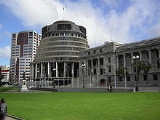
New Zealand House of Representatives

Encyclopedia
The New Zealand House of Representatives is the sole chamber of the legislature
of New Zealand
. The House and the Queen of New Zealand
form the New Zealand Parliament.
The House of Representatives is a democratically elected body, usually consisting of 120 members (currently 122 due to an overhang
) known as Members of Parliament
. Members are elected for limited terms, holding office until Parliament is dissolved (a maximum of three years).
New Zealand essentially follows the Westminster system
of government, and is governed by a cabinet
and Prime Minister
commanding a majority
in the House of Representatives.
The House of Representatives was established by the British
New Zealand Constitution Act 1852
which established a bicameral
legislature, but the upper house, the Legislative Council
, was abolished in 1951 so Parliament is now unicameral
. Parliament received full control over all New Zealand affairs in 1947 with the passage of the Statute of Westminster Adoption Act
.
as the Queen-in-Parliament
and the House of Representatives).
as its model. It normally consists of 120 members, known as "Members of Parliament" (MPs). They were known as "Members of the House of Representatives" (MHRs) until the passing of the Parliamentary and Executive Titles Act 1907 when New Zealand became a dominion
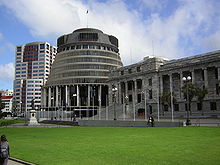
. The House of Representatives meets in Parliament House in Wellington
. Seats in the debating chamber form a horseshoe pattern, with members of the governing party or coalition sitting on the right hand of the Speaker and members of the opposition sitting opposite. The Speaker of the House of Representatives
acts as the presiding officer.
The executive branch of the New Zealand government (the Cabinet
) draws its membership exclusively from the House of Representatives, based on which party or parties can claim a majority. The Prime Minister
(PM) leads the government: the Governor-General
appoints the Prime Minister from a party or coalition which appears to have enough support in the House to govern. This support is immediately tested through a Motion of Confidence. The current government is a coalition between the National Party
, ACT Party, United Future and the Maori Party
; the Prime Minister is John Key
. The Leader of the Opposition
is the leader of the largest opposition party. Currently the Leader of the Opposition is Phil Goff
of the Labour Party
.
For information on current members of Parliament, see 49th New Zealand Parliament
.
Election to the House is by the Mixed Member Proportional (MMP) electoral system
, which provides for proportional representation
. The MMP system means that there are usually several parties
present in the House — at present, there are seven. The MMP system replaced
the old "first-past-the-post" system after a referendum in 1993. The first MMP vote was at the 1996 election
.
 The New Zealand Parliament's model for passing Acts of Parliament
is similar (but not identical) to that of other Westminster System
governments.
Laws are initially proposed to the House of Representatives as bills. They become Acts after being approved three times by House votes and then receiving the Royal Assent
from the Governor-General
. The majority of bills are promulgated by the government of the day (that is, the party or parties that have a majority in the House). It is rare for government bills to be defeated, indeed the first to be defeated in the twentieth century was in 1998. It is also possible for individual MPs to promote their own bills, called member's bills — these are usually put forward by opposition parties, or by MPs who wish to deal with a matter that parties do not take positions on. Local government and private individuals (for $2000 and only affecting themselves) may also bring forward legislation.
Proxy voting
is allowed, in which members may designate a party or another member to vote on their behalf. An excuse is required.
The MP introducing the bill will generally make a recommendation that the bill be considered by an appropriate Select Committee (see below). Sometimes, it will be recommended that a special Committee be formed, usually when the bill is particularly important or controversial. The House then votes as to whether the bill should be sent to the Committee for deliberation. It is not uncommon for a bill to be voted to the Select Committee stage even by parties which do not support it — since Select Committees can recommend amendments to bills, parties will often not make a final decision on whether to back a bill until the Second Reading.
, but in the multi-party environment there is significant scope for real debate. Select Committees frequently recommend changes to bills, with prompts for change coming from the MPs on the Committee, officials who advise the Committee, and members of the public. When a majority of the Committee is satisfied with the bill, the Committee will report back to the House on it. Unless Parliament grants an extension, the time limit for Select Committee deliberations is six months or whatever deadline was set by the House when the bill was referred.
The Government (usually through the Minister of Finance
) has the power (given by the House's Standing Orders) to veto any bill (or amendment to a bill) that would have a major impact on the Government's budget and expenditure plans. This veto could be invoked at any stage of the process, but if applied to a bill as a whole would most likely be employed at the Second Reading stage. This has not occurred since the veto power was introduced in 1996, although many amendments have been vetoed at the Committee of the whole House stage (see below).
If a bill receives its Second Reading, it goes on to be considered by a Committee of the whole House.
During the Committee of the whole House stage, a bill is debated in detail, usually "part by part" (a "part" is a grouping of clauses). MPs may make five-minute speeches on a particular part or provision of the bill and may propose further amendments, but theoretically should not make general speeches on the bill's overall goals or principles (that should have occurred at the Second Reading).
Sometimes a member may advertise his or her proposed amendments beforehand by having them printed on a "Supplementary Order Paper". This is common for amendments proposed by government Ministers. Some Supplementary Order Papers are very extensive, and, if agreed to, can result in major amendments to bills. On rare occasions, Supplementary Order Papers are referred to Select Committees for comment.
The extent to which a bill changes during this process varies. If the Select Committee that considered the bill did not have a government majority and made significant alterations, the Government may make significant "corrective" amendments. There is some criticism that bills may be amended to incorporate significant policy changes without the benefit of Select Committee scrutiny or public submissions, or even that such major changes can be made with little or no notice. However, under the MMP system when the Government is less likely to have an absolute majority, any amendments will usually need to be negotiated with other parties to obtain majority support.
The Opposition may also put forward wrecking amendment
s. These amendments are often just symbolic of their contrasting policy position, or simply intended to delay the passage of the bill through the sheer quantity of amendments for the Committee of the whole House to vote on.
For the 48th Parliament, which finished with the 2008 general election in November 2008, there were 18 select committees in the House of Representatives, as follows:
Occasionally a special Select Committee will be created on a temporary basis. An example was the Select Committee established to study the foreshore and seabed bill
.
:Category:New Zealand House of Representatives accredited news organisations
Legislature
A legislature is a kind of deliberative assembly with the power to pass, amend, and repeal laws. The law created by a legislature is called legislation or statutory law. In addition to enacting laws, legislatures usually have exclusive authority to raise or lower taxes and adopt the budget and...
of New Zealand
New Zealand
New Zealand is an island country in the south-western Pacific Ocean comprising two main landmasses and numerous smaller islands. The country is situated some east of Australia across the Tasman Sea, and roughly south of the Pacific island nations of New Caledonia, Fiji, and Tonga...
. The House and the Queen of New Zealand
Monarchy in New Zealand
The monarchy of New Zealand also referred to as The Crown in Right of New Zealand, Her Majesty in Right of New Zealand, or The Queen in Right of New Zealand is the constitutional system of government in which a hereditary monarch is the sovereign and head of state of the Realm of New Zealand,...
form the New Zealand Parliament.
The House of Representatives is a democratically elected body, usually consisting of 120 members (currently 122 due to an overhang
Overhang seat
Overhang seats can arise in elections under the traditional mixed member proportional system, when a party is entitled to fewer seats as a result of party votes than it has won constituencies.-How overhang seats arise:...
) known as Members of Parliament
Member of Parliament
A Member of Parliament is a representative of the voters to a :parliament. In many countries with bicameral parliaments, the term applies specifically to members of the lower house, as upper houses often have a different title, such as senate, and thus also have different titles for its members,...
. Members are elected for limited terms, holding office until Parliament is dissolved (a maximum of three years).
New Zealand essentially follows the Westminster system
Westminster System
The Westminster system is a democratic parliamentary system of government modelled after the politics of the United Kingdom. This term comes from the Palace of Westminster, the seat of the Parliament of the United Kingdom....
of government, and is governed by a cabinet
New Zealand Cabinet
The Cabinet of New Zealand functions as the policy and decision-making body of the executive branch within the New Zealand government system...
and Prime Minister
Prime Minister of New Zealand
The Prime Minister of New Zealand is New Zealand's head of government consequent on being the leader of the party or coalition with majority support in the Parliament of New Zealand...
commanding a majority
Majority
A majority is a subset of a group consisting of more than half of its members. This can be compared to a plurality, which is a subset larger than any other subset; i.e. a plurality is not necessarily a majority as the largest subset may consist of less than half the group's population...
in the House of Representatives.
The House of Representatives was established by the British
United Kingdom
The United Kingdom of Great Britain and Northern IrelandIn the United Kingdom and Dependencies, other languages have been officially recognised as legitimate autochthonous languages under the European Charter for Regional or Minority Languages...
New Zealand Constitution Act 1852
New Zealand Constitution Act 1852
The New Zealand Constitution Act 1852 was an Act of the Parliament of the United Kingdom that granted self-government to the colony of New Zealand...
which established a bicameral
Bicameralism
In the government, bicameralism is the practice of having two legislative or parliamentary chambers. Thus, a bicameral parliament or bicameral legislature is a legislature which consists of two chambers or houses....
legislature, but the upper house, the Legislative Council
New Zealand Legislative Council
The Legislative Council of New Zealand was the upper house of the New Zealand Parliament from 1853 until 1951. Unlike the lower house, the New Zealand House of Representatives, the Legislative Council was appointed.-Role:...
, was abolished in 1951 so Parliament is now unicameral
Unicameralism
In government, unicameralism is the practice of having one legislative or parliamentary chamber. Thus, a unicameral parliament or unicameral legislature is a legislature which consists of one chamber or house...
. Parliament received full control over all New Zealand affairs in 1947 with the passage of the Statute of Westminster Adoption Act
Statute of Westminster Adoption Act 1947
The Statute of Westminster Adoption Act 1947 was a constitutional Act of the New Zealand Parliament that formally accepted the full external autonomy offered by the British Parliament...
.
Title
The official title of the New Zealand House of Representatives was originally the General Assembly until 1986 when it became the New Zealand House of Representatives, which it had been called in practice since the nineteenth century. It is commonly referred to as "Parliament" (the term "Parliament" encompasses both the monarchMonarchy in New Zealand
The monarchy of New Zealand also referred to as The Crown in Right of New Zealand, Her Majesty in Right of New Zealand, or The Queen in Right of New Zealand is the constitutional system of government in which a hereditary monarch is the sovereign and head of state of the Realm of New Zealand,...
as the Queen-in-Parliament
Queen-in-Parliament
The Queen-in-Parliament , sometimes referred to as the Crown-in-Parliament or, more fully, as the King in Parliament under God, is a technical term of constitutional law in the Commonwealth realms that refers to the Crown in its legislative role, acting with the advice and consent of the lower...
and the House of Representatives).
Members of Parliament
The House of Representatives takes the British House of CommonsBritish House of Commons
The House of Commons is the lower house of the Parliament of the United Kingdom, which also comprises the Sovereign and the House of Lords . Both Commons and Lords meet in the Palace of Westminster. The Commons is a democratically elected body, consisting of 650 members , who are known as Members...
as its model. It normally consists of 120 members, known as "Members of Parliament" (MPs). They were known as "Members of the House of Representatives" (MHRs) until the passing of the Parliamentary and Executive Titles Act 1907 when New Zealand became a dominion
Dominion
A dominion, often Dominion, refers to one of a group of autonomous polities that were nominally under British sovereignty, constituting the British Empire and British Commonwealth, beginning in the latter part of the 19th century. They have included Canada, Australia, New Zealand, Newfoundland,...
. The House of Representatives meets in Parliament House in Wellington
Wellington
Wellington is the capital city and third most populous urban area of New Zealand, although it is likely to have surpassed Christchurch due to the exodus following the Canterbury Earthquake. It is at the southwestern tip of the North Island, between Cook Strait and the Rimutaka Range...
. Seats in the debating chamber form a horseshoe pattern, with members of the governing party or coalition sitting on the right hand of the Speaker and members of the opposition sitting opposite. The Speaker of the House of Representatives
Speaker of the New Zealand House of Representatives
In New Zealand the Speaker of the House of Representatives is the individual who chairs the country's legislative body, the New Zealand House of Representatives...
acts as the presiding officer.
The executive branch of the New Zealand government (the Cabinet
New Zealand Cabinet
The Cabinet of New Zealand functions as the policy and decision-making body of the executive branch within the New Zealand government system...
) draws its membership exclusively from the House of Representatives, based on which party or parties can claim a majority. The Prime Minister
Prime Minister of New Zealand
The Prime Minister of New Zealand is New Zealand's head of government consequent on being the leader of the party or coalition with majority support in the Parliament of New Zealand...
(PM) leads the government: the Governor-General
Governor-General of New Zealand
The Governor-General of New Zealand is the representative of the monarch of New Zealand . The Governor-General acts as the Queen's vice-regal representative in New Zealand and is often viewed as the de facto head of state....
appoints the Prime Minister from a party or coalition which appears to have enough support in the House to govern. This support is immediately tested through a Motion of Confidence. The current government is a coalition between the National Party
New Zealand National Party
The New Zealand National Party is the largest party in the New Zealand House of Representatives and in November 2008 formed a minority government with support from three minor parties.-Policies:...
, ACT Party, United Future and the Maori Party
Maori Party
The Māori Party, a political party in New Zealand, was formed on 7 July 2004. The Party is guided by eight constitutional "kaupapa", or Party objectives. Tariana Turia formed the Māori Party after resigning from the Labour Party where she had been a Cabinet Minister in the Fifth Labour-led...
; the Prime Minister is John Key
John Key
John Phillip Key is the 38th Prime Minister of New Zealand, in office since 2008. He has led the New Zealand National Party since 2006....
. The Leader of the Opposition
Leader of the Opposition (New Zealand)
The Leader of the Opposition in New Zealand is the politician who, at least in theory, commands the support of the non-government bloc of members in the New Zealand Parliament. In the debating chamber the Leader of the Opposition sits directly opposite the Prime Minister...
is the leader of the largest opposition party. Currently the Leader of the Opposition is Phil Goff
Phil Goff
Philip Bruce Goff is the current Leader of the Opposition and the Leader of the New Zealand Labour Party. During the Fifth Labour Government, he served in a number of ministerial portfolios, including Minister of Defence of New Zealand, Minister of Corrections, Minister of Foreign Affairs and...
of the Labour Party
New Zealand Labour Party
The New Zealand Labour Party is a New Zealand political party. It describes itself as centre-left and socially progressive and has been one of the two primary parties of New Zealand politics since 1935....
.
For information on current members of Parliament, see 49th New Zealand Parliament
49th New Zealand Parliament
The 49th New Zealand Parliament was elected at the 2008 election. It consists of 122 members, including an overhang of two seats caused by the Māori Party having won two more electorate seats than its share of the party vote would otherwise have given it. The Parliament will serve from 2008 until...
.
Elections
- See: Electoral system of New ZealandElectoral system of New ZealandIn 1994 New Zealand officially adopted mixed member proportional representation as its electoral system for the House of Representatives after many years of first-past-the-post voting. The first MMP election was held in 1996....
Election to the House is by the Mixed Member Proportional (MMP) electoral system
Electoral system of New Zealand
In 1994 New Zealand officially adopted mixed member proportional representation as its electoral system for the House of Representatives after many years of first-past-the-post voting. The first MMP election was held in 1996....
, which provides for proportional representation
Proportional representation
Proportional representation is a concept in voting systems used to elect an assembly or council. PR means that the number of seats won by a party or group of candidates is proportionate to the number of votes received. For example, under a PR voting system if 30% of voters support a particular...
. The MMP system means that there are usually several parties
Multi-party system
A multi-party system is a system in which multiple political parties have the capacity to gain control of government separately or in coalition, e.g.The Conservative-Liberal Democrat coalition in the United Kingdom formed in 2010. The effective number of parties in a multi-party system is normally...
present in the House — at present, there are seven. The MMP system replaced
Electoral reform in New Zealand
Electoral reform in New Zealand has, in recent years, become a political issue as major changes have been made to both Parliamentary and local government electoral systems.- Parliamentary Electoral Reform :...
the old "first-past-the-post" system after a referendum in 1993. The first MMP vote was at the 1996 election
New Zealand general election, 1996
The 1996 New Zealand general election was held on 12 October 1996 to determine the composition of the 45th New Zealand Parliament. It was notable for being the first election to be held under the new Mixed Member Proportional electoral system, and produced a parliament considerably more diverse...
.
Last election results
See also New Zealand general election, 2011New Zealand general election, 2011
The 2011 New Zealand general election on Saturday 26 November 2011 determined the membership of the 50th New Zealand Parliament.One hundred and twenty-one MPs were elected to the New Zealand House of Representatives, 70 from single-member electorates, including one overhang seat, and 51 from party...
Passage of legislation
Act of Parliament
An Act of Parliament is a statute enacted as primary legislation by a national or sub-national parliament. In the Republic of Ireland the term Act of the Oireachtas is used, and in the United States the term Act of Congress is used.In Commonwealth countries, the term is used both in a narrow...
is similar (but not identical) to that of other Westminster System
Westminster System
The Westminster system is a democratic parliamentary system of government modelled after the politics of the United Kingdom. This term comes from the Palace of Westminster, the seat of the Parliament of the United Kingdom....
governments.
Laws are initially proposed to the House of Representatives as bills. They become Acts after being approved three times by House votes and then receiving the Royal Assent
Royal Assent
The granting of royal assent refers to the method by which any constitutional monarch formally approves and promulgates an act of his or her nation's parliament, thus making it a law...
from the Governor-General
Governor-General of New Zealand
The Governor-General of New Zealand is the representative of the monarch of New Zealand . The Governor-General acts as the Queen's vice-regal representative in New Zealand and is often viewed as the de facto head of state....
. The majority of bills are promulgated by the government of the day (that is, the party or parties that have a majority in the House). It is rare for government bills to be defeated, indeed the first to be defeated in the twentieth century was in 1998. It is also possible for individual MPs to promote their own bills, called member's bills — these are usually put forward by opposition parties, or by MPs who wish to deal with a matter that parties do not take positions on. Local government and private individuals (for $2000 and only affecting themselves) may also bring forward legislation.
Proxy voting
Proxy voting
Proxy voting has two forms: delegable voting and delegated voting, which are procedures for the delegation to another member of a voting body of that member's power to vote in his absence, and/or for the selection of additional representatives, as in the case with transitive proxies...
is allowed, in which members may designate a party or another member to vote on their behalf. An excuse is required.
First Reading
The first stage of the process is the First Reading. The MP introducing the bill (often a minister) will give a detailed speech on the bill as a whole. Debate on the bill generally lasts two hours, with 12 MPs making ten-minute speeches (although they can split their speaking time with another MP) on the bill's general principles. Speaking slots are allocated based on the size of each party, with different parties using different methods to distribute their slots among their MPs.The MP introducing the bill will generally make a recommendation that the bill be considered by an appropriate Select Committee (see below). Sometimes, it will be recommended that a special Committee be formed, usually when the bill is particularly important or controversial. The House then votes as to whether the bill should be sent to the Committee for deliberation. It is not uncommon for a bill to be voted to the Select Committee stage even by parties which do not support it — since Select Committees can recommend amendments to bills, parties will often not make a final decision on whether to back a bill until the Second Reading.
Select Committee stage
The Select Committee will scrutinise the bill, going over it in more detail than can be achieved by the whole membership of the House. The public can also make submissions to Select Committees, offering support, criticism, or merely comments. The Select Committee stage is seen as increasingly important today — in the past, the governing party generally dominated Select Committees, making the process something of a rubber stampRubber stamp (politics)
A rubber stamp, as a political metaphor, refers to a person or institution with considerable de jure power but little de facto power; one that rarely disagrees with more powerful organs....
, but in the multi-party environment there is significant scope for real debate. Select Committees frequently recommend changes to bills, with prompts for change coming from the MPs on the Committee, officials who advise the Committee, and members of the public. When a majority of the Committee is satisfied with the bill, the Committee will report back to the House on it. Unless Parliament grants an extension, the time limit for Select Committee deliberations is six months or whatever deadline was set by the House when the bill was referred.
Second Reading
The Second Reading, like the first, generally consists of a two-hour debate in which MPs make ten-minute speeches. Again, speaking slots are allocated to parties based on their size. In theory, speeches should relate to the principles and objects of the bill, and also to the consideration and recommendations of the Select Committee and issues raised in public submissions. Parties will usually have made their final decision on a bill after the Select Committee stage, and will make their views clear during the Second Reading debates. At the conclusion of the Second Reading debate, the House votes on whether to accept any amendments recommended by the Select Committee by majority (unanimous amendments are not subjected to this extra hurdle).The Government (usually through the Minister of Finance
Minister of Finance (New Zealand)
The Minister of Finance is a senior figure within the government of New Zealand. The position is often considered to be the most important Cabinet role after that of the Prime Minister....
) has the power (given by the House's Standing Orders) to veto any bill (or amendment to a bill) that would have a major impact on the Government's budget and expenditure plans. This veto could be invoked at any stage of the process, but if applied to a bill as a whole would most likely be employed at the Second Reading stage. This has not occurred since the veto power was introduced in 1996, although many amendments have been vetoed at the Committee of the whole House stage (see below).
If a bill receives its Second Reading, it goes on to be considered by a Committee of the whole House.
Committee of the whole House
When a bill reaches the Committee of the whole House stage, the House resolves itself "Into Committee", that is, it forms a committee consisting of all MPs (as distinct from a Select Committee, which consists only of a few members). When the House is "In Committee", it is able to operate in a slightly less formal way than usual.During the Committee of the whole House stage, a bill is debated in detail, usually "part by part" (a "part" is a grouping of clauses). MPs may make five-minute speeches on a particular part or provision of the bill and may propose further amendments, but theoretically should not make general speeches on the bill's overall goals or principles (that should have occurred at the Second Reading).
Sometimes a member may advertise his or her proposed amendments beforehand by having them printed on a "Supplementary Order Paper". This is common for amendments proposed by government Ministers. Some Supplementary Order Papers are very extensive, and, if agreed to, can result in major amendments to bills. On rare occasions, Supplementary Order Papers are referred to Select Committees for comment.
The extent to which a bill changes during this process varies. If the Select Committee that considered the bill did not have a government majority and made significant alterations, the Government may make significant "corrective" amendments. There is some criticism that bills may be amended to incorporate significant policy changes without the benefit of Select Committee scrutiny or public submissions, or even that such major changes can be made with little or no notice. However, under the MMP system when the Government is less likely to have an absolute majority, any amendments will usually need to be negotiated with other parties to obtain majority support.
The Opposition may also put forward wrecking amendment
Wrecking amendment
In legislative debate, a wrecking amendment is an amendment made by a legislator who disagrees with the principles of a bill and who seeks to make it useless rather than directly opposing the bill by simply voting...
s. These amendments are often just symbolic of their contrasting policy position, or simply intended to delay the passage of the bill through the sheer quantity of amendments for the Committee of the whole House to vote on.
Third Reading
The final Reading takes the same format as the First and Second Readings — a two-hour debate with MPs making ten-minute speeches. The speeches once again refer to the bill in general terms, and represent the final chance for debate. A final vote is taken. If a bill passes its third reading, it is passed on to the Governor-General, who may (assuming constitutional conventions are followed) give it Royal Assent as a matter of law. It then becomes law.Select committees
Legislation is scrutinised by select committees. The committees can call for submissions from the public, thereby meaning that there is a degree of public consultation before a parliamentary bill proceeds into law. The strengthening of the committee system was in response to concerns that legislation was being forced through, without receiving due examination and revision. Each select committee has a chairperson and a deputy chairperson. MPs may be members of more than one select committee.For the 48th Parliament, which finished with the 2008 general election in November 2008, there were 18 select committees in the House of Representatives, as follows:
| Select committee | Members (Roles) | |
|---|---|---|
| Auckland Governance Legislation |
|
|
| Business |
Jim Anderton James Patrick Anderton, usually known as Jim Anderton , is the leader of the Progressive Party, a New Zealand political party. He has served in Parliament since 1984. He served as Deputy Prime Minister from 1999 to 2002 and is currently also the sitting Father of the House, the longest... , Progressives New Zealand Progressive Party Jim Anderton's Progressive Party , is a New Zealand political party generally somewhat to the left of its ally, the Labour Party.... (Member) Peter Dunne Peter Dunne is a New Zealand politician and Member of Parliament who leads the United Future political party. He has served as a Cabinet minister in governments dominated by the centre-left Labour Party as well as by the centre-right National Party... , United Future (Member) Te Ururoa Flavell Te Ururoa James William Ben Flavell is a New Zealand politician and serves as a member of the New Zealand Parliament.-Ancestry:... , Māori Maori Party The Māori Party, a political party in New Zealand, was formed on 7 July 2004. The Party is guided by eight constitutional "kaupapa", or Party objectives. Tariana Turia formed the Māori Party after resigning from the Labour Party where she had been a Cabinet Minister in the Fifth Labour-led... (Member) Nathan Guy Nathan Guy is a New Zealand politician, and currently serves as a member of Parliament representing the National Party.-Background:... , National New Zealand National Party The New Zealand National Party is the largest party in the New Zealand House of Representatives and in November 2008 formed a minority government with support from three minor parties.-Policies:... (Member) Darren Hughes Darren Colyn Hughes was a New Zealand Member of Parliament between 2002 and 2011, first elected at the age of 24. He represented the Labour Party and was a Minister outside Cabinet in the Fifth Labour Government of New Zealand.... , Labour New Zealand Labour Party The New Zealand Labour Party is a New Zealand political party. It describes itself as centre-left and socially progressive and has been one of the two primary parties of New Zealand politics since 1935.... (Member) Heather Roy Heather Roy , is a New Zealand politician and has served as an ACT Member of Parliament since 2002. From 2006 until 17 August 2010, Roy was ACT's Deputy Leader... , ACT (Member) Lockwood Smith Alexander Lockwood Smith is a New Zealand politician, the 28th and current Speaker of the House of Representatives. Smith is a member of the New Zealand National Party, who has served as a Member of Parliament since 1984... , National New Zealand National Party The New Zealand National Party is the largest party in the New Zealand House of Representatives and in November 2008 formed a minority government with support from three minor parties.-Policies:... (Chairperson) Metiria Turei Metiria Leanne Agnes Stanton Turei is a New Zealand member of Parliament and the female co-leader of the Green Party. she is the Green Party spokesperson on Social Equity, Electoral Reform, Māori and Treaty Issues, Housing and Children.... , Greens Green Party of Aotearoa New Zealand The Green Party of Aotearoa New Zealand is a political party that has seats in the New Zealand parliament. It focuses firstly on environmentalism, arguing that all other aspects of humanity will cease to be of concern if there is no environment to sustain it... (Member) |
|
| Commerce |
John Boscawen John Boscawen is an ACT New Zealand member of the New Zealand House of Representatives and as of May 2011, ACT's Parliamentary Leader and former Minister of Consumer Affairs of New Zealand. He came to parliament in the 2008 general election as a list MP, having been ranked fourth... , ACT (Member) Charles Chauvel (politician) Charles Pierre Chauvel is a New Zealand lawyer and politician. Since 2006 he has been a Member of Parliament in the New Zealand House of Representatives. He is the first New Zealand MP of Tahitian ancestry... , Labour New Zealand Labour Party The New Zealand Labour Party is a New Zealand political party. It describes itself as centre-left and socially progressive and has been one of the two primary parties of New Zealand politics since 1935.... (Member) Shane Jones Shane Geoffrey Jones is a New Zealand politician. He was a cabinet minister in the Fifth Labour Government of New Zealand.-Early life:Jones is Māori, of Te Aupōuri and Ngai Takoto descent, as well as having Dalmatian ancestry... , Labour New Zealand Labour Party The New Zealand Labour Party is a New Zealand political party. It describes itself as centre-left and socially progressive and has been one of the two primary parties of New Zealand politics since 1935.... (Member) Clare Curran Clare Elizabeth Curran is the 3rd and current member of the New Zealand Parliament for Dunedin South.-Early life and education:Curran grew up and was educated in Dunedin, she attended Moreau College where she achieved School Certificate... , Labour New Zealand Labour Party The New Zealand Labour Party is a New Zealand political party. It describes itself as centre-left and socially progressive and has been one of the two primary parties of New Zealand politics since 1935.... (Member) Lianne Dalziel Lianne Audrey Dalziel is a member of the New Zealand Parliament and was Minister of Immigration, Commerce, Minister of Food Safety and Associate Minister of Justice in the Fifth Labour Government of New Zealand... , Labour New Zealand Labour Party The New Zealand Labour Party is a New Zealand political party. It describes itself as centre-left and socially progressive and has been one of the two primary parties of New Zealand politics since 1935.... (Chairperson) Te Ururoa Flavell Te Ururoa James William Ben Flavell is a New Zealand politician and serves as a member of the New Zealand Parliament.-Ancestry:... , Māori Maori Party The Māori Party, a political party in New Zealand, was formed on 7 July 2004. The Party is guided by eight constitutional "kaupapa", or Party objectives. Tariana Turia formed the Māori Party after resigning from the Labour Party where she had been a Cabinet Minister in the Fifth Labour-led... (Member Melissa Lee Melissa Lee is a New Zealand politician. She was elected to the House of Representatives as a list MP for the National Party in the 2008 election. She is currently a member of the Commerce and Law and Order committees.... , National New Zealand National Party The New Zealand National Party is the largest party in the New Zealand House of Representatives and in November 2008 formed a minority government with support from three minor parties.-Policies:... (Member) New Zealand National Party The New Zealand National Party is the largest party in the New Zealand House of Representatives and in November 2008 formed a minority government with support from three minor parties.-Policies:... (Deputy Chairperson) Katrina Shanks The New Zealand politician Katrina Shanks serves as a list member of Parliament for the New Zealand National Party Party. Shanks became a Member of Parliament on 7 February 2007, following the formal resignation of Don Brash from Parliament.... , National New Zealand National Party The New Zealand National Party is the largest party in the New Zealand House of Representatives and in November 2008 formed a minority government with support from three minor parties.-Policies:... (Member) |
|
| Education and Science |
Chris Carter (politician) Christopher Joseph Carter was an independent Member of Parliament in New Zealand, and a former member of the New Zealand Labour Party until his expulsion. Carter was a senior Cabinet Minister in the Fifth Labour Government of New Zealand, serving lastly as Minister of Education, Minister... , Labour New Zealand Labour Party The New Zealand Labour Party is a New Zealand political party. It describes itself as centre-left and socially progressive and has been one of the two primary parties of New Zealand politics since 1935.... (Deputy-Chairperson) Catherine Delahunty Catherine Delahunty is a current New Zealand MP representing the Green Party who was first elected to parliament in 2008. she is the Green Party spokesperson on Education, Forestry, Treaty of Waitangi, Civil Defence, Disability Issues, Women's Affairs, Arts & Culture; and associate spokesperson on... , Greens Green Party of Aotearoa New Zealand The Green Party of Aotearoa New Zealand is a political party that has seats in the New Zealand parliament. It focuses firstly on environmentalism, arguing that all other aspects of humanity will cease to be of concern if there is no environment to sustain it... (Member) Roger Douglas Sir Roger Owen Douglas , is a New Zealand politician who formerly served as a senior New Zealand Labour Party Cabinet minister. He became arguably best-known for his prominent role in the radical economic restructuring undertaken by the Fourth Labour Government during the 1980s... , ACT (Member) Aaron Gilmore Aaron Gilmore is a New Zealand politician and member of the New Zealand National Party. He has been a list MP since the 2008 election.-Early life and education:... , National New Zealand National Party The New Zealand National Party is the largest party in the New Zealand House of Representatives and in November 2008 formed a minority government with support from three minor parties.-Policies:... (Member) Nikki Kaye Nicola Laura Kaye is the member of the New Zealand Parliament for the Auckland Central electorate, having defeated incumbent Labour MP Judith Tizard in the 2008 election.-Early life:... , National New Zealand National Party The New Zealand National Party is the largest party in the New Zealand House of Representatives and in November 2008 formed a minority government with support from three minor parties.-Policies:... (Member) Colin King Colin King MNZM is a New Zealand politician, and currently serves as a member of Parliament.-Early years:King was born in 1949 in Canterbury. He is a farmer from Marlborough, and has held senior roles in various boards and trusts relating to the agricultural sector... , National New Zealand National Party The New Zealand National Party is the largest party in the New Zealand House of Representatives and in November 2008 formed a minority government with support from three minor parties.-Policies:... (Member) Sue Moroney Suzanne Mary Moroney , generally known as Sue Moroney, is a New Zealand politician. She is a member of the New Zealand Labour Party and was first elected at the 2005 general election. She is based in Hamilton, New Zealand.-Early life:... , Labour New Zealand Labour Party The New Zealand Labour Party is a New Zealand political party. It describes itself as centre-left and socially progressive and has been one of the two primary parties of New Zealand politics since 1935.... (Member) Allan Peachey Allan Peachey was a New Zealand politician and Member of Parliament for Tamaki.-School principal:Before his election to Parliament, Peachey was employed as the principal of Rangitoto College, the largest secondary school in New Zealand... , National New Zealand National Party The New Zealand National Party is the largest party in the New Zealand House of Representatives and in November 2008 formed a minority government with support from three minor parties.-Policies:... (Chairperson) Maryan Street Maryan Street is a Member of the New Zealand Parliament for the New Zealand Labour Party. In the 2005 elections, she became the first openly lesbian woman elected to the New Zealand Parliament.-Early years:... , Labour New Zealand Labour Party The New Zealand Labour Party is a New Zealand political party. It describes itself as centre-left and socially progressive and has been one of the two primary parties of New Zealand politics since 1935.... (Member) |
|
| Emissions Trading Scheme Review | Finance and Expenditure Finance and Expenditure Committee The Finance and Expenditure Committee is a committee of the New Zealand Parliament, responsible for matters relating to the audit of the financial statements of the Government and departments, Government finance, revenue, and taxation... |
|
| Foreign Affairs, Defence and Trade |
Helen Clark Helen Elizabeth Clark, ONZ is a New Zealand political figure who was the 37th Prime Minister of New Zealand for three consecutive terms from 1999 to 2008... , Labour New Zealand Labour Party The New Zealand Labour Party is a New Zealand political party. It describes itself as centre-left and socially progressive and has been one of the two primary parties of New Zealand politics since 1935.... (Member) Jacqui Dean Jacqueline Isobel Dean is a New Zealand politician and the current Member of Parliament for the Waitaki electorate.-Early career:Dean has worked in a number of roles, including professional acting... , National New Zealand National Party The New Zealand National Party is the largest party in the New Zealand House of Representatives and in November 2008 formed a minority government with support from three minor parties.-Policies:... (Deputy-Chairperson) John Hayes (NZ politician) John Bernard Hayes, ONZM is a New Zealand politician and diplomat. He became a MP in 2005, representing the electorate of Wairarapa for the National Party.- Career :... , National New Zealand National Party The New Zealand National Party is the largest party in the New Zealand House of Representatives and in November 2008 formed a minority government with support from three minor parties.-Policies:... (Chairperson) Pete Hodgson Peter Colin Hodgson is a New Zealand politician. He is a member of the Labour Party.Hodgson was born in Whangarei, and received a Bachelor's degree in veterinary science from Massey University... , Labour New Zealand Labour Party The New Zealand Labour Party is a New Zealand political party. It describes itself as centre-left and socially progressive and has been one of the two primary parties of New Zealand politics since 1935.... (Member) New Zealand National Party The New Zealand National Party is the largest party in the New Zealand House of Representatives and in November 2008 formed a minority government with support from three minor parties.-Policies:... (Member) Keith Locke Keith James Locke is a current New Zealand MP representing the Green Party who was first elected to parliament in 1999. he is the Green Party spokesperson on Foreign Affairs, Defence, Ethnic Affairs, Pacific Affairs, Human Rights, Immigration, Police and Auckland Transport... , Greens Green Party of Aotearoa New Zealand The Green Party of Aotearoa New Zealand is a political party that has seats in the New Zealand parliament. It focuses firstly on environmentalism, arguing that all other aspects of humanity will cease to be of concern if there is no environment to sustain it... (Member) Todd McClay Todd Michael McClay is a New Zealand politician and former ambassador. He was formerly an ambassador for the Cook Islands and Niue to the European Union, and is presently the representative for Rotorua in the 49th New Zealand Parliament.- Early life :Todd McClay was born in Rotorua on 22 November... , National New Zealand National Party The New Zealand National Party is the largest party in the New Zealand House of Representatives and in November 2008 formed a minority government with support from three minor parties.-Policies:... (Member) Phil Twyford Philip Stoner Twyford is a politician from New Zealand and a member of the Labour Party. He has been a member of parliament since 2008. He is the Labour Party candidate for Te Atatū.-Member of Parliament:... , Labour New Zealand Labour Party The New Zealand Labour Party is a New Zealand political party. It describes itself as centre-left and socially progressive and has been one of the two primary parties of New Zealand politics since 1935.... (Member) |
|
| Government Administration |
Shane Ardern Philip Shane Ardern is a New Zealand politician. He is a member of the National Party, representing the electorate of Taranaki-King Country.-Early years:... , National New Zealand National Party The New Zealand National Party is the largest party in the New Zealand House of Representatives and in November 2008 formed a minority government with support from three minor parties.-Policies:... (Chairperson) Darien Fenton Darien Fenton is a New Zealand politician and Member of Parliament.-Personal life and early career:Fenton's grandfather, Fred Frost, was a Labour MP for New Plymouth from 1938 – 1943.... , Labour New Zealand Labour Party The New Zealand Labour Party is a New Zealand political party. It describes itself as centre-left and socially progressive and has been one of the two primary parties of New Zealand politics since 1935.... (Deputy-Chairperson) Charles Chauvel (politician) Charles Pierre Chauvel is a New Zealand lawyer and politician. Since 2006 he has been a Member of Parliament in the New Zealand House of Representatives. He is the first New Zealand MP of Tahitian ancestry... , Labour New Zealand Labour Party The New Zealand Labour Party is a New Zealand political party. It describes itself as centre-left and socially progressive and has been one of the two primary parties of New Zealand politics since 1935.... (Member) Brian Connell The New Zealand politician Brian David Connell represented the New Zealand National Party in the New Zealand Parliament from 2002 to 2008.... , National New Zealand National Party The New Zealand National Party is the largest party in the New Zealand House of Representatives and in November 2008 formed a minority government with support from three minor parties.-Policies:... (Member) Sandra Goudie Sandra Anne Goudie is a New Zealand politician. She is a member of the National Party.-Early years:Before entering politics, Goudie was a farmer, and was later a councillor for the Thames-Coromandel District.-Member of Parliament:... , National New Zealand National Party The New Zealand National Party is the largest party in the New Zealand House of Representatives and in November 2008 formed a minority government with support from three minor parties.-Policies:... (Member) |
|
| Health |
Sue Kedgley Susan Jane Kedgley , BA , TTC , MA , is a New Zealand politician, food campaigner and author.-Early career and Wellington City Council:... , Greens Green Party of Aotearoa New Zealand The Green Party of Aotearoa New Zealand is a political party that has seats in the New Zealand parliament. It focuses firstly on environmentalism, arguing that all other aspects of humanity will cease to be of concern if there is no environment to sustain it... (Chairperson) Maryan Street Maryan Street is a Member of the New Zealand Parliament for the New Zealand Labour Party. In the 2005 elections, she became the first openly lesbian woman elected to the New Zealand Parliament.-Early years:... , Labour New Zealand Labour Party The New Zealand Labour Party is a New Zealand political party. It describes itself as centre-left and socially progressive and has been one of the two primary parties of New Zealand politics since 1935.... (Deputy-Chairperson) Jackie Blue Dr Jackie Blue MP is a New Zealand politician and member of Parliament for the National Party.-Personal life:Blue was born in 1956. She attended Selwyn College in Auckland, and then went on to gain a BSc from the University of Auckland in 1976 and MB ChB from Auckland Medical School in 1983... , National New Zealand National Party The New Zealand National Party is the largest party in the New Zealand House of Representatives and in November 2008 formed a minority government with support from three minor parties.-Policies:... (Member) Jonathan Coleman (New Zealand) -Early years:After attending Auckland Grammar School where he was Head Prefect in 1984, Coleman trained as a doctor, graduating from University of Auckland's medical school. He worked as a doctor in New Zealand, the United Kingdom, and Australia... , National New Zealand National Party The New Zealand National Party is the largest party in the New Zealand House of Representatives and in November 2008 formed a minority government with support from three minor parties.-Policies:... (Member) Jo Goodhew Jo Goodhew is a New Zealand politician, and currently serves as a member of Parliament.-Early years:Goodhew grew up in Timaru, and attended Timaru Girls' High School. She holds a qualification in nursing from Otago Polytechnic... , National New Zealand National Party The New Zealand National Party is the largest party in the New Zealand House of Representatives and in November 2008 formed a minority government with support from three minor parties.-Policies:... (Member) Ann Hartley Margaret Ann Hartley known as Ann Hartley is a former New Zealand member of parliament, a former Mayor of North Shore City, and a member of the Labour Party.-Early years:... , Labour New Zealand Labour Party The New Zealand Labour Party is a New Zealand political party. It describes itself as centre-left and socially progressive and has been one of the two primary parties of New Zealand politics since 1935.... (Member) Sue Moroney Suzanne Mary Moroney , generally known as Sue Moroney, is a New Zealand politician. She is a member of the New Zealand Labour Party and was first elected at the 2005 general election. She is based in Hamilton, New Zealand.-Early life:... , Labour New Zealand Labour Party The New Zealand Labour Party is a New Zealand political party. It describes itself as centre-left and socially progressive and has been one of the two primary parties of New Zealand politics since 1935.... (Member) Tony Ryall Anthony Boyd Williams "Tony" Ryall is New Zealand politician. He has represented voters and the National Party in the New Zealand Parliament since 1990. Since November 2008 he has served as a cabinet minister, holding the posts of Minister of Health and Minister of State Services... , National New Zealand National Party The New Zealand National Party is the largest party in the New Zealand House of Representatives and in November 2008 formed a minority government with support from three minor parties.-Policies:... (Member) Tariana Turia Tariana Turia is a New Zealand politician. She gained considerable prominence during the foreshore and seabed controversy, and eventually broke with her party as a result... , Māori Maori Party The Māori Party, a political party in New Zealand, was formed on 7 July 2004. The Party is guided by eight constitutional "kaupapa", or Party objectives. Tariana Turia formed the Māori Party after resigning from the Labour Party where she had been a Cabinet Minister in the Fifth Labour-led... (Member) |
|
| Justice and Electoral |
Lynne Pillay Barbara Lynne Pillay, known as Lynne Pillay is a New Zealand politician, and member of the Labour Party.- Member of Parliament :... , Labour New Zealand Labour Party The New Zealand Labour Party is a New Zealand political party. It describes itself as centre-left and socially progressive and has been one of the two primary parties of New Zealand politics since 1935.... (Chairperson) Chris Finlayson Christopher Francis Finlayson is a New Zealand lawyer, politician and Member of Parliament, representing the National Party. He is a Cabinet minister and the Attorney-General of New Zealand... , National New Zealand National Party The New Zealand National Party is the largest party in the New Zealand House of Representatives and in November 2008 formed a minority government with support from three minor parties.-Policies:... (Deputy-Chairperson) Ann Hartley Margaret Ann Hartley known as Ann Hartley is a former New Zealand member of parliament, a former Mayor of North Shore City, and a member of the Labour Party.-Early years:... , Labour New Zealand Labour Party The New Zealand Labour Party is a New Zealand political party. It describes itself as centre-left and socially progressive and has been one of the two primary parties of New Zealand politics since 1935.... (Member) Nicky Wagner Nicky Wagner is a New Zealand politician, who holds a list seat for the New Zealand National Party in the Parliament of New Zealand.-Early life and career:... , National New Zealand National Party The New Zealand National Party is the largest party in the New Zealand House of Representatives and in November 2008 formed a minority government with support from three minor parties.-Policies:... (Member) Richard Worth Richard Westwood Worth, OBE, VRD, KStJ is a former New Zealand politician. He was a member of the National Party parliamentary caucus until he resigned on Friday 12 June 2009.-Background:... , National New Zealand National Party The New Zealand National Party is the largest party in the New Zealand House of Representatives and in November 2008 formed a minority government with support from three minor parties.-Policies:... (Member) |
|
| Law and Order |
New Zealand Labour Party The New Zealand Labour Party is a New Zealand political party. It describes itself as centre-left and socially progressive and has been one of the two primary parties of New Zealand politics since 1935.... (Chairperson) Chester Borrows Kerry James "Chester" Borrows is a New Zealand politician.-Early years:Borrows initially worked as a police officer, and later gained an LLB from Victoria University of Wellington in a record time of two years and 14 days... , National New Zealand National Party The New Zealand National Party is the largest party in the New Zealand House of Representatives and in November 2008 formed a minority government with support from three minor parties.-Policies:... (Member) New Zealand Labour Party The New Zealand Labour Party is a New Zealand political party. It describes itself as centre-left and socially progressive and has been one of the two primary parties of New Zealand politics since 1935.... (Member) Jill Pettis Marjorie Jill Pettis is a New Zealand politician, and a member of the Labour Party.Pettis became MP for Whanganui in the 1993 elections, but in 2005 she narrowly lost the seat to Chester Borrows. She was returned to Parliament however as a list MP... , Labour New Zealand Labour Party The New Zealand Labour Party is a New Zealand political party. It describes itself as centre-left and socially progressive and has been one of the two primary parties of New Zealand politics since 1935.... (Member) Simon Power Simon James Power is a New Zealand politician. He is a prominent member of the National Party and a cabinet minister. He currently holds the posts of Minister of Justice, Minister for State Owned Enterprises, Minister of Commerce, Minister Responsible for the Law Commission andAssociate Minister... , National New Zealand National Party The New Zealand National Party is the largest party in the New Zealand House of Representatives and in November 2008 formed a minority government with support from three minor parties.-Policies:... (Member) Kate Wilkinson (politician) Catherine Joan "Kate" Wilkinson is a New Zealand politician, and currently serves as a member of Parliament.- Biography :... , National New Zealand National Party The New Zealand National Party is the largest party in the New Zealand House of Representatives and in November 2008 formed a minority government with support from three minor parties.-Policies:... (Member) |
|
| Local Government and Environment |
New Zealand Labour Party The New Zealand Labour Party is a New Zealand political party. It describes itself as centre-left and socially progressive and has been one of the two primary parties of New Zealand politics since 1935.... (Chairperson) John Carter (New Zealand) John McGregor Carter is a New Zealand politician, and member of the National Party. He represented the Bay of Islands, Far North and Northland electorates from 1987 until June 2011... , National New Zealand National Party The New Zealand National Party is the largest party in the New Zealand House of Representatives and in November 2008 formed a minority government with support from three minor parties.-Policies:... (Deputy-Chairperson) New Zealand Labour Party The New Zealand Labour Party is a New Zealand political party. It describes itself as centre-left and socially progressive and has been one of the two primary parties of New Zealand politics since 1935.... (Member) Eric Roy Eric Wilbur Roy is a New Zealand politician. He is a National Party Member of Parliament , being first elected in 1993.-Early years:... , National New Zealand National Party The New Zealand National Party is the largest party in the New Zealand House of Representatives and in November 2008 formed a minority government with support from three minor parties.-Policies:... (Member) Nick Smith (New Zealand) Nicolas Rex "Nick" Smith is a New Zealand politician and a member of the New Zealand Parliament as a National Party MP... , National New Zealand National Party The New Zealand National Party is the largest party in the New Zealand House of Representatives and in November 2008 formed a minority government with support from three minor parties.-Policies:... (Member) Metiria Turei Metiria Leanne Agnes Stanton Turei is a New Zealand member of Parliament and the female co-leader of the Green Party. she is the Green Party spokesperson on Social Equity, Electoral Reform, Māori and Treaty Issues, Housing and Children.... , Greens Green Party of Aotearoa New Zealand The Green Party of Aotearoa New Zealand is a political party that has seats in the New Zealand parliament. It focuses firstly on environmentalism, arguing that all other aspects of humanity will cease to be of concern if there is no environment to sustain it... (Member) |
|
| Māori Affairs |
Dave Hereora Dave Hereora is a New Zealand politician. He is a member of the Labour Party.-Early life:Hereora was born in 1956. He was a worker at Affco Meatworks and became a trade union organiser.-Political career:... , Labour New Zealand Labour Party The New Zealand Labour Party is a New Zealand political party. It describes itself as centre-left and socially progressive and has been one of the two primary parties of New Zealand politics since 1935.... (Chairperson) Pita Sharples Pita Russell Sharples, CBE, , a Māori academic and politician, currently co-leads the Māori Party. He currently is the member for Tamaki Makaurau in New Zealand's Parliament.-Early life:... , Māori Maori Party The Māori Party, a political party in New Zealand, was formed on 7 July 2004. The Party is guided by eight constitutional "kaupapa", or Party objectives. Tariana Turia formed the Māori Party after resigning from the Labour Party where she had been a Cabinet Minister in the Fifth Labour-led... (Deputy-Chairperson) Gerry Brownlee Gerard Anthony "Gerry" Brownlee is a New Zealand politician. He served from 17 November 2003 to 27 November 2006 as deputy-leader of the National Party – during that period the second-largest party in the New Zealand Parliament, and thus forming the core of the Opposition... , National New Zealand National Party The New Zealand National Party is the largest party in the New Zealand House of Representatives and in November 2008 formed a minority government with support from three minor parties.-Policies:... (Member) Tau Henare Tau Henare is a New Zealand Māori parliamentarian. He served as a Member of Parliament from 1993 to 1999 and returned to Parliament in 2005. He has been involved with four political parties: Mana Motuhake, New Zealand First, Mauri Pacific and the National Party - representing three in... , National New Zealand National Party The New Zealand National Party is the largest party in the New Zealand House of Representatives and in November 2008 formed a minority government with support from three minor parties.-Policies:... (Member) Mahara Okeroa The New Zealand politician Mahara Okeroa, a member of the Labour Party, represented the voters of the Te Tai Tonga Māori electorate as their Member of Parliament from 1999 to 2008.- Career :... , Labour New Zealand Labour Party The New Zealand Labour Party is a New Zealand political party. It describes itself as centre-left and socially progressive and has been one of the two primary parties of New Zealand politics since 1935.... (Member) Mita Ririnui Mita Michael Ririnui is a New Zealand politician and a member of the Labour Party. He has been a member of parliament since 1999.-Early years:... , Labour New Zealand Labour Party The New Zealand Labour Party is a New Zealand political party. It describes itself as centre-left and socially progressive and has been one of the two primary parties of New Zealand politics since 1935.... (Member) Georgina Te Heuheu Georgina Manunui te Heuheu QSO is a Māori descent of Tūhoe, Tūwharetoa, Te Arawa and Ngāti Awa. MP in the New Zealand National Party and a Cabinet Minister in the New Zealand Government.-Early life:... , National New Zealand National Party The New Zealand National Party is the largest party in the New Zealand House of Representatives and in November 2008 formed a minority government with support from three minor parties.-Policies:... (Member) |
|
| Officers of Parliament |
Jeanette Fitzsimons Jeanette Mary Fitzsimons, CNZM is a New Zealand politician and environmentalist. She was the co-leader of the Green Party of Aotearoa New Zealand from 1995 to 2009, and was a Member of Parliament from 1996 to 2010.-Career:... , Greens Green Party of Aotearoa New Zealand The Green Party of Aotearoa New Zealand is a political party that has seats in the New Zealand parliament. It focuses firstly on environmentalism, arguing that all other aspects of humanity will cease to be of concern if there is no environment to sustain it... (Member) Darren Hughes Darren Colyn Hughes was a New Zealand Member of Parliament between 2002 and 2011, first elected at the age of 24. He represented the Labour Party and was a Minister outside Cabinet in the Fifth Labour Government of New Zealand.... , Labour New Zealand Labour Party The New Zealand Labour Party is a New Zealand political party. It describes itself as centre-left and socially progressive and has been one of the two primary parties of New Zealand politics since 1935.... (Member) Ross Robertson Harold Valentine Ross Robertson is a New Zealand politician for the Labour Party. He has been a Member of Parliament since 1987.-Early life:Robertson was born in Wellington... , Labour New Zealand Labour Party The New Zealand Labour Party is a New Zealand political party. It describes itself as centre-left and socially progressive and has been one of the two primary parties of New Zealand politics since 1935.... (Member) Lindsay Tisch William Lindsay Tisch, known as Lindsay Tisch, JP, is a New Zealand politician, and member of the National Party.-Member of Parliament:... , National New Zealand National Party The New Zealand National Party is the largest party in the New Zealand House of Representatives and in November 2008 formed a minority government with support from three minor parties.-Policies:... (Member) Anne Tolley Anne Merrilyn Tolley is a politician representing the New Zealand National Party. With the formation of the Fifth National Government in late 2008, she became the Minister of Education, the first woman ever to assume the role.Tolley is the Member for the East Coast electorate, representing... , National New Zealand National Party The New Zealand National Party is the largest party in the New Zealand House of Representatives and in November 2008 formed a minority government with support from three minor parties.-Policies:... (Member) |
|
| Primary Production |
David Carter (politician) David Cunningham Carter is a New Zealand politician, currently a government cabinet minister. He is a member of the National Party.-Early life:... , National New Zealand National Party The New Zealand National Party is the largest party in the New Zealand House of Representatives and in November 2008 formed a minority government with support from three minor parties.-Policies:... (Chairperson) Ashraf Choudhary Dr Ashraf Choudhary, QSO, is a Pakistani-New Zealand scientist in agricultural engineering and a member of the Parliament in New Zealand. He is a member of the Labour Party, and is New Zealand's first MP from South Asia and Pakistan.... , Labour New Zealand Labour Party The New Zealand Labour Party is a New Zealand political party. It describes itself as centre-left and socially progressive and has been one of the two primary parties of New Zealand politics since 1935.... (Deputy-Chairperson) Nathan Guy Nathan Guy is a New Zealand politician, and currently serves as a member of Parliament representing the National Party.-Background:... , National New Zealand National Party The New Zealand National Party is the largest party in the New Zealand House of Representatives and in November 2008 formed a minority government with support from three minor parties.-Policies:... (Member) New Zealand National Party The New Zealand National Party is the largest party in the New Zealand House of Representatives and in November 2008 formed a minority government with support from three minor parties.-Policies:... (Member) Dave Hereora Dave Hereora is a New Zealand politician. He is a member of the Labour Party.-Early life:Hereora was born in 1956. He was a worker at Affco Meatworks and became a trade union organiser.-Political career:... , Labour New Zealand Labour Party The New Zealand Labour Party is a New Zealand political party. It describes itself as centre-left and socially progressive and has been one of the two primary parties of New Zealand politics since 1935.... (Member) Colin King Colin King MNZM is a New Zealand politician, and currently serves as a member of Parliament.-Early years:King was born in 1949 in Canterbury. He is a farmer from Marlborough, and has held senior roles in various boards and trusts relating to the agricultural sector... , National New Zealand National Party The New Zealand National Party is the largest party in the New Zealand House of Representatives and in November 2008 formed a minority government with support from three minor parties.-Policies:... (Member) Moana Mackey Moana Lynore Mackey is a New Zealand politician and has represented the New Zealand Labour Party in the Parliament of New Zealand since 2003. She has Māori, Irish, Scottish and Spanish ancestry.... , Labour New Zealand Labour Party The New Zealand Labour Party is a New Zealand political party. It describes itself as centre-left and socially progressive and has been one of the two primary parties of New Zealand politics since 1935.... (Member) |
|
| Privileges |
Simon Power Simon James Power is a New Zealand politician. He is a prominent member of the National Party and a cabinet minister. He currently holds the posts of Minister of Justice, Minister for State Owned Enterprises, Minister of Commerce, Minister Responsible for the Law Commission andAssociate Minister... , National New Zealand National Party The New Zealand National Party is the largest party in the New Zealand House of Representatives and in November 2008 formed a minority government with support from three minor parties.-Policies:... (Chairperson) New Zealand Labour Party The New Zealand Labour Party is a New Zealand political party. It describes itself as centre-left and socially progressive and has been one of the two primary parties of New Zealand politics since 1935.... (Deputy-Chairperson) Gerry Brownlee Gerard Anthony "Gerry" Brownlee is a New Zealand politician. He served from 17 November 2003 to 27 November 2006 as deputy-leader of the National Party – during that period the second-largest party in the New Zealand Parliament, and thus forming the core of the Opposition... , National New Zealand National Party The New Zealand National Party is the largest party in the New Zealand House of Representatives and in November 2008 formed a minority government with support from three minor parties.-Policies:... (Member) Lianne Dalziel Lianne Audrey Dalziel is a member of the New Zealand Parliament and was Minister of Immigration, Commerce, Minister of Food Safety and Associate Minister of Justice in the Fifth Labour Government of New Zealand... , Labour New Zealand Labour Party The New Zealand Labour Party is a New Zealand political party. It describes itself as centre-left and socially progressive and has been one of the two primary parties of New Zealand politics since 1935.... (Member) Peter Dunne Peter Dunne is a New Zealand politician and Member of Parliament who leads the United Future political party. He has served as a Cabinet minister in governments dominated by the centre-left Labour Party as well as by the centre-right National Party... , United Future (Member) Hone Harawira Hone Pani Tamati Waka Nene Harawira is a New Zealand Māori activist and parliamentarian. He was elected to the Parliament of New Zealand for the Māori electorate of Te Tai Tokerau in the 2005 general election as the Māori Party candidate. His resignation caused the Te Tai Tokerau by-election, held... , Māori Maori Party The Māori Party, a political party in New Zealand, was formed on 7 July 2004. The Party is guided by eight constitutional "kaupapa", or Party objectives. Tariana Turia formed the Māori Party after resigning from the Labour Party where she had been a Cabinet Minister in the Fifth Labour-led... (Member) Rodney Hide Rodney Hide is a New Zealand politician who was leader of the political party ACT New Zealand from 2004 to 2011. From 2005 to 2011 he represented the electorate of Epsom as its Member of Parliament. Rodney Hide was Minister of Local Government, Associate Minister of Commerce and Minister of... , Act (Member) Wayne Mapp Wayne Daniel Mapp is a New Zealand politician, representing the National Party in the New Zealand Parliament. He has served as the MP for the North Shore electorate since the 1996 elections. Before entering politics, he lectured in commercial law at University of Auckland.-Early years:He gained... , National New Zealand National Party The New Zealand National Party is the largest party in the New Zealand House of Representatives and in November 2008 formed a minority government with support from three minor parties.-Policies:... (Member) Lindsay Tisch William Lindsay Tisch, known as Lindsay Tisch, JP, is a New Zealand politician, and member of the National Party.-Member of Parliament:... , National New Zealand National Party The New Zealand National Party is the largest party in the New Zealand House of Representatives and in November 2008 formed a minority government with support from three minor parties.-Policies:... (Member) Metiria Turei Metiria Leanne Agnes Stanton Turei is a New Zealand member of Parliament and the female co-leader of the Green Party. she is the Green Party spokesperson on Social Equity, Electoral Reform, Māori and Treaty Issues, Housing and Children.... , Greens Green Party of Aotearoa New Zealand The Green Party of Aotearoa New Zealand is a political party that has seats in the New Zealand parliament. It focuses firstly on environmentalism, arguing that all other aspects of humanity will cease to be of concern if there is no environment to sustain it... (Member) |
|
| Regulations Review |
Richard Worth Richard Westwood Worth, OBE, VRD, KStJ is a former New Zealand politician. He was a member of the National Party parliamentary caucus until he resigned on Friday 12 June 2009.-Background:... , National New Zealand National Party The New Zealand National Party is the largest party in the New Zealand House of Representatives and in November 2008 formed a minority government with support from three minor parties.-Policies:... (Chairperson) Charles Chauvel (politician) Charles Pierre Chauvel is a New Zealand lawyer and politician. Since 2006 he has been a Member of Parliament in the New Zealand House of Representatives. He is the first New Zealand MP of Tahitian ancestry... , Labour New Zealand Labour Party The New Zealand Labour Party is a New Zealand political party. It describes itself as centre-left and socially progressive and has been one of the two primary parties of New Zealand politics since 1935.... (Member) Eric Roy Eric Wilbur Roy is a New Zealand politician. He is a National Party Member of Parliament , being first elected in 1993.-Early years:... , National New Zealand National Party The New Zealand National Party is the largest party in the New Zealand House of Representatives and in November 2008 formed a minority government with support from three minor parties.-Policies:... (Member) Pita Sharples Pita Russell Sharples, CBE, , a Māori academic and politician, currently co-leads the Māori Party. He currently is the member for Tamaki Makaurau in New Zealand's Parliament.-Early life:... , Māori Maori Party The Māori Party, a political party in New Zealand, was formed on 7 July 2004. The Party is guided by eight constitutional "kaupapa", or Party objectives. Tariana Turia formed the Māori Party after resigning from the Labour Party where she had been a Cabinet Minister in the Fifth Labour-led... (Member) Maryan Street Maryan Street is a Member of the New Zealand Parliament for the New Zealand Labour Party. In the 2005 elections, she became the first openly lesbian woman elected to the New Zealand Parliament.-Early years:... , Labour New Zealand Labour Party The New Zealand Labour Party is a New Zealand political party. It describes itself as centre-left and socially progressive and has been one of the two primary parties of New Zealand politics since 1935.... (Member) Kate Wilkinson (politician) Catherine Joan "Kate" Wilkinson is a New Zealand politician, and currently serves as a member of Parliament.- Biography :... , National New Zealand National Party The New Zealand National Party is the largest party in the New Zealand House of Representatives and in November 2008 formed a minority government with support from three minor parties.-Policies:... (Member) |
|
| Social Services |
Judith Collins Judith Anne Collins is a New Zealand National Party politician and a lawyer. She is a front bench Cabinet minister with the portfolios of Police, Corrections and Veterans' Affairs in the Fifth National Government.... , National New Zealand National Party The New Zealand National Party is the largest party in the New Zealand House of Representatives and in November 2008 formed a minority government with support from three minor parties.-Policies:... (Deputy-Chairperson) Paula Bennett Paula Lee Bennett is a New Zealand politician and member of parliament for the National Party. She is a Cabinet minister with the roles of Minister for Social Development and Employment, Minister for Disability Issues and Minister of Youth Affairs.-Early life:Bennett was born in 1969 to Bob... , National New Zealand National Party The New Zealand National Party is the largest party in the New Zealand House of Representatives and in November 2008 formed a minority government with support from three minor parties.-Policies:... (Member) Sue Bradford Sue Bradford is a New Zealand politician who served as a list Member of Parliament representing the Green Party from 1999 to 2009.- Early life :... , Greens Green Party of Aotearoa New Zealand The Green Party of Aotearoa New Zealand is a political party that has seats in the New Zealand parliament. It focuses firstly on environmentalism, arguing that all other aspects of humanity will cease to be of concern if there is no environment to sustain it... (Member) New Zealand Labour Party The New Zealand Labour Party is a New Zealand political party. It describes itself as centre-left and socially progressive and has been one of the two primary parties of New Zealand politics since 1935.... (Member) Paul Hutchison Charles Paul Telford Hutchison, known as Paul Hutchison is a New Zealand politician and former health professional. He is a member of the National Party.-Early years:... , National New Zealand National Party The New Zealand National Party is the largest party in the New Zealand House of Representatives and in November 2008 formed a minority government with support from three minor parties.-Policies:... (Member) Heather Roy Heather Roy , is a New Zealand politician and has served as an ACT Member of Parliament since 2002. From 2006 until 17 August 2010, Roy was ACT's Deputy Leader... , Act (Member) Anne Tolley Anne Merrilyn Tolley is a politician representing the New Zealand National Party. With the formation of the Fifth National Government in late 2008, she became the Minister of Education, the first woman ever to assume the role.Tolley is the Member for the East Coast electorate, representing... , National New Zealand National Party The New Zealand National Party is the largest party in the New Zealand House of Representatives and in November 2008 formed a minority government with support from three minor parties.-Policies:... (Member) |
|
| Standing Orders |
New Zealand Labour Party The New Zealand Labour Party is a New Zealand political party. It describes itself as centre-left and socially progressive and has been one of the two primary parties of New Zealand politics since 1935.... (Deputy-Chairperson) New Zealand Labour Party The New Zealand Labour Party is a New Zealand political party. It describes itself as centre-left and socially progressive and has been one of the two primary parties of New Zealand politics since 1935.... (Member) Gerry Brownlee Gerard Anthony "Gerry" Brownlee is a New Zealand politician. He served from 17 November 2003 to 27 November 2006 as deputy-leader of the National Party – during that period the second-largest party in the New Zealand Parliament, and thus forming the core of the Opposition... , National New Zealand National Party The New Zealand National Party is the largest party in the New Zealand House of Representatives and in November 2008 formed a minority government with support from three minor parties.-Policies:... (Member) Peter Dunne Peter Dunne is a New Zealand politician and Member of Parliament who leads the United Future political party. He has served as a Cabinet minister in governments dominated by the centre-left Labour Party as well as by the centre-right National Party... , United Future (Member) Te Ururoa Flavell Te Ururoa James William Ben Flavell is a New Zealand politician and serves as a member of the New Zealand Parliament.-Ancestry:... , Māori Maori Party The Māori Party, a political party in New Zealand, was formed on 7 July 2004. The Party is guided by eight constitutional "kaupapa", or Party objectives. Tariana Turia formed the Māori Party after resigning from the Labour Party where she had been a Cabinet Minister in the Fifth Labour-led... (Member) Rodney Hide Rodney Hide is a New Zealand politician who was leader of the political party ACT New Zealand from 2004 to 2011. From 2005 to 2011 he represented the electorate of Epsom as its Member of Parliament. Rodney Hide was Minister of Local Government, Associate Minister of Commerce and Minister of... , Act (Member) Lindsay Tisch William Lindsay Tisch, known as Lindsay Tisch, JP, is a New Zealand politician, and member of the National Party.-Member of Parliament:... , National New Zealand National Party The New Zealand National Party is the largest party in the New Zealand House of Representatives and in November 2008 formed a minority government with support from three minor parties.-Policies:... (Member) |
|
| Transport and Industrial Relations |
Maurice Williamson Maurice Donald Williamson is a New Zealand politician, representing Pakuranga in the House of Representatives as a member of the National Party... , National New Zealand National Party The New Zealand National Party is the largest party in the New Zealand House of Representatives and in November 2008 formed a minority government with support from three minor parties.-Policies:... (Deputy-Chairperson) David Bennett (New Zealand) David Bennett is a New Zealand politician. He has been a Member of Parliament since 2005, representing a Hamilton electorate for the National Party.-Early years:... , National New Zealand National Party The New Zealand National Party is the largest party in the New Zealand House of Representatives and in November 2008 formed a minority government with support from three minor parties.-Policies:... (Member) Darien Fenton Darien Fenton is a New Zealand politician and Member of Parliament.-Personal life and early career:Fenton's grandfather, Fred Frost, was a Labour MP for New Plymouth from 1938 – 1943.... , Labour New Zealand Labour Party The New Zealand Labour Party is a New Zealand political party. It describes itself as centre-left and socially progressive and has been one of the two primary parties of New Zealand politics since 1935.... (Member) Wayne Mapp Wayne Daniel Mapp is a New Zealand politician, representing the National Party in the New Zealand Parliament. He has served as the MP for the North Shore electorate since the 1996 elections. Before entering politics, he lectured in commercial law at University of Auckland.-Early years:He gained... , National New Zealand National Party The New Zealand National Party is the largest party in the New Zealand House of Representatives and in November 2008 formed a minority government with support from three minor parties.-Policies:... (Member) Sue Moroney Suzanne Mary Moroney , generally known as Sue Moroney, is a New Zealand politician. She is a member of the New Zealand Labour Party and was first elected at the 2005 general election. She is based in Hamilton, New Zealand.-Early life:... , Labour New Zealand Labour Party The New Zealand Labour Party is a New Zealand political party. It describes itself as centre-left and socially progressive and has been one of the two primary parties of New Zealand politics since 1935.... (Member) |
Occasionally a special Select Committee will be created on a temporary basis. An example was the Select Committee established to study the foreshore and seabed bill
New Zealand foreshore and seabed controversy
The New Zealand foreshore and seabed controversy is a debate in the politics of New Zealand. It concerns the ownership of the country's foreshore and seabed, with many Māori groups claiming that Māori have a rightful claim to title. These claims are based around historical possession and the Treaty...
.
Other functions
The House also has several other important functions.- Questions may be asked of Ministers, select committee chairs, and members in charge of bills every sitting day.
New Zealand Youth Parliament
- Once in every term of Parliament a New Zealand Youth ParliamentNew Zealand Youth ParliamentThe New Zealand Youth Parliament is a national event held once in each term of parliament . New Zealand’s 6th Youth Parliament will be held on 6 & 7 July 2010. The previous youth parliaments were held in 2007 , 2004, 2000 and 1997 and 1994.Youth Parliament is an initiative of the Minister of Youth...
is held. This major national event is open to 16 - 18 year olds who are appointed by individual MPs to represent them in their role for a few days in Wellington. The Youth MPs spend time debating a mock bill in the House and in select committees and asking questions of Cabinet Ministers. The last New Zealand Youth ParliamentNew Zealand Youth ParliamentThe New Zealand Youth Parliament is a national event held once in each term of parliament . New Zealand’s 6th Youth Parliament will be held on 6 & 7 July 2010. The previous youth parliaments were held in 2007 , 2004, 2000 and 1997 and 1994.Youth Parliament is an initiative of the Minister of Youth...
was held on 6 & 7 July 2010.
See also
- Constitution of New Zealand
- Parliament of New ZealandParliament of New ZealandThe Parliament of New Zealand consists of the Queen of New Zealand and the New Zealand House of Representatives and, until 1951, the New Zealand Legislative Council. The House of Representatives is often referred to as "Parliament".The House of Representatives usually consists of 120 Members of...
:Category:New Zealand House of Representatives accredited news organisations