

New Zealand Army

Encyclopedia
The New Zealand
Army (Maori
: Ngāti Tumatauenga, "Tribe of the God of war"), is the land component of the New Zealand Defence Force
and comprises around 4,500 Regular Force personnel, 2,000 Territorial Force personnel and 500 civilian
s. Formerly the New Zealand Military Forces, the current name was adopted around 1946. The New Zealand Army traces its history from settler militia raised in 1845.
New Zealand soldiers served with distinction in the major conflicts in the 20th Century, including South Africa
1899–1902, World War I
, World War II
, the Korean War
, the Malayan Emergency
, Borneo Confrontation and the Vietnam War
. Since the 1970s, deployments have tended to be assistance to multilateral peacekeeping efforts. Considering the small size of the force, operational commitments have remained high since the start of the East Timor deployment in 1999. New Zealand personnel served in the First Gulf War
, Iraq and are currently serving in East Timor
, Afghanistan
and several UN and other peacekeeping missions.
dominated the first years of European trade and settlement. The first European settlers in the Bay of Islands
formed a volunteer militia from which some New Zealand army units trace their origins. British forces and Māori fought in various New Zealand Wars starting in the north of the country in 1845, and culminating in major campaign in the Waikato in the mid 1860s, during which settler forces were used with great effect. Toward the end of the war the numbers of British troops was reduced, leaving settler units to continue the campaign.
) to the Boer War
, of which the first six were raised and instructed by Lt.-Colonel Joseph Henry Banks, who led the 6th Contingent into battle. These were mounted riflemen, and the first contingents had to pay to go, providing their own horse, equipment and weapon.
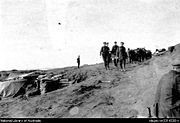
New Zealand sent an expeditionary force, the 1NZEF, of soldiers who fought with Australians as the Australian and New Zealand Army Corps
at Gallipoli
, subsequently immortalised as "ANZACs". A New Zealand Division then formed which fought on the Western Front. In addition the Mounted Rifles fought in Palestine.
The total number of New Zealand troops and nurses to serve overseas in 1914-1918, excluding those in British and other Dominion forces, was 103,000, from a population of just over a million. Forty-two percent of men of military age served in the NZEF. 16,697 New Zealanders were killed and 41,317 were wounded during the war - a 58 percent casualty rate. Approximately a further thousand men died within five years of the war's end, as a result of injuries sustained, and 507 died whilst training in New Zealand between 1914 and 1918. New Zealand had one of the highest casualty- and death-rates per capita of any country involved in the war.
the 2nd Division 2 NZEF, fought in Greece, Crete, North Africa and Italy. Following Japan's entry into the war, 3rd Division, 2 NZEF IP (In Pacific) saw action in the Pacific, seizing a number of islands from the Japanese. New Zealanders contributed to various special forces units, such as the original Long Range Desert Group
in North Africa and Z Force
in the Pacific.
 In addition to the two divisions overseas, the Army raised three others at home during 1942–1943. 1st Division was formed in the Northern Military District (with 1st and 12th Brigades), 4th in the Central Military District (with 2nd and 7th Brigades), and 5th
in the south. They were disbanded in 1943 after the danger of invasion receded. The 6th New Zealand Division was also briefly formed as a deception formation by renaming the NZ camp at Maadi
in southern Cairo
, the New Zealanders' base area in Egypt, in 1942.
was introduced to man the force, which was initially division-sized. The division was alternatively known as '3NZEF.' It was disbanded in 1961, as succeeding governments reduced the force first to two brigades, and then a single one. This one-brigade force became in the 1980s the Integrated Expansion Force, to be formed by producing three composite battalions from the six Territorial Force infantry regiments. Many of the available resources were directed instead to maintaining the New Zealand infantry battalion in the Malaysia-Singapore area. The battalion was committed to the Far East Strategic Reserve
. The battalion, designated 1st Battalion RNZIR
by that time, was brought home in 1989. In 1978 a national museum for the army, the QEII Army Memorial Museum
, was built at Waiouru
, the army's main training base in the central North Island
.
Since World War II the New Zealand army has fought in the Korean War
, the Malayan Emergency
, the Indonesian confrontation
, the Vietnam War
, East Timor
, and Afghanistan
. New Zealand personnel have served in a large number of UN and other peacekeeping deployments, including UNTSO in the Middle East, Operation Agila
in Rhodesia, the Multinational Force and Observers
(MFO) in the Sinai, Cambodia, Bosnia, Sierra Leone, Mozambique, Angola
, Bosnia
, Bougainville
, the Solomon Islands, and the Sudan
.
is the main annual commemorative activity for New Zealand soldiers. On 25 April each year the landings at Gallipoli are remembered, though the day has come to mean remembering the fallen from all wars in which New Zealand has been involved. While a New Zealand public holiday, it is a duty day for New Zealand military personnel, who, even if not involved in official commemorative activities are required to attend an ANZAC Day Dawn Parade in ceremonial uniform in their home location.
Remembrance Day
, commemorating the end of World War I
on 11 November 1918, is marked by official activities with a military contribution normally with parades and church services on the closest Sunday. However, ANZAC Day has a much greater profile and involves a much higher proportion of military personnel.
The various regiments of the New Zealand Army mark their own Corps Days, many of which are derived from those of the corresponding British regiments. Examples are Cambrai Day on 20 November for the Royal New Zealand Armoured Corps, St Barbara's Day on 4 December for the Royal Regiment of New Zealand Artillery.
as the most visible national distinction. This was adopted by the Wellington Regiment about 1911 and became general issue for all New Zealand units during the latter stages of World War I. The different branches of service were distinguished by coloured puggarees or wide bands around the base of the crown (blue and red for artillery, green for mounted rifles, khaki and red for infantry etc.). The "lemon squeezer" was worn to a certain extent during World War II, although often replaced by more convenient forage caps or beret
s, or helmets. British-pattern Battledress was worn until the 1970s, with "Jungle Greens" being used as field wear. British DPM was adopted in 1980. Modern field wear is New Zealand DPM camouflage, which closely resembles British DPM field uniforms. On overseas service, a New Zealand flag badge and a white Kiwi on a circular black field with the words "New Zealand" are worn. The DPM uniform, with the addition of a beret or sometimes the Mounted Rifles Hat, is the usual working uniform and according the one most commonly worn.
In recent years a number of distinctive New Zealand features have appeared. The "lemon squeezer", after being in abeyance since the 1950s, was reintroduced for parade dress in 1993 where it replaced the khaki
"No 2" British Army service dress
cap. Officer cadet
s and some bands wear this headdress with a scarlet and blue full dress uniform. A wide brimmed khaki hat with green puggaree, of a pattern formerly worn by the New Zealand Mounted Rifle (cavalry) regiments, replaced the British style peaked cap as service dress headdress for all branches in 1998. The red or dark blue sash
es worn by sergeants are now embroidered with a traditional Māori
motif or 'mokowaewae' denoting speed and agility. On the infantry sash the mokowaewae appears in black, white and red diagonal 'steps' and on that of the New Zealand Scottish in green, black and white. Short Māori cloaks are sometimes worn by senior officers as a mark of distinction on occasions of special ceremony, though they are not part of the regulation uniform.
The British "infantry pattern" mess uniform is still worn by officers and senior NCOs for formal evening occasions. A universal pattern comprising scarlet mess jackets and blue-black trousers has replaced the various regimental and corps mess dress uniforms previously worn. The universal mess dress has also replaced the white jacket and black Barathea trousers previously worn in summer or tropical climates. The dark blue No 1 dress formerly worn by officers, before the general adoption of mess uniforms, was last worn in the early 1990s, although it was nominally retained for wear by the Chief of Army on appropriate State occasions.
Highland orders of dress (glengarry
, kilt
, sporran
s etc.) are authorised for wear by the New Zealand Scottish Squadron of the RNZAC, at the discretion of the Squadron Commander. They are also authorised for the pipes and drums of the 5th (Wellington, West Coast and Taranaki) Battalion Group
.
or 2-star appointment. The current Chief of Army is Major General Timothy Keating, MNZM, who was a former Assistant Chief of General Staff, Office of Strategy Management. The Chief of Army has responsibility for raising, training and sustaining those forces necessary to meet agreed Government outputs. For operations, the Army's combat units fall under the command of the Land Component Commander, who is on the staff of the COMJFNZ at HQ Joint Forces New Zealand at Trentham in Upper Hutt. Forces under the Land Component Commander include 2 Land Force Group and 3 Land Force Group and 1 NZ SAS Group.
 Tactical air transport for the army is provided by No. 3 Squadron
of the RNZAF
.
In the event of full mobilisation and deployment, the three infantry battalions plus the other necessary combat elements would form a brigade group, which exists on paper as 7 Brigade. HQ 2 Land Force Group would, if needed, form HQ 7 Brigade.
Land Training and Doctrine Group
The term 'Regiment' can be accurately applied in the British regimental systems sense, as all the subunits collectively have been given the heritage of the former NZ infantry regiments (1900–1964).
TF regiments prepare and provide trained individuals in order to top-up and sustain operational and non-operational units to meet directed outputs. TF regiments perform the function of a training unit, preparing individuals to meet prescribed outputs. The six regiments command all Territorial Force personnel within their region except those posted to formation/command headquarters, Military Police (MP) Company, Force Intelligence Group (FIG) or 1 New Zealand Special Air Services (NZSAS) Group. At a minimum, each regiment consists of a headquarters, a recruit induction training (RIT) company, at least one rifle company, and a number of combat support/combat service support companies or platoons.
3/1st Battalion, Royal New Zealand Infantry Regiment previously existed on paper as a cadre
. If needed, it would have been raised to full strength through the regimentation of the Territorial Force infantry units.
Army plans now envisage a three manoeuvre unit structure of 1 RNZIR, QAMR, and 2/1 RNZIR (light), being brought up to strength by TF individual and subunit reinforcements.
The New Zealand Cadet Corps
also exists as an army-affiliated youth training and development organisation, part of the New Zealand Cadet Forces
.
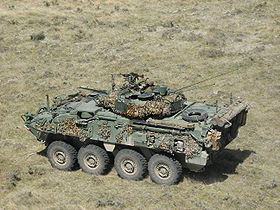 Armoured Fighting Vehicles 105 x NZ Light Armoured Vehicle (NZLAV
)
Light operational vehicles 352 x Pinzgauer High Mobility All-Terrain Vehicle
(248 non-armoured / 60 armoured)
Support vehicles U1700 Unimog trucks
Fire support/artillery 50 x L16A2 81 mm Mortar 24 x 105 mm L119 Light Gun
Missile/rocket systems M72 Light Anti-Armour Weapon
42 x 84 mm Carl Gustav recoilless rifle
M3 Man-portable Light Anti-armour Weapon 24 x Javelin Anti-Tank Guided Missile (ATGM) launchers, 120 missiles 12 x Mistral
Very Low Level Air Defence Weapon
Weapons/ Rifle 5.56mm IW Steyr
The first 5000 weapons were manufactured by Steyr-Daimler-Puch
, and all subsequent weapons have been manufactured by Thales Australia (formerly ADI). The New Zealand variant is similar to the Australian F88 Austeyr, but does not have the automatic lock out (ALO) button. SIG P226
9 mm Pistol M203 grenade launcher
C9
Minimi 5.56mm Light Machine Gun FN MAG 58
7.62 mm GPMG (General Purpose Machine Gun) to replace the older L7A2 British version Benelli M3
12 gauge Shotgun/ M2 machine gun .50 Calibre Heavy Machine Gun L96 Sniper Rifle LMT 308 MWS
Artic Warfare AW50 12.7mm Anti Materiel/ sniper rifle// L1A1 Self-loading rifle (in storage)
s, purchased in the 1960s, with the NZLAV
http://www.army.mil.nz/?CHANNEL=LAV+III&PAGE=NZLAVIII, and the M113s were decommissioned by the end of 2004. An agreement made to sell the M113s via an Australian weapons dealer in February 2006 had to be cancelled when the US State Department refused permission for New Zealand to sell the M113s under a contract made when the vehicles were initially purchased. http://tvnz.co.nz/view/page/554440/662504
The replacement of the M113s with the General Motors LAV III (NZLAV
) led to a review in 2001 on the purchase decision-making by New Zealand's Auditor-General. The review found short-comings in the defence acquisition process but not the eventual vehicle selected.
In 2010 the government said it would look at the possibility of selling 35 LAVs, around a third of the fleet, as being surplus to requirements.
New Zealand
New Zealand is an island country in the south-western Pacific Ocean comprising two main landmasses and numerous smaller islands. The country is situated some east of Australia across the Tasman Sea, and roughly south of the Pacific island nations of New Caledonia, Fiji, and Tonga...
Army (Maori
Maori language
Māori or te reo Māori , commonly te reo , is the language of the indigenous population of New Zealand, the Māori. It has the status of an official language in New Zealand...
: Ngāti Tumatauenga, "Tribe of the God of war"), is the land component of the New Zealand Defence Force
New Zealand Defence Force
The New Zealand Defence Force consists of three services: the Royal New Zealand Navy; the New Zealand Army; and the Royal New Zealand Air Force. The Commander-in-Chief of the NZDF is His Excellency Rt. Hon...
and comprises around 4,500 Regular Force personnel, 2,000 Territorial Force personnel and 500 civilian
Civilian
A civilian under international humanitarian law is a person who is not a member of his or her country's armed forces or other militia. Civilians are distinct from combatants. They are afforded a degree of legal protection from the effects of war and military occupation...
s. Formerly the New Zealand Military Forces, the current name was adopted around 1946. The New Zealand Army traces its history from settler militia raised in 1845.
New Zealand soldiers served with distinction in the major conflicts in the 20th Century, including South Africa
South Africa
The Republic of South Africa is a country in southern Africa. Located at the southern tip of Africa, it is divided into nine provinces, with of coastline on the Atlantic and Indian oceans...
1899–1902, World War I
World War I
World War I , which was predominantly called the World War or the Great War from its occurrence until 1939, and the First World War or World War I thereafter, was a major war centred in Europe that began on 28 July 1914 and lasted until 11 November 1918...
, World War II
World War II
World War II, or the Second World War , was a global conflict lasting from 1939 to 1945, involving most of the world's nations—including all of the great powers—eventually forming two opposing military alliances: the Allies and the Axis...
, the Korean War
Korean War
The Korean War was a conventional war between South Korea, supported by the United Nations, and North Korea, supported by the People's Republic of China , with military material aid from the Soviet Union...
, the Malayan Emergency
Malayan Emergency
The Malayan Emergency was a guerrilla war fought between Commonwealth armed forces and the Malayan National Liberation Army , the military arm of the Malayan Communist Party, from 1948 to 1960....
, Borneo Confrontation and the Vietnam War
Vietnam War
The Vietnam War was a Cold War-era military conflict that occurred in Vietnam, Laos, and Cambodia from 1 November 1955 to the fall of Saigon on 30 April 1975. This war followed the First Indochina War and was fought between North Vietnam, supported by its communist allies, and the government of...
. Since the 1970s, deployments have tended to be assistance to multilateral peacekeeping efforts. Considering the small size of the force, operational commitments have remained high since the start of the East Timor deployment in 1999. New Zealand personnel served in the First Gulf War
Gulf War
The Persian Gulf War , commonly referred to as simply the Gulf War, was a war waged by a U.N.-authorized coalition force from 34 nations led by the United States, against Iraq in response to Iraq's invasion and annexation of Kuwait.The war is also known under other names, such as the First Gulf...
, Iraq and are currently serving in East Timor
East Timor
The Democratic Republic of Timor-Leste, commonly known as East Timor , is a state in Southeast Asia. It comprises the eastern half of the island of Timor, the nearby islands of Atauro and Jaco, and Oecusse, an exclave on the northwestern side of the island, within Indonesian West Timor...
, Afghanistan
Afghanistan
Afghanistan , officially the Islamic Republic of Afghanistan, is a landlocked country located in the centre of Asia, forming South Asia, Central Asia and the Middle East. With a population of about 29 million, it has an area of , making it the 42nd most populous and 41st largest nation in the world...
and several UN and other peacekeeping missions.
The Musket Wars, Settlement and the New Zealand Wars
War had been an integral part of the life and culture of the Māori people. The Musket WarsMusket Wars
The Musket Wars were a series of five hundred or more battles mainly fought between various hapū , sometimes alliances of pan-hapū groups and less often larger iwi of Māori between 1807 and 1842, in New Zealand.Northern tribes such as the rivals Ngāpuhi and Ngāti Whātua were the first to obtain...
dominated the first years of European trade and settlement. The first European settlers in the Bay of Islands
Bay of Islands
The Bay of Islands is an area in the Northland Region of the North Island of New Zealand. Located 60 km north-west of Whangarei, it is close to the northern tip of the country....
formed a volunteer militia from which some New Zealand army units trace their origins. British forces and Māori fought in various New Zealand Wars starting in the north of the country in 1845, and culminating in major campaign in the Waikato in the mid 1860s, during which settler forces were used with great effect. Toward the end of the war the numbers of British troops was reduced, leaving settler units to continue the campaign.
South Africa 1899–1902
The New Zealand army sent ten contingents (including the 4th New Zealand Contingent4th New Zealand Contingent
The 4th New Zealand Contingent was one of ten contingents of New Zealand volunteers for service during the Second Boer War. It served from April 1900 through to June 1901. The contingent went from New Zealand to Beira, Portuguese East Africa in the SS Gymeric, though there was a "mutiny" on the...
) to the Boer War
Second Boer War
The Second Boer War was fought from 11 October 1899 until 31 May 1902 between the British Empire and the Afrikaans-speaking Dutch settlers of two independent Boer republics, the South African Republic and the Orange Free State...
, of which the first six were raised and instructed by Lt.-Colonel Joseph Henry Banks, who led the 6th Contingent into battle. These were mounted riflemen, and the first contingents had to pay to go, providing their own horse, equipment and weapon.
World War I
In World War IMilitary history of New Zealand in World War I
When the United Kingdom declared war on Germany at the start of the First World War, the New Zealand government followed without hesitation, despite its geographic isolation and small population...
New Zealand sent an expeditionary force, the 1NZEF, of soldiers who fought with Australians as the Australian and New Zealand Army Corps
Australian and New Zealand Army Corps
The Australian and New Zealand Army Corps was a First World War army corps of the Mediterranean Expeditionary Force that was formed in Egypt in 1915 and operated during the Battle of Gallipoli. General William Birdwood commanded the corps, which comprised troops from the First Australian Imperial...
at Gallipoli
Gallipoli
The Gallipoli peninsula is located in Turkish Thrace , the European part of Turkey, with the Aegean Sea to the west and the Dardanelles straits to the east. Gallipoli derives its name from the Greek "Καλλίπολις" , meaning "Beautiful City"...
, subsequently immortalised as "ANZACs". A New Zealand Division then formed which fought on the Western Front. In addition the Mounted Rifles fought in Palestine.
The total number of New Zealand troops and nurses to serve overseas in 1914-1918, excluding those in British and other Dominion forces, was 103,000, from a population of just over a million. Forty-two percent of men of military age served in the NZEF. 16,697 New Zealanders were killed and 41,317 were wounded during the war - a 58 percent casualty rate. Approximately a further thousand men died within five years of the war's end, as a result of injuries sustained, and 507 died whilst training in New Zealand between 1914 and 1918. New Zealand had one of the highest casualty- and death-rates per capita of any country involved in the war.
World War II
In World War IIMilitary history of New Zealand during World War II
thumb|A 1940 poster, signed by Michael Joseph Savage, calling on New Zealanders to support the war effort.New Zealand entered the Second World War by declaring war on Nazi Germany with Britain...
the 2nd Division 2 NZEF, fought in Greece, Crete, North Africa and Italy. Following Japan's entry into the war, 3rd Division, 2 NZEF IP (In Pacific) saw action in the Pacific, seizing a number of islands from the Japanese. New Zealanders contributed to various special forces units, such as the original Long Range Desert Group
Long Range Desert Group
The Long Range Desert Group was a reconnaissance and raiding unit of the British Army during the Second World War. The commander of the German Afrika Corps, Field Marshal Erwin Rommel, admitted that the LRDG "caused us more damage than any other British unit of equal strength".Originally called...
in North Africa and Z Force
Z Special Unit
Z Special Unit was a joint Allied special forces unit formed during the Second World War to operate behind Japanese lines in South East Asia...
in the Pacific.
5th Division (New Zealand)
The 5th Division, New Zealand Military Forces, was raised in the Southern Military District during the Second World War. It consisted of 3rd and 10th Brigades and 11th Brigade Group...
in the south. They were disbanded in 1943 after the danger of invasion receded. The 6th New Zealand Division was also briefly formed as a deception formation by renaming the NZ camp at Maadi
Maadi
Maadi is a wealthy suburb south of Cairo, Egypt. The town is home to the Supreme Constitutional Court of Egypt, Cairo American College , Lycée Français du Caire , Misr American College , Maadi British International School , the Cairo Rugby Club, and the national Egyptian Geological Museum.-...
in southern Cairo
Cairo
Cairo , is the capital of Egypt and the largest city in the Arab world and Africa, and the 16th largest metropolitan area in the world. Nicknamed "The City of a Thousand Minarets" for its preponderance of Islamic architecture, Cairo has long been a centre of the region's political and cultural life...
, the New Zealanders' base area in Egypt, in 1942.
Post-War
The New Zealand Army was formally formed from the New Zealand Military Forces following the Second World War. Attention focused on preparing a third Expeditionary Force potentially for service against the Soviets. Compulsory Military TrainingCompulsory Military Training in New Zealand
Compulsory military training , a form of conscription, has been used in New Zealand during a number of historical periods.-Origins and world wars:CMT was first introduced in New Zealand with the Defence Act of 1909...
was introduced to man the force, which was initially division-sized. The division was alternatively known as '3NZEF.' It was disbanded in 1961, as succeeding governments reduced the force first to two brigades, and then a single one. This one-brigade force became in the 1980s the Integrated Expansion Force, to be formed by producing three composite battalions from the six Territorial Force infantry regiments. Many of the available resources were directed instead to maintaining the New Zealand infantry battalion in the Malaysia-Singapore area. The battalion was committed to the Far East Strategic Reserve
Far East Strategic Reserve
The British Commonwealth Far East Strategic Reserve was a joint military force of the British, Australian, and New Zealand armed forces...
. The battalion, designated 1st Battalion RNZIR
Royal New Zealand Infantry Regiment
The Royal New Zealand Infantry Regiment is the main combat unit in the regular New Zealand Army. It was formed 9 January 1947 as the New Zealand Regiment with a single infantry battalion as part of the newly created infantry corps....
by that time, was brought home in 1989. In 1978 a national museum for the army, the QEII Army Memorial Museum
QEII Army Memorial Museum
The National Army Museum is the museum of the New Zealand Army. It was formerly known as the Queen Elizabeth II Army Memorial Museum. It is situated 94 minutes south of Taupo on State Highway One, on the southern side of the small military town of Waiouru. The 1300 square metre museum is...
, was built at Waiouru
Waiouru
Waiouru is a small town in the centre of the North Island of New Zealand. It is on the North Island Volcanic Plateau, 25 kilometres south-east of Mount Ruapehu, and in the Ruapehu District....
, the army's main training base in the central North Island
North Island
The North Island is one of the two main islands of New Zealand, separated from the much less populous South Island by Cook Strait. The island is in area, making it the world's 14th-largest island...
.
Since World War II the New Zealand army has fought in the Korean War
Korean War
The Korean War was a conventional war between South Korea, supported by the United Nations, and North Korea, supported by the People's Republic of China , with military material aid from the Soviet Union...
, the Malayan Emergency
Malayan Emergency
The Malayan Emergency was a guerrilla war fought between Commonwealth armed forces and the Malayan National Liberation Army , the military arm of the Malayan Communist Party, from 1948 to 1960....
, the Indonesian confrontation
Indonesia-Malaysia confrontation
Indonesia–Malaysia confrontation during 1962–1966 was Indonesia’s political and armed opposition to the creation of Malaysia. It is also known by its Indonesian/Malay name Konfrontasi...
, the Vietnam War
Vietnam War
The Vietnam War was a Cold War-era military conflict that occurred in Vietnam, Laos, and Cambodia from 1 November 1955 to the fall of Saigon on 30 April 1975. This war followed the First Indochina War and was fought between North Vietnam, supported by its communist allies, and the government of...
, East Timor
East Timor
The Democratic Republic of Timor-Leste, commonly known as East Timor , is a state in Southeast Asia. It comprises the eastern half of the island of Timor, the nearby islands of Atauro and Jaco, and Oecusse, an exclave on the northwestern side of the island, within Indonesian West Timor...
, and Afghanistan
War in Afghanistan (2001–present)
The War in Afghanistan began on October 7, 2001, as the armed forces of the United States of America, the United Kingdom, Australia, and the Afghan United Front launched Operation Enduring Freedom...
. New Zealand personnel have served in a large number of UN and other peacekeeping deployments, including UNTSO in the Middle East, Operation Agila
Operation Midford
Operation Midford was New Zealand's contribution to the Commonwealth Monitoring Force in Rhodesia in late 1979 and early 1980.-Background:The Rhodesian War had dragged on for some 14 years from 1965 until 1979, being largely overshadowed by the television driven Vietnam War...
in Rhodesia, the Multinational Force and Observers
Multinational Force and Observers
The Multinational Force and Observers is an international peacekeeping force overseeing the terms of the peace treaty between Egypt and Israel.-Background:...
(MFO) in the Sinai, Cambodia, Bosnia, Sierra Leone, Mozambique, Angola
United Nations Angola Verification Mission II
The United Nations Angola Verification Mission II , established May 1991 and lasting until February 1995, was the second United Nations peacekeeping mission, of a total of four, deployed to Angola during the course of the Angolan Civil War, the longest war in modern African history...
, Bosnia
United Nations Protection Force
The United Nations Protection Force ', was the first United Nations peacekeeping force in Croatia and in Bosnia and Herzegovina during the Yugoslav wars. It existed between the beginning of UN involvement in February 1992, and its restructuring into other forces in March 1995...
, Bougainville
Bougainville Island
Bougainville Island is the main island of the Autonomous Region of Bougainville of Papua New Guinea. This region is also known as Bougainville Province or the North Solomons. The population of the province is 175,160 , which includes the adjacent island of Buka and assorted outlying islands...
, the Solomon Islands, and the Sudan
War in Darfur
The Darfur Conflict was a guerrilla conflict or civil war centered on the Darfur region of Sudan. It began in February 2003 when the Sudan Liberation Movement/Army and Justice and Equality Movement groups in Darfur took up arms, accusing the Sudanese government of oppressing non-Arab Sudanese in...
.
Commemorations
ANZAC DayANZAC Day
Anzac Day is a national day of remembrance in Australia and New Zealand, commemorated by both countries on 25 April every year to honour the members of the Australian and New Zealand Army Corps who fought at Gallipoli in the Ottoman Empire during World War I. It now more broadly commemorates all...
is the main annual commemorative activity for New Zealand soldiers. On 25 April each year the landings at Gallipoli are remembered, though the day has come to mean remembering the fallen from all wars in which New Zealand has been involved. While a New Zealand public holiday, it is a duty day for New Zealand military personnel, who, even if not involved in official commemorative activities are required to attend an ANZAC Day Dawn Parade in ceremonial uniform in their home location.
Remembrance Day
Remembrance Day
Remembrance Day is a memorial day observed in Commonwealth countries since the end of World War I to remember the members of their armed forces who have died in the line of duty. This day, or alternative dates, are also recognized as special days for war remembrances in many non-Commonwealth...
, commemorating the end of World War I
World War I
World War I , which was predominantly called the World War or the Great War from its occurrence until 1939, and the First World War or World War I thereafter, was a major war centred in Europe that began on 28 July 1914 and lasted until 11 November 1918...
on 11 November 1918, is marked by official activities with a military contribution normally with parades and church services on the closest Sunday. However, ANZAC Day has a much greater profile and involves a much higher proportion of military personnel.
The various regiments of the New Zealand Army mark their own Corps Days, many of which are derived from those of the corresponding British regiments. Examples are Cambrai Day on 20 November for the Royal New Zealand Armoured Corps, St Barbara's Day on 4 December for the Royal Regiment of New Zealand Artillery.
Current deployments
The New Zealand Army currently participates in three major overseas deployments:- AfghanistanAfghanistanAfghanistan , officially the Islamic Republic of Afghanistan, is a landlocked country located in the centre of Asia, forming South Asia, Central Asia and the Middle East. With a population of about 29 million, it has an area of , making it the 42nd most populous and 41st largest nation in the world...
- 225 personnel are attached to the New Zealand Provincial Reconstruction TeamProvincial reconstruction teamA Provincial Reconstruction Team is a unit introduced by the United States government, consisting of military officers, diplomats, and reconstruction subject matter experts, working to support reconstruction efforts in unstable states. PRTs were first established in Afghanistan in late 2001 or...
in Bamyan Province. - Timor-LesteEast TimorThe Democratic Republic of Timor-Leste, commonly known as East Timor , is a state in Southeast Asia. It comprises the eastern half of the island of Timor, the nearby islands of Atauro and Jaco, and Oecusse, an exclave on the northwestern side of the island, within Indonesian West Timor...
- An infantry company from 2/1st Battalion, Royal New Zealand Infantry RegimentRoyal New Zealand Infantry RegimentThe Royal New Zealand Infantry Regiment is the main combat unit in the regular New Zealand Army. It was formed 9 January 1947 as the New Zealand Regiment with a single infantry battalion as part of the newly created infantry corps....
is deployed in East Timor under Australian command, as part of the ANZAC Battle GroupANZAC Battle GroupThe ANZAC Battle Group is an Australian-led battle group deployed to Timor Leste as part of Operation Astute. The battle group was established in September 2006 and comprises several rifle companies, including a company from the New Zealand Army, and sub-units of other Australian Army units...
. - Solomon IslandsSolomon IslandsSolomon Islands is a sovereign state in Oceania, east of Papua New Guinea, consisting of nearly one thousand islands. It covers a land mass of . The capital, Honiara, is located on the island of Guadalcanal...
- An infantry company from 2/1st Battalion, Royal New Zealand Infantry Regiment is deployed alongside two Australian infantry companies as part of the Regional Assistance Mission to the Solomon IslandsRegional Assistance Mission to the Solomon IslandsThe Regional Assistance Mission to Solomon Islands , also known as Operation Helpem Fren, was created in 2003 in response to a request for international aid by the Governor-General of the Solomon Islands... - In addition, small numbers of NZ personnel are deployed on various United NationsUnited NationsThe United Nations is an international organization whose stated aims are facilitating cooperation in international law, international security, economic development, social progress, human rights, and achievement of world peace...
peacekeepingPeacekeepingPeacekeeping is an activity that aims to create the conditions for lasting peace. It is distinguished from both peacebuilding and peacemaking....
missions around the world, and with the Multinational Force and ObserversMultinational Force and ObserversThe Multinational Force and Observers is an international peacekeeping force overseeing the terms of the peace treaty between Egypt and Israel.-Background:...
. - On 4 September 2010, in the aftermath of the 2010 Canterbury Earthquake, the New Zealand Defence Force deployed to the worst affected areas of Christchurch to aid in relief efforts and assist NZ Police in enforcing a night time curfew at the request of Christchurch Mayor Bob Parker and the Prime Minister John Key.
Dress
New Zealand Army uniforms have historically followed the British pattern with the high crowned "lemon squeezer" hatCampaign hat
A campaign cover is a broad-brimmed felt or straw hat, with a high crown, pinched symmetrically at the four corners .It is associated with the New Zealand Army, the Royal Canadian...
as the most visible national distinction. This was adopted by the Wellington Regiment about 1911 and became general issue for all New Zealand units during the latter stages of World War I. The different branches of service were distinguished by coloured puggarees or wide bands around the base of the crown (blue and red for artillery, green for mounted rifles, khaki and red for infantry etc.). The "lemon squeezer" was worn to a certain extent during World War II, although often replaced by more convenient forage caps or beret
Beret
A beret is a soft, round, flat-crowned hat, designated a "cap", usually of woven, hand-knitted wool, crocheted cotton, or wool felt, or acrylic fiber....
s, or helmets. British-pattern Battledress was worn until the 1970s, with "Jungle Greens" being used as field wear. British DPM was adopted in 1980. Modern field wear is New Zealand DPM camouflage, which closely resembles British DPM field uniforms. On overseas service, a New Zealand flag badge and a white Kiwi on a circular black field with the words "New Zealand" are worn. The DPM uniform, with the addition of a beret or sometimes the Mounted Rifles Hat, is the usual working uniform and according the one most commonly worn.
In recent years a number of distinctive New Zealand features have appeared. The "lemon squeezer", after being in abeyance since the 1950s, was reintroduced for parade dress in 1993 where it replaced the khaki
Khaki
This article is about the fabric. For the color, see Khaki . Kaki, another name for the persimmon, is often misspelled "Khaki".Khaki is a type of fabric or the color of such fabric...
"No 2" British Army service dress
Service Dress (British Army)
Service Dress was the new style of khaki uniform introduced by the British Army for use in the field from the early 1900s, following the experiences of a number of imperial wars and conflicts, including the Second Boer War. This variant of uniform continues to be worn today, although only in a...
cap. Officer cadet
Officer Cadet
Officer cadet is a rank held by military and merchant navy cadets during their training to become commissioned officers and merchant navy officers, respectively. The term officer trainee is used interchangeably in some countries...
s and some bands wear this headdress with a scarlet and blue full dress uniform. A wide brimmed khaki hat with green puggaree, of a pattern formerly worn by the New Zealand Mounted Rifle (cavalry) regiments, replaced the British style peaked cap as service dress headdress for all branches in 1998. The red or dark blue sash
Sash
A sash is a cloth belt used to hold a robe together, and is usually tied about the waist. The Japanese equivalent of a sash, obi, serves to hold a kimono or yukata together. Decorative sashes may pass from the shoulder to the hip rather than around the waist...
es worn by sergeants are now embroidered with a traditional Māori
Maori culture
Māori culture is the culture of the Māori of New Zealand, an Eastern Polynesian people, and forms a distinctive part of New Zealand culture. Within the Māori community, and to a lesser extent throughout New Zealand as a whole, the word Māoritanga is often used as an approximate synonym for Māori...
motif or 'mokowaewae' denoting speed and agility. On the infantry sash the mokowaewae appears in black, white and red diagonal 'steps' and on that of the New Zealand Scottish in green, black and white. Short Māori cloaks are sometimes worn by senior officers as a mark of distinction on occasions of special ceremony, though they are not part of the regulation uniform.
The British "infantry pattern" mess uniform is still worn by officers and senior NCOs for formal evening occasions. A universal pattern comprising scarlet mess jackets and blue-black trousers has replaced the various regimental and corps mess dress uniforms previously worn. The universal mess dress has also replaced the white jacket and black Barathea trousers previously worn in summer or tropical climates. The dark blue No 1 dress formerly worn by officers, before the general adoption of mess uniforms, was last worn in the early 1990s, although it was nominally retained for wear by the Chief of Army on appropriate State occasions.
Highland orders of dress (glengarry
Glengarry
The glengarry bonnet is a traditional boat-shaped hat without a peak made of thick-milled woollen material with a toorie on top, a rosette cockade on the left, and ribbons hanging down behind...
, kilt
Kilt
The kilt is a knee-length garment with pleats at the rear, originating in the traditional dress of men and boys in the Scottish Highlands of the 16th century. Since the 19th century it has become associated with the wider culture of Scotland in general, or with Celtic heritage even more broadly...
, sporran
Sporran
The Sporran is a traditional part of male Scottish Highland dress. It is a pouch that performs the same function as pockets on the pocketless Scottish kilt....
s etc.) are authorised for wear by the New Zealand Scottish Squadron of the RNZAC, at the discretion of the Squadron Commander. They are also authorised for the pipes and drums of the 5th (Wellington, West Coast and Taranaki) Battalion Group
Wellington West Coast and Taranaki Regiment
The Wellington West Coast and Taranaki Regiment is a Territorial Force unit of the New Zealand Army. It was originally formed in 1948 by the amalgamation of two separate regiments:...
.
Structure
The New Zealand Army is commanded by the Chief of Army (Chief of the General Staff until 2003), who is a Major GeneralMajor General
Major general or major-general is a military rank used in many countries. It is derived from the older rank of sergeant major general. A major general is a high-ranking officer, normally subordinate to the rank of lieutenant general and senior to the ranks of brigadier and brigadier general...
or 2-star appointment. The current Chief of Army is Major General Timothy Keating, MNZM, who was a former Assistant Chief of General Staff, Office of Strategy Management. The Chief of Army has responsibility for raising, training and sustaining those forces necessary to meet agreed Government outputs. For operations, the Army's combat units fall under the command of the Land Component Commander, who is on the staff of the COMJFNZ at HQ Joint Forces New Zealand at Trentham in Upper Hutt. Forces under the Land Component Commander include 2 Land Force Group and 3 Land Force Group and 1 NZ SAS Group.
No. 3 Squadron RNZAF
3 Squadron is a unit of the RNZAF. It remains on active duty.-History:No. 3 Squadron RNZAF formed as a Territorial unit of the New Zealand Permanent Air Force based at Christchurch in 1930....
of the RNZAF
Royal New Zealand Air Force
The Royal New Zealand Air Force is the air arm of the New Zealand Defence Force...
.
In the event of full mobilisation and deployment, the three infantry battalions plus the other necessary combat elements would form a brigade group, which exists on paper as 7 Brigade. HQ 2 Land Force Group would, if needed, form HQ 7 Brigade.
Land Training and Doctrine Group
- Land Operations Training Centre Waiouru encompasses the main army trade schools:
- Combat School
- School of Artillery
- Logistics Operations School
- School of Tactics
- Royal New Zealand School of Signals
- School of Military Intelligence and SecuritySchool of Military Intelligence and SecurityThe School of Military Intelligence and Security is the New Zealand Intelligence Corps school. It is presently located at the Waiouru Army Camp. It is responsible for training NZIC personnel and other members of the New Zealand Defence Force in aspects of intelligence and security....
- Joint Catering School
- Trade Training School (Trentham)
- Joint Services Health School (Burnham)
- School of Military Engineering, 2 Engineer Regiment (Linton)
Regiments and Corps of the Regular Army
- Royal New Zealand Infantry RegimentRoyal New Zealand Infantry RegimentThe Royal New Zealand Infantry Regiment is the main combat unit in the regular New Zealand Army. It was formed 9 January 1947 as the New Zealand Regiment with a single infantry battalion as part of the newly created infantry corps....
- New Zealand Special Air Service
- Queen Alexandra's Mounted RiflesQueen Alexandra's Mounted RiflesQueen Alexandra's Mounted Rifles is an armoured squadron of the New Zealand Army and forms part of the Royal New Zealand Armoured Corps. The squadron was formed in 1864 and is currently an armoured cavalry unit equipped with NZLAV.- History :...
- Royal Regiment of New Zealand ArtilleryRoyal Regiment of New Zealand ArtilleryThe Royal New Zealand Artillery forms the artillery section of the New Zealand Army. In its current form it was founded in 1947 with the amalgamation of the regular and volunteer units of artillery in New Zealand.-Modern structure:...
- Corps of Royal New Zealand EngineersCorps of Royal New Zealand EngineersThe 2nd Engineer Regiment is housed in Linton Military Camp that is situated approximately 10 km South of the City of Palmerston North. Raised on the 1st of July 1993 the Regiment is the only major military engineer Unit in the New Zealand Army. Linton Camp has been known throughout the Army...
- Royal New Zealand Corps of SignalsRoyal New Zealand Corps of SignalsThe Royal New Zealand Signals Corps provides, co-ordinates and operates the communications networks of the New Zealand Army.The role of RNZSigs is "To support other Arms by providing Communication Information System required for Command and Control of Units, Formations and Administrative...
- Royal New Zealand Army Logistic RegimentRoyal New Zealand Army Logistic RegimentFormed on the 9th of December 1996, the Royal New Zealand Army Logistic Regiment , sometimes known as "the Duke of York's Own", reflecting Prince Andrew's patronage, is the New Zealand Army's main Military Logistics & Combat Service Support element...
- Royal New Zealand Army Medical CorpsRoyal New Zealand Army Medical CorpsThe Royal New Zealand Army Medical Corps is a corps of the New Zealand Army, the land branch of the New Zealand Defence Force. The Medical Corps provides for the medical needs of soldiers, such as diagnosing and treating diseases and injuries...
- Royal New Zealand Army Nursing Corps
- Royal New Zealand Army Dental Corps
- Corps of Royal New Zealand Military PoliceCorps of Royal New Zealand Military PoliceThe Corps of Royal New Zealand Military Police provide military police services to the New Zealand Army, including criminal investigative services. It consists of one major unit, 1st Military Police Company; though members of the Corps are included in other units within the New Zealand Army...
- New Zealand Intelligence CorpsNew Zealand Intelligence CorpsThe New Zealand Intelligence Corps analyses information from a variety of sources and provides commanders with intelligence on such things as enemy locations, capabilities and intentions. The NZIC is one of the smallest corps in the New Zealand Army. It was formed in 1942, apparently disbanded in...
- Joint Services Fire Training School
- New Zealand Army Band
Army Reserve
The Territorial Force (TF), the long established reserve component of the New Zealand Army, has as of 2009–2010 been renamed the Army Reserve (matching the Australian Army Reserve). It provides individual augmentees and formed bodies for operational deployments. There are Reserve units throughout New Zealand, and they have a long history. The modern Army Reserve is divided into 6 regionally-based battalion groups. Each of these is made up of smaller units of different specialities. The terms 'Regiment' and 'Battalion Group' seem to be interchangeably used, which can cause confusion. However, it can be argued that both are accurate in slightly different senses. In a tactical sense, given that the Reserve units are groupings of all arms, the term Battalion Group is accurate, though usually used for a much more single-arm heavy grouping, three infantry companies plus one armoured squadron, for example. NZ Reserve Battalion Groups are composed of a large number of small units of different types.The term 'Regiment' can be accurately applied in the British regimental systems sense, as all the subunits collectively have been given the heritage of the former NZ infantry regiments (1900–1964).
| Regiment | ||||||||
| 2nd Canterbury, and Nelson-Marlborough and West Coast Battalion Group Canterbury, and Nelson-Marlborough and West Coast Regiment The Canterbury, and Nelson-Marlborough and West Coast Regiment is a Territorial Force unit of the New Zealand Army. It was formed in 1964 during the reorganisation of the army by the amalgamation of two separate regiments:... |
 |
 |
 |
 |
 |
 |
||
| 3rd Auckland (Countess of Ranfurly's Own) and Northland Battalion Group Auckland (Countess of Ranfurly's Own) and Northland Regiment The 3rd Battalion, and Northland Regiment is a Territorial Force Battalion of the New Zealand Army, one of three of the 1st Infantry Combat Brigade Group with Headquarters in Arch Hill Auckland Army Centre... |
|
 |
|
|
|
|
||
| 4th Otago and Southland Battalion Group Otago and Southland Regiment The Otago and Southland Regiment is a Territorial Force unit of the New Zealand Army. It was originally formed in 1948 by the amalgamation of two separate regiments:*Otago Regiment*Southland Regiment... |
|
|
|
|
||||
| 5th Wellington West Coast and Taranaki Battalion Group Wellington West Coast and Taranaki Regiment The Wellington West Coast and Taranaki Regiment is a Territorial Force unit of the New Zealand Army. It was originally formed in 1948 by the amalgamation of two separate regiments:... |
|
|
|
|
||||
| 6th Hauraki Battalion Group Hauraki Regiment The Hauraki Regiment is a Territorial Force unit of the New Zealand Army. The regiment is unique among the TF units in that it has never been amalgamated, and thus can trace its history directly back to its formation in 1898. The regiment was formed as the 2nd Battalion, Auckland Rifle Volunteers... |
|
 |
|
|
||||
| 7th Wellington (City of Wellington's Own) and Hawke's Bay Battalion Group Wellington (City of Wellington's Own) and Hawke's Bay Regiment The Wellington and Hawke's Bay Regiment is a Territorial Force unit of the New Zealand Army. It was formed in 1964 during the reorganisation of the army by the amalgamation of two separate regiments:*5th Wellington Regiment... |
|
 |
|
|
TF regiments prepare and provide trained individuals in order to top-up and sustain operational and non-operational units to meet directed outputs. TF regiments perform the function of a training unit, preparing individuals to meet prescribed outputs. The six regiments command all Territorial Force personnel within their region except those posted to formation/command headquarters, Military Police (MP) Company, Force Intelligence Group (FIG) or 1 New Zealand Special Air Services (NZSAS) Group. At a minimum, each regiment consists of a headquarters, a recruit induction training (RIT) company, at least one rifle company, and a number of combat support/combat service support companies or platoons.
3/1st Battalion, Royal New Zealand Infantry Regiment previously existed on paper as a cadre
En cadre
En cadre or cadre is a French expression originally denoting either the complement of commissioned officers of a regiment or the permanent skeleton establishment of a unit, around which the unit could be built if needed...
. If needed, it would have been raised to full strength through the regimentation of the Territorial Force infantry units.
Army plans now envisage a three manoeuvre unit structure of 1 RNZIR, QAMR, and 2/1 RNZIR (light), being brought up to strength by TF individual and subunit reinforcements.
The New Zealand Cadet Corps
New Zealand Cadet Corps
The New Zealand Cadet Corps , is one of the three corps in the New Zealand Cadet Forces, the other two being the Air Training Corps, and Sea Cadet Corps. There is no reference to the Army within the official title of the NZCC, but an army theme is used for the NZCC. All of its members, from the...
also exists as an army-affiliated youth training and development organisation, part of the New Zealand Cadet Forces
New Zealand Cadet Forces
The New Zealand Cadet Forces is a voluntary military training organisation for youth. Run in a partnership between the Ministry of Defence, New Zealand Defence Force and a number of appointed community organizations, it is composed of three Corps: the Air Training Corps , the New Zealand Cadet...
.
Major equipment
NZLAV
The NZLAV armoured fighting vehicle is a variant of the General Dynamics LAV III which itself is a variant of the MOWAG Piranha IIIH 8x8. The New Zealand army purchased 105 vehicles in 2003. It was developed by Canada and is the primary armoured vehicle of the New Zealand military...
)
-
- 95 Infantry Mobility Vehicle (IMV)
- 7 Light Obstacle Blade Vehicle (LOB)
- 3 Recovery Vehicle (LAV-R)
Light operational vehicles 352 x Pinzgauer High Mobility All-Terrain Vehicle
Pinzgauer High Mobility All-Terrain Vehicle
The Pinzgauer is a family of high-mobility all-terrain 4WD and 6WD military utility vehicles. They were manufactured in Guildford, Surrey, United Kingdom, by BAE Systems Land & Armaments. The vehicle was originally developed in the late 1960s by Steyr-Daimler-Puch of Graz, Austria, and was named...
(248 non-armoured / 60 armoured)
-
- 122 / 23 command and control variants
- 68 / 37 crew served weapon carrier variants
- 95 general service variants
- 15 shelter carrier variants
- 8 ambulance variants
- 13 special operations
Support vehicles U1700 Unimog trucks
Unimog
Unimog is a range of multi-purpose auto four wheel drive medium trucks produced by Mercedes-Benz, a division of Daimler AG. The name Unimog is pronounced in German and is an acronym for the German "UNIversal-MOtor-Gerät", Gerät being the German word for machine or device...
Fire support/artillery 50 x L16A2 81 mm Mortar 24 x 105 mm L119 Light Gun
L118 Light Gun
The L118 Light Gun is a 105 mm towed howitzer, originally produced for the British Army in the 1970s and widely exported since, including to the United States, where a modified version is known as the M119A1...
Missile/rocket systems M72 Light Anti-Armour Weapon
M72 LAW
The M72 LAW is a portable one-shot 66 mm unguided anti-tank weapon, designed in the United States by Paul V. Choate, Charles B. Weeks, and Frank A. Spinale et al...
42 x 84 mm Carl Gustav recoilless rifle
Carl Gustav recoilless rifle
The Carl Gustav is the common name for the 84 mm man-portable reusable multi-role recoilless rifle produced by Saab Bofors Dynamics in Sweden...
M3 Man-portable Light Anti-armour Weapon 24 x Javelin Anti-Tank Guided Missile (ATGM) launchers, 120 missiles 12 x Mistral
Mistral missile
Mistral is an infrared homing surface-to-air missile manufactured by the European multinational company MBDA missile systems . Based on the French SATCP , the portable missile later to become the Mistral began development in 1974...
Very Low Level Air Defence Weapon
Weapons/
Rifle 5.56mm IW SteyrSteyr AUG
The AUG is an Austrian bullpup 5.56mm assault rifle, designed in the early 1970s by Steyr Mannlicher GmbH & Co KG . The AUG was adopted by the Austrian Army as the StG 77 in 1977, where it replaced the 7.62mm StG 58 automatic rifle...
The first 5000 weapons were manufactured by Steyr-Daimler-Puch
Steyr-Daimler-Puch
Steyr-Daimler-Puch was a large manufacturing conglomerate based in Steyr, Austria, which was broken up in stages between 1987 and 2001. The component parts and operations continued to exist under separate ownership and new names.-History:...
, and all subsequent weapons have been manufactured by Thales Australia (formerly ADI). The New Zealand variant is similar to the Australian F88 Austeyr, but does not have the automatic lock out (ALO) button. SIG P226
SIG P226
The SIG P226 is a full-sized, service-type pistol made by SIG Sauer. It is chambered for the 9×19mm Parabellum, .40 S&W, .357 SIG, and .22 Long Rifle. It is essentially the same basic design of the SIG P220, but developed to use higher capacity, staggered-column magazines in place of the...
9 mm Pistol M203 grenade launcher
M203 grenade launcher
The M203 is a single shot 40 mm grenade launcher designed to attach to a rifle. It uses the same rounds as the older M79 break-action grenade launcher, which utilize the High-Low Propulsion System to keep recoil forces low. Though versatile, and compatible with many rifle models, the M203 was...
C9
FN Minimi
The Minimi is a Belgian 5.56mm light machine gun developed by Fabrique Nationale in Herstal by Ernest Vervier. First introduced in 1974, it has entered service with the armed forces of over thirty countries...
Minimi 5.56mm Light Machine Gun FN MAG 58
FN MAG
The FN MAG is a Belgian 7.62 mm general-purpose machine gun, designed in the early 1950s at Fabrique Nationale by Ernest Vervier. It has been used by more than 80 countries, and it has been made under licence in countries such as Argentina, Egypt, India, Singapore, the United Kingdom and the...
7.62 mm GPMG (General Purpose Machine Gun) to replace the older L7A2 British version Benelli M3
Benelli M3
The Benelli M3 is a dual-mode shotgun designed and manufactured by Italian firearms manufacturer Benelli. The M3 holds a maximum of seven rounds and uses the proprietary Benelli semi-automatic system first showcased in the M1. The M3 is notable for allowing the user the choice of semi-automatic...
12 gauge Shotgun/
M2 machine gun .50 Calibre Heavy Machine Gun L96 Sniper Rifle LMT 308 MWSLewis Machine and Tool Company
Lewis Machine & Tool Company was founded by Karl Lewis in 1980. LMT started its business by providing law enforcement and government agencies with military type weapons and accessories. Today, LMT still provides law enforcement and government agencies with weapons, but they have now also...
Artic Warfare AW50 12.7mm Anti Materiel/ sniper rifle//
L1A1 Self-loading rifle (in storage)M113 replacement
New Zealand decided in 2003 to replace its existing fleet of M113 Armored Personnel CarrierM113 Armored Personnel Carrier
The M113 is a fully tracked armored personnel carrier that has formed the backbone of the United States Army's mechanized infantry units from the time of its first fielding in Vietnam in April 1962. The M113 was the most widely used armored vehicle of the U.S...
s, purchased in the 1960s, with the NZLAV
NZLAV
The NZLAV armoured fighting vehicle is a variant of the General Dynamics LAV III which itself is a variant of the MOWAG Piranha IIIH 8x8. The New Zealand army purchased 105 vehicles in 2003. It was developed by Canada and is the primary armoured vehicle of the New Zealand military...
http://www.army.mil.nz/?CHANNEL=LAV+III&PAGE=NZLAVIII, and the M113s were decommissioned by the end of 2004. An agreement made to sell the M113s via an Australian weapons dealer in February 2006 had to be cancelled when the US State Department refused permission for New Zealand to sell the M113s under a contract made when the vehicles were initially purchased. http://tvnz.co.nz/view/page/554440/662504
The replacement of the M113s with the General Motors LAV III (NZLAV
NZLAV
The NZLAV armoured fighting vehicle is a variant of the General Dynamics LAV III which itself is a variant of the MOWAG Piranha IIIH 8x8. The New Zealand army purchased 105 vehicles in 2003. It was developed by Canada and is the primary armoured vehicle of the New Zealand military...
) led to a review in 2001 on the purchase decision-making by New Zealand's Auditor-General. The review found short-comings in the defence acquisition process but not the eventual vehicle selected.
In 2010 the government said it would look at the possibility of selling 35 LAVs, around a third of the fleet, as being surplus to requirements.
See also
- New Zealand military ranksNew Zealand military ranksNew Zealand military ranks are largely based on those of the United Kingdom. The three forces have their own rank structure, with a rank equivalency that allows seamless interoperability between the services...
- New Zealand Defence CollegeNew Zealand Defence CollegeThe New Zealand Defence College is the premier educational institute for the New Zealand Defence Force and is located at Trentham Military Camp, Upper Hutt . The New Zealand Defence College provides professional military education to New Zealand Defence Force officers...
- Māori BattalionMaori BattalionThe 28th Battalion, more commonly known as the Māori Battalion, was an infantry battalion of the New Zealand Army that served during the Second World War. It was formed following pressure on the Labour government by some Māori MPs and Māori organisations throughout the country wanting a full Māori...
- List of individual weapons of the New Zealand armed forces