
All Topics  
New York Draft Riots

 
New York Draft Riots

   Email Print
   Bookmark   Link


New York Draft Riots


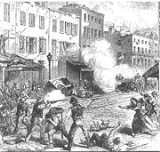
The New York Draft Riots (July 11 to July 16, 1863; known at the time as Draft Week), were violent disturbances
Riot

A riot is a form of civil disorder characterized by disorganized groups lashing out in a sudden and intense rash of violence, vandalism or other crime....
 in New York City
New York City

The City of New York is the List of United States cities by population in the United States, while the New York metropolitan area ranks among the List of urban areas by population....
 that were the culmination of discontent with new laws passed by Congress
United States Congress

The United States Congress is the Bicameralism legislature of the Federal government of the United States of the United States of America, consisting of two houses, the United States Senate and the United States House of Representatives....
 to draft
Conscription in the United States

Conscription in the United States has been employed several times, usually during war but also during the nominal peace of the Cold War. The United States discontinued the draft in 1973, moving to an all-volunteer United States Military, thus there is currently no mandatory conscription....
 men to fight in the ongoing American Civil War
American Civil War

The American Civil War , also known as the War Between the States and several Naming the American Civil War, was a civil war in the United States....
. The riots were the largest civil insurrection in American history apart from the Civil War itself. President Abraham Lincoln
Abraham Lincoln

Abraham Lincoln was the List of Presidents of the United States President of the United States. He successfully led the country through its greatest internal crisis, the American Civil War, preserving the Union and ending slavery....
 sent several regiments of militia and volunteer troops to control the city.


Discussion
Ask a question about 'New York Draft Riots'
Start a new discussion about 'New York Draft Riots'
Answer questions from other users
Full Discussion Forum


Recent Posts


Encyclopedia


The New York Draft Riots (July 11 to July 16, 1863; known at the time as Draft Week), were violent disturbances
Riot

A riot is a form of civil disorder characterized by disorganized groups lashing out in a sudden and intense rash of violence, vandalism or other crime....
 in New York City
New York City

The City of New York is the List of United States cities by population in the United States, while the New York metropolitan area ranks among the List of urban areas by population....
 that were the culmination of discontent with new laws passed by Congress
United States Congress

The United States Congress is the Bicameralism legislature of the Federal government of the United States of the United States of America, consisting of two houses, the United States Senate and the United States House of Representatives....
 to draft
Conscription in the United States

Conscription in the United States has been employed several times, usually during war but also during the nominal peace of the Cold War. The United States discontinued the draft in 1973, moving to an all-volunteer United States Military, thus there is currently no mandatory conscription....
 men to fight in the ongoing American Civil War
American Civil War

The American Civil War , also known as the War Between the States and several Naming the American Civil War, was a civil war in the United States....
. The riots were the largest civil insurrection in American history apart from the Civil War itself. President Abraham Lincoln
Abraham Lincoln

Abraham Lincoln was the List of Presidents of the United States President of the United States. He successfully led the country through its greatest internal crisis, the American Civil War, preserving the Union and ending slavery....
 sent several regiments of militia and volunteer troops to control the city. Although not the majority, many of those arrested had Irish names, according to the listed compiled by Adrian Cook in his "Armies of the Streets."

Initially intended to express anger at the draft, the protests degraded into "a virtual racial pogrom, with uncounted numbers of blacks murdered on the streets". The conditions in the city were such that Major General John E. Wool
John E. Wool

John Ellis Wool was an officer in the United States Army during three consecutive U.S. wars: the War of 1812, the Mexican-American War and the oldest Union general of the American Civil War....
 stated on July 16, "Martial law
Martial law

Martial law is the system of rules that takes effect when the military takes control of the normal administration of justice.Martial law is sometimes imposed during wars or occupied territory in the absence of any other civil government....
 ought to be proclaimed, but I have not a sufficient force to enforce it." The military suppressed the mob using artillery and fixed bayonets, but not before numerous buildings were ransacked or destroyed, including many homes and an orphanage for black children.

Causes

When the Civil War started in April 1861, New Yorkers quickly rallied behind the Union cause, including a massive rally at Union Square
Union Square (New York City)

Union Square is an important and historic intersection in New York City, located where Broadway and Bowery, Manhattan came together in the early 19th century; its name does not celebrate the federal union but rather denotes the fact that "here was the union of the two principal thoroughfares of the island" and the confluence of several troll...
 attended by an estimated 100,000 to 250,000. When Abraham Lincoln
Abraham Lincoln

Abraham Lincoln was the List of Presidents of the United States President of the United States. He successfully led the country through its greatest internal crisis, the American Civil War, preserving the Union and ending slavery....
 called for 75,000 volunteers to join the military and fight for the Union, 8,000 from New York City signed up within ten days. The First Battle of Bull Run
First Battle of Bull Run

The First Battle of Bull Run, also known as the First Battle of Manassas , was the first major land battle of the American Civil War, fought on July 21, 1861, near Manassas, Virginia....
 in July 1861 took a heavy toll on Union forces, including those from New York City, leading to declining enthusiasm and optimism. A large contingent of Democrats
History of the United States Democratic Party

The history of the Democratic Party of the United States is an account of the oldest political party in the United States and arguably the oldest democratic party in the world....
 in New York City, known as Copperheads
Copperheads (politics)

The Copperheads were a vocal group of History of the United States Democratic Party in the Northern United States who opposed the American Civil War, wanting an immediate peace settlement with the Confederate States of America....
, were opposed to the war and favored negotiated peace. New York Governor Horatio Seymour
Horatio Seymour

Horatio Seymour was an United States politician. He was List of Governors of New York of New York from 1853 to 1854 and from 1863 to 1864. He was the United States Democratic Party nominee for president of the United States in the U.S....
 was elected in 1862, running on an anti-war platform.

As the war dragged on, a military manpower shortage occurred in the Union. Congress passed the first conscription act in United States history on March 3, 1863, authorizing the President to draft citizens between the ages of 18 and 35 for a three-year term of military service. Copperheads were dismayed by the news. Their main objection was to national service of any kind, but in terms of rhetoric, they attacked the provision allowing men drafted to pay either $300 or supply a substitute as a "commutation fee" to procure exemption from service. This led to the derisive term "300 dollar man". In actuality, the draft was designed to spur voluntary enlistment, and relatively few men were formally drafted into service.

In practice, however, men formed clubs whereby if one was drafted the others chipped in to pay the commutation fee. Regardless of the intent of the $300 provision—as a means of securing some much-needed funding for the war effort or sparing the sons of the rich from serving similar to draft dodging
Draft dodger

A draft dodger, draft evader or draft resister, is a person who avoids or otherwise violates the conscription policies of the nation in which he or she is a citizen or resident, by leaving the country, going into hiding, attempting to fraudulently obtain conscientious objector status, or by open resistance ....
—public perception among the middle and lower classes was that the war had become "the rich man's war and the poor man's fight."

The first drawing of names happened on Saturday, July 11 without incident. Names were put on small pieces of paper, placed in a box, and then drawn one-by-one. The names put into the drawing were mainly mechanics and laborers that had been published in newspapers. Though rioting in New York did not commence yet, riots involving opponents of conscription
Conscription

Conscription is a general term for involuntary labor demanded by an established authority. It is most often used in the specific sense of government policies that require citizens to serve in the military....
 broke out in other cities, including Buffalo
Buffalo, New York

Buffalo , is the second largest city in the state of New York. Located in Western New York on the eastern shores of Lake Erie and at the head of the Niagara River, Buffalo is the principal city of the Buffalo-Niagara Falls metropolitan area and the county seat of Erie County, New York....
 on July 6, 1863. There was speculation about similar reaction in New York City to the draft, which coincided with the efforts of Tammany Hall
Tammany Hall

Tammany Hall , was the History of the United States Democratic Party political machine that played a major role in controlling History of New York City politics and helping immigrants rise up in American politics from the 1790s to the 1960s....
 (the base of Democratic power in the city) to enroll Irish immigrants as citizens so they could vote in local elections. Consequently, many such immigrants suddenly discovered they had to fight for their new country.

It should also be noted, particularly with respect to New York City, that the timing of the draft was extremely ill-considered since it was held on the July 12 anniversary of Boyne Day
Battle of the Boyne

The Battle of the Boyne was fought in 1690 between two rival claimants of the English, Scottish and Irish thrones - the Catholic James II of England and the Protestant William III of England, who had Glorious revolution....
, the traditional time for celebrating the victory of Protestant William of Orange-Nassau over Ireland's Catholics. Scores died during the Orange and Green riots in New York City in July 1871 when militia fired on crowds jeering the Orange marchers.

Riots


Monday

The second drawing of numbers was held on Monday, July 13, 1863, ten days after the Union victory in the Battle of Gettysburg
Battle of Gettysburg

The Battle of Gettysburg , fought in and around the town of Gettysburg, Pennsylvania, as part of the Gettysburg Campaign, was the battle with the largest number of casualties in the American Civil War and is frequently cited as the war's Turning point of the American Civil War....
. At 10 a.m., a furious crowd of 500 led by the Black Joke Engine Company 33, soon attacked the assistant Ninth District Provost Marshal's Office, at Third Avenue and 47th Street, where the draft was taking place. The crowd began throwing large paving stones through windows, bursting through doors, and setting the building ablaze. Many of the rioters, being Irish labourers, were also opposed to gradualism
Gradualism

Gradualism is the belief that changes occur, or ought to occur, slowly in the form of gradual steps ...
, because they did not want to compete with emancipated slaves for occupational opportunities.

The New York State Militia
New York Guard

The New York Guard is the name of the State Defense Force of New York State. As of June 2008 the New York Guard, a recognized command under the State of New York, Military law, has line item funding in the state?s budget....
 was absent, having been sent to assist Union troops in Pennsylvania
Pennsylvania

The Commonwealth of Pennsylvania , often colloquially referred to as PA by natives and Northeasterners, is a U.S. state located in the Northeastern United States and Mid-Atlantic States regions of the United States....
, leaving the police to deal with the riots. The police superintendent, John Kennedy
John Alexander Kennedy

John Alexander Kennedy was the superintendent of police for New York City....
, came by on Monday to check on the situation. Although he was not in uniform, he was recognized by people in the mob and they attacked him. Kennedy was left nearly unconscious, having had his face bruised and cut, an injured eye, swelled lips, his hand cut with a knife, and a mass of bruises and blood all over his body. In response, police drew their club
Club (weapon)

A club is among the simplest of all weapons. A club is essentially a short staff , or stick, usually made of wood, and wielded as a weapon....
s and revolver
Revolver

A revolver is a repeating firearm that has a Cylinder containing multiple Chamber and at least one Gun barrel for firing. As the user cocks the hammer , the cylinder revolves to align the next chamber and round with the hammer and barrel, which gives this type of firearm its name....
s, and charged the crowd, but the crowd overpowered them. The New York City Police Department
New York City Police Department

The New York City Police Department , established in 1844, is currently the largest police force in the United States, with primary responsibilities in law enforcement and investigation within Borough of New York City....
 forces were badly outnumbered and unable to quell the riots; however, they were able to keep the rioting out of Lower Manhattan
Lower Manhattan

Lower Manhattan is the southernmost part of the island of Manhattan, the main island and center of business and government of the New York City....
, below Union Square
Union Square (New York City)

Union Square is an important and historic intersection in New York City, located where Broadway and Bowery, Manhattan came together in the early 19th century; its name does not celebrate the federal union but rather denotes the fact that "here was the union of the two principal thoroughfares of the island" and the confluence of several troll...
. Immigrants and others in the "Bloody Sixth" Ward, around the seaport
South Street Seaport

The South Street Seaport is a historic area in the New York City borough of Manhattan, located where Fulton Street meets the East River, and adjacent to the Financial District, Manhattan....
, refrained from getting involved in the Draft Riots, having experienced more than enough violence in the 1830s and 1850s. The Bull's Head hotel on 44th Street, which refused to provide alcohol, was burned. The mayor's residence on Fifth Avenue, the Eighth and Fifth District police stations, and other buildings were attacked and set on fire. Other targets included the office of the leading Republican
History of the United States Republican Party

The Republican Party is the second oldest currently existing political party in the United States....
 newspaper, the New York Tribune
New York Tribune

The New York Tribune was an American newspaper, first established by Horace Greeley in 1841, which was long considered one of the leading newspapers in the United States....
. The mob was turned back at the New York Tribune office by staff manning two Gatling gun
Gatling gun

The Gatling gun was one of the most well known rapid-fire weapons to be used in the 1860s by the Union forces of the Civil War, following the 1851 invention of the mitrailleuse by the Belgian Army....
s. Fire engine companies responded, but some of the firefighters were sympathetic to the rioters, since they too had been drafted on Saturday. Later in the afternoon, authorities shot and killed a man as a crowd attacked the Armory at Second Avenue and 21st Street.

African Americans became scapegoat
Scapegoat

The scapegoat was a goat that was driven off into the wilderness as part of the ceremonies of Yom Kippur, the Day of Atonement, in Judaism during the times of the Temple in Jerusalem....
s and the target of the rioters' anger. Many immigrants and poor viewed freed slaves as competition for scarce jobs and African Americans as the reason why the civil war was being fought. African Americans who fell into the mob's hands were often beaten, tortured, and/or killed, including one man that was attacked by a crowd of 400 with clubs and paving stones, then hung from a tree and set alight. The Colored Orphan Asylum on Fifth Avenue, which provided shelter for hundreds of children, was attacked by a mob. The police were able to secure the orphanage for enough time to allow orphans to escape.

Tuesday

Heavy rain fell on Monday night, helping to abate the fires and sending rioters home, but the crowd returned the next day. Commerce in the city was halted, with workers joining the crowd. Rioters went after the homes of notable Republican
Republican Party (United States)

The Republican Party is one of the two major party contemporary political parties in the United States, along with the Democratic Party . It is often called the Grand Old Party or the GOP....
s, including activist Abby Hopper Gibbons
Abigail Hopper Gibbons

Abigail Hopper Gibbons was an abolitionist, activist, and a nurse during the American Civil War.Gibbons grew up in a Religious Society of Friends family, and her father,Isaac Hopper, spent much of his time and money aiding runaway slaverys....
, among others.

Governor Horatio Seymour
Horatio Seymour

Horatio Seymour was an United States politician. He was List of Governors of New York of New York from 1853 to 1854 and from 1863 to 1864. He was the United States Democratic Party nominee for president of the United States in the U.S....
 arrived on Tuesday and spoke at City Hall
New York City Hall

New York City Hall is located at the center of City Hall Park in the Civic Center, Manhattan section of Lower Manhattan between Broadway , Park Row and Chambers Street ....
, where he attempted to assuage the crowd by proclaiming the Conscription Act was unconstitutional. General John E. Wool
John E. Wool

John Ellis Wool was an officer in the United States Army during three consecutive U.S. wars: the War of 1812, the Mexican-American War and the oldest Union general of the American Civil War....
 brought approximately 800 troops in from forts in the New York Harbor
New York Harbor

New York Harbor, a geographic term, refers collectively to the rivers, bays, and tidal estuaries near the mouth of the Hudson River in the vicinity of New York City....
 and from West Point. He also ordered the militias to return to New York.

Wednesday and Thursday: order restored

The situation improved on Wednesday, when assistant provost-marshal-general Robert Nugent
Robert Nugent (officer)

Brigadier General Robert Nugent was an Irish-born American United States Army officer during the American Civil War and the Indian Wars. He served with the Irish Brigade's 69th Infantry Regiment , from its days as a New York National Guard unit and into its incorporation into the Union Army at the start of the war, and was one of its senior...
 received word from his superior officer, Colonel James Barnet Fry
James Barnet Fry

James Barnet Fry was an United States soldier and prolific author of historical books....
, to suspend the draft. As this news appeared in newspapers, some rioters stayed home. But, some of the militias began to return and used harsh measures against the remaining mobs.

Order began to be restored on Thursday as more federal troops returned to New York, including the 152nd New York Volunteers, the 26th Michigan Volunteers
26th Michigan Volunteer Infantry Regiment

The 26th Regiment Michigan Volunteer Infantry was an infantry regiment that served in the Union Army during the American Civil War....
, the 30th Indiana Volunteers and the 7th Regiment New York State Militia from Frederick, Maryland
Frederick, Maryland

Frederick is a city in west-central Maryland, United States. It is the county seat of Frederick County, Maryland, the largest county by area in the State of Maryland....
, after a forced march. In addition, the governor sent in the 74th and 65th regiments of the New York state militia, which had not been in federal service, and a section of the 20th Independent Battery, New York Volunteer Artillery
20th Independent Battery, New York Volunteer Artillery

The 20th Independent Battery, New York Volunteer Artillery garrisioned Fort Schuyler and Fort Columbus, NY during the American Civil War and took part in quelling the New York Draft Riots....
 from Fort Schuyler in Throgs Neck
Throgs Neck

Throggs Neck is a narrow spit of land in the southeastern portion of the borough of the Bronx in New York City. It demarcates the passage between the East River and Long Island Sound....
. By July 16, there were several thousand Federal troops in the city. A final confrontation occurred on Thursday evening near Gramercy Park
Gramercy Park

Gramercy Park is a small, fenced-in private park in the Gramercy, Manhattan neighborhood of Manhattan, New York City, New York State. The park is one of only two remaining private parks in New York City with almost no access to the public, the other being Sunnyside Gardens, Queens....
, resulting in the deaths of many rioters.

Aftermath

The exact death toll during the New York Draft Riots is unknown, but according to historian James M. McPherson (2001), at least 120 civilians were killed. Estimates are that at least 2,000 more injured. Total property damage was about $1 million. Historian Samuel Morison wrote that the riots were "equivalent to a Confederate victory". The city treasury later indemnified
Indemnity

An indemnity is a sum paid by A to B by way of Damages for a particular loss suffered by B. The indemnifying party may or may not be responsible for the loss suffered by the indemnified party ....
 one-quarter of the amount. Fifty buildings, including two Protestant churches, burned to the ground. On August 19, the draft was resumed. It was completed within 10 days without further incident, although far fewer men were actually drafted than had been feared: of the 750,000 selected for conscription nationwide, only about 45,000 actually went into service.

While the rioting mainly involved the working class, the middle and upper-class New Yorkers had split sentiments on the draft and use of federal power or martial law
Martial law

Martial law is the system of rules that takes effect when the military takes control of the normal administration of justice.Martial law is sometimes imposed during wars or occupied territory in the absence of any other civil government....
 to enforce the draft. Many wealthy Democratic
Democratic Party (United States)

The Democratic Party is one of two major party contemporary political parties in the United States, along with the Republican Party . It is the oldest political party in continuous operation in the United States and it is one of the oldest parties in the world....
 businessmen sought to have the draft declared unconstitutional
Constitutionality

Constitutionality is the status of a law, a procedure, or an act's accordance with the laws or guidelines set forth in the applicable constitution....
. Tammany
Tammany Hall

Tammany Hall , was the History of the United States Democratic Party political machine that played a major role in controlling History of New York City politics and helping immigrants rise up in American politics from the 1790s to the 1960s....
 Democrats did not seek to have the draft declared unconstitutional, but would help pay commutation fees on behalf of poor who were drafted.

New York City's immense support for the Union cause continued, however grudgingly. By the end of the war over 200,000 soldiers, sailors and militia enlisted at New York City. 20,000 of them died during the war. The city's Irish and Excelsior brigades were among the five Union brigades with the most combat dead. Including its losses at Bull Run, no Union army infantry regiment had more combat dead than the city's 69th "Fighting Irish" Regiment. Little recognized by today's historians, their 100+ Medals of Honor are a testament to their valor.

Fictional portrayals

The Draft Riots are fictionally portrayed in the novels On Secret Service
On Secret Service

On Secret Service is a 1933 British thriller film directed by Arthur B. Woods and starring Greta Nissen, Karl Ludwig Diehl, Don Alvarado and Austin Trevor....
 by John Jakes
John Jakes

John William Jakes is a writer of fiction. Jakes first sold stories to pulp magazines while still in college in the early 1950s. He published several stories and novels over the next 20 years, many of them fantasy fiction, science fiction and westerns and other sorts of historical fiction, while working in the advertising industry....
 and Paradise Alley by Kevin Baker
Kevin Baker

Kevin Baker is an United States novelist and journalist. He was born in Englewood, New Jersey, New Jersey and grew up in New Jersey and Rockport, Massachusetts, Massachusetts....
. The short-lived 1968 Broadway
Broadway theatre

Broadway theatre, commonly called simply Broadway, refers to theatrical performances presented in one of the 39 large professional theaters with 500 seats or more located in the Theatre District, New York in Manhattan, New York City....
 musical
Musical theatre

Musical theatre is a form of theatre combining music, songs, spoken dialogue and dance. The emotional content of the piece ? humor, pathos, love, anger ? as well as the story itself, is communicated through the words, music, movement and technical aspects of the entertainment as an integrated whole....
 Maggie Flynn
Maggie Flynn

Maggie Flynn is a musical theatre with a book by Hugo Peretti, Luigi Creatore, and George David Weiss and music and lyrics by Peretti, Creatore, and Weiss....
 was set in an orphanage for black children that came under siege during the Draft Riots. In the steampunk
Steampunk

Steampunk is a sub-genre of fantasy fiction and speculative fiction that came into prominence in the 1980s and early 1990s. The term denotes works set in an era or world where steam power is still widely used?usually the 19th century, and often set in Victorian era England?but with prominent elements of either science fiction or fantasy, suc...
 novel The Difference Engine
The Difference Engine

The Difference Engine is an alternate history novel by William Gibson and Bruce Sterling. It is a prime example of the steampunk sub-genre....
 (1990) by William Gibson
William Gibson

William Gibson is an American-Canadian science fiction author.William Gibson may also refer to:*William Gibson , English Catholic martyr...
 and Bruce Sterling
Bruce Sterling

Michael Bruce Sterling is an American science fiction author, best known for his novels and his seminal work on the Mirrorshades anthology, which helped define the cyberpunk genre....
, readers are told that the riots (during an earlier Civil War finally won by the Confederate States
Confederate States of America

The Confederate States of America formed as the government set up from 1861 to 1865 by eleven Southern United States U.S. state of the United States of America that had declared their secession from the U.S....
) end in the creation of a Manhattan commune
Commune (intentional community)

A commune is an intentional community of people living together, sharing common interests, property, possessions, resources, employment and income....
 (compare with the Paris commune
Paris Commune

The Paris Commune was a government that briefly ruled Paris from March 28 to May 28, 1871. It existed before the split between Anarchism and Socialism, and is hailed by both as the first seizure of power by the working class....
) led by Karl Marx
Karl Marx

Karl Heinrich Marx was a Germanphilosophy, political economy, historian, sociologist, humanism, political theorist and revolutionary credited as the founder of communism....
. In Newt Gingrich
Newt Gingrich

Newton "Newt" Leroy Gingrich is an American politician and author, who served as the Speaker of the United States House of Representatives from 1995 to 1999....
's alternate history novel Grant Comes East
Grant Comes East

Grant Comes East: A Novel of the Civil War is a New York Times bestseller written by former Speaker of the United States House of Representatives Newt Gingrich, William R....
, the riots are portrayed as far more severe than they were in actuality, as this book is a sequel to his previous novel
Gettysburg: A Novel of the Civil War

Gettysburg: A Novel of the Civil War is an alternate history novel written by Newt Gingrich and William R. Forstchen. It was published in 2003 and became a New York Times bestseller....
 where the Confederacy won the Battle of Gettysburg
Battle of Gettysburg

The Battle of Gettysburg , fought in and around the town of Gettysburg, Pennsylvania, as part of the Gettysburg Campaign, was the battle with the largest number of casualties in the American Civil War and is frequently cited as the war's Turning point of the American Civil War....
.

The Manhattan commune can be played as in Victoria.

The Martin Scorsese
Martin Scorsese

Martin Marcantonio Luciano Scorsese is an Academy Award-winning American filmmaker, screenwriter, film producer, and film historian. Also affectionately known as "Marty", he is the founder of the World Cinema Foundation and a recipient of the AFI Life Achievement Award for his contributions to the cinema and has won awards from the Gol...
 film Gangs of New York
Gangs of New York

Gangs of New York is a 2002 in film USA historical film crime film set in the mid-19th century in the Five Points, Manhattan district of New York City....
 (2002), set around the time of the Riots, was an inaccurate depiction of conflated events, attempting to depict "the birth of Manhattan and the way the different waves of immigrants have shaped New York City's evolution
Sociocultural evolution

Sociocultural evolution is an umbrella term for theories of cultural evolution and social evolution, describing how cultures and society have developed over time....
". According to author and journalist Pete Hamill
Pete Hamill

Pete Hamill is a prominent United States journalist, columnist, novelist, and short story writer....
: "...[T]he Irish hoodlums established the nexus between New York crime and New York politics that would last more than a century. A path was established among the Dead Rabbits
Dead Rabbits

The Dead Rabbits was a gang in New York City in the 1850s originally part of the Roach Guards. The name has a second meaning rooted in Irish American vernacular of NYC in 1857....
, the Plug Uglies
Plug Uglies

The Plug Uglies were a street gang that operated in the westside of Baltimore, Maryland from 1854 to 1860. The Plug Uglies coalesced shortly after the creation of the Mount Vernon, Baltimore Hook-and-Ladder Company, a volunteer fire company whose truck house was on Biddle Street, between Pennsylvania Avenue and Ross Street ....
, the Bowery Boys
Bowery boys

Bowery boys may refer to:* Bowery_Boys_, a 19th century New York City gang* B'hoy and g'hal, 19th century slang terms* The Bowery Boys, a comedy team...
 that continues all the way to today’s Latin Kings
Latin Kings

The Latin Kings is an organized Hispanic Gang, which has its roots dating back to the 1940s in Chicago, Illinois. Latin King documents reveal a man by the name "Gino Gustavo Colon" is considered the "SUN" of the Almighty Latin King Nation in Chicago and has been for a long time....
, Crips
Crips

The Crips are a primarily, but not exclusively, African American gang founded in Los Angeles, California in 1971 mainly by 15-year-old Raymond Washington and Stanley Williams....
 and Bloods
Bloods

The Bloods are a street gang originally founded in Los Angeles, California. The gang is widely known for its rivalry with the Crips. They are identified by the red color worn by their members and by particular gang symbols, including distinctive hand signs....
."

See also

  • History of New York City (1855-1897)
    History of New York City (1855-1897)

    The history of New York City started with the inauguration in 1855 of Fernando Wood as the first mayor from Tammany Hall, an institution that would dominate the city throughout this period....
  • Opposition to the American Civil War
    Opposition to the American Civil War

    Popular opposition to the American Civil War, which lasted from 1861 to 1865, was widespread. Although there had been many attempts at compromise prior to the outbreak of war, there were those who felt it could still be ended peacefully or did not believe it should have occurred in the first place....
  • Domestic terrorism in the United States
    Domestic terrorism in the United States

    In the United States, acts of domestic terrorism are generally considered to be uncommon. According to the FBI, however, between the years of 1980 and 2000, 250 of the 335 incidents confirmed as or suspected to be definition of terrorism acts in the United States were carried out by American citizens....
  • List of people associated with the New York Draft Riots


External links

  • First Edition Harper's News Report on the
  • 1863 New York City Draft Riots
  • A mentioned in this article