
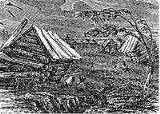
The 1811-1812
New Madrid earthquakes (nuː ˈmædrɨd) were an intense
intraplate earthquakeAn intraplate earthquake is an earthquake that occurs in the interior of a tectonic plate, whereas an interplate earthquake is one that occurs at a plate boundary....
series beginning with an initial pair of very large earthquakes on December 16, 1811. These earthquakes remain the most powerful earthquakes ever to hit the eastern United States in recorded history. These events, as well as the seismic zone of their occurrence, were named for the
Mississippi RiverThe Mississippi River is the largest river system in North America. Flowing entirely in the United States, this river rises in western Minnesota and meanders slowly southwards for to the Mississippi River Delta at the Gulf of Mexico. With its many tributaries, the Mississippi's watershed drains...
town of
New MadridNew Madrid is a city in New Madrid County, Missouri, 42 miles south by west of Cairo, Illinois, on the Mississippi River. New Madrid was founded in 1788 by American frontiersmen. In 1900, 1,489 people lived in New Madrid, Missouri; in 1910, the population was 1,882. The population was 3,334 at...
, then part of the
Louisiana TerritoryThe Territory of Louisiana or Louisiana Territory was an organized incorporated territory of the United States that existed from July 4, 1805 until June 4, 1812, when it was renamed to Missouri Territory...
, now within
MissouriMissouri is a US state located in the Midwestern United States, bordered by Iowa, Illinois, Kentucky, Tennessee, Arkansas, Oklahoma, Kansas and Nebraska. With a 2010 population of 5,988,927, Missouri is the 18th most populous state in the nation and the fifth most populous in the Midwest. It...
.
There are estimates that the earthquakes were felt strongly over roughly 130000 square kilometres (50,193.3 sq mi), and moderately across nearly 3 million square kilometers (1 million square miles). The historic
1906 San Francisco earthquakeThe San Francisco earthquake of 1906 was a major earthquake that struck San Francisco, California, and the coast of Northern California at 5:12 a.m. on Wednesday, April 18, 1906. The most widely accepted estimate for the magnitude of the earthquake is a moment magnitude of 7.9; however, other...
, by comparison, was felt moderately over roughly 16000 square kilometres (6,177.6 sq mi).
The four earthquakes
- December 16, 1811, 0815 UTC (2:15 a.m.); (M ~7.2 – 8.1) epicenter in northeast Arkansas. It caused only slight damage to man-made structures, mainly because of the sparse population in the epicentral area. The future location of Memphis, Tennessee
Memphis is a city in the southwestern corner of the U.S. state of Tennessee, and the county seat of Shelby County. The city is located on the 4th Chickasaw Bluff, south of the confluence of the Wolf and Mississippi rivers....
experienced level IX shaking on the Mercalli intensity scaleThe Mercalli intensity scale is a seismic scale used for measuring the intensity of an earthquake. It measures the effects of an earthquake, and is distinct from the moment magnitude M_w usually reported for an earthquake , which is a measure of the energy released...
. A seismic seicheA seiche is a standing wave in an enclosed or partially enclosed body of water. Seiches and seiche-related phenomena have been observed on lakes, reservoirs, swimming pools, bays, harbors and seas...
propagated upriver and Little Prairie was heavily damaged by soil liquefactionSoil liquefaction describes a phenomenon whereby a saturated soil substantially loses strength and stiffness in response to an applied stress, usually earthquake shaking or other sudden change in stress condition, causing it to behave like a liquid....
.
- December 16, 1811, 1415 UTC (8:15 a.m.); (M ~7.2–8.1) epicenter in northeast Arkansas. This shock followed the first earthquake by six hours and was similar in intensity.
- January 23, 1812, 1500 UTC (9 a.m.); (M ~7.0–7.8) epicenter in the Missouri Bootheel. The meizoseismal area
The meizoseismal area in an earthquake is the area of maximum damage. For example, in the Charleston, South Carolina, earthquake of 1886, the meizoseismal area was an area about twenty by thirty miles stretching northeast between Charleston and Jedburg and incorporating Summerville. The estimated...
was characterized by general ground warping, ejections, fissuring, severe landslides, and caving of stream banks. Johnson and Schweig attributed this earthquake to a rupture on the New Madrid North Fault. This may have placed strain on the Reelfoot Fault.
- February 7, 1812, 0945 UTC (4:45 a.m.); (M ~7.4–8.0) epicenter near New Madrid, Missouri. New Madrid was destroyed. At St. Louis, Missouri
St. Louis is an independent city on the eastern border of Missouri, United States. With a population of 319,294, it was the 58th-largest U.S. city at the 2010 U.S. Census. The Greater St...
, many houses were severely damaged, and their chimneys were toppled. This shock was definitively attributed to the Reelfoot Fault by Johnston and Schweig. Uplift along a segment of this reverse fault created temporary waterfalls on the Mississippi at Kentucky BendThe Kentucky Bend, variously called the New Madrid Bend, Madrid Bend, Bessie Bend, or Bubbleland, is an exclave of Fulton County, Kentucky, in the United States....
, created waves that propagated upstream, and caused the formation of Reelfoot LakeReelfoot Lake is a shallow natural lake located in the northwest portion of Tennessee, United States of America. Much of it is really more of a swamp, with bayou-like ditches connecting more open bodies of water called basins, the largest of which is called Blue Basin. Reelfoot Lake is noted for...
by obstructing streams in Lake CountyLake County may refer to:In New Zealand* Lake County, New ZealandIn the United StatesIt is the name of twelve counties in the United States of America:*Named for Great Lakes, near which they are located:** Lake County, Illinois** Lake County, Indiana...
, Tennessee.
Susan Hough, a seismologist of the
United States Geological SurveyThe United States Geological Survey is a scientific agency of the United States government. The scientists of the USGS study the landscape of the United States, its natural resources, and the natural hazards that threaten it. The organization has four major science disciplines, concerning biology,...
(USGS), has recently estimated the earthquakes' magnitudes as "right around magnitude 7. Possibly a bit below, possibly a bit above, but not as big as 7.5."
Eyewitness accounts
John Bradbury, a Fellow of the Linnean Society, was on the Mississippi on the night of December 15, 1811, and describes the tremors in great detail in his Travels in the Interior of America in the Years 1809, 1810 and 1811, published in 1817. The key text is found between page 199 and page 207.
After supper. we went to sleep as usual: about ten o'clock, and in the night I was awakened by the most tremendous noise, accompanied by an agitation of the boat so violent, that it appeared in danger of upsetting...I could distinctly see the river as if agitated by a storm; and although the noise was inconceivably loud and terrific, I could distinctly hear the crash of falling trees, and the screaming of the wild fowl on the river, but found that the boat was still safe at her moorings...
By the time we could get to our fire. which was on a large flag, in the stern of the boat, the shock had ceased; but immediately the perpendicular banks, both above and below us, began to fall into the river in such vast masses, as to nearly sink our boat by the swell they occasioned . . . At day-light we had counted twenty-seven shocks . . .
Eliza Bryan in New Madrid,
Territory of MissouriThe Territory of Missouri was an organized incorporated territory of the United States that existed from June 4, 1812 until August 10, 1821, when the southeastern portion of the territory was admitted to the Union as the State of Missouri.-History:...
, wrote the following eyewitness account in March, 1812.
On the 16th of December, 1811, about two o'clock, a.m., we were visited by a violent shock of an earthquake, accompanied by a very awful noise resembling loud but distant thunder, but more hoarse and vibrating, which was followed in a few minutes by the complete saturation of the atmosphere, with sulphurious vapor, causing total darkness. The screams of the affrighted inhabitants running to and fro, not knowing where to go, or what to do —the cries of the fowls and beasts of every species —the cracking of trees falling, and the roaring of the Mississippi — the current of which was retrograde for a few minutes, owing as is supposed, to an irruption in its bed — formed a scene truly horrible.
John ReynoldsJohn Reynolds was a United States politician from the state of Illinois. He was one of the original four justices of the Illinois Supreme Court, 1818–1825, a member of the Illinois House of Representatives from 1826–1830, 1846–1848, and 1852–1854 , and the 4th Illinois Governor from 1830–1834...
(February 26, 1788 – May 8, 1865) who was the 4th governor of Illinois, among other political posts, mentions the earthquake in his biography My Own Times: Embracing Also the History of My Life (1855):
On the night of 16th November [sic], 1811, an earthquake occurred, that produced great consternation amongst the people. The centre of the violence was in New Madrid, Missouri, but the whole valley of the Mississippi was violently agitated. Our family all were sleeping in a log cabin, and my father leaped out of bed crying aloud 'the Indians are on the house.' ... We laughed at the mistake of my father, but soon found out it was worse than the Indians. Not one in the family knew at the time that it was an earthquake. The next morning another shock made us acquainted with it, so we decided it was an earthquake. The cattle came running home bellowing with fear, and all animals were terribly alarmed on the occasion. Our house cracked and quivered, so we were fearful it would fall to the ground.
In the American Bottom many chimneys were thrown down, and the church bell in Cahokia sounded by the agitation of the building.
It is said the shock of an earthquake was felt in Kaskaskia in 1804, but I did not perceive it. The shocks continued for years in Illinois, and some have experienced it this year, 1855.
The Shaker diarist Samuel Swan McClelland described the effects of the earthquake on the Shaker settlement at
West Union (Busro), IndianaWest Union is an abandoned Shaker community in Busseron Township, northwestern Knox County, Indiana, about fifteen miles north of Vincennes. The settlement was inhabited by the Shakers from 1811 to 1827...
, where the earthquakes contributed to the temporary abandonment of the westernmost Shaker community.
Consequence of the 1811-12 earthquakes
Some sections of the Mississippi River appeared to run backward for a short time.
Sand blowsA sand volcano or sand blow is a cone of sand formed by the ejection of sand onto a surface from a central point. The sand builds up as a cone with slopes at the sand's angle of repose. A crater is commonly seen at the summit...
were common throughout the area, and can still be seen from the air in cultivated fields. The shockwaves propagated efficiently through the firm midwestern bedrock, with residents as far away as
Pittsburgh, PennsylvaniaPittsburgh is the second-largest city in the US Commonwealth of Pennsylvania and the county seat of Allegheny County. Regionally, it anchors the largest urban area of Appalachia and the Ohio River Valley, and nationally, it is the 22nd-largest urban area in the United States...
, and
Norfolk, VirginiaNorfolk is an independent city in the Commonwealth of Virginia in the United States. With a population of 242,803 as of the 2010 Census, it is Virginia's second-largest city behind neighboring Virginia Beach....
, awakened by intense shaking. Church bells were reported to ring as far as Boston, Massachusetts and
York, Ontario (now Toronto)Toronto is the provincial capital of Ontario and the largest city in Canada. It is located in Southern Ontario on the northwestern shore of Lake Ontario. A relatively modern city, Toronto's history dates back to the late-18th century, when its land was first purchased by the British monarchy from...
, and sidewalks were reported to have been cracked and broken in
Washington, D.C.Washington, D.C., formally the District of Columbia and commonly referred to as Washington, "the District", or simply D.C., is the capital of the United States. On July 16, 1790, the United States Congress approved the creation of a permanent national capital as permitted by the U.S. Constitution....
There were also reports of toppled chimneys in
MaineMaine is a state in the New England region of the northeastern United States, bordered by the Atlantic Ocean to the east and south, New Hampshire to the west, and the Canadian provinces of Quebec to the northwest and New Brunswick to the northeast. Maine is both the northernmost and easternmost...
.
Disaster relief
A request, dated January 13, 1812, by
William ClarkWilliam Clark was an American explorer, soldier, Indian agent, and territorial governor. A native of Virginia, he grew up in prestatehood Kentucky before later settling in what became the state of Missouri...
(famous for his exploration of the American West with
Meriwether LewisMeriwether Lewis was an American explorer, soldier, and public administrator, best known for his role as the leader of the Lewis and Clark Expedition also known as the Corps of Discovery, with William Clark...
and the Corps of Discovery from 1803 to 1805), then the governor of the
Louisiana TerritoryThe Territory of Louisiana or Louisiana Territory was an organized incorporated territory of the United States that existed from July 4, 1805 until June 4, 1812, when it was renamed to Missouri Territory...
(the territory was renamed the
Missouri TerritoryThe Territory of Missouri was an organized incorporated territory of the United States that existed from June 4, 1812 until August 10, 1821, when the southeastern portion of the territory was admitted to the Union as the State of Missouri.-History:...
soon after the quake to eliminate confusion with the new state of
LouisianaLouisiana is a state located in the southern region of the United States of America. Its capital is Baton Rouge and largest city is New Orleans. Louisiana is the only state in the U.S. with political subdivisions termed parishes, which are local governments equivalent to counties...
), asked for federal relief for the "inhabitants of New Madrid County."
Whereas the Catalogue of miseries and afflictions, with which it has pleased the Supreme Being of the Universe to visit the inhabitants of the earth there are none more
truly awful and destructive than Earthquakes. . . The inhabitants of the late District now County of New Madrid, in this Territory, have lately been visited with several calamities
of this kind, which have deluged large portions of their country and involved in the greatest distress many families, whilst others have been entirely ruined. . .In the opinion of
the said General Assembly provisions ought to be made by law for or cashiered to the said inhabitants relief, either out of the public fund or in some other way as may can meet to
the cost demand availability of the General Government.
This is possibly the very first request that the U.S. Federal Government had received for aid from one of its territories.
Other
The earthquakes helped bring to justice the murderers of
George LewisGeorge Lewis was an African American held as a slave; he was murdered in western Kentucky on the night of December 15-16, 1811 by Lilburn and Isham Lewis, grown sons of Dr...
(commonly known as "Slave George"). George was slain on the night of December 15–16, 1811 by two nephews of
Thomas JeffersonThomas Jefferson was the principal author of the United States Declaration of Independence and the Statute of Virginia for Religious Freedom , the third President of the United States and founder of the University of Virginia...
, Lilburn Lewis and Isham Lewis, who were also relatives of
Meriwether LewisMeriwether Lewis was an American explorer, soldier, and public administrator, best known for his role as the leader of the Lewis and Clark Expedition also known as the Corps of Discovery, with William Clark...
. After killing him with an axe in front of other slaves, George's owners intended to burn his mutilated corpse, but the first New Madrid earthquake interrupted their effort, and so the corpse was interred in a brick chimney. The murder may well have escaped discovery by authorities, except that the January 23 and February 7 quakes caused the chimney to partially collapse, exposing George's remains. Lilburn and Isham Lewis were quickly investigated, arrested and charged. Lilburn killed himself; Isham escaped from jail and probably died during the
War of 1812The War of 1812 was a military conflict fought between the forces of the United States of America and those of the British Empire. The Americans declared war in 1812 for several reasons, including trade restrictions because of Britain's ongoing war with France, impressment of American merchant...
.
Geologic setting
The underlying cause of New Madrid earthquakes is not well understood, but modern faulting seems to be related to an ancient geologic feature buried under the Mississippi River alluvial plain, known as the Reelfoot Rift.
Reelfoot rift
The New Madrid Seismic Zone (NMSZ) is made up of reactivated faults that formed when what is now
North AmericaNorth America is a continent wholly within the Northern Hemisphere and almost wholly within the Western Hemisphere. It is also considered a northern subcontinent of the Americas...
began to split or
riftIn geology, a rift or chasm is a place where the Earth's crust and lithosphere are being pulled apart and is an example of extensional tectonics....
apart during the breakup of the
supercontinentIn geology, a supercontinent is a landmass comprising more than one continental core, or craton. The assembly of cratons and accreted terranes that form Eurasia qualifies as a supercontinent today.-History:...
RodiniaIn geology, Rodinia is the name of a supercontinent, a continent which contained most or all of Earth's landmass. According to plate tectonic reconstructions, Rodinia existed between 1.1 billion and 750 million years ago, in the Neoproterozoic era...
in the
NeoproterozoicThe Neoproterozoic Era is the unit of geologic time from 1,000 to 542.0 ± 1.0 million years ago. The terminal Era of the formal Proterozoic Eon , it is further subdivided into the Tonian, Cryogenian, and Ediacaran Periods...
Era (about 750 million years ago). Faults were created along the rift and igneous rocks formed from
magmaMagma is a mixture of molten rock, volatiles and solids that is found beneath the surface of the Earth, and is expected to exist on other terrestrial planets. Besides molten rock, magma may also contain suspended crystals and dissolved gas and sometimes also gas bubbles. Magma often collects in...
that was being pushed towards the surface. The resulting rift system failed but has remained as an
aulacogenIn geology, an aulacogen is a failed arm of a triple junction of a plate tectonics rift system. A triple junction beneath a continental plate initiates a three way breakup of the continental plate. As the continental break-up develops one of the three spreading ridges typically fails or stops...
(a scar or zone of weakness) deep underground. Another unsuccessful attempt at rifting 200 million years ago created additional faults, which made the area weaker. The resulting geological structures make up the Reelfoot Rift, and have since been deeply buried by younger sediments. But the ancient faults appear to have made the rocks deep in the Earth's crust in the New Madrid area mechanically weaker than much of the rest of North America.
This weakness, possibly combined with focusing effects from mechanically stronger igneous rocks nearby, allows the relatively small east-west compressive forces that exist in the North American plate to reactivate old faults, making the area prone to earthquakes.
Since other rifts are known to occur in North America's stress environment but not all are associated with modern earthquakes, (for example the
Midcontinent Rift SystemThe Midcontinent Rift System or Keweenawan Rift is a long geological rift in the center of the North American continent and south-central part of the North American plate. It formed when the continent's core, the North American craton, began to split apart during the Mesoproterozoic era of the...
that stretches from
MinnesotaMinnesota is a U.S. state located in the Midwestern United States. The twelfth largest state of the U.S., it is the twenty-first most populous, with 5.3 million residents. Minnesota was carved out of the eastern half of the Minnesota Territory and admitted to the Union as the thirty-second state...
to
KansasKansas is a US state located in the Midwestern United States. It is named after the Kansas River which flows through it, which in turn was named after the Kansa Native American tribe, which inhabited the area. The tribe's name is often said to mean "people of the wind" or "people of the south...
), other processes could be at work to locally increase mechanical stress on the New Madrid faults. Stress changes associated with bending of the
lithosphereThe lithosphere is the rigid outermost shell of a rocky planet. On Earth, it comprises the crust and the portion of the upper mantle that behaves elastically on time scales of thousands of years or greater.- Earth's lithosphere :...
caused by the melting of continental glaciers at the end of the last
Ice AgeAn ice age or, more precisely, glacial age, is a generic geological period of long-term reduction in the temperature of the Earth's surface and atmosphere, resulting in the presence or expansion of continental ice sheets, polar ice sheets and alpine glaciers...
, has been considered to play a role, as well as downward pull from sinking igneous rock bodies below the fault. It has also been suggested that some form of heating in the lithosphere below the area may be making deep rocks more plastic, which concentrates compressive stress in the shallower subsurface area where the faulting occurs. There may be local stress from a change in the flow of the
mantleThe mantle is a part of a terrestrial planet or other rocky body large enough to have differentiation by density. The interior of the Earth, similar to the other terrestrial planets, is chemically divided into layers. The mantle is a highly viscous layer between the crust and the outer core....
beneath the NMSZ, caused by the sinking
Farallon PlateThe Farallon Plate was an ancient oceanic plate, which began subducting under the west coast of the North American Plate— then located in modern Utah— as Pangaea broke apart during the Jurassic Period...
, according to one model.
Seismic zone
When epicenters of modern earthquakes are plotted on a map, three trends become apparent. First is the general northeast-southwest trend paralleling the trend of the Reelfoot Rift, in Arkansas, south of where the epicenters turn northwest. This is a right-lateral strike-slip fault system parallel to the Reelfoot Rift.
The second is the southeast to northwest trend that occurs just southwest of New Madrid. This trend is a stepover thrust fault known as the Reelfoot Fault, associated with the Tiptonville dome and the impoundment of Reelfoot Lake. Epicenter locations on this fault are more spread out because the fault surface is inclined and dips into the ground, towards the south, at around forty degrees. Slip is towards the northeast. Motion on this fault in the 1811-1812 series created waterfalls on the Mississippi.
The third line, extending northeast from the northwestern end of the Reelfoot Fault is another right-lateral strike-slip fault, termed New Madrid North.
The epicenters of over 4,000 earthquakes can be identified from seismic measurements taken since 1974. It can be seen that the earthquakes originate from the seismic activity of the Reelfoot Rift. The zone which is colored in red on the map is called the New Madrid Seismic Zone.
Recent earthquakes
The zone remains active today. In recent decades minor earthquakes have continued. New forecasts estimate a 7 to 10 percent chance, in the next 50 years, of a repeat of a major earthquake like those that occurred in 1811–1812, which likely had magnitudes of between 7.5 and 8.0. There is a 25 to 40 percent chance, in a 50-year time span, of a magnitude 6.0 or greater earthquake.
Recurrence potential
In a report filed in November 2008, The U.S.
Federal Emergency Management AgencyThe Federal Emergency Management Agency is an agency of the United States Department of Homeland Security, initially created by Presidential Reorganization Plan No. 1 of 1978 and implemented by two Executive Orders...
warned that a serious earthquake in the New Madrid Seismic Zone could result in "the highest economic losses due to a natural disaster in the United States," further predicting "widespread and catastrophic" damage across Alabama, Arkansas, Illinois, Indiana, Kentucky, Mississippi, Missouri and particularly Tennessee, where a 7.7 magnitude quake or greater would cause damage to tens of thousands of structures affecting
water distributionWater purification is the process of removing undesirable chemicals, materials, and biological contaminants from contaminated water. The goal is to produce water fit for a specific purpose...
, transportation systems, and other vital
infrastructureInfrastructure is basic physical and organizational structures needed for the operation of a society or enterprise, or the services and facilities necessary for an economy to function...
.
The potential for the recurrence of large earthquakes and their impact today on densely populated cities in and around the seismic zone has prompted research devoted to understanding in the New Madrid Seismic Zone. By studying evidence of past quakes and closely monitoring ground motion and current earthquake activity, scientists attempt to understand their causes and recurrence intervals.
The lack of apparent land movement along the New Madrid fault system has long puzzled scientists. In 2009 two studies based on eight years of GPS measurements indicated that the faults were moving at no more than 0.2 millimetre (0.0078740157480315 in) a year. This contrasts to the rate of slippage on the
San Andreas FaultThe San Andreas Fault is a continental strike-slip fault that runs a length of roughly through California in the United States. The fault's motion is right-lateral strike-slip...
which averages up to 37 mm (1.5 in) a year across California.
See also
- New Madrid Seismic Zone
The New Madrid Seismic Zone , sometimes called the New Madrid Fault Line, is a major seismic zone and a prolific source of intraplate earthquakes in the southern and midwestern United States, stretching to the southwest from New Madrid, Missouri.The New Madrid fault system was responsible for the...
- List of earthquakes in the United States
- List of earthquakes
- Postglacial rebound
- 1865 Memphis earthquake
The 1865 Memphis earthquake struck southwest Tennessee on August 17, 1865. Soon after the magnitude 5.0 earthquake hit, land appeared to roll and waves formed in nearby rivers. The force of the earthquake felled and cracked chimneys in Memphis and New Madrid. Shaking of the earthquake spread as far...
- 1886 Charleston earthquake
External links