


Neuron doctrine

Encyclopedia
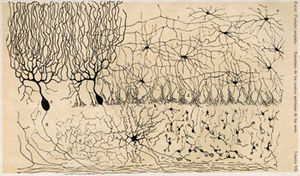
Santiago Ramón y Cajal
Santiago Ramón y Cajal ForMemRS was a Spanish pathologist, histologist, neuroscientist, and Nobel laureate. His pioneering investigations of the microscopic structure of the brain were original: he is considered by many to be the father of modern neuroscience...
and later presented, among others, by H. Waldeyer-Hartz
Heinrich Wilhelm Gottfried von Waldeyer-Hartz
Heinrich Wilhelm Gottfried von Waldeyer-Hartz was a German anatomist, famous for consolidating the neuron theory of organization of the nervous system and for naming the chromosome...
. The term neuron
Neuron
A neuron is an electrically excitable cell that processes and transmits information by electrical and chemical signaling. Chemical signaling occurs via synapses, specialized connections with other cells. Neurons connect to each other to form networks. Neurons are the core components of the nervous...
(also spelt neurone in English) was itself coined by Waldeyer as a way of identifying the cells in question. The neuron doctrine, as it became known, served to position neurons as special cases under the broader cell theory
Cell theory
Cell theory refers to the idea that cells are the basic unit of structure in every living thing. Development of this theory during the mid 17th century was made possible by advances in microscopy. This theory is one of the foundations of biology...
evolved some decades earlier. He appropriated the concept not from his own research but from the disparate observation of the histological work of Albert von Kölliker
Albert von Kölliker
Albert von Kölliker was a Swiss anatomist and physiologist.-Biography:Albert Kölliker was born in Zurich, Switzerland. His early education was carried on in Zurich, and he entered the university there in 1836...
, Camillo Golgi
Camillo Golgi
Camillo Golgi was an Italian physician, pathologist, scientist, and Nobel laureate.-Biography:Camillo Golgi was born in the village of Corteno, Lombardy, then part of the Austrian Empire. The village is now named Corteno Golgi in his honour. His father was a physician and district medical officer...
, Franz Nissl
Franz Nissl
Franz Nissl was a German medical researcher. He was a noted neuropathologist.-Early life:...
, Santiago Ramón y Cajal
Santiago Ramón y Cajal
Santiago Ramón y Cajal ForMemRS was a Spanish pathologist, histologist, neuroscientist, and Nobel laureate. His pioneering investigations of the microscopic structure of the brain were original: he is considered by many to be the father of modern neuroscience...
, Auguste Forel and others.
Historical Context
Theodor SchwannTheodor Schwann
Theodor Schwann was a German physiologist. His many contributions to biology include the development of cell theory, the discovery of Schwann cells in the peripheral nervous system, the discovery and study of pepsin, the discovery of the organic nature of yeast, and the invention of the term...
proposed in 1839 that the tissues of all organisms are composed of cells . Schwann was expanding on the proposal of his good friend Matthias Jakob Schleiden
Matthias Jakob Schleiden
Matthias Jakob Schleiden was a German botanist and co-founder of the cell theory, along with Theodor Schwann and Rudolf Virchow....
the previous year that all plant tissues were composed of cells. The nervous system stood as an exception. Although nerve cells had been described in tissue by numerous investigators including Jan Purkinje, Gabriel Valentin, and Robert Remak
Robert Remak
-External links:*** in the Virtual Laboratory of the Max Planck Institute for the History of Science...
, the relationship between the nerve cells and other features such as dendrites and axons was not clear. The connections between the large cell bodies and smaller features could not be observed, and it was possible that "neurofibrils" would stand as an exception to cell theory as non-cellular components of living tissue. Technical limitations of microscopy and tissue preparation were largely responsible. Chromatic aberration
Chromatic aberration
In optics, chromatic aberration is a type of distortion in which there is a failure of a lens to focus all colors to the same convergence point. It occurs because lenses have a different refractive index for different wavelengths of light...
, spherical aberration
Spherical aberration
thumb|right|Spherical aberration. A perfect lens focuses all incoming rays to a point on the [[Optical axis|optic axis]]. A real lens with spherical surfaces suffers from spherical aberration: it focuses rays more tightly if they enter it far from the optic axis than if they enter closer to the...
and the dependence on natural light all played a role in limiting microscope performance in the early 19th century. Tissue was typically lightly mashed in water and pressed between a glass slide and cover slip. There was also a limited number of dyes and fixatives available prior to the middle of the 19th century.
Elements of the Neuron Doctrine
Neuron Theory is an example of consilienceConsilience
Consilience, or the unity of knowledge , has its roots in the ancient Greek concept of an intrinsic orderliness that governs our cosmos, inherently comprehensible by logical process, a vision at odds with mystical views in many cultures that surrounded the Hellenes...
where low level theories are absorbed into higher level theories that explain the base data as part of higher order structure. As a result the neuron doctrine has multiple elements, each of which were the subject of low level theories, debate, and primary data collection. Some of these elements are imposed by the necessity of cell theory that Waldeyer was trying to use to explain the direct observations, and other elements try to explain observations so that they are compatible with cell theory.
Neural units
The brain is made up of individual units that contain specialized features such as dendrites, a cell body, and an axon.
Neurons are cells
These individual units are cells as understood from other tissues in the body.
Specialization
These units may differ in size, shape, and structure according to their location or functional specialization.
Nucleus is Key
The nucleus is the trophic center for the cell. If the cell is divided only the portion containing the nucleus will survive.
Nerve Fibers are Cell Processes
Nerve fibers are outgrowths of nerve cells.
Cell Division
Nerve cells are generated by cell division.
Contact
Nerve cells are connected by sites of contact and not cytoplasmic continuity.
Waldeyer himself was neutral on this point, and strictly speaking the neuron doctrine does not depend upon this element. The heart is an example of excitable tissue where the cells connect via cytoplasmic continuity and yet is perfectly consistent with cell theory. This is true of other examples such as connections between horizontal cells of the retina, or the Mauthner cell synapse in goldfish.
Law of Dynamic Polarization
Although the axon can conduct in both directions, in tissue there is a preferred direction for transmission from cell to cell.
Later elements that were not included by Waldeyer, but were added in the following decades.
Synapse
A barrier to transmission exists at the site of contact between two neurons that may permit transmission.
Unity of Transmission
If a contact is made between two cells, then that contact can be either excitatory or inhibitory, but will always be of the same type.
Dale's Law
Each nerve terminal releases a single type of transmitter.
Updating the neuron doctrine
While the neuron doctrine is a central tenet of modern neuroscienceNeuroscience
Neuroscience is the scientific study of the nervous system. Traditionally, neuroscience has been seen as a branch of biology. However, it is currently an interdisciplinary science that collaborates with other fields such as chemistry, computer science, engineering, linguistics, mathematics,...
, recent studies suggest that there are notable exceptions and important additions to our knowledge about how neurons function.
Electrical synapses are more common in the central nervous system than previously thought. Thus, rather than functioning as individual units, in some parts of the brain large ensembles of neurons may be active simultaneously to process neural information. Electrical synapses are formed by gap junctions that allow molecules to directly pass between neurons, creating a cytoplasm-to-cytoplasm connection.