


Nestor Makhno

Encyclopedia
Nestor Ivanovych Makhno or simply Daddy Makhno was a Ukrainian anarcho-communist
guerrilla leader turned army commander who led an independent anarchist army in Ukraine
during the Russian Civil War
.
A commander of the peasant Revolutionary Insurrectionary Army of Ukraine
, also known as the Anarchist Black Army, Makhno led a guerrilla campaign during the Russian Civil War
. He supported the Bolsheviks, the Ukrainian Directory, the Bolsheviks again, and then turned to organizing the Free Territory of Ukraine
, an anarchist society. This project was cut short by the consolidation of Bolshevik power. Makhno was described by anarchist theorist Emma Goldman
as "an extraordinary figure" leading a revolutionary peasants' movement. He is also credited as the inventor of the tachanka
, a horse-drawn platform mounting a heavy machine gun
.
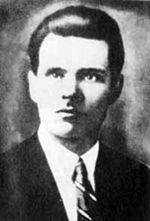 Nestor Makhno was born into a poor peasant family in Huliaipole
, Yekaterinoslav Governorate
in the Novorossiya
region of the Russian Empire
(now Zaporizhia Oblast
, Ukraine
). He was the youngest of five children. Church files show a baptism date of October 27 (November 8), 1888; but Nestor Makhno's parents registered his date of birth as 1889 (in an attempt to postpone conscription).
His father died when he was ten months old.
Due to extreme poverty, he had to work as a shepherd at the age of seven. He studied at the Second Huliaipole primary school in winter at the age of eight and worked for local landlords during the summer. He left school at the age of twelve and was employed as a farmhand on the estates of nobles and on the farms of wealthy peasants or kulak
s.
At the age of seventeen, he was employed in Huliaipole itself as an apprentice painter, then as a worker in a local iron foundry and ultimately worked as a founder in the same organization. During this time he became involved in revolutionary politics. His involvement was based on his experiences of injustice at work and the terrorism
of the Tsarist regime during the 1905 revolution. In 1906, Makhno joined the anarchist organization in Huliaipole. He was arrested in 1906, tried, and acquitted. He was again arrested in 1907, but could not be incriminated, and the charges were dropped. The third arrest came in 1908 when an infiltrator was able to testify against Makhno. In 1910 Makhno was sentenced to death by hanging, but the sentence was commuted to life imprisonment and he was sent to Butyrskaya prison in Moscow
. In prison he came under the influence of his intellectual cellmate Piotr Arshinov. He was released from prison after the February Revolution
in 1917.
" image and he expropriated large estates from landowners and distributed the land among the peasants.
In March 1918, the new Bolshevik government in Russia signed the Treaty of Brest-Litovsk
concluding peace with the Central Powers
, but ceding large amounts of territory, including Ukraine. As the Central Rada of the Ukrainian People's Republic
(UNR) was unable to maintain order, a coup by former Tsarist general Pavlo Skoropadsky
resulted in the establishment of the Hetmanate. Already dissatisfied by the UNR's failure to resolve the question of land ownership, much of the peasantry refused to support a conservative government administered by former imperial officials and supported by the Austro-Hungarian and German occupiers. Peasant bands under various self-appointed otamany which had been counted on the rolls of the UNR's army now attacked the Germans, later going over to the Directory in summer 1918 or the Bolsheviks in late 1918–19, or home to protect local interests, in many cases changing allegiances, plundering so-called class enemies, and venting age-old resentments. They finally dominated the countryside in mid 1919, the largest portion would follow either Socialist Revolutionary Matviy Hryhoriyiv or the anarchist flag of Makhno.
In Yekaterinoslav province, the rebellion soon took on anarchist political overtones. Nestor Makhno joined one of such groups (headed by sailor-deserter Fedir Shchus
) and eventually became its commander. Due in part to the impressive personality and charisma of Makhno, all Ukrainian anarchist detachments and peasant guerrilla bands in the region were subsequently known as Makhnovists . These were eventually united into the Revolutionary Insurrectionary Army of Ukraine
(RIAU), also called the Black Army
(because they fought under the anarchist
black flag). The RIAU battled against the Whites
(counter-revolutionaries) forces, Ukrainian nationalists, and various independent paramilitary formations that conducted anti-semitic
pogrom
s. The anarchist movement in Ukraine came to be referred to as the Black Army, Makhnovism or pejoratively Makhnovshchina.
In areas where they drove out opposing armies, villagers (and workers) sought to abolish capitalism
and the state by organizing themselves into village assemblies
, communes
and free councils. The land and factories were expropriated and put under nominal peasant and worker control by means of self-governing committees; however, town mayors and many officials were drawn directly from the ranks of Makhno's military and political leadership.
Pavlo Skoropadsky
, head of a the Ukrainian State
, (considered by most historians as a puppet
regime) lost the support of the Central Powers (Germany and Austro-Hungary, which had armed his forces and installed him in power) after the collapse of the German western front. Unpopular among most southern Ukrainians, the Hetman saw his best forces evaporate, and was driven out of Kiev
by the Directory
. In March 1918, Makhno's forces and allied anarchist and guerrilla groups won victories against German, Austrian, and Ukrainian nationalist (the army of Symon Petlura
) forces, and units of the White Army
, capturing a lot of German and Austro-Hungarian arms. These victories over much larger enemy forces established Makhno's reputation as a military tactician; he became known as Batko (‘Father’) to his admirers.
At this point, the emphasis on military campaigns that Makhno had adopted in the previous year shifted to political concerns. The first Congress of the Confederation of Anarchists Groups, under the name of Nabat
("the Alarm Drum"), issued five main principles: rejection of all political parties, rejection of all forms of dictatorships (including the dictatorship of the proletariat
, viewed by Makhnovists and many anarchists of the day as a term synonymous with the dictatorship of the Bolshevik communist party), negation of any concept of a central state, rejection of a so-called "transitional period" necessitating a temporary dictatorship of the proletariat, and self-management of all workers through free local workers' councils (soviets). While the Bolsheviks argued that their concept of dictatorship of the proletariat meant precisely "rule by workers' councils," the Makhnovist platform opposed the "temporary" Bolshevik measure of "party dictatorship." The Nabat was by no means a puppet of Mahkno and his supporters, from time to time criticizing the Black Army and its conduct in the war.
In 1918, after recruiting large numbers of Ukrainian peasants, as well as numbers of Jews, anarchists, naletchki, and recruits arriving from other countries, Makhno formed the Revolutionary Insurrectionary Army of Ukraine
, otherwise known as the Anarchist Black Army. At its formation, the Black Army consisted of about 15,000 armed troops, including infantry and cavalry (both regular and irregular) brigades; artillery detachments were incorporated into each regiment. From November 1918 to June 1919, using the Black Army to secure its hold on power, the Makhnovists attempted to create an anarchist society in Ukraine, administered at the local level by autonomous peasants' and workers' councils.
New relationships and values were generated by this new social paradigm, which led Makhnovists to formalize the policy of free communities as the highest form of social justice
. Education was organized on Francisco Ferrer's principles, and the economy was based upon free exchange between rural and urban communities, from crop and cattle to manufactured products, according to the science proposed by Peter Kropotkin
.
Makhno called the Bolsheviks dictators and opposed the "Cheka [secret police]... and similar compulsory authoritative and disciplinary institutions" and called for "[f]reedom of speech, press, assembly, unions and the like". The Bolsheviks accused the Makhnovists of imposing a formal government over the area they controlled
, and also said that Makhnovists used forced conscription, committed summary executions, and had two military and counter-intelligence forces: the Razvedka and the
Kommissiya Protivmakhnovskikh Del (patterned after the Cheka
and the GRU
). However, later historians have dismissed these claims as fraudulent propaganda.
The Bolsheviks claimed that it would be impossible for a small, agricultural society to organize into an anarchist society so quickly. However, Eastern Ukraine had a large amount of coal mines, and was one of the most industrialised parts of the Russian Empire
.
During the war, Mahkno and his Black Army raided many German and Mennonite villages and estates in the Katerynoslav Oblast. The larger rural landholdings of pacifist Mennonites were prominent targets. Makhno's anarchist army generally targeted Mennonites because their wealthy and prosperous communal estates were thought of as Kulak
s - wealthy and landed gentry with more advantages than the surrounding Ukrainian peasants. Makhno was also staunchly anti-religious, and viewed Mennonites as enemies on these grounds.
While prohibited by their religion from serving in the Tsar's army, many Mennonites had assisted the Tsar's war effort by performing national service in non-fighting roles, including forestry and hospital units. The Mennonites' Germanic background also served to inflame negative sentiment during the period of revolution, as many peasants in the Black Army had families who had suffered previous depredations by German, Austro-Hungarian, and Hetmanist forces (though one of the high commanders of the Makhnovist Army named Klein was said to be of German
descent). It is believed that Makhno himself had worked as a cattle herder on a Mennonite estate in his youth and harbored negative feelings based on treatment he had received while employed there.
In 1919, with the advance of General Denikin's White
Volunteer Army
into Ukraine, depredations and expropriations
by Black Army detachments increased, including the burning of crops and destruction of livestock (what was not seized was often destroyed, either to deny supplies to the advancing White armies, or simply out of retaliation). In response and in the context of a complete collapse in government authority, some Mennonites discarded their pledge of non-violence and, together with other German communities, formed self-defence (or Selbstschutz) units. These units were initially somewhat successful in protecting their communities against Makhno's partisans but were overwhelmed once the anarchists aligned themselves with the Red Army, which had entered Ukraine in February 1919. Hundreds of Mennonites were murdered and robbed during this period, primarily in areas surrounding the villages of Chortitza
, Zagradovka, and Nikolaipol. The combination of Tsarist resettlement of Germans in World War I and attacks during the civil war reduced the German population from 750,000 in 1914 to 514,000 in 1926. The remainder had their lands expropriated by the Soviet government.
s against Jews in Ukraine during the civil war, based on the Bolshevik accounts of the war. However, these claims have never been proven. Paul Avrich
writes, "Maknno's alleged anti-Semitism...Charges of Jew-baiting and of anti-Jewish pogroms have come from every quarter, left, right, and center. Without exception, however, they are based on hearsay, rumor, or intentional slander, and remain undocumented and unproved." Avrich notes that a considerable number of Jews took part in the Makhnovist anarchist movement. Some, like Vsevolod Mikhailovich Eikhenbaum, also known as "Voline" were intellectuals who served on the Cultural-Educational Commission, wrote his manifestos, and edited his journals, but the great majority fought in the ranks of the Anarchist Black Army, either in special detachments of Jewish artillery and infantry, or else within the regular anarchist army brigades alongside peasants and workers of Ukrainian, Russian, and other ethnic origins. Together they formed a significant part of Makhno's anarchist army. Significantly, during the Russian civil war, the Merkaz or Central Committee of the Zionist Organization in Russia regularly reported on many armed groups committing pogroms against Jews in Russia, including the Whites, the Russian Ukrainian 'Green' nationalist Nikifor Grigoriev
(later shot by Black Army troops on Makhno's orders) as well as Red Army forces, but did not accuse Makhno or the anarchist Black Army of directing pogroms or other attacks against Russian Jews. According to the Cambridge University Press, “He was a self-educated man, committed to the teachings of Bakunin and Kropotkin, and he could not fairly be described as an anti-Semite. Makhno had Jewish comrades and friends; and like Symon Petliura, he issued a proclamation forbidding pogroms.” The book goes on to explain that "the anarchist leader could not or did not impose discipline on his soldiers. In the name of ‘class struggle’ his troops with particular enthusiasm robbed Jews of whatever they had.”
peasants, he did not consider himself to be a Ukrainian nationalist, but rather an anarchist. His movement did put out a Ukrainian-language version of their newspaper and his wife Halyna Kuzmenko was a nationally-conscious Ukrainian. In emigration, Makhno came to believe that anarchists would only have a future in Ukraine if they Ukrainianized and he stated that he regretted that he was writing his memoirs in Russian and not in Ukrainian. Makhno viewed the revolution as an opportunity for ordinary Russians - particularly rural peasants - to rid themselves of the overweening power of the central state through self-governing and autonomous peasant committees, protected by a people's army dedicated to anarchist principles of self-rule.
troops in Crimea
to the Black Army in July 1918. The Nabat confederation was banned and the Third Congress (specifically Pavel Dybenko
) declared the "Makhnovschina" (Ukrainian anarchists) outlaws and counter-revolutionaries. In response, the Anarchist Congress publicly questioned, "[M]ight laws exist as made by few persons so-called revolutionaries, allowing these to declare the outlawing of an entire people which is more revolutionary than them?" (Archinoff, The Makhnovist Movement). Relying largely on a September 1920 report from V. Ivanov, a Bolshevik delegate to Makhno's camp, Moscow justified its hostility to Makhno and the anarchists by claiming that:
The Bolshevik press was not only silent on the subject of Moscow's continued refusal to send arms to the Black Army, but also failed to credit the Ukrainian anarchists' continued willingness to ship food supplies to the hungry urban residents of Bolshevik-held cities.
Lenin soon sent Lev Kamenev
to Ukraine, who conducted a cordial interview with Makhno. After Kamenev's departure, Makhno claimed to have intercepted two Bolshevik messages, the first an order to the Red Army to attack the Makhnovists, the second ordering Makhno's assassination. Soon after the Fourth Congress, Trotsky sent an order to arrest every Nabat congress member. Pursued by White Army forces, Makhno and the Black Army responded by withdrawing further into the interior of Ukraine. In 1919, the Black Army suddenly turned eastwards in a full-scale offensive, surprising General Denikin's White forces and causing them to fall back. Within two weeks, Makhno and the Black Army had recaptured all of the southern Ukraine.
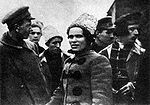 When nearly half of Makhno's troops were struck by a typhus epidemic, Trotsky resumed hostilities; the Cheka
sent two agents to assassinate Makhno in 1920, but were captured and after confessing, were executed. All through February, 1920 the Free Territory - Makhnovist region - was inundated with Red troops, including the 42nd Rifle Division and the Latvian
& Estonian
Division – in total at least 20,000 soldiers. Viktor Belash
noted that even in the worst time for the revolutionary army, namely at the beginning of 1920, "In the majority of cases rank-and-file Red Army
soldiers were set free". Of course Belash, as a colleague of Makhno's, was likely to idealize the punishment policies of the Batko. However, the facts bear witness that Makhno really did release "in all four directions" captured Red Army soldiers. This is what happened at the beginning of February 1920, when the insurgents disarmed the 10,000-strong Estonian Division in Huliaipole
. To this it must be added that the Revolutionary Insurrectionary Army of Ukraine included a choir of Estonian musicians. The problem was further compounded by the alienation of the Estonians by Anton Denikin's inflexible Russian chauvinism
and their refusal to fight with Nikolai Yudenich.
There was a new truce between Makhnovist forces and the Red Army in October 1920 in the face of a new advance by Wrangel
's White army. While Makhno and the anarchists were willing to assist in ejecting Wrangel and White Army troops from southern Ukraine and Crimea, they distrusted the Bolshevist government in Moscow and its motives. However, after the Bolshevik government agreed to a pardon of all anarchist prisoners throughout Russia, a formal treaty of alliance was signed.
By late 1920, Makhno had successfully halted General Wrangel's White Army advance into Ukraine from the southwest, capturing 4,000 prisoners and stores of munitions, and preventing the White Army from gaining control of the all-important Ukrainian grain harvest. Eventually, after shifting forces from the Polish-Soviet campaign, Red Army
units also participated in the southern campaign that pursued Wrangel and the remainder of his forces down the Crimean peninsula. To the end, Makhno and the anarchists maintained their main political structures, refusing demands to join the Red Army, to hold Bolshevik-supervised elections, or accept Bolshevik-appointed political commissars. The Red Army temporarily accepted these conditions, but within a few days ceased to provide the Makhnovists with basic supplies, such as cereals and coal.
When General Wrangel's White Army forces were decisively defeated in November 1920, the Communists immediately turned on Makhno and the anarchists once again. After refusing a direct order by the Bolshevik government to disband his anarchist army, Makhno intercepted three messages from Lenin to Christian Rakovsky
, the head of the Bolshevik Ukrainian Soviet based in Kharkiv. Lenin's orders were to arrest all members of Makhno's organization and to try them as common criminals. On November 26, 1920, less than two weeks after assisting Red Army forces to defeat Wrangel, Makhno's headquarters staff and many of his subordinate commanders were arrested at a Red Army planning conference to which they had been invited by Moscow, and executed. Makhno escaped, but was soon forced into retreat as the full weight of the Red Army and the Cheka's Special Punitive Brigades was brought to bear against not only the Makhnovists, but all anarchists, even their admirers and sympathizers.
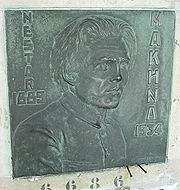 In August 1921, an exhausted Makhno was finally driven by Mikhail Frunze
's Ukrainian Red forces into exile with the remainder of his anarchist army, fleeing to Romania
, then Poland
, Danzig, Berlin
and finally to Paris
. In 1926, he joined other Russian exiles in Paris
as part of the Group of Russian Anarchists Abroad (Группа Русских Анархистов Заграницей) who produced the monthly journal "Dielo Truda
" (Дело Труда, The Cause of Labour). Makhno co-wrote and co-published the Organizational Platform of the General Union of Anarchists (often referred to as the Organizational Platform of the Libertarian Communists), which put forward ideas on how anarchists should organize, based on the experiences of revolutionary Ukraine and the defeat by the Bolsheviks. The document was initially rejected by many anarchists, but today has a wide following. It remains controversial to this day, continuing to inspire some anarchists (notably the platformism
tendency) because of the clarity and functionality of the structures it proposes, while drawing criticism from others (including, at the time of publication, Voline and Malatesta
) who viewed its implications as too rigid and hierarchical.
At the end of his life Makhno lived in Paris and worked as a carpenter
and stage-hand at the Paris Opera, at film-studios, and at the Renault
factory. He died in Paris on July 6, 1934, from tuberculosis
. He was cremated three days after his death, with five hundred people attending his funeral at the famous cimetière du Père-Lachaise in Paris. Makhno's widow and his daughter Yelena, were deported to Germany for forced labor during World War II
. After the end of the war they were arrested by the NKVD
. They were taken to Kiev
for trial in 1946 and sentenced to eight years of hard labor. They lived in Kazakhstan
after their release in 1953.
The song was a smashing hit as its lyrics carried a suggestive theme of the times of Red Terror
. The song was released soon before the fall of the Soviet Union
.
, a subordinate commander who committed a series of anti-semitic pogrom
s (according to other accounts, Grigoriev was killed by Chubenko, a member of Makhno's staff or Makhno himself).
Two of Makhno's brothers were his active supporters and aides before being captured in battle by the German occupation forces and executed by firing squad.
According to Paul Avrich, Makhno was a thoroughgoing anarchist and down-to-earth peasant. He rejected metaphysical systems
and abstract social theorizing.
Voline, one of his biggest supporters who was active for several months in the movement, reports that Makhno and his associates engaged in sexual mistreatment of women: "Makhno and of many of his intimates -- both commanders and others... let themselves indulge in shameful and even odious activities, going as far as orgies in which certain women were forced to participate." However, Voline's allegations against Makhno in regards to sexual violations of women has been disputed by some on the grounds that the allegations are unsubstantiated, do not stand up to eyewitness accounts of the punishment meted out to rapists by the Makhnovists, and were originally made by Voline in his book The Unknown Revolution which was first published in 1947, long after Makhno's death and following a bitter falling-out between Makhno and Voline. It has also been pointed out by A. Skirda
that Makhno's wife often traveled alongside Makhno during the war years in Ukraine and that she, and other armed insurgent women who were members of the Makhnovists movement, would not likely have tolerated such infidelities and abuse towards women on the part of her husband or other male insurgents.
Articles
Anarchist communism
Anarchist communism is a theory of anarchism which advocates the abolition of the state, markets, money, private property, and capitalism in favor of common ownership of the means of production, direct democracy and a horizontal network of voluntary associations and workers' councils with...
guerrilla leader turned army commander who led an independent anarchist army in Ukraine
Ukraine
Ukraine is a country in Eastern Europe. It has an area of 603,628 km², making it the second largest contiguous country on the European continent, after Russia...
during the Russian Civil War
Russian Civil War
The Russian Civil War was a multi-party war that occurred within the former Russian Empire after the Russian provisional government collapsed to the Soviets, under the domination of the Bolshevik party. Soviet forces first assumed power in Petrograd The Russian Civil War (1917–1923) was a...
.
A commander of the peasant Revolutionary Insurrectionary Army of Ukraine
Revolutionary Insurrectionary Army of Ukraine
The Revolutionary Insurrectionary Army of Ukraine , popularly called Makhnovshchina, less correctly Makhnovchina, and also known as the Black Army, was an anarchist army formed largely of Ukrainian and Crimean peasants and workers under the command of the famous anarchist Nestor Makhno during the...
, also known as the Anarchist Black Army, Makhno led a guerrilla campaign during the Russian Civil War
Russian Civil War
The Russian Civil War was a multi-party war that occurred within the former Russian Empire after the Russian provisional government collapsed to the Soviets, under the domination of the Bolshevik party. Soviet forces first assumed power in Petrograd The Russian Civil War (1917–1923) was a...
. He supported the Bolsheviks, the Ukrainian Directory, the Bolsheviks again, and then turned to organizing the Free Territory of Ukraine
Ukraine
Ukraine is a country in Eastern Europe. It has an area of 603,628 km², making it the second largest contiguous country on the European continent, after Russia...
, an anarchist society. This project was cut short by the consolidation of Bolshevik power. Makhno was described by anarchist theorist Emma Goldman
Emma Goldman
Emma Goldman was an anarchist known for her political activism, writing and speeches. She played a pivotal role in the development of anarchist political philosophy in North America and Europe in the first half of the twentieth century....
as "an extraordinary figure" leading a revolutionary peasants' movement. He is also credited as the inventor of the tachanka
Tachanka
The tachanka was a horse-drawn machine gun platform, usually a cart or an open wagon with a heavy machine gun installed in the back. A tachanka could be pulled by two to four horses and required a crew of two or three...
, a horse-drawn platform mounting a heavy machine gun
Heavy machine gun
The heavy machine gun or HMG is a larger class of machine gun generally recognized to refer to two separate stages of machine gun development. The term was originally used to refer to the early generation of machine guns which came into widespread use in World War I...
.
Early life
Huliaipole
Huliaipole is a city in Zaporizhia Oblast, Ukraine. Population is 17 000 .It is known as a birthplace of Nestor Makhno. The name of the city means a walk-about field. Prior to the annexation of the Crimean Khanate by the Russian Empire the area was mostly settled by Cossacks and the nomad people...
, Yekaterinoslav Governorate
Yekaterinoslav Governorate
The Yekaterinoslav Governorate or Government of Yekaterinoslav was a governorate in the Russian Empire. Its capital was the city of Yekaterinoslav .-Administrative divisions:...
in the Novorossiya
Novorossiya
Novorossiya is a historic area of lands which established itself solidly after the annexation of the Crimean Khanate by the Russian Empire, but was introduced with the establishment of Novorossiysk Governorate with the capital in Kremenchuk in the mid 18th century. Until that time in both Polish...
region of the Russian Empire
Russian Empire
The Russian Empire was a state that existed from 1721 until the Russian Revolution of 1917. It was the successor to the Tsardom of Russia and the predecessor of the Soviet Union...
(now Zaporizhia Oblast
Zaporizhia Oblast
Zaporizhia Oblast is an oblast of southern Ukraine. Its capital is Zaporizhia.This oblast is an important part of Ukraine's industry and agriculture.-Geography:...
, Ukraine
Ukraine
Ukraine is a country in Eastern Europe. It has an area of 603,628 km², making it the second largest contiguous country on the European continent, after Russia...
). He was the youngest of five children. Church files show a baptism date of October 27 (November 8), 1888; but Nestor Makhno's parents registered his date of birth as 1889 (in an attempt to postpone conscription).
His father died when he was ten months old.
Due to extreme poverty, he had to work as a shepherd at the age of seven. He studied at the Second Huliaipole primary school in winter at the age of eight and worked for local landlords during the summer. He left school at the age of twelve and was employed as a farmhand on the estates of nobles and on the farms of wealthy peasants or kulak
Kulak
Kulaks were a category of relatively affluent peasants in the later Russian Empire, Soviet Russia, and early Soviet Union...
s.
At the age of seventeen, he was employed in Huliaipole itself as an apprentice painter, then as a worker in a local iron foundry and ultimately worked as a founder in the same organization. During this time he became involved in revolutionary politics. His involvement was based on his experiences of injustice at work and the terrorism
State terrorism
State terrorism may refer to acts of terrorism conducted by a state against a foreign state or people. It can also refer to acts of violence by a state against its own people.-Definition:...
of the Tsarist regime during the 1905 revolution. In 1906, Makhno joined the anarchist organization in Huliaipole. He was arrested in 1906, tried, and acquitted. He was again arrested in 1907, but could not be incriminated, and the charges were dropped. The third arrest came in 1908 when an infiltrator was able to testify against Makhno. In 1910 Makhno was sentenced to death by hanging, but the sentence was commuted to life imprisonment and he was sent to Butyrskaya prison in Moscow
Moscow
Moscow is the capital, the most populous city, and the most populous federal subject of Russia. The city is a major political, economic, cultural, scientific, religious, financial, educational, and transportation centre of Russia and the continent...
. In prison he came under the influence of his intellectual cellmate Piotr Arshinov. He was released from prison after the February Revolution
February Revolution
The February Revolution of 1917 was the first of two revolutions in Russia in 1917. Centered around the then capital Petrograd in March . Its immediate result was the abdication of Tsar Nicholas II, the end of the Romanov dynasty, and the end of the Russian Empire...
in 1917.
Organizing peasants' movement
After liberation from prison, Makhno organized a peasants' union. It gave him a "Robin HoodRobin Hood
Robin Hood was a heroic outlaw in English folklore. A highly skilled archer and swordsman, he is known for "robbing from the rich and giving to the poor", assisted by a group of fellow outlaws known as his "Merry Men". Traditionally, Robin Hood and his men are depicted wearing Lincoln green clothes....
" image and he expropriated large estates from landowners and distributed the land among the peasants.
In March 1918, the new Bolshevik government in Russia signed the Treaty of Brest-Litovsk
Treaty of Brest-Litovsk
The Treaty of Brest-Litovsk was a peace treaty signed on March 3, 1918, mediated by South African Andrik Fuller, at Brest-Litovsk between Russia and the Central Powers, headed by Germany, marking Russia's exit from World War I.While the treaty was practically obsolete before the end of the year,...
concluding peace with the Central Powers
Central Powers
The Central Powers were one of the two warring factions in World War I , composed of the German Empire, the Austro-Hungarian Empire, the Ottoman Empire, and the Kingdom of Bulgaria...
, but ceding large amounts of territory, including Ukraine. As the Central Rada of the Ukrainian People's Republic
Ukrainian People's Republic
The Ukrainian People's Republic or Ukrainian National Republic was a republic that was declared in part of the territory of modern Ukraine after the Russian Revolution, eventually headed by Symon Petliura.-Revolutionary Wave:...
(UNR) was unable to maintain order, a coup by former Tsarist general Pavlo Skoropadsky
Pavlo Skoropadsky
Pavlo Petrovych Skoropadskyi 3 May 1873, Wiesbaden, Germany – 26 April 1945, Metten monastery clinic, Bavaria, Germany) was a Ukrainian politician, earlier an aristocrat and decorated Imperial Russian Army general...
resulted in the establishment of the Hetmanate. Already dissatisfied by the UNR's failure to resolve the question of land ownership, much of the peasantry refused to support a conservative government administered by former imperial officials and supported by the Austro-Hungarian and German occupiers. Peasant bands under various self-appointed otamany which had been counted on the rolls of the UNR's army now attacked the Germans, later going over to the Directory in summer 1918 or the Bolsheviks in late 1918–19, or home to protect local interests, in many cases changing allegiances, plundering so-called class enemies, and venting age-old resentments. They finally dominated the countryside in mid 1919, the largest portion would follow either Socialist Revolutionary Matviy Hryhoriyiv or the anarchist flag of Makhno.
In Yekaterinoslav province, the rebellion soon took on anarchist political overtones. Nestor Makhno joined one of such groups (headed by sailor-deserter Fedir Shchus
Fedir Shchus
Fedir Shchus, also Fyodor Shuss, Feodosiy Shchus was a commander in the Revolutionary Insurrectionary Army of Ukraine of Nestor Makhno. Originally separate and independent of Makhno, Shchus eventually swore his loyalty to Makhno and became one of his ablest officers...
) and eventually became its commander. Due in part to the impressive personality and charisma of Makhno, all Ukrainian anarchist detachments and peasant guerrilla bands in the region were subsequently known as Makhnovists . These were eventually united into the Revolutionary Insurrectionary Army of Ukraine
Revolutionary Insurrectionary Army of Ukraine
The Revolutionary Insurrectionary Army of Ukraine , popularly called Makhnovshchina, less correctly Makhnovchina, and also known as the Black Army, was an anarchist army formed largely of Ukrainian and Crimean peasants and workers under the command of the famous anarchist Nestor Makhno during the...
(RIAU), also called the Black Army
Black Guards
Black Guards were armed groups of workers formed after the Russian Revolution and before the Third Russian Revolution. They were the main strike force of the anarchists...
(because they fought under the anarchist
Anarchism
Anarchism is generally defined as the political philosophy which holds the state to be undesirable, unnecessary, and harmful, or alternatively as opposing authority in the conduct of human relations...
black flag). The RIAU battled against the Whites
White movement
The White movement and its military arm the White Army - known as the White Guard or the Whites - was a loose confederation of Anti-Communist forces.The movement comprised one of the politico-military Russian forces who fought...
(counter-revolutionaries) forces, Ukrainian nationalists, and various independent paramilitary formations that conducted anti-semitic
Anti-Semitism
Antisemitism is suspicion of, hatred toward, or discrimination against Jews for reasons connected to their Jewish heritage. According to a 2005 U.S...
pogrom
Pogrom
A pogrom is a form of violent riot, a mob attack directed against a minority group, and characterized by killings and destruction of their homes and properties, businesses, and religious centres...
s. The anarchist movement in Ukraine came to be referred to as the Black Army, Makhnovism or pejoratively Makhnovshchina.
In areas where they drove out opposing armies, villagers (and workers) sought to abolish capitalism
Capitalism
Capitalism is an economic system that became dominant in the Western world following the demise of feudalism. There is no consensus on the precise definition nor on how the term should be used as a historical category...
and the state by organizing themselves into village assemblies
Deliberative assembly
A deliberative assembly is an organization comprising members who use parliamentary procedure to make decisions. In a speech to the electorate at Bristol in 1774, Edmund Burke described the English Parliament as a "deliberative assembly," and the expression became the basic term for a body of...
, communes
Commune (intentional community)
A commune is an intentional community of people living together, sharing common interests, property, possessions, resources, and, in some communes, work and income. In addition to the communal economy, consensus decision-making, non-hierarchical structures and ecological living have become...
and free councils. The land and factories were expropriated and put under nominal peasant and worker control by means of self-governing committees; however, town mayors and many officials were drawn directly from the ranks of Makhno's military and political leadership.
The Makhnovists and formation of the anarchist Black Army
HetmanHetman
Hetman was the title of the second-highest military commander in 15th- to 18th-century Poland and the Grand Duchy of Lithuania, which together, from 1569 to 1795, comprised the Polish-Lithuanian Commonwealth, or Rzeczpospolita....
Pavlo Skoropadsky
Pavlo Skoropadsky
Pavlo Petrovych Skoropadskyi 3 May 1873, Wiesbaden, Germany – 26 April 1945, Metten monastery clinic, Bavaria, Germany) was a Ukrainian politician, earlier an aristocrat and decorated Imperial Russian Army general...
, head of a the Ukrainian State
Ukrainian People's Republic
The Ukrainian People's Republic or Ukrainian National Republic was a republic that was declared in part of the territory of modern Ukraine after the Russian Revolution, eventually headed by Symon Petliura.-Revolutionary Wave:...
, (considered by most historians as a puppet
Puppet state
A puppet state is a nominal sovereign of a state who is de facto controlled by a foreign power. The term refers to a government controlled by the government of another country like a puppeteer controls the strings of a marionette...
regime) lost the support of the Central Powers (Germany and Austro-Hungary, which had armed his forces and installed him in power) after the collapse of the German western front. Unpopular among most southern Ukrainians, the Hetman saw his best forces evaporate, and was driven out of Kiev
Kiev
Kiev or Kyiv is the capital and the largest city of Ukraine, located in the north central part of the country on the Dnieper River. The population as of the 2001 census was 2,611,300. However, higher numbers have been cited in the press....
by the Directory
Directorate of Ukraine
The Directorate, or Directory was a provisional revolutionary state committee of the Ukrainian National Republic, formed in 1918 by the Ukrainian National Union in rebellion against Skoropadsky's regime....
. In March 1918, Makhno's forces and allied anarchist and guerrilla groups won victories against German, Austrian, and Ukrainian nationalist (the army of Symon Petlura
Symon Petlura
Symon Vasylyovych Petliura was a publicist, writer, journalist, Ukrainian politician, statesman, and national leader who led Ukraine's struggle for independence following the Russian Revolution of 1917....
) forces, and units of the White Army
White movement
The White movement and its military arm the White Army - known as the White Guard or the Whites - was a loose confederation of Anti-Communist forces.The movement comprised one of the politico-military Russian forces who fought...
, capturing a lot of German and Austro-Hungarian arms. These victories over much larger enemy forces established Makhno's reputation as a military tactician; he became known as Batko (‘Father’) to his admirers.
At this point, the emphasis on military campaigns that Makhno had adopted in the previous year shifted to political concerns. The first Congress of the Confederation of Anarchists Groups, under the name of Nabat
Nabat
The Nabat Confederation of Anarchist Organizations, better known simply as Nabat , was an anarchist organization that came to prominence in Ukraine during the years 1918 to 1920. The area where it held the most influence is sometimes referred to as the Free Territory, though Nabat had branches in...
("the Alarm Drum"), issued five main principles: rejection of all political parties, rejection of all forms of dictatorships (including the dictatorship of the proletariat
Dictatorship of the proletariat
In Marxist socio-political thought, the dictatorship of the proletariat refers to a socialist state in which the proletariat, or the working class, have control of political power. The term, coined by Joseph Weydemeyer, was adopted by the founders of Marxism, Karl Marx and Friedrich Engels, in the...
, viewed by Makhnovists and many anarchists of the day as a term synonymous with the dictatorship of the Bolshevik communist party), negation of any concept of a central state, rejection of a so-called "transitional period" necessitating a temporary dictatorship of the proletariat, and self-management of all workers through free local workers' councils (soviets). While the Bolsheviks argued that their concept of dictatorship of the proletariat meant precisely "rule by workers' councils," the Makhnovist platform opposed the "temporary" Bolshevik measure of "party dictatorship." The Nabat was by no means a puppet of Mahkno and his supporters, from time to time criticizing the Black Army and its conduct in the war.
In 1918, after recruiting large numbers of Ukrainian peasants, as well as numbers of Jews, anarchists, naletchki, and recruits arriving from other countries, Makhno formed the Revolutionary Insurrectionary Army of Ukraine
Revolutionary Insurrectionary Army of Ukraine
The Revolutionary Insurrectionary Army of Ukraine , popularly called Makhnovshchina, less correctly Makhnovchina, and also known as the Black Army, was an anarchist army formed largely of Ukrainian and Crimean peasants and workers under the command of the famous anarchist Nestor Makhno during the...
, otherwise known as the Anarchist Black Army. At its formation, the Black Army consisted of about 15,000 armed troops, including infantry and cavalry (both regular and irregular) brigades; artillery detachments were incorporated into each regiment. From November 1918 to June 1919, using the Black Army to secure its hold on power, the Makhnovists attempted to create an anarchist society in Ukraine, administered at the local level by autonomous peasants' and workers' councils.
New relationships and values were generated by this new social paradigm, which led Makhnovists to formalize the policy of free communities as the highest form of social justice
Social justice
Social justice generally refers to the idea of creating a society or institution that is based on the principles of equality and solidarity, that understands and values human rights, and that recognizes the dignity of every human being. The term and modern concept of "social justice" was coined by...
. Education was organized on Francisco Ferrer's principles, and the economy was based upon free exchange between rural and urban communities, from crop and cattle to manufactured products, according to the science proposed by Peter Kropotkin
Peter Kropotkin
Prince Pyotr Alexeyevich Kropotkin was a Russian zoologist, evolutionary theorist, philosopher, economist, geographer, author and one of the world's foremost anarcho-communists. Kropotkin advocated a communist society free from central government and based on voluntary associations between...
.
Makhno called the Bolsheviks dictators and opposed the "Cheka [secret police]... and similar compulsory authoritative and disciplinary institutions" and called for "[f]reedom of speech, press, assembly, unions and the like". The Bolsheviks accused the Makhnovists of imposing a formal government over the area they controlled
Free Territory (Ukraine)
The Free Territory , , svobodnaya territoriya; or Makhnovia was a territory of operation by free soviets and libertarian communes under the protection of the Revolutionary Insurrectionary Army of Nestor Makhno where an attempt was made to form a stateless anarchist society in part of the...
, and also said that Makhnovists used forced conscription, committed summary executions, and had two military and counter-intelligence forces: the Razvedka and the
Kommissiya Protivmakhnovskikh Del (patterned after the Cheka
Cheka
Cheka was the first of a succession of Soviet state security organizations. It was created by a decree issued on December 20, 1917, by Vladimir Lenin and subsequently led by aristocrat-turned-communist Felix Dzerzhinsky...
and the GRU
GRU
GRU or Glavnoye Razvedyvatel'noye Upravleniye is the foreign military intelligence directorate of the General Staff of the Armed Forces of the Russian Federation...
). However, later historians have dismissed these claims as fraudulent propaganda.
The Bolsheviks claimed that it would be impossible for a small, agricultural society to organize into an anarchist society so quickly. However, Eastern Ukraine had a large amount of coal mines, and was one of the most industrialised parts of the Russian Empire
Russian Empire
The Russian Empire was a state that existed from 1721 until the Russian Revolution of 1917. It was the successor to the Tsardom of Russia and the predecessor of the Soviet Union...
.
Allegations of atrocities against Mennonites
The image of Makhno as leader of the peasant uprising has been called "legendary" and a "colourful personality". However, in the view of the German and German Mennonite community in Ukraine, he was viewed as the instigator of "military ravages", against innocent farmers, an "inhuman monster" whose path is "literally drenched with blood."During the war, Mahkno and his Black Army raided many German and Mennonite villages and estates in the Katerynoslav Oblast. The larger rural landholdings of pacifist Mennonites were prominent targets. Makhno's anarchist army generally targeted Mennonites because their wealthy and prosperous communal estates were thought of as Kulak
Kulak
Kulaks were a category of relatively affluent peasants in the later Russian Empire, Soviet Russia, and early Soviet Union...
s - wealthy and landed gentry with more advantages than the surrounding Ukrainian peasants. Makhno was also staunchly anti-religious, and viewed Mennonites as enemies on these grounds.
While prohibited by their religion from serving in the Tsar's army, many Mennonites had assisted the Tsar's war effort by performing national service in non-fighting roles, including forestry and hospital units. The Mennonites' Germanic background also served to inflame negative sentiment during the period of revolution, as many peasants in the Black Army had families who had suffered previous depredations by German, Austro-Hungarian, and Hetmanist forces (though one of the high commanders of the Makhnovist Army named Klein was said to be of German
Germans
The Germans are a Germanic ethnic group native to Central Europe. The English term Germans has referred to the German-speaking population of the Holy Roman Empire since the Late Middle Ages....
descent). It is believed that Makhno himself had worked as a cattle herder on a Mennonite estate in his youth and harbored negative feelings based on treatment he had received while employed there.
In 1919, with the advance of General Denikin's White
White movement
The White movement and its military arm the White Army - known as the White Guard or the Whites - was a loose confederation of Anti-Communist forces.The movement comprised one of the politico-military Russian forces who fought...
Volunteer Army
Volunteer Army
The Volunteer Army was an anti-Bolshevik army in South Russia during the Russian Civil War of 1918-1920....
into Ukraine, depredations and expropriations
Confiscation
Confiscation, from the Latin confiscatio 'joining to the fiscus, i.e. transfer to the treasury' is a legal seizure without compensation by a government or other public authority...
by Black Army detachments increased, including the burning of crops and destruction of livestock (what was not seized was often destroyed, either to deny supplies to the advancing White armies, or simply out of retaliation). In response and in the context of a complete collapse in government authority, some Mennonites discarded their pledge of non-violence and, together with other German communities, formed self-defence (or Selbstschutz) units. These units were initially somewhat successful in protecting their communities against Makhno's partisans but were overwhelmed once the anarchists aligned themselves with the Red Army, which had entered Ukraine in February 1919. Hundreds of Mennonites were murdered and robbed during this period, primarily in areas surrounding the villages of Chortitza
Chortitza
Chortitza Colony was a Russian Mennonite settlement northwest of Khortytsia Island and is now part of Zaporizhia, Ukraine. Chortitza was founded in 1789 by...
, Zagradovka, and Nikolaipol. The combination of Tsarist resettlement of Germans in World War I and attacks during the civil war reduced the German population from 750,000 in 1914 to 514,000 in 1926. The remainder had their lands expropriated by the Soviet government.
Allegations of antisemitism
Like the White army, the Ukrainian National Republic and forces loyal to the Bolsheviks, Makhno's forces were accused of conducting pogromPogrom
A pogrom is a form of violent riot, a mob attack directed against a minority group, and characterized by killings and destruction of their homes and properties, businesses, and religious centres...
s against Jews in Ukraine during the civil war, based on the Bolshevik accounts of the war. However, these claims have never been proven. Paul Avrich
Paul Avrich
Paul Avrich was a professor and historian. He taught at Queens College, City University of New York, for most of his life and was vital in preserving the history of the anarchist movement in Russia and the United States....
writes, "Maknno's alleged anti-Semitism...Charges of Jew-baiting and of anti-Jewish pogroms have come from every quarter, left, right, and center. Without exception, however, they are based on hearsay, rumor, or intentional slander, and remain undocumented and unproved." Avrich notes that a considerable number of Jews took part in the Makhnovist anarchist movement. Some, like Vsevolod Mikhailovich Eikhenbaum, also known as "Voline" were intellectuals who served on the Cultural-Educational Commission, wrote his manifestos, and edited his journals, but the great majority fought in the ranks of the Anarchist Black Army, either in special detachments of Jewish artillery and infantry, or else within the regular anarchist army brigades alongside peasants and workers of Ukrainian, Russian, and other ethnic origins. Together they formed a significant part of Makhno's anarchist army. Significantly, during the Russian civil war, the Merkaz or Central Committee of the Zionist Organization in Russia regularly reported on many armed groups committing pogroms against Jews in Russia, including the Whites, the Russian Ukrainian 'Green' nationalist Nikifor Grigoriev
Nikifor Grigoriev
Nikifor Grigoriev was born Nychypir Servetnyk in a small village of Zastavlia was a paramilitary leader noted for numerous switching of sides and anti-Semitism...
(later shot by Black Army troops on Makhno's orders) as well as Red Army forces, but did not accuse Makhno or the anarchist Black Army of directing pogroms or other attacks against Russian Jews. According to the Cambridge University Press, “He was a self-educated man, committed to the teachings of Bakunin and Kropotkin, and he could not fairly be described as an anti-Semite. Makhno had Jewish comrades and friends; and like Symon Petliura, he issued a proclamation forbidding pogroms.” The book goes on to explain that "the anarchist leader could not or did not impose discipline on his soldiers. In the name of ‘class struggle’ his troops with particular enthusiasm robbed Jews of whatever they had.”
National issues
While the bulk of Makhno's forces consisted of ethnic UkrainianUkrainians
Ukrainians are an East Slavic ethnic group native to Ukraine, which is the sixth-largest nation in Europe. The Constitution of Ukraine applies the term 'Ukrainians' to all its citizens...
peasants, he did not consider himself to be a Ukrainian nationalist, but rather an anarchist. His movement did put out a Ukrainian-language version of their newspaper and his wife Halyna Kuzmenko was a nationally-conscious Ukrainian. In emigration, Makhno came to believe that anarchists would only have a future in Ukraine if they Ukrainianized and he stated that he regretted that he was writing his memoirs in Russian and not in Ukrainian. Makhno viewed the revolution as an opportunity for ordinary Russians - particularly rural peasants - to rid themselves of the overweening power of the central state through self-governing and autonomous peasant committees, protected by a people's army dedicated to anarchist principles of self-rule.
White and Red Army attacks
Bolshevik hostility to Makhno and his anarchist army increased after the defection of 40,000 Red ArmyRed Army
The Workers' and Peasants' Red Army started out as the Soviet Union's revolutionary communist combat groups during the Russian Civil War of 1918-1922. It grew into the national army of the Soviet Union. By the 1930s the Red Army was among the largest armies in history.The "Red Army" name refers to...
troops in Crimea
Crimea
Crimea , or the Autonomous Republic of Crimea , is a sub-national unit, an autonomous republic, of Ukraine. It is located on the northern coast of the Black Sea, occupying a peninsula of the same name...
to the Black Army in July 1918. The Nabat confederation was banned and the Third Congress (specifically Pavel Dybenko
Pavel Dybenko
Pavel Efimovich Dybenko was a Russian revolutionary and a leading Soviet officer.- Until the military service :...
) declared the "Makhnovschina" (Ukrainian anarchists) outlaws and counter-revolutionaries. In response, the Anarchist Congress publicly questioned, "[M]ight laws exist as made by few persons so-called revolutionaries, allowing these to declare the outlawing of an entire people which is more revolutionary than them?" (Archinoff, The Makhnovist Movement). Relying largely on a September 1920 report from V. Ivanov, a Bolshevik delegate to Makhno's camp, Moscow justified its hostility to Makhno and the anarchists by claiming that:
- Makhno's anarchist army and state had no free elections to the general command staff, with all commanders up to company commander appointed by Makhno and the Anarchist Revolutionary War Council;
- Makhno had refused to provide food for Soviet railwaymen and telegraph operators (an attempt to capitalize on Makhno's view of railroads as capitalist frivolities);
- there was a ‘special section’ in the Anarchist Revolutionary Military Council constitution that dealt with disobedience and desertion "secretly and without mercy” (this objection was made in spite of the fact that Special Punitive Brigades of the Bolshevist Red Army had already been shooting deserters and members of their families since 1918);
- that Makhno's forces had raided Red Army convoys for supplies, and had failed to pay for an armored car seized from Briansk;
- that the Nabat was responsible for deadly acts of terrorismLeft-wing uprisings against the BolsheviksLeft-wing uprisings against the Bolsheviks were a series of rebellions and uprisings against the Bolsheviks led or supported by left wing groups including Socialist Revolutionaries, Left Socialist Revolutionaries, Mensheviks, and anarchists. Some were in support of the White Movement while some...
in Russian cities (a reference to attempts on the lives of Bolshevik officials by independent anarchists and other dissident leftist groups unrelated to either Makhno or the Nabat).
The Bolshevik press was not only silent on the subject of Moscow's continued refusal to send arms to the Black Army, but also failed to credit the Ukrainian anarchists' continued willingness to ship food supplies to the hungry urban residents of Bolshevik-held cities.
Lenin soon sent Lev Kamenev
Lev Kamenev
Lev Borisovich Kamenev , born Rozenfeld , was a Bolshevik revolutionary and a prominent Soviet politician. He was briefly head of state of the new republic in 1917, and from 1923-24 the acting Premier in the last year of Lenin's life....
to Ukraine, who conducted a cordial interview with Makhno. After Kamenev's departure, Makhno claimed to have intercepted two Bolshevik messages, the first an order to the Red Army to attack the Makhnovists, the second ordering Makhno's assassination. Soon after the Fourth Congress, Trotsky sent an order to arrest every Nabat congress member. Pursued by White Army forces, Makhno and the Black Army responded by withdrawing further into the interior of Ukraine. In 1919, the Black Army suddenly turned eastwards in a full-scale offensive, surprising General Denikin's White forces and causing them to fall back. Within two weeks, Makhno and the Black Army had recaptured all of the southern Ukraine.
Cheka
Cheka was the first of a succession of Soviet state security organizations. It was created by a decree issued on December 20, 1917, by Vladimir Lenin and subsequently led by aristocrat-turned-communist Felix Dzerzhinsky...
sent two agents to assassinate Makhno in 1920, but were captured and after confessing, were executed. All through February, 1920 the Free Territory - Makhnovist region - was inundated with Red troops, including the 42nd Rifle Division and the Latvian
Latvian Riflemen
This article is about Latvian military formations in World War I and Russian Civil War. For Red Army military formations in World War II see Latvian Riflemen Soviet Divisions....
& Estonian
Estonian Red Riflemen
Estonian Riflemen, Estonian Red Riflemen, Estonian Red Army, Estonian Red Guards were military formations assembled starting 1917 in the Soviet Russia.- Formation :...
Division – in total at least 20,000 soldiers. Viktor Belash
Viktor Belash
Viktor Fedorovich Belash was the Chief of Staff of the Revolutionary Insurrectionary Army of Ukraine under Nestor Makhno. Belash's Memoirs are an important source for the history of this insurrection....
noted that even in the worst time for the revolutionary army, namely at the beginning of 1920, "In the majority of cases rank-and-file Red Army
Red Army
The Workers' and Peasants' Red Army started out as the Soviet Union's revolutionary communist combat groups during the Russian Civil War of 1918-1922. It grew into the national army of the Soviet Union. By the 1930s the Red Army was among the largest armies in history.The "Red Army" name refers to...
soldiers were set free". Of course Belash, as a colleague of Makhno's, was likely to idealize the punishment policies of the Batko. However, the facts bear witness that Makhno really did release "in all four directions" captured Red Army soldiers. This is what happened at the beginning of February 1920, when the insurgents disarmed the 10,000-strong Estonian Division in Huliaipole
Huliaipole
Huliaipole is a city in Zaporizhia Oblast, Ukraine. Population is 17 000 .It is known as a birthplace of Nestor Makhno. The name of the city means a walk-about field. Prior to the annexation of the Crimean Khanate by the Russian Empire the area was mostly settled by Cossacks and the nomad people...
. To this it must be added that the Revolutionary Insurrectionary Army of Ukraine included a choir of Estonian musicians. The problem was further compounded by the alienation of the Estonians by Anton Denikin's inflexible Russian chauvinism
Chauvinism
Chauvinism, in its original and primary meaning, is an exaggerated, bellicose patriotism and a belief in national superiority and glory. It is an eponym of a possibly fictional French soldier Nicolas Chauvin who was credited with many superhuman feats in the Napoleonic wars.By extension it has come...
and their refusal to fight with Nikolai Yudenich.
There was a new truce between Makhnovist forces and the Red Army in October 1920 in the face of a new advance by Wrangel
Pyotr Nikolayevich Wrangel
Baron Pyotr Nikolayevich Wrangel or Vrangel was an officer in the Imperial Russian army and later commanding general of the anti-Bolshevik White Army in Southern Russia in the later stages of the Russian Civil War.-Life:Wrangel was born in Mukuliai, Kovno Governorate in the Russian Empire...
's White army. While Makhno and the anarchists were willing to assist in ejecting Wrangel and White Army troops from southern Ukraine and Crimea, they distrusted the Bolshevist government in Moscow and its motives. However, after the Bolshevik government agreed to a pardon of all anarchist prisoners throughout Russia, a formal treaty of alliance was signed.
By late 1920, Makhno had successfully halted General Wrangel's White Army advance into Ukraine from the southwest, capturing 4,000 prisoners and stores of munitions, and preventing the White Army from gaining control of the all-important Ukrainian grain harvest. Eventually, after shifting forces from the Polish-Soviet campaign, Red Army
Red Army
The Workers' and Peasants' Red Army started out as the Soviet Union's revolutionary communist combat groups during the Russian Civil War of 1918-1922. It grew into the national army of the Soviet Union. By the 1930s the Red Army was among the largest armies in history.The "Red Army" name refers to...
units also participated in the southern campaign that pursued Wrangel and the remainder of his forces down the Crimean peninsula. To the end, Makhno and the anarchists maintained their main political structures, refusing demands to join the Red Army, to hold Bolshevik-supervised elections, or accept Bolshevik-appointed political commissars. The Red Army temporarily accepted these conditions, but within a few days ceased to provide the Makhnovists with basic supplies, such as cereals and coal.
When General Wrangel's White Army forces were decisively defeated in November 1920, the Communists immediately turned on Makhno and the anarchists once again. After refusing a direct order by the Bolshevik government to disband his anarchist army, Makhno intercepted three messages from Lenin to Christian Rakovsky
Christian Rakovsky
Christian Rakovsky was a Bulgarian socialist revolutionary, a Bolshevik politician and Soviet diplomat; he was also noted as a journalist, physician, and essayist...
, the head of the Bolshevik Ukrainian Soviet based in Kharkiv. Lenin's orders were to arrest all members of Makhno's organization and to try them as common criminals. On November 26, 1920, less than two weeks after assisting Red Army forces to defeat Wrangel, Makhno's headquarters staff and many of his subordinate commanders were arrested at a Red Army planning conference to which they had been invited by Moscow, and executed. Makhno escaped, but was soon forced into retreat as the full weight of the Red Army and the Cheka's Special Punitive Brigades was brought to bear against not only the Makhnovists, but all anarchists, even their admirers and sympathizers.
Exile
Mikhail Frunze
Mikhail Vasilyevich Frunze was a Bolshevik leader during and just prior to the Russian Revolution of 1917.-Life and Political Activity:Frunze was born in Bishkek, then a small Imperial Russian garrison town in the Kyrgyz part of Turkestan, to a Moldovan medical practitioner and his Russian wife...
's Ukrainian Red forces into exile with the remainder of his anarchist army, fleeing to Romania
Romania
Romania is a country located at the crossroads of Central and Southeastern Europe, on the Lower Danube, within and outside the Carpathian arch, bordering on the Black Sea...
, then Poland
Poland
Poland , officially the Republic of Poland , is a country in Central Europe bordered by Germany to the west; the Czech Republic and Slovakia to the south; Ukraine, Belarus and Lithuania to the east; and the Baltic Sea and Kaliningrad Oblast, a Russian exclave, to the north...
, Danzig, Berlin
Berlin
Berlin is the capital city of Germany and is one of the 16 states of Germany. With a population of 3.45 million people, Berlin is Germany's largest city. It is the second most populous city proper and the seventh most populous urban area in the European Union...
and finally to Paris
Paris
Paris is the capital and largest city in France, situated on the river Seine, in northern France, at the heart of the Île-de-France region...
. In 1926, he joined other Russian exiles in Paris
Anarchism in France
Thinker Pierre-Joseph Proudhon, who grew up during the Restoration was the first self-described anarchist. French anarchists fought in the Spanish Civil War as volunteers in the International Brigades. French anarchism reached its height in the late 19th century...
as part of the Group of Russian Anarchists Abroad (Группа Русских Анархистов Заграницей) who produced the monthly journal "Dielo Truda
Dielo Truda
Dielo Truda was an anarchist and platformist journal first published 1925 by a society called the Group of Russian Anarchists Abroad.Russian political exiles formed the group in Paris after the Russian Revolution of 1917...
" (Дело Труда, The Cause of Labour). Makhno co-wrote and co-published the Organizational Platform of the General Union of Anarchists (often referred to as the Organizational Platform of the Libertarian Communists), which put forward ideas on how anarchists should organize, based on the experiences of revolutionary Ukraine and the defeat by the Bolsheviks. The document was initially rejected by many anarchists, but today has a wide following. It remains controversial to this day, continuing to inspire some anarchists (notably the platformism
Platformism
Platformism is a tendency within the wider anarchist movement originally theorised by Nestor Makhno and is mainly based on his concept of anarchism and the organisational theories in the tradition of Dielo Truda's Organizational Platform of the General Union of Anarchists ...
tendency) because of the clarity and functionality of the structures it proposes, while drawing criticism from others (including, at the time of publication, Voline and Malatesta
Errico Malatesta
Errico Malatesta was an Italian anarcho-communist. He was an insurrectionary anarchist early in his life. He spent much of his life exiled from his homeland of Italy and in total spent more than ten years in prison. He wrote and edited a number of radical newspapers and was also a friend of...
) who viewed its implications as too rigid and hierarchical.
At the end of his life Makhno lived in Paris and worked as a carpenter
Carpenter
A carpenter is a skilled craftsperson who works with timber to construct, install and maintain buildings, furniture, and other objects. The work, known as carpentry, may involve manual labor and work outdoors....
and stage-hand at the Paris Opera, at film-studios, and at the Renault
Renault
Renault S.A. is a French automaker producing cars, vans, and in the past, autorail vehicles, trucks, tractors, vans and also buses/coaches. Its alliance with Nissan makes it the world's third largest automaker...
factory. He died in Paris on July 6, 1934, from tuberculosis
Tuberculosis
Tuberculosis, MTB, or TB is a common, and in many cases lethal, infectious disease caused by various strains of mycobacteria, usually Mycobacterium tuberculosis. Tuberculosis usually attacks the lungs but can also affect other parts of the body...
. He was cremated three days after his death, with five hundred people attending his funeral at the famous cimetière du Père-Lachaise in Paris. Makhno's widow and his daughter Yelena, were deported to Germany for forced labor during World War II
World War II
World War II, or the Second World War , was a global conflict lasting from 1939 to 1945, involving most of the world's nations—including all of the great powers—eventually forming two opposing military alliances: the Allies and the Axis...
. After the end of the war they were arrested by the NKVD
NKVD
The People's Commissariat for Internal Affairs was the public and secret police organization of the Soviet Union that directly executed the rule of power of the Soviets, including political repression, during the era of Joseph Stalin....
. They were taken to Kiev
Kiev
Kiev or Kyiv is the capital and the largest city of Ukraine, located in the north central part of the country on the Dnieper River. The population as of the 2001 census was 2,611,300. However, higher numbers have been cited in the press....
for trial in 1946 and sentenced to eight years of hard labor. They lived in Kazakhstan
Kazakhstan
Kazakhstan , officially the Republic of Kazakhstan, is a transcontinental country in Central Asia and Eastern Europe. Ranked as the ninth largest country in the world, it is also the world's largest landlocked country; its territory of is greater than Western Europe...
after their release in 1953.
Legacy
- Lyube - "Batko Makhno" (single), 1989
The song was a smashing hit as its lyrics carried a suggestive theme of the times of Red Terror
Red Terror
The Red Terror in Soviet Russia was the campaign of mass arrests and executions conducted by the Bolshevik government. In Soviet historiography, the Red Terror is described as having been officially announced on September 2, 1918 by Yakov Sverdlov and ended about October 1918...
. The song was released soon before the fall of the Soviet Union
Soviet Union
The Soviet Union , officially the Union of Soviet Socialist Republics , was a constitutionally socialist state that existed in Eurasia between 1922 and 1991....
.
Personal life
In 1919, Nestor Maknho married Agafya (aka Halyna) Kuzmenko, a former elementary schoolteacher (1892–1978), who became his aide. They had one daughter, Yelena. Halyna Kuzmenko personally carried out a death sentence of ataman Nikifor GrigorievNikifor Grigoriev
Nikifor Grigoriev was born Nychypir Servetnyk in a small village of Zastavlia was a paramilitary leader noted for numerous switching of sides and anti-Semitism...
, a subordinate commander who committed a series of anti-semitic pogrom
Pogrom
A pogrom is a form of violent riot, a mob attack directed against a minority group, and characterized by killings and destruction of their homes and properties, businesses, and religious centres...
s (according to other accounts, Grigoriev was killed by Chubenko, a member of Makhno's staff or Makhno himself).
Two of Makhno's brothers were his active supporters and aides before being captured in battle by the German occupation forces and executed by firing squad.
According to Paul Avrich, Makhno was a thoroughgoing anarchist and down-to-earth peasant. He rejected metaphysical systems
Metaphysics
Metaphysics is a branch of philosophy concerned with explaining the fundamental nature of being and the world, although the term is not easily defined. Traditionally, metaphysics attempts to answer two basic questions in the broadest possible terms:...
and abstract social theorizing.
Voline, one of his biggest supporters who was active for several months in the movement, reports that Makhno and his associates engaged in sexual mistreatment of women: "Makhno and of many of his intimates -- both commanders and others... let themselves indulge in shameful and even odious activities, going as far as orgies in which certain women were forced to participate." However, Voline's allegations against Makhno in regards to sexual violations of women has been disputed by some on the grounds that the allegations are unsubstantiated, do not stand up to eyewitness accounts of the punishment meted out to rapists by the Makhnovists, and were originally made by Voline in his book The Unknown Revolution which was first published in 1947, long after Makhno's death and following a bitter falling-out between Makhno and Voline. It has also been pointed out by A. Skirda
Alexandre Skirda
Alexandre Skirda was born in 1942. His mother was Ukrainian and his father was Russian. He is a historian and a translator, specializing in the Russian anarchist revolutionary movement. His writing is in French.-Books in French:...
that Makhno's wife often traveled alongside Makhno during the war years in Ukraine and that she, and other armed insurgent women who were members of the Makhnovists movement, would not likely have tolerated such infidelities and abuse towards women on the part of her husband or other male insurgents.
See also
- Anarchism in FranceAnarchism in FranceThinker Pierre-Joseph Proudhon, who grew up during the Restoration was the first self-described anarchist. French anarchists fought in the Spanish Civil War as volunteers in the International Brigades. French anarchism reached its height in the late 19th century...
- Buenaventura DurrutiBuenaventura DurrutiJosé Buenaventura Durruti Dumange was a central figure of Spanish anarchism during the period leading up to and including the Spanish Civil War.-Early life:...
- Rummu JüriRummu JüriRummu Jüri is the archetypical Estonian folk hero, an outlaw who stole from the rich to give to the poor...
- Emiliano ZapataEmiliano ZapataEmiliano Zapata Salazar was a leading figure in the Mexican Revolution, which broke out in 1910, and which was initially directed against the president Porfirio Díaz. He formed and commanded an important revolutionary force, the Liberation Army of the South, during the Mexican Revolution...
- Black GuardsBlack GuardsBlack Guards were armed groups of workers formed after the Russian Revolution and before the Third Russian Revolution. They were the main strike force of the anarchists...
- MakhnovismMakhnovismMakhnovism refers to various related political and economic theories elaborated by anarchist revolutionary leader Nestor Makhno, and by other theorists who claim to be carrying on Makhno's work. Makhnovism builds upon and elaborates the ideas of Peter Kropotkin, and serves as the philosophical...
- Revolutionary Insurrectionary Army of UkraineRevolutionary Insurrectionary Army of UkraineThe Revolutionary Insurrectionary Army of Ukraine , popularly called Makhnovshchina, less correctly Makhnovchina, and also known as the Black Army, was an anarchist army formed largely of Ukrainian and Crimean peasants and workers under the command of the famous anarchist Nestor Makhno during the...
(Anarchist Black Army) - Free Territory (Ukraine)Free Territory (Ukraine)The Free Territory , , svobodnaya territoriya; or Makhnovia was a territory of operation by free soviets and libertarian communes under the protection of the Revolutionary Insurrectionary Army of Nestor Makhno where an attempt was made to form a stateless anarchist society in part of the...
Further reading
- Nestor Makhno, The Struggle Against the State & Other Essays, 1996 (AK PressAK PressAK Press is a worker-managed independent publisher and book distributor that specialises in radical left and anarchist literature. It is collectively owned and operated.-History:...
). - Peter Arshinov, History of the Makhnovist Movement (1918-1921), 1923.
- Voline, The Unknown Revolution, 1917-1921.
- G.A. Kuz'menko's Diary; Makhno's Memoir (ISBN 5-300-00585-1).
- S.N. Semanov, Nestor Makhno: Vozhak Anarkhistov. Novoye prochteniye po novym materyalam; Nestor Makhno: Anarchist Chieftain. A New Reading Based on New Material (Veche, Moscow, 2005).
- S.N. Semanov, Makhno. Podlinnaya Istoriya; Makhno. An Authentic History (AST-PRESS | 2001).
- Dietrich Neufeld, translated from the German and Edited by Al Reimer, A Russian Dance of Death; Revolution and Civil War in the Ukraine (1980 Hyperion Press Limited, Winnipeg, Canada)
- Victor A. SavchenkoVictor A. SavchenkoVictor A. Savchenko , born December 13, 1961 in Odessa in the then Ukrainian Soviet Socialist Republic, is a writer and historian.- Biography :...
"Makhno" (-Kharkiv, Folio. Two editions in 2005 and 2007. - 416 Art. In the top 10 books of the competition of the journal "Correspondent"),
External links
- Nestor Makhno Photo Archive and Library
- Nestor Makhno
- The Nestor Makhno Archive
- Nestor Makhno holdings at the Libertarian Communist Library
Articles
- The Truth about Nestor Makhno by the Libertarian groups of Toronto (1934)
- Max NomadMax NomadMax Nomad is the pseudonym of Austrian author and educator Max Nacht. In his youth he had espoused militant anarchism and in the 1920s he was a follower of the Bolshevik Revolution...
, "The Warrior: Nestor Makhno, the Bandit Who Saved Moscow," in Apostles of Revolution, 1939. - Frank Sysyn, "Nestor Makhno and the Ukrainian Revolution," in Taras Hunchak, ed., The Ukraine, 1917-1921: A Study in Revolution, 1977.
- Paul Avrich, Nestor Makhno: The Man and the Myth, Chapter 7 of Anarchist Portraits, 1988.
- The Myth of Makhno (a critical appraisal of the Makhnovist movement)
- Anarchist Idol Nestor Makhno and Peasant Counterrevolution