


Neo-Grec

Encyclopedia

Neoclassicism
Neoclassicism is the name given to Western movements in the decorative and visual arts, literature, theatre, music, and architecture that draw inspiration from the "classical" art and culture of Ancient Greece or Ancient Rome...
, early Neo-Renaissance
Neo-Renaissance
Renaissance Revival is an all-encompassing designation that covers many 19th century architectural revival styles which were neither Grecian nor Gothic but which instead drew inspiration from a wide range of classicizing Italian modes...
now called the Greek Revival style, which was popularized in architecture
Architecture
Architecture is both the process and product of planning, designing and construction. Architectural works, in the material form of buildings, are often perceived as cultural and political symbols and as works of art...
, the decorative art
Decorative art
The decorative arts is traditionally a term for the design and manufacture of functional objects. It includes interior design, but not usually architecture. The decorative arts are often categorized in opposition to the "fine arts", namely, painting, drawing, photography, and large-scale...
s, and in painting
Painting
Painting is the practice of applying paint, pigment, color or other medium to a surface . The application of the medium is commonly applied to the base with a brush but other objects can be used. In art, the term painting describes both the act and the result of the action. However, painting is...
during France
France
The French Republic , The French Republic , The French Republic , (commonly known as France , is a unitary semi-presidential republic in Western Europe with several overseas territories and islands located on other continents and in the Indian, Pacific, and Atlantic oceans. Metropolitan France...
's Second Empire
Second French Empire
The Second French Empire or French Empire was the Imperial Bonapartist regime of Napoleon III from 1852 to 1870, between the Second Republic and the Third Republic, in France.-Rule of Napoleon III:...
, or the reign of Napoleon III, a period that lasted approximately between 1848 and 1865. It was one of many "Revival styles" of the mid to late 19th century, and just one among several concurrent modes of Classicism
Classicism
Classicism, in the arts, refers generally to a high regard for classical antiquity, as setting standards for taste which the classicists seek to emulate. The art of classicism typically seeks to be formal and restrained: of the Discobolus Sir Kenneth Clark observed, "if we object to his restraint...
. The Neo-Grec vogue took as its starting point the earlier expressions of the Neoclassical style inspired by 18th-century excavations at Pompeii
Pompeii
The city of Pompeii is a partially buried Roman town-city near modern Naples in the Italian region of Campania, in the territory of the comune of Pompei. Along with Herculaneum, Pompeii was destroyed and completely buried during a long catastrophic eruption of the volcano Mount Vesuvius spanning...
, which resumed in earnest in 1848, and similar excavations at Herculaneum
Herculaneum
Herculaneum was an ancient Roman town destroyed by volcanic pyroclastic flows in AD 79, located in the territory of the current commune of Ercolano, in the Italian region of Campania in the shadow of Mt...
.
Decorative arts
In the decorative arts, Neo-Grec was based on the standard repertory of Greco-Roman ornament, combining motifs drawn from Greek vase-paintingPottery of Ancient Greece
As the result of its relative durability, pottery is a large part of the archaeological record of Ancient Greece, and because there is so much of it it has exerted a disproportionately large influence on our understanding of Greek society...
and repetitive architectural motifs like anthemions, palmette
Palmette
The palmette is a motif in decorative art which, in its most characteristic expression, resembles the fan-shaped leaves of a palm tree. It has an extremely long history, originating in Ancient Egypt with a subsequent development through the art of most of Eurasia, often in forms that bear...
s, Greek key with elements from the Adam
Adam style
The Adam style is an 18th century neoclassical style of interior design and architecture, as practiced by the three Adam brothers from Scotland; of whom Robert Adam and James Adam were the most widely known.The Adam brothers were the first to advocate an integrated style for architecture and...
and Louis XVI
Louis XVI of France
Louis XVI was a Bourbon monarch who ruled as King of France and Navarre until 1791, and then as King of the French from 1791 to 1792, before being executed in 1793....
styles of early Neoclassicism (c. 1765–1790), and of Napoleonic-era Egyptian revival decorative arts
Egyptian revival decorative arts
Egyptian revival decorative arts is an early nineteenth century movement in which Egyptian motifs were applied to a wide variety of Decorative arts objects....
; it can be identified by the frequent use of isolated motifs of Classical heads and figures, masks, winged griffins, sea-serpents, urns, medallions, arabesque
Arabesque
The arabesque is a form of artistic decoration consisting of "surface decorations based on rhythmic linear patterns of scrolling and interlacing foliage, tendrils" or plain lines, often combined with other elements...
s and lotus buds confined within panels, shaped reserves or multiple borders of anthemion, guilloche, and Greek fret pattern. Neo-Grec was eclectic, abstracted, polychromatic, and sometimes bizarre. Its treatment was intentionally dry and linear. Its vignettes and repeating patterns lent themselves to stencil
Stencil
A stencil is a thin sheet of material, such as paper, plastic, or metal, with letters or a design cut from it, used to produce the letters or design on an underlying surface by applying pigment through the cut-out holes in the material. The key advantage of a stencil is that it can be reused to...
ling. Typical "Neo-Grec" color harmonies were rich and harsh: black motifs and outlines against "Pompeian" red, powder blue and puce, bistre and olive drab might be combined in a single decor.
Decorative arts in Britain
In spite of much effort, it was not till after the publication of Stuart's Athens, in 1761, and of Adam's Spalatro — a statistical description, with many plates, of the palace of DiocletianDiocletian
Diocletian |latinized]] upon his accession to Diocletian . c. 22 December 244 – 3 December 311), was a Roman Emperor from 284 to 305....
— in 1757, that the reign of pure and severe classicism began in England, although Inigo Jones
Inigo Jones
Inigo Jones is the first significant British architect of the modern period, and the first to bring Italianate Renaissance architecture to England...
, Sir Christopher Wren
Christopher Wren
Sir Christopher Wren FRS is one of the most highly acclaimed English architects in history.He used to be accorded responsibility for rebuilding 51 churches in the City of London after the Great Fire in 1666, including his masterpiece, St. Paul's Cathedral, on Ludgate Hill, completed in 1710...
, and Sir John Vanbrugh
John Vanbrugh
Sir John Vanbrugh – 26 March 1726) was an English architect and dramatist, perhaps best known as the designer of Blenheim Palace and Castle Howard. He wrote two argumentative and outspoken Restoration comedies, The Relapse and The Provoked Wife , which have become enduring stage favourites...
had all done their best. Even then the classic struggled with the Chinese, Sir William Chambers's book of Chinese interiors having been published in the same year with Spalatro, while the best workers condescended to design and gild and carve, when required, in all the mesquinages of the Rococo. Excellent things were nevertheless produced not only by the Chippendales, but by George Hepplewhite
George Hepplewhite
George Hepplewhite was a cabinetmaker. He is regarded as having been one of the "big three" English furniture makers of the 18th century, along with Thomas Sheraton and Thomas Chippendale...
, among others, Henry Copeland
Henry Copeland
Henry Copeland was an 18th century English cabinetmaker and furniture designer. In partnership with Mathias Locke during the mid 18th century in London, they produced many furniture designs in the Rococo Furniture Style...
and Matthias Lock
Matthias Lock
Matthias Lock was an English 18th century furniture designer and cabinet-maker. The dates of his birth and death are unknown; but he was a disciple of Thomas Chippendale, and subsequently of the Adams, and was possibly in partnership with Henry Copeland....
, by Thomas Sheraton
Thomas Sheraton
Thomas Sheraton was a furniture designer, one of the "big three" English furniture makers of the 18th century, along with Thomas Chippendale and George Hepplewhite.-Biography:...
, and particularly by the brothers Adam, who designed exterior and interior fittings and furnishings, who introduced polished steel grates, and who took the pains to visit Italy and procure at the source instructions for their columns and capitals and moldings and festoons. The Adams were the authors of numerous fine designs, none finer than their mantles and their looking-glass frames, which latter, exquisitely carved in airy grace and delicacy of broken garlands of fine blossoms falling about the great beveled sheet of glass, whether ebony or white or gilt, are of unrivaled beauty.
There was much mechanical arrangement at this time about the furniture, which, although to be regretted for its tendency toward instability, had some reason for its being, in the use of bedrooms for sitting rooms, writing rooms, and for the reception of favored guests; tables that opened if a portion were lifted; desks that transformed themselves; chairs, sofas, and wardrobes that answered two purposes. Lions' heads and feet and eagles' talons, although an old ornament, were now everywhere to be found again. There were claw-footed loo tables, and bedsteads and chairs resting on feet where the claws clutched a ball; certain tall secretaires, whose glass doors were sashed and latticed, were a nearly universal article; and there were charming light chairs of satin wood and marquetry — for satin wood had come in with the last as mahogany had with the first quarter of the century, and it would be difficult to imagine woods capable of producing more beauty than the creamy richness of the one or the wine-dark depths of the other, especially when ornamented, as frequently was the case, with medallions painted by Angelica Kauffmann
Angelica Kauffmann
Maria Anna Angelika/Angelica Katharina Kauffman was a Swiss-Austrian Neoclassical painter. Kauffman is the preferred spelling of her name; it is the form she herself used most in signing her correspondence, documents and paintings.- Early years :She was born at Chur in Graubünden, Switzerland,...
and by Giovanni Cipriani
Giovanni Battista Cipriani
Giovanni Battista Cipriani , Italian painter and engraver, Pistoiese by descent, was born in Florence.-History:His first lessons were given him by a Florentine of English descent, Ignatius Hugford, and then under Anton Domenico Gabbiani...
.
With the more finished acquaintance with classic subjects that the latter portion of the century acquired, of course the confused and mongrel shapes and decorations in furniture grew more and more distasteful, and the efforts to reach the purity of the classic were correspondingly increased. Something of this was due to the way in which the buried beauty of Pompeii had been slowly rising from its ashes, and something to the splendor of the Louis Seize revival of that beauty — an effort rather helped than hindered, too, by the classical assumptions of the First Empire. The British fancy was carried captive; journeys were taken, explorations were set on foot, measurements were made and at last the Elgin Marbles
Elgin Marbles
The Parthenon Marbles, forming a part of the collection known as the Elgin Marbles , are a collection of classical Greek marble sculptures , inscriptions and architectural members that originally were part of the Parthenon and other buildings on the Acropolis of Athens...
came to England.
Just before this event, Thomas Hope, the brilliant author of Anastasius, a man of vast wealth and learning, and a discriminating collector, had published his folio volume of plates and text upon the subject of Furniture and Internal Decoration, which did a great deal to stimulate the popular taste. Mr. Hope described one of his own many and magnificent rooms, designed entirely with reference to the statuary which was its chief ornament: "The central object in this room is a fine marble group, executed by Mr. Flaxman, and representing Aurora
Aurora (mythology)
Aurora is the Latin word for dawn, the goddess of dawn in Roman mythology and Latin poetry.Like Greek Eos and Rigvedic Ushas , Aurora continues the name of an earlier Indo-European dawn goddess, *Hausos....
visiting Cephalus
Cephalus
Cephalus is an Ancient Greek name, used both for the hero-figure in Greek mythology and carried as a theophoric name by historical persons. The word kephalos is Greek for "head", perhaps used here because Cephalus was the founding "head" of a great family that includes Odysseus...
on Mount Ida
Mount Ida
In Greek mythology, two sacred mountains are called Mount Ida, the "Mountain of the Goddess": Mount Ida in Crete; and Mount Ida in the ancient Troad region of western Anatolia which was also known as the Phrygian Ida in classical antiquity and is the mountain that is mentioned in the Iliad of...
. The whole surrounding decoration has been rendered in some degree analogous to these personages, and to the face of nature at the moment when the first of the two, the goddess of the morn, is supposed to announce approaching day. Round the bottom of the room still reign the emblems of night. In the rail of a black marble table are introduced medallions of the god of sleep and of the goddess of night. The bird consecrated to the latter deity perches on the pillars of a black marble mantelpiece, whose broad frieze is studded with golden stars. The sides of the room display, in satin curtains draped in ample folds over panels of looking-glass and edged with black velvet, the fiery hue which fringes the clouds just before sunrise; and in a ceiling of cooler sky blue are sown, amidst a few unextinguished luminaries of the night, the roses which the harbinger of the day in her course spreads on every side around her. The pedestal of the group offers the torches, the garlands, the wreaths, and the other insignia belonging to the mistress of Cephalus, disposed around the fatal dart of which she made her lover a present. The broad band which girds the top of the room contains medallions of the ruddy goddess and of the Phrygian youth intermixed with the instruments and the emblems of the chase, his favorite amusement. Figures of the youthful Horae
Horae
In Greek mythology the Horae or Hours were the goddesses of the seasons and the natural portions of time. They were originally the personifications of nature in its different seasonal aspects, but in later times they were regarded as goddessess of order in general and natural justice...
, adorned with wreaths of foliage, adorn part of the furniture, which is chiefly gilt in order to give more relief to the azure, the black, and the orange compartments of the hangings."
It was not often that the style could be treated on such a scale of splendor as this; yet it needed the most lavish expenditure and critical care in order to be seen at its best, and with any poverty of treatment it became hard and formal and almost unlovely. It maintained its supremacy briefly before other fashions came to the top in France.
Architecture
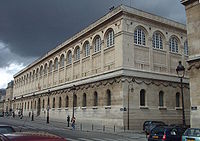
In architecture the Neo-Grec is not always clearly distinguishable from the Neoclassical designs of the earlier part of the century, in buildings such as the Church of the Madeleine, Paris. The classic example of Neo-Grec architecture is Henri Labrouste
Henri Labrouste
Pierre François Henri Labrouste was a French architect from the famous École des Beaux Arts school of architecture. After a six year stay in Rome, Labrouste opened an architectural training workshop, which quickly became the center of the Rationalist view...
's innovative Bibliothèque Sainte Genevieve in Paris
Paris
Paris is the capital and largest city in France, situated on the river Seine, in northern France, at the heart of the Île-de-France region...
, 1843–50, generally seen as the first major public building in this later mode of classicism.
Not only was the Neo-Grec popular in France
France
The French Republic , The French Republic , The French Republic , (commonly known as France , is a unitary semi-presidential republic in Western Europe with several overseas territories and islands located on other continents and in the Indian, Pacific, and Atlantic oceans. Metropolitan France...
, but also in Victorian
Victorian era
The Victorian era of British history was the period of Queen Victoria's reign from 20 June 1837 until her death on 22 January 1901. It was a long period of peace, prosperity, refined sensibilities and national self-confidence...
England
England
England is a country that is part of the United Kingdom. It shares land borders with Scotland to the north and Wales to the west; the Irish Sea is to the north west, the Celtic Sea to the south west, with the North Sea to the east and the English Channel to the south separating it from continental...
and especially in the United States
United States
The United States of America is a federal constitutional republic comprising fifty states and a federal district...
, where its severity accorded with the "American Renaissance
American Renaissance
In the history of American architecture and the arts, the American Renaissance was the period in 1835-1880 characterized by renewed national self-confidence and a feeling that the United States was the heir to Greek democracy, Roman law, and Renaissance humanism...
". The architectural historian Neil Levine has explained the style as a reaction against the rigidity of classicism
Classicism
Classicism, in the arts, refers generally to a high regard for classical antiquity, as setting standards for taste which the classicists seek to emulate. The art of classicism typically seeks to be formal and restrained: of the Discobolus Sir Kenneth Clark observed, "if we object to his restraint...
. According to Levine, Neo-Grec was a somewhat looser style, which "replaced the rhetorical form of classical architectural discourse by a more literal and descriptive syntax of form." It was meant to be a "readable" architecture.
Painting
Painting
Painting is the practice of applying paint, pigment, color or other medium to a surface . The application of the medium is commonly applied to the base with a brush but other objects can be used. In art, the term painting describes both the act and the result of the action. However, painting is...
, the Neoclassical style continued to be taught in the French Academy des Beaux-Arts, inculcating crisp outlines, pellucid atmosphere, and a clear, clean palette. However, a formal Neo-Grec group of artists was created in the mid 19th century after growing interest in Ancient Greece
Ancient Greece
Ancient Greece is a civilization belonging to a period of Greek history that lasted from the Archaic period of the 8th to 6th centuries BC to the end of antiquity. Immediately following this period was the beginning of the Early Middle Ages and the Byzantine era. Included in Ancient Greece is the...
and Rome
Ancient Rome
Ancient Rome was a thriving civilization that grew on the Italian Peninsula as early as the 8th century BC. Located along the Mediterranean Sea and centered on the city of Rome, it expanded to one of the largest empires in the ancient world....
, and especially the later excavations at Pompeii
Pompeii
The city of Pompeii is a partially buried Roman town-city near modern Naples in the Italian region of Campania, in the territory of the comune of Pompei. Along with Herculaneum, Pompeii was destroyed and completely buried during a long catastrophic eruption of the volcano Mount Vesuvius spanning...
. The Paris Salon
Paris Salon
The Salon , or rarely Paris Salon , beginning in 1725 was the official art exhibition of the Académie des Beaux-Arts in Paris, France. Between 1748–1890 it was the greatest annual or biannual art event in the Western world...
of 1847, an art exhibition, revealed the academic painter
Academic art
Academic art is a style of painting and sculpture produced under the influence of European academies of art. Specifically, academic art is the art and artists influenced by the standards of the French Académie des Beaux-Arts, which practiced under the movements of Neoclassicism and Romanticism,...
Jean-Léon Gérôme
Jean-Léon Gérôme
Jean-Léon Gérôme was a French painter and sculptor in the style now known as Academicism. The range of his oeuvre included historical painting, Greek mythology, Orientalism, portraits and other subjects, bringing the Academic painting tradition to an artistic climax.-Life:Jean-Léon Gérôme was born...
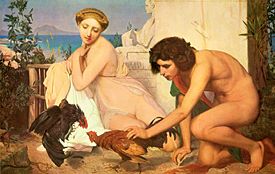
, who in The Cock Fight depicted a composition in which, in a scene of antiquity, a young boy and a girl attend the combat of two cocks. Gérôme gained fame from this exhibition, and in the next year formed the Neo-Grec group with Jean-Louis Hamon
Jean-Louis Hamon
Jean-Louis Hamon was a French painter.He was born at Plouha, in today's Côtes-d'Armor département, in France...
and Henri-Pierre Picou
Henri-Pierre Picou
Henri-Pierre Picou was a French painter born in Nantes. His oeuvre began with portraits and classical historical subject matter but he later moved on to allegorical and mythological themes....
—all three pupils in the same atelier under Charles Gleyre. Gleyre himself adopted the tenets of neo-classicism more strictly than others at the time, adopting the classical style and aesthetic, but almost exclusively applying it to myths and motifs from antiquity, recalling both characters from Greek myth, and antique emblems such as bacchantes and putti. The Neo-Grec group took Gleyre's style and interests, but adapted it from use in history painting
History painting
History painting is a genre in painting defined by subject matter rather than an artistic style, depicting a moment in a narrative story, rather than a static subject such as a portrait...
as in Gleyre's work, into genre painting
Genre painting
Genre works, also called genre scenes or genre views, are pictorial representations in any of various media that represent scenes or events from everyday life, such as markets, domestic settings, interiors, parties, inn scenes, and street scenes. Such representations may be realistic, imagined, or...
. Because they were inspired by discoveries at Pompeii
Pompeii
The city of Pompeii is a partially buried Roman town-city near modern Naples in the Italian region of Campania, in the territory of the comune of Pompei. Along with Herculaneum, Pompeii was destroyed and completely buried during a long catastrophic eruption of the volcano Mount Vesuvius spanning...
, they were also called néo-pompéiens.
The paintings of the Neo-Grecs sought to capture everyday, anecdotal trivialities of ancient Greek
Ancient Greece
Ancient Greece is a civilization belonging to a period of Greek history that lasted from the Archaic period of the 8th to 6th centuries BC to the end of antiquity. Immediately following this period was the beginning of the Early Middle Ages and the Byzantine era. Included in Ancient Greece is the...
life, in a manner of whimsy, grace, and charm, and were often realistic, sensual, and erotic. For this reason they were also called "anacreontic" after the Greek poet Anacreon
Anacreon
Anacreon was a Greek lyric poet, notable for his drinking songs and hymns. Later Greeks included him in the canonical list of nine lyric poets.- Life :...
, who wrote sprightly verses in praise of love and wine. Alfred de Tanouarn describes one of Hamon's paintings as "clear, simple and natural, the idea, the attitudes and the aspects. It leads the lips a soft smile; it causes us an inexpressible feeling of pleasure in which one is happy to stop and view the painting". It can perhaps be said the motto of this group was "the goal of art is to charm". Most Neo-Grec paintings were also done in a horizontal layout as in a frieze
Frieze
thumb|267px|Frieze of the [[Tower of the Winds]], AthensIn architecture the frieze is the wide central section part of an entablature and may be plain in the Ionic or Doric order, or decorated with bas-reliefs. Even when neither columns nor pilasters are expressed, on an astylar wall it lies upon...
decoration or Greek vases, with the composition simplified.
The Neo-Grec school was criticized in many respects; for its attention to historical detail it was said by Baudelaire "the scholarship is to disguise the absence of imagination", and the subject matter was considered by many as trivial. The painters were also charged with selectively adopting the ancient Greek
Ancient Greece
Ancient Greece is a civilization belonging to a period of Greek history that lasted from the Archaic period of the 8th to 6th centuries BC to the end of antiquity. Immediately following this period was the beginning of the Early Middle Ages and the Byzantine era. Included in Ancient Greece is the...
style, in that they left out noble themes and only focused on trivial daily life—leading to the accusation that they were creating art that supported the ideologies of the bourgeoisie
Bourgeoisie
In sociology and political science, bourgeoisie describes a range of groups across history. In the Western world, between the late 18th century and the present day, the bourgeoisie is a social class "characterized by their ownership of capital and their related culture." A member of the...
, or comfortable middle class.
The discovery in Pompeii also inspired history paintings based on the event, not necessarily strictly in a Neo-Grec style, such as The Last Day of Pompeii
The Last Day of Pompeii
The Last Day of Pompeii is a large canvas painted by Russian artist Karl Briullov in 1830-33.The Russian painter visited the site of Pompeii in 1828 and made numerous sketches. Depicting the eruption of Vesuvius in 79 AD, the completed canvas was exhibited in Rome to rapturous reviews of critics...
by Karl Briullov
Karl Briullov
Karl Pavlovich Bryullov , also transliterated Briullov or Briuloff and referred to by his friends as "The Great Karl", was a Russian painter...
.
Music
The Neo-Grec vogue even made its way into French musicMusic
Music is an art form whose medium is sound and silence. Its common elements are pitch , rhythm , dynamics, and the sonic qualities of timbre and texture...
through the works of the composer Erik Satie
Erik Satie
Éric Alfred Leslie Satie was a French composer and pianist. Satie was a colourful figure in the early 20th century Parisian avant-garde...
in a series of pieces called Gymnopédies--the title a reference to dances performed by the youths of ancient Sparta
Sparta
Sparta or Lacedaemon, was a prominent city-state in ancient Greece, situated on the banks of the River Eurotas in Laconia, in south-eastern Peloponnese. It emerged as a political entity around the 10th century BC, when the invading Dorians subjugated the local, non-Dorian population. From c...
in honour of Diana and Apollo
Apollo
Apollo is one of the most important and complex of the Olympian deities in Greek and Roman mythology...
at ceremonies commemorating the dead of the Battle of Thyrea. Their archaic melodies float above a modally oriented harmonic basis. The melodies of the Gnossiennes go further in this direction—they use ancient Greek chromatic mode (A - G flat - F - E - D flat - C - B - A) and an arabesque
Arabesque
The arabesque is a form of artistic decoration consisting of "surface decorations based on rhythmic linear patterns of scrolling and interlacing foliage, tendrils" or plain lines, often combined with other elements...
ornamentation.
See also
- American Empire styleAmerican Empire (style)American Empire is a French-inspired Neoclassical style of American furniture and decoration that takes its name and originates from the Empire style introduced during the First French Empire period under Napoleon's rule. It gained its greatest popularity in the U.S...
- Adam styleAdam styleThe Adam style is an 18th century neoclassical style of interior design and architecture, as practiced by the three Adam brothers from Scotland; of whom Robert Adam and James Adam were the most widely known.The Adam brothers were the first to advocate an integrated style for architecture and...
- Goût grecGoût grecGoût grec is the term applied to the earliest expression of the neoclassical style in France, it refers specifically to the decorative arts and architecture of the mid-1750s to the late 1760s. The style was more fanciful than historically accurate though the first archaeological surveys of Greece...
- Empire styleEmpire (style)The Empire style, , sometimes considered the second phase of Neoclassicism, is an early-19th-century design movement in architecture, furniture, other decorative arts, and the visual arts followed in Europe and America until around 1830, although in the U. S. it continued in popularity in...
- Federal architectureFederal architectureFederal-style architecture is the name for the classicizing architecture built in the United States between c. 1780 and 1830, and particularly from 1785 to 1815. This style shares its name with its era, the Federal Period. The name Federal style is also used in association with furniture design...
- Greek Revival architectureGreek Revival architectureThe Greek Revival was an architectural movement of the late 18th and early 19th centuries, predominantly in Northern Europe and the United States. A product of Hellenism, it may be looked upon as the last phase in the development of Neoclassical architecture...
- Neoclassicism (music)Neoclassicism (music)Neoclassicism in music was a twentieth-century trend, particularly current in the period between the two World Wars, in which composers sought to return to aesthetic precepts associated with the broadly defined concept of "classicism", namely order, balance, clarity, economy, and emotional restraint...
- Neoclassical influenced fashions
External links
- Greek Revival - Buffalo Architecture and History Neo-Grec features and examples from Buffalo
- Antique Room Neo-Grec furniture furniture gallery
- Bradbury & Bradbury Wallpapers Neo-grec roomset and links to wallpapers showing typical neo-grec patterns