


Neo-Attic

Encyclopedia
Classical antiquity
Classical antiquity is a broad term for a long period of cultural history centered on the Mediterranean Sea, comprising the interlocking civilizations of ancient Greece and ancient Rome, collectively known as the Greco-Roman world...
(5th–4th centuries BCE) and Archaic
Archaic period in Greece
The Archaic period in Greece was a period of ancient Greek history that followed the Greek Dark Ages. This period saw the rise of the polis and the founding of colonies, as well as the first inklings of classical philosophy, theatre in the form of tragedies performed during Dionysia, and written...
(6th century BCE) periods. It was first produced by a number of Neo-Attic workshops at Athens
Athens
Athens , is the capital and largest city of Greece. Athens dominates the Attica region and is one of the world's oldest cities, as its recorded history spans around 3,400 years. Classical Athens was a powerful city-state...
, which began to specialize in it, producing works for purchase by Roman connoisseurs, and was taken up in Rome, probably by Greek artisans.
The Neo-Attic mode, a reaction against the baroque extravagances of Hellenistic art, was an early manifestation of Neoclassicism
Neoclassicism
Neoclassicism is the name given to Western movements in the decorative and visual arts, literature, theatre, music, and architecture that draw inspiration from the "classical" art and culture of Ancient Greece or Ancient Rome...
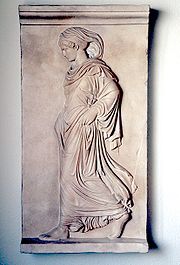
, which demonstrates how self-conscious the later Hellenistic art world had become. Neo-Attic style emphasises grace and charm, serenity and animation, correctness of taste in adapting a reduced canon of prototypical figures and forms, in crisp, tamed and refined execution.
This style designation was introduced by the German classical archaeologist and art historian Friedrich Hauser
Friedrich Hauser
Friedrich Hauser was a German classical archaeologist and art historian. His most famous single publication is Die Neuattischen Reliefs in which he identified a style-category he called "Neo-Attic" among sculpture that was being produced in later Hellenistic circles during the last century or so...
(1859-1917), in Die Neuattischen Reliefs (Stuttgart: Verlag von Konrad Wittwer, 1889). The corpus that Hauser called "Neo-Attic" consists of bas-reliefs molded on decorative vessels and plaques, employing a figural and drapery style that looked for its canon of "classic" models to late fifth and early fourth-century Athens and Attica.