

Negev Bedouins

Encyclopedia
The Negev Bedouin are traditionally pastoral semi-nomadic Arab
tribes indigenous to the Negev
region in Israel
, who hold close ties to the Bedouin
of the Sinai Peninsula
. The move away from their traditional lifestyle in modern times has led to sedentarization.
Estimated to number some 160,000, they comprise 12% of the Arab citizenry of Israel
. Of Israel's total population, 12% live in the Negev, and Negev Bedouin constitute approximately 25% percent of the total population therein.
 Negev Bedouin are defined today as Arab
nomads who live by rearing livestock in the deserts of southern Israel
. The Negev Bedouin community consists of indigenous tribes that used to be nomadic/semi-nomadic. The community is traditional and conservative, with a well-defined value system that directs and monitors behaviour and interpersonal relations.
The Negev Bedouin tribes have been divided into three classes, according to their origin: descendants of ancient Arabian nomads, peasants (Fellaheen) who came from cultivated areas, and
descendants of those brought from Africa as slaves
.
Counter to the image of the Bedouin as fierce stateless nomads roving the entire region, by the turn of the 20th century, much of the Bedouin population in Palestine was settled, semi-nomadic, and engaged in agriculture according to an intricate system of land ownership, grazing rights, and water access.
Today, many Bedouin call themselves 'Negev Arabs' rather than ‘Bedouin,’ explaining that 'Bedouin' identity is intimately tied in with a pastoral nomadic way of life – a way of life they say is over. Although the Bedouin in Israel continue to be perceived as nomads, today all of them are fully sedentarized, and about half are urbanites. Nevertheless, Negev Bedouin continue to possess goats and sheep: in 2000 the Ministry of Agriculture estimated that the Negev Bedouin owned 200,000 head of sheep and 5,000 of goats, while Bedouin estimates referred to 230,000 sheep and 20,000 goats.
 The first recorded nomadic settlement in the Negev dates back 4,000-7,000 years. The Bedouin were the only inhabitants of this area for most of the pre-1948 period. In contrast, Jewish settlement only began in the Negev in the years leading up to the 1948 War, as Israeli and international literature both confirm. The Bedouin of the Sinai peninsula
migrated to and from the Negev repeatedly throughout their history. Similar migrations
took place under early Islamic rule.
The Bedouin established very few permanent settlements; however, some Bedouin did build in the Negev; some evidence remains of traditional baika buildings, seasonal dwellings for the rainy season when Bedouin would stop to engage in farming. Cemeteries known as "nawamis" dating to the late fourth millennium B.C. have been also found. Similarly, open-air mosques (i.e., those without a roof), dating from the early Islamic period, are common and still in use. The Bedouin also conducted extensive farming on plots scattered throughout the Negev. They held this semi-nomadic lifestyle up until the existence of Israel.
During the sixth century, the Emperor Justinian sent Wallachian and Bosnian
slaves to the Sinai to build the Saint Catherine's Monastery
. Over time these slaves converted to Islam
, and adopted an Arab Bedouin lifestyle.
In the seventh century, the Islamic Umayyad
dynasty defeated the Byzantine
armies, conquering Palestine
. The Umayyads began sponsoring building programs throughout Palestine, a region in close proximity to the dynastic capital in Damascus
, and the Bedouin flourished. However, this activity decreased after the capital was move to Baghdad
during the subsequent Abbasid
reign.
The first major European impact on the traditional Bedouin lifestyle came after the French invasion
of Egypt
in 1798. The rise of the puritanical Wahabbi sect also forced them to reduce raiding caravans
. Instead, the Bedouin acquired a monopoly on guiding pilgrim caravans to Mecca
, as well as selling them provisions. The opening of the Suez canal
reduced the dependence on desert caravans, thus limiting the Bedouin's income, while attracting them to newly formed settlements that sprung up along the canal.
During World War I
, the Bedouin in the Negev Desert fought with the Turks
against the British
, but later withdrew from the conflict. The British Mandate in Palestine brought order to the Negev; however, this order was accompanied by losses in sources of income and poverty among the Bedouin. The Bedouin nevertheless retained their lifestyle, and a 1927 report describes them as the "untamed denizens of the Arabian deserts". The British also established the first formal schools for the Bedouin.
In Orientalist historiography, the Negev Bedouin have been described as remaining largely unaffected by changes in the outside world until recently. Their society was often considered a "world without time". Recent scholars have challenged the notion of the Bedouin as 'fossilized,' or 'stagnant' reflections of an unchanging desert culture. In fact, as Emanuel Marx has shown, Bedouin were engaged in a constantly dynamic reciprocal relation with urban centers. Bedouin scholar Michael Meeker explains that "the city was to be found in their midst."
By the 20th century, much of the Bedouin population was settled, semi-nomadic, and engaged in agriculture according to an intricate system of land ownership, grazing rights, and water access.
, the vast majority of the Bedouin in the Negev region fled to Egypt
, or Jordan
(including the territories of the former British Mandate that came under their control). Of the approximately 65,000 that lived in the area before the war about 11,000 remained. Those who remained belonged to the Tiaha confederation. They were relocated by the Israeli government in the 1950s and 1960s to a restricted zone in the northeast corner of the Negev
, called the ha-Siyag made up of relatively infertile land in 10% of the Negev desert in the northeast.
In 1951, the United Nations
reported the expulsion of about 7,000 Negev Bedouin into neighbouring Jordan
, the Gaza Strip
and the Sinai, but many returned undetected. The new government failed to issue the Bedouin identity cards until 1952 and expelled thousands of Bedouin who remained within the new borders. Expulsions continued into the late 1950s, as reported by Haaretz in 1959: "The army's desert patrols would turn up in the midst of a Bedouin encampment day after day, dispersing it with a sudden burst of machine-gun fire until the sons of the desert were broken and, gathering what little was left of their belongings, led their camels in long silent strings into the heart of the Sinai desert." In 1950 Israel decided to stop using the Arabic place names on its official maps, and adopt Hebrew names instead.. For 120 locations in the Negev the Hebrew traditional name was adopted instead of the Arabic one (e.g. Etzion Gaver). 175 Arab names were translated literally into Hebrew (e.g. A-Soweida >> Shḥoret), and 150 Arabic names were phonetically altered to sound more like Hebrew names (e.g. Jarf >> Garof, or Al-Koreim >> Karmah). 50 names were borrowed from the Hebrew Bible without having historical connection to the specific location in question. 30 names were invented and 8 names remained in their Arabic form. Explaining this policy in 1949, Israeli prime minister David Ben-Gurion wrote, "We are obliged to remove the Arabic names for reasons of state. Just as we do not recognize the Arabs' political proprietorship of the land, so also we do not recognize their spiritual proprietorship and their names."
The legal grounds cited for the displacement of the Bedouin from their lands was the 1858 Ottoman Land Law
. Under the Tanzimat
reforms instituted as the Ottoman Empire gradually lost power, the Ottoman Land Law of 1858 instituted an unprecedented land registration process in order to boost the empire's tax base. Few Bedouin opted to register their lands with the Ottoman Tapu
, due to lack of enforcement by the Ottomans, the inability of Bedouin at the time to read and write, the Bedouins' disinteresty in paying taxes to the ailing regime, and the lack of relevance of written documentation of ownership to the Bedouin way of life at that time. Due to the relative infertility of the land and the fact that the nearest permanent settlement was Beer Sheba, Israel claimed the land fell under the Ottoman class of 'non-workable' (mawat) land and thus according to Ottoman law should be reverted to the state.
, and the Bedouin came to reside on just over 1% of the Negev.
The Black Goat Law of 1950 curbed grazing so as to prevent land erosion, prohibiting the grazing of goats outside recognized land holdings. Because few Bedouin territorial claims were recognized, most grazing was rendered illegal. Since both Ottoman and British land registration processes had failed to reach into the Negev region before Israeli rule, and since most Bedouin preferred not to register their lands as this would mean being taxed, few Bedouin possessed any documentation of their land claims. Those whose land claims were recognized found it almost impossible to keep their goats within the periphery of their newly limited range. Into the 1970s and 1980s, only a small portion of the Bedouin were able to continue to graze their goats, and instead of migrating with their goats in search of pasture, most Bedouin migrated in search of work.
Despite state hegemony over the Negev, the Bedouin regarded 600,000 dunams of the Negev as theirs, and later petitioned the government for their return. Various claims committees were established to make legal arrangements to solve land disputes at least partially, but no suggestions acceptable to both sides have been developed.As a consequence of losing access to their lands, the Bedouin also lost access to their means of self-subsistence. Thus, throughout the 1950s many Bedouin men sought work on Jewish farms in the Negev. However, preference was given to Jewish labor, and as of 1958, employment in the Bedouin male population was less than 3.5%.
told Haaretz: "We should transform the Bedouin into an urban proletariat - in industry, services, construction, and agriculture. 88% of the Israeli population are not farmers, let the Bedouin be like them. Indeed, this will be a radical move which means that the Bedouin would not live on his land with his herds, but would become an urban person who comes home in the afternoon and puts his slippers on. His children will get used to a father who wears pants, without a dagger, and who does not pick out their nits in public. They will go to school, their hair combed and parted. This will be a revolution, but it can be achieved in two generations. Without coercion but with governmental direction ... this phenomenon of the Bedouins will disappear."
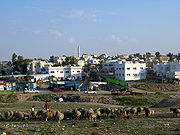 Between 1968 and 1989 the state established urban townships for housing of deported Bedouin tribes and promised Bedouin services in exchange for the renunciation of their ancestral land. Within a few years, half of the Bedouin population moved into the seven townships built for them by the Israeli government. The largest Bedouin locality in Israel is the city of Rahat
. Other towns include Ar'arat an-Naqab (Ar'ara BaNegev), Bir Hadaj
, Hura
, Kuseife
, Lakiya
, Shaqib al-Salam
(Segev Shalom) and Tel as-Sabi (Tel Sheva).
As a result of denied access to their former sources of sustenance via grazing restrictions, severed from the possibility of access to water, electricity, roads, education, and health care in the unrecognized villages, and trusting in government promises that they would receive services if they moved, in the 1970s and 1980s, tens of thousands of Bedouin citizens of Israel resettled in seven legal towns constructed by the government.
According to Ben Gurion University's Negev Center for Regional Development, the towns were built without an urban policy framework, lacking business districts or industrial zones; as Harvey Lithwick of the Negev Center for Regional Development explains: "... the major failure was a lack of an economic rationale for the towns... " According to Lithwick, and Ismael and Kathleen Abu Saad of Ben Gurion University, the towns quickly became among the most deprived towns in Israel, severely lacking in services such as public transport
and bank
s. The urban townships became concentration centers for tens of thousands of Bedouin lacking job prospects or access to self-subsistence agriculture, and came to be known as ghettos suffering from endemic joblessness and resulting cycles of crime and drug trafficking.
According to an article published in 2000, over 25% of Bedouin men in the townships were unemployed.According to a State Comptroller report from 2002, the townships were built with minimal investment, and infrastructure in all seven townships had not improved much in the span of three decades. In 2002, "most homes are not connected to a sewage system and suffer from an unreliable water supply and damaged road system."
In 2008, a railway station opened near the largest Bedouin town in the Negev, Rahat
(Lehavim-Rahat Railway Station
), a noticeable improvement to the transportation situation.
, although the Regional Council of Unrecognized Villages
(RCUV) refer to Bedouin in unrecognized villages as half the Negev Bedouin population. The RCUV figures include the five villages which remain unrecognized despite incorporation into the Abu Basma Regional Council
.
Many remain in unrecognized villages in the hope of retaining their traditions and customs; these are rural villages, some of which pre-date Israel. However in 1984, the courts ruled that the Negev Bedouin had no land ownership claims, effectively illegalizing their existing settlements. The Israeli government defines these rural Bedouin villages as "dispersals" while the international community refers to them as "unrecognized villages
". Few of the Bedouin in unrecognized villages have seen the urban townships as a desirable form of settlement. Extreme unemployment has afflicted unrecognized villages as well, breeding extreme crime levels. Since sources of income such as grazing has been severely restricted, and the Bedouin rarely receive permits to engage in self-subsistence agriculture,
Many of the Bedouin villages were created in the 1950s when the Israeli army resettled Bedouin from the Sinai desert. These villages do not directly appear on commercial Israeli maps, and lack basic services like water, electricity and schools. Building permanent structures and farming is prohibited although many do, risking fines and home demolition. The Israeli government frequently demolishes homes and sprays toxic pesticides onto crops in the unrecognized villages. Some Bedouin homes were demolished to make way for the establishment of a Jewish town.
Today, several unrecognized villages are in the process of 'recognition.' They have been incorporated into the Abu Basma Regional Council
, but most remain without water, electricity and garbage services. Five of the towns incorporated into the council remain unrecognized. The process is mired in urban planning difficulties and land ownership problems.
Unrecognized villages lack municipal waste services including sewage systems and treatment, and trash pickup. As a result large-scale backyard burning has emerged, with serious impacts on Bedouin and their surrounding environment.
According to the World Zionist Organization, although in the 1980s, as compared with 90% of the Jewish population, only 50% of the Bedouin population was covered by Israel's General Sick Fund, the situation improved after the 1996 National Health Insurance Law incorporated another 30% of Negev Bedouin into the Sick Fund.
The Bedouin infant mortality rate is still the highest in Israel, and one of the highest in the developed world. In 2010, the mortality rate of Bedouin babies rose to 13.6 per 1,000, compared to 4.1 per 1,000 in Jewish communities in the south. According to the Israeli Ministry of Helath, 43 percent of deaths among infants up to a year old result from hereditary conditions and/or birth defects. Other reasons cited for the higher infant mortality rates are poverty, lack of education and proper nourishment of mothers, lack of access to preventive medical care and unwillingness to undergo recommended tests. In 2011, funding for this purpose was tripled.
60% of Bedouin men smoke. Among the Bedouin, as of 2003,7.3% of females and 9.9% of males have diabetes. Between 1998 and 2002, Bedouin towns and villages had among the highest per-capita hospitalization rates. Rahat
and Tel Sheva
ranked highest. However, the rate of reported new cancer incidents in Bedouin localities is very low, with Rahat having the 3rd-lowest rate in Israel at 141.9 cases per 100,000, compared to 422.1 cases in Haifa
.
The Centre for Women's Health Studies and Promotion notes that in the unrecognised Bedouin villages in the Negev, very few health care facilities are available; ambulances do not serve the villages and 38 villages have no medical services. According to the Israeli NGO Physicians for Human Rights (PHR-Israel) the number of doctors is a third of the norm.
In urban townships, access to water is also an issue: an article from the World Zionist Organization Hagshama Department explains that water allocation to Bedouin towns is 25-50% of that to Jewish towns. Since the State has not built water infrastructure in the unrecognized villages, residents must buy water and store it in large tanks where fungi, bacteria and rust develop very quickly in the plastic containers or metal tanks under conditions of extreme heat; this has led to numerous infections and skin diseases.
Drop-out rates are very high among Negev Bedouin. In 1998 only 43 percent of Bedouin youngsters reached the 12th grade.Enforcement of mandatory education for the Bedouin has been weak, particularly in the case of young girls. According to a 2001 study by the Centre for Women’s Health Studies and Promotion, poor access to education has resulted in troubling data: more than 75% of Bedouin women had no schooling at all or had not completed their elementary school. This is due to a combination of internal Bedouin traditional attitudes towards women, lack of government enforcement of the Mandatory Education Law and insufficient budgets for Bedouin schools.
However, the number of Bedouin students in Israel has started to rise. Arabic summer schools are being developed. As of 2006 there were 162 male and 112 female students in Ben Gurion university. In particular, the number of female students grew sixfold from 1996-2001. The university had made special Bedouin-only scholarship programs available in order to encourage higher education among the Bedouin.
There were reports that some Bedouin tribes had previously conducted female genital cutting
. However, this practice was considered far less severe than what is carried out in some places in Africa, consisting of a "small" cut. The practice was carried out independently by women, and men didn't play a part and in most cases were unaware of the practice. However, by 2009 the practice seemed to have disappeared. Researchers are unclear as to how it disappeared (the Israeli government did not make any efforts to stop FGC) but suggest modernisation as the probably cause.
and crafts are growing industries and in rare cases, such as Drijat
, have reduced unemployment significantly.
cited the rising crime rate in the sector as the reason for the unit's inauguration. The unit was founded after a period of time when regular police units conducted raids on Bedouin settlements to stop theft (especially car theft) and drug dealing.
Notable is human trafficking
from Egypt
to Israel
through the Sinai Desert, mostly of prostitutes, and illicit drug trafficking and this is due to the Bedouin's intimate knowledge of the area. It is claimed that the police and the IDF
is doing little to stop this from occurring. Other characteristic crimes are racketeering (the collection of "protection
" payments from local businesses), selling drugs and the theft of cars. Other crimes, e.g. domestic violence
, alcohol
related offences or burglary (house breaking) are lower amongst the Bedouin.
The reasons for the high crime phenomenon are contested, and are probably not as high as thought. After a group of Bedouin ran over a policeman in March 2008, Asaf Hefetz, a former Israel Police commissioner, claimed that while the police should act with a strong hand on the matter, the reason for the high crime rates in the "Wild South" is long-term neglect by the state and a low socio-economic level. Yaakov Turner, the former mayor of Beersheba
and himself a former police commissioner, believes that the Bedouin as a whole are not responsible for all the crime in their sector.
Israeli environmental leader Alon Tal claims Bedouin construction is among the top ten environmental hazards in Israel. In 2008, he wrote that the Bedouin are taking up open spaces that should be used for park land. In 2007, Bustan
organization disagreed with this contention: "Regarding rural Bedouin land use as a threat to open spaces fails to take into account the fact that Bedouin occupy little more than 1% of the Negev and fails to call into question the IDF’s hegemony over more than 85% of the Negev’s open spaces." Gideon Kressel has proposed a brand of pastoralism that preserves open spaces for rangeland herding.
Wadi al-Na'am
is located close to the Ramat Hovav
toxic waste dump, and residents have suffered from higher than average incidences of respiratory illnesses and cancer. Given the small scale of the country, Bedouin and Jews of the region share some 2.5 % of the desert with Israel's nuclear reactors, 22 agro and petrochemical factories, an oil terminal, closed military zones, quarries, a toxic waste incinerator (Ramat Hovav
), cell towers, a power plant, several airports, a prison, and 2 rivers of open sewage.
In 2005 Ronald Lauder
of the Jewish National Fund
announced plans to bring 250-000-500,000 new settlers into the Negev through the Blueprint Negev
, incurring opposition from Bedouin rights groups concerned that the unrecognized villages might be cleared to make way for Jewish-only development and potentially ignite internal civil strife.
" often in their language. Traditions of ancestors have been important. The Negev Bedouins have been compared to the American Indians in terms of suffering. Like the Indians, the Bedouin culture has been suppressed.
, (unlike Druze
, and Jewish Israelis, they are not required by law to do so).
The legendary Israeli soldier, Amos Yarkoni
, first commander of the Shaked Reconnaissance Battalion in the Givati Brigade, was a Bedouin (born Abd el-Majid Hidr). Despite their uniquely high numbers in the Israeli Defense Forces over the decades, the percentage of Bedouin in the army fell drastically after the October 2000 events
. It is believed that reduced willingness to join the IDF is because despite their service in the army over half are denied access to water, electricity, and trash pickup, and are denied the right to build roads to make schools and hospitals accessible.
A 2001 poll suggests that Bedouin feel more estranged from the state than do Arabs in the north. A Jewish Telegraphic Agency article reports that, "Forty-two percent said they reject Israel's right to exist
, compared with 16 percent in the non-Bedouin Arab sector." The article quoted Thabet abu-Ras of Ben-Gurion University: "You neglect what is basically a loyal, quiet, nonpoliticized population, and it ends up exploding in your face. There is no way around it."
In contrast, a 2004 study found that Negev Bedouins tend to identify more as Israelis than other Arab citizens of Israel.
Ismail Khaldi
is the first Bedouin
vice consul of the State of Israel and the highest ranking Muslim
in the Israeli foreign service. Khaldi is a strong advocate of Israel. While acknowledging that the state of Israeli Bedouin minority is not ideal, he said
Because of their status in Israeli society as the principal Arab population that served in the army (in addition to a portion of the Druze
), Bedouin have experienced a rift with the Palestinian population on several levels. On the one hand, many Bedouin have played a role in policing borders which they themselves traditionally moved across freely, ejecting Palestinian workers sneaking into Israel, and even preventing the free movement of other Bedouin to whom they are often related. Identifying themselves with the same national terminology applied to those they have played a role in occupying presents serious moral quandaries. Many Bedouin want to disassociate themselves from the ‘term’ Palestinian, which is associated with terrorism in Israel; already in an extremely tenuous situation, they fear that identifying themselves with Palestinians will further injure their status in Israeli society and their potential to gain respect for their rights as citizens. Some scholars regard these developments as an illustration of a strategy of 'Divide to Rule'.
According to a report of Human Rights Watch (2008) present Palestinian Arab Bedouin see themselves as a part of the larger Palestinian Arab minority inside Israel, with a distinct history of a nomadic and semi-nomadic lifestyle.
A 2001 study suggests that regular meetings and cross border exchanges involving Negev Bedouin and their relatives or neighbors living in the West Bank, the Gaza Strip or Sinai may be more common than expected, casting "doubt on the accepted view of relationships between the Bedouin of the Negev and their Palestinian neighbors." Reports from the Regional Council of Unrecognized Villages
regularly refer to "the indigenous Palestinian Bedouin."
Arab
Arab people, also known as Arabs , are a panethnicity primarily living in the Arab world, which is located in Western Asia and North Africa. They are identified as such on one or more of genealogical, linguistic, or cultural grounds, with tribal affiliations, and intra-tribal relationships playing...
tribes indigenous to the Negev
Negev
The Negev is a desert and semidesert region of southern Israel. The Arabs, including the native Bedouin population of the region, refer to the desert as al-Naqab. The origin of the word Neghebh is from the Hebrew root denoting 'dry'...
region in Israel
Israel
The State of Israel is a parliamentary republic located in the Middle East, along the eastern shore of the Mediterranean Sea...
, who hold close ties to the Bedouin
Bedouin
The Bedouin are a part of a predominantly desert-dwelling Arab ethnic group traditionally divided into tribes or clans, known in Arabic as ..-Etymology:...
of the Sinai Peninsula
Sinai Peninsula
The Sinai Peninsula or Sinai is a triangular peninsula in Egypt about in area. It is situated between the Mediterranean Sea to the north, and the Red Sea to the south, and is the only part of Egyptian territory located in Asia as opposed to Africa, effectively serving as a land bridge between two...
. The move away from their traditional lifestyle in modern times has led to sedentarization.
Estimated to number some 160,000, they comprise 12% of the Arab citizenry of Israel
Arab citizens of Israel
Arab citizens of Israel refers to citizens of Israel who are not Jewish, and whose cultural and linguistic heritage or ethnic identity is Arab....
. Of Israel's total population, 12% live in the Negev, and Negev Bedouin constitute approximately 25% percent of the total population therein.
Definition
Arab
Arab people, also known as Arabs , are a panethnicity primarily living in the Arab world, which is located in Western Asia and North Africa. They are identified as such on one or more of genealogical, linguistic, or cultural grounds, with tribal affiliations, and intra-tribal relationships playing...
nomads who live by rearing livestock in the deserts of southern Israel
Negev
The Negev is a desert and semidesert region of southern Israel. The Arabs, including the native Bedouin population of the region, refer to the desert as al-Naqab. The origin of the word Neghebh is from the Hebrew root denoting 'dry'...
. The Negev Bedouin community consists of indigenous tribes that used to be nomadic/semi-nomadic. The community is traditional and conservative, with a well-defined value system that directs and monitors behaviour and interpersonal relations.
The Negev Bedouin tribes have been divided into three classes, according to their origin: descendants of ancient Arabian nomads, peasants (Fellaheen) who came from cultivated areas, and
descendants of those brought from Africa as slaves
Slavery
Slavery is a system under which people are treated as property to be bought and sold, and are forced to work. Slaves can be held against their will from the time of their capture, purchase or birth, and deprived of the right to leave, to refuse to work, or to demand compensation...
.
Counter to the image of the Bedouin as fierce stateless nomads roving the entire region, by the turn of the 20th century, much of the Bedouin population in Palestine was settled, semi-nomadic, and engaged in agriculture according to an intricate system of land ownership, grazing rights, and water access.
Today, many Bedouin call themselves 'Negev Arabs' rather than ‘Bedouin,’ explaining that 'Bedouin' identity is intimately tied in with a pastoral nomadic way of life – a way of life they say is over. Although the Bedouin in Israel continue to be perceived as nomads, today all of them are fully sedentarized, and about half are urbanites. Nevertheless, Negev Bedouin continue to possess goats and sheep: in 2000 the Ministry of Agriculture estimated that the Negev Bedouin owned 200,000 head of sheep and 5,000 of goats, while Bedouin estimates referred to 230,000 sheep and 20,000 goats.
History
Historically, the Bedouin engaged in nomadic herding, agriculture and sometimes fishing. They also earned income by transporting goods and people across the desert. Scarcity of water and of permanent pastoral land required them to move constantly.Sinai Peninsula
The Sinai Peninsula or Sinai is a triangular peninsula in Egypt about in area. It is situated between the Mediterranean Sea to the north, and the Red Sea to the south, and is the only part of Egyptian territory located in Asia as opposed to Africa, effectively serving as a land bridge between two...
migrated to and from the Negev repeatedly throughout their history. Similar migrations
Nomad
Nomadic people , commonly known as itinerants in modern-day contexts, are communities of people who move from one place to another, rather than settling permanently in one location. There are an estimated 30-40 million nomads in the world. Many cultures have traditionally been nomadic, but...
took place under early Islamic rule.
The Bedouin established very few permanent settlements; however, some Bedouin did build in the Negev; some evidence remains of traditional baika buildings, seasonal dwellings for the rainy season when Bedouin would stop to engage in farming. Cemeteries known as "nawamis" dating to the late fourth millennium B.C. have been also found. Similarly, open-air mosques (i.e., those without a roof), dating from the early Islamic period, are common and still in use. The Bedouin also conducted extensive farming on plots scattered throughout the Negev. They held this semi-nomadic lifestyle up until the existence of Israel.
During the sixth century, the Emperor Justinian sent Wallachian and Bosnian
Bosnians
Bosnians are people who reside in, or come from, Bosnia and Herzegovina. By the modern state definition a Bosnian can be anyone who holds citizenship of the state. This includes, but is not limited to, members of the constituent ethnic groups of Bosnia and Herzegovina: Bosniaks, Bosnian Serbs and...
slaves to the Sinai to build the Saint Catherine's Monastery
Saint Catherine's Monastery, Mount Sinai
Saint Catherine's Monastery lies on the Sinai Peninsula, at the mouth of a gorge at the foot of Mount Sinai in the city of Saint Catherine in Egypt's South Sinai Governorate. The monastery is Orthodox and is a UNESCO World Heritage Site...
. Over time these slaves converted to Islam
Islam
Islam . The most common are and . : Arabic pronunciation varies regionally. The first vowel ranges from ~~. The second vowel ranges from ~~~...
, and adopted an Arab Bedouin lifestyle.
In the seventh century, the Islamic Umayyad
Umayyad
The Umayyad Caliphate was the second of the four major Arab caliphates established after the death of Muhammad. It was ruled by the Umayyad dynasty, whose name derives from Umayya ibn Abd Shams, the great-grandfather of the first Umayyad caliph. Although the Umayyad family originally came from the...
dynasty defeated the Byzantine
Byzantine
Byzantine usually refers to the Roman Empire during the Middle Ages.Byzantine may also refer to:* A citizen of the Byzantine Empire, or native Greek during the Middle Ages...
armies, conquering Palestine
Palestine
Palestine is a conventional name, among others, used to describe the geographic region between the Mediterranean Sea and the Jordan River, and various adjoining lands....
. The Umayyads began sponsoring building programs throughout Palestine, a region in close proximity to the dynastic capital in Damascus
Damascus
Damascus , commonly known in Syria as Al Sham , and as the City of Jasmine , is the capital and the second largest city of Syria after Aleppo, both are part of the country's 14 governorates. In addition to being one of the oldest continuously inhabited cities in the world, Damascus is a major...
, and the Bedouin flourished. However, this activity decreased after the capital was move to Baghdad
Baghdad
Baghdad is the capital of Iraq, as well as the coterminous Baghdad Governorate. The population of Baghdad in 2011 is approximately 7,216,040...
during the subsequent Abbasid
Abbasid
The Abbasid Caliphate or, more simply, the Abbasids , was the third of the Islamic caliphates. It was ruled by the Abbasid dynasty of caliphs, who built their capital in Baghdad after overthrowing the Umayyad caliphate from all but the al-Andalus region....
reign.
The first major European impact on the traditional Bedouin lifestyle came after the French invasion
Invasion
An invasion is a military offensive consisting of all, or large parts of the armed forces of one geopolitical entity aggressively entering territory controlled by another such entity, generally with the objective of either conquering, liberating or re-establishing control or authority over a...
of Egypt
Egypt
Egypt , officially the Arab Republic of Egypt, Arabic: , is a country mainly in North Africa, with the Sinai Peninsula forming a land bridge in Southwest Asia. Egypt is thus a transcontinental country, and a major power in Africa, the Mediterranean Basin, the Middle East and the Muslim world...
in 1798. The rise of the puritanical Wahabbi sect also forced them to reduce raiding caravans
Caravan (travellers)
A caravan is a group of people traveling together, often on a trade expedition. Caravans were used mainly in desert areas and throughout the Silk Road, where traveling in groups aided in defence against bandits as well as helped to improve economies of scale in trade.In historical times, caravans...
. Instead, the Bedouin acquired a monopoly on guiding pilgrim caravans to Mecca
Mecca
Mecca is a city in the Hijaz and the capital of Makkah province in Saudi Arabia. The city is located inland from Jeddah in a narrow valley at a height of above sea level...
, as well as selling them provisions. The opening of the Suez canal
Suez Canal
The Suez Canal , also known by the nickname "The Highway to India", is an artificial sea-level waterway in Egypt, connecting the Mediterranean Sea and the Red Sea. Opened in November 1869 after 10 years of construction work, it allows water transportation between Europe and Asia without navigation...
reduced the dependence on desert caravans, thus limiting the Bedouin's income, while attracting them to newly formed settlements that sprung up along the canal.
During World War I
World War I
World War I , which was predominantly called the World War or the Great War from its occurrence until 1939, and the First World War or World War I thereafter, was a major war centred in Europe that began on 28 July 1914 and lasted until 11 November 1918...
, the Bedouin in the Negev Desert fought with the Turks
Ottoman Empire
The Ottoman EmpireIt was usually referred to as the "Ottoman Empire", the "Turkish Empire", the "Ottoman Caliphate" or more commonly "Turkey" by its contemporaries...
against the British
United Kingdom
The United Kingdom of Great Britain and Northern IrelandIn the United Kingdom and Dependencies, other languages have been officially recognised as legitimate autochthonous languages under the European Charter for Regional or Minority Languages...
, but later withdrew from the conflict. The British Mandate in Palestine brought order to the Negev; however, this order was accompanied by losses in sources of income and poverty among the Bedouin. The Bedouin nevertheless retained their lifestyle, and a 1927 report describes them as the "untamed denizens of the Arabian deserts". The British also established the first formal schools for the Bedouin.
In Orientalist historiography, the Negev Bedouin have been described as remaining largely unaffected by changes in the outside world until recently. Their society was often considered a "world without time". Recent scholars have challenged the notion of the Bedouin as 'fossilized,' or 'stagnant' reflections of an unchanging desert culture. In fact, as Emanuel Marx has shown, Bedouin were engaged in a constantly dynamic reciprocal relation with urban centers. Bedouin scholar Michael Meeker explains that "the city was to be found in their midst."
By the 20th century, much of the Bedouin population was settled, semi-nomadic, and engaged in agriculture according to an intricate system of land ownership, grazing rights, and water access.
1948 War
During the 1948 Arab-Israeli War1948 Arab-Israeli War
The 1948 Arab–Israeli War, known to Israelis as the War of Independence or War of Liberation The war commenced after the termination of the British Mandate for Palestine and the creation of an independent Israel at midnight on 14 May 1948 when, following a period of civil war, Arab armies invaded...
, the vast majority of the Bedouin in the Negev region fled to Egypt
Egypt
Egypt , officially the Arab Republic of Egypt, Arabic: , is a country mainly in North Africa, with the Sinai Peninsula forming a land bridge in Southwest Asia. Egypt is thus a transcontinental country, and a major power in Africa, the Mediterranean Basin, the Middle East and the Muslim world...
, or Jordan
Jordan
Jordan , officially the Hashemite Kingdom of Jordan , Al-Mamlaka al-Urduniyya al-Hashemiyya) is a kingdom on the East Bank of the River Jordan. The country borders Saudi Arabia to the east and south-east, Iraq to the north-east, Syria to the north and the West Bank and Israel to the west, sharing...
(including the territories of the former British Mandate that came under their control). Of the approximately 65,000 that lived in the area before the war about 11,000 remained. Those who remained belonged to the Tiaha confederation. They were relocated by the Israeli government in the 1950s and 1960s to a restricted zone in the northeast corner of the Negev
Negev
The Negev is a desert and semidesert region of southern Israel. The Arabs, including the native Bedouin population of the region, refer to the desert as al-Naqab. The origin of the word Neghebh is from the Hebrew root denoting 'dry'...
, called the ha-Siyag made up of relatively infertile land in 10% of the Negev desert in the northeast.
In 1951, the United Nations
United Nations
The United Nations is an international organization whose stated aims are facilitating cooperation in international law, international security, economic development, social progress, human rights, and achievement of world peace...
reported the expulsion of about 7,000 Negev Bedouin into neighbouring Jordan
Jordan
Jordan , officially the Hashemite Kingdom of Jordan , Al-Mamlaka al-Urduniyya al-Hashemiyya) is a kingdom on the East Bank of the River Jordan. The country borders Saudi Arabia to the east and south-east, Iraq to the north-east, Syria to the north and the West Bank and Israel to the west, sharing...
, the Gaza Strip
Gaza Strip
thumb|Gaza city skylineThe Gaza Strip lies on the Eastern coast of the Mediterranean Sea. The Strip borders Egypt on the southwest and Israel on the south, east and north. It is about long, and between 6 and 12 kilometres wide, with a total area of...
and the Sinai, but many returned undetected. The new government failed to issue the Bedouin identity cards until 1952 and expelled thousands of Bedouin who remained within the new borders. Expulsions continued into the late 1950s, as reported by Haaretz in 1959: "The army's desert patrols would turn up in the midst of a Bedouin encampment day after day, dispersing it with a sudden burst of machine-gun fire until the sons of the desert were broken and, gathering what little was left of their belongings, led their camels in long silent strings into the heart of the Sinai desert." In 1950 Israel decided to stop using the Arabic place names on its official maps, and adopt Hebrew names instead.. For 120 locations in the Negev the Hebrew traditional name was adopted instead of the Arabic one (e.g. Etzion Gaver). 175 Arab names were translated literally into Hebrew (e.g. A-Soweida >> Shḥoret), and 150 Arabic names were phonetically altered to sound more like Hebrew names (e.g. Jarf >> Garof, or Al-Koreim >> Karmah). 50 names were borrowed from the Hebrew Bible without having historical connection to the specific location in question. 30 names were invented and 8 names remained in their Arabic form. Explaining this policy in 1949, Israeli prime minister David Ben-Gurion wrote, "We are obliged to remove the Arabic names for reasons of state. Just as we do not recognize the Arabs' political proprietorship of the land, so also we do not recognize their spiritual proprietorship and their names."
The legal grounds cited for the displacement of the Bedouin from their lands was the 1858 Ottoman Land Law
Tanzimat
The Tanzimât , meaning reorganization of the Ottoman Empire, was a period of reformation that began in 1839 and ended with the First Constitutional Era in 1876. The Tanzimât reform era was characterized by various attempts to modernize the Ottoman Empire, to secure its territorial integrity against...
. Under the Tanzimat
Tanzimat
The Tanzimât , meaning reorganization of the Ottoman Empire, was a period of reformation that began in 1839 and ended with the First Constitutional Era in 1876. The Tanzimât reform era was characterized by various attempts to modernize the Ottoman Empire, to secure its territorial integrity against...
reforms instituted as the Ottoman Empire gradually lost power, the Ottoman Land Law of 1858 instituted an unprecedented land registration process in order to boost the empire's tax base. Few Bedouin opted to register their lands with the Ottoman Tapu
Tapu (Ottoman history)
In the Ottoman Empire, tapu was a permanent lease of state-owned arable land to a peasant family. The family head acquired the usufruct of the land and was able to transmit this right to his male descendants upon his death...
, due to lack of enforcement by the Ottomans, the inability of Bedouin at the time to read and write, the Bedouins' disinteresty in paying taxes to the ailing regime, and the lack of relevance of written documentation of ownership to the Bedouin way of life at that time. Due to the relative infertility of the land and the fact that the nearest permanent settlement was Beer Sheba, Israel claimed the land fell under the Ottoman class of 'non-workable' (mawat) land and thus according to Ottoman law should be reverted to the state.
Grazing restrictions
In the years after the establishment of Israel, Bedouin herding was restricted by land expropriation. Between 1950 and 1966, the new State of Israel imposed a military administration over Arabs in the region and designated 85% of the Negev "State Land". Bedouin habitation on this land was retroactively declared illegal and "unrecognized." The government concentrated these Bedouin tribes into the Siyag (Hebrew for "fence") triangle of Beer Sheva, Arad and DimonaDimona
Dimona is an Israeli city in the Negev desert, to the south of Beersheba and west of the Dead Sea above the Arava valley in the Southern District of Israel. Its population at the end of 2007 was 33,600.-History:...
, and the Bedouin came to reside on just over 1% of the Negev.
The Black Goat Law of 1950 curbed grazing so as to prevent land erosion, prohibiting the grazing of goats outside recognized land holdings. Because few Bedouin territorial claims were recognized, most grazing was rendered illegal. Since both Ottoman and British land registration processes had failed to reach into the Negev region before Israeli rule, and since most Bedouin preferred not to register their lands as this would mean being taxed, few Bedouin possessed any documentation of their land claims. Those whose land claims were recognized found it almost impossible to keep their goats within the periphery of their newly limited range. Into the 1970s and 1980s, only a small portion of the Bedouin were able to continue to graze their goats, and instead of migrating with their goats in search of pasture, most Bedouin migrated in search of work.
Despite state hegemony over the Negev, the Bedouin regarded 600,000 dunams of the Negev as theirs, and later petitioned the government for their return. Various claims committees were established to make legal arrangements to solve land disputes at least partially, but no suggestions acceptable to both sides have been developed.As a consequence of losing access to their lands, the Bedouin also lost access to their means of self-subsistence. Thus, throughout the 1950s many Bedouin men sought work on Jewish farms in the Negev. However, preference was given to Jewish labor, and as of 1958, employment in the Bedouin male population was less than 3.5%.
Settlement policy
In 1963, Moshe DayanMoshe Dayan
Moshe Dayan was an Israeli military leader and politician. The fourth Chief of Staff of the Israel Defense Forces , he became a fighting symbol to the world of the new State of Israel...
told Haaretz: "We should transform the Bedouin into an urban proletariat - in industry, services, construction, and agriculture. 88% of the Israeli population are not farmers, let the Bedouin be like them. Indeed, this will be a radical move which means that the Bedouin would not live on his land with his herds, but would become an urban person who comes home in the afternoon and puts his slippers on. His children will get used to a father who wears pants, without a dagger, and who does not pick out their nits in public. They will go to school, their hair combed and parted. This will be a revolution, but it can be achieved in two generations. Without coercion but with governmental direction ... this phenomenon of the Bedouins will disappear."
Israeli-built townships
Rahat
Rahat is a predominantly Bedouin city in the South District of Israel. According to the Israel Central Bureau of Statistics , at the end of 2009 the city had a total population of 51,700...
. Other towns include Ar'arat an-Naqab (Ar'ara BaNegev), Bir Hadaj
Bir Hadaj
Bir Hadaj is a Bedouin agricultural town located in the Negev desert, near Revivim. It was recognized by Israel in 2004 and along with 8 other villages, became a part of the Abu Basma Regional Council. It is the largest town of Abu Basma with a population of approximately 5,000 and a total land...
, Hura
Hura
-See also:*List of Arab localities in Israel*Negev Bedouins...
, Kuseife
Kuseife
Kuseife is a Bedouin town in the Southern District of Israel.According to the Israel Central Bureau of Statistics , the population of Kuseife was 10,300 in December 2006...
, Lakiya
Lakiya
Lakiya, or Laqye is a Bedouin town in the Southern District of Israel.According to the Israel Central Bureau of Statistics , the population of Lakiya was 7,600 in December 2004...
, Shaqib al-Salam
Shaqib al-Salam
Shaqib al-Salam or Segev Shalom is a Bedouin town and a local council in the South District of Israel, southeast of Beersheba.According to the Israel Central Bureau of Statistics , the population of Shaqib was 6,500 in December 2006...
(Segev Shalom) and Tel as-Sabi (Tel Sheva).
As a result of denied access to their former sources of sustenance via grazing restrictions, severed from the possibility of access to water, electricity, roads, education, and health care in the unrecognized villages, and trusting in government promises that they would receive services if they moved, in the 1970s and 1980s, tens of thousands of Bedouin citizens of Israel resettled in seven legal towns constructed by the government.
According to Ben Gurion University's Negev Center for Regional Development, the towns were built without an urban policy framework, lacking business districts or industrial zones; as Harvey Lithwick of the Negev Center for Regional Development explains: "... the major failure was a lack of an economic rationale for the towns... " According to Lithwick, and Ismael and Kathleen Abu Saad of Ben Gurion University, the towns quickly became among the most deprived towns in Israel, severely lacking in services such as public transport
Public transport
Public transport is a shared passenger transportation service which is available for use by the general public, as distinct from modes such as taxicab, car pooling or hired buses which are not shared by strangers without private arrangement.Public transport modes include buses, trolleybuses, trams...
and bank
Bank
A bank is a financial institution that serves as a financial intermediary. The term "bank" may refer to one of several related types of entities:...
s. The urban townships became concentration centers for tens of thousands of Bedouin lacking job prospects or access to self-subsistence agriculture, and came to be known as ghettos suffering from endemic joblessness and resulting cycles of crime and drug trafficking.
According to an article published in 2000, over 25% of Bedouin men in the townships were unemployed.According to a State Comptroller report from 2002, the townships were built with minimal investment, and infrastructure in all seven townships had not improved much in the span of three decades. In 2002, "most homes are not connected to a sewage system and suffer from an unreliable water supply and damaged road system."
In 2008, a railway station opened near the largest Bedouin town in the Negev, Rahat
Rahat
Rahat is a predominantly Bedouin city in the South District of Israel. According to the Israel Central Bureau of Statistics , at the end of 2009 the city had a total population of 51,700...
(Lehavim-Rahat Railway Station
Lehavim-Rahat Railway Station
Lehavim Rahat Railway Station is a station on the Israel Railways lines between Tel Aviv and Beersheba, located near Lehavim Junction. The station was opened on June 23, 2007...
), a noticeable improvement to the transportation situation.
Unrecognized Villages
Those Bedouin resisting forced sedentarization and concentration into urban townships remained in their old villages. They live in 39-45 villages which are not recognized by the Israeli government and are thus ineligible for municipal services such as connection to the electrical grid, water mains or trash-pickup. According to the Israel Land Authority, in 2007 40% of the Bedouin lived in Unrecognized villagesUnrecognized villages
The term Unrecognized Bedouin villages in Israel refers to Arab villages in the Negev and the Galilee which the Israeli government does not recognize as legal settlements. Approximately half of Bedouin citizens of Israel live in 39-45 such villages...
, although the Regional Council of Unrecognized Villages
Regional Council of Unrecognized Villages
The Regional Council of Unrecognized Villages is a democratic representative body for the 80,000-something residents of the Bedouin unrecognized villages of the Negev Desert. The residents of the Bedouin unrecognized villages belong to no municipalities of their own and thus cannot elect...
(RCUV) refer to Bedouin in unrecognized villages as half the Negev Bedouin population. The RCUV figures include the five villages which remain unrecognized despite incorporation into the Abu Basma Regional Council
Abu Basma Regional Council
Abu Basma Regional Council is a regional council covering several Bedouin villages in the northwestern Negev desert of Israel.The council was formed as a result of Government Resolution 881 of 29 September 2003, known as the "Abu Basma Plan", which stated the need to establish seven new Bedouin...
.
Many remain in unrecognized villages in the hope of retaining their traditions and customs; these are rural villages, some of which pre-date Israel. However in 1984, the courts ruled that the Negev Bedouin had no land ownership claims, effectively illegalizing their existing settlements. The Israeli government defines these rural Bedouin villages as "dispersals" while the international community refers to them as "unrecognized villages
Unrecognized villages
The term Unrecognized Bedouin villages in Israel refers to Arab villages in the Negev and the Galilee which the Israeli government does not recognize as legal settlements. Approximately half of Bedouin citizens of Israel live in 39-45 such villages...
". Few of the Bedouin in unrecognized villages have seen the urban townships as a desirable form of settlement. Extreme unemployment has afflicted unrecognized villages as well, breeding extreme crime levels. Since sources of income such as grazing has been severely restricted, and the Bedouin rarely receive permits to engage in self-subsistence agriculture,
Many of the Bedouin villages were created in the 1950s when the Israeli army resettled Bedouin from the Sinai desert. These villages do not directly appear on commercial Israeli maps, and lack basic services like water, electricity and schools. Building permanent structures and farming is prohibited although many do, risking fines and home demolition. The Israeli government frequently demolishes homes and sprays toxic pesticides onto crops in the unrecognized villages. Some Bedouin homes were demolished to make way for the establishment of a Jewish town.
Today, several unrecognized villages are in the process of 'recognition.' They have been incorporated into the Abu Basma Regional Council
Abu Basma Regional Council
Abu Basma Regional Council is a regional council covering several Bedouin villages in the northwestern Negev desert of Israel.The council was formed as a result of Government Resolution 881 of 29 September 2003, known as the "Abu Basma Plan", which stated the need to establish seven new Bedouin...
, but most remain without water, electricity and garbage services. Five of the towns incorporated into the council remain unrecognized. The process is mired in urban planning difficulties and land ownership problems.
Unrecognized villages lack municipal waste services including sewage systems and treatment, and trash pickup. As a result large-scale backyard burning has emerged, with serious impacts on Bedouin and their surrounding environment.
Healthcare
The Bedouin benefited from the introduction of modern health care in the region.According to the World Zionist Organization, although in the 1980s, as compared with 90% of the Jewish population, only 50% of the Bedouin population was covered by Israel's General Sick Fund, the situation improved after the 1996 National Health Insurance Law incorporated another 30% of Negev Bedouin into the Sick Fund.
The Bedouin infant mortality rate is still the highest in Israel, and one of the highest in the developed world. In 2010, the mortality rate of Bedouin babies rose to 13.6 per 1,000, compared to 4.1 per 1,000 in Jewish communities in the south. According to the Israeli Ministry of Helath, 43 percent of deaths among infants up to a year old result from hereditary conditions and/or birth defects. Other reasons cited for the higher infant mortality rates are poverty, lack of education and proper nourishment of mothers, lack of access to preventive medical care and unwillingness to undergo recommended tests. In 2011, funding for this purpose was tripled.
60% of Bedouin men smoke. Among the Bedouin, as of 2003,7.3% of females and 9.9% of males have diabetes. Between 1998 and 2002, Bedouin towns and villages had among the highest per-capita hospitalization rates. Rahat
Rahat
Rahat is a predominantly Bedouin city in the South District of Israel. According to the Israel Central Bureau of Statistics , at the end of 2009 the city had a total population of 51,700...
and Tel Sheva
Tel Sheva
Tel as-Sabi or Tel Sheva is a Bedouin town in the Southern District of Israel, bordering Be'er Sheva.According to the Israel Central Bureau of Statistics , the population of Tel as-Sabi was 13,000 in December 2005. Tel as-Sabi's jurisdiction is 5,000 dunams...
ranked highest. However, the rate of reported new cancer incidents in Bedouin localities is very low, with Rahat having the 3rd-lowest rate in Israel at 141.9 cases per 100,000, compared to 422.1 cases in Haifa
Haifa
Haifa is the largest city in northern Israel, and the third-largest city in the country, with a population of over 268,000. Another 300,000 people live in towns directly adjacent to the city including the cities of the Krayot, as well as, Tirat Carmel, Daliyat al-Karmel and Nesher...
.
The Centre for Women's Health Studies and Promotion notes that in the unrecognised Bedouin villages in the Negev, very few health care facilities are available; ambulances do not serve the villages and 38 villages have no medical services. According to the Israeli NGO Physicians for Human Rights (PHR-Israel) the number of doctors is a third of the norm.
In urban townships, access to water is also an issue: an article from the World Zionist Organization Hagshama Department explains that water allocation to Bedouin towns is 25-50% of that to Jewish towns. Since the State has not built water infrastructure in the unrecognized villages, residents must buy water and store it in large tanks where fungi, bacteria and rust develop very quickly in the plastic containers or metal tanks under conditions of extreme heat; this has led to numerous infections and skin diseases.
Education
In the 1950s, mandatory schooling was extended to the Bedouin sector, leading to a massive increase in literacy levels. Illiteracy decreased from around 95% to 25% within the span of a single generation, with the majority of the illiterate being 55 or older.Drop-out rates are very high among Negev Bedouin. In 1998 only 43 percent of Bedouin youngsters reached the 12th grade.Enforcement of mandatory education for the Bedouin has been weak, particularly in the case of young girls. According to a 2001 study by the Centre for Women’s Health Studies and Promotion, poor access to education has resulted in troubling data: more than 75% of Bedouin women had no schooling at all or had not completed their elementary school. This is due to a combination of internal Bedouin traditional attitudes towards women, lack of government enforcement of the Mandatory Education Law and insufficient budgets for Bedouin schools.
However, the number of Bedouin students in Israel has started to rise. Arabic summer schools are being developed. As of 2006 there were 162 male and 112 female students in Ben Gurion university. In particular, the number of female students grew sixfold from 1996-2001. The university had made special Bedouin-only scholarship programs available in order to encourage higher education among the Bedouin.
Women's status
According to a range of studies, including a 2001 study by the Centre for Women’s Health Studies and Promotion at Ben Gurion University, in the transition from self-subsistence agriculture and animal husbandry to a settled semi-urban lifestyle, women have lost their traditional sources of power within the family. The study explains that poor access to education among women has triggered new disparities between Bedouin men and women and compounded the loss of Bedouin women's status in the family.There were reports that some Bedouin tribes had previously conducted female genital cutting
Female genital cutting
Female genital mutilation , also known as female genital cutting and female circumcision, is defined by the World Health Organization as "all procedures that involve partial or total removal of the external female genitalia, or other injury to the female genital organs for non-medical reasons."FGM...
. However, this practice was considered far less severe than what is carried out in some places in Africa, consisting of a "small" cut. The practice was carried out independently by women, and men didn't play a part and in most cases were unaware of the practice. However, by 2009 the practice seemed to have disappeared. Researchers are unclear as to how it disappeared (the Israeli government did not make any efforts to stop FGC) but suggest modernisation as the probably cause.
Poverty
Bedouin citizens of Israel suffer from extreme rates of joblessness and endure the highest poverty rate in Israel. According to a 2007 Van Leer Institute study, 66 percent of Negev Bedouin as a whole lived under the poverty line (in unrecognized villages, the figure reached 80 percent), as compared with a poverty rate of 25 percent in the general Israeli population. According to a 2003 Ben Gurion University study, 71% of Bedouin citizens suffer from hunger; among those supported by social services, 87% of children are in danger of hunger. On the other hand TourismTourism
Tourism is travel for recreational, leisure or business purposes. The World Tourism Organization defines tourists as people "traveling to and staying in places outside their usual environment for not more than one consecutive year for leisure, business and other purposes".Tourism has become a...
and crafts are growing industries and in rare cases, such as Drijat
Drijat
Drijat , also known as Draijat, is an Arab village located near the Israeli city of Arad, between Kuseife and the Yatir Forest, in the northern Negev. In 2007 its population was 575.-History:...
, have reduced unemployment significantly.
Crime
The crime rates in the Bedouin sector in the Negev are alleged to be high. To that end, a special police unit, codenamed Blimat Herum (lit. emergency halt), consisting of about 100 regular policemen, was founded in 2003 to fight crime in the sector. The Southern District of the Israel PoliceIsrael Police
The Israel Police is the civilian police force of Israel. As with most other police forces in the world, its duties include crime fighting, traffic control, maintaining public safety, and counter-terrorism...
cited the rising crime rate in the sector as the reason for the unit's inauguration. The unit was founded after a period of time when regular police units conducted raids on Bedouin settlements to stop theft (especially car theft) and drug dealing.
Notable is human trafficking
Human trafficking
Human trafficking is the illegal trade of human beings for the purposes of reproductive slavery, commercial sexual exploitation, forced labor, or a modern-day form of slavery...
from Egypt
Egypt
Egypt , officially the Arab Republic of Egypt, Arabic: , is a country mainly in North Africa, with the Sinai Peninsula forming a land bridge in Southwest Asia. Egypt is thus a transcontinental country, and a major power in Africa, the Mediterranean Basin, the Middle East and the Muslim world...
to Israel
Israel
The State of Israel is a parliamentary republic located in the Middle East, along the eastern shore of the Mediterranean Sea...
through the Sinai Desert, mostly of prostitutes, and illicit drug trafficking and this is due to the Bedouin's intimate knowledge of the area. It is claimed that the police and the IDF
Israel Defense Forces
The Israel Defense Forces , commonly known in Israel by the Hebrew acronym Tzahal , are the military forces of the State of Israel. They consist of the ground forces, air force and navy. It is the sole military wing of the Israeli security forces, and has no civilian jurisdiction within Israel...
is doing little to stop this from occurring. Other characteristic crimes are racketeering (the collection of "protection
Protection racket
A protection racket is an extortion scheme whereby a criminal group or individual coerces a victim to pay money, supposedly for protection services against violence or property damage. Racketeers coerce reticent potential victims into buying "protection" by demonstrating what will happen if they...
" payments from local businesses), selling drugs and the theft of cars. Other crimes, e.g. domestic violence
Domestic violence
Domestic violence, also known as domestic abuse, spousal abuse, battering, family violence, and intimate partner violence , is broadly defined as a pattern of abusive behaviors by one or both partners in an intimate relationship such as marriage, dating, family, or cohabitation...
, alcohol
Alcohol
In chemistry, an alcohol is an organic compound in which the hydroxy functional group is bound to a carbon atom. In particular, this carbon center should be saturated, having single bonds to three other atoms....
related offences or burglary (house breaking) are lower amongst the Bedouin.
The reasons for the high crime phenomenon are contested, and are probably not as high as thought. After a group of Bedouin ran over a policeman in March 2008, Asaf Hefetz, a former Israel Police commissioner, claimed that while the police should act with a strong hand on the matter, the reason for the high crime rates in the "Wild South" is long-term neglect by the state and a low socio-economic level. Yaakov Turner, the former mayor of Beersheba
Beersheba
Beersheba is the largest city in the Negev desert of southern Israel. Often referred to as the "Capital of the Negev", it is the seventh-largest city in Israel with a population of 194,300....
and himself a former police commissioner, believes that the Bedouin as a whole are not responsible for all the crime in their sector.
Environmental issues
In 1979, a 1,500 square kilometer area in the Negev was declared a protected nature reserve, rendering it out of bounds for Bedouin herders. In conjunction with this move, the Green Patrol, was established that disbanded 900 Bedouin encampments and cut goat herds by more than a third. With the black goat nearly extinct, black goat hair to weave tents is hard to come by.Israeli environmental leader Alon Tal claims Bedouin construction is among the top ten environmental hazards in Israel. In 2008, he wrote that the Bedouin are taking up open spaces that should be used for park land. In 2007, Bustan
Bustan (organization)
Bustan is a joint Israeli-Palestinian non-profit organization of eco-builders, architects, academics, and farmers who promote environmental and social justice in Israel/Palestine...
organization disagreed with this contention: "Regarding rural Bedouin land use as a threat to open spaces fails to take into account the fact that Bedouin occupy little more than 1% of the Negev and fails to call into question the IDF’s hegemony over more than 85% of the Negev’s open spaces." Gideon Kressel has proposed a brand of pastoralism that preserves open spaces for rangeland herding.
Wadi al-Na'am
Wadi al-Na'am
Wadi al-Na'am is an unrecognized village in the Negev Desert in Southern Israel. The nearest official settlement is Beersheba. The village is home to about 5,000 Bedouin that live mainly in tents and tin shacks less than 500 meters away from a toxic waste dump, largely surrounded by the Ramat Hovav...
is located close to the Ramat Hovav
Ramat Hovav
Ramat Hovav is an industrial zone in southern Israel and the site of Israel's main hazardous waste disposal facility. Ramat Hovav Industrial Zone is the locus of 19 chemical factories, including Makhteshim Agan, a pesticide plant; Teva Pharmaceutical Industries, a pharmaceuticals plant; Israel...
toxic waste dump, and residents have suffered from higher than average incidences of respiratory illnesses and cancer. Given the small scale of the country, Bedouin and Jews of the region share some 2.5 % of the desert with Israel's nuclear reactors, 22 agro and petrochemical factories, an oil terminal, closed military zones, quarries, a toxic waste incinerator (Ramat Hovav
Ramat Hovav
Ramat Hovav is an industrial zone in southern Israel and the site of Israel's main hazardous waste disposal facility. Ramat Hovav Industrial Zone is the locus of 19 chemical factories, including Makhteshim Agan, a pesticide plant; Teva Pharmaceutical Industries, a pharmaceuticals plant; Israel...
), cell towers, a power plant, several airports, a prison, and 2 rivers of open sewage.
Demographics
Bedouin advocates argue that the main reason for the transfer of the Bedouin into townships against their will is demographic. The Bedouin comprise the youngest population in Israeli society and with an annual growth rate of 5.5%.In 2003, Director of the Israeli Population Administration Department, Herzl Gedj, described polygamy in the Bedouin sector a "security threat" and advocated various means of reducing the Arab birth rate.In 2005 Ronald Lauder
Ronald Lauder
Ronald Steven Lauder is a Jewish-American businessman, civic leader, philanthropist, and art collector. Forbes lists Lauder among the richest people of the world with an estimated net worth of $3.0 billion in 2007.-Life and career:...
of the Jewish National Fund
Jewish National Fund
The Jewish National Fund was founded in 1901 to buy and develop land in Ottoman Palestine for Jewish settlement. The JNF is a quasi-governmental, non-profit organisation...
announced plans to bring 250-000-500,000 new settlers into the Negev through the Blueprint Negev
Blueprint Negev
Blueprint Negev is a Jewish National Fund project to develop the Negev region of Israel.The project aims to increase the Negev's population by 250,000 new residents, improving transportation infrastructure, adding businesses and employment opportunities, preserving water resources and protecting...
, incurring opposition from Bedouin rights groups concerned that the unrecognized villages might be cleared to make way for Jewish-only development and potentially ignite internal civil strife.
Identity
The Bedouins have had a culture and a code of laws. They were illiterate, but the Bedouins always comprehended natural events, and used "AllahAllah
Allah is a word for God used in the context of Islam. In Arabic, the word means simply "God". It is used primarily by Muslims and Bahá'ís, and often, albeit not exclusively, used by Arabic-speaking Eastern Catholic Christians, Maltese Roman Catholics, Eastern Orthodox Christians, Mizrahi Jews and...
" often in their language. Traditions of ancestors have been important. The Negev Bedouins have been compared to the American Indians in terms of suffering. Like the Indians, the Bedouin culture has been suppressed.
Attitude towards Israel
Each year, between 5%-10% of the Bedouin of draft age volunteer for the Israeli armyIsrael Defense Forces
The Israel Defense Forces , commonly known in Israel by the Hebrew acronym Tzahal , are the military forces of the State of Israel. They consist of the ground forces, air force and navy. It is the sole military wing of the Israeli security forces, and has no civilian jurisdiction within Israel...
, (unlike Druze
Druze
The Druze are an esoteric, monotheistic religious community, found primarily in Syria, Lebanon, Israel, and Jordan, which emerged during the 11th century from Ismailism. The Druze have an eclectic set of beliefs that incorporate several elements from Abrahamic religions, Gnosticism, Neoplatonism...
, and Jewish Israelis, they are not required by law to do so).
The legendary Israeli soldier, Amos Yarkoni
Amos Yarkoni
Lieutenant Colonel Amos Yarkoni , born as Abd el-Majid Hidr was a legendary officer in the Israel Defense Forces and one of six Israeli Arabs to have received the IDF's third highest decoration, the Medal of Distinguished Service...
, first commander of the Shaked Reconnaissance Battalion in the Givati Brigade, was a Bedouin (born Abd el-Majid Hidr). Despite their uniquely high numbers in the Israeli Defense Forces over the decades, the percentage of Bedouin in the army fell drastically after the October 2000 events
October 2000 events
The October 2000 events were a series of protests in Arab villages in northern Israel in October 2000 that turned violent, escalating into clashes between Israeli Arabs and the Israel Police and ending in the deaths of demonstrators.The Or Commission was established to investigate the police...
. It is believed that reduced willingness to join the IDF is because despite their service in the army over half are denied access to water, electricity, and trash pickup, and are denied the right to build roads to make schools and hospitals accessible.
A 2001 poll suggests that Bedouin feel more estranged from the state than do Arabs in the north. A Jewish Telegraphic Agency article reports that, "Forty-two percent said they reject Israel's right to exist
Right to exist
The right to exist is said to be an attribute of nations. According to an essay by the nineteenth century French philosopher Ernest Renan, a state has the right to exist when individuals are willing to sacrifice their own interests for the community it represents. Unlike self-determination, the...
, compared with 16 percent in the non-Bedouin Arab sector." The article quoted Thabet abu-Ras of Ben-Gurion University: "You neglect what is basically a loyal, quiet, nonpoliticized population, and it ends up exploding in your face. There is no way around it."
In contrast, a 2004 study found that Negev Bedouins tend to identify more as Israelis than other Arab citizens of Israel.
Ismail Khaldi
Ismail Khaldi
Ismail Khaldi is the first Bedouin vice consul of Israel and the first high ranking Muslim diplomat in the Israeli Ministry of Foreign Affairs.-Biography:...
is the first Bedouin
Bedouin
The Bedouin are a part of a predominantly desert-dwelling Arab ethnic group traditionally divided into tribes or clans, known in Arabic as ..-Etymology:...
vice consul of the State of Israel and the highest ranking Muslim
Muslim
A Muslim, also spelled Moslem, is an adherent of Islam, a monotheistic, Abrahamic religion based on the Quran, which Muslims consider the verbatim word of God as revealed to prophet Muhammad. "Muslim" is the Arabic term for "submitter" .Muslims believe that God is one and incomparable...
in the Israeli foreign service. Khaldi is a strong advocate of Israel. While acknowledging that the state of Israeli Bedouin minority is not ideal, he said
I am a proud Israeli - along with many other non-Jewish Israelis such as Druze, Bahai, Bedouin, Christians and Muslims, who live in one of the most culturally diversified societies and the only true democracy in the Middle East. Like America, Israeli society is far from perfect, but let us deals honestly. By any yardstick you choose -- educational opportunity, economic development, women and gay's rights, freedom of speech and assembly, legislative representation -- Israel's minorities fare far better than any other country in the Middle East.
Relationships with Palestinians
Before 1948 the relationships between Negev Bedouin and the farmers to the north was marked by intrinsic cultural differences as well as common language and some common traditions. Whereas the Bedouin referred to themselves as ‘arab’ instead of ‘bedû’ (Bedouin), farmers in the area ‘fellahîn’ (farmers) used the term Bedû, meaning "inhabitants of the desert" (Bâdiya), more often.Because of their status in Israeli society as the principal Arab population that served in the army (in addition to a portion of the Druze
Druze
The Druze are an esoteric, monotheistic religious community, found primarily in Syria, Lebanon, Israel, and Jordan, which emerged during the 11th century from Ismailism. The Druze have an eclectic set of beliefs that incorporate several elements from Abrahamic religions, Gnosticism, Neoplatonism...
), Bedouin have experienced a rift with the Palestinian population on several levels. On the one hand, many Bedouin have played a role in policing borders which they themselves traditionally moved across freely, ejecting Palestinian workers sneaking into Israel, and even preventing the free movement of other Bedouin to whom they are often related. Identifying themselves with the same national terminology applied to those they have played a role in occupying presents serious moral quandaries. Many Bedouin want to disassociate themselves from the ‘term’ Palestinian, which is associated with terrorism in Israel; already in an extremely tenuous situation, they fear that identifying themselves with Palestinians will further injure their status in Israeli society and their potential to gain respect for their rights as citizens. Some scholars regard these developments as an illustration of a strategy of 'Divide to Rule'.
According to a report of Human Rights Watch (2008) present Palestinian Arab Bedouin see themselves as a part of the larger Palestinian Arab minority inside Israel, with a distinct history of a nomadic and semi-nomadic lifestyle.
A 2001 study suggests that regular meetings and cross border exchanges involving Negev Bedouin and their relatives or neighbors living in the West Bank, the Gaza Strip or Sinai may be more common than expected, casting "doubt on the accepted view of relationships between the Bedouin of the Negev and their Palestinian neighbors." Reports from the Regional Council of Unrecognized Villages
Regional Council of Unrecognized Villages
The Regional Council of Unrecognized Villages is a democratic representative body for the 80,000-something residents of the Bedouin unrecognized villages of the Negev Desert. The residents of the Bedouin unrecognized villages belong to no municipalities of their own and thus cannot elect...
regularly refer to "the indigenous Palestinian Bedouin."
Further reading
- Abu-Saad, I. (2003). "Bedouin Arabs in Israel between the Hammer and the Anvil: Education as a Foundation for Survival and Development." In Champagne, D. and Abu-Saad, I. (eds) Future of Indigenous Peoples: Strategies for Survival and Development. Los Angeles: UCLA American Indian Studies Center, pp. 103–120.
- Ben-David, Y. "The Bedouins in Israel — Land Conflicts and Social Issues." Jerusalem, Jerusalem Institute for Israel Studies, Jerusalem, (2004)
- Eran Razin and Harvey Lithwick."The Fiscal Capacity of the Bedouin Local Authorities in the Negev" and "Investment Opportunities in the Bedouin Urban Sector"; Ben Gurion University, 2000
- Shamir, R. (1996) "Suspended in Space: Bedouins under the Law of Israel". Law & Society Review v30 (2), p. 231-57
- "Resolution adopted by the General Assembly -- without reference to a Main Committee (A/61/L.67 and Add.1)-- 61/295. United Nations Declaration on the Rights of Indigenous Peoples"; UN, Sept. 13 2007
- Yocheved Miriam Russo. "The Battle to settle the Negev", The Jerusalem Post, June 16, 2005
External links
- Everything about the Negev Bedouin Way of Life
- http://www.nisped.org.il/ Negev Institute for Strategies of Peace and Development.
- Israel's Bedouin villages struggle for existence in the Harvard Law RecordHarvard Law RecordThe Harvard Law Record is an independent, biweekly student-edited newspaper based at Harvard Law School. Founded in 1946, it is the oldest law school newspaper in the United States.-Characteristics:...
- BBC - Israel's forgotten Bedouin
- Joe Alon Bedouin cultural center and museum in Lahav Forest
- UNRECOGNIZED Photo Exhibition Stories of unrecognized villages, by Tal Adler