
Encyclopedia
Necromancy is a form of
divination in which the practitioner seeks to summon the spirits of the dead, called "operative spirits" or "spirits of divination", in order to gain knowledge of future events from them. The word
necromancy derives from the Greek ?e???? , "dead", and µa?te?a , "divination". However, since the Middle Ages, necromancy has come to be associated more broadly with black magic and
demon-summoning in general, sometimes losing its earlier, more specialized meaning.
Ancient necromancy
Early necromancy is likely related to
shamanism, which calls upon spirits such as the ghosts of ancestors. Classical necromancers addressed the dead in "a mixture of high-pitch squeaking and low droning", comparable to the trance-state mutterings of shamans.
The historian
Strabo refers to necromancy as the principal form of divination amongst the people of
Persia , and it is believed to also have been widespread amongst the peoples of Chaldea ,
Etruria, and Babylonia. The Babylonian necromancers were called
Manzazuu or
Sha'etemmu, and the spirits they raised were called
Etemmu.
Necromancy was widespread in
ancient Greece from prehistoric times. In the
Odyssey is one of the two major ancient Greek [i] epic poem [i] ...
,
Odysseus makes a voyage to
Hades, the Underworld, and raises the spirits of the dead using spells which he had learnt from
Circe . His intention is to invoke and ask questions of the shade of Tiresias, but he is unable to summon it without the assistance of others.
Although some cultures may have considered the knowledge of the dead to be unlimited, to the ancient Greeks and Romans, there is an indication that individual shades knew only certain things. The apparent value of their counsel may have been a result of things they had known in life, or of knowledge they acquired after death:
Ovid writes of a marketplace in the underworld, where the dead could exchange news and gossip .e are also many references to necromancers, called "bone-conjurers", in the
Bible. The Book of Deuteronomy explicitly warns the Israelites against the Canaanite practice of divination from the dead. This warning was not always heeded:
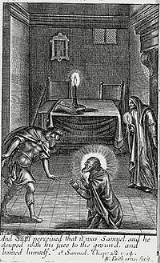
King Saul has the
Witch of Endor invoke the shade of Samuel using a magical amulet, for example. Later Christian writers rejected the idea that humans could bring back the spirits of the dead, and interpreted such shades as disguised demons, thus conflating necromancy with demon-summoning.
Norse mythology also contains examples of necromancy , such as the scene in the
Völuspá is the first and best known poem of the Poetic Edda [i]. ...
in which
Odin summons a seeress from the dead to tell him of the future. In Grógaldr, the first part of
Svipdagsmál, the hero
Svipdag summons his dead
Völva mother, Gróa, to cast spells for him.
Medieval necromancy
In the middle ages the literate members of society were either the Nobility or Christian
clergy. Either of these groups may have been responsible for the propagation and ongoing practice of necromancy, even though it is forbidden in Christianity. It is apparent that necromancy was not a method of
witchcraft. It may have been only available to the scholarly of Europe, because of the accessibility, language, knowledge and methods it employs. There are a few confessions of some Nobles or Clergy members professing a history of experience with necromancy, although these may well have been obtained under duress . Some suggest that Necromancy could have become a way for idle literate Europeans to integrate
Hebrew and Arabic legend and language into forbidden manuals of sorcery.
The possibility exists that literate Europeans were the main forces simultaneously practicing and condemning necromancy. The language, execution and format of the rituals illustrated in the Munich Handbook are strikingly similar to Christian rites. In a
Christian exorcism, various demons and spirits are driven away by name, in the name of God, Jesus or
the Holy Spirit. The spells of necromancy are very similar to these Christian rites in their complete opposition. The distortion of the rites into spells is within the scope of Christian understanding at that time. Necromantic spells were mainly illusory or utility spells. Modern scholarship suggests that most were written with hopes that their utility would prove to be useful in acquiring a feast, horse, cloak of invisibility or perhaps just notoriety among others in the necromancy practicing clergy. The nature of these spells lend themselves to being understood as underground clergy members deviantly indulging in unlawful pleasures.
The rare confessions of those accused of Necromancy suggest that there was a range of spell casting and the related magical experimentation. It is difficult to determine if these details were due to their practices, as opposed to the whims of their interrogators. John of Salisbury is one of the first examples related by Kieckhefer, but as a Parisian ecclesiastical court record of 1323 shows, a “group who were plotting to invoke the
demon Berich from inside a circle made from strips of cat skin,” were obviously participating in the church’s definition of “necromancy.”
The probable reason that these renegade so-called Necromancers were dabbling in the dark arts is that the evolution of "natural" magic and "spiritual" magic was slow. Caesarius of Arles entreats his audience to put no stock in any demons, or “Gods” other than the one true Christian God, even if the working of spells appears to provide benefit. He states that demons only act with divine permission, and permitted by God to test Christian people. Caesarius does not condemn man here; he only states that the art of necromancy exists, although it is prohibited by the bible. Within the Rawlinson necromantic manuscript, a fable is presented as a warning to those that would perform necromancy, although the story ends with a note of physical trial, but without mention of the ramifications in the afterlife.
In the wake of these inconsistencies of judgment, necromancers, sorcerers and witches were able to utilize spells with holy names with impunity, as biblical references in such rituals could be construed as prayers as opposed to spells. As a result, the necromancy discussed in the Munich Manual is an evolution of these understandings. It has even been suggested that the authors of the Munich Manual knowingly designed this book to be in discord with understood ecclesiastical law.
It is possible to trace Christian ritual and
prayer and its subsequent mutant forms of utility and healing prayer/spells to full-blown necromancy. The main recipe employed throughout the manual in the necromancy sorcery uses the same vocabulary and structure utilizing the same languages, sections, names of power alongside
demonic names. The understanding of the names of God from apocryphal texts and the Hebrew
torah demand that the author of such rites have at least a casual familiarity of these texts. The structure of the spells themselves also requires that the author have experience with Christian rites that are not pedestrian, again suggesting either the Nobility or Christian scholars as possible suspects.
As we have suggested that alleged Christians might have been the authors of the sundry necromancy manuals, the question of their inspirations must arise. One of the first clues could be the Gods and demons references in the illusions, conjurations and spells. The Hebrew
Tetragrammaton and various Hebrew derivatives are found, as well as Hebrew and Greek liturgical formulas . Within the tales related in these Manuals, we also find connections with other stories in similar cultural literature . The ceremony for conjuring a horse closely relates to the Arabic
The Thousand and One Nights, and the French romances.
Chaucer’s
The Squire's Tale also has marked similarities. This becomes a parallel evolution of spells to foreign Gods or demons that were once acceptable, and framing them into a new Christian context, albeit demonic and forbidden. Most forms of Satanic Necromancy today include prayers to such Demons, namely Nebiros, Azrael, and Beelzebub.
As the source material for these manuals is apparently derived from scholarly magical and religious texts from a variety of sources in many languages, it is easy to conclude that the scholars that studied these texts manufactured their own aggregate sourcebook and manual with which to work spells or magic.
The 17th-century
Rosicrucian Robert Fludd describes
Goetic necromancy as consisting of "diabolical commerce with unclean spirits, in rites of criminal curiosity, in illicit songs and invocations and in the evocation of the souls of the dead".
It is important to note that necromancy is separated by a thin line from demonology and conjuration. Necromancy is communing with the spirits of the dead, rather than the evil spirits of conjuration and demonology.
Modern necromancy
Modern séances, channeling and
Spiritualism verge on necromancy when the invoked spirits are asked to reveal future events. Necromancy may also be dressed up as sciomancy, a branch of theurgic magic.
Necromancy is extensively practised in
vodou.
Necromancy in fiction
Books and articles
Bygone Beliefs
In
Bygone Beliefs, Herbert Stanley Redgrove regards necromancy as being one of three chief branches of mediaeval Ceremonial magic, the others being Black magic and White magic.
Eliphas Levi
Eliphas Levi, in his book
Dogma et Ritual, states that necromancy is the evoking of aerial bodies.
Leilah Wendell
In an article by Leilah Wendell, called
Necromancy 101, she states a newer interpretation of necromancy:
- True necromancy, or what I prefer to call Necromantic Practice can only be achieved when all elements of fear are eradicated. Necromantic Practice does not involve dominance and servitude. In other words, the spirits of the dead, or of Death Itself, are not at the magician's beck and call, nor will they, nor "He" do your "bidding". It is only the arrogant soul that believes this. One cannot "conjure" nor "command" spirits.
Da Vinci
In the The Notebooks of
Leonardo Da Vinci, it is stated that:
- Of all human opinions that is to be reputed the most foolish which deals with the belief in Necromancy, the sister of Alchemy, which gives birth to simple and natural things.
An Encyclopedia of Occultism
An Encyclopedia of Occultism states:
- The art is of almost universal usage. Considerable difference of opinion exists among modern adepts as to the exact methods to be properly pursued in the necromantic art, and it must be borne in mind the necromancy, which in the Middle Ages was called sorcery, shades into modern spiritualistic practice. There is no doubt, however, that necromancy is the touchstone of occultism, for if, after careful preparation the adept can carry through to a successful issue, the raising of the soul from the other world, he has proved the value of his art. It would be fruitless in this place to enter into a psychological discussion as to whether the feat is possible of accomplishment or not, and we will confine ourselves to the material which has been placed at our disposal by the sages of the past, who have left full details as to how the process should be approached.
See also
References
Greco-Roman- . Chapter 11 is on
- Ogden, Daniel, Greek and Roman Necromancy 2004. ISBN 0-691-11968-6 — , Bryn Mawr Classical Review , with stinging methodological criticism.
- Ruickbie, Leo, Witchcraft Out of the Shadows. Robert Hale, 2004. ISBN 0-7090-7567-7. See ch. 1 in general and p.24 in particular for discussion of necromancy in the encounter between Circe and Odysseus.
- Wendell, Leilah. . Necromany 101.
- Spence, Lewis. . An Encyclopedia of Occultism. Hyde Park, NY : University Books.
Medieval- Kieckhefer, Richard. . Forbidden Rites. Sutton Publishing.
- ____. . Magic in the Middle Ages. Cambridge : Cambridge University Press. ISBN 0-521-78576-6
- Kors & Peters . Witchcraft in Europe 400-1700. Philadelphia : University of Pennsylvania Press. ISBN 0-8122-1751-9
- Vulliaud, Paul. . La Kabbale Juive : histoire et doctrine, 2 vols. Paris : Émile Nourry, 62 Rue des Écoles.
External links
- Excellent page with lots of useful information!
- New Age Necromantic Practices
- Necromancy Tradition