

Near v. Minnesota

Encyclopedia
Near v. Minnesota, 283 U.S. 697
(1931), was a United States Supreme Court
decision that recognized the freedom of the press
by roundly rejecting prior restraint
s on publication, a principle that was applied to free speech generally in subsequent jurisprudence
. The Court ruled that a Minnesota
law that targeted publishers of "malicious
" or "scandal
ous" newspaper
s violated the First Amendment to the United States Constitution
(as applied
through the Fourteenth Amendment
). Legal scholar and columnist Anthony Lewis
called Near the Court's "first great press case."
It was later a key precedent in New York Times Co. v. United States
(1971), in which the Court ruled against the Nixon administration's attempt to enjoin publication of the Pentagon Papers
.
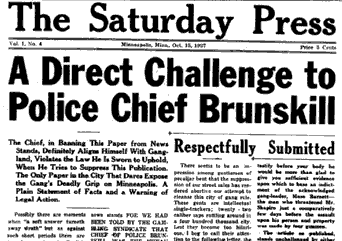 In 1927, Jay M. Near, who has been described as "anti-Catholic
, anti-Semitic, anti-black
and anti-labor" began publishing The Saturday Press in Minneapolis
with Howard A. Guilford, a former mayoral candidate who had been convicted of criminal libel
.
The paper claimed that Jewish gangs were "practically ruling" the city along with the police chief
, Frank W. Brunskill, who was accused of participation in graft
. Among the paper's other targets were mayor George E. Leach
, Hennepin County
attorney and future three-term governor
Floyd B. Olson
, and the members of the grand jury
of Hennepin County, who the paper claimed were either incompetent or willfully failing to investigate and prosecute known criminal activity.
Shortly after the first issue was distributed, Guilford was gunned down and hospitalized, where a further attempt on his life was made. At least one of the stories printed in The Saturday Press led to a successful prosecution of a gangster called Big Mose Barnett who had intimidated a local dry cleaner by destroying his customers' clothing.
s against those who created a "public nuisance
," by publishing, selling, or distributing a "malicious, scandalous and defamatory newspaper." Olson claimed that the allegations raised against him and the other named public officials in all nine issues published between September 24, 1927, and November 19, 1927, as well as the paper's overall anti-Semitic tone, constituted a violation of this law. On November 22, 1927, Judge Matthias Baldwin of the Hennepin County District Court issued a temporary injunction that barred the defendants from editing, publishing, or circulating The Saturday Press or any other publication containing similar material. This injunction was granted without notice to either defendant on an ex parte
hearing between Olson and the judge, and was to extend until the hearing on the judge's order for the defendants to show cause as to why they should not be permanently enjoined from publishing their paper. The hearing was held December 9, and future Minneapolis mayor, Thomas Latimer, argued that the defendants' activities were protected by the U.S. and Minnesota constitutions and demurred
to the complaint.
Judge Baldwin denied the demurrer and was affirmed by the Minnesota Supreme Court
on appeal.
," "dog
s," "malicious fences
" "itinerant carnivals," "lotteries
," and "noxious weeds." The court considered that a newspaper may also endanger safety, because "scandalous material" tended to disturb the peace and provoke assaults. The court cited previous Minnesota decisions that upheld the right of the state to enjoin the publication of "details of execution of criminals" and the teaching of "things injurious to society." Restricting the publication of a newspaper based on its harmful content accordingly fell within the legitimate power of "the people speaking through their representatives" to preserve "public morals" and the "public welfare." The court stated that it had to give heavy deference to such decisions, because "[i]t is the prerogative of the legislature to determine not only what the public interests require but also the measures necessary to protect such interests."
Regarding Near and Guilford's defense of freedom of the press under article 1, section 3 of the Minnesota Constitution
, the State Supreme Court did not believe that the right was intended to protect the publishing of "scandalous material", but that it only provided "a shield for the honest, careful and conscientious press," not the "defamer and the scandalmonger." Instead, "[h]e who uses the press is responsible for its abuse." The court also ruled that the state constitution's due process
clause did not extend any additional protection.
Only Near appealed from this decision to the U.S. Supreme Court, which reversed the decision of the Minnesota Supreme Court and ruled that the Public Nuisance Law of 1925 was unconstitutional.
is unconstitutional
. The court held:
Note that the paragraph above cites the Fourteenth Amendment
and not the First Amendment
. This is because the Fourteenth Amendment incorporates
the First and makes it applicable to the States. As literally written, the First Amendment applies to Congress
and the federal government
, not the states
.
This case strengthened the notion that a prior restraint
of the press violates the First Amendment. However, it left a loophole which would be used later for other prior restraint cases, citing certain circumstances in which prior restraint could potentially be used:
Hughes (Ct): "...the fact that liberty of press may be abused does not make any less necessary the immunity of the press from prior restraint...a more serious evil would result if officials could determine which stories can be published..."
The Court closed off one of the few outlets remaining to censor the press under Near in New York Times Co. v. Sullivan
, which seriously limited the grounds upon which a public official could sue for libel. Statements made regarding their official conduct were only actionable if made with "actual malice," meaning a knowing or reckless disregard for the truth.
Hustler Magazine v. Falwell
excluded parodies
from even this limited standard, as they included no actionable statements of fact. Hustler made clear this protection extended beyond merely defamation suits to cover other torts such as intentional infliction of emotional distress
.
Case citation
Case citation is the system used in many countries to identify the decisions in past court cases, either in special series of books called reporters or law reports, or in a 'neutral' form which will identify a decision wherever it was reported...
(1931), was a United States Supreme Court
Supreme Court of the United States
The Supreme Court of the United States is the highest court in the United States. It has ultimate appellate jurisdiction over all state and federal courts, and original jurisdiction over a small range of cases...
decision that recognized the freedom of the press
Freedom of the press
Freedom of the press or freedom of the media is the freedom of communication and expression through vehicles including various electronic media and published materials...
by roundly rejecting prior restraint
Prior restraint
Prior restraint or prior censorship is censorship in which certain material may not be published or communicated, rather than not prohibiting publication but making the publisher answerable for what is made known...
s on publication, a principle that was applied to free speech generally in subsequent jurisprudence
Jurisprudence
Jurisprudence is the theory and philosophy of law. Scholars of jurisprudence, or legal theorists , hope to obtain a deeper understanding of the nature of law, of legal reasoning, legal systems and of legal institutions...
. The Court ruled that a Minnesota
Minnesota
Minnesota is a U.S. state located in the Midwestern United States. The twelfth largest state of the U.S., it is the twenty-first most populous, with 5.3 million residents. Minnesota was carved out of the eastern half of the Minnesota Territory and admitted to the Union as the thirty-second state...
law that targeted publishers of "malicious
Malice (legal term)
Malice is a legal term referring to a party's intention to do injury to another party. Malice is either expressed or implied. Malice is expressed when there is manifested a deliberate intention unlawfully to take away the life of a human being...
" or "scandal
Scandal
A scandal is a widely publicized allegation or set of allegations that damages the reputation of an institution, individual or creed...
ous" newspaper
Newspaper
A newspaper is a scheduled publication containing news of current events, informative articles, diverse features and advertising. It usually is printed on relatively inexpensive, low-grade paper such as newsprint. By 2007, there were 6580 daily newspapers in the world selling 395 million copies a...
s violated the First Amendment to the United States Constitution
First Amendment to the United States Constitution
The First Amendment to the United States Constitution is part of the Bill of Rights. The amendment prohibits the making of any law respecting an establishment of religion, impeding the free exercise of religion, abridging the freedom of speech, infringing on the freedom of the press, interfering...
(as applied
Incorporation (Bill of Rights)
The incorporation of the Bill of Rights is the process by which American courts have applied portions of the U.S. Bill of Rights to the states. Prior to the 1890s, the Bill of Rights was held only to apply to the federal government...
through the Fourteenth Amendment
Fourteenth Amendment to the United States Constitution
The Fourteenth Amendment to the United States Constitution was adopted on July 9, 1868, as one of the Reconstruction Amendments.Its Citizenship Clause provides a broad definition of citizenship that overruled the Dred Scott v...
). Legal scholar and columnist Anthony Lewis
Anthony Lewis
Anthony Lewis is a prominent liberal intellectual, writing for The New York Times op-ed page and The New York Review of Books, among other publications. He was previously a columnist for the Times . Before that he was London bureau chief , Washington, D.C...
called Near the Court's "first great press case."
It was later a key precedent in New York Times Co. v. United States
New York Times Co. v. United States
New York Times Co. v. United States, 403 U.S. 713 , was a United States Supreme Court per curiam decision. The ruling made it possible for the New York Times and Washington Post newspapers to publish the then-classified Pentagon Papers without risk of government censure.President Richard Nixon had...
(1971), in which the Court ruled against the Nixon administration's attempt to enjoin publication of the Pentagon Papers
Pentagon Papers
The Pentagon Papers, officially titled United States – Vietnam Relations, 1945–1967: A Study Prepared by the Department of Defense, is a United States Department of Defense history of the United States' political-military involvement in Vietnam from 1945 to 1967...
.
Background of the case
Anti-Catholicism
Anti-Catholicism is a generic term for discrimination, hostility or prejudice directed against Catholicism, and especially against the Catholic Church, its clergy or its adherents...
, anti-Semitic, anti-black
Racism
Racism is the belief that inherent different traits in human racial groups justify discrimination. In the modern English language, the term "racism" is used predominantly as a pejorative epithet. It is applied especially to the practice or advocacy of racial discrimination of a pernicious nature...
and anti-labor" began publishing The Saturday Press in Minneapolis
Minneapolis, Minnesota
Minneapolis , nicknamed "City of Lakes" and the "Mill City," is the county seat of Hennepin County, the largest city in the U.S. state of Minnesota, and the 48th largest in the United States...
with Howard A. Guilford, a former mayoral candidate who had been convicted of criminal libel
Criminal libel
Criminal libel is a legal term, of English origin, which may be used with one of two distinct meanings, in those common law jurisdictions where it is still used....
.
The paper claimed that Jewish gangs were "practically ruling" the city along with the police chief
Chief of police
A Chief of Police is the title typically given to the top official in the chain of command of a police department, particularly in North America. Alternate titles for this position include Commissioner, Superintendent, and Chief constable...
, Frank W. Brunskill, who was accused of participation in graft
Political corruption
Political corruption is the use of legislated powers by government officials for illegitimate private gain. Misuse of government power for other purposes, such as repression of political opponents and general police brutality, is not considered political corruption. Neither are illegal acts by...
. Among the paper's other targets were mayor George E. Leach
George E. Leach
Major General George E. Leach was an American military officer and two-time Republican mayor of Minneapolis, Minnesota.He was commissioned a second lieutenant, Field Artillery on April 15, 1905 in the Minnesota National Guard....
, Hennepin County
Hennepin County, Minnesota
Hennepin County is a county located in the U.S. state of Minnesota, named in honor of the 17th-century explorer Father Louis Hennepin. As of 2010 the population was 1,152,425. Its county seat is Minneapolis. It is by far the most populous county in Minnesota; more than one in five Minnesotans live...
attorney and future three-term governor
Governor of Minnesota
The Governor of Minnesota is the chief executive of the U.S. state of Minnesota, leading the state's executive branch. Forty different people have been governors of the state, though historically there were also three governors of Minnesota Territory. Alexander Ramsey, the first territorial...
Floyd B. Olson
Floyd B. Olson
Floyd Bjørnstjerne Olson was an American politician. He served as the 22nd Governor of Minnesota from January 6, 1931 to August 22, 1936. He died in office from stomach cancer. He was a member of the Minnesota Farmer-Labor Party, and was the first member of the Farmer-Labor Party to win the...
, and the members of the grand jury
Grand jury
A grand jury is a type of jury that determines whether a criminal indictment will issue. Currently, only the United States retains grand juries, although some other common law jurisdictions formerly employed them, and most other jurisdictions employ some other type of preliminary hearing...
of Hennepin County, who the paper claimed were either incompetent or willfully failing to investigate and prosecute known criminal activity.
Shortly after the first issue was distributed, Guilford was gunned down and hospitalized, where a further attempt on his life was made. At least one of the stories printed in The Saturday Press led to a successful prosecution of a gangster called Big Mose Barnett who had intimidated a local dry cleaner by destroying his customers' clothing.
First trial court proceeding
Olson filed a complaint against Near and Guilford under the Public Nuisance Law of 1925. Also known as the "Minnesota Gag Law", it provided permanent injunctionInjunction
An injunction is an equitable remedy in the form of a court order that requires a party to do or refrain from doing certain acts. A party that fails to comply with an injunction faces criminal or civil penalties and may have to pay damages or accept sanctions...
s against those who created a "public nuisance
Nuisance
Nuisance is a common law tort. It means that which causes offence, annoyance, trouble or injury. A nuisance can be either public or private. A public nuisance was defined by English scholar Sir J. F...
," by publishing, selling, or distributing a "malicious, scandalous and defamatory newspaper." Olson claimed that the allegations raised against him and the other named public officials in all nine issues published between September 24, 1927, and November 19, 1927, as well as the paper's overall anti-Semitic tone, constituted a violation of this law. On November 22, 1927, Judge Matthias Baldwin of the Hennepin County District Court issued a temporary injunction that barred the defendants from editing, publishing, or circulating The Saturday Press or any other publication containing similar material. This injunction was granted without notice to either defendant on an ex parte
Ex parte
Ex parte is a Latin legal term meaning "from one party" .An ex parte decision is one decided by a judge without requiring all of the parties to the controversy to be present. In Australian, Canadian, U.K., Indian and U.S...
hearing between Olson and the judge, and was to extend until the hearing on the judge's order for the defendants to show cause as to why they should not be permanently enjoined from publishing their paper. The hearing was held December 9, and future Minneapolis mayor, Thomas Latimer, argued that the defendants' activities were protected by the U.S. and Minnesota constitutions and demurred
Demurrer
A demurrer is a pleading in a lawsuit that objects to or challenges a pleading filed by an opposing party. The word demur means "to object"; a demurrer is the document that makes the objection...
to the complaint.
Judge Baldwin denied the demurrer and was affirmed by the Minnesota Supreme Court
Minnesota Supreme Court
The Minnesota Supreme Court is the highest court in the U.S. state of Minnesota and consists of seven members. The court was first assembled as a three-judge panel in 1849 when Minnesota was still a territory. The first members were lawyers from outside of the region who were appointed by...
on appeal.
First Minnesota Supreme Court decision
The State Supreme Court wrote that a scandalous publication "annoys, injures and endangers the comfort and repose of a considerable number of persons," and so constituted a nuisance just as surely as "places where intoxicating liquor is illegally sold," "houses of prostitutionBrothel
Brothels are business establishments where patrons can engage in sexual activities with prostitutes. Brothels are known under a variety of names, including bordello, cathouse, knocking shop, whorehouse, strumpet house, sporting house, house of ill repute, house of prostitution, and bawdy house...
," "dog
Dog
The domestic dog is a domesticated form of the gray wolf, a member of the Canidae family of the order Carnivora. The term is used for both feral and pet varieties. The dog may have been the first animal to be domesticated, and has been the most widely kept working, hunting, and companion animal in...
s," "malicious fences
Spite fence
A spite fence is an overly tall fence, structure in the nature of a fence, or a row of trees, bushes, or hedges, constructed or planted between adjacent lots by a property owner who is annoyed with or wishes to annoy a neighbor, or who wishes to completely obstruct the view between lots. The fence...
" "itinerant carnivals," "lotteries
Lottery
A lottery is a form of gambling which involves the drawing of lots for a prize.Lottery is outlawed by some governments, while others endorse it to the extent of organizing a national or state lottery. It is common to find some degree of regulation of lottery by governments...
," and "noxious weeds." The court considered that a newspaper may also endanger safety, because "scandalous material" tended to disturb the peace and provoke assaults. The court cited previous Minnesota decisions that upheld the right of the state to enjoin the publication of "details of execution of criminals" and the teaching of "things injurious to society." Restricting the publication of a newspaper based on its harmful content accordingly fell within the legitimate power of "the people speaking through their representatives" to preserve "public morals" and the "public welfare." The court stated that it had to give heavy deference to such decisions, because "[i]t is the prerogative of the legislature to determine not only what the public interests require but also the measures necessary to protect such interests."
Regarding Near and Guilford's defense of freedom of the press under article 1, section 3 of the Minnesota Constitution
Minnesota Constitution
The Constitution of the State of Minnesota, USA was initially approved by the residents of Minnesota Territory in a special election held on October 13, 1857, and was ratified by the United States Senate on May 11, 1858, marking the admittance of Minnesota to the Union...
, the State Supreme Court did not believe that the right was intended to protect the publishing of "scandalous material", but that it only provided "a shield for the honest, careful and conscientious press," not the "defamer and the scandalmonger." Instead, "[h]e who uses the press is responsible for its abuse." The court also ruled that the state constitution's due process
Due process
Due process is the legal code that the state must venerate all of the legal rights that are owed to a person under the principle. Due process balances the power of the state law of the land and thus protects individual persons from it...
clause did not extend any additional protection.
The trial court's decision after remand
The case then returned to the Hennepin County District Court, and Near and Guilford renewed their objection to the constitutionality of the Public Nuisance Law. Judge Baldwin again overruled their objection. Only the verified complaint that Olson had filed and the newspaper issues themselves were entered as evidence, and the defendants did not try to argue that the Saturday Press did not fit the definition under the statute, or that their published stories were in fact true. Baldwin ruled that the newspapers contained nothing but scandalous and defamatory material, and permanently enjoined the defendants "from producing, editing, publishing, circulating, having in their possession, selling or giving away any publication whatsoever which is a malicious, scandalous or defamatory newspaper, as defined by law," and also "from further conducting said nuisance under the name and title of said 'The Saturday Press or any other name or title."Second Minnesota Supreme Court decision
On appeal once again, the Minnesota Supreme Court ruled that its first decision left little question as to the constitutionality of the statute, both under the defendants' state constitutional challenge and a new argument based on due process under the 14th Amendment to the U.S. Constitution. The defendants also argued that the trial court's injunction went too far because it effectively prevented them from operating any newspaper, but their appeal did not request a modification of the order. The court in any case disagreed with their interpretation of the order's scope, stating that it did allow them to publish a newspaper, so long as it was operated "in harmony with the public welfare."Only Near appealed from this decision to the U.S. Supreme Court, which reversed the decision of the Minnesota Supreme Court and ruled that the Public Nuisance Law of 1925 was unconstitutional.
The Court's decision
The U.S. Supreme Court held that, except in rare cases, censorshipPrior restraint
Prior restraint or prior censorship is censorship in which certain material may not be published or communicated, rather than not prohibiting publication but making the publisher answerable for what is made known...
is unconstitutional
Constitutionality
Constitutionality is the condition of acting in accordance with an applicable constitution. Acts that are not in accordance with the rules laid down in the constitution are deemed to be ultra vires.-See also:*ultra vires*Company law*Constitutional law...
. The court held:
"For these reasons we hold the statute, so far as it authorized the proceedings in this action under clause (b) [723] of section one, to be an infringement of the liberty of the press guaranteed by the Fourteenth AmendmentFourteenth Amendment to the United States ConstitutionThe Fourteenth Amendment to the United States Constitution was adopted on July 9, 1868, as one of the Reconstruction Amendments.Its Citizenship Clause provides a broad definition of citizenship that overruled the Dred Scott v...
. We should add that this decision rests upon the operation and effect of the statute, without regard to the question of the truth of the charges contained in the particular periodical. The fact that the public officers named in this case, and those associated with the charges of official dereliction, may be deemed to be impeccable cannot affect the conclusion that the statute imposes an unconstitutional restraint upon publication."
Note that the paragraph above cites the Fourteenth Amendment
Fourteenth Amendment to the United States Constitution
The Fourteenth Amendment to the United States Constitution was adopted on July 9, 1868, as one of the Reconstruction Amendments.Its Citizenship Clause provides a broad definition of citizenship that overruled the Dred Scott v...
and not the First Amendment
First Amendment to the United States Constitution
The First Amendment to the United States Constitution is part of the Bill of Rights. The amendment prohibits the making of any law respecting an establishment of religion, impeding the free exercise of religion, abridging the freedom of speech, infringing on the freedom of the press, interfering...
. This is because the Fourteenth Amendment incorporates
Incorporation (Bill of Rights)
The incorporation of the Bill of Rights is the process by which American courts have applied portions of the U.S. Bill of Rights to the states. Prior to the 1890s, the Bill of Rights was held only to apply to the federal government...
the First and makes it applicable to the States. As literally written, the First Amendment applies to Congress
United States Congress
The United States Congress is the bicameral legislature of the federal government of the United States, consisting of the Senate and the House of Representatives. The Congress meets in the United States Capitol in Washington, D.C....
and the federal government
Federal government of the United States
The federal government of the United States is the national government of the constitutional republic of fifty states that is the United States of America. The federal government comprises three distinct branches of government: a legislative, an executive and a judiciary. These branches and...
, not the states
U.S. state
A U.S. state is any one of the 50 federated states of the United States of America that share sovereignty with the federal government. Because of this shared sovereignty, an American is a citizen both of the federal entity and of his or her state of domicile. Four states use the official title of...
.
This case strengthened the notion that a prior restraint
Prior restraint
Prior restraint or prior censorship is censorship in which certain material may not be published or communicated, rather than not prohibiting publication but making the publisher answerable for what is made known...
of the press violates the First Amendment. However, it left a loophole which would be used later for other prior restraint cases, citing certain circumstances in which prior restraint could potentially be used:
"The objection has also been made that the principle as to immunity from previous restraint is stated too broadly, if every such restraint is deemed to be prohibited. That is undoubtedly true; the protection even as to previous restraint is not absolutely unlimited. But the limitation has been recognized only in exceptional cases. 'When a nation is at war many things that might be said in time of peace are such a hindrance to its effort that their utterance will not be endured so long as men fight and that no Court could regard them as protected by any constitutional right.' (Schenck v. United StatesSchenck v. United StatesSchenck v. United States, , was a United States Supreme Court decision that upheld the Espionage Act of 1917 and concluded that a defendant did not have a First Amendment right to express freedom of speech against the draft during World War I. Ultimately, the case established the "clear and present...
). No one would question but that a government might prevent actual obstruction to its recruiting service or the publication of the sailing dates of transports or the number and location of troops. On similar grounds, the primary requirements of decency may be enforced against obscene publications. The security of the community life may be protected against incitements to acts of violence and the overthrow by force of orderly government."
Hughes (Ct): "...the fact that liberty of press may be abused does not make any less necessary the immunity of the press from prior restraint...a more serious evil would result if officials could determine which stories can be published..."
Subsequent developments
Guilford later joined the staff of the Twin City Reporter. He continued to draw the ire of organized crime in Minneapolis and was shot and killed on September 6, 1934.The Court closed off one of the few outlets remaining to censor the press under Near in New York Times Co. v. Sullivan
New York Times Co. v. Sullivan
New York Times Co. v. Sullivan, 376 U.S. 254 , was a United States Supreme Court case which established the actual malice standard which has to be met before press reports about public officials or public figures can be considered to be defamation and libel; and hence allowed free reporting of the...
, which seriously limited the grounds upon which a public official could sue for libel. Statements made regarding their official conduct were only actionable if made with "actual malice," meaning a knowing or reckless disregard for the truth.
Hustler Magazine v. Falwell
Hustler Magazine v. Falwell
In Hustler Magazine, Inc. v. Falwell, 485 U.S. 46 , the United States Supreme Court held, in a unanimous 8–0 decision , that the First Amendment's free-speech guarantee prohibits awarding damages to public figures to compensate for emotional distress intentionally inflicted upon them.Thus,...
excluded parodies
Parody
A parody , in current usage, is an imitative work created to mock, comment on, or trivialise an original work, its subject, author, style, or some other target, by means of humorous, satiric or ironic imitation...
from even this limited standard, as they included no actionable statements of fact. Hustler made clear this protection extended beyond merely defamation suits to cover other torts such as intentional infliction of emotional distress
Intentional infliction of emotional distress
Intentional infliction of emotional distress is a tort claim of recent origin for intentional conduct that results in extreme emotional distress. Some courts and commentators have substituted mental for emotional, but the tort is the same...
.
See also
- List of United States Supreme Court cases, volume 279
- Prior restraintPrior restraintPrior restraint or prior censorship is censorship in which certain material may not be published or communicated, rather than not prohibiting publication but making the publisher answerable for what is made known...
- New York Times Co. v. United StatesNew York Times Co. v. United StatesNew York Times Co. v. United States, 403 U.S. 713 , was a United States Supreme Court per curiam decision. The ruling made it possible for the New York Times and Washington Post newspapers to publish the then-classified Pentagon Papers without risk of government censure.President Richard Nixon had...
- Westmoreland v. CBSWestmoreland v. CBSWestmoreland v. CBS was a $120 million libel suit brought by former U.S. Army Chief of Staff General William Westmoreland against CBS Television for the televising of a documentary entitled The Uncounted Enemy: A Vietnam Deception, narrated by the investigative reporter, Mike Wallace. It was shown...
- Pentagon papersPentagon PapersThe Pentagon Papers, officially titled United States – Vietnam Relations, 1945–1967: A Study Prepared by the Department of Defense, is a United States Department of Defense history of the United States' political-military involvement in Vietnam from 1945 to 1967...
- NewspaperNewspaperA newspaper is a scheduled publication containing news of current events, informative articles, diverse features and advertising. It usually is printed on relatively inexpensive, low-grade paper such as newsprint. By 2007, there were 6580 daily newspapers in the world selling 395 million copies a...
- Yellow journalismYellow journalismYellow journalism or the yellow press is a type of journalism that presents little or no legitimate well-researched news and instead uses eye-catching headlines to sell more newspapers. Techniques may include exaggerations of news events, scandal-mongering, or sensationalism...
- Muckraking
- Kid CannKid CannIsadore Blumenfeld , commonly known as Kid Cann, was a Jewish-American organized crime figure based in Minneapolis, Minnesota, for over four decades and remains the most notorious mobster in the history of Minnesota...
, one of the most notable gangsters in Minneapolis - Thomas E. LatimerThomas E. LatimerThomas E. Latimer was an American lawyer who served as the Minnesota Farmer-Labor Party mayor of Minneapolis, Minnesota from 1935 to 1937. His mayoral term coincided with a period of labor unrest in the city. Prior to that, Latimer worked as a lawyer on the freedom of the press dispute that...
- Joseph H. WestonJoseph H. WestonJoseph H. Weston was a controversial newspaper editor in Cave City in Sharp County in northern Arkansas, whose work led to a change in his state's libel law....
External links
- Friendly, Fred W.Fred W. FriendlyFred W. Friendly was a president of CBS News and the creator, along with Edward R. Murrow, of the documentary television program See It Now...
Minnesota Rag May 1981 (Random House) ISBN 0-394-50752-5; Reprinted May 2003 (University of Minnesota Press) ISBN 0-8166-4161-7 - Lewis, AnthonyAnthony LewisAnthony Lewis is a prominent liberal intellectual, writing for The New York Times op-ed page and The New York Review of Books, among other publications. He was previously a columnist for the Times . Before that he was London bureau chief , Washington, D.C...
Make No Law, pp. 90–99 - The Supreme Court and the Second Bill of Rights, by Richard Cortner.
- http://www.class.uh.edu/comm/classes/comm4303/section3/nearvsminnesota.html#nvm