

Near side of the Moon

Encyclopedia
The near side of the Moon is the lunar
hemisphere that is permanently turned towards the Earth
, whereas the opposite side is the far side of the Moon
. Only one side of the Moon is visible from Earth because the Moon rotates about its spin axis at the same rate that the Moon orbits the Earth, a situation known as synchronous rotation
or tidal locking
. The Moon is directly illuminated by the Sun
, and the cyclically varying viewing conditions cause the lunar phase
s. The unilluminated portions of the Moon can sometimes be dimly seen as a result of earthshine
, which is sunlight reflected off the surface of the Earth and onto the Moon. Since the Moon's orbit is both somewhat elliptical, and inclined to its equatorial plane
, librations allow up to 59% of the Moon's surface to be viewed from Earth (but only half at any instant from any point).
and Francesco Maria Grimaldi
). Although it was found out later that the Moon has no seas, the term "mare" (plural: maria) are still used. The lighter toned regions are referred to as "terrae", or more commonly, the "highlands".
Note that west and east on the Moon are where you would expect them, when standing on the Moon.. But when we, on Earth, see the Moon in the sky, then the east — west direction is just reversed. When specifying coordinates on the Moon it should therefore always be mentioned whether geographic (or rather selenographic
) coordinates are used or astronomical coordinates.
The actual orientation you see the Moon in the sky or on the horizon depends on your geographic latitude
on Earth. In the following description a few typical cases will be considered.
Moon
The Moon is Earth's only known natural satellite,There are a number of near-Earth asteroids including 3753 Cruithne that are co-orbital with Earth: their orbits bring them close to Earth for periods of time but then alter in the long term . These are quasi-satellites and not true moons. For more...
hemisphere that is permanently turned towards the Earth
Earth
Earth is the third planet from the Sun, and the densest and fifth-largest of the eight planets in the Solar System. It is also the largest of the Solar System's four terrestrial planets...
, whereas the opposite side is the far side of the Moon
Far side of the Moon
The far side of the Moon is the lunar hemisphere that is permanently turned away, and is not visible from the surface of the Earth. The far hemisphere was first photographed by the Soviet Luna 3 probe in 1959, and was first directly observed by human eyes when the Apollo 8 mission orbited the Moon...
. Only one side of the Moon is visible from Earth because the Moon rotates about its spin axis at the same rate that the Moon orbits the Earth, a situation known as synchronous rotation
Synchronous rotation
In astronomy, synchronous rotation is a planetological term describing a body orbiting another, where the orbiting body takes as long to rotate on its axis as it does to make one orbit; and therefore always keeps the same hemisphere pointed at the body it is orbiting...
or tidal locking
Tidal locking
Tidal locking occurs when the gravitational gradient makes one side of an astronomical body always face another; for example, the same side of the Earth's Moon always faces the Earth. A tidally locked body takes just as long to rotate around its own axis as it does to revolve around its partner...
. The Moon is directly illuminated by the Sun
Sun
The Sun is the star at the center of the Solar System. It is almost perfectly spherical and consists of hot plasma interwoven with magnetic fields...
, and the cyclically varying viewing conditions cause the lunar phase
Lunar phase
A lunar phase or phase of the moon is the appearance of the illuminated portion of the Moon as seen by an observer, usually on Earth. The lunar phases change cyclically as the Moon orbits the Earth, according to the changing relative positions of the Earth, Moon, and Sun...
s. The unilluminated portions of the Moon can sometimes be dimly seen as a result of earthshine
Planetshine
The phenomenon known as planetshine occurs when reflected sunlight from a planet illuminates the night side of one of its moons. Typically, this results in the moon's night side being bathed in a soft, faint light. The best known example of planetshine is earthshine, which can be seen from Earth...
, which is sunlight reflected off the surface of the Earth and onto the Moon. Since the Moon's orbit is both somewhat elliptical, and inclined to its equatorial plane
Equator
An equator is the intersection of a sphere's surface with the plane perpendicular to the sphere's axis of rotation and containing the sphere's center of mass....
, librations allow up to 59% of the Moon's surface to be viewed from Earth (but only half at any instant from any point).
Names
The near side of the Moon is characterised by large dark areas that were once believed to be seas by astronomers who first mapped them in the 17th century (notably, Giovanni Battista RiccioliGiovanni Battista Riccioli
Giovanni Battista Riccioli was an Italian astronomer and a Catholic priest in the Jesuit order...
and Francesco Maria Grimaldi
Francesco Maria Grimaldi
Francesco Maria Grimaldi was an Italian Jesuit priest, mathematician and physicist who taught at the Jesuit college in Bologna....
). Although it was found out later that the Moon has no seas, the term "mare" (plural: maria) are still used. The lighter toned regions are referred to as "terrae", or more commonly, the "highlands".
Orientation
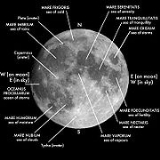
The image of the Moon here is drawn as is normally shown on maps, that is with north on top and west to the left. Astronomers usually turn the map over to have south on top, as to correspond with the view in most telescopes which also show the image upside down.Note that west and east on the Moon are where you would expect them, when standing on the Moon.. But when we, on Earth, see the Moon in the sky, then the east — west direction is just reversed. When specifying coordinates on the Moon it should therefore always be mentioned whether geographic (or rather selenographic
Selenographic coordinates
Selenographic coordinates are used to refer to locations on the surface of Earth's moon. Any position on the lunar surface can be referenced by specifying two numerical values, which are comparable to the latitude and longitude of Earth...
) coordinates are used or astronomical coordinates.
The actual orientation you see the Moon in the sky or on the horizon depends on your geographic latitude
Latitude
In geography, the latitude of a location on the Earth is the angular distance of that location south or north of the Equator. The latitude is an angle, and is usually measured in degrees . The equator has a latitude of 0°, the North pole has a latitude of 90° north , and the South pole has a...
on Earth. In the following description a few typical cases will be considered.
- On the north pole, if the Moon is visible, it stands low above the horizon with its north pole up.
- In mid northern latitudes (North America, Europe, Asia) the Moon rises in the east with its northeastern limb up (Mare Crisium), it reaches it highest point in the south with its north on top, and sets in the west with its northwestern limb (Mare Imbrium) on top.
- On the equator, when the Moon rises in the east, its N — S axis appears horizontal and Mare Foecunditatis is on top. When it sets in the west, about 12.5 hours later, the axis is still horizontal, and Oceanus Procellarum is the last area to dip below the horizon. In between these events, the Moon reached its highest point in the zenithZenithThe zenith is an imaginary point directly "above" a particular location, on the imaginary celestial sphere. "Above" means in the vertical direction opposite to the apparent gravitational force at that location. The opposite direction, i.e...
and then its selenographic directions are lined up with those on Earth. - In mid southern latitudes (South America, South Pacific, Australia, South Africa) the Moon rises in the east with its southeastern limb up (Mare Nectaris), it reaches it highest point in the north with its south on top, and sets in the west with its southwestern limb (Mare Humorum) on top.
- On the south pole the Moon behaves as on the north pole, but there it appears with its south pole up.
See also
- Far side of the MoonFar side of the MoonThe far side of the Moon is the lunar hemisphere that is permanently turned away, and is not visible from the surface of the Earth. The far hemisphere was first photographed by the Soviet Luna 3 probe in 1959, and was first directly observed by human eyes when the Apollo 8 mission orbited the Moon...
- Geology of the MoonGeology of the MoonThe geology of the Moon is quite different from that of the Earth...
- Lunar mareLunar mareThe lunar maria are large, dark, basaltic plains on Earth's Moon, formed by ancient volcanic eruptions. They were dubbed maria, Latin for "seas", by early astronomers who mistook them for actual seas. They are less reflective than the "highlands" as a result of their iron-rich compositions, and...
- Giant impact hypothesisGiant impact hypothesisThe giant impact hypothesis states that the Moon was created out of the debris left over from a collision between the young Earth and a Mars-sized body. The colliding body is sometimes called Theia for the mythical Greek Titan who was the mother of Selene, the goddess of the moon.The giant impact...