

Naturalistic fallacy

Encyclopedia
The naturalistic fallacy is often claimed to be a formal fallacy
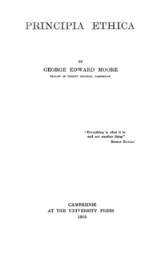
. It was described and named by British philosopher G. E. Moore in his 1903 book Principia Ethica
. Moore stated that a naturalistic fallacy is committed whenever a philosopher attempts to prove a claim about ethics
by appealing to a definition of the term "good" in terms of one or more natural properties (such as "pleasant", "more evolved", "desired", etc.) Arthur N. Prior defined it as
The term is sometimes used loosely to describe any arguments that claim to draw ethical conclusions from natural facts. This view is in opposition to ethical naturalism
.
The naturalistic fallacy is related to (and even confused with) the is–ought problem, which comes from Hume's
Treatise
.
Alternatively, the phrase "naturalistic fallacy" is used to refer to the claim that what is natural is inherently good or right, and that what is unnatural is bad or wrong (see also "Appeal to nature
"). This naturalistic fallacy is the converse of the moralistic fallacy
, the notion that what is good or right is natural and inherent.
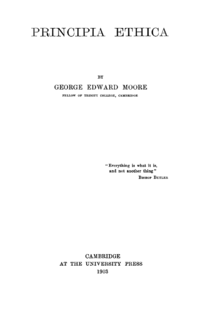 Moore's argument in Principia Ethica is (among other things) a defense of ethical non-naturalism
; he argues that the term "good" (in the sense of intrinsic value
) is indefinable, because it names a simple, non-natural property. It is, rather, "one of those innumerable objects of thought which are themselves incapable of definition, because they are the ultimate terms by reference to which whatever is capable of definition must be defined" (Principia Ethica § 10 ¶ 1). By contrast, many ethical philosophers have tried to prove some of their claims about ethics by appealing to an analysis of the meaning of the term "good"; they held, that is, that "good" can be defined in terms of one or more natural properties which we already understand (such as "pleasure", in the case of hedonists
).
Moore coined the term "naturalistic fallacy" to describe arguments of this form; he explains (in § 12) that the fallacy involved is an instance of a more general type of fallacy, which he leaves unnamed, but which we might call the "definitional fallacy". The fallacy is committed whenever a statement to the effect that some object has a simple indefinable property is misunderstood as a definition that gives the meaning of the simple indefinable property:
The point here is connected with Moore's understanding of properties and the terms that stand for them. Moore holds (§7) that properties are either complexes of simple properties, or else irreducibly simple. The meaning of terms that stand for complex properties can be given by using terms for their constituent properties in a definition; simple properties cannot be defined, because they are made up only of themselves and there are no simpler constituents to refer to. Besides "good" and "pleasure", Moore also offers colour terms as an example of indefinable terms; thus if one wants to understand the meaning of "yellow", one has to be shown examples of it. Yellow, then, may be understood as a quale
; it will do no good to read the dictionary and learn that "yellow" names the colour of egg yolks and ripe lemons, or that "yellow" names the primary colour between green and orange on the spectrum, or that the perception of yellow is stimulated by electromagnetic radiation with a wavelength of between 570 and 590 nanometers. It is true that yellow is all these things, that "egg yolks are yellow" and "the colour perceived when the retina is stimulated by electromagnetic radiation with a wavelength of between 570 and 590 nanometers is yellow" are true statements. But the statements do not give the meaning of the term "yellow", and (Moore argues) to confuse them with a definition of "yellow" would be to commit the same fallacy that is committed when "Pleasure is good" is confused with a definition of "good".
Moore goes on to explain that he pays special attention to the fallacy as it occurs in ethics, and identifies that specific form of the fallacy as ‘naturalistic’, because (1) it is so commonly committed in ethics, and (2) because committing the fallacy in ethics involves confusing a natural object (such as survival or pleasure) with goodness, something that is (he argues) not a natural object. The target of Moore's discussion of the "naturalistic fallacy" is reductionism at least as much as it is naturalism specifically, and the important lesson, for Moore, is that the meaning of the term "good" and the nature of the property goodness are irreducibly sui generis
.
Moore advanced an argument for the indefinability of “good” (and demonstrating the “naturalistic fallacy”) which is known as the Open Question Argument
.
" to characterize inferences of the form "This behaviour is natural; therefore, this behaviour is morally acceptable" or "This property is unnatural; therefore, this property is undesireable." Such inferences are common in discussions of homosexuality
and environmentalism
. Moore is not concerned with these, he is instead concerned with the semantic and metaphysical underpinnings of ethics.
However, emotivists like Charles Leslie Stevenson hold that it may be reasonable to assert that the term "good" is merely an affirmation of approval and that, as such, good may be defined as "I approve."
. An example of a naturalistic fallacy in this sense would be to conclude Social Darwinism
from the theory of evolution
by natural selection
, and of the reverse naturalistic fallacy to argue that the immorality of survival of the fittest
implies the theory of evolution is false. Moralists Jeremy Bentham
and Immanuel Kant
both indicated the is–ought problem in order to identify their theories of morality and law.
In using his categorical imperative Kant deduced that experience was necessary for their applications. But experience on its own or the imperative on its own could not possibly identify an act as being moral or immoral. We can have no certain knowledge of morality from them, being incapable of deducing how things ought to be from the fact that they happen to be arranged in a particular manner in experience.
Bentham, in discussing the relations of law and morality, found that when people discuss problems and issues they talk about how they wish it would be as opposed to how it actually is. This can be seen in discussions of natural law
and positive law
. Bentham criticized natural law theory because in his view it was a naturalistic fallacy, claiming that it described how things ought to be instead of how things are.
, Moore's use of the phrase 'naturalistic fallacy' to describe this particular kind of meta-ethical thinking was a 'spectacular misnomer'; Williams contending that it is not properly either naturalistic or a fallacy. Far from clear is whether the thinkers Moore criticised, even supposing he were right in those criticisms, were committing an error of inference - the true meaning of 'fallacy' - rather than simply a metaphysical mistake, or a dubious redefiniton. Moreover, the mistake being made is not very closely related to what would ordinarily be considered either moral or metaphysical naturalism. Moore's arguments may rule out attempts to define 'goodness' in such obviously naturalistic terms as 'happiness' while at the same time do not preclude similar attempts to define the good in terms of God's will — in other words, divine command theory
.
Formal fallacy
In philosophy, a formal fallacy is a pattern of reasoning that is always wrong. This is due to a flaw in the logical structure of the argument which renders the argument invalid...
. It was described and named by British philosopher G. E. Moore in his 1903 book Principia Ethica
Principia Ethica
Principia Ethica is a monograph by philosopher G. E. Moore, first published in 1903. It is one of the standard texts of modern ethics, and introduced the term naturalistic fallacy.-External links:* of Principia Ethica....
. Moore stated that a naturalistic fallacy is committed whenever a philosopher attempts to prove a claim about ethics
Ethics
Ethics, also known as moral philosophy, is a branch of philosophy that addresses questions about morality—that is, concepts such as good and evil, right and wrong, virtue and vice, justice and crime, etc.Major branches of ethics include:...
by appealing to a definition of the term "good" in terms of one or more natural properties (such as "pleasant", "more evolved", "desired", etc.) Arthur N. Prior defined it as
…the assumption that because some quality or combination of qualities invariably and necessarily accompanies the quality of goodness, or is invariably and necessarily accompanied by it, or both, this quality or combination of qualities is identical with goodness. If, for example, it is believed that whatever is pleasant is and must be good, or that whatever is good is and must be pleasant, or both, it is committing the naturalistic fallacy to infer from this that goodness and pleasantness are one and the same quality. The naturalistic fallacy is the assumption that because the words 'good' and, say, 'pleasant' necessarily describe the same objects, they must attribute the same quality to them.
The term is sometimes used loosely to describe any arguments that claim to draw ethical conclusions from natural facts. This view is in opposition to ethical naturalism
Ethical naturalism
Ethical naturalism is the meta-ethical view which claims that:# Ethical sentences express propositions.# Some such propositions are true....
.
The naturalistic fallacy is related to (and even confused with) the is–ought problem, which comes from Hume's
David Hume
David Hume was a Scottish philosopher, historian, economist, and essayist, known especially for his philosophical empiricism and skepticism. He was one of the most important figures in the history of Western philosophy and the Scottish Enlightenment...
Treatise
A Treatise of Human Nature
A Treatise of Human Nature is a book by Scottish philosopher David Hume, first published in 1739–1740.The full title of the Treatise is 'A Treatise of Human Nature: Being an Attempt to introduce the experimental Method of Reasoning into Moral Subjects'. It contains the following sections:* Book 1:...
.
Alternatively, the phrase "naturalistic fallacy" is used to refer to the claim that what is natural is inherently good or right, and that what is unnatural is bad or wrong (see also "Appeal to nature
Appeal to nature
An appeal to nature is a type of argument that depends on an understanding of nature as a source of intelligibility for its claims, and which relies on that understanding for its outcome...
"). This naturalistic fallacy is the converse of the moralistic fallacy
Moralistic fallacy
The moralistic fallacy is in essence the reverse of the naturalistic fallacy.Naturalistic fallacy presumes that what is—or what occurs—forms what ought to be. Thus the observed natural is reasoned a priori as moral....
, the notion that what is good or right is natural and inherent.
Moore's discussion
Ethical non-naturalism
Ethical non-naturalism is the meta-ethical view which claims that:# Ethical sentences express propositions.# Some such propositions are true.# Those propositions are made true by objective features of the world, independent of human opinion....
; he argues that the term "good" (in the sense of intrinsic value
Intrinsic value
Intrinsic value can refer to:*Intrinsic value , of an option or stock.*Intrinsic value , of a coin.*Intrinsic value , in ethics and philosophy.*Intrinsic value , in philosophy....
) is indefinable, because it names a simple, non-natural property. It is, rather, "one of those innumerable objects of thought which are themselves incapable of definition, because they are the ultimate terms by reference to which whatever is capable of definition must be defined" (Principia Ethica § 10 ¶ 1). By contrast, many ethical philosophers have tried to prove some of their claims about ethics by appealing to an analysis of the meaning of the term "good"; they held, that is, that "good" can be defined in terms of one or more natural properties which we already understand (such as "pleasure", in the case of hedonists
Hedonism
Hedonism is a school of thought which argues that pleasure is the only intrinsic good. In very simple terms, a hedonist strives to maximize net pleasure .-Etymology:The name derives from the Greek word for "delight" ....
).
Moore coined the term "naturalistic fallacy" to describe arguments of this form; he explains (in § 12) that the fallacy involved is an instance of a more general type of fallacy, which he leaves unnamed, but which we might call the "definitional fallacy". The fallacy is committed whenever a statement to the effect that some object has a simple indefinable property is misunderstood as a definition that gives the meaning of the simple indefinable property:
The point here is connected with Moore's understanding of properties and the terms that stand for them. Moore holds (§7) that properties are either complexes of simple properties, or else irreducibly simple. The meaning of terms that stand for complex properties can be given by using terms for their constituent properties in a definition; simple properties cannot be defined, because they are made up only of themselves and there are no simpler constituents to refer to. Besides "good" and "pleasure", Moore also offers colour terms as an example of indefinable terms; thus if one wants to understand the meaning of "yellow", one has to be shown examples of it. Yellow, then, may be understood as a quale
Qualia
Qualia , singular "quale" , from a Latin word meaning for "what sort" or "what kind," is a term used in philosophy to refer to subjective conscious experiences as 'raw feels'. Examples of qualia are the pain of a headache, the taste of wine, the experience of taking a recreational drug, or the...
; it will do no good to read the dictionary and learn that "yellow" names the colour of egg yolks and ripe lemons, or that "yellow" names the primary colour between green and orange on the spectrum, or that the perception of yellow is stimulated by electromagnetic radiation with a wavelength of between 570 and 590 nanometers. It is true that yellow is all these things, that "egg yolks are yellow" and "the colour perceived when the retina is stimulated by electromagnetic radiation with a wavelength of between 570 and 590 nanometers is yellow" are true statements. But the statements do not give the meaning of the term "yellow", and (Moore argues) to confuse them with a definition of "yellow" would be to commit the same fallacy that is committed when "Pleasure is good" is confused with a definition of "good".
Moore goes on to explain that he pays special attention to the fallacy as it occurs in ethics, and identifies that specific form of the fallacy as ‘naturalistic’, because (1) it is so commonly committed in ethics, and (2) because committing the fallacy in ethics involves confusing a natural object (such as survival or pleasure) with goodness, something that is (he argues) not a natural object. The target of Moore's discussion of the "naturalistic fallacy" is reductionism at least as much as it is naturalism specifically, and the important lesson, for Moore, is that the meaning of the term "good" and the nature of the property goodness are irreducibly sui generis
Sui generis
Sui generis is a Latin expression, literally meaning of its own kind/genus or unique in its characteristics. The expression is often used in analytic philosophy to indicate an idea, an entity, or a reality which cannot be included in a wider concept....
.
Moore advanced an argument for the indefinability of “good” (and demonstrating the “naturalistic fallacy”) which is known as the Open Question Argument
Open Question Argument
The Open Question Argument is a philosophical argument put forward by British philosopher G. E. Moore in , to refute the equating of the property good with some non-moral property, whether naturalistic or meta-physical...
.
Appeal to nature
Some people use the phrase "naturalistic fallacy" or "appeal to natureAppeal to nature
An appeal to nature is a type of argument that depends on an understanding of nature as a source of intelligibility for its claims, and which relies on that understanding for its outcome...
" to characterize inferences of the form "This behaviour is natural; therefore, this behaviour is morally acceptable" or "This property is unnatural; therefore, this property is undesireable." Such inferences are common in discussions of homosexuality
Homosexuality
Homosexuality is romantic or sexual attraction or behavior between members of the same sex or gender. As a sexual orientation, homosexuality refers to "an enduring pattern of or disposition to experience sexual, affectional, or romantic attractions" primarily or exclusively to people of the same...
and environmentalism
Environmentalism
Environmentalism is a broad philosophy, ideology and social movement regarding concerns for environmental conservation and improvement of the health of the environment, particularly as the measure for this health seeks to incorporate the concerns of non-human elements...
. Moore is not concerned with these, he is instead concerned with the semantic and metaphysical underpinnings of ethics.
However, emotivists like Charles Leslie Stevenson hold that it may be reasonable to assert that the term "good" is merely an affirmation of approval and that, as such, good may be defined as "I approve."
The is–ought problem
The term "naturalistic fallacy" is also sometimes used to describe the deduction of an "ought" from an "is" (the Is–ought problem), and has inspired the use of mutually reinforcing terminology which describes the converse (deducing an "is" from an "ought") either as the "reverse naturalistic fallacy" or as the moralistic fallacyMoralistic fallacy
The moralistic fallacy is in essence the reverse of the naturalistic fallacy.Naturalistic fallacy presumes that what is—or what occurs—forms what ought to be. Thus the observed natural is reasoned a priori as moral....
. An example of a naturalistic fallacy in this sense would be to conclude Social Darwinism
Social Darwinism
Social Darwinism is a term commonly used for theories of society that emerged in England and the United States in the 1870s, seeking to apply the principles of Darwinian evolution to sociology and politics...
from the theory of evolution
Evolution
Evolution is any change across successive generations in the heritable characteristics of biological populations. Evolutionary processes give rise to diversity at every level of biological organisation, including species, individual organisms and molecules such as DNA and proteins.Life on Earth...
by natural selection
Natural selection
Natural selection is the nonrandom process by which biologic traits become either more or less common in a population as a function of differential reproduction of their bearers. It is a key mechanism of evolution....
, and of the reverse naturalistic fallacy to argue that the immorality of survival of the fittest
Survival of the fittest
"Survival of the fittest" is a phrase originating in evolutionary theory, as an alternative description of Natural selection. The phrase is today commonly used in contexts that are incompatible with the original meaning as intended by its first two proponents: British polymath philosopher Herbert...
implies the theory of evolution is false. Moralists Jeremy Bentham
Jeremy Bentham
Jeremy Bentham was an English jurist, philosopher, and legal and social reformer. He became a leading theorist in Anglo-American philosophy of law, and a political radical whose ideas influenced the development of welfarism...
and Immanuel Kant
Immanuel Kant
Immanuel Kant was a German philosopher from Königsberg , researching, lecturing and writing on philosophy and anthropology at the end of the 18th Century Enlightenment....
both indicated the is–ought problem in order to identify their theories of morality and law.
In using his categorical imperative Kant deduced that experience was necessary for their applications. But experience on its own or the imperative on its own could not possibly identify an act as being moral or immoral. We can have no certain knowledge of morality from them, being incapable of deducing how things ought to be from the fact that they happen to be arranged in a particular manner in experience.
Bentham, in discussing the relations of law and morality, found that when people discuss problems and issues they talk about how they wish it would be as opposed to how it actually is. This can be seen in discussions of natural law
Natural law
Natural law, or the law of nature , is any system of law which is purportedly determined by nature, and thus universal. Classically, natural law refers to the use of reason to analyze human nature and deduce binding rules of moral behavior. Natural law is contrasted with the positive law Natural...
and positive law
Positive law
Positive law is the term generally used to describe man-made laws which bestow specific privileges upon, or remove them from, an individual or group...
. Bentham criticized natural law theory because in his view it was a naturalistic fallacy, claiming that it described how things ought to be instead of how things are.
Terminology
According to Bernard WilliamsBernard Williams
Sir Bernard Arthur Owen Williams was an English moral philosopher, described by The Times as the most brilliant and most important British moral philosopher of his time. His publications include Problems of the Self , Moral Luck , Ethics and the Limits of Philosophy , and Truth and Truthfulness...
, Moore's use of the phrase 'naturalistic fallacy' to describe this particular kind of meta-ethical thinking was a 'spectacular misnomer'; Williams contending that it is not properly either naturalistic or a fallacy. Far from clear is whether the thinkers Moore criticised, even supposing he were right in those criticisms, were committing an error of inference - the true meaning of 'fallacy' - rather than simply a metaphysical mistake, or a dubious redefiniton. Moreover, the mistake being made is not very closely related to what would ordinarily be considered either moral or metaphysical naturalism. Moore's arguments may rule out attempts to define 'goodness' in such obviously naturalistic terms as 'happiness' while at the same time do not preclude similar attempts to define the good in terms of God's will — in other words, divine command theory
Divine command theory
Divine command theory is the meta-ethical view about the semantics or meaning of ethical sentences, which claims that ethical sentences express propositions, some of which are true, about the attitudes of God...
.
See also
- Appeal to natureAppeal to natureAn appeal to nature is a type of argument that depends on an understanding of nature as a source of intelligibility for its claims, and which relies on that understanding for its outcome...
- Appeal to noveltyAppeal to noveltyThe appeal to novelty is a fallacy in which someone prematurely claims that an idea or proposal is correct or superior, exclusively because it is new and modern. In a controversy between status quo and new inventions, an appeal to novelty argument isn't in itself a valid argument...
- Appeal to traditionAppeal to traditionAppeal to tradition is a common fallacy in which a thesis is deemed correct on the basis that it correlates with some past or present tradition...
- Definist fallacyDefinist fallacyThe definist fallacy can refer to three logical fallacies related to how terms are defined in an argument. The first, coined by William Frankena in 1939, involves the definition of one property in terms of another. The second fallacy refers to the insisted use of a persuasive definition in an...
- Evolution of moralityEvolution of moralityThe evolution of morality refers to the emergence of human moral behavior over the course of human evolution. Morality can be defined as a system of ideas about right and wrong conduct. In everyday life, morality is typically associated with human behavior and not much thought is given to the...
- Fact-value distinctionFact-value distinctionThe fact-value distinction is a concept used to distinguish between arguments which can be claimed through reason alone, and those where rationality is limited to describing a collective opinion. In another formulation, it is the distinction between what is and what ought to be...
- Meta-ethicsMeta-ethicsIn philosophy, meta-ethics is the branch of ethics that seeks to understand the nature of ethical properties, statements, attitudes, and judgments. Meta-ethics is one of the three branches of ethics generally recognized by philosophers, the others being normative ethics and applied ethics. Ethical...
- Moralistic fallacyMoralistic fallacyThe moralistic fallacy is in essence the reverse of the naturalistic fallacy.Naturalistic fallacy presumes that what is—or what occurs—forms what ought to be. Thus the observed natural is reasoned a priori as moral....
- Philosophical naturalismNaturalism (philosophy)Naturalism commonly refers to the philosophical viewpoint that the natural universe and its natural laws and forces operate in the universe, and that nothing exists beyond the natural universe or, if it does, it does not affect the natural universe that we know...
- Norm (philosophy)Norm (philosophy)Norms are concepts of practical import, oriented to effecting an action, rather than conceptual abstractions that describe, explain, and express. Normative sentences imply “ought-to” types of statements and assertions, in distinction to sentences that provide “is” types of statements and assertions...
- Open Question ArgumentOpen Question ArgumentThe Open Question Argument is a philosophical argument put forward by British philosopher G. E. Moore in , to refute the equating of the property good with some non-moral property, whether naturalistic or meta-physical...
- Value theoryValue theoryValue theory encompasses a range of approaches to understanding how, why and to what degree people should value things; whether the thing is a person, idea, object, or anything else. This investigation began in ancient philosophy, where it is called axiology or ethics. Early philosophical...
External links
- Appeal to Nature entry in The Fallacy Files
- Principia Ethica