


National Congress of Bolivia

Encyclopedia
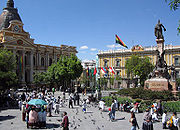
Legislature
A legislature is a kind of deliberative assembly with the power to pass, amend, and repeal laws. The law created by a legislature is called legislation or statutory law. In addition to enacting laws, legislatures usually have exclusive authority to raise or lower taxes and adopt the budget and...
of Bolivia
Bolivia
Bolivia officially known as Plurinational State of Bolivia , is a landlocked country in central South America. It is the poorest country in South America...
, based in the nation's de facto
De facto
De facto is a Latin expression that means "concerning fact." In law, it often means "in practice but not necessarily ordained by law" or "in practice or actuality, but not officially established." It is commonly used in contrast to de jure when referring to matters of law, governance, or...
capital, La Paz
La Paz
Nuestra Señora de La Paz is the administrative capital of Bolivia, as well as the departmental capital of the La Paz Department, and the second largest city in the country after Santa Cruz de la Sierra...
.
The National Congress is bicameral
Bicameralism
In the government, bicameralism is the practice of having two legislative or parliamentary chambers. Thus, a bicameral parliament or bicameral legislature is a legislature which consists of two chambers or houses....
, consisting of a lower house
Lower house
A lower house is one of two chambers of a bicameral legislature, the other chamber being the upper house.Despite its official position "below" the upper house, in many legislatures worldwide the lower house has come to wield more power...
(the Chamber of Deputies or Cámara de Diputados) and an upper house
Upper house
An upper house, often called a senate, is one of two chambers of a bicameral legislature, the other chamber being the lower house; a legislature composed of only one house is described as unicameral.- Possible specific characteristics :...
(the Senate, or Cámara de Senadores).
The Senate has 36 seats. Each of the country's nine departments
Departments of Bolivia
Bolivia is divided into nine departments . Each of the departments is subdivided into provinces , which are further subdivided into municipalities ....
returns four senators elected by proportional representation (D'Hondt) (Until 2009 the Senate had 27 seats: three seats per department: two from the party or formula that receives the most votes, with the third senator representing the second-placed party.) Senators are elected from party lists to serve five-year terms, and the minimum age to hold a Senate seat is 35 years.
The Chamber of Deputies comprises 130 seats: 77 deputies are elected to represent single-member electoral district
Electoral district
An electoral district is a distinct territorial subdivision for holding a separate election for one or more seats in a legislative body...
s, and an additional 53 are elected by proportional representation from party lists on a departmental basis. Deputies also serve five-year terms, and must be aged at least 25 on the day of the election. For the 2005 general election, seats were reapportioned, making 70 single-member electoral district
Electoral district
An electoral district is a distinct territorial subdivision for holding a separate election for one or more seats in a legislative body...
s (60 are elected by proportional representation).
2010–2015 Congress
The 2010–2015 Plurinational Legislative Assembly is controlled in both houses by the governing Movement for Socialism (MAS-IPSP)Movement for Socialism (Bolivia)
The Movement for Socialism-Political Instrument for the Sovereignty of the Peoples , alternately referred to as "Movement Toward Socialism" or "Movement to Socialism", is a left-wing, socialist, Bolivian political organization led by Evo Morales, founded in 1995...
, elected with a 2/3 supermajority
Supermajority
A supermajority or a qualified majority is a requirement for a proposal to gain a specified level or type of support which exceeds a simple majority . In some jurisdictions, for example, parliamentary procedure requires that any action that may alter the rights of the minority has a supermajority...
. Just four incumbent members of the 2005–2010 Congress returned: Deputy Antonio Franco; Deputy Javier Zabaleta (MAS-IPSP/MSM); Senator René Martínez (MAS-IPSP), who was a deputy; and Senator Róger Pinto, previously of Podemos and now representing PPB-CN. As part of a break between the MAS-IPSP and its ally the Without Fear Movement
Without Fear Movement
Without Fear Movement is a Progressive political party in Bolivia. MSM was founded on March 1, 1999.The leader of the party, Juan del Granado, has been mayor of La Paz since 2000...
(MSM), the latter party's four deputies, elected on the MAS slate pledged in late March 2010, "to act in accord with our political identity, with our conscience, and with the people who elected us with their vote." Consequently, MAS-IPSP now has 84 members in the Chambers of Deputies, while the MSM has four.
Congressional elections were held as part of general elections
Bolivian general election, 2009
The Bolivian general election, 2009 was held on 6 December, 2009, following a constitutional referendum held on 25 January 2009. Voters elected:*President and Vice President of the Republic.*130 members of the Chamber of Deputies.*36 members of the Senate....
on 9 December 2009. After the votes were counted, party strengths in Congress were as follows:
| Party | Votes | Percentage | Deputies | Senators | |
|---|---|---|---|---|---|
| Movement for Socialism Movement for Socialism (Bolivia) The Movement for Socialism-Political Instrument for the Sovereignty of the Peoples , alternately referred to as "Movement Toward Socialism" or "Movement to Socialism", is a left-wing, socialist, Bolivian political organization led by Evo Morales, founded in 1995... |
2.943.209 | 64,22 | 88 | 26 | |
| Plan Progress for Bolivia – National Convergence Plan Progress for Bolivia – National Convergence Plan Progress for Bolivia – National Convergence is a coalition that has been Bolivia's largest national opposition political party since the 2009 general elections. PPB-CN is a Bolivian political alliance of the right-wing formed in advance of the 2009 elections... |
1.212.795 | 26,46 | 37 | 10 | |
| National Unity Front National Unity Front The National Unity Front is a political party in Bolivia.At the legislative elections in 2005, the party won 7.8 % of the popular vote and 8 out of 130 seats in the Chamber of Deputies and 1 out of 27 seats in the Senate. Its candidate at the presidential elections, Samuel Jorge Doria Medina Auza,... |
258.971 | 5,65 | 3 | ||
| Social Alliance Social Alliance The Social Alliance is a Bolivian political party founded on 9 October 2005. The party grew out of the successful 2004 campaign of leader René Joaquino Cabrera for mayor of Potosí.-External links:**... |
106.027 | 2,31 | 2 | ||
| Social Patriotic Unity Movement | 23.257 | 0,51 | |||
| People | 15.627 | 0,34 | |||
| Peoples for Liberty and Sovereignty | 12.995 | 0,28 | |||
| Social Democratic Bolivia | 9.905 | 0,22 | |||
| Source: Comisión Nacional Electoral | |||||
The President of the Senate, elected on 19 January 2010, is Ana María Romero de Campero
Ana María Romero de Campero
Ana María Romero de Campero was a Bolivian journalist, writer, activist and influential public figure in her country. She was President of the Senate at the time of her death...
(MAS-IPSP, La Paz). Seventeen of 36 members of the Senate are women. The 26-member MAS-IPSP majority includes all four senators from La Paz, Oruro, and Potosí; three senators from Cochabamba and Chuquisaca; and two senators from each of Santa Cruz, Beni, Pando, and Tarija.
The President of the Chamber of Deputies, elected on 19 January 2010, is Héctor Arce (MAS-IPSP). 33 of 130 deputies (25.38%) are women.
2002–2005 Congress
Congressional elections were held on 30 June 2002. After the votes were counted, party strengths in Congress were as follows:| Parties | Deputies | Senators |
|---|---|---|
| Revolutionary Nationalist Movement Revolutionary Nationalist Movement The Revolutionary Nationalist Movement is a Bolivian political party, perhaps the most important in the country during the 20th century. At the legislative elections in 2002, the party won, in an alliance with the Free Bolivia Movement, 26.9% of the popular vote and 36 out of 130 seats in the... (Movimiento Nacionalista Revolucionario, MNR) |
36 | 11 |
| Movement for Socialism Movement for Socialism (Bolivia) The Movement for Socialism-Political Instrument for the Sovereignty of the Peoples , alternately referred to as "Movement Toward Socialism" or "Movement to Socialism", is a left-wing, socialist, Bolivian political organization led by Evo Morales, founded in 1995... (Movimiento al Socialismo, MAS) |
27 | 8 |
| Movement of Revolutionary Left Revolutionary Left Movement (Bolivia) The Revolutionary Left Movement - New Majority is a social democratic political party in Bolivia... (Movimiento Izquierda Revolucionaria, MIR) |
26 | 5 |
| New Republican Force New Republican Force The New Republican Force is a center-right personalist political party in Bolivia.At the legislative elections in 2002, the party won 26.5 % of the popular vote and 25 out of 130 seats in the Chamber of Deputies and two out of 27 seats in the Senate... (Nueva Fuerza Republicana, NFR) |
25 | 2 |
| Nationalist Democratic Action Nationalist Democratic Action Nationalist Democratic Action is a right-wing political party in Bolivia led by Jorge Quiroga. ADN was founded on March 23, 1979 by the military dictator Hugo Banzer after he stepped down from power. It later expanded to include the Revolutionary Left Party and a faction of the Bolivian Socialist... (Acción Democrática Nacionalista, ADN) |
4 | 1 |
| Indigenous Pachakuti Movement Indigenous Pachakuti Movement The Pachakuti Indigenous Movement is a left-wing indigenist political party in Bolivia founded in november 2000.... (Movimiento Indígena Pachakuti, MIP) |
6 | 0 |
| Citizens' Solidarity Union (Unión Cívica Solidaridad, UCS) | 5 | 0 |
| Socialist Party Socialist Party (Bolivia) The Socialist Party-1 is a socialist political party in Bolivia.At the legislative elections in 2002, the party won 0.7% of the popular vote and one out of 130 seats in the Chamber of Deputies and no seats in the Senate.... (Partido Socialista, PS) |
1 | 0 |
| Total | 130 | 27 |
The next election was scheduled to take place in June 2007, but was brought forward to December 2005 on a decision from interim President Eduardo Rodríguez
Eduardo Rodríguez
Eduardo Rodríguez Veltzé is a former president of Bolivia; prior to that appointment he was the chief justice of the Supreme Court.-Background:...
.
2005–2010 Congress
Congressional electionsBolivian legislative election, 2005
The 2005 Bolivian legislative election was held simultaneously with the presidential election on 18 December 2005. The elections were held to elect a new National Congress, composed of the Chamber of Deputies and Senate, for a full four-year term....
were held on 18 December 2005, concurrently with the 2005 presidential election
Bolivian presidential election, 2005
The 2005 Bolivian presidential election was held on December 18, 2005. The two main candidates were Evo Morales of the Movement Towards Socialism Party, and Jorge Quiroga, leader of the Democratic and Social Power Party and former head of the Acción Democrática Nacionalista Party. Felipe Quispe,...
.
The Chamber of Deputies had the following leadership: President Edmundo Novillo Aguilar (MAS, Cochabamba); First Vice President Julia Ramos (MAS); Second Vice President Oscar Urenda (Social Democratic Power
Social and Democratic Power
Podemos is the name of a right-of-center, pro-business Bolivian political party. It is a pseudo-acronym standing for 'Poder Democrático y Social' , but the word also means "We can."-Nationalist Democratic Action:...
, Podemos); First Secretary Oscar Chirinos (MAS); Second Secretary Alex Cerrogrande (MAS); Third Secretary Jorge Becerra (National Unity Front
National Unity Front
The National Unity Front is a political party in Bolivia.At the legislative elections in 2005, the party won 7.8 % of the popular vote and 8 out of 130 seats in the Chamber of Deputies and 1 out of 27 seats in the Senate. Its candidate at the presidential elections, Samuel Jorge Doria Medina Auza,...
, UN), and Fourth Secretary Roxana Sandoval (Revolutionary Nationalist Movement
Revolutionary Nationalist Movement
The Revolutionary Nationalist Movement is a Bolivian political party, perhaps the most important in the country during the 20th century. At the legislative elections in 2002, the party won, in an alliance with the Free Bolivia Movement, 26.9% of the popular vote and 36 out of 130 seats in the...
, MNR).
Buildings

Palacio Quemado
The Palacio Quemado is a popular name to denote the Bolivian Palace of Government, located on Plaza Murillo in downtown La Paz. It is the building from which the Bolivian executive conducts its business.The building has had many incarnations...
– the "Burnt Palace" – on account of repeated attempts to raze it to the ground in the 19th century) and the cathedral of Nuestra Señora de La Paz. Prior to becoming the seat of the legislature in 1904, the congress building had, at different times, housed a convent
Convent
A convent is either a community of priests, religious brothers, religious sisters, or nuns, or the building used by the community, particularly in the Roman Catholic Church and in the Anglican Communion...
and a university
University
A university is an institution of higher education and research, which grants academic degrees in a variety of subjects. A university is an organisation that provides both undergraduate education and postgraduate education...
.
The Vice-President, in his capacity as President of Congress, has an imposing suite of offices on Calle Mercado in central La Paz. The building, designed by Emilio Villanueva
Emilio Villanueva
Dr. Emilio Villanueva Peñaranda was a revolutionary Bolivian architect. His parents were Jose Villanueva and Maria Peñaranda . His brother, Dr...
, was erected during the 1920s and was originally intended to serve as the headquarters of Bolivia's central bank
Central bank
A central bank, reserve bank, or monetary authority is a public institution that usually issues the currency, regulates the money supply, and controls the interest rates in a country. Central banks often also oversee the commercial banking system of their respective countries...
(Banco de la Nación Boliviana). Under Jaime Paz Zamora
Jaime Paz Zamora
Jaime Paz Zamora was President of Bolivia from August 6, 1989 to August 6, 1993. He also served as Vice-President between 1982 and 1984.-Foundation of the MIR and alliance with Siles Zuazo:...
's 1989–1993 presidency
President of Bolivia
The President of Bolivia is head of state and head of government of Bolivia. According to the current Constitution, the president is elected by popular vote to a five year term, renewable once...
, the building was reassigned to the vice-presidency, but the vice-presidential staff did not relocate entirely until major reconstruction and renovation work, starting in 1997, had been carried out. The Library of Congress and the National Congressional Archive are also located on the premises.
See also
- List of Presidents of the Chamber of Senators of Bolivia
- List of Presidents of the Chamber of Deputies of Bolivia