

National Congress of Belgium

Encyclopedia
The Belgian
National Congress was a temporary legislative assembly in 1830, established shortly after the Provisional Government of Belgium
had proclaimed Belgian independence
on October 4 of that year. Its primary task was to create a constitution
for the newly formed state.
 The National Congress was elected by approximately 30,000 voters on November 3, 1830 and consisted of 200 members. Its president was Baron Erasme Louis Surlet de Chokier
.
The assembly chose a constitutional
popular monarchy
as the form of government
for Belgium and chose the son of the French
king Louis-Philippe, Louis, Duke of Nemours
, as the new head of state. Other candidates included Auguste de Beauharnais
and Archduke Charles of Austria
, the last Governor-General
of the Austrian Netherlands
. The choice of Louis, Duke of Nemours
, was unacceptable to the government of the United Kingdom
and another candidate had to be found. Baron Surlet de Chokier was appointed Regent
while awaiting a new decision and was replaced as president of the National Congress by Etienne Constantin, Baron de Gerlache
. Leopold of Saxe-Coburg and Gotha
was definitively chosen to become the first King of the Belgians. The National Congress appointed him king on June 4 and six weeks later he was sworn in by swearing allegiance to the Belgian constitution in front of the Sint Jacobs Church at Coudenbergh Place in Brussels
. This day (July 21) has since been the National holiday for Belgium.
The Constitution of Belgium
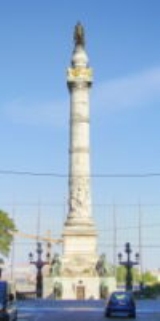
, which was very progressive for its time, was accepted on February 7, 1831. The Provisional Government was subsequently dismantled. The National Congress itself remained in place until the official elections of a first Parliament on September 8, 1831. A monument in Brussels, the Congress Column
, was erected in its honour. On the base of the Congress-column, there are four bronze statues that represent the four basic freedoms enshrined in the Belgian Constitution of 1831: freedom of religion
, association
, education
and the press
.
These four basic freedoms are also reflected in the streets of Brussels
. There are four streets that lead to the Place de la Liberté/Vrijheidsplein (Freedom Square): the Rue des Cultes/Eredienststraat (Religion Street), the Rue de l'Association/Verenigingsstraat (Association Street), the Rue de l'Enseignement/Onderrichtstraat (Education Street) and the Rue de la Presse/Drukpersstraat (Press Street).
Belgium
Belgium , officially the Kingdom of Belgium, is a federal state in Western Europe. It is a founding member of the European Union and hosts the EU's headquarters, and those of several other major international organisations such as NATO.Belgium is also a member of, or affiliated to, many...
National Congress was a temporary legislative assembly in 1830, established shortly after the Provisional Government of Belgium
Provisional Government of Belgium
The Provisional Government was formed as a revolutionary committee of notables during the Belgian Revolution on September 24, 1830 at the Brussels City Hall under the name of Administrative Commission....
had proclaimed Belgian independence
Belgian Revolution
The Belgian Revolution was the conflict which led to the secession of the Southern provinces from the United Kingdom of the Netherlands and established an independent Kingdom of Belgium....
on October 4 of that year. Its primary task was to create a constitution
Constitution
A constitution is a set of fundamental principles or established precedents according to which a state or other organization is governed. These rules together make up, i.e. constitute, what the entity is...
for the newly formed state.
Erasme Louis Surlet de Chokier
Erasme Louis, Baron Surlet de Chokier , born in Liège, was a Belgian politician and before the accession of Leopold I to the Belgian throne, was the first Regent of Belgium....
.
The assembly chose a constitutional
Constitutional monarchy
Constitutional monarchy is a form of government in which a monarch acts as head of state within the parameters of a constitution, whether it be a written, uncodified or blended constitution...
popular monarchy
Popular monarchy
Popular monarchy is a system of monarchical governance in which the monarch's title is linked with a popular mandate rather than a constitutional state. It was the norm in some places from the Middle Ages, and was occasionally used in 19th- and 20th-century Europe, often reflecting the results of...
as the form of government
Form of government
A form of government, or form of state governance, refers to the set of political institutions by which a government of a state is organized. Synonyms include "regime type" and "system of government".-Empirical and conceptual problems:...
for Belgium and chose the son of the French
France
The French Republic , The French Republic , The French Republic , (commonly known as France , is a unitary semi-presidential republic in Western Europe with several overseas territories and islands located on other continents and in the Indian, Pacific, and Atlantic oceans. Metropolitan France...
king Louis-Philippe, Louis, Duke of Nemours
Louis, Duke of Nemours
Prince Louis of Orléans was the second son of the future King Louis-Philippe I of France, and his wife Maria Amalia of Naples and Sicily. Under the reign of his father from 1830–1848, he was styled as Prince Louis, Duke of Nemours.-Childhood:He was born at the Palais Royal, in Paris...
, as the new head of state. Other candidates included Auguste de Beauharnais
Auguste de Beauharnais, 2nd Duke of Leuchtenberg
Auguste Charles Eugène Napoléon de Beauharnais, 2nd Duke of Leuchtenberg was the first Prince consort of Maria II of Portugal.-Family:...
and Archduke Charles of Austria
Archduke Charles, Duke of Teschen
Archduke Charles of Austria, Duke of Teschen was an Austrian field-marshal, the third son of emperor Leopold II and his wife Infanta Maria Luisa of Spain...
, the last Governor-General
Governors of the Habsburg Netherlands
The Governor of the Habsburg Netherlands ruled the Habsburg Netherlands as a representative of the Duke of Burgundy .- Habsburg Netherlands :...
of the Austrian Netherlands
Southern Netherlands
Southern Netherlands were a part of the Low Countries controlled by Spain , Austria and annexed by France...
. The choice of Louis, Duke of Nemours
Louis, Duke of Nemours
Prince Louis of Orléans was the second son of the future King Louis-Philippe I of France, and his wife Maria Amalia of Naples and Sicily. Under the reign of his father from 1830–1848, he was styled as Prince Louis, Duke of Nemours.-Childhood:He was born at the Palais Royal, in Paris...
, was unacceptable to the government of the United Kingdom
United Kingdom
The United Kingdom of Great Britain and Northern IrelandIn the United Kingdom and Dependencies, other languages have been officially recognised as legitimate autochthonous languages under the European Charter for Regional or Minority Languages...
and another candidate had to be found. Baron Surlet de Chokier was appointed Regent
Regent
A regent, from the Latin regens "one who reigns", is a person selected to act as head of state because the ruler is a minor, not present, or debilitated. Currently there are only two ruling Regencies in the world, sovereign Liechtenstein and the Malaysian constitutive state of Terengganu...
while awaiting a new decision and was replaced as president of the National Congress by Etienne Constantin, Baron de Gerlache
Etienne Constantin, Baron de Gerlache
Etienne Constantin, Baron de Gerlache was a lawyer and politician in the United Kingdom of the Netherlands, and later became in 1831 the first Prime Minister of the newly founded Belgian state....
. Leopold of Saxe-Coburg and Gotha
Leopold I of Belgium
Leopold I was from 21 July 1831 the first King of the Belgians, following Belgium's independence from the Netherlands. He was the founder of the Belgian line of the House of Saxe-Coburg-Gotha...
was definitively chosen to become the first King of the Belgians. The National Congress appointed him king on June 4 and six weeks later he was sworn in by swearing allegiance to the Belgian constitution in front of the Sint Jacobs Church at Coudenbergh Place in Brussels
Brussels
Brussels , officially the Brussels Region or Brussels-Capital Region , is the capital of Belgium and the de facto capital of the European Union...
. This day (July 21) has since been the National holiday for Belgium.
The Constitution of Belgium
Constitution of Belgium
The Constitution of Belgium dates back to 1831. Since then Belgium has been a parliamentary monarchy that applies the principles of ministerial responsibility for the government policy and the Trias Politica. The Constitution established Belgium as a centralised unitary state...
, which was very progressive for its time, was accepted on February 7, 1831. The Provisional Government was subsequently dismantled. The National Congress itself remained in place until the official elections of a first Parliament on September 8, 1831. A monument in Brussels, the Congress Column
Congress Column
The Congress Column is a monument situated on the Place du Congrès / Congresplein in Brussels. It commemorates the formation of the Belgian state and constitution by the National Congress in 1830-1831. It was erected on the initiative of Charles Rogier after a design by Joseph Poelaert between...
, was erected in its honour. On the base of the Congress-column, there are four bronze statues that represent the four basic freedoms enshrined in the Belgian Constitution of 1831: freedom of religion
Freedom of religion
Freedom of religion is a principle that supports the freedom of an individual or community, in public or private, to manifest religion or belief in teaching, practice, worship, and observance; the concept is generally recognized also to include the freedom to change religion or not to follow any...
, association
Freedom of association
Freedom of association is the individual right to come together with other individuals and collectively express, promote, pursue and defend common interests....
, education
Freedom of education
Freedom of education is a constitutional concept that has been included in the European Convention on Human Rights, Protocol 1, Article 2 and several national constitutions, e.g. the , the Belgian constitution and the Dutch constitution...
and the press
Freedom of the press
Freedom of the press or freedom of the media is the freedom of communication and expression through vehicles including various electronic media and published materials...
.
These four basic freedoms are also reflected in the streets of Brussels
Brussels
Brussels , officially the Brussels Region or Brussels-Capital Region , is the capital of Belgium and the de facto capital of the European Union...
. There are four streets that lead to the Place de la Liberté/Vrijheidsplein (Freedom Square): the Rue des Cultes/Eredienststraat (Religion Street), the Rue de l'Association/Verenigingsstraat (Association Street), the Rue de l'Enseignement/Onderrichtstraat (Education Street) and the Rue de la Presse/Drukpersstraat (Press Street).
See also
- Constituent Assembly of LuxembourgConstituent Assembly of LuxembourgThe Constituent Assembly of Luxembourg was a constituent assembly called in 1848 in Luxembourg to write and pass a new national constitution.The Grand Duchy had been administratively separate from the United Kingdom of the Netherlands since the Belgian Revolution in 1830, but remained in personal...
, a similar constituent assembly in Luxembourg in 1848