

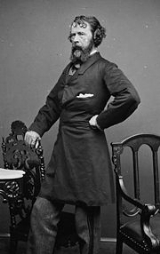
Nathaniel Parker Willis

Encyclopedia
Nathaniel Parker Willis also known as N. P. Willis, was an American author
, poet
and editor
who worked with several notable American writers including Edgar Allan Poe
and Henry Wadsworth Longfellow
. He became the highest-paid magazine writer of his day. For a time, he was the employer of former slave and future writer Harriet Jacobs. His brother was the composer Richard Storrs Willis and his sister wrote under the name Fanny Fern
.
Born in Portland, Maine
, Willis came from a family of publishers. His grandfather Nathaniel Willis owned newspapers in Massachusetts and Virginia, and his father Nathaniel Willis was the founder of Youth's Companion
, the first newspaper specifically for children. Willis developed an interest in literature while attending Yale College
and began publishing poetry. After graduation, he worked as an overseas correspondent for the New York Mirror
. He eventually moved to New York and began to build his literary reputation. Working with multiple publications, he was earning about US$100 per article and between $5,000 and $10,000 per year. In 1846, he started his own publication, the Home Journal, which was eventually renamed Town & Country
. Shortly after, Willis moved to a home on the Hudson River
where he lived a semi-retired life until his death in 1867.
Willis embedded his own personality into his writing and addressed his readers personally, specifically in his travel writing
s, so that his reputation was built in part because of his character. Critics, including his sister in her novel Ruth Hall
, occasionally described him as being effeminate and Europeanized. Willis also published several poems, tales, and a play. Despite his intense popularity for a time, at his death Willis was nearly forgotten.
and it was her husband's offer to edit the Eastern Argus in Maine that caused their move to Portland. Willis's younger sister was Sara Willis Parton, who would later become a writer under the pseudonym
Fanny Fern
. His brother, Richard Storrs Willis, became a musician and music journalist known for writing the melody for "It Came Upon the Midnight Clear". His other siblings were Lucy Douglas (born 1804), Louisa Harris (1807), Julia Dean (1809), Mary Perry (1813), Edward Payson (1816), and Ellen Holmes (1821).
In 1816, the family moved to Boston, where Willis's father established the Boston Recorder and, nine years later, the Youth's Companion
, the world's first newspaper for children. The elder Willis's emphasis on religious themes earned him the nickname "Deacon" Willis. After attending a Boston grammar school and Phillips Academy
at Andover
, Nathaniel Parker Willis entered Yale College
in October 1823 where he roomed with Horace Bushnell
. Willis credited Bushnell with teaching him the proper technique for sharpening a razor by "drawing it from heel to point both ways ... the two cross frictions correct each other". At Yale, he further developed an interest in literature, often neglecting his other studies. He graduated in 1827 and spent time touring parts of the United States and Canada. In Montreal
, he met Chester Harding
, with whom he would become a lifelong friend. Years later, Harding referred to Willis during this period as "the 'lion' of the town". Willis began publishing poetry in his father's Boston Periodical, often using one of two literary personalities under the pen name
s "Roy" (for religious subjects) and "Cassius" (for more secular topics). The same year, Willis published a volume of poetical Sketches.
The Token
, making him the only person to be editor in the book's 15-year history besides its founder, Samuel Griswold Goodrich
. That year, Willis founded the American Monthly Magazine, which began publishing in April 1829 until it was discontinued in August 1831. He blamed its failure on the "tight purses of Boston culture" and moved to Europe to serve as foreign editor and correspondent of the New York Mirror
. In 1832, while in Florence, Italy, he met Horatio Greenough
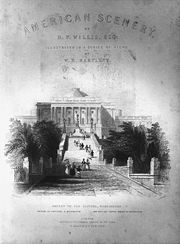
, who sculpted a bust of the writer. Between 1832 and 1836, Willis contributed a series of letters for the Mirror, about half of which were later collected as Pencillings by the Way, printed in London in 1835. The romantic descriptions of scenes and modes of life in Europe sold well despite the then high price tag of $7 a copy. The work became popular and boosted Willis's literary reputation enough that an American edition was soon issued.
 Despite this popularity, he was censured by some critics for indiscretion in reporting private conversations. At one point he fought a bloodless duel with Captain Frederick Marryat
, then editor of the Metropolitan Magazine, after Willis sent a private letter of Marryat's to George Pope Morris
, who had it printed. Still, in 1835 Willis was popular enough to introduce Henry Wadsworth Longfellow
to important literary figures in England, including Ada Byron
, daughter of Lord Byron
.
While abroad, Willis wrote to a friend, "I should like to marry in England". He soon married Mary Stace, daughter of General William Stace of Woolwich
, on October 1, 1835, after a month-long engagement. The couple took a two-week honeymoon
in Paris
. The couple moved to London where, in 1836, Willis met Charles Dickens
, who was working for the Morning Chronicle at the time.
In 1837, Willis and his wife returned to the United States and settled at a small estate on Owego Creek
in New York
, just above its junction with the Susquehanna River
. He named the home Glenmary and the 200 acre (0.809372 km²) rural setting inspired him to write Letters from under a Bridge. On October 20, 1838, Willis began a series of articles called "A New Series of Letters from London", one of which suggested an illicit relationship between writer Letitia Elizabeth Landon
and editor William Jordan. The article caused some scandal, for which Willis's publisher had to apologize.
On June 20, 1839, Willis's play Tortesa, the Usurer premiered in Philadelphia at the Walnut Street Theatre. Edgar Allan Poe
called it "by far the best play from the pen of an American author". That year, he was also editor of the short-lived periodical The Corsair, for which he enlisted William Makepeace Thackery to write short sketches of France. Another major work, Two Ways of Dying for a Husband, was published in England during a short visit there in 1839–1840. Shortly after returning to the United States, his personal life was touched with grief when his first child was stillborn
on December 4, 1840. He and Stace had a second daughter, Imogen, who was born June 20, 1842.
Later that year, Willis attended a ball in honor of Charles Dickens in New York. After dancing with Dickens's wife, Willis and Dickens went out for "rum toddy
and broiled oysters". By this time, his fame had grown enough that he was often invited to lecture and recite poetry, including his presentation to the Linonian Society
at Yale on August 17, 1841. Willis was invited to submit a column to the each weekly issue of Brother Johnathan, a publication from New York with 20,000 subscribers, which he did until September 1841. By 1842, Willis was earning the unusually high salary of $4,800 a year. As a later journalist remarked, this made Willis "the first magazine writer who was tolerably well paid".
In 1842, Willis employed Harriet Jacobs, an escaped slave from North Carolina
, as a house servant and nanny. When her owners sought to have her returned to their plantation, Willis's wife bought her freedom for $300. Nearly two decades later, Jacobs would write in her fictionalized autobiography Incidents in the Life of a Slave Girl
, which she began composing while working for the Willis family, that she "was convinced that ... Nathaniel Parker Willis was proslavery". Willis is depicted as "Mr. Bruce", an unattractive Southern sympathizer in the book. One of Willis's tales, "The Night Funeral of a Slave", featured an abolitionist who visits the South and regrets his anti-slavery views; Frederick Douglass
later used the work to criticize Northerners who were pro-slavery.
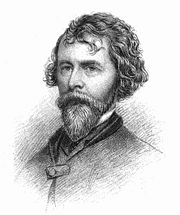 Returning to New York City
, Willis reorganized, along with George Pope Morris, the weekly New York Mirror as the daily Evening Mirror in 1844 with a weekly supplement called the Weekly Mirror, in part due to the rising cost of postage
. By this time, Willis was a popular writer (a joke was that Johann Wolfgang von Goethe
was Germany's version of N. P. Willis) and one of the first commercially successful magazine writers in America. In the fall of that year, he also became the first editor of the annual gift book The Opal
founded by Rufus Wilmot Griswold
. During this time, he became the highest-paid magazine writer in America, earning about $100 per article and $5,000 per year, a number which would soon double. Even the popular poet Longfellow admitted his jealousy of Willis's salary.
As a critic, Willis did not believe in including discussions of personalities of writers when reviewing their works. He also believed that, though publications should discuss political topics, they should not express party opinions or choose sides. The Mirror flourished at a time when many publications were discontinuing. Its success was due to the shrewd management of Willis and Morris and the two demonstrated that the American public could support literary endeavors. Willis was becoming an expert in American literature and so, in 1845, Willis and Morris issued an anthology
, The Prose and Poetry of America.
While Willis was editor of the Evening Mirror, its issue for January 29, 1845, included the first printing of Poe's poem "The Raven
" with his name attached. In his introduction, Willis called it "unsurpassed in English poetry for subtle conception, masterly ingenuity of versification, and consistent, sustaining of imaginative lift ... It will stick to the memory of everybody who reads it". Willis and Poe were close friends, and Willis helped Poe financially during his wife Virginia's
illness and while Poe was suing Thomas Dunn English
for libel
. Willis often tried to persuade Poe to be less destructive in his criticism and concentrate on his poetry. Even so, Willis published many pieces of what would later be referred to as "The Longfellow War", a literary battle between Poe and the supporters of Henry Wadsworth Longfellow, whom Poe called overrated and guilty of plagiarism
. Willis also introduced Poe to Fanny Osgood
; the two would later carry out a very public literary flirtation.
Willis's wife Mary Stace died in childbirth on March 25, 1845. Their daughter, Blanche, died as well and Willis wrote in his notebook that she was "an angel without fault or foible". He brought his surviving daughter Imogen to England to be with her mother's family and left her behind when he returned to the United States. In October 1846, he married Cornelia Grinnell, a wealthy Quaker from New Bedford and the adopted daughter of a local Congressman. She was two decades younger than Willis at the time and vocally disliked slavery, unlike her new husband. After the marriage, Willis's daughter Imogen came to live with the newlyweds in New York.
in 1901, and it is still published under that title as of 2011. During Willis's time at the journal, he especially promoted the works of women poets, including Frances Sargent Osgood
, Anne Lynch Botta
, Grace Greenwood
, and Julia Ward Howe
. Willis and his editors favorably reviewed many works now considered important today, including Henry David Thoreau's
Walden
and Nathaniel Hawthorne's
The Blithedale Romance
.
 In 1846, Willis settled near the banks of Canterbury Creek near the Hudson River
in New York and named his new home Idlewild. When Willis first visited the property, the owners said it had little value and that it was "an idle wild of which nothing could ever be made". He built a fourteen-room "cottage", as he called it, at the edge of a plateau by Moodna Creek
next to a sudden 200 feet (61 m) drop into a gorge. Willis worked closely with the architect, Calvert Vaux
, to carefully plan each gable and piazza to fully take advantage of the dramatic view of the river and mountains.
Because of failing health Willis spent the remainder of his life chiefly in retirement at Idlewild. His wife Cornelia was also recovering from a difficult illness after the birth of their first child together, a son named Grinnell, who was born April 28, 1848. They had four other children: Lilian (born April 27, 1850), Edith (born September 28, 1853), Bailey
(born May 31, 1857), and a daughter that died only a few minutes after her birth on October 31, 1860. Harriet Jacobs was re-hired by Willis to work for the family.
During these last years at Idlewild, Willis continued contributing a weekly letter to the Home Journal. In 1850 he assisted Rufus Wilmot Griswold
in preparing an anthology of the works of Poe, who had died mysteriously
the year before. Griswold also wrote the first biography of Poe in which he purposely set out to ruin the dead author's reputation. Willis was one of the most vocal of Poe's defenders, writing at one point: "The indictment (for it deserves no other name) is not true. It is full of cruel misrepresentations. It deepens the shadows unto unnatural darkness, and shuts out the rays of sunshines that ought to relieve them".
Willis was involved in the 1850 divorce
suit between the actor Edwin Forrest
and his wife Catherine. In January 1849, Forrest had found a love letter
to his wife from fellow actor George W. Jamieson
. As a result, he and Catherine separated in April 1849. He moved to Philadelphia and filed for divorce in February 1850 though the Pennsylvania legislature denied his application. Catharine went to live with the family of Parke Godwin
and the separation became a public affair, with newspapers throughout New York reporting on supposed infidelities and other gossip.
Willis defended Catharine, who maintained her innocence, in the Home Journal and suggested that Forrest was merely jealous of her intellectual superiority. On June 17, 1850, shortly after Forrest had filed for divorce in the New York Supreme Court, Forrest beat Willis with a gutta-percha
whip
in New York's Washington Square, shouting "this man is the seducer of my wife". Willis, who was recovering from a rheumatic fever
at the time, was unable to fight back. His wife soon received an anonymous letter with an accusation that Willis was in an adulterous relationship with Catherine Forrest. Willis later sued Forrest for assault and, by March 1852, was awarded $2,500 plus court costs. Throughout the Forrest divorce case, which lasted six weeks, several witnesses made additional claims that Catherine Forrest and Nathaniel Parker Willis were having an affair, including a waiter who claimed he had seen the couple "lying on each other". As the press reported, "thousands and thousands of the anxious public" awaited the court's verdict; ultimately, the court sided with Catherine Forrest and Willis's name was cleared.
, a barely concealed semi-autobiographical account of her own difficulties in the literary world. Nathaniel Willis was represented as "Hyacinth Ellet", an effeminate, self-serving editor who schemes to ruin his sister's prospects as a writer. Willis did not publicly protest but in private he asserted that, despite his fictitious equivalent, he had done his best to support his sister during her difficult times, especially after the death of her first husband.
Among his later works, following in his traditional sketches about his life and people he has met, were Hurry-Graphs (1851), Out-Doors at Idlewild (1854), and Ragbag (1855). Willis had complained that his magazine writing prevented him from writing a longer work. He finally had the time in 1856, and he wrote his only novel, Paul Fane, which was published a year later. The character Bosh Blivins, who served as comic relief
in the novel, may have been based on painter Chester Harding. His final work was The Convalescent (1859), which included a chapter on his time spent with Washington Irving
at Sunnyside
.
 In July 1860, Willis took his last major trip. Along with his wife, he stopped in Chicago
and Yellow Springs, Ohio
, as far west as Madison, Wisconsin
, and also took a steamboat down the Mississippi River
to St. Louis, Missouri
, and returned through Cincinnati, Ohio
and Pittsburgh, Pennsylvania. In 1861, Willis allowed the Home Journal to break its pledge to avoid taking sides in political discussions when the Confederate States of America
was established, calling the move a purposeful act to bring on war. On May 28, 1861, Willis was part of a committee of literary figures—including William Cullen Bryant
, Charles Anderson Dana
, and Horace Greeley
—to invite Edward Everett
to speak in New York on behalf of maintaining the Union. The Home Journal lost many subscribers during the American Civil War
, Morris died in 1864, and the Willis family had to take in boarders and for a time turned Idlewild into a girls' school for income.
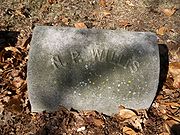
Willis was very sick in these final years: he suffered from violent epileptic seizures and, early in November 1866, fainted in the streets, prompting Harriet Jacobs to return to help his wife. Willis died on his sixty-first birthday, January 20, 1867, and was buried in Mount Auburn Cemetery
in Cambridge, Massachusetts. Four days later, the day of his funeral, all bookstores in the city were closed as a token of respect. His pallbearers included Longfellow, James Russell Lowell
, Oliver Wendell Holmes
, Samuel Gridley Howe
, and James Thomas Fields
.
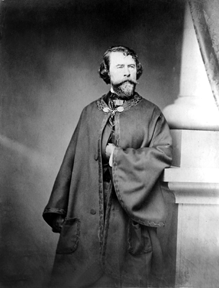 Throughout his literary career, Willis was well liked and known for his good nature amongst friends. Well traveled and clever, he had a striking appearance at six feet tall and was typically dressed elegantly. Many, however, remarked that Willis was effeminate, Europeanized, and guilty of "Miss Nancyism". One editor called him "an impersonal passive verb—a pronoun of the feminine gender". A contemporary caricature
depicted him wearing a fashionable beaver hat and tightly closed coat and carrying a cane, reflecting Willis's wide reputation as a "dandy
". Willis put considerable effort into his appearance and his fashion sense, presenting himself as a member of an upcoming American aristocracy. As Oliver Wendell Holmes, Sr.
once said, Willis was "something between a remembrance of Count D'Orsay
and an anticipation of Oscar Wilde
". Publisher Charles Frederick Briggs
once wrote that "Willis was too Willisy". He described his writings as the "novelty and gossip of the hour" and was not necessarily concerned about facts but with the "material of conversation and speculation, which may be mere rumor, may be the truth". Willis's behavior in social groups annoyed fellow poet Henry Wadsworth Longfellow. "He is too artificial", Longfellow wrote to his friend George Washington Greene
. "And his poetry has now lost one of its greatest charms for me—its sincerity". E. Burke Fisher, a journalist in Pittsburgh, wrote that "Willis is a kind of national pet and we must regard his faults as we do those of a spoiled stripling, in the hope that he will amend".
Willis built up his reputation in the public at a time when readers were interested in the personal lives of writers. In his writings, he described the "high life" of the "Upper Ten Thousand
", a phrase he coined. His travel writings in particular were popular for this reason as Willis was actually living the life he was describing and recommending to readers. Even so, he manufactured a humble and modest persona, questioned his own literary merit, and purposely used titles, such as Pencillings by the Way and Dashes at Life With Free Pencil, which downplayed their own quality. His informally toned editorials, which covered a variety of topics, were also very successful. Using whimsicality and humor, he was purposely informal to allow his personality to show in his writing. He addressed his readers personally, as if having a private conversation with them. As he once wrote: "We would have you ... indulge us in our innocent egotism as if it were all whispered in your private ear and over our iced Margaux
". When women poets were becoming popular in the 1850s, he emulated their style and focused on sentimental and moral subjects.
In the publishing world, Willis was known as a shrewd magazinist and an innovator who focused on appealing to readers' special interests while still recognizing new talent. In fact, Willis became the standard by which other magazinists were judged. According to writer George William Curtis
, "His gayety [sic] and his graceful fluency made him the first of our proper 'magazinists'". For a time, it was said that Willis was the "most-talked-about author" in the United States. Poe questioned Willis's fame, however. "Willis is no genius–a graceful trifler–no more", he wrote in a letter to James Russell Lowell. "In me, at least, he never excites an emotion." Minor Southern writer Joseph Beckham Cobb wrote: "No sane person, we are persuaded, can read his poetry". Future senator Charles Sumner
reported: "I find Willis is much laughed at for his sketches". Even so, most contemporaries recognized how prolific he was as a writer and how much time he put into all of his writings. James Parton
said of him:
By 1850 and with the publication of Hurry-Graphs, Willis was becoming a forgotten celebrity. In August 1853, future President
James A. Garfield discussed Willis's declining popularity in his diary: "Willis is said to be a licentious man, although an unrivaled poet. How strange that such men should go to ruin, when they might soar perpetually in the heaven of heavens". After Willis's death, obituaries reported that he had outlived his fame. One remarked, "the man who withdraws from the whirling currents of active life is speedily forgotten". This obituary also stated that Americans "will ever remember and cherish Nathaniel P. Willis as one worthy to stand with Fenimore Cooper
and Washington Irving". In 1946, the centennial issue of Town & Country reported that Willis "led a generation of Americans through a gate where weeds gave way to horticulture". More modern scholars have dismissed Willis's work as "sentimental prattle" or refer to him only as an obstacle in the progress of his more talented sister as well as Harriet Jacobs. As biographer Thomas N. Baker wrote, Willis is today only referred to as a footnote in relation to other authors.
Plays
Poetry
Author
An author is broadly defined as "the person who originates or gives existence to anything" and that authorship determines responsibility for what is created. Narrowly defined, an author is the originator of any written work.-Legal significance:...
, poet
Poet
A poet is a person who writes poetry. A poet's work can be literal, meaning that his work is derived from a specific event, or metaphorical, meaning that his work can take on many meanings and forms. Poets have existed since antiquity, in nearly all languages, and have produced works that vary...
and editor
Editing
Editing is the process of selecting and preparing written, visual, audible, and film media used to convey information through the processes of correction, condensation, organization, and other modifications performed with an intention of producing a correct, consistent, accurate, and complete...
who worked with several notable American writers including Edgar Allan Poe
Edgar Allan Poe
Edgar Allan Poe was an American author, poet, editor and literary critic, considered part of the American Romantic Movement. Best known for his tales of mystery and the macabre, Poe was one of the earliest American practitioners of the short story and is considered the inventor of the detective...
and Henry Wadsworth Longfellow
Henry Wadsworth Longfellow
Henry Wadsworth Longfellow was an American poet and educator whose works include "Paul Revere's Ride", The Song of Hiawatha, and Evangeline...
. He became the highest-paid magazine writer of his day. For a time, he was the employer of former slave and future writer Harriet Jacobs. His brother was the composer Richard Storrs Willis and his sister wrote under the name Fanny Fern
Fanny Fern
Fanny Fern, born Sara Willis , was an American writer and the first woman to have a regular newspaper column. She was also a humorist, novelist, and author of children's stories in the 1850s-1870s. Fern's great popularity has been attributed to her conversational style and sense of what mattered to...
.
Born in Portland, Maine
Portland, Maine
Portland is the largest city in Maine and is the county seat of Cumberland County. The 2010 city population was 66,194, growing 3 percent since the census of 2000...
, Willis came from a family of publishers. His grandfather Nathaniel Willis owned newspapers in Massachusetts and Virginia, and his father Nathaniel Willis was the founder of Youth's Companion
Youth's Companion
The Youth's Companion , known in later years as simply The Companion—For All the Family, was an American children's magazine that existed for over one hundred years until it finally merged with The American Boy in 1929...
, the first newspaper specifically for children. Willis developed an interest in literature while attending Yale College
Yale College
Yale College was the official name of Yale University from 1718 to 1887. The name now refers to the undergraduate part of the university. Each undergraduate student is assigned to one of 12 residential colleges.-Residential colleges:...
and began publishing poetry. After graduation, he worked as an overseas correspondent for the New York Mirror
New York Mirror
The New-York Mirror was a weekly newspaper published in New York City from 1823 to 1842, and again as a daily newspaper renamed The Evening Mirror from 1844 to 1898.-History:...
. He eventually moved to New York and began to build his literary reputation. Working with multiple publications, he was earning about US$100 per article and between $5,000 and $10,000 per year. In 1846, he started his own publication, the Home Journal, which was eventually renamed Town & Country
Town & Country (magazine)
Town & Country, formerly the Home Journal and The National Press, is a monthly American lifestyle magazine. It is the oldest continually published general interest magazine in the United States.-Early history:...
. Shortly after, Willis moved to a home on the Hudson River
Hudson River
The Hudson is a river that flows from north to south through eastern New York. The highest official source is at Lake Tear of the Clouds, on the slopes of Mount Marcy in the Adirondack Mountains. The river itself officially begins in Henderson Lake in Newcomb, New York...
where he lived a semi-retired life until his death in 1867.
Willis embedded his own personality into his writing and addressed his readers personally, specifically in his travel writing
Travel writing
Travel writing is a genre that has, as its focus, accounts of real or imaginary places. The genre encompasses a number of styles that may range from the documentary to the evocative, from literary to journalistic, and from the humorous to the serious....
s, so that his reputation was built in part because of his character. Critics, including his sister in her novel Ruth Hall
Ruth Hall
Ruth Hall: a Domestic Tale of the Present Time is a roman à clef by Fanny Fern , a popular 19th-century newspaper writer. Following on her meteoric rise to fame as a columnist, she signed a contract in February 1854 to write a full-length novel...
, occasionally described him as being effeminate and Europeanized. Willis also published several poems, tales, and a play. Despite his intense popularity for a time, at his death Willis was nearly forgotten.
Early life and family
Nathaniel Parker Willis was born on January 20, 1806, in Portland, Maine. His father Nathaniel Willis was a newspaper proprietor there and his grandfather owned newspapers in Boston, Massachusetts and western Virginia. His mother was Hannah Willis (née Parker) from Holliston, MassachusettsHolliston, Massachusetts
Holliston is a town in Middlesex County, Massachusetts, United States in the Greater Boston area. The population was 13,547 at the 2010 census. It is part of the region known as MetroWest. Holliston is the only town in Middlesex County that borders both Norfolk and Worcester...
and it was her husband's offer to edit the Eastern Argus in Maine that caused their move to Portland. Willis's younger sister was Sara Willis Parton, who would later become a writer under the pseudonym
Pseudonym
A pseudonym is a name that a person assumes for a particular purpose and that differs from his or her original orthonym...
Fanny Fern
Fanny Fern
Fanny Fern, born Sara Willis , was an American writer and the first woman to have a regular newspaper column. She was also a humorist, novelist, and author of children's stories in the 1850s-1870s. Fern's great popularity has been attributed to her conversational style and sense of what mattered to...
. His brother, Richard Storrs Willis, became a musician and music journalist known for writing the melody for "It Came Upon the Midnight Clear". His other siblings were Lucy Douglas (born 1804), Louisa Harris (1807), Julia Dean (1809), Mary Perry (1813), Edward Payson (1816), and Ellen Holmes (1821).
In 1816, the family moved to Boston, where Willis's father established the Boston Recorder and, nine years later, the Youth's Companion
Youth's Companion
The Youth's Companion , known in later years as simply The Companion—For All the Family, was an American children's magazine that existed for over one hundred years until it finally merged with The American Boy in 1929...
, the world's first newspaper for children. The elder Willis's emphasis on religious themes earned him the nickname "Deacon" Willis. After attending a Boston grammar school and Phillips Academy
Phillips Academy
Phillips Academy is a selective, co-educational independent boarding high school for boarding and day students in grades 9–12, along with a post-graduate year...
at Andover
Andover, Massachusetts
Andover is a town in Essex County, Massachusetts, United States. It was incorporated in 1646 and as of the 2010 census, the population was 33,201...
, Nathaniel Parker Willis entered Yale College
Yale College
Yale College was the official name of Yale University from 1718 to 1887. The name now refers to the undergraduate part of the university. Each undergraduate student is assigned to one of 12 residential colleges.-Residential colleges:...
in October 1823 where he roomed with Horace Bushnell
Horace Bushnell
Horace Bushnell was an American Congregational clergyman and theologian.-Life:Bushnell was a Yankee born in the village of Bantam, township of Litchfield, Connecticut. He attended Yale College where he roomed with future magazinist Nathaniel Parker Willis. Willis credited Bushnell with teaching...
. Willis credited Bushnell with teaching him the proper technique for sharpening a razor by "drawing it from heel to point both ways ... the two cross frictions correct each other". At Yale, he further developed an interest in literature, often neglecting his other studies. He graduated in 1827 and spent time touring parts of the United States and Canada. In Montreal
Montreal
Montreal is a city in Canada. It is the largest city in the province of Quebec, the second-largest city in Canada and the seventh largest in North America...
, he met Chester Harding
Chester Harding (painter)
Chester Harding was an American portrait painter.-Biography:Harding was born at Conway, Massachusetts. Brought up in the wilderness of New York state, he was a lad of robust physique, standing over 6 feet 3 inches...
, with whom he would become a lifelong friend. Years later, Harding referred to Willis during this period as "the 'lion' of the town". Willis began publishing poetry in his father's Boston Periodical, often using one of two literary personalities under the pen name
Pen name
A pen name, nom de plume, or literary double, is a pseudonym adopted by an author. A pen name may be used to make the author's name more distinctive, to disguise his or her gender, to distance an author from some or all of his or her works, to protect the author from retribution for his or her...
s "Roy" (for religious subjects) and "Cassius" (for more secular topics). The same year, Willis published a volume of poetical Sketches.
Literary career
In the latter part of the 1820s, Willis began contributing more frequently to magazines and periodicals. In 1829, he served as editor for the gift bookGift book
Gift books, literary annuals or a keepsake, were 19th century books, often lavishly decorated, which collected essays, short fiction, and poetry. They were primarily published in the autumn, in time for the holiday season and were intended to be given away rather than read by the purchaser...
The Token
The Token and Atlantic Souvenir
The Token was an annual, illustrated gift book, containing stories, poems and other light and entertaining reading. In 1833, it became The Token and Atlantic Souvenir.-History:...
, making him the only person to be editor in the book's 15-year history besides its founder, Samuel Griswold Goodrich
Samuel Griswold Goodrich
Samuel Griswold Goodrich was an American author, better known under the pseudonym Peter Parley.-Biography:Goodrich was born at Ridgefield, Connecticut as the son of a Congregational minister...
. That year, Willis founded the American Monthly Magazine, which began publishing in April 1829 until it was discontinued in August 1831. He blamed its failure on the "tight purses of Boston culture" and moved to Europe to serve as foreign editor and correspondent of the New York Mirror
New York Mirror
The New-York Mirror was a weekly newspaper published in New York City from 1823 to 1842, and again as a daily newspaper renamed The Evening Mirror from 1844 to 1898.-History:...
. In 1832, while in Florence, Italy, he met Horatio Greenough
Horatio Greenough
Horatio Greenough was an American sculptor best known for his United States government commissions The Rescue and George Washington .-Biography:...
, who sculpted a bust of the writer. Between 1832 and 1836, Willis contributed a series of letters for the Mirror, about half of which were later collected as Pencillings by the Way, printed in London in 1835. The romantic descriptions of scenes and modes of life in Europe sold well despite the then high price tag of $7 a copy. The work became popular and boosted Willis's literary reputation enough that an American edition was soon issued.
Frederick Marryat
Captain Frederick Marryat was an English Royal Navy officer, novelist, and a contemporary and acquaintance of Charles Dickens, noted today as an early pioneer of the sea story...
, then editor of the Metropolitan Magazine, after Willis sent a private letter of Marryat's to George Pope Morris
George Pope Morris
George Pope Morris was an American editor, poet, and songwriter.-Life and work:With Nathaniel Parker Willis, he co-founded the daily New York Evening Mirror by merging his fledgling weekly New York Mirror with Willis's American Monthly in August 1831...
, who had it printed. Still, in 1835 Willis was popular enough to introduce Henry Wadsworth Longfellow
Henry Wadsworth Longfellow
Henry Wadsworth Longfellow was an American poet and educator whose works include "Paul Revere's Ride", The Song of Hiawatha, and Evangeline...
to important literary figures in England, including Ada Byron
Ada Lovelace
Augusta Ada King, Countess of Lovelace , born Augusta Ada Byron, was an English writer chiefly known for her work on Charles Babbage's early mechanical general-purpose computer, the analytical engine...
, daughter of Lord Byron
George Gordon Byron, 6th Baron Byron
George Gordon Byron, 6th Baron Byron, later George Gordon Noel, 6th Baron Byron, FRS , commonly known simply as Lord Byron, was a British poet and a leading figure in the Romantic movement...
.
While abroad, Willis wrote to a friend, "I should like to marry in England". He soon married Mary Stace, daughter of General William Stace of Woolwich
Woolwich
Woolwich is a district in south London, England, located in the London Borough of Greenwich. The area is identified in the London Plan as one of 35 major centres in Greater London.Woolwich formed part of Kent until 1889 when the County of London was created...
, on October 1, 1835, after a month-long engagement. The couple took a two-week honeymoon
Honeymoon
-History:One early reference to a honeymoon is in Deuteronomy 24:5 “When a man is newly wed, he need not go out on a military expedition, nor shall any public duty be imposed on him...
in Paris
Paris
Paris is the capital and largest city in France, situated on the river Seine, in northern France, at the heart of the Île-de-France region...
. The couple moved to London where, in 1836, Willis met Charles Dickens
Charles Dickens
Charles John Huffam Dickens was an English novelist, generally considered the greatest of the Victorian period. Dickens enjoyed a wider popularity and fame than had any previous author during his lifetime, and he remains popular, having been responsible for some of English literature's most iconic...
, who was working for the Morning Chronicle at the time.
In 1837, Willis and his wife returned to the United States and settled at a small estate on Owego Creek
Owego (town), New York
Owego is a town in Tioga County, New York, USA. The population was 20,365 at the 2000 census. The name is derived from the Iroquois word Ahwaga, meaning where the valley widens....
in New York
New York
New York is a state in the Northeastern region of the United States. It is the nation's third most populous state. New York is bordered by New Jersey and Pennsylvania to the south, and by Connecticut, Massachusetts and Vermont to the east...
, just above its junction with the Susquehanna River
Susquehanna River
The Susquehanna River is a river located in the northeastern United States. At long, it is the longest river on the American east coast that drains into the Atlantic Ocean, and with its watershed it is the 16th largest river in the United States, and the longest river in the continental United...
. He named the home Glenmary and the 200 acre (0.809372 km²) rural setting inspired him to write Letters from under a Bridge. On October 20, 1838, Willis began a series of articles called "A New Series of Letters from London", one of which suggested an illicit relationship between writer Letitia Elizabeth Landon
Letitia Elizabeth Landon
Letitia Elizabeth Landon , English poet and novelist, better known by her initials L. E. L.- Early life :...
and editor William Jordan. The article caused some scandal, for which Willis's publisher had to apologize.
On June 20, 1839, Willis's play Tortesa, the Usurer premiered in Philadelphia at the Walnut Street Theatre. Edgar Allan Poe
Edgar Allan Poe
Edgar Allan Poe was an American author, poet, editor and literary critic, considered part of the American Romantic Movement. Best known for his tales of mystery and the macabre, Poe was one of the earliest American practitioners of the short story and is considered the inventor of the detective...
called it "by far the best play from the pen of an American author". That year, he was also editor of the short-lived periodical The Corsair, for which he enlisted William Makepeace Thackery to write short sketches of France. Another major work, Two Ways of Dying for a Husband, was published in England during a short visit there in 1839–1840. Shortly after returning to the United States, his personal life was touched with grief when his first child was stillborn
Stillbirth
A stillbirth occurs when a fetus has died in the uterus. The Australian definition specifies that fetal death is termed a stillbirth after 20 weeks gestation or the fetus weighs more than . Once the fetus has died the mother still has contractions and remains undelivered. The term is often used in...
on December 4, 1840. He and Stace had a second daughter, Imogen, who was born June 20, 1842.
Later that year, Willis attended a ball in honor of Charles Dickens in New York. After dancing with Dickens's wife, Willis and Dickens went out for "rum toddy
Hot toddy
A hot toddy is a mixed drink, usually including alcohol, that is served hot. Hot toddies are traditionally drunk before going to bed, or in wet or cold weather...
and broiled oysters". By this time, his fame had grown enough that he was often invited to lecture and recite poetry, including his presentation to the Linonian Society
Linonian Society
Linonia is a literary and debating society founded in 1753 at Yale University.-History:Linonia was founded in 1753 as Yale University's second literary and debating society. By the late eighteenth century, all incoming freshmen at Yale College became members either of Linonia or its rival society,...
at Yale on August 17, 1841. Willis was invited to submit a column to the each weekly issue of Brother Johnathan, a publication from New York with 20,000 subscribers, which he did until September 1841. By 1842, Willis was earning the unusually high salary of $4,800 a year. As a later journalist remarked, this made Willis "the first magazine writer who was tolerably well paid".
In 1842, Willis employed Harriet Jacobs, an escaped slave from North Carolina
North Carolina
North Carolina is a state located in the southeastern United States. The state borders South Carolina and Georgia to the south, Tennessee to the west and Virginia to the north. North Carolina contains 100 counties. Its capital is Raleigh, and its largest city is Charlotte...
, as a house servant and nanny. When her owners sought to have her returned to their plantation, Willis's wife bought her freedom for $300. Nearly two decades later, Jacobs would write in her fictionalized autobiography Incidents in the Life of a Slave Girl
Incidents in the Life of a Slave Girl
Incidents in the Life of a Slave Girl is a book that was published in 1861 by Harriet Jacobs, using the pen name "Linda Brent". While on one level it chronicles the experiences of Harriet Jacobs as a slave, and the various humiliations she had to endure in that unhappy state, it also deals with...
, which she began composing while working for the Willis family, that she "was convinced that ... Nathaniel Parker Willis was proslavery". Willis is depicted as "Mr. Bruce", an unattractive Southern sympathizer in the book. One of Willis's tales, "The Night Funeral of a Slave", featured an abolitionist who visits the South and regrets his anti-slavery views; Frederick Douglass
Frederick Douglass
Frederick Douglass was an American social reformer, orator, writer and statesman. After escaping from slavery, he became a leader of the abolitionist movement, gaining note for his dazzling oratory and incisive antislavery writing...
later used the work to criticize Northerners who were pro-slavery.
Evening Mirror
New York City
New York is the most populous city in the United States and the center of the New York Metropolitan Area, one of the most populous metropolitan areas in the world. New York exerts a significant impact upon global commerce, finance, media, art, fashion, research, technology, education, and...
, Willis reorganized, along with George Pope Morris, the weekly New York Mirror as the daily Evening Mirror in 1844 with a weekly supplement called the Weekly Mirror, in part due to the rising cost of postage
Mail
Mail, or post, is a system for transporting letters and other tangible objects: written documents, typically enclosed in envelopes, and also small packages are delivered to destinations around the world. Anything sent through the postal system is called mail or post.In principle, a postal service...
. By this time, Willis was a popular writer (a joke was that Johann Wolfgang von Goethe
Johann Wolfgang von Goethe
Johann Wolfgang von Goethe was a German writer, pictorial artist, biologist, theoretical physicist, and polymath. He is considered the supreme genius of modern German literature. His works span the fields of poetry, drama, prose, philosophy, and science. His Faust has been called the greatest long...
was Germany's version of N. P. Willis) and one of the first commercially successful magazine writers in America. In the fall of that year, he also became the first editor of the annual gift book The Opal
The Opal (annual)
The Opal, A Pure Gift for the Holy Days, was an annual gift book, founded by Rufus Wilmot Griswold and published in New York by John C. Riker, from 1844 to 1849. Content included short stories, illustrations and poems....
founded by Rufus Wilmot Griswold
Rufus Wilmot Griswold
Rufus Wilmot Griswold was an American anthologist, editor, poet, and critic. Born in Vermont, Griswold left home when he was 15 years old. He worked as a journalist, editor, and critic in Philadelphia, New York City, and elsewhere. He built up a strong literary reputation, in part due to his 1842...
. During this time, he became the highest-paid magazine writer in America, earning about $100 per article and $5,000 per year, a number which would soon double. Even the popular poet Longfellow admitted his jealousy of Willis's salary.
As a critic, Willis did not believe in including discussions of personalities of writers when reviewing their works. He also believed that, though publications should discuss political topics, they should not express party opinions or choose sides. The Mirror flourished at a time when many publications were discontinuing. Its success was due to the shrewd management of Willis and Morris and the two demonstrated that the American public could support literary endeavors. Willis was becoming an expert in American literature and so, in 1845, Willis and Morris issued an anthology
Anthology
An anthology is a collection of literary works chosen by the compiler. It may be a collection of poems, short stories, plays, songs, or excerpts...
, The Prose and Poetry of America.
While Willis was editor of the Evening Mirror, its issue for January 29, 1845, included the first printing of Poe's poem "The Raven
The Raven
"The Raven" is a narrative poem by American writer Edgar Allan Poe, first published in January 1845. It is often noted for its musicality, stylized language, and supernatural atmosphere. It tells of a talking raven's mysterious visit to a distraught lover, tracing the man's slow descent into madness...
" with his name attached. In his introduction, Willis called it "unsurpassed in English poetry for subtle conception, masterly ingenuity of versification, and consistent, sustaining of imaginative lift ... It will stick to the memory of everybody who reads it". Willis and Poe were close friends, and Willis helped Poe financially during his wife Virginia's
Virginia Eliza Clemm Poe
Virginia Eliza Clemm Poe was the wife of American writer Edgar Allan Poe. The couple were first cousins and married when Virginia Clemm was 13 and Poe was 27...
illness and while Poe was suing Thomas Dunn English
Thomas Dunn English
Thomas Dunn English was an American Democratic Party politician from New Jersey who represented the state's 6th congressional district in the House of Representatives from 1891 to 1895. He was also a published author and songwriter, who had a bitter ongoing feud with Edgar Allan...
for libel
Slander and libel
Defamation—also called calumny, vilification, traducement, slander , and libel —is the communication of a statement that makes a claim, expressly stated or implied to be factual, that may give an individual, business, product, group, government, or nation a negative image...
. Willis often tried to persuade Poe to be less destructive in his criticism and concentrate on his poetry. Even so, Willis published many pieces of what would later be referred to as "The Longfellow War", a literary battle between Poe and the supporters of Henry Wadsworth Longfellow, whom Poe called overrated and guilty of plagiarism
Plagiarism
Plagiarism is defined in dictionaries as the "wrongful appropriation," "close imitation," or "purloining and publication" of another author's "language, thoughts, ideas, or expressions," and the representation of them as one's own original work, but the notion remains problematic with nebulous...
. Willis also introduced Poe to Fanny Osgood
Frances Sargent Osgood
Frances Sargent Osgood was an American poet and one of the most popular women writers during her time...
; the two would later carry out a very public literary flirtation.
Willis's wife Mary Stace died in childbirth on March 25, 1845. Their daughter, Blanche, died as well and Willis wrote in his notebook that she was "an angel without fault or foible". He brought his surviving daughter Imogen to England to be with her mother's family and left her behind when he returned to the United States. In October 1846, he married Cornelia Grinnell, a wealthy Quaker from New Bedford and the adopted daughter of a local Congressman. She was two decades younger than Willis at the time and vocally disliked slavery, unlike her new husband. After the marriage, Willis's daughter Imogen came to live with the newlyweds in New York.
Home Journal
In 1846, Willis and Morris left the Evening Mirror and attempted to edit a new weekly, the National Press, which was renamed the Home Journal after eight months. Their prospectus for the publication, published November 21, 1846, announced their intentions to create a magazine "to circle around the family table". Willis intended the magazine for the middle and lower classes and included the message of upward social mobility, using himself as an example, often describing in detail his personal possessions. When discussing his own social climbing, however, he emphasized his frustrations rather than his successes, endearing him to his audience. He edited the Home Journal until his death in 1867. It was renamed Town & CountryTown & Country (magazine)
Town & Country, formerly the Home Journal and The National Press, is a monthly American lifestyle magazine. It is the oldest continually published general interest magazine in the United States.-Early history:...
in 1901, and it is still published under that title as of 2011. During Willis's time at the journal, he especially promoted the works of women poets, including Frances Sargent Osgood
Frances Sargent Osgood
Frances Sargent Osgood was an American poet and one of the most popular women writers during her time...
, Anne Lynch Botta
Anne Lynch Botta
Anne Charlotte Lynch Botta was an American poet, writer, teacher and socialite whose home was the central gathering place of the literary elite of her era.-Early life:...
, Grace Greenwood
Sara Jane Lippincott
Sara Jane Lippincott was better known by the pseudonym Grace Greenwood. She was an American author, poet and lecturer. One of the first women to gain access into the Congressional press galleries, she used her questions to advocate for social reform and women's rights.-Biography:thumb|left|Sara...
, and Julia Ward Howe
Julia Ward Howe
Julia Ward Howe was a prominent American abolitionist, social activist, and poet, most famous as the author of "The Battle Hymn of the Republic".-Biography:...
. Willis and his editors favorably reviewed many works now considered important today, including Henry David Thoreau's
Henry David Thoreau
Henry David Thoreau was an American author, poet, philosopher, abolitionist, naturalist, tax resister, development critic, surveyor, historian, and leading transcendentalist...
Walden
Walden
Walden is an American book written by noted Transcendentalist Henry David Thoreau...
and Nathaniel Hawthorne's
Nathaniel Hawthorne
Nathaniel Hawthorne was an American novelist and short story writer.Nathaniel Hawthorne was born in 1804 in the city of Salem, Massachusetts to Nathaniel Hathorne and the former Elizabeth Clarke Manning. His ancestors include John Hathorne, a judge during the Salem Witch Trials...
The Blithedale Romance
The Blithedale Romance
The Blithedale Romance is Nathaniel Hawthorne's third major romance. In Hawthorne , Henry James called it "the lightest, the brightest, the liveliest" of Hawthorne's "unhumorous fictions."-Plot summary:...
.
Idlewild
Hudson River
The Hudson is a river that flows from north to south through eastern New York. The highest official source is at Lake Tear of the Clouds, on the slopes of Mount Marcy in the Adirondack Mountains. The river itself officially begins in Henderson Lake in Newcomb, New York...
in New York and named his new home Idlewild. When Willis first visited the property, the owners said it had little value and that it was "an idle wild of which nothing could ever be made". He built a fourteen-room "cottage", as he called it, at the edge of a plateau by Moodna Creek
Moodna Creek
Moodna Creek is a small tributary of the Hudson River that drains eastern Orange County, New York. At 15.5 miles in length from its source at the confluence of Cromline Creek and Otter Kill west of Washingtonville, it is the longest stream located entirely within the county.Despite its small...
next to a sudden 200 feet (61 m) drop into a gorge. Willis worked closely with the architect, Calvert Vaux
Calvert Vaux
Calvert Vaux , was an architect and landscape designer. He is best remembered as the co-designer , of New York's Central Park....
, to carefully plan each gable and piazza to fully take advantage of the dramatic view of the river and mountains.
Because of failing health Willis spent the remainder of his life chiefly in retirement at Idlewild. His wife Cornelia was also recovering from a difficult illness after the birth of their first child together, a son named Grinnell, who was born April 28, 1848. They had four other children: Lilian (born April 27, 1850), Edith (born September 28, 1853), Bailey
Bailey Willis
Bailey Willis was a geological engineer who worked for the United States Geological Survey , and lectured at two prominent American universities. He also played a key role in getting Mount Rainier designated as a national park in 1899...
(born May 31, 1857), and a daughter that died only a few minutes after her birth on October 31, 1860. Harriet Jacobs was re-hired by Willis to work for the family.
During these last years at Idlewild, Willis continued contributing a weekly letter to the Home Journal. In 1850 he assisted Rufus Wilmot Griswold
Rufus Wilmot Griswold
Rufus Wilmot Griswold was an American anthologist, editor, poet, and critic. Born in Vermont, Griswold left home when he was 15 years old. He worked as a journalist, editor, and critic in Philadelphia, New York City, and elsewhere. He built up a strong literary reputation, in part due to his 1842...
in preparing an anthology of the works of Poe, who had died mysteriously
Death of Edgar Allan Poe
The death of Edgar Allan Poe on October 7, 1849, has remained mysterious: the circumstances leading up to it are uncertain and the cause of death is disputed. On October 3, Poe was found delirious on the streets of Baltimore, Maryland, "in great distress, and ... in need of immediate assistance",...
the year before. Griswold also wrote the first biography of Poe in which he purposely set out to ruin the dead author's reputation. Willis was one of the most vocal of Poe's defenders, writing at one point: "The indictment (for it deserves no other name) is not true. It is full of cruel misrepresentations. It deepens the shadows unto unnatural darkness, and shuts out the rays of sunshines that ought to relieve them".
Willis was involved in the 1850 divorce
Divorce
Divorce is the final termination of a marital union, canceling the legal duties and responsibilities of marriage and dissolving the bonds of matrimony between the parties...
suit between the actor Edwin Forrest
Edwin Forrest
Edwin Forrest was an American actor.-Early life:Forrest was born in Philadelphia, Pennsylvania, of Scottish and German descent. His father died and he was brought up by his mother, a German woman of humble origins. He was educated at the common schools in Philadelphia, and early evinced a taste...
and his wife Catherine. In January 1849, Forrest had found a love letter
Love letter
A love letter is a romantic way to express feelings of love in written form. Delivered by hand, by mail or romantically left in a secret location, the letter may be anything from a short and simple message of love to a lengthy explanation of feelings...
to his wife from fellow actor George W. Jamieson
George W. Jamieson
George W. Jamieson was an American actor and lapidary, born in Varick Street, New York. His mother was an American of remarkable talents; his father was an Irishman. At an early age he was apprenticed to a lapidary, and in cutting gems he acquired facility, — his cameos being considered...
. As a result, he and Catherine separated in April 1849. He moved to Philadelphia and filed for divorce in February 1850 though the Pennsylvania legislature denied his application. Catharine went to live with the family of Parke Godwin
Parke Godwin (journalist)
Parke Godwin was an American journalist associated with New York.-Biography:Godwin was born on February 28, 1816, in Paterson, New Jersey. His father was an officer in the war of 1812, and his grandfather a soldier of the American Revolution...
and the separation became a public affair, with newspapers throughout New York reporting on supposed infidelities and other gossip.
Willis defended Catharine, who maintained her innocence, in the Home Journal and suggested that Forrest was merely jealous of her intellectual superiority. On June 17, 1850, shortly after Forrest had filed for divorce in the New York Supreme Court, Forrest beat Willis with a gutta-percha
Gutta-percha
Gutta-percha is a genus of tropical trees native to Southeast Asia and northern Australasia, from Taiwan south to the Malay Peninsula and east to the Solomon Islands. The same term is used to refer to an inelastic natural latex produced from the sap of these trees, particularly from the species...
whip
Whip
A whip is a tool traditionally used by humans to exert control over animals or other people, through pain compliance or fear of pain, although in some activities whips can be used without use of pain, such as an additional pressure aid in dressage...
in New York's Washington Square, shouting "this man is the seducer of my wife". Willis, who was recovering from a rheumatic fever
Rheumatic fever
Rheumatic fever is an inflammatory disease that occurs following a Streptococcus pyogenes infection, such as strep throat or scarlet fever. Believed to be caused by antibody cross-reactivity that can involve the heart, joints, skin, and brain, the illness typically develops two to three weeks after...
at the time, was unable to fight back. His wife soon received an anonymous letter with an accusation that Willis was in an adulterous relationship with Catherine Forrest. Willis later sued Forrest for assault and, by March 1852, was awarded $2,500 plus court costs. Throughout the Forrest divorce case, which lasted six weeks, several witnesses made additional claims that Catherine Forrest and Nathaniel Parker Willis were having an affair, including a waiter who claimed he had seen the couple "lying on each other". As the press reported, "thousands and thousands of the anxious public" awaited the court's verdict; ultimately, the court sided with Catherine Forrest and Willis's name was cleared.
Ruth Hall
Willis refused to print the work of his sister Sara Willis ("Fanny Fern") after 1854, though she previously had contributed anonymous book reviews to the Home Journal. She had recently been widowed, became destitute, and was publicly denounced by her abusive second husband. Criticizing what he perceived as her restlessness, Willis once made her the subject of his poem "To My Wild Sis". As Fanny Fern, she had published Fern Leaves, which sold over 100,000 copies the year before. Willis, however, did not encourage his sister's writings. "You overstrain the pathetic, and your humor runs into dreadful vulgarity sometimes ... I am sorry that any editor knows that a sister of mine wrote some of these which you sent me", he wrote. In 1854 she published Ruth Hall, a Domestic Tale of the Present TimeRuth Hall
Ruth Hall: a Domestic Tale of the Present Time is a roman à clef by Fanny Fern , a popular 19th-century newspaper writer. Following on her meteoric rise to fame as a columnist, she signed a contract in February 1854 to write a full-length novel...
, a barely concealed semi-autobiographical account of her own difficulties in the literary world. Nathaniel Willis was represented as "Hyacinth Ellet", an effeminate, self-serving editor who schemes to ruin his sister's prospects as a writer. Willis did not publicly protest but in private he asserted that, despite his fictitious equivalent, he had done his best to support his sister during her difficult times, especially after the death of her first husband.
Among his later works, following in his traditional sketches about his life and people he has met, were Hurry-Graphs (1851), Out-Doors at Idlewild (1854), and Ragbag (1855). Willis had complained that his magazine writing prevented him from writing a longer work. He finally had the time in 1856, and he wrote his only novel, Paul Fane, which was published a year later. The character Bosh Blivins, who served as comic relief
Comic relief
Comic relief is the inclusion of a humorous character, scene or witty dialogue in an otherwise serious work, often to relieve tension.-Definition:...
in the novel, may have been based on painter Chester Harding. His final work was The Convalescent (1859), which included a chapter on his time spent with Washington Irving
Washington Irving
Washington Irving was an American author, essayist, biographer and historian of the early 19th century. He was best known for his short stories "The Legend of Sleepy Hollow" and "Rip Van Winkle", both of which appear in his book The Sketch Book of Geoffrey Crayon, Gent. His historical works...
at Sunnyside
Sunnyside (Tarrytown, New York)
Sunnyside is a historic house on 10 acres of grounds alongside the Hudson River in Tarrytown, New York. It was formerly the home of noted early American author Washington Irving, best known for his short stories "The Legend of Sleepy Hollow" and "Rip Van Winkle", and is a National Historic...
.
Final years and death
Chicago
Chicago is the largest city in the US state of Illinois. With nearly 2.7 million residents, it is the most populous city in the Midwestern United States and the third most populous in the US, after New York City and Los Angeles...
and Yellow Springs, Ohio
Yellow Springs, Ohio
Yellow Springs is a village in Greene County, Ohio, United States, and is the location of Antioch College and Antioch University Midwest. The population was 3,487 at the 2010 census...
, as far west as Madison, Wisconsin
Madison, Wisconsin
Madison is the capital of the U.S. state of Wisconsin and the county seat of Dane County. It is also home to the University of Wisconsin–Madison....
, and also took a steamboat down the Mississippi River
Mississippi River
The Mississippi River is the largest river system in North America. Flowing entirely in the United States, this river rises in western Minnesota and meanders slowly southwards for to the Mississippi River Delta at the Gulf of Mexico. With its many tributaries, the Mississippi's watershed drains...
to St. Louis, Missouri
St. Louis, Missouri
St. Louis is an independent city on the eastern border of Missouri, United States. With a population of 319,294, it was the 58th-largest U.S. city at the 2010 U.S. Census. The Greater St...
, and returned through Cincinnati, Ohio
Cincinnati, Ohio
Cincinnati is a city in the U.S. state of Ohio. Cincinnati is the county seat of Hamilton County. Settled in 1788, the city is located to north of the Ohio River at the Ohio-Kentucky border, near Indiana. The population within city limits is 296,943 according to the 2010 census, making it Ohio's...
and Pittsburgh, Pennsylvania. In 1861, Willis allowed the Home Journal to break its pledge to avoid taking sides in political discussions when the Confederate States of America
Confederate States of America
The Confederate States of America was a government set up from 1861 to 1865 by 11 Southern slave states of the United States of America that had declared their secession from the U.S...
was established, calling the move a purposeful act to bring on war. On May 28, 1861, Willis was part of a committee of literary figures—including William Cullen Bryant
William Cullen Bryant
William Cullen Bryant was an American romantic poet, journalist, and long-time editor of the New York Evening Post.-Youth and education:...
, Charles Anderson Dana
Charles Anderson Dana
Charles Anderson Dana was an American journalist, author, and government official, best known for his association with Ulysses S. Grant during the American Civil War and his aggressive political advocacy after the war....
, and Horace Greeley
Horace Greeley
Horace Greeley was an American newspaper editor, a founder of the Liberal Republican Party, a reformer, a politician, and an outspoken opponent of slavery...
—to invite Edward Everett
Edward Everett
Edward Everett was an American politician and educator from Massachusetts. Everett, a Whig, served as U.S. Representative, and U.S. Senator, the 15th Governor of Massachusetts, Minister to Great Britain, and United States Secretary of State...
to speak in New York on behalf of maintaining the Union. The Home Journal lost many subscribers during the American Civil War
American Civil War
The American Civil War was a civil war fought in the United States of America. In response to the election of Abraham Lincoln as President of the United States, 11 southern slave states declared their secession from the United States and formed the Confederate States of America ; the other 25...
, Morris died in 1864, and the Willis family had to take in boarders and for a time turned Idlewild into a girls' school for income.
Willis was very sick in these final years: he suffered from violent epileptic seizures and, early in November 1866, fainted in the streets, prompting Harriet Jacobs to return to help his wife. Willis died on his sixty-first birthday, January 20, 1867, and was buried in Mount Auburn Cemetery
Mount Auburn Cemetery
Mount Auburn Cemetery was founded in 1831 as "America's first garden cemetery", or the first "rural cemetery", with classical monuments set in a rolling landscaped terrain...
in Cambridge, Massachusetts. Four days later, the day of his funeral, all bookstores in the city were closed as a token of respect. His pallbearers included Longfellow, James Russell Lowell
James Russell Lowell
James Russell Lowell was an American Romantic poet, critic, editor, and diplomat. He is associated with the Fireside Poets, a group of New England writers who were among the first American poets who rivaled the popularity of British poets...
, Oliver Wendell Holmes
Oliver Wendell Holmes, Sr.
Oliver Wendell Holmes, Sr. was an American physician, professor, lecturer, and author. Regarded by his peers as one of the best writers of the 19th century, he is considered a member of the Fireside Poets. His most famous prose works are the "Breakfast-Table" series, which began with The Autocrat...
, Samuel Gridley Howe
Samuel Gridley Howe
Samuel Gridley Howe was a nineteenth century United States physician, abolitionist, and an advocate of education for the blind.-Early life and education:...
, and James Thomas Fields
James Thomas Fields
James Thomas Fields was an American publisher, editor, and poet.-Early life and family:He was born in Portsmouth, New Hampshire on December 31, 1817 and named James Field; the family later added the "s". His father was a sea captain and died before Fields was three...
.
Reputation
Caricature
A caricature is a portrait that exaggerates or distorts the essence of a person or thing to create an easily identifiable visual likeness. In literature, a caricature is a description of a person using exaggeration of some characteristics and oversimplification of others.Caricatures can be...
depicted him wearing a fashionable beaver hat and tightly closed coat and carrying a cane, reflecting Willis's wide reputation as a "dandy
Dandy
A dandy is a man who places particular importance upon physical appearance, refined language, and leisurely hobbies, pursued with the appearance of nonchalance in a cult of Self...
". Willis put considerable effort into his appearance and his fashion sense, presenting himself as a member of an upcoming American aristocracy. As Oliver Wendell Holmes, Sr.
Oliver Wendell Holmes, Sr.
Oliver Wendell Holmes, Sr. was an American physician, professor, lecturer, and author. Regarded by his peers as one of the best writers of the 19th century, he is considered a member of the Fireside Poets. His most famous prose works are the "Breakfast-Table" series, which began with The Autocrat...
once said, Willis was "something between a remembrance of Count D'Orsay
Alfred Guillaume Gabriel, Count D'Orsay
Alfred d'Orsay, known as the comte d'Orsay was a French amateur artist, dandy, and man of fashion in the early- to mid-19th century.-Life:...
and an anticipation of Oscar Wilde
Oscar Wilde
Oscar Fingal O'Flahertie Wills Wilde was an Irish writer and poet. After writing in different forms throughout the 1880s, he became one of London's most popular playwrights in the early 1890s...
". Publisher Charles Frederick Briggs
Charles Frederick Briggs
Charles Frederick Briggs , also called C. F. Briggs, was an American journalist, author and editor, born in Nantucket, Massachusetts...
once wrote that "Willis was too Willisy". He described his writings as the "novelty and gossip of the hour" and was not necessarily concerned about facts but with the "material of conversation and speculation, which may be mere rumor, may be the truth". Willis's behavior in social groups annoyed fellow poet Henry Wadsworth Longfellow. "He is too artificial", Longfellow wrote to his friend George Washington Greene
George Washington Greene
George Washington Greene was an American historian as well as the grandson of Major-General Nathanael Greene, who served during the American Revolutionary War.-Biography:...
. "And his poetry has now lost one of its greatest charms for me—its sincerity". E. Burke Fisher, a journalist in Pittsburgh, wrote that "Willis is a kind of national pet and we must regard his faults as we do those of a spoiled stripling, in the hope that he will amend".
Willis built up his reputation in the public at a time when readers were interested in the personal lives of writers. In his writings, he described the "high life" of the "Upper Ten Thousand
Upper ten thousand
Upper Ten Thousand, or simply, The Upper Ten, is a phrase coined in 1852 by American poet Nathaniel Parker Willis to describe the upper circles of New York, and hence of other major cities....
", a phrase he coined. His travel writings in particular were popular for this reason as Willis was actually living the life he was describing and recommending to readers. Even so, he manufactured a humble and modest persona, questioned his own literary merit, and purposely used titles, such as Pencillings by the Way and Dashes at Life With Free Pencil, which downplayed their own quality. His informally toned editorials, which covered a variety of topics, were also very successful. Using whimsicality and humor, he was purposely informal to allow his personality to show in his writing. He addressed his readers personally, as if having a private conversation with them. As he once wrote: "We would have you ... indulge us in our innocent egotism as if it were all whispered in your private ear and over our iced Margaux
Margaux
Margaux is a commune in the Gironde department in Aquitaine in southwestern France.-Geography:The village lies in the Haut Médoc wine making region on the left bank of the Garonne estuary, northwest of the city of Bordeaux.-Population:-Wines:...
". When women poets were becoming popular in the 1850s, he emulated their style and focused on sentimental and moral subjects.
In the publishing world, Willis was known as a shrewd magazinist and an innovator who focused on appealing to readers' special interests while still recognizing new talent. In fact, Willis became the standard by which other magazinists were judged. According to writer George William Curtis
George William Curtis
George William Curtis was an American writer and public speaker, born in Providence, Rhode Island, of old New England stock.-Biography:...
, "His gayety [sic] and his graceful fluency made him the first of our proper 'magazinists'". For a time, it was said that Willis was the "most-talked-about author" in the United States. Poe questioned Willis's fame, however. "Willis is no genius–a graceful trifler–no more", he wrote in a letter to James Russell Lowell. "In me, at least, he never excites an emotion." Minor Southern writer Joseph Beckham Cobb wrote: "No sane person, we are persuaded, can read his poetry". Future senator Charles Sumner
Charles Sumner
Charles Sumner was an American politician and senator from Massachusetts. An academic lawyer and a powerful orator, Sumner was the leader of the antislavery forces in Massachusetts and a leader of the Radical Republicans in the United States Senate during the American Civil War and Reconstruction,...
reported: "I find Willis is much laughed at for his sketches". Even so, most contemporaries recognized how prolific he was as a writer and how much time he put into all of his writings. James Parton
James Parton
James Parton was an England-born American biographer.-Biography:Parton was born in Canterbury, England in 1822. He was taken to the United States when he was five years old, studied in New York City and White Plains, New York, and was a schoolmaster in Philadelphia and then in New York...
said of him:
By 1850 and with the publication of Hurry-Graphs, Willis was becoming a forgotten celebrity. In August 1853, future President
President of the United States
The President of the United States of America is the head of state and head of government of the United States. The president leads the executive branch of the federal government and is the commander-in-chief of the United States Armed Forces....
James A. Garfield discussed Willis's declining popularity in his diary: "Willis is said to be a licentious man, although an unrivaled poet. How strange that such men should go to ruin, when they might soar perpetually in the heaven of heavens". After Willis's death, obituaries reported that he had outlived his fame. One remarked, "the man who withdraws from the whirling currents of active life is speedily forgotten". This obituary also stated that Americans "will ever remember and cherish Nathaniel P. Willis as one worthy to stand with Fenimore Cooper
James Fenimore Cooper
James Fenimore Cooper was a prolific and popular American writer of the early 19th century. He is best remembered as a novelist who wrote numerous sea-stories and the historical novels known as the Leatherstocking Tales, featuring frontiersman Natty Bumppo...
and Washington Irving". In 1946, the centennial issue of Town & Country reported that Willis "led a generation of Americans through a gate where weeds gave way to horticulture". More modern scholars have dismissed Willis's work as "sentimental prattle" or refer to him only as an obstacle in the progress of his more talented sister as well as Harriet Jacobs. As biographer Thomas N. Baker wrote, Willis is today only referred to as a footnote in relation to other authors.
Selected list of works
Prose- Sketches (1827)
- Pencillings by the Way (1835)
- Inklings of Adventure (1836)
- À l'Abri; or, The Tent Pitched (1839)
- Loiterings of Travel (1840)
- The Romance of Travel (1840)
- American Scenery (2 volumes 1840)
- Dashes at Life with a Free Pencil (1845)
- Rural Letters and Other Records of Thoughts at Leisure (1849)
- People I Have Met (1850)
- Life Here and There (1850)
- Hurry-Graphs (1851)
- Summer Cruise in the Mediterranean (1853)
- Fun Jottings; or, Laughs I have taken a Pen to (1853)
- Health Trip to the Tropics (1854)
- Ephemera (1854)
- Famous Persons and Places (1854)
- Out-Doors at Idlewild; or, The Shaping of a Home on the Banks of the Hudson (1855)
- The Rag Bag. A Collection of Ephemera (1855)
- Paul Fane; or, Parts of a Life Else Untold. A Novel (1857)
- The Convalescent (1859)
Plays
- Bianca Visconti; or, The Heart Overtasked. A Tragedy in Five Acts (1839)
- Tortesa; or, The Userer Matched (1839)
Poetry
- Fugitive Poetry (1829)
- Melanie and Other Poems (1831)
- The Sacred Poems of N. P. Willis (1843)
- Poems of Passion (1843)
- Lady Jane and Humorous Poems (1844)
- The Poems, Sacred, Passionate, and Humorous (1868)
Sources
- Auser, Cortland P. Nathaniel P. Willis. New York: Twayne Publishers, Inc., 1969.
- Baker, Thomas N. Sentiment and Celebrity: Nathaniel Parker Willis and the Trials of Literary Fame. New York, Oxford University Press, 2001. ISBN 0-19-512073-6
- Bayless, Joy. Rufus Wilmot Griswold: Poe's Literary Executor. Nashville: Vanderbilt University Press, 1943.
- Beers, Henry A. Nathaniel Parker Willis. Boston: Houghton Mifflin Company, 1913.
- Callow, James T. Kindred Spirits: Knickerbocker Writers and American Artists, 1807–1855. Chapel Hill: The University of North Carolina Press, 1967.
- Meyers, Jeffrey. Edgar Allan Poe: His Life and Legacy. New York: Cooper Square Press, 1992. ISBN 0-8154-1038-7
- Pattee, Fred Lewis. The First Century of American Literature: 1770–1870. New York: Cooper Square Publishers, 1966.
- Phillips, Mary E. Edgar Allan Poe: The Man. Volume II. Chicago: The John C. Winston Co., 1926.
- Quinn, Arthur Hobson. Edgar Allan Poe: A Critical Biography. New York: Appleton-Century-Crofts, Inc., 1941. ISBN 0801857309
- Silverman, Kenneth. Edgar A. Poe: Mournful and Never-ending Remembrance. New York: Harper Perennial, 1991. ISBN 0-06-092331-8
- Tomc, Sandra. "An Idle Industry: Nathaniel Parker Willis and the Workings of Literary Leisure", American Quarterly. Vol. 49, Issue 4, December 1997: 780–805.
- Yellin, Jean Fagan. Harriet Jacobs: A Life. Cambridge, Massachusetts: Basic Civitas Books, 2004. ISBN 0465092888
External links
- "Death of Edgar Poe" by Nathaniel Parker Willis. From the Home Journal, October 20, 1849. Courtesy of The Edgar Allan Poe Society Online
- Summer cruise in the Mediterranean on board an American frigate by Nathaniel Parker Willis
- Nathaniel Parker Willis vs. Edwin Forrest from The New York Times, May 2, 1852
- "Letter from Idlewild" from Home Journal , February 21, 1852