Nataraja

Encyclopedia
Tamil language
Tamil is a Dravidian language spoken predominantly by Tamil people of the Indian subcontinent. It has official status in the Indian state of Tamil Nadu and in the Indian union territory of Pondicherry. Tamil is also an official language of Sri Lanka and Singapore...
: கூத்தன் (Kooththan);Telugu
Telugu language
Telugu is a Central Dravidian language primarily spoken in the state of Andhra Pradesh, India, where it is an official language. It is also spoken in the neighbouring states of Chattisgarh, Karnataka, Maharashtra, Orissa and Tamil Nadu...
:నటరాజ is a depiction of the Hindu
Hindu
Hindu refers to an identity associated with the philosophical, religious and cultural systems that are indigenous to the Indian subcontinent. As used in the Constitution of India, the word "Hindu" is also attributed to all persons professing any Indian religion...
god Shiva
Shiva
Shiva is a major Hindu deity, and is the destroyer god or transformer among the Trimurti, the Hindu Trinity of the primary aspects of the divine. God Shiva is a yogi who has notice of everything that happens in the world and is the main aspect of life. Yet one with great power lives a life of a...
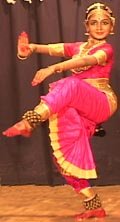
as the cosmic dancer Koothan who performs his divine dance to destroy a weary universe and make preparations for god Brahma
Brahma
Brahma is the Hindu god of creation and one of the Trimurti, the others being Vishnu and Shiva. According to the Brahma Purana, he is the father of Mānu, and from Mānu all human beings are descended. In the Ramayana and the...
to start the process of creation. A Tamil concept, Shiva was first depicted as Nataraja in the famous Chola bronzes
Chola Art
The period of the imperial Cholas was an age of continuous improvement and refinement of the Dravidian art and architecture. They utilised their prodigious wealth earned through their extensive conquests in building long-lasting stone temples and exquisite bronze sculptures...
and sculptures of Chidambaram. The dance of Shiva in Tillai, the traditional name for Chidambaram
Chidambaram
Chidambaram is a fast growing industrial city in Eastern part of Tamil Nadu and the taluk headquarters of the Cuddalore district. It is located in 58 km from Pondicherry, 60 km from Karaikal, and 240 km south of Chennai by rail...
, forms the motif for all the depictions of Shiva as Nataraja. He is also known as "Sabesan" which splits as "Sabayil aadum eesan" in Tamil which means "The Lord who dances on the dais
Dais
Dais is any raised platform located either in or outside of a room or enclosure, often for dignified occupancy, as at the front of a lecture hall or sanctuary....
". The form is present in most Shiva temples in South India, and is the main deity in the famous temple at Chidambaram
Chidambaram Temple
Thillai Natarajah Temple, Chidambaram is a Hindu temple dedicated to Shiva located in the town of Chidambaram, East-Central Tamil Nadu, South India. The temple is known as the foremost of all temples to Saivites and has influenced worship, architecture, sculpture and performance art for over two...
.
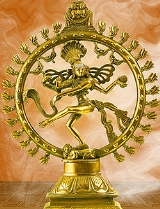
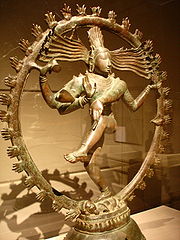
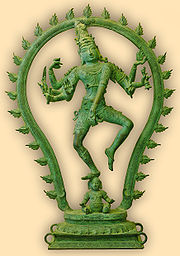
The sculpture is usually made in bronze, with Shiva dancing in an aureole of flames, lifting his left leg (or in rare cases, the right leg) and balancing over a demon or dwarf (Apasmara
Apasmara
According to Hindu mythology, Apasmara was a dwarf who represented ignorance and epilepsy. During the cosmic dance of tandava by god Shiva in the form of Nataraja - the Lord of Dance, Apasmara was crushed by the right foot of Shiva and was killed. This mythological dwarf is generally depicted with...
) who symbolizes ignorance. It is a well known sculptural symbol in India and popularly used as a symbol of Indian culture.
The two most common forms of Shiva's dance are the Lasya (the gentle form of dance), associated with the creation of the world, and the Tandava (the violent and dangerous dance), associated with the destruction of weary worldviews - weary perspectives & lifestyles. In essence, the Lasya
Lasya
Lasya means beauty, happiness and grace. The term Lasya, in the context of Hindu mythology, describes the dance performed by Goddess Parvathi as it expresses happiness and is filled with grace and beauty...
and the Tandava
Tandava
' or ', the divine art form, is a dance performed by the god Shiva, who is revered by Hindus. According to Hindu mythology, Shiva’s Tandava is a vigorous dance that is the source of the cycle of creation, preservation and dissolution...
are just two aspects of Shiva's nature; for he destroys in order to create, tearing down to build again.
Etymology
Koothan is derived from the Tamil word KoothuKoothu
Koothu , means dance or performance in Tamil language, is a folk art originated from the early Tamil country. But more precisely Koothu refers Therukoothu that is street dance or street play since it will be performed village squares. At early age the art of entertainment reached its peak in...
, which means dance or performance. A male dancer is termed Koothan. Nāṭaraja is derived from the Sanskrit words narta rājan "lord of dance". The change of the dental /rt/ to a retroflex /ṭ/ with concomitant vowel lengthening is a normal sound change for the Prakrit languages descended from Sanskrit.
Characteristics
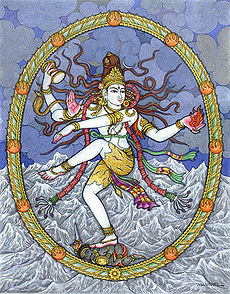
- A cobra uncoils from his lower right forearm, and the crescent moon and a skull are on his crest. He dances within an arch of flames. This dance is called the Dance of Bliss, aananda taandavam.
- The upper right hand holds a small drum shaped like an hourglass that is called a in Sanskrit. A specific hand gesture (mudraMudraA mudrā is a symbolic or ritual gesture in Hinduism and Buddhism. While some mudrās involve the entire body, most are performed with the hands and fingers...
) called (Sanskrit for "-hand") is used to hold the drum. It symbolizes sound originating creation or the beat of the drum is the passage of time. - The upper left hand contains Agni or fire, which signifies destruction. The opposing concepts in the upper hands show the counterpoise of creation and destruction or the fire of life.
- The second right hand shows the Abhaya mudraMudraA mudrā is a symbolic or ritual gesture in Hinduism and Buddhism. While some mudrās involve the entire body, most are performed with the hands and fingers...
(meaning fearlessness in SanskritSanskritSanskrit , is a historical Indo-Aryan language and the primary liturgical language of Hinduism, Jainism and Buddhism.Buddhism: besides Pali, see Buddhist Hybrid Sanskrit Today, it is listed as one of the 22 scheduled languages of India and is an official language of the state of Uttarakhand...
), bestowing protection from both evil and ignorance to those who follow the righteousness of dharmaDharmaDharma means Law or Natural Law and is a concept of central importance in Indian philosophy and religion. In the context of Hinduism, it refers to one's personal obligations, calling and duties, and a Hindu's dharma is affected by the person's age, caste, class, occupation, and gender...
. - The second left hand points towards the raised foot which signifies upliftment and liberation. It also points to the left foot with the sign of the elephant which leads the way through the jungle of ignorance.
- The dwarf on which Nataraja dances is the demon ApasmaraApasmaraAccording to Hindu mythology, Apasmara was a dwarf who represented ignorance and epilepsy. During the cosmic dance of tandava by god Shiva in the form of Nataraja - the Lord of Dance, Apasmara was crushed by the right foot of Shiva and was killed. This mythological dwarf is generally depicted with...
(Muyalaka. as known in TamilTamil languageTamil is a Dravidian language spoken predominantly by Tamil people of the Indian subcontinent. It has official status in the Indian state of Tamil Nadu and in the Indian union territory of Pondicherry. Tamil is also an official language of Sri Lanka and Singapore...
), which symbolises Shiva's victory over ignorance. It also represents the passage of spirit from the divine into material. - As the Lord of Dance, Nataraja, Shiva performs the tandavaTandava' or ', the divine art form, is a dance performed by the god Shiva, who is revered by Hindus. According to Hindu mythology, Shiva’s Tandava is a vigorous dance that is the source of the cycle of creation, preservation and dissolution...
, the dance in which the universe is created, maintained, and dissolved. Shiva's long, matted tresses, usually piled up in a knot, loosen during the dance and crash into the heavenly bodies, knocking them off course or destroying them utterly. - The surrounding flames represent the manifest UniverseUniverseThe Universe is commonly defined as the totality of everything that exists, including all matter and energy, the planets, stars, galaxies, and the contents of intergalactic space. Definitions and usage vary and similar terms include the cosmos, the world and nature...
. - The snake swirling around his waist is kundaliniKundaliniKundalini literally means coiled. In yoga, a "corporeal energy" - an unconscious, instinctive or libidinal force or Shakti, lies coiled at the base of the spine. It is envisioned either as a goddess or else as a sleeping serpent, hence a number of English renderings of the term such as 'serpent...
, the ShaktiShaktiShakti from Sanskrit shak - "to be able," meaning sacred force or empowerment, is the primordial cosmic energy and represents the dynamic forces that are thought to move through the entire universe in Hinduism. Shakti is the concept, or personification, of divine feminine creative power, sometimes...
or divine force thought to reside within everything. This also parallels the cords of life warn by the brahmins to represent the second rebirth. - The stoic face of Shiva represents his neutrality, thus being in balance.
Significance
Shiva
Shiva is a major Hindu deity, and is the destroyer god or transformer among the Trimurti, the Hindu Trinity of the primary aspects of the divine. God Shiva is a yogi who has notice of everything that happens in the world and is the main aspect of life. Yet one with great power lives a life of a...
dance at Tillai, the traditional name of Chidambaram
Chidambaram
Chidambaram is a fast growing industrial city in Eastern part of Tamil Nadu and the taluk headquarters of the Cuddalore district. It is located in 58 km from Pondicherry, 60 km from Karaikal, and 240 km south of Chennai by rail...
, can be explained as:
- First, it is seen as the image of his rhythmic play which is the source of all movement within the universe. This is represented by the circular or elliptical frame surrounding the Lord.
- Secondly, the purpose of his dance is to release the souls of all men from the snare of illusion.
- Lastly, the place of the dance, ChidambaramChidambaramChidambaram is a fast growing industrial city in Eastern part of Tamil Nadu and the taluk headquarters of the Cuddalore district. It is located in 58 km from Pondicherry, 60 km from Karaikal, and 240 km south of Chennai by rail...
, which is portrayed as the center of the universe, is actually within the heart.
Dancing is seen as an art in which the artist and the art s/he creates are one and the same, thought to evoke the oneness of God
God
God is the English name given to a singular being in theistic and deistic religions who is either the sole deity in monotheism, or a single deity in polytheism....
and creation.
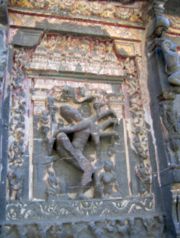
Bhagavad Gita
The ' , also more simply known as Gita, is a 700-verse Hindu scripture that is part of the ancient Sanskrit epic, the Mahabharata, but is frequently treated as a freestanding text, and in particular, as an Upanishad in its own right, one of the several books that constitute general Vedic tradition...
, there are three basic guna: Satvic, Tamsic and Rajsic. These combine with each other, and the life forms are created as a result of this divine activity. These life forms remain devoid of prana
Prana
Prana is the Sanskrit word for "vital life" .It is one of the five organs of vitality or sensation, viz. prana "breath", vac "speech", chakshus "sight", shrotra "hearing", and manas "thought" Prana is the Sanskrit word for "vital life" (from the root "to fill", cognate to Latin plenus...
(breath), until the Divine entity infuses them with life. The Geeta says the division of the Divine entity is ninefold, of which eight can be known by humans, but the ninth is eternally unexplainable and hidden and secret.
These eight divisions are the elements, Earth, Water, Fire, Air, Akash, Mana, Buddhi, Ahamkara.
Nataraj is a visual interpretation of Brahman
Brahman
In Hinduism, Brahman is the one supreme, universal Spirit that is the origin and support of the phenomenal universe. Brahman is sometimes referred to as the Absolute or Godhead which is the Divine Ground of all being...
and a dance posture of Lord Shiva. It is the representation of reality at the time of cosmic destruction. We being life forms, cosmic destruction would mean the disappearance of all life. The half moon shown in the head of Nataraj is a symbol only. The fall of the moon would result in cosmic destruction.
The third eye on the forehead of the Lord is a symbol. The serpent wrapped around the neck is a cosmic entity, just as Shiv. Other vedic texts mention a cosmic serpent called Kundalini, present in every living form at the base of the spinal cord. Myths abound about Kundalini's presence and the cosmic dangers associated with its arousal. More abstract and invisible divine energy centres, called Chakras, are associated with its Rise.
Statues
Tamil Nadu
Tamil Nadu is one of the 28 states of India. Its capital and largest city is Chennai. Tamil Nadu lies in the southernmost part of the Indian Peninsula and is bordered by the union territory of Pondicherry, and the states of Kerala, Karnataka, and Andhra Pradesh...
in southern India. The trajectory of the dancing Shiva is traced: from the processional worship of metal icons outside the sanctum to the cultic elevation of the Nataraja bronze into the sanctum at Chidambaram
Chidambaram
Chidambaram is a fast growing industrial city in Eastern part of Tamil Nadu and the taluk headquarters of the Cuddalore district. It is located in 58 km from Pondicherry, 60 km from Karaikal, and 240 km south of Chennai by rail...
.
Archaeo metallurgical studies made on south Indian bronzes by Sharada Srinivasan
Sharada Srinivasan
Sharada Srinivasan, Associate Professor, National Institute of Advanced Studies, Bangalore, India, works in the field of inter-disciplinary scientific studies in art, archaeology, archaeometallurgy and culture and is also an acclaimed exponent of classical Bharata Natyam dance. She has a PhD...
combined with iconographic and literary showed that the Nataraja bronze was a Pallava innovation (seventh to mid-ninth century), rather than tenth-century Chola as widely believed. That formulation was informed of 'cosmic' or metaphysical
Metaphysics
Metaphysics is a branch of philosophy concerned with explaining the fundamental nature of being and the world, although the term is not easily defined. Traditionally, metaphysics attempts to answer two basic questions in the broadest possible terms:...
connotations is also argued on the basis of the testimony of the hymns of Tamil
Tamil people
Tamil people , also called Tamils or Tamilians, are an ethnic group native to Tamil Nadu, India and the north-eastern region of Sri Lanka. Historic and post 15th century emigrant communities are also found across the world, notably Malaysia, Singapore, Mauritius, South Africa, Australia, Canada,...
saints.
The largest gold Nataraja statue is in Neyveli
Neyveli
Neyveli is a mining and power generation township in Cuddalore district in the Indian state of Tamil Nadu. It is located at 11.30° N - 79.29° E. It is 52 km inland from Bay of Bengal, west of Pondicherry and 197 km south of Chennai. The township was developed after mining of lignite...
, Tamil Nadu
Tamil Nadu
Tamil Nadu is one of the 28 states of India. Its capital and largest city is Chennai. Tamil Nadu lies in the southernmost part of the Indian Peninsula and is bordered by the union territory of Pondicherry, and the states of Kerala, Karnataka, and Andhra Pradesh...
.
The image of the Lord as the Cosmic Dancer is shown at the Chidambaram temple
Chidambaram Temple
Thillai Natarajah Temple, Chidambaram is a Hindu temple dedicated to Shiva located in the town of Chidambaram, East-Central Tamil Nadu, South India. The temple is known as the foremost of all temples to Saivites and has influenced worship, architecture, sculpture and performance art for over two...
, an unusual fact as Shiva is depicted in an anthropomorphic form rather than in the usual non-anthropomorphic form of the linga.
In 2004, a 2m statue of the dancing Shiva was unveiled at CERN
CERN
The European Organization for Nuclear Research , known as CERN , is an international organization whose purpose is to operate the world's largest particle physics laboratory, which is situated in the northwest suburbs of Geneva on the Franco–Swiss border...
, the European Center for Research in Particle Physics in Geneva. A special plaque next to the Shiva statue explains the significance of the metaphor of Shiva's cosmic dance with quotations from Fritjof Capra
Fritjof Capra
Fritjof Capra is an Austrian-born American physicist. He is a founding director of the Center for Ecoliteracy in Berkeley, California, and is on the faculty of Schumacher College....
: "Hundreds of years ago, Indian artists created visual images of dancing Shivas in a beautiful series of bronzes. In our time, physicists have used the most advanced technology to portray the patterns of the cosmic dance. The metaphor of the cosmic dance thus unifies ancient mythology, religious art and modern physics."