


Names of the Greeks

Encyclopedia
The Greeks
have been called by several names, both by themselves and by other people. The most common native ethnonym
is Hellenes (Έλληνες); the name Greeks
(Graeci) was used by the Romans
and then in all European languages.
The first Greek-speaking people entered the region of present day Greece
during the 19th century BC and they are called by the historians Myceneans after their most powerful city Mycenae, or Myceneans-Achaeans because Homer
refers to Achaeans as the dominating tribe during the period of the Trojan war
.
In Homer, Hellenes was the name of a relative small tribe in Thessaly
. The Dorians an important Greek-speaking group entered Greece during the 13th century BC. According to the Greek tradition the previous called Graekhes (Greeks) were named Hellenes and the name was probably used with the establishment of the asocciation of the Great Amphictyonic League
, after the Trojan war. It seems that the myth of their patriarch Hellen
, was invented when several Greek tribe
s started to separate from each other and it indicates their common origin. His descendants the Aeolians
, Dorians, Achaeans
and Ionians
correspond to the main Greek tribes and to the main dialects spoken in [Greece and Asia Minor
(Anatolia
). Among his descendants are also mentioned the Graeces and the Makedones
.
When the Romans first encountered the Greeks in southern Italy
, they used the name Graeci for the colonists and then for all Greeks, which is the root of all relevant terms in Europe
an languages. The Persians used the name Yaunas
(Yunans) after the Ionians, a Greek tribe who occupied some areas on the coasts of western Asia Minor
and the term was used later by the Jews
(Yavanim , by all Arabic languages and also by the Turks
. By Late Antiquity
, the Greeks referred to themselves as Rhomaioi or Romioi , i.e. "Romans", since after AD 212 virtually all Greeks were Roman citizens. After the establishment of Christianity by Theodosius I
, "Hellene" was applied to the followers of the polytheistic
("pagan") religion. A unique form is used in Georgian
, where the Greeks are called berdzeni , probably deriving from the Georgian word for "wise".
(Grecija)(Hrecyja)(Hrecija)(Gǎrcija) (Grcija)
In Middle Eastern and South Asian languages, the common root is "yun" or "ywn". It is borrowed from the Greek name "Ionia
", the Greek region of Asia Minor
:
The third root is "hl", used by a few languages around the world, including Greek:
In the Georgian language
, the root for "Greek" is "-berdz-" (from the word for "wisdom"), so "Greece" is "Saberdzneti"
In the Chechen language
, the name is Джелтимохк (Džieltimohk)
entered mainland Greece
from the north at the end of the 3rd milemnium BC. There is no evidence that populations from the north moved to Crete
in this period. From the Ancient Greek dialects as they presented themselves centuries later, it seems that at least two migrations of Greeks followed, the first of the Ionians
and the Aeolians
probably in the 19th century BC and the second of the Dorians probably in the 13th century BC. The first migration resulted in Mycenean Greek, an archaic Greek language which appears in Linear B
syllabic inscriptions and the second to the Dorian
dialect which displaced the Arcadocypriot dialect that seems to be closest to the Mycenean Greek.
The autochthonous or Proto Greek
speaking people were called later by the Greeks Pelasgians
who have uncertain origins and lived mainly in Thessaly
and Epirus
, Eteocretans
who lived in Crete
(descendants of the ancient Minoans
) and Minyans
who lived in Boeotia
.
The later called Aeolians
and Ionians
established several feudal-kingdoms around Greece and the historians called them Myceneans after their most powerful kingdom Mycenea in Peloponnese
or Myceneans-Achaeans because in Homer
the Achaeans were the dominating tribe in Greece and the name Achiyawa that appears in Hittite
texts seems to correspond to a thalassocratic country which might me Mycenea. Although Homer is referring to a union of the Greek kingdoms under the leadership of the king of Mycenea during the Trojan war
, there is no evidence that these kingdoms were dominated by a central power. The Mycenean palaces were destroyed by invaders at the end of the 13th century BC. The Greek tradition relates this destruction with the Dorians, however it is suggested that the Dorian invasion
was only one of the causes of the bronze-age collapse in Eastern-Mediterranean, because there is no evidence that the newcomers established a different civilization. The destruction was followed by the Greek Dark Ages
with very poor archaeological findings, when most occupied areas were deserted, but some areas like Attica
occupied by the Ionians remained untouched by the invaders. Several Greek tribes moved to certain regions of Greece where they acquired different names, and groups of population moved through the islands to the western coasts of Asia Minor
where they kept their native names Aeolians, Ionians and Dorians.
It seems that the myth of Hellen
, the patriarch of Hellenes was invented when the Greek tribes started to separate from each other and inspired to them their common origin. The name Hellenes was probably used by the Greeks with the establishment of the Great Amphictyonic League
,an ancient asocciation of Greek tribes. According to the legend it was founded after the Trojan war, by the eponymous Amphictyon
,brother of Hellen. It had twelve founders and was organized to protect the great temples of Apollo
in Delphi
(Phocis
) and of Demeter
near Thermopylae
(Locris
).The twelve founders enumerated by Aeschines
were the Aenianes or Oetaeans (Αἰνιᾶνες, Οἰταῖοι), the Boeotians (Βοιωτοί) of Thebes, the Dolopes (Δόλοπες), the Dorians (Δωριείς) of Sparta
, the Ionians
(Ἴωνες) of Athens
, the Phthia
n Achaeans (Ἀχαιοί), the Locrians
(Λοκροί) (Opuntians,Ὀπούντιοι and Ozolians, Ὀζολοί ), the Magnesia
ns (Μάγνητες), the Malians
(Μαλιεῖς), the Perrhaebians (Περραιβοί), the Phocians (Φωκεῖς), the Pythia
ns (Πύθιοι) of Delphi
, and the Thessalians (Θεσσαλοί). Among the descendants of Hellen are mentioned Aeolus
, Ion
, Achaeus, Dorus
, Graecos and Makedon
. It seems that the Macedonians
were a Dorian tribe which stood behind in Macedonia when the main Dorian tribes moved to the south.
The evidence from before this period, such as it is, shows much less trace of any hard distinction between Greeks and the rest of humanity. The surviving samples of Linear B
are inventory records, and do not discuss ethnicity; Hesiod
's Theogony
is one great genealogical tree, including gods, men, and monsters; Persians, Latins, and Etrucscans.
In Homer
's Iliad
, the Greek allied forces are described under three different names, often used interchangeably: Argives (in Greek: Argeioi, Αργείοι; used 29 times in the Iliad), Danaans (Δαναοί, used 138 times) and Achaeans (Αχαιοί, used 598 times). Argives is an annotation drawn from the original capital of the Achaeans, Argos
). Danaans is the name attributed to a Greek mythological character, twin brother of Aegyptus
and son of Achiroe
and Belus
.
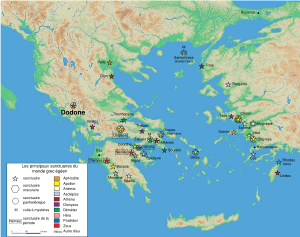 There is currently no satisfactory etymology of the name Hellenes. Some scholars assert that the name of the priests of Zeus
in Dodona
, Selloi
changed to Sellanes (as Akarnanes) and then to Hellanes-Hellenes. This theory is based on Aristotle
s comments in Meteorologica where he places Ancient Hellas in Epirus
between Dodona and the Achelous
river, where in his opinion the great deluge of Deucalion
must have occurred. The land was occupied by Selloi and Graii, who later came to be known as Hellenes". In that regard Graii (or Graikhes) was a native name of a Dorian
tribe in Epirus which was used by the Illyrians
.".Homer
mentions that Selloi were the prophets of Zeus in Dodona, but he is referring to Zeus of Dodona as god of the Pelasgians
who were Pre-Dorian populations. It is possible that the extension of a particular cult of Zeus in Dodona (a tendency among the Greeks to form ever-larger communities and amphictionies
) caused the name to further extend to the rest of the peninsula.
However this theory connects the name Hellenes with the Dorians who occupied Epirus and the relation with the name Greeks given by the Romans
becomes uncertain. The toponyms, especially an ancient city Hellas in southern Thessaly
and the Greek tradition indicate that the name Hellenes is Pre-Dorian and that it is more possible that the homeland of the Graekhes which were later called Hellenes was in central Greece. The Greek tradition mentions an older deluge of Ogyges
in the region of Boeotia
which was occupied by the Minyans
a group of autochthonous or Proto Greek
speaking people. The region was called Graiki
in ancient times probably after the old city Graea
(from Proto Greek
grau-j,"old lady") on the coast. The name Greek can be derived from Graikhos, "inhabitant of Graea". and it seems to be related with Proto-Greek
guraj, "old age", later geras,keras in Mycenean Greek from PIE
*gere, "to grow old".
Homer
refers originally to Hellenes as a relatively small tribe settled in Thessalic
Phthia
. During the era of the Trojan War
they were centered along the settlements of Alos
, Alope
, Trachis
, and the Pelasgian Argos
. This Homeric Hellas is expressly described as "καλλιγύναικος", kalligýnaikos, "of beautiful women", and its warriors, the Hellenes, along with the feared Myrmidons
were under the command of Achilles
. In the Parian Chronicle
is mentioned that Phthia was the homeland of Hellenes and that this name was given to those previously called Greeks .Alcman
(7th century BC) also refers that the mothers of Hellenes were Graekhes. In Greek mythology
, Hellen
, the patriarch of Hellenes, was son of Deucalion
, who ruled around Phthia with Pyrrha
, the only survivors after the great deluge. It seems that the myth was invented when the Greek tribes started to separate from each other in certain areas of Greece and it indicates their common origin. The name Hellenes was probably used by the Greeks with the establishment of the Great Amphictyonic League
. This was an ancient asocciation of Greek tribes with twelve founders which was organized to protect the great temples of Apollo
in Delphi
(Phocis
) and of Demeter
near Thermopylae
(Locris
). According to the legend it was founded after the Troyan
war, by the eponymous Amphictyon
, brother of Hellen
.
Another etymology connects Hellenes with Helene (Ελένη= torch), Vedic svarana (the shining one).
 The modern English noun Greek (old English Grecas or Crecas) is derived from the Latin
Graeci
, which in turn originates from Greek
Γραικός (Graikos). It seems that the word is related with the Greek word geron,"old man" (from the PIE
base *gere, "to grow old"), Proto Greek
guraj, "old age" and later kera, geras, "gift of honour" in Mycenean Greek and grau-j,"old lady". The Germanic languages borrowed the name with an initial k sound, which was probably their initial sound closest to the Latin g (Goth. Kreks)
Aristotle
used the term Graikhos related with Hellenes (Meteorologica I xiv) and claimed that it was the name originally used by the Illyrians
for the Dorians in Epirus
from Graii native name of the people of Epirus. He places Ancient Hellas in the region of Achelous
river around Dodona
where in his opinion the great deluge of Deucalion
must have occurred. The priests of Zeus
in Dodona were called Selloi which could lead to Sellanes (like Akarnanes) and then to Hellanes-Hellenes. (Compare PIE
*saewol with Latin sol, Greek helios) However the toponyms and the Greek tradition indicate that it is more possible that the homeland of the Greeks was originally in central Greece and that the name was probably Pre-Dorian. A Greek legend is referring to an older deluge of Ogyges
in Boeotia
,in the region occupied by the Minyans
which are considered autochthonous or Proto Greek
speaking people. The region outside of Attica
including Boeotia was called Graiki
and the word Ogyges related with ocean
came to mean "from earliest days".Homer
is referring to Hellenes as a relative small tribe in Phthia
in central Greece (Achaea Pthiotis). In the Parian Chronicle
is mentioned that Phthia was the homeland of Hellenes and that this name was given to those previously called Graekhes . In Greek mythology
, Hellen
, the patriarch of Hellenes, was son of Deucalion
, who ruled around Phthia and Pyrrha
, the only survivors after the great deluge. Hesiod
is referring to Graecus
son of Pandora
who was sister of Hellen
and Alcman
mentions that the mothers of Hellenes were Graekhes.
The German classical historian Georg Busolt (1850–1920) derives the name from Graikhos,"inhabitant of Graea
,a town on the coast of Boeotia. The name Graea (γραία) is derived from Proto Greek
grau-j,"old lady".Homer
, while reciting the Boeotian forces in the Iliads Catalogue of Ships
, provides the first known reference to a region named Graea
, and Pausanias
mentions that the ancient city of Tanagra
was for a time called Graea, adding that "no one knows where this Graia really was; Aristotle thought it was near Oropus, further east on the same coast as Delion." Busolt claimed that the name was given by the Romans originally to the Greek colonists from Graea who helped to found Cumae
the important city in southern Italy
where the Latins first encountered the Greeks and then to all Greeks.
, dedicated to Heracles
for his victory in the Amphictyonic Games, and refers to the 48th Olympiad (584 BC). It appears to have been introduced in the 8th century BC with the Olympic Games, and permanently established itself by the 5th century BC. After the Greco-Persian Wars
, an inscription was written in Delphi celebrating victory over the Persians and calling Pausanias
the leading general of the Hellenes. Awareness of a pan-Hellenic unity was promoted by religious festivals, most significantly in the Eleusinian Mysteries
, in which prospective initiates had to speak Greek
, and almost as importantly through participation in the four Panhellenic Games
—including the Olympic Games—in which participants were recognized by tribal affiliation. Neither women nor non-Greeks were allowed to participate; the occasional exception in later times, such as that made for Emperor Nero
, was a sure sign of Roman
political hegemony.
ous founder-figures, long after the actual southward migration of the four tribal groups recognized by the Greeks, affected how the identity of northern tribes was perceived. According to the most prevailing legend, Hellen
, son of Deucalion
and Pyrrha
, received from the nymph Orseis
three sons, Aeolus
, Dorus
, and Xuthus
, each of whom founded a primary tribe of Hellas–the Aeolians
, Dorians, Achaeans
and Ionians
.
At the time of the Trojan War, the Epirotes (Molossians
, Thesprotians
and Chaonians
) were not considered Hellenes, for the people so named were then limited to a small tribe in Thessaly of which Achilles was a member. After the name was extended to all peoples south of Mount Olympus
, however, it still left out those of common origin living in the north. One factor contributing to this was their non-participation in the Persian Wars
, which were considered a vital affair for all Hellenes; subsequent to the Persian Wars, representatives of these tribes were accepted in the Olympic Games and competed alongside other Hellenes. The fact that each of these northern peoples at this time continued to live as an ethnos
, or collection of tribes, under an archaic monarchial
political system – as opposed to the democratic or oligarchic polis
(city state) of the south–also contributed to this view of them as "barbaric".
Thucydides
calls the Acarnania
ns, Aetolia
ns, Epirotes and Upper Macedonians barbarian
s, but does so in a strictly linguistic sense – these peoples were considered barbarophone to the extent that their dialects of Greek were sufficiently different and archaic so as to sound crude and barely understandable to a southern Attic
speaker such as Thucydides. Similarly, when the Athenian orator Demosthenes
called Philip II of Macedon
worse than a barbarian in his Third Philippic
, he did so with respect to the culture they demonstrated as foreigners not adhering to proper Hellenic standards, and did not raise the issue of their origin: "not only no Greek, nor related to the Greeks, but not even a barbarian from any place that can be named with honors, but a pestilent knave
from Macedonia, whence it was never yet possible to buy a decent slave." Polybius
, on the other hand, regards the tribes of western Hellas
, Epirus, and Macedonia as Hellenic in every respect.
, representing the uncivilized.
The Greek tribes quickly noticed that they did not speak the same tongue as their neighbors, and used the term "βάρβαρος" ("barbarian") for them, with the meanings "uncultured", "uncivilized" or "speaker of a foreign language". The term βάρβαρος is thought to be onomatopoeic in origin: "bar-bar"—i.e. stammering
—may have been how the speech of foreign peoples sounded to Greek speakers. This was also the case for the Egyptians
, who, according to Herodotus
, "named barbarians all those who spoke a different tongue", and in later years for the Slavs
, who gave the Germans
the name nemec, which means "mute", while calling themselves slověnski or "people of the word". In his play The Birds
, Aristophanes
calls the illiterate supervisor a "barbarian" who nevertheless taught the birds how to talk. The term eventually picked up a derogatory use and was extended to indicate the entire lifestyle of foreigners, and finally coming to mean "illiterate" or "uncivilized" in general. Thus "an illiterate man is also a barbarian". According to Dionysius of Halicarnassus
, a Hellene differed from a barbarian in four ways: refined language, education, religion, and the rule of law. Greek education became identified with noble upbringing. Paul of Tarsus
considered it his obligation to preach the Gospel
to all men, "Hellenes and barbarians, both wise and foolish".
Discrimination between Hellenes and barbarians lasted until the 4th century BC. Euripides
thought it plausible that Hellenes should rule over barbarians, because the first were destined for freedom
and the other for slavery
. Aristotle
came to the conclusion that "the nature of a barbarian and a slave is one and the same". Racial differentiation faded away through the teachings of Stoics, who distinguished between nature and convention and taught that all men have equal claim before the gods and thus by nature cannot be unequal to each other. With time, Hellene, to use the words of Isocrates
, became a trait of intellect, not race.
Alexander the Great's conquests consolidated Greek influence in the East by exporting Greek culture into Asia and permanently transformed education and society in the region. Isocrates
declared in his speech Panegyricus: "So far has Athens left the rest of mankind behind in thought and expression that her pupils have become the teachers of the world, and she has made the name of Hellas distinctive no longer of race but of intellect, and the title of Hellene a badge of education rather than of common descent." With a small reformation, the Hellenistic civilization
is the evolution of classical Greek civilization into a civilization with global proportions, this time open to everybody. Similarly, "Hellene" evolved from a national name signifying an ethnic Greek to a cultural term signifying anybody who conducted his life according to Greek mores
.
. The ancient people of the Middle East referred to the Hellenes as Yunan, deriving from Persian
Yauna, itself a loan of Greek
Ιωνία (Ionia
), the western coast of Asia Minor
. It is by affiliation with the Ionian tribe the Persians conquered in the late 6th century BC that their name extended to all Hellenes. All peoples under Persian influence adopted the term, and it is from this root that Sanskrit
Yavana
derives, which one encounters in ancient Sanskrit sources, first attested in Pāṇini's grammar, and later referring, together with Pali
Yona
, Yonaka to the Indo-Greeks
. The term Yunan is used in current Persian
, Arabic
(يوناني), Azeri
, Turkish
, Hindi
(यूनान), Indonesian
and Malay
.
The related Hebrew name, Yavan or Javan (יָוָן), was used to refer to the Greek nation in the Eastern Mediterranean in early Biblical times. There was an eponymous character Javan
mentioned in Genesis 10:2. In later times it was used for all Hellenistic kingdoms (for example, the Maccabeans applied it to their Seleucid foes). "Yavan" is still the name used for modern Greece in contemporary Israel
.
Although the contemporary Chinese term for Greece (希臘 Xīlà) is based on Hellas, Chinese previously used what was likely a version of the Yunan or Yona root when referring to the Dàyuān
(大宛). The Dàyuān were probably the descendants of the Greek colonies that were established by Alexander the Great and prospered within the Hellenistic realm of the Seleucids and Greco-Bactrians, until they were isolated by the migrations of the Yueh-Chih around 160 BC. It has been suggested that the name Yuan was simply a transliteration of the words Yunan, Yona, or Ionians, so that Dàyuān (literally "Great Yuan") would mean "Great Yunans" or "Great Ionians."
ity in the first centuries, during which the early Christian church played an instrumental role in accelerating the transition, and it retained that meaning until the end of the millennium. It is believed that contact with Christian Jews
led some Christians to use Hellene as a means of religious differentiation. Jews, like Greeks
, distinguished themselves from foreigners, but unlike Greeks, did so according to religious rather than cultural standards.
Roman domination of the Greek world enhanced the prestige of the religious institutions that remained intact. Early Christians adopted the religious differentiation of humankind, and so the meaning of the word Hellene as a cultural attribute became marginalized by its religious element, which eventually supplanted the older meaning entirely. Eventually, Christians came to refer to all pagans as Hellenes.
St. Paul
in his Epistles uses Hellene almost always juxtaposed to Hebrew, and in disregard of all other ethnicities (Romans, Syrians, Egyptians, etc.) living in the area at the time. This is probably done with the aim of representing the sums of those two religious communities, the polytheistic and the monotheistic, whose cardinal theological difference was belief to either many or to one god, respectively. Hellene is used in a religious meaning for the first time in the New Testament
. In the Gospel of Mark
7:26, a woman arrives before Jesus
kneeling before him: "The woman was a Hellene, a Syrophœnician by nation; and she besought him that he would cast forth the devil out of her daughter." Since the nationality or ethnicity of the woman is stated to be Syrophœnician, "Greek" (translated as such into the English of the King James Version, but as haiþno "heathen" in Ulfilas
's Gothic
; Wycliffe
and Coverdale
likewise have heathen) must therefore signify her polytheistic religion. A broadly similar statement is found in John
12:20-23; "And there were certain Hellenes among them that came up to worship at the feast ... Jesus answered them, saying, The hour is come, that the Son of man should be glorified". This could have one of two interpretations: either that Jesus meant that the time had come for his religion to spread to the pagans (in which case the term "Hellenes" is religious), or that it will spread by using the Greek language
(in which case the term "Hellenes" is meant to be linguistic). The development towards a purely religious meaning was slow, and complete by approximately the 2nd or 3rd century AD: Athenian statesman Aristeides
, in his written Apology to the Emperor Hadrian
, picked out the Hellenes as one of the representative pagan peoples of the world along with the Egyptians and the Chaldæans
. Later, Clement of Alexandria
reports an unknown Christian writer who named all of the above Hellenes and spoke of two old nations and one new: the Christian nation.
Several books written at this time demonstrate quite clearly the semantic shift. Perhaps the first was Tatian
's Address to the Greeks, completed in 170 AD, where Tatian criticizes pagan beliefs in order to defend Christian ones. Most important of the later works was Athanasius' Against Hellenes, originally titled Against the Gentiles (Greek ethnikoi) according to older manuscripts. It was changed by a future writer at a time when Hellene had lost its ancient meaning entirely. Henceforth, Hellene no longer signified an ethnic Greek or those adhered to Greek culture, but pagans in general, regardless of race. Emperor Julian's
attempt to restore paganism to the forefront of society failed, and according to Pope Gregory I
, "matters moved in favor of Christianity and the position of the Hellenes was severely aggravated". Half a century later Christians protest against the Eparch
of Alexandria
, whom they accused of being a Hellene. Theodosius I
initiated the first legal steps against paganism, but it was Justinian's
legal reforms that triggered pagan persecutions on a massive scale. The Corpus Juris Civilis
contained two statutes which decreed the total destruction of Hellenism, even in civic life, and were zealously enforced even of men in high position. The official suppression of paganism made non-Christians a public threat which further derogated the meaning of Hellene. Paradoxically, Tribonian
, Justinian's own legal commissioner, according to the Suda
dictionary, was a Hellene (pagan).
The name Hellene meaning Pagan has managed to persist into modern times. Many groups advocating a revival or reconstruction of the worship of the Olympian Gods, call themselves Hellenic Polytheists or Hellenists and the religion Hellenismos. Such groups outside of Greece are careful not to imply that, by calling themselves Hellenes, they consider themselves Greek nationals.
. The name originally signified the inhabitants of the city of Rome in Italy, but with the increasing grants of Roman citizenship
to the Greeks and other nations of the Roman Empire, it soon lost its connection with the Latins
. This process culminated in 212 AD, when Emperor Caracalla's Constitutio Antoniniana
granted the citizenship to all free-born men of the Empire. However, the Greeks transmogrified their newly acquired political title (Romans) and began to refer to themselves solely as Rhomaioi. The new term was created in order to establish a dualistic identity that represented the Greeks' Roman citizenship, as well as their Hellenic ancestry, culture, and language. Moreover, the new term represented the Greeks' religious affiliation toward Orthodox Christendom
signifying that the Christianization
of the Roman Empire
led to only the religious vitiation of the name Hellene. Overall, the word Rhomaios came to represent the hellenized inhabitants of the East Roman Empire. It is even used today (albeit extremely rarely), being the most popular national name after Hellene.
Overall, the foreign borrowed name (Romans) initially had a more political than national meaning, which went hand in hand with the universalizing ideology of Rome that aspired to encompass all nations of the world under one true God. Up until the early 7th century, when the Empire still extended over large areas and many peoples, the use of the name "Roman" always indicated citizenship
and never descent. Various ethnicities could apply their own ethnonyms or toponyms to disambiguate citizenship from genealogy, which is why the historian Procopius
prefers to call the Byzantines as Hellenized Romans, while other authors use Romhellenes and Graecoromans, aiming to indicate descent and citizenship simultaneously. The Lombard
and Arab
invasions in the same century resulted in the loss of most of the provinces including Italy and all of the Middle East, save for Anatolia
. The areas that did remain were mostly Greek-speaking, thereby turning the empire into a much more cohesive unit that eventually developed a fairly self-conscious identity. Unlike in the previous centuries, there is a clear sense of nationalism
reflected in East Roman
documents towards the end of the 1st millennium
.
The Byzantines' failure to protect the Pope
from the Lombards
forced the Pope to search for help elsewhere. The man who answered his call was Pepin II of Aquitaine
, whom he had named "Patrician", a title that caused a serious conflict. In 772, Rome ceased commemorating the emperor that first ruled from Constantinople
, and in 800 Charlemagne
was crowned Roman Emperor by the Pope himself, officially rejecting the Eastern Roman Empire as true Romans. According to the Frankish
interpretation of events, the papacy appropriately "transferred Roman imperial authority from the Greeks to the Germans
, in the name of His Greatness, Charles". From then on, a war of names about the New Rome
revolved around Roman imperial rights. Unable to deny that an emperor did exist in Constantinople, they sufficed in renouncing him as a successor of Roman heritage on the grounds that Greeks
have nothing to do with the Roman legacy. In 865
, Pope Nicholas I
wrote to the Emperor Michael III
: "You ceased to be called 'Emperor of the Romans' since the Romans, of whom you claim to be Emperor, are in fact according to you barbarians."
Henceforth, the emperor in the East was known and referred to in the West as Emperor of the Greeks and their land as Greek Empire, reserving both "Roman" titles for the Frankish king. The interests of both sides were nominal rather than actual. No land areas were ever claimed, but the insult the Byzantines took on the accusation demonstrates how close at heart the Roman name (Ρωμαίος) had become to them. In fact, Bishop Liutprand of Cremona
, a delegate of the Frankish court, was briefly imprisoned in Constantinople for not referring to the Roman emperor by his appropriate title, and in reprisal for his king, Otto I, claiming the "Roman" title by styling himself as Holy Roman Emperor
.
See Rüm
and Rumeli for Turkish and Islamic changes of meaning.
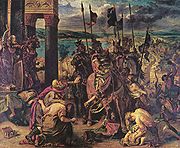 The secular use of Hellene revived in the 9th century, after paganism had been eclipsed and was no longer a threat to Christianity
's dominance. The revival followed the same track as its disappearance. The name had originally declined from a national term in antiquity
, to a cultural term in the Hellenistic years, to a religious term in the early Christian
years. With the demise of paganism and the revival of learning in the Byzantine Empire
it had regained its cultural meaning, and finally, by the 11th century it had returned to its ancient national form of an "ethnic Greek", synonymous at the time to "Roman".
Accounts from the 11th century onward (from Anna Komnena, Michael Psellos, John III Vatatzes, George Pletho Gemistos and several others) prove that the revival of the term Hellene (as a potential replacement for ethnic terms like Graekos and Romios) did occur. For example, Anna Komnena writes of her contemporaries as Hellenes, but does not use the word as a synonym for a pagan worshipper. Moreover, Anna boasts about her Hellenic classical education, and she speaks as a native Greek and not as an outsider/foreigner who learned Greek.
The refounding of the University of Constantinople
in the palaces of Magnaura
promoted an interest in learning, particularly in Greek studies. Patriarch Photius was irritated because "Hellenic studies are preferred over spiritual works". Michael Psellus thought it a compliment when Emperor Romanus III praised him for being raised "in the Hellenic way" and a weakness for Emperor Michael IV for being completely devoid of a Hellenic education, while Anna Comnena claimed that she had "carried the study of Hellenic to the highest pitch". Also, commenting on the orphanage her father founded, she stated that "there could be seen a Latin being trained, and a Scythian studying Hellenic, and a Roman handling Hellenic texts and an illiterate Hellene speaking Hellenic correctly". In this case we reach a point where the Byzantines are Romans on the political level but Hellenic by descent. Eustathius of Thessalonike
disambiguates the distinction in his account of the fall of Constantinople in 1204 by referring to the invaders with the generic term "Latins", encompassing all adherents to the Roman Catholic Church
, and the "Hellenes" as the dominant population of the empire.
After the fall of Constantinople to the Crusaders
, Greek nationalism accentuated. Nicetas Choniates
insisted on using the name "Hellenes", stressing the outrages of the "Latins" against the "Hellenes" in the Peloponessus and how the Alfeios River
might carry the news to the barbarians in Sicily
, the Normans
. Nicephorus Blemmydes
referred to the Byzantine emperors as Hellenes, and Theodore Alanias wrote in a letter to his brother that "the homeland may have been captured, but Hellas still exists within every wise man". The second Emperor of Nicaea, John III Ducas Vatatzes, wrote in a letter to Pope Gregory IX
about the wisdom that "rains upon the Hellenic nation". He maintained that the transfer of the imperial authority from Rome to Constantinople was national and not geographic, and therefore did not belong to the Latins
occupying Constantinople: Constantine's heritage was passed on to the Hellenes, so he argued, and they alone were its inheritors and successors. His son, Theodore II Lascaris, was eager to project the name of the Greeks with true nationalistic zeal. He made it a point that "the Hellenic race looms over all other languages" and that "every kind of philosophy and form of knowledge is a discovery of Hellenes... What do you, O Italian, have to display?"
The evolution of the name was slow and did never replace the "Roman" name completely. Nicephorus Gregoras
named his historical work Roman History. Emperor John VI Cantacuzenus, a big supporter of Greek education, in his own memoirs always refers to the Byzantines as "Romans", yet, in a letter sent by the sultan
of Egypt
, Nasser Hassan Ben Mohamed, referred to him as "Emperor of the Hellenes, Bulgars
, Sassanians, Vlachs
, Russians
, Alanians
" but not of the "Romans". Over the next century, George Gemistus Plethon pointed out to Constantine Palaeologus
that the people he leads are "Hellenes, as their race and language and education testifies", while Laonicus Chalcondyles
was a proponent of completely substituting "Roman" terminology for "Greek" terminology. Constantine Palaeologus himself in the end proclaimed Constantinople
the "refuge for Christians, hope and delight of all Hellenes". On the other hand, the same Emperor in his final speech before the Empire's demise called upon his audience to rally to the defenses by characteristically referring to them as "descendants of Hellenes and Romans", most possibly as an attempt to combine Greek national sentiment with the Roman tradition of the Byzantine crown and Empire, both highly respected elements in his subjects' psyche at that moment.
The term "Byzantine Empire" was introduced in 1557, about a century after the Fall of Constantinople
by German historian Hieronymus Wolf
, who introduced a system of Byzantine historiography
in his work Corpus Historiae Byzantinae in order to distinguish ancient Roman from medieval Greek history without drawing attention to their ancient predecessors. Several authors adopted his terminology thereafter but it still remained relatively unknown. When interest did arise, English historians preferred to use Roman terminology (Edward Gibbon
used it in a particularly belittling manner), while French historians preferred to call it Greek. The term reappeared in the mid-19th century and has since dominated completely in historiography, even in Greece despite objections by Constantine Paparregopoulos
(Gibbon's influential Greek counterpart) that the empire should be called Greek. Few Greek scholars did adopt the terminology at that time, but only became popular in the second half of the 20th century.
, a historian of the 5th century AD. The historian stated in one of his accounts that while unofficially on an embassy to Attila the Hun, he had met at Attila's court someone who dressed like a Scythian yet spoke Greek. When Priskos asked the person where he had learned the language, the man smiled and said that he was a Graekos by birth. Many other "Byzantine" authors speak of the Empire's natives as Greeks [Graikoi] or Hellenes such as Constantine Porphyrogennitos of the 10th century. His accounts discuss about the revolt of a Slavic tribe in the district of Patras in the Peloponnese. Constantine states that the Slavs who revolted first proceeded to sack the dwellings of their neighbors, the Greeks (ton Graikon), and next they moved against the inhabitants of the city of Patras. Overall, ancient Hellenic continuity was evident all throughout the history of the Eastern Roman Empire. The "Byzantines" were not merely a general Orthodox Christian populace that referred to themselves as merely "Romans." Though they used the term for legal and administrative purposes, other terms were in fact used to ethnically distinguish themselves. In short, the Greek inhabitants of the Eastern Roman Empire were very conscious of their ancient Hellenic heritage and were able to preserve their identity while adapting to the changes the world was undergoing at the time.
and during the Ottoman Greece
a fierce ideological battle ensued regarding the three rival national names of the Greeks. This struggle may have settled down after the Greek War of Independence
but was permanently resolved only recently in the 20th century after the loss of Asia Minor
to the Turks
.
The struggle reflected the diverging view of history between classicists and medievalists (katharevousa
and demotic) in their attempt to define Greek nationality
at a time without a Byzantine
state to foster the movement. The concept of Hellene for a person of Greek origin was already well established since the late Middle Ages
. However, for the majority of the population, especially those in rural areas away from urban centers, the dominant perception was still that of a Roman/Romios, a descendant of the Byzantine Empire. Scholar Rigas Feraios
called "Bulgars and Arvanites
, Armenians
and Romans" to rise in arms against the Ottomans. General Makrygiannis
recalled a friend asking him: "What say you, is the Roman State far away from coming? Are we to sleep with the Turks and awaken with the Romans?"
Greek (Γραικός) was the least popular of the three terms, but received disproportionately larger attention by scholars compared to its popular use. Adamantios Korais
, a renowned Greek classicist, justified his preference in A Dialogue between Two Greeks: "Our ancestors used to call themselves Greeks but adopted afterwards the name Hellenes by a Greek who called himself Hellen
. One of the above two, therefore, is our true name. I approved 'Greece' because that is what all the enlightened nations of Europe call us." Hellenes for Korais are the pre-Christian inhabitants of Greece.
The absence of a Byzantine state gradually led to the marginalization of the Roman name and allowed Hellene (Έλλην) to resurface as the primary national name. Dionysius Pyrrus requests the exclusive use of Hellene in his Cheiragogy: "Never desire to call yourselves Romans, but Hellenes, for the Romans from ancient Rome enslaved and destroyed Hellas". The anonymous author of The Hellenic Realm of Law, published in 1806 in Pavia
, Italy, speaks of Hellenes: "The time has come, O Hellenes, to liberate our home". The leader of the Greek War of Independence
began his Declaration with a phrase similar to the above: "The time has come, O men, Hellenes". After the name was accepted by the spiritual and political leadership of the land, it rapidly spread to the population, especially with the onset of the Greek War of Independence where many naïve leaders and war figures distinguished between idle Romans and rebellious Hellenes. General Theodoros Kolokotronis
in particular made a point of always addressing his revolutionary troops as Hellenes and invariably wore a helmet
of ancient Greek style.
General Makrygiannis tells of a priest who performed his duty in front of the "Romans" (civilians) but secretly spied on the "Hellenes" (fighters). "Roman" almost came to be associated with passiveness and enslavement, and "Hellene" brought back the memory of ancient glories and the fight for freedom. Eyewitness historian Ambrosius Phrantzes writes that while the Turkish authorities and colonists in Niokastro
had surrendered to the advancing Greek army, reportedly, shouts of defiance were made that led to their massacre by the mob
: "They spoke to the petty and small Hellenes as 'Romans'. It was as if they called them 'slaves'! The Hellenes not bearing to hear the word, for it reminded of their situation and the outcome of tyranny..."
The citizens of the newly independent state were called "Hellenes" making the connection with ancient Greece
all the more clear. That in turn also fostered a fi xation on antiquity and negligence for the other periods of history, especially the Byzantine Empire
, for an age that bore different names and was a devisor to different, and in many ways more important legacies. The classicist trend was soon balanced by the Greek Great Idea
that sought to recover Constantinople
and reestablish the Byzantine Empire for all Greeks. As the Minister of Foreign Affairs proclaimed in front of Parliament in 1844, "The Kingdom of Greece
is not Greece; it is only part of it, a small and poor part of Greece... There are two great centers of Hellenism
. Athens is the capital of the Kingdom. Constantinople is the great capital, the City, dream and hýope of all Greeks."
Greeks
The Greeks, also known as the Hellenes , are a nation and ethnic group native to Greece, Cyprus and neighboring regions. They also form a significant diaspora, with Greek communities established around the world....
have been called by several names, both by themselves and by other people. The most common native ethnonym
Ethnonym
An ethnonym is the name applied to a given ethnic group. Ethnonyms can be divided into two categories: exonyms and autonyms or endonyms .As an example, the ethnonym for...
is Hellenes (Έλληνες); the name Greeks
Greeks
The Greeks, also known as the Hellenes , are a nation and ethnic group native to Greece, Cyprus and neighboring regions. They also form a significant diaspora, with Greek communities established around the world....
(Graeci) was used by the Romans
Ancient Rome
Ancient Rome was a thriving civilization that grew on the Italian Peninsula as early as the 8th century BC. Located along the Mediterranean Sea and centered on the city of Rome, it expanded to one of the largest empires in the ancient world....
and then in all European languages.
The first Greek-speaking people entered the region of present day Greece
Greece
Greece , officially the Hellenic Republic , and historically Hellas or the Republic of Greece in English, is a country in southeastern Europe....
during the 19th century BC and they are called by the historians Myceneans after their most powerful city Mycenae, or Myceneans-Achaeans because Homer
Homer
In the Western classical tradition Homer , is the author of the Iliad and the Odyssey, and is revered as the greatest ancient Greek epic poet. These epics lie at the beginning of the Western canon of literature, and have had an enormous influence on the history of literature.When he lived is...
refers to Achaeans as the dominating tribe during the period of the Trojan war
Trojan War
In Greek mythology, the Trojan War was waged against the city of Troy by the Achaeans after Paris of Troy took Helen from her husband Menelaus, the king of Sparta. The war is among the most important events in Greek mythology and was narrated in many works of Greek literature, including the Iliad...
.
In Homer, Hellenes was the name of a relative small tribe in Thessaly
Thessaly
Thessaly is a traditional geographical region and an administrative region of Greece, comprising most of the ancient region of the same name. Before the Greek Dark Ages, Thessaly was known as Aeolia, and appears thus in Homer's Odyssey....
. The Dorians an important Greek-speaking group entered Greece during the 13th century BC. According to the Greek tradition the previous called Graekhes (Greeks) were named Hellenes and the name was probably used with the establishment of the asocciation of the Great Amphictyonic League
Amphictyonic League
In the Archaic period of ancient Greece, an amphictyony , a "league of neighbors", or Amphictyonic League was an ancient association of Greek tribes formed in the dim past, before the rise of the Greek polis...
, after the Trojan war. It seems that the myth of their patriarch Hellen
Hellen
Hellen , the son of Deucalion and Pyrrha, brother of Amphictyon and father of Aeolus, Xuthus, and Dorus. His name is also another name for Greek, meaning a person of Greek descent or pertaining to Greek culture, and the source of the adjective "Hellenic".Each of his sons founded a primary tribe of...
, was invented when several Greek tribe
Tribe
A tribe, viewed historically or developmentally, consists of a social group existing before the development of, or outside of, states.Many anthropologists use the term tribal society to refer to societies organized largely on the basis of kinship, especially corporate descent groups .Some theorists...
s started to separate from each other and it indicates their common origin. His descendants the Aeolians
Aeolians
The Aeolians were one of the four major ancient Greek tribes comprising Ancient Greeks. Their name derives from Aeolus, the mythical ancestor of the Aeolic branch and son of Hellen, the mythical patriarch of the Greek nation...
, Dorians, Achaeans
Achaeans (tribe)
The Achaeans were one of the four major tribes into which the people of Classical Greece divided themselves. According to the foundation myth formalized by Hesiod, their name comes from Achaeus, the mythical founder of the Achaean tribe, who was supposedly one of the sons of Xuthus, and brother of...
and Ionians
Ionians
The Ionians were one of the four major tribes into which the Classical Greeks considered the population of Hellenes to have been divided...
correspond to the main Greek tribes and to the main dialects spoken in [Greece and Asia Minor
Asia Minor
Asia Minor is a geographical location at the westernmost protrusion of Asia, also called Anatolia, and corresponds to the western two thirds of the Asian part of Turkey...
(Anatolia
Anatolia
Anatolia is a geographic and historical term denoting the westernmost protrusion of Asia, comprising the majority of the Republic of Turkey...
). Among his descendants are also mentioned the Graeces and the Makedones
Ancient Macedonians
The Macedonians originated from inhabitants of the northeastern part of the Greek peninsula, in the alluvial plain around the rivers Haliacmon and lower Axios...
.
When the Romans first encountered the Greeks in southern Italy
Italy
Italy , officially the Italian Republic languages]] under the European Charter for Regional or Minority Languages. In each of these, Italy's official name is as follows:;;;;;;;;), is a unitary parliamentary republic in South-Central Europe. To the north it borders France, Switzerland, Austria and...
, they used the name Graeci for the colonists and then for all Greeks, which is the root of all relevant terms in Europe
Europe
Europe is, by convention, one of the world's seven continents. Comprising the westernmost peninsula of Eurasia, Europe is generally 'divided' from Asia to its east by the watershed divides of the Ural and Caucasus Mountains, the Ural River, the Caspian and Black Seas, and the waterways connecting...
an languages. The Persians used the name Yaunas
Ionia (satrapy)
Yauna or Ionia, was a satrapy of the Achaemenid Empire. The first mention of the Yauna is at the Behistun inscription...
(Yunans) after the Ionians, a Greek tribe who occupied some areas on the coasts of western Asia Minor
Asia Minor
Asia Minor is a geographical location at the westernmost protrusion of Asia, also called Anatolia, and corresponds to the western two thirds of the Asian part of Turkey...
and the term was used later by the Jews
Jews
The Jews , also known as the Jewish people, are a nation and ethnoreligious group originating in the Israelites or Hebrews of the Ancient Near East. The Jewish ethnicity, nationality, and religion are strongly interrelated, as Judaism is the traditional faith of the Jewish nation...
(Yavanim , by all Arabic languages and also by the Turks
Turkic peoples
The Turkic peoples are peoples residing in northern, central and western Asia, southern Siberia and northwestern China and parts of eastern Europe. They speak languages belonging to the Turkic language family. They share, to varying degrees, certain cultural traits and historical backgrounds...
. By Late Antiquity
Late Antiquity
Late Antiquity is a periodization used by historians to describe the time of transition from Classical Antiquity to the Middle Ages, in both mainland Europe and the Mediterranean world. Precise boundaries for the period are a matter of debate, but noted historian of the period Peter Brown proposed...
, the Greeks referred to themselves as Rhomaioi or Romioi , i.e. "Romans", since after AD 212 virtually all Greeks were Roman citizens. After the establishment of Christianity by Theodosius I
Theodosius I
Theodosius I , also known as Theodosius the Great, was Roman Emperor from 379 to 395. Theodosius was the last emperor to rule over both the eastern and the western halves of the Roman Empire. During his reign, the Goths secured control of Illyricum after the Gothic War, establishing their homeland...
, "Hellene" was applied to the followers of the polytheistic
Ancient Greek religion
Greek religion encompasses the collection of beliefs and rituals practiced in ancient Greece in the form of both popular public religion and cult practices. These different groups varied enough for it to be possible to speak of Greek religions or "cults" in the plural, though most of them shared...
("pagan") religion. A unique form is used in Georgian
Georgian language
Georgian is the native language of the Georgians and the official language of Georgia, a country in the Caucasus.Georgian is the primary language of about 4 million people in Georgia itself, and of another 500,000 abroad...
, where the Greeks are called berdzeni , probably deriving from the Georgian word for "wise".
General names of Greece
Most European languages, and languages that have borrowed the name from one of them, use names for Greece that are ultimately derived from the Latin Graecia and Graecus, the name the Romans used for the Greeks:- CatalanCatalan languageCatalan is a Romance language, the national and only official language of Andorra and a co-official language in the Spanish autonomous communities of Catalonia, the Balearic Islands and Valencian Community, where it is known as Valencian , as well as in the city of Alghero, on the Italian island...
: Grècia - CroatianCroatian languageCroatian is the collective name for the standard language and dialects spoken by Croats, principally in Croatia, Bosnia and Herzegovina, the Serbian province of Vojvodina and other neighbouring countries...
: Grčka - West FrisianWest Frisian languageWest Frisian is a language spoken mostly in the province of Friesland in the north of the Netherlands. West Frisian is the name by which this language is usually known outside the Netherlands, to distinguish it from the closely related Frisian languages of Saterland Frisian and North Frisian,...
: Grikelân
- FilipinoFilipino languageThis move has drawn much criticism from other regional groups.In 1987, a new constitution introduced many provisions for the language.Article XIV, Section 6, omits any mention of Tagalog as the basis for Filipino, and states that:...
: Gresya
(Grecija)(Hrecyja)(Hrecija)(Gǎrcija) (Grcija)
- JapaneseJapanese languageis a language spoken by over 130 million people in Japan and in Japanese emigrant communities. It is a member of the Japonic language family, which has a number of proposed relationships with other languages, none of which has gained wide acceptance among historical linguists .Japanese is an...
: ギリシャ (Girisha) (Krech) - KoreanKorean languageKorean is the official language of the country Korea, in both South and North. It is also one of the two official languages in the Yanbian Korean Autonomous Prefecture in People's Republic of China. There are about 78 million Korean speakers worldwide. In the 15th century, a national writing...
: 그리스 (Geuriseu)
In Middle Eastern and South Asian languages, the common root is "yun" or "ywn". It is borrowed from the Greek name "Ionia
Ionia
Ionia is an ancient region of central coastal Anatolia in present-day Turkey, the region nearest İzmir, which was historically Smyrna. It consisted of the northernmost territories of the Ionian League of Greek settlements...
", the Greek region of Asia Minor
Asia Minor
Asia Minor is a geographical location at the westernmost protrusion of Asia, also called Anatolia, and corresponds to the western two thirds of the Asian part of Turkey...
:
- ArabicArabic languageArabic is a name applied to the descendants of the Classical Arabic language of the 6th century AD, used most prominently in the Quran, the Islamic Holy Book...
: يونان (Yūnān) - AramaicAramaic languageAramaic is a group of languages belonging to the Afroasiatic language phylum. The name of the language is based on the name of Aram, an ancient region in central Syria. Within this family, Aramaic belongs to the Semitic family, and more specifically, is a part of the Northwest Semitic subfamily,...
: ܝܘܢ or יון (Yawān, Yawon)(Hounastan) - AzeriAzerbaijani languageAzerbaijani or Azeri or Torki is a language belonging to the Turkic language family, spoken in southwestern Asia by the Azerbaijani people, primarily in Azerbaijan and northwestern Iran...
: Yunanıstan - Hindi: यूनान (Yūnān)
- Biblical Hebrew: יָוָן (Yāwān)
- Modern HebrewHebrew languageHebrew is a Semitic language of the Afroasiatic language family. Culturally, is it considered by Jews and other religious groups as the language of the Jewish people, though other Jewish languages had originated among diaspora Jews, and the Hebrew language is also used by non-Jewish groups, such...
: יוון (Yavan) - KJV Bible: Javan
- Modern Hebrew
- LazLaz languageThe Laz language is a South Caucasian language spoken by the Laz people on the Southeast shore of the Black Sea...
: Yonaneti-Xorumona (ხორუმონა) - NepaleseNepali languageNepali or Nepalese is a language in the Indo-Aryan branch of the Indo-European language family.It is the official language and de facto lingua franca of Nepal and is also spoken in Bhutan, parts of India and parts of Myanmar...
: यूनान (Yūnān) - PersianPersian languagePersian is an Iranian language within the Indo-Iranian branch of the Indo-European languages. It is primarily spoken in Iran, Afghanistan, Tajikistan and countries which historically came under Persian influence...
: یونان (Yūnān) - TojikiTajik languageTajik, Tajik Persian, or Tajiki, is a variety of modern Persian spoken in Central Asia. Historically Tajiks called their language zabani farsī , meaning Persian language in English; the term zabani tajikī, or Tajik language, was introduced in the 20th century by the Soviets...
: Юнон (Yunon)
The third root is "hl", used by a few languages around the world, including Greek:
-
- Polytonic: or
- Monotonic: or
- ChineseChinese languageThe Chinese language is a language or language family consisting of varieties which are mutually intelligible to varying degrees. Originally the indigenous languages spoken by the Han Chinese in China, it forms one of the branches of Sino-Tibetan family of languages...
: 希臘(T) / 希腊(S) (pinyinPinyinPinyin is the official system to transcribe Chinese characters into the Roman alphabet in China, Malaysia, Singapore and Taiwan. It is also often used to teach Mandarin Chinese and spell Chinese names in foreign publications and used as an input method to enter Chinese characters into...
: Xīlà; jyutpingJyutpingJyutping is a romanization system for Cantonese developed by the Linguistic Society of Hong Kong in 1993. Its formal name is The Linguistic Society of Hong Kong Cantonese Romanization Scheme...
: hei1 laap6)
In the Georgian language
Georgian language
Georgian is the native language of the Georgians and the official language of Georgia, a country in the Caucasus.Georgian is the primary language of about 4 million people in Georgia itself, and of another 500,000 abroad...
, the root for "Greek" is "-berdz-" (from the word for "wisdom"), so "Greece" is "Saberdzneti"
In the Chechen language
Chechen language
The Chechen language is spoken by more than 1.5 million people, mostly in Chechnya and by Chechen people elsewhere. It is a member of the Northeast Caucasian languages.-Classification:...
, the name is Джелтимохк (Džieltimohk)
Brief history
The first people speaking an ancient Proto-Greek languageProto-Greek language
The Proto-Greek language is the assumed last common ancestor of all known varieties of Greek, including Mycenaean, the classical Greek dialects , and ultimately Koine, Byzantine and modern Greek...
entered mainland Greece
Greece
Greece , officially the Hellenic Republic , and historically Hellas or the Republic of Greece in English, is a country in southeastern Europe....
from the north at the end of the 3rd milemnium BC. There is no evidence that populations from the north moved to Crete
Crete
Crete is the largest and most populous of the Greek islands, the fifth largest island in the Mediterranean Sea, and one of the thirteen administrative regions of Greece. It forms a significant part of the economy and cultural heritage of Greece while retaining its own local cultural traits...
in this period. From the Ancient Greek dialects as they presented themselves centuries later, it seems that at least two migrations of Greeks followed, the first of the Ionians
Ionians
The Ionians were one of the four major tribes into which the Classical Greeks considered the population of Hellenes to have been divided...
and the Aeolians
Aeolians
The Aeolians were one of the four major ancient Greek tribes comprising Ancient Greeks. Their name derives from Aeolus, the mythical ancestor of the Aeolic branch and son of Hellen, the mythical patriarch of the Greek nation...
probably in the 19th century BC and the second of the Dorians probably in the 13th century BC. The first migration resulted in Mycenean Greek, an archaic Greek language which appears in Linear B
Linear B
Linear B is a syllabic script that was used for writing Mycenaean Greek, an early form of Greek. It pre-dated the Greek alphabet by several centuries and seems to have died out with the fall of Mycenaean civilization...
syllabic inscriptions and the second to the Dorian
Dorian
The Dorians were one of the four major ethnē into which the Ancient Greeks, or Hellenes, of the Classical period considered themselves divided. Ethnos has the sense of ethnic group. Herodotus uses the word with regard to them...
dialect which displaced the Arcadocypriot dialect that seems to be closest to the Mycenean Greek.
The autochthonous or Proto Greek
Proto-Greek language
The Proto-Greek language is the assumed last common ancestor of all known varieties of Greek, including Mycenaean, the classical Greek dialects , and ultimately Koine, Byzantine and modern Greek...
speaking people were called later by the Greeks Pelasgians
Pelasgians
The name Pelasgians was used by some ancient Greek writers to refer to populations that were either the ancestors of the Greeks or who preceded the Greeks in Greece, "a hold-all term for any ancient, primitive and presumably indigenous people in the Greek world." In general, "Pelasgian" has come...
who have uncertain origins and lived mainly in Thessaly
Thessaly
Thessaly is a traditional geographical region and an administrative region of Greece, comprising most of the ancient region of the same name. Before the Greek Dark Ages, Thessaly was known as Aeolia, and appears thus in Homer's Odyssey....
and Epirus
Epirus
The name Epirus, from the Greek "Ήπειρος" meaning continent may refer to:-Geographical:* Epirus - a historical and geographical region of the southwestern Balkans, straddling modern Greece and Albania...
, Eteocretans
Eteocretan language
The Minoan language was spoken in ancient Crete before it was replaced with the language of the mainland; the relationship between Minoan and Greek is unknown. While attempts have been made to connect it to other languages, Minoan must be considered unclassified until a linguistic affiliation can...
who lived in Crete
Crete
Crete is the largest and most populous of the Greek islands, the fifth largest island in the Mediterranean Sea, and one of the thirteen administrative regions of Greece. It forms a significant part of the economy and cultural heritage of Greece while retaining its own local cultural traits...
(descendants of the ancient Minoans
Minoan civilization
The Minoan civilization was a Bronze Age civilization that arose on the island of Crete and flourished from approximately the 27th century BC to the 15th century BC. It was rediscovered at the beginning of the 20th century through the work of the British archaeologist Arthur Evans...
) and Minyans
Minyans
According to Greek mythology and legendary prehistory of the Aegean region, the Minyans were an autochthonous group inhabiting the Aegean region...
who lived in Boeotia
Boeotia
Boeotia, also spelled Beotia and Bœotia , is one of the regional units of Greece. It is part of the region of Central Greece. It was also a region of ancient Greece. Its capital is Livadeia, the second largest city being Thebes.-Geography:...
.
The later called Aeolians
Aeolians
The Aeolians were one of the four major ancient Greek tribes comprising Ancient Greeks. Their name derives from Aeolus, the mythical ancestor of the Aeolic branch and son of Hellen, the mythical patriarch of the Greek nation...
and Ionians
Ionians
The Ionians were one of the four major tribes into which the Classical Greeks considered the population of Hellenes to have been divided...
established several feudal-kingdoms around Greece and the historians called them Myceneans after their most powerful kingdom Mycenea in Peloponnese
Peloponnese
The Peloponnese, Peloponnesos or Peloponnesus , is a large peninsula , located in a region of southern Greece, forming the part of the country south of the Gulf of Corinth...
or Myceneans-Achaeans because in Homer
Homer
In the Western classical tradition Homer , is the author of the Iliad and the Odyssey, and is revered as the greatest ancient Greek epic poet. These epics lie at the beginning of the Western canon of literature, and have had an enormous influence on the history of literature.When he lived is...
the Achaeans were the dominating tribe in Greece and the name Achiyawa that appears in Hittite
Hittites
The Hittites were a Bronze Age people of Anatolia.They established a kingdom centered at Hattusa in north-central Anatolia c. the 18th century BC. The Hittite empire reached its height c...
texts seems to correspond to a thalassocratic country which might me Mycenea. Although Homer is referring to a union of the Greek kingdoms under the leadership of the king of Mycenea during the Trojan war
Trojan War
In Greek mythology, the Trojan War was waged against the city of Troy by the Achaeans after Paris of Troy took Helen from her husband Menelaus, the king of Sparta. The war is among the most important events in Greek mythology and was narrated in many works of Greek literature, including the Iliad...
, there is no evidence that these kingdoms were dominated by a central power. The Mycenean palaces were destroyed by invaders at the end of the 13th century BC. The Greek tradition relates this destruction with the Dorians, however it is suggested that the Dorian invasion
Dorian invasion
The Dorian invasion is a concept devised by historians of Ancient Greece to explain the replacement of pre-classical dialects and traditions in southern Greece by the ones that prevailed in Classical Greece...
was only one of the causes of the bronze-age collapse in Eastern-Mediterranean, because there is no evidence that the newcomers established a different civilization. The destruction was followed by the Greek Dark Ages
Greek Dark Ages
The Greek Dark Age or Ages also known as Geometric or Homeric Age are terms which have regularly been used to refer to the period of Greek history from the presumed Dorian invasion and end of the Mycenaean Palatial civilization around 1200 BC, to the first signs of the Greek city-states in the 9th...
with very poor archaeological findings, when most occupied areas were deserted, but some areas like Attica
Attica
Attica is a historical region of Greece, containing Athens, the current capital of Greece. The historical region is centered on the Attic peninsula, which projects into the Aegean Sea...
occupied by the Ionians remained untouched by the invaders. Several Greek tribes moved to certain regions of Greece where they acquired different names, and groups of population moved through the islands to the western coasts of Asia Minor
Asia Minor
Asia Minor is a geographical location at the westernmost protrusion of Asia, also called Anatolia, and corresponds to the western two thirds of the Asian part of Turkey...
where they kept their native names Aeolians, Ionians and Dorians.
It seems that the myth of Hellen
Hellen
Hellen , the son of Deucalion and Pyrrha, brother of Amphictyon and father of Aeolus, Xuthus, and Dorus. His name is also another name for Greek, meaning a person of Greek descent or pertaining to Greek culture, and the source of the adjective "Hellenic".Each of his sons founded a primary tribe of...
, the patriarch of Hellenes was invented when the Greek tribes started to separate from each other and inspired to them their common origin. The name Hellenes was probably used by the Greeks with the establishment of the Great Amphictyonic League
Amphictyonic League
In the Archaic period of ancient Greece, an amphictyony , a "league of neighbors", or Amphictyonic League was an ancient association of Greek tribes formed in the dim past, before the rise of the Greek polis...
,an ancient asocciation of Greek tribes. According to the legend it was founded after the Trojan war, by the eponymous Amphictyon
Amphictyon
Amphictyon , in Greek mythology, was the second son of Deucalion and Pyrrha, although there was also a tradition that he was autochthonous ; he is also said to be a son of Hellen son of Deucalion and Pyrrha. Amphictyon was king of Thermopylae and married a daughter of Cranaus of Athens...
,brother of Hellen. It had twelve founders and was organized to protect the great temples of Apollo
Apollo
Apollo is one of the most important and complex of the Olympian deities in Greek and Roman mythology...
in Delphi
Delphi
Delphi is both an archaeological site and a modern town in Greece on the south-western spur of Mount Parnassus in the valley of Phocis.In Greek mythology, Delphi was the site of the Delphic oracle, the most important oracle in the classical Greek world, and a major site for the worship of the god...
(Phocis
Phocis
Phocis is one of the regional units of Greece. It is part of the administrative region of Central Greece. It stretches from the western mountainsides of Parnassus on the east to the mountain range of Vardousia on the west, upon the Gulf of Corinth...
) and of Demeter
Demeter
In Greek mythology, Demeter is the goddess of the harvest, who presided over grains, the fertility of the earth, and the seasons . Her common surnames are Sito as the giver of food or corn/grain and Thesmophoros as a mark of the civilized existence of agricultural society...
near Thermopylae
Thermopylae
Thermopylae is a location in Greece where a narrow coastal passage existed in antiquity. It derives its name from its hot sulphur springs. "Hot gates" is also "the place of hot springs and cavernous entrances to Hades"....
(Locris
Locris
Locris was a region of ancient Greece, the homeland of the Locrians, made up of three distinct districts.-Locrian tribe:...
).The twelve founders enumerated by Aeschines
Aeschines
Aeschines was a Greek statesman and one of the ten Attic orators.-Life:Although it is known he was born in Athens, the records regarding his parentage and early life are conflicting; but it seems probable that his parents, though poor, were respectable. Aeschines' father was Atrometus, an...
were the Aenianes or Oetaeans (Αἰνιᾶνες, Οἰταῖοι), the Boeotians (Βοιωτοί) of Thebes, the Dolopes (Δόλοπες), the Dorians (Δωριείς) of Sparta
Sparta
Sparta or Lacedaemon, was a prominent city-state in ancient Greece, situated on the banks of the River Eurotas in Laconia, in south-eastern Peloponnese. It emerged as a political entity around the 10th century BC, when the invading Dorians subjugated the local, non-Dorian population. From c...
, the Ionians
Ionians
The Ionians were one of the four major tribes into which the Classical Greeks considered the population of Hellenes to have been divided...
(Ἴωνες) of Athens
Athens
Athens , is the capital and largest city of Greece. Athens dominates the Attica region and is one of the world's oldest cities, as its recorded history spans around 3,400 years. Classical Athens was a powerful city-state...
, the Phthia
Phthia
Phthia , Phthíē ) in ancient Greece was the southernmost region of ancient Thessaly, on both sides of Othrys Mountain. It was the homeland of the Myrmidones tribe, who took part in the Trojan War under Achilles....
n Achaeans (Ἀχαιοί), the Locrians
Locrians
The Locrians were an ancient Greek tribe in Greece. The Locrians spoke the Locrian dialect, a Doric-Northwest dialect, which indicates that they may have been relatives of the Dorians. They inhabited the ancient region of Locris in Central Greece....
(Λοκροί) (Opuntians,Ὀπούντιοι and Ozolians, Ὀζολοί ), the Magnesia
Magnesia Prefecture
Magnesia Prefecture was one of the prefectures of Greece. Its capital was Volos. It was established in 1899 from the Larissa Prefecture. The prefecture was disbanded on 1 January 2011 by the Kallikratis programme, and split into the peripheral units of Magnesia and the Sporades.The toponym is...
ns (Μάγνητες), the Malians
Malians (Greek tribe)
The Malians were a Greek tribe that resided at the mouth of the river Spercheios in Greece. The Malian Gulf is named after them. In the western valley of the Spercheios, their land was adjacent to the Aenianes. Their main town was Trachis. In the town of Anthele, the Malians had an important...
(Μαλιεῖς), the Perrhaebians (Περραιβοί), the Phocians (Φωκεῖς), the Pythia
Pythia
The Pythia , commonly known as the Oracle of Delphi, was the priestess at the Temple of Apollo at Delphi, located on the slopes of Mount Parnassus. The Pythia was widely credited for her prophecies inspired by Apollo. The Delphic oracle was established in the 8th century BC...
ns (Πύθιοι) of Delphi
Delphi
Delphi is both an archaeological site and a modern town in Greece on the south-western spur of Mount Parnassus in the valley of Phocis.In Greek mythology, Delphi was the site of the Delphic oracle, the most important oracle in the classical Greek world, and a major site for the worship of the god...
, and the Thessalians (Θεσσαλοί). Among the descendants of Hellen are mentioned Aeolus
Aeolus
Aeolus was the ruler of the winds in Greek mythology. In fact this name was shared by three mythic characters. These three personages are often difficult to tell apart, and even the ancient mythographers appear to have been perplexed about which Aeolus was which...
, Ion
Ion
An ion is an atom or molecule in which the total number of electrons is not equal to the total number of protons, giving it a net positive or negative electrical charge. The name was given by physicist Michael Faraday for the substances that allow a current to pass between electrodes in a...
, Achaeus, Dorus
Dorus
-People:*Dorus de Vries, Dutch footballer*Dorus Rijkers, Dutch lifeboat captain*Stage name of Dutch comedian Tom Manders-Greek mythology:*Dorus, son of Hellen and founder of the Dorian nation*Dorus, son of Apollo and Phthia, and the father of Xanthippe...
, Graecos and Makedon
Ancient Macedonians
The Macedonians originated from inhabitants of the northeastern part of the Greek peninsula, in the alluvial plain around the rivers Haliacmon and lower Axios...
. It seems that the Macedonians
Ancient Macedonians
The Macedonians originated from inhabitants of the northeastern part of the Greek peninsula, in the alluvial plain around the rivers Haliacmon and lower Axios...
were a Dorian tribe which stood behind in Macedonia when the main Dorian tribes moved to the south.
Achaeans (Αχαιοί)
The Greek cultural tradition has been continuous for centuries; it has always been centered on those who were wealthy and literate enough to have produced literature and have it preserved. They have defined the Greeks as those being in some ways similar to themselves, by descent, speech, culture, or religion. In the earliest surviving literary prose, from the fifth century BC, there is a strong distinction marked between the Greeks (who are called Hellenes) and the rest of humankind; exactly who falls within this wall varies, depending on the century, the observer, and the purpose.The evidence from before this period, such as it is, shows much less trace of any hard distinction between Greeks and the rest of humanity. The surviving samples of Linear B
Linear B
Linear B is a syllabic script that was used for writing Mycenaean Greek, an early form of Greek. It pre-dated the Greek alphabet by several centuries and seems to have died out with the fall of Mycenaean civilization...
are inventory records, and do not discuss ethnicity; Hesiod
Hesiod
Hesiod was a Greek oral poet generally thought by scholars to have been active between 750 and 650 BC, around the same time as Homer. His is the first European poetry in which the poet regards himself as a topic, an individual with a distinctive role to play. Ancient authors credited him and...
's Theogony
Theogony
The Theogony is a poem by Hesiod describing the origins and genealogies of the gods of the ancient Greeks, composed circa 700 BC...
is one great genealogical tree, including gods, men, and monsters; Persians, Latins, and Etrucscans.
In Homer
Homer
In the Western classical tradition Homer , is the author of the Iliad and the Odyssey, and is revered as the greatest ancient Greek epic poet. These epics lie at the beginning of the Western canon of literature, and have had an enormous influence on the history of literature.When he lived is...
's Iliad
Iliad
The Iliad is an epic poem in dactylic hexameters, traditionally attributed to Homer. Set during the Trojan War, the ten-year siege of the city of Troy by a coalition of Greek states, it tells of the battles and events during the weeks of a quarrel between King Agamemnon and the warrior Achilles...
, the Greek allied forces are described under three different names, often used interchangeably: Argives (in Greek: Argeioi, Αργείοι; used 29 times in the Iliad), Danaans (Δαναοί, used 138 times) and Achaeans (Αχαιοί, used 598 times). Argives is an annotation drawn from the original capital of the Achaeans, Argos
Argos
Argos is a city and a former municipality in Argolis, Peloponnese, Greece. Since the 2011 local government reform it is part of the municipality Argos-Mykines, of which it is a municipal unit. It is 11 kilometres from Nafplion, which was its historic harbour...
). Danaans is the name attributed to a Greek mythological character, twin brother of Aegyptus
Aegyptus
- Aegyptus, King of Egypt and Arabia :In Greek mythology, Aegyptus is a descendant of the heifer maiden, Io, and the river-god Nilus, and was a king in Egypt. Aegyptos was the son of Belus and Achiroe, a naiad daughter of Nile. Aegyptus fathered fifty sons, who were all but one murdered by the...
and son of Achiroe
Achiroe
Achiroë or Anchirrhoë , or according to Apollodorus Anchinoë , which is perhaps a mistake for Anchiroë, was in Greek mythology a naiad, a daughter of the river-god Nilus. She was also the wife of Belus, by whom she became the mother of Aegyptus and Danaus, and, according to some accounts, ...
and Belus
Belus
Belus or Belos may be:* The classical Latin or Greek rendition of Bel the Semitic honorific**Ba`al as a Semitic deity** Belus , the Greek Zeus Belos and Latin Jupiter Belus as translations of the Babylonian god Bel Marduk...
.
Hellenes (Έλληνες)
Zeus
In the ancient Greek religion, Zeus was the "Father of Gods and men" who ruled the Olympians of Mount Olympus as a father ruled the family. He was the god of sky and thunder in Greek mythology. His Roman counterpart is Jupiter and his Etruscan counterpart is Tinia.Zeus was the child of Cronus...
in Dodona
Dodona
Dodona in Epirus in northwestern Greece, was an oracle devoted to a Mother Goddess identified at other sites with Rhea or Gaia, but here called Dione, who was joined and partly supplanted in historical times by the Greek god Zeus.The shrine of Dodona was regarded as the oldest Hellenic oracle,...
, Selloi
Selloi
Selloi were inhabitants of Epirus of ancient Greece, in a region between Dodona - where existed the oldest reported oracle - and Achelous river. Aristotle names this area ancient Hellas. There the Selloi dwelt and those who were formerly called Graeci and later Hellenes. According to Homer, they...
changed to Sellanes (as Akarnanes) and then to Hellanes-Hellenes. This theory is based on Aristotle
Aristotle
Aristotle was a Greek philosopher and polymath, a student of Plato and teacher of Alexander the Great. His writings cover many subjects, including physics, metaphysics, poetry, theater, music, logic, rhetoric, linguistics, politics, government, ethics, biology, and zoology...
s comments in Meteorologica where he places Ancient Hellas in Epirus
Epirus
The name Epirus, from the Greek "Ήπειρος" meaning continent may refer to:-Geographical:* Epirus - a historical and geographical region of the southwestern Balkans, straddling modern Greece and Albania...
between Dodona and the Achelous
Achelous
In Greek mythology, Achelous was the patron deity of the "silver-swirling" Achelous River, which is the largest river of Greece, and thus the chief of all river deities, every river having its own river spirit. His name is pre-Greek, its meaning unknown...
river, where in his opinion the great deluge of Deucalion
Deucalion
In Greek mythology Deucalion was a son of Prometheus and Pronoia. The anger of Zeus was ignited by the hubris of the Pelasgians, and he decided to put an end to the Bronze Age. Lycaon, the king of Arcadia, had sacrificed a boy to Zeus, who was appalled by this savage offering...
must have occurred. The land was occupied by Selloi and Graii, who later came to be known as Hellenes". In that regard Graii (or Graikhes) was a native name of a Dorian
Dorian
The Dorians were one of the four major ethnē into which the Ancient Greeks, or Hellenes, of the Classical period considered themselves divided. Ethnos has the sense of ethnic group. Herodotus uses the word with regard to them...
tribe in Epirus which was used by the Illyrians
Illyrians
The Illyrians were a group of tribes who inhabited part of the western Balkans in antiquity and the south-eastern coasts of the Italian peninsula...
.".Homer
Homer
In the Western classical tradition Homer , is the author of the Iliad and the Odyssey, and is revered as the greatest ancient Greek epic poet. These epics lie at the beginning of the Western canon of literature, and have had an enormous influence on the history of literature.When he lived is...
mentions that Selloi were the prophets of Zeus in Dodona, but he is referring to Zeus of Dodona as god of the Pelasgians
Pelasgians
The name Pelasgians was used by some ancient Greek writers to refer to populations that were either the ancestors of the Greeks or who preceded the Greeks in Greece, "a hold-all term for any ancient, primitive and presumably indigenous people in the Greek world." In general, "Pelasgian" has come...
who were Pre-Dorian populations. It is possible that the extension of a particular cult of Zeus in Dodona (a tendency among the Greeks to form ever-larger communities and amphictionies
Amphictyonic League
In the Archaic period of ancient Greece, an amphictyony , a "league of neighbors", or Amphictyonic League was an ancient association of Greek tribes formed in the dim past, before the rise of the Greek polis...
) caused the name to further extend to the rest of the peninsula.
However this theory connects the name Hellenes with the Dorians who occupied Epirus and the relation with the name Greeks given by the Romans
Ancient Rome
Ancient Rome was a thriving civilization that grew on the Italian Peninsula as early as the 8th century BC. Located along the Mediterranean Sea and centered on the city of Rome, it expanded to one of the largest empires in the ancient world....
becomes uncertain. The toponyms, especially an ancient city Hellas in southern Thessaly
Thessaly
Thessaly is a traditional geographical region and an administrative region of Greece, comprising most of the ancient region of the same name. Before the Greek Dark Ages, Thessaly was known as Aeolia, and appears thus in Homer's Odyssey....
and the Greek tradition indicate that the name Hellenes is Pre-Dorian and that it is more possible that the homeland of the Graekhes which were later called Hellenes was in central Greece. The Greek tradition mentions an older deluge of Ogyges
Ogyges
Ogyges, Ogygus or Ogygos is a primeval mythological ruler in ancient Greece, generally of Boeotia, but an alternative tradition makes him the first king of Attica.-Etymology:...
in the region of Boeotia
Boeotia
Boeotia, also spelled Beotia and Bœotia , is one of the regional units of Greece. It is part of the region of Central Greece. It was also a region of ancient Greece. Its capital is Livadeia, the second largest city being Thebes.-Geography:...
which was occupied by the Minyans
Minyans
According to Greek mythology and legendary prehistory of the Aegean region, the Minyans were an autochthonous group inhabiting the Aegean region...
a group of autochthonous or Proto Greek
Proto-Greek language
The Proto-Greek language is the assumed last common ancestor of all known varieties of Greek, including Mycenaean, the classical Greek dialects , and ultimately Koine, Byzantine and modern Greek...
speaking people. The region was called Graiki
Graiki
Graiki was the name given by some ancient sources to the area out of ancient Attica including ancient Boeotia. The word seems to be derived from the Greek word "graia" meaning "old lady" , and the region is related with the Ogygian deluge, the first mentioned worldwide deluge in Greek...
in ancient times probably after the old city Graea
Graea
Graea or Graia is a region,or a city of ancient Greece that is placed under Boeotia in Homer's Catalogue of Ships; it seems to have included the city of Oropos, though by the fifth century BC it was probably a kome of that city...
(from Proto Greek
Proto-Greek language
The Proto-Greek language is the assumed last common ancestor of all known varieties of Greek, including Mycenaean, the classical Greek dialects , and ultimately Koine, Byzantine and modern Greek...
grau-j,"old lady") on the coast. The name Greek can be derived from Graikhos, "inhabitant of Graea". and it seems to be related with Proto-Greek
Proto-Greek language
The Proto-Greek language is the assumed last common ancestor of all known varieties of Greek, including Mycenaean, the classical Greek dialects , and ultimately Koine, Byzantine and modern Greek...
guraj, "old age", later geras,keras in Mycenean Greek from PIE
Pie
A pie is a baked dish which is usually made of a pastry dough casing that covers or completely contains a filling of various sweet or savoury ingredients....
*gere, "to grow old".
Homer
Homer
In the Western classical tradition Homer , is the author of the Iliad and the Odyssey, and is revered as the greatest ancient Greek epic poet. These epics lie at the beginning of the Western canon of literature, and have had an enormous influence on the history of literature.When he lived is...
refers originally to Hellenes as a relatively small tribe settled in Thessalic
Thessaly
Thessaly is a traditional geographical region and an administrative region of Greece, comprising most of the ancient region of the same name. Before the Greek Dark Ages, Thessaly was known as Aeolia, and appears thus in Homer's Odyssey....
Phthia
Phthia
Phthia , Phthíē ) in ancient Greece was the southernmost region of ancient Thessaly, on both sides of Othrys Mountain. It was the homeland of the Myrmidones tribe, who took part in the Trojan War under Achilles....
. During the era of the Trojan War
Trojan War
In Greek mythology, the Trojan War was waged against the city of Troy by the Achaeans after Paris of Troy took Helen from her husband Menelaus, the king of Sparta. The war is among the most important events in Greek mythology and was narrated in many works of Greek literature, including the Iliad...
they were centered along the settlements of Alos
Alos, Greece
Alos or Halos was an ancient Greek city, located 10 km south from present-day Almyros. The city is mentioned by Herodotus as one of the places where the Persian king Xerxes stayed in the summer of 480 during his attack on Greece; Herodotus digresses upon a human sacrifice ritual...
, Alope
Alope
Alopê was in Greek mythology a mortal woman, the daughter of Cercyon, known for her great beauty. Poseidon, in the guise of a kingfisher, seduced Alope, his granddaughter through Cercyon, and from the union she gave birth to Hippothoon...
, Trachis
Trachis
Trachis was a region in ancient Greece. Situated south of the river Spercheios, it was populated by the Malians.Its main town was also called Trachis until 426 BC, when it became Heraclea Trachinia. It is located to the west of Thermopylae. Trachis is located just west of the western-most tip of...
, and the Pelasgian Argos
Argos
Argos is a city and a former municipality in Argolis, Peloponnese, Greece. Since the 2011 local government reform it is part of the municipality Argos-Mykines, of which it is a municipal unit. It is 11 kilometres from Nafplion, which was its historic harbour...
. This Homeric Hellas is expressly described as "καλλιγύναικος", kalligýnaikos, "of beautiful women", and its warriors, the Hellenes, along with the feared Myrmidons
Myrmidons
The Myrmidons or Myrmidones were legendary people of Greek history. They were very brave and skilled warriors commanded by Achilles, as described in Homer's Iliad. Their eponymous ancestor was Myrmidon, a king of Thessalian Phthia, who was the son of Zeus and "wide-ruling" Eurymedousa, a...
were under the command of Achilles
Achilles
In Greek mythology, Achilles was a Greek hero of the Trojan War, the central character and the greatest warrior of Homer's Iliad.Plato named Achilles the handsomest of the heroes assembled against Troy....
. In the Parian Chronicle
Parian Chronicle
The Parian Marble or Parian Chronicle is a Greek chronological table, covering the years from 1581 BC to 264 BC, inscribed on a stele...
is mentioned that Phthia was the homeland of Hellenes and that this name was given to those previously called Greeks .Alcman
Alcman
Alcman was an Ancient Greek choral lyric poet from Sparta. He is the earliest representative of the Alexandrinian canon of the nine lyric poets.- Family :...
(7th century BC) also refers that the mothers of Hellenes were Graekhes. In Greek mythology
Greek mythology
Greek mythology is the body of myths and legends belonging to the ancient Greeks, concerning their gods and heroes, the nature of the world, and the origins and significance of their own cult and ritual practices. They were a part of religion in ancient Greece...
, Hellen
Hellen
Hellen , the son of Deucalion and Pyrrha, brother of Amphictyon and father of Aeolus, Xuthus, and Dorus. His name is also another name for Greek, meaning a person of Greek descent or pertaining to Greek culture, and the source of the adjective "Hellenic".Each of his sons founded a primary tribe of...
, the patriarch of Hellenes, was son of Deucalion
Deucalion
In Greek mythology Deucalion was a son of Prometheus and Pronoia. The anger of Zeus was ignited by the hubris of the Pelasgians, and he decided to put an end to the Bronze Age. Lycaon, the king of Arcadia, had sacrificed a boy to Zeus, who was appalled by this savage offering...
, who ruled around Phthia with Pyrrha
Pyrrha
In Greek mythology, Pyrrha was the daughter of Epimetheus and Pandora and wife of Deucalion.When Zeus decided to end the Bronze Age with the great deluge, Deucalion and his wife, Pyrrha, were the only survivors...
, the only survivors after the great deluge. It seems that the myth was invented when the Greek tribes started to separate from each other in certain areas of Greece and it indicates their common origin. The name Hellenes was probably used by the Greeks with the establishment of the Great Amphictyonic League
Amphictyonic League
In the Archaic period of ancient Greece, an amphictyony , a "league of neighbors", or Amphictyonic League was an ancient association of Greek tribes formed in the dim past, before the rise of the Greek polis...
. This was an ancient asocciation of Greek tribes with twelve founders which was organized to protect the great temples of Apollo
Apollo
Apollo is one of the most important and complex of the Olympian deities in Greek and Roman mythology...
in Delphi
Delphi
Delphi is both an archaeological site and a modern town in Greece on the south-western spur of Mount Parnassus in the valley of Phocis.In Greek mythology, Delphi was the site of the Delphic oracle, the most important oracle in the classical Greek world, and a major site for the worship of the god...
(Phocis
Phocis
Phocis is one of the regional units of Greece. It is part of the administrative region of Central Greece. It stretches from the western mountainsides of Parnassus on the east to the mountain range of Vardousia on the west, upon the Gulf of Corinth...
) and of Demeter
Demeter
In Greek mythology, Demeter is the goddess of the harvest, who presided over grains, the fertility of the earth, and the seasons . Her common surnames are Sito as the giver of food or corn/grain and Thesmophoros as a mark of the civilized existence of agricultural society...
near Thermopylae
Thermopylae
Thermopylae is a location in Greece where a narrow coastal passage existed in antiquity. It derives its name from its hot sulphur springs. "Hot gates" is also "the place of hot springs and cavernous entrances to Hades"....
(Locris
Locris
Locris was a region of ancient Greece, the homeland of the Locrians, made up of three distinct districts.-Locrian tribe:...
). According to the legend it was founded after the Troyan
Troyan
Troyan is a town in Lovech Province in central Bulgaria with population of 21,997 inhabitants, as of December 2009,. It is the administrative centre of the homonymous Troyan Municipality. The town is about 160 km away from the country capital Sofia. The nearest civilian airport is Gorna...
war, by the eponymous Amphictyon
Amphictyon
Amphictyon , in Greek mythology, was the second son of Deucalion and Pyrrha, although there was also a tradition that he was autochthonous ; he is also said to be a son of Hellen son of Deucalion and Pyrrha. Amphictyon was king of Thermopylae and married a daughter of Cranaus of Athens...
, brother of Hellen
Hellen
Hellen , the son of Deucalion and Pyrrha, brother of Amphictyon and father of Aeolus, Xuthus, and Dorus. His name is also another name for Greek, meaning a person of Greek descent or pertaining to Greek culture, and the source of the adjective "Hellenic".Each of his sons founded a primary tribe of...
.
Another etymology connects Hellenes with Helene (Ελένη= torch), Vedic svarana (the shining one).
Greeks (Γραικοί)
Latin
Latin is an Italic language originally spoken in Latium and Ancient Rome. It, along with most European languages, is a descendant of the ancient Proto-Indo-European language. Although it is considered a dead language, a number of scholars and members of the Christian clergy speak it fluently, and...
Graeci
Graecus
Graecus or Græcus was, according to Hesiod's "Eoiae" or Catalogue of Women on the origin of the Greeks, the son of Pandora II and Zeus...
, which in turn originates from Greek
Greek language
Greek is an independent branch of the Indo-European family of languages. Native to the southern Balkans, it has the longest documented history of any Indo-European language, spanning 34 centuries of written records. Its writing system has been the Greek alphabet for the majority of its history;...
Γραικός (Graikos). It seems that the word is related with the Greek word geron,"old man" (from the PIE
Pie
A pie is a baked dish which is usually made of a pastry dough casing that covers or completely contains a filling of various sweet or savoury ingredients....
base *gere, "to grow old"), Proto Greek
Proto-Greek language
The Proto-Greek language is the assumed last common ancestor of all known varieties of Greek, including Mycenaean, the classical Greek dialects , and ultimately Koine, Byzantine and modern Greek...
guraj, "old age" and later kera, geras, "gift of honour" in Mycenean Greek and grau-j,"old lady". The Germanic languages borrowed the name with an initial k sound, which was probably their initial sound closest to the Latin g (Goth. Kreks)
Aristotle
Aristotle
Aristotle was a Greek philosopher and polymath, a student of Plato and teacher of Alexander the Great. His writings cover many subjects, including physics, metaphysics, poetry, theater, music, logic, rhetoric, linguistics, politics, government, ethics, biology, and zoology...
used the term Graikhos related with Hellenes (Meteorologica I xiv) and claimed that it was the name originally used by the Illyrians
Illyrians
The Illyrians were a group of tribes who inhabited part of the western Balkans in antiquity and the south-eastern coasts of the Italian peninsula...
for the Dorians in Epirus
Epirus
The name Epirus, from the Greek "Ήπειρος" meaning continent may refer to:-Geographical:* Epirus - a historical and geographical region of the southwestern Balkans, straddling modern Greece and Albania...
from Graii native name of the people of Epirus. He places Ancient Hellas in the region of Achelous
Achelous
In Greek mythology, Achelous was the patron deity of the "silver-swirling" Achelous River, which is the largest river of Greece, and thus the chief of all river deities, every river having its own river spirit. His name is pre-Greek, its meaning unknown...
river around Dodona
Dodona
Dodona in Epirus in northwestern Greece, was an oracle devoted to a Mother Goddess identified at other sites with Rhea or Gaia, but here called Dione, who was joined and partly supplanted in historical times by the Greek god Zeus.The shrine of Dodona was regarded as the oldest Hellenic oracle,...
where in his opinion the great deluge of Deucalion
Deucalion
In Greek mythology Deucalion was a son of Prometheus and Pronoia. The anger of Zeus was ignited by the hubris of the Pelasgians, and he decided to put an end to the Bronze Age. Lycaon, the king of Arcadia, had sacrificed a boy to Zeus, who was appalled by this savage offering...
must have occurred. The priests of Zeus
Zeus
In the ancient Greek religion, Zeus was the "Father of Gods and men" who ruled the Olympians of Mount Olympus as a father ruled the family. He was the god of sky and thunder in Greek mythology. His Roman counterpart is Jupiter and his Etruscan counterpart is Tinia.Zeus was the child of Cronus...
in Dodona were called Selloi which could lead to Sellanes (like Akarnanes) and then to Hellanes-Hellenes. (Compare PIE
Pie
A pie is a baked dish which is usually made of a pastry dough casing that covers or completely contains a filling of various sweet or savoury ingredients....
*saewol with Latin sol, Greek helios) However the toponyms and the Greek tradition indicate that it is more possible that the homeland of the Greeks was originally in central Greece and that the name was probably Pre-Dorian. A Greek legend is referring to an older deluge of Ogyges
Ogyges
Ogyges, Ogygus or Ogygos is a primeval mythological ruler in ancient Greece, generally of Boeotia, but an alternative tradition makes him the first king of Attica.-Etymology:...
in Boeotia
Boeotia
Boeotia, also spelled Beotia and Bœotia , is one of the regional units of Greece. It is part of the region of Central Greece. It was also a region of ancient Greece. Its capital is Livadeia, the second largest city being Thebes.-Geography:...
,in the region occupied by the Minyans
Minyans
According to Greek mythology and legendary prehistory of the Aegean region, the Minyans were an autochthonous group inhabiting the Aegean region...
which are considered autochthonous or Proto Greek
Proto-Greek language
The Proto-Greek language is the assumed last common ancestor of all known varieties of Greek, including Mycenaean, the classical Greek dialects , and ultimately Koine, Byzantine and modern Greek...
speaking people. The region outside of Attica
Attica
Attica is a historical region of Greece, containing Athens, the current capital of Greece. The historical region is centered on the Attic peninsula, which projects into the Aegean Sea...
including Boeotia was called Graiki
Graiki
Graiki was the name given by some ancient sources to the area out of ancient Attica including ancient Boeotia. The word seems to be derived from the Greek word "graia" meaning "old lady" , and the region is related with the Ogygian deluge, the first mentioned worldwide deluge in Greek...
and the word Ogyges related with ocean
Ocean
An ocean is a major body of saline water, and a principal component of the hydrosphere. Approximately 71% of the Earth's surface is covered by ocean, a continuous body of water that is customarily divided into several principal oceans and smaller seas.More than half of this area is over 3,000...
came to mean "from earliest days".Homer
Homer
In the Western classical tradition Homer , is the author of the Iliad and the Odyssey, and is revered as the greatest ancient Greek epic poet. These epics lie at the beginning of the Western canon of literature, and have had an enormous influence on the history of literature.When he lived is...
is referring to Hellenes as a relative small tribe in Phthia
Phthia
Phthia , Phthíē ) in ancient Greece was the southernmost region of ancient Thessaly, on both sides of Othrys Mountain. It was the homeland of the Myrmidones tribe, who took part in the Trojan War under Achilles....
in central Greece (Achaea Pthiotis). In the Parian Chronicle
Parian Chronicle
The Parian Marble or Parian Chronicle is a Greek chronological table, covering the years from 1581 BC to 264 BC, inscribed on a stele...
is mentioned that Phthia was the homeland of Hellenes and that this name was given to those previously called Graekhes . In Greek mythology
Greek mythology
Greek mythology is the body of myths and legends belonging to the ancient Greeks, concerning their gods and heroes, the nature of the world, and the origins and significance of their own cult and ritual practices. They were a part of religion in ancient Greece...
, Hellen
Hellen
Hellen , the son of Deucalion and Pyrrha, brother of Amphictyon and father of Aeolus, Xuthus, and Dorus. His name is also another name for Greek, meaning a person of Greek descent or pertaining to Greek culture, and the source of the adjective "Hellenic".Each of his sons founded a primary tribe of...
, the patriarch of Hellenes, was son of Deucalion
Deucalion
In Greek mythology Deucalion was a son of Prometheus and Pronoia. The anger of Zeus was ignited by the hubris of the Pelasgians, and he decided to put an end to the Bronze Age. Lycaon, the king of Arcadia, had sacrificed a boy to Zeus, who was appalled by this savage offering...
, who ruled around Phthia and Pyrrha
Pyrrha
In Greek mythology, Pyrrha was the daughter of Epimetheus and Pandora and wife of Deucalion.When Zeus decided to end the Bronze Age with the great deluge, Deucalion and his wife, Pyrrha, were the only survivors...
, the only survivors after the great deluge. Hesiod
Hesiod
Hesiod was a Greek oral poet generally thought by scholars to have been active between 750 and 650 BC, around the same time as Homer. His is the first European poetry in which the poet regards himself as a topic, an individual with a distinctive role to play. Ancient authors credited him and...
is referring to Graecus
Graecus
Graecus or Græcus was, according to Hesiod's "Eoiae" or Catalogue of Women on the origin of the Greeks, the son of Pandora II and Zeus...
son of Pandora
Pandora
In Greek mythology, Pandora was the first woman. As Hesiod related it, each god helped create her by giving her unique gifts...
who was sister of Hellen
Hellen
Hellen , the son of Deucalion and Pyrrha, brother of Amphictyon and father of Aeolus, Xuthus, and Dorus. His name is also another name for Greek, meaning a person of Greek descent or pertaining to Greek culture, and the source of the adjective "Hellenic".Each of his sons founded a primary tribe of...
and Alcman
Alcman
Alcman was an Ancient Greek choral lyric poet from Sparta. He is the earliest representative of the Alexandrinian canon of the nine lyric poets.- Family :...
mentions that the mothers of Hellenes were Graekhes.
The German classical historian Georg Busolt (1850–1920) derives the name from Graikhos,"inhabitant of Graea
Graea
Graea or Graia is a region,or a city of ancient Greece that is placed under Boeotia in Homer's Catalogue of Ships; it seems to have included the city of Oropos, though by the fifth century BC it was probably a kome of that city...
,a town on the coast of Boeotia. The name Graea (γραία) is derived from Proto Greek
Proto-Greek language
The Proto-Greek language is the assumed last common ancestor of all known varieties of Greek, including Mycenaean, the classical Greek dialects , and ultimately Koine, Byzantine and modern Greek...
grau-j,"old lady".Homer
Homer
In the Western classical tradition Homer , is the author of the Iliad and the Odyssey, and is revered as the greatest ancient Greek epic poet. These epics lie at the beginning of the Western canon of literature, and have had an enormous influence on the history of literature.When he lived is...
, while reciting the Boeotian forces in the Iliads Catalogue of Ships
Catalogue of Ships
The Catalogue of Ships is a passage in Book 2 of Homer's Iliad , which lists the contingents of the Achaean army that sailed to Troy...
, provides the first known reference to a region named Graea
Graea
Graea or Graia is a region,or a city of ancient Greece that is placed under Boeotia in Homer's Catalogue of Ships; it seems to have included the city of Oropos, though by the fifth century BC it was probably a kome of that city...
, and Pausanias
Pausanias (geographer)
Pausanias was a Greek traveler and geographer of the 2nd century AD, who lived in the times of Hadrian, Antoninus Pius and Marcus Aurelius. He is famous for his Description of Greece , a lengthy work that describes ancient Greece from firsthand observations, and is a crucial link between classical...
mentions that the ancient city of Tanagra
Tanagra
Tanagra is a town and a municipality north of Athens in Boeotia, Greece. The seat of the municipality is the town Schimatari. It is not far from Thebes, and it was noted in antiquity for the figurines named after it...
was for a time called Graea, adding that "no one knows where this Graia really was; Aristotle thought it was near Oropus, further east on the same coast as Delion." Busolt claimed that the name was given by the Romans originally to the Greek colonists from Graea who helped to found Cumae
Cumae
Cumae is an ancient Greek settlement lying to the northwest of Naples in the Italian region of Campania. Cumae was the first Greek colony on the mainland of Italy , and the seat of the Cumaean Sibyl...
the important city in southern Italy
Italy
Italy , officially the Italian Republic languages]] under the European Charter for Regional or Minority Languages. In each of these, Italy's official name is as follows:;;;;;;;;), is a unitary parliamentary republic in South-Central Europe. To the north it borders France, Switzerland, Austria and...
where the Latins first encountered the Greeks and then to all Greeks.
Spread of the use of the term "Hellenes"
Hellenes in the wider meaning of the word appears in writing for the first time in an inscription by EchembrotusEchembrotus
Echembrotus was an ancient Arcadian Greek lyricist and poet. According to Pausanias, Echembrotus offered a bronze tripod to Heracles when the latter won at the Amphictyonic Games....
, dedicated to Heracles
Heracles
Heracles ,born Alcaeus or Alcides , was a divine hero in Greek mythology, the son of Zeus and Alcmene, foster son of Amphitryon and great-grandson of Perseus...
for his victory in the Amphictyonic Games, and refers to the 48th Olympiad (584 BC). It appears to have been introduced in the 8th century BC with the Olympic Games, and permanently established itself by the 5th century BC. After the Greco-Persian Wars
Greco-Persian Wars
The Greco-Persian Wars were a series of conflicts between the Achaemenid Empire of Persia and city-states of the Hellenic world that started in 499 BC and lasted until 449 BC. The collision between the fractious political world of the Greeks and the enormous empire of the Persians began when Cyrus...
, an inscription was written in Delphi celebrating victory over the Persians and calling Pausanias
Pausanias (general)
Pausanias was a Spartan general of the 5th century BC. He was the son of Cleombrotus and nephew of Leonidas I, serving as regent after the latter's death, since Leonidas' son Pleistarchus was still under-age. Pausanias was also the father of Pleistoanax, who later became king, and Cleomenes...
the leading general of the Hellenes. Awareness of a pan-Hellenic unity was promoted by religious festivals, most significantly in the Eleusinian Mysteries
Eleusinian Mysteries
The Eleusinian Mysteries were initiation ceremonies held every year for the cult of Demeter and Persephone based at Eleusis in ancient Greece. Of all the mysteries celebrated in ancient times, these were held to be the ones of greatest importance...
, in which prospective initiates had to speak Greek
Greek language
Greek is an independent branch of the Indo-European family of languages. Native to the southern Balkans, it has the longest documented history of any Indo-European language, spanning 34 centuries of written records. Its writing system has been the Greek alphabet for the majority of its history;...
, and almost as importantly through participation in the four Panhellenic Games
Panhellenic Games
Panhellenic Games is the collective term for four separate sports festivals held in ancient Greece. The four Games were:-Description:The Games took place in a four-year cycle known as the Olympiad, which was one of the ways the Greeks measured time...
—including the Olympic Games—in which participants were recognized by tribal affiliation. Neither women nor non-Greeks were allowed to participate; the occasional exception in later times, such as that made for Emperor Nero
Nero
Nero , was Roman Emperor from 54 to 68, and the last in the Julio-Claudian dynasty. Nero was adopted by his great-uncle Claudius to become his heir and successor, and succeeded to the throne in 54 following Claudius' death....
, was a sure sign of Roman
Ancient Rome
Ancient Rome was a thriving civilization that grew on the Italian Peninsula as early as the 8th century BC. Located along the Mediterranean Sea and centered on the city of Rome, it expanded to one of the largest empires in the ancient world....
political hegemony.
The tribal societies of the north
The development of mythological genealogies of descent from eponymEponym
An eponym is the name of a person or thing, whether real or fictitious, after which a particular place, tribe, era, discovery, or other item is named or thought to be named...
ous founder-figures, long after the actual southward migration of the four tribal groups recognized by the Greeks, affected how the identity of northern tribes was perceived. According to the most prevailing legend, Hellen
Hellen
Hellen , the son of Deucalion and Pyrrha, brother of Amphictyon and father of Aeolus, Xuthus, and Dorus. His name is also another name for Greek, meaning a person of Greek descent or pertaining to Greek culture, and the source of the adjective "Hellenic".Each of his sons founded a primary tribe of...
, son of Deucalion
Deucalion
In Greek mythology Deucalion was a son of Prometheus and Pronoia. The anger of Zeus was ignited by the hubris of the Pelasgians, and he decided to put an end to the Bronze Age. Lycaon, the king of Arcadia, had sacrificed a boy to Zeus, who was appalled by this savage offering...
and Pyrrha
Pyrrha
In Greek mythology, Pyrrha was the daughter of Epimetheus and Pandora and wife of Deucalion.When Zeus decided to end the Bronze Age with the great deluge, Deucalion and his wife, Pyrrha, were the only survivors...
, received from the nymph Orseis
Orseis
In Greek mythology, Orseis, was the water-nymph of a spring in Thessalia, Greece, and the mythical ancestor of the Greeks. It is uncertain whether she was believed to be the daughter of Oceanus or the river-god of Thessalia, Peneios. There is even a possibility that she was the daughter of Zeus...
three sons, Aeolus
Aeolus
Aeolus was the ruler of the winds in Greek mythology. In fact this name was shared by three mythic characters. These three personages are often difficult to tell apart, and even the ancient mythographers appear to have been perplexed about which Aeolus was which...
, Dorus
Dorus
-People:*Dorus de Vries, Dutch footballer*Dorus Rijkers, Dutch lifeboat captain*Stage name of Dutch comedian Tom Manders-Greek mythology:*Dorus, son of Hellen and founder of the Dorian nation*Dorus, son of Apollo and Phthia, and the father of Xanthippe...
, and Xuthus
Xuthus
In Greek mythology, Xuthus was a son of Hellen and Orseis and founder of the Achaean and Ionian nations. He had two sons by Creusa: Ion and Achaeus and a daughter named Diomede.- Hesiod :...
, each of whom founded a primary tribe of Hellas–the Aeolians
Aeolians
The Aeolians were one of the four major ancient Greek tribes comprising Ancient Greeks. Their name derives from Aeolus, the mythical ancestor of the Aeolic branch and son of Hellen, the mythical patriarch of the Greek nation...
, Dorians, Achaeans
Achaeans (tribe)
The Achaeans were one of the four major tribes into which the people of Classical Greece divided themselves. According to the foundation myth formalized by Hesiod, their name comes from Achaeus, the mythical founder of the Achaean tribe, who was supposedly one of the sons of Xuthus, and brother of...
and Ionians
Ionians
The Ionians were one of the four major tribes into which the Classical Greeks considered the population of Hellenes to have been divided...
.
At the time of the Trojan War, the Epirotes (Molossians
Molossians
The Molossians were an ancient Greek tribe that inhabited the region of Epirus since the Mycenaean era. On their northeast frontier they had the Chaonians and to their southern frontier the kingdom of the Thesprotians, to their north were the Illyrians. The Molossians were part of the League of...
, Thesprotians
Thesprotians
The Thesprotians were an ancient Greek tribe of Thesprotis, Epirus, akin to the Molossians. The poet Homer frequently mentions Thesprotia which had friendly relations with Ithaca and Doulichi. On their northeast frontier they had the Chaonians and to the north the kingdom of the Molossians...
and Chaonians
Chaonians
The Chaonians were an ancient Greek tribe that inhabited the region of Epirus located in the north-west of modern Greece and southern Albania. On their southern frontier lay another Epirote kingdom, that of the Molossians, to their southwest stood the kingdom of the Thesprotians, and to their...
) were not considered Hellenes, for the people so named were then limited to a small tribe in Thessaly of which Achilles was a member. After the name was extended to all peoples south of Mount Olympus
Mount Olympus
Mount Olympus is the highest mountain in Greece, located on the border between Thessaly and Macedonia, about 100 kilometres away from Thessaloniki, Greece's second largest city. Mount Olympus has 52 peaks. The highest peak Mytikas, meaning "nose", rises to 2,917 metres...
, however, it still left out those of common origin living in the north. One factor contributing to this was their non-participation in the Persian Wars
Greco-Persian Wars
The Greco-Persian Wars were a series of conflicts between the Achaemenid Empire of Persia and city-states of the Hellenic world that started in 499 BC and lasted until 449 BC. The collision between the fractious political world of the Greeks and the enormous empire of the Persians began when Cyrus...
, which were considered a vital affair for all Hellenes; subsequent to the Persian Wars, representatives of these tribes were accepted in the Olympic Games and competed alongside other Hellenes. The fact that each of these northern peoples at this time continued to live as an ethnos
Ethnos
Ethnos may refer to:*Ethnic group*Ethnos...
, or collection of tribes, under an archaic monarchial
Monarchy
A monarchy is a form of government in which the office of head of state is usually held until death or abdication and is often hereditary and includes a royal house. In some cases, the monarch is elected...
political system – as opposed to the democratic or oligarchic polis
Polis
Polis , plural poleis , literally means city in Greek. It could also mean citizenship and body of citizens. In modern historiography "polis" is normally used to indicate the ancient Greek city-states, like Classical Athens and its contemporaries, so polis is often translated as "city-state."The...
(city state) of the south–also contributed to this view of them as "barbaric".
Thucydides
Thucydides
Thucydides was a Greek historian and author from Alimos. His History of the Peloponnesian War recounts the 5th century BC war between Sparta and Athens to the year 411 BC...
calls the Acarnania
Acarnania
Acarnania is a region of west-central Greece that lies along the Ionian Sea, west of Aetolia, with the Achelous River for a boundary, and north of the gulf of Calydon, which is the entrance to the Gulf of Corinth. Today it forms the western part of the prefecture of Aetolia-Acarnania. The capital...
ns, Aetolia
Aetolia
Aetolia is a mountainous region of Greece on the north coast of the Gulf of Corinth, forming the eastern part of the modern prefecture of Aetolia-Acarnania.-Geography:...
ns, Epirotes and Upper Macedonians barbarian
Barbarian
Barbarian and savage are terms used to refer to a person who is perceived to be uncivilized. The word is often used either in a general reference to a member of a nation or ethnos, typically a tribal society as seen by an urban civilization either viewed as inferior, or admired as a noble savage...
s, but does so in a strictly linguistic sense – these peoples were considered barbarophone to the extent that their dialects of Greek were sufficiently different and archaic so as to sound crude and barely understandable to a southern Attic
Attic Greek
Attic Greek is the prestige dialect of Ancient Greek that was spoken in Attica, which includes Athens. Of the ancient dialects, it is the most similar to later Greek, and is the standard form of the language studied in courses of "Ancient Greek". It is sometimes included in Ionic.- Origin and range...
speaker such as Thucydides. Similarly, when the Athenian orator Demosthenes
Demosthenes
Demosthenes was a prominent Greek statesman and orator of ancient Athens. His orations constitute a significant expression of contemporary Athenian intellectual prowess and provide an insight into the politics and culture of ancient Greece during the 4th century BC. Demosthenes learned rhetoric by...
called Philip II of Macedon
Philip II of Macedon
Philip II of Macedon "friend" + ἵππος "horse" — transliterated ; 382 – 336 BC), was a king of Macedon from 359 BC until his assassination in 336 BC. He was the father of Alexander the Great and Philip III.-Biography:...
worse than a barbarian in his Third Philippic
Philippic
A philippic is a fiery, damning speech, or tirade, delivered to condemn a particular political actor. The term originates with Demosthenes, who delivered several attacks on Philip II of Macedon in the 4th century BC....
, he did so with respect to the culture they demonstrated as foreigners not adhering to proper Hellenic standards, and did not raise the issue of their origin: "not only no Greek, nor related to the Greeks, but not even a barbarian from any place that can be named with honors, but a pestilent knave
Knave
Knave may refer to:* Knave , a British adult magazine*A male servant see also varlet*A journeyman*Another name for the Jack in a deck of cards*In knights and knaves logic puzzles, a person who always lies...
from Macedonia, whence it was never yet possible to buy a decent slave." Polybius
Polybius
Polybius , Greek ) was a Greek historian of the Hellenistic Period noted for his work, The Histories, which covered the period of 220–146 BC in detail. The work describes in part the rise of the Roman Republic and its gradual domination over Greece...
, on the other hand, regards the tribes of western Hellas
West Greece
West Greece is one of the thirteen regions of Greece. It comprises the western part of continental Greece and the northwestern part of the Peloponnese peninsula.- Administration :...
, Epirus, and Macedonia as Hellenic in every respect.
Hellenes and barbarians
In the following centuries, Hellene typically contrasted with barbarianBarbarian
Barbarian and savage are terms used to refer to a person who is perceived to be uncivilized. The word is often used either in a general reference to a member of a nation or ethnos, typically a tribal society as seen by an urban civilization either viewed as inferior, or admired as a noble savage...
, representing the uncivilized.
The Greek tribes quickly noticed that they did not speak the same tongue as their neighbors, and used the term "βάρβαρος" ("barbarian") for them, with the meanings "uncultured", "uncivilized" or "speaker of a foreign language". The term βάρβαρος is thought to be onomatopoeic in origin: "bar-bar"—i.e. stammering
Stuttering
Stuttering , also known as stammering , is a speech disorder in which the flow of speech is disrupted by involuntary repetitions and prolongations of sounds, syllables, words or phrases, and involuntary silent pauses or blocks in which the stutterer is unable to produce sounds...
—may have been how the speech of foreign peoples sounded to Greek speakers. This was also the case for the Egyptians
Ancient Egypt
Ancient Egypt was an ancient civilization of Northeastern Africa, concentrated along the lower reaches of the Nile River in what is now the modern country of Egypt. Egyptian civilization coalesced around 3150 BC with the political unification of Upper and Lower Egypt under the first pharaoh...
, who, according to Herodotus
Herodotus
Herodotus was an ancient Greek historian who was born in Halicarnassus, Caria and lived in the 5th century BC . He has been called the "Father of History", and was the first historian known to collect his materials systematically, test their accuracy to a certain extent and arrange them in a...
, "named barbarians all those who spoke a different tongue", and in later years for the Slavs
Slavic peoples
The Slavic people are an Indo-European panethnicity living in Eastern Europe, Southeast Europe, North Asia and Central Asia. The term Slavic represents a broad ethno-linguistic group of people, who speak languages belonging to the Slavic language family and share, to varying degrees, certain...
, who gave the Germans
Germans
The Germans are a Germanic ethnic group native to Central Europe. The English term Germans has referred to the German-speaking population of the Holy Roman Empire since the Late Middle Ages....
the name nemec, which means "mute", while calling themselves slověnski or "people of the word". In his play The Birds
The Birds (play)
The Birds is a comedy by the Ancient Greek playwright Aristophanes. It was performed in 414 BCE at the City Dionysia where it won second prize. It has been acclaimed by modern critics as a perfectly realized fantasy remarkable for its mimicry of birds and for the gaiety of its songs...
, Aristophanes
Aristophanes
Aristophanes , son of Philippus, of the deme Cydathenaus, was a comic playwright of ancient Athens. Eleven of his forty plays survive virtually complete...
calls the illiterate supervisor a "barbarian" who nevertheless taught the birds how to talk. The term eventually picked up a derogatory use and was extended to indicate the entire lifestyle of foreigners, and finally coming to mean "illiterate" or "uncivilized" in general. Thus "an illiterate man is also a barbarian". According to Dionysius of Halicarnassus
Dionysius of Halicarnassus
Dionysius of Halicarnassus was a Greek historian and teacher of rhetoric, who flourished during the reign of Caesar Augustus. His literary style was Attistic — imitating Classical Attic Greek in its prime.-Life:...
, a Hellene differed from a barbarian in four ways: refined language, education, religion, and the rule of law. Greek education became identified with noble upbringing. Paul of Tarsus
Paul of Tarsus
Paul the Apostle , also known as Saul of Tarsus, is described in the Christian New Testament as one of the most influential early Christian missionaries, with the writings ascribed to him by the church forming a considerable portion of the New Testament...
considered it his obligation to preach the Gospel
Gospel
A gospel is an account, often written, that describes the life of Jesus of Nazareth. In a more general sense the term "gospel" may refer to the good news message of the New Testament. It is primarily used in reference to the four canonical gospels of Matthew, Mark, Luke, and John...
to all men, "Hellenes and barbarians, both wise and foolish".
Discrimination between Hellenes and barbarians lasted until the 4th century BC. Euripides
Euripides
Euripides was one of the three great tragedians of classical Athens, the other two being Aeschylus and Sophocles. Some ancient scholars attributed ninety-five plays to him but according to the Suda it was ninety-two at most...
thought it plausible that Hellenes should rule over barbarians, because the first were destined for freedom
Freedom (political)
Political freedom is a central philosophy in Western history and political thought, and one of the most important features of democratic societies...
and the other for slavery
Slavery
Slavery is a system under which people are treated as property to be bought and sold, and are forced to work. Slaves can be held against their will from the time of their capture, purchase or birth, and deprived of the right to leave, to refuse to work, or to demand compensation...
. Aristotle
Aristotle
Aristotle was a Greek philosopher and polymath, a student of Plato and teacher of Alexander the Great. His writings cover many subjects, including physics, metaphysics, poetry, theater, music, logic, rhetoric, linguistics, politics, government, ethics, biology, and zoology...
came to the conclusion that "the nature of a barbarian and a slave is one and the same". Racial differentiation faded away through the teachings of Stoics, who distinguished between nature and convention and taught that all men have equal claim before the gods and thus by nature cannot be unequal to each other. With time, Hellene, to use the words of Isocrates
Isocrates
Isocrates , an ancient Greek rhetorician, was one of the ten Attic orators. In his time, he was probably the most influential rhetorician in Greece and made many contributions to rhetoric and education through his teaching and written works....
, became a trait of intellect, not race.
Alexander the Great's conquests consolidated Greek influence in the East by exporting Greek culture into Asia and permanently transformed education and society in the region. Isocrates
Isocrates
Isocrates , an ancient Greek rhetorician, was one of the ten Attic orators. In his time, he was probably the most influential rhetorician in Greece and made many contributions to rhetoric and education through his teaching and written works....
declared in his speech Panegyricus: "So far has Athens left the rest of mankind behind in thought and expression that her pupils have become the teachers of the world, and she has made the name of Hellas distinctive no longer of race but of intellect, and the title of Hellene a badge of education rather than of common descent." With a small reformation, the Hellenistic civilization
Hellenistic civilization
Hellenistic civilization represents the zenith of Greek influence in the ancient world from 323 BCE to about 146 BCE...
is the evolution of classical Greek civilization into a civilization with global proportions, this time open to everybody. Similarly, "Hellene" evolved from a national name signifying an ethnic Greek to a cultural term signifying anybody who conducted his life according to Greek mores
Mores
Mores, in sociology, are any given society's particular norms, virtues, or values. The word mores is a plurale tantum term borrowed from Latin, which has been used in the English language since the 1890s....
.
Yunani (Ίωνες), and Yavan (יָוָן)
A wholly different term came to establish itself in the EastEastern world
__FORCETOC__The term Eastern world refers very broadly to the various cultures or social structures and philosophical systems of Eastern Asia or geographically the Eastern Culture...
. The ancient people of the Middle East referred to the Hellenes as Yunan, deriving from Persian
Old Persian language
The Old Persian language is one of the two directly attested Old Iranian languages . Old Persian appears primarily in the inscriptions, clay tablets, and seals of the Achaemenid era...
Yauna, itself a loan of Greek
Greek language
Greek is an independent branch of the Indo-European family of languages. Native to the southern Balkans, it has the longest documented history of any Indo-European language, spanning 34 centuries of written records. Its writing system has been the Greek alphabet for the majority of its history;...
Ιωνία (Ionia
Ionia
Ionia is an ancient region of central coastal Anatolia in present-day Turkey, the region nearest İzmir, which was historically Smyrna. It consisted of the northernmost territories of the Ionian League of Greek settlements...
), the western coast of Asia Minor
Asia Minor
Asia Minor is a geographical location at the westernmost protrusion of Asia, also called Anatolia, and corresponds to the western two thirds of the Asian part of Turkey...
. It is by affiliation with the Ionian tribe the Persians conquered in the late 6th century BC that their name extended to all Hellenes. All peoples under Persian influence adopted the term, and it is from this root that Sanskrit
Sanskrit
Sanskrit , is a historical Indo-Aryan language and the primary liturgical language of Hinduism, Jainism and Buddhism.Buddhism: besides Pali, see Buddhist Hybrid Sanskrit Today, it is listed as one of the 22 scheduled languages of India and is an official language of the state of Uttarakhand...
Yavana
Yona
"Yona" is a Pali word used in ancient India to designate Greek speakers. Its equivalent in Sanskrit, Malayalam, Kannada, Telugu and Tamil is the word "Yavana" and "Jobonan/Jubonan" in Bengali...
derives, which one encounters in ancient Sanskrit sources, first attested in Pāṇini's grammar, and later referring, together with Pali
Páli
- External links :* *...
Yona
Yona
"Yona" is a Pali word used in ancient India to designate Greek speakers. Its equivalent in Sanskrit, Malayalam, Kannada, Telugu and Tamil is the word "Yavana" and "Jobonan/Jubonan" in Bengali...
, Yonaka to the Indo-Greeks
Indo-Greek Kingdom
The Indo-Greek Kingdom or Graeco-Indian Kingdom covered various parts of the northwest regions of the Indian subcontinent during the last two centuries BC, and was ruled by more than 30 Hellenistic kings, often in conflict with each other...
. The term Yunan is used in current Persian
Persian language
Persian is an Iranian language within the Indo-Iranian branch of the Indo-European languages. It is primarily spoken in Iran, Afghanistan, Tajikistan and countries which historically came under Persian influence...
, Arabic
Arabic language
Arabic is a name applied to the descendants of the Classical Arabic language of the 6th century AD, used most prominently in the Quran, the Islamic Holy Book...
(يوناني), Azeri
Azerbaijani language
Azerbaijani or Azeri or Torki is a language belonging to the Turkic language family, spoken in southwestern Asia by the Azerbaijani people, primarily in Azerbaijan and northwestern Iran...
, Turkish
Turkish language
Turkish is a language spoken as a native language by over 83 million people worldwide, making it the most commonly spoken of the Turkic languages. Its speakers are located predominantly in Turkey and Northern Cyprus with smaller groups in Iraq, Greece, Bulgaria, the Republic of Macedonia, Kosovo,...
, Hindi
Hindi
Standard Hindi, or more precisely Modern Standard Hindi, also known as Manak Hindi , High Hindi, Nagari Hindi, and Literary Hindi, is a standardized and sanskritized register of the Hindustani language derived from the Khariboli dialect of Delhi...
(यूनान), Indonesian
Indonesian language
Indonesian is the official language of Indonesia. Indonesian is a normative form of the Riau Islands dialect of Malay, an Austronesian language which has been used as a lingua franca in the Indonesian archipelago for centuries....
and Malay
Malay language
Malay is a major language of the Austronesian family. It is the official language of Malaysia , Indonesia , Brunei and Singapore...
.
The related Hebrew name, Yavan or Javan (יָוָן), was used to refer to the Greek nation in the Eastern Mediterranean in early Biblical times. There was an eponymous character Javan
Javan
Javan was the fourth son of Noah's son Japheth according to the "Table of Nations" in the Hebrew Bible...
mentioned in Genesis 10:2. In later times it was used for all Hellenistic kingdoms (for example, the Maccabeans applied it to their Seleucid foes). "Yavan" is still the name used for modern Greece in contemporary Israel
Israel
The State of Israel is a parliamentary republic located in the Middle East, along the eastern shore of the Mediterranean Sea...
.
Although the contemporary Chinese term for Greece (希臘 Xīlà) is based on Hellas, Chinese previously used what was likely a version of the Yunan or Yona root when referring to the Dàyuān
Dayuan
The Dayuan or Ta-Yuan were a people of Ferghana in Central Asia, described in the Chinese historical works of Records of the Grand Historian and the Book of Han. It is mentioned in the accounts of the famous Chinese explorer Zhang Qian in 130 BCE and the numerous embassies that followed him into...
(大宛). The Dàyuān were probably the descendants of the Greek colonies that were established by Alexander the Great and prospered within the Hellenistic realm of the Seleucids and Greco-Bactrians, until they were isolated by the migrations of the Yueh-Chih around 160 BC. It has been suggested that the name Yuan was simply a transliteration of the words Yunan, Yona, or Ionians, so that Dàyuān (literally "Great Yuan") would mean "Great Yunans" or "Great Ionians."
Hellene comes to mean "pagan"
The name Hellene came to mean "pagan" with the institutionalisation of ChristianChristian
A Christian is a person who adheres to Christianity, an Abrahamic, monotheistic religion based on the life and teachings of Jesus of Nazareth as recorded in the Canonical gospels and the letters of the New Testament...
ity in the first centuries, during which the early Christian church played an instrumental role in accelerating the transition, and it retained that meaning until the end of the millennium. It is believed that contact with Christian Jews
Jews
The Jews , also known as the Jewish people, are a nation and ethnoreligious group originating in the Israelites or Hebrews of the Ancient Near East. The Jewish ethnicity, nationality, and religion are strongly interrelated, as Judaism is the traditional faith of the Jewish nation...
led some Christians to use Hellene as a means of religious differentiation. Jews, like Greeks
Greeks
The Greeks, also known as the Hellenes , are a nation and ethnic group native to Greece, Cyprus and neighboring regions. They also form a significant diaspora, with Greek communities established around the world....
, distinguished themselves from foreigners, but unlike Greeks, did so according to religious rather than cultural standards.
Roman domination of the Greek world enhanced the prestige of the religious institutions that remained intact. Early Christians adopted the religious differentiation of humankind, and so the meaning of the word Hellene as a cultural attribute became marginalized by its religious element, which eventually supplanted the older meaning entirely. Eventually, Christians came to refer to all pagans as Hellenes.
St. Paul
Paul of Tarsus
Paul the Apostle , also known as Saul of Tarsus, is described in the Christian New Testament as one of the most influential early Christian missionaries, with the writings ascribed to him by the church forming a considerable portion of the New Testament...
in his Epistles uses Hellene almost always juxtaposed to Hebrew, and in disregard of all other ethnicities (Romans, Syrians, Egyptians, etc.) living in the area at the time. This is probably done with the aim of representing the sums of those two religious communities, the polytheistic and the monotheistic, whose cardinal theological difference was belief to either many or to one god, respectively. Hellene is used in a religious meaning for the first time in the New Testament
New Testament
The New Testament is the second major division of the Christian biblical canon, the first such division being the much longer Old Testament....
. In the Gospel of Mark
Gospel of Mark
The Gospel According to Mark , commonly shortened to the Gospel of Mark or simply Mark, is the second book of the New Testament. This canonical account of the life of Jesus of Nazareth is one of the three synoptic gospels. It was thought to be an epitome, which accounts for its place as the second...
7:26, a woman arrives before Jesus
Jesus
Jesus of Nazareth , commonly referred to as Jesus Christ or simply as Jesus or Christ, is the central figure of Christianity...
kneeling before him: "The woman was a Hellene, a Syrophœnician by nation; and she besought him that he would cast forth the devil out of her daughter." Since the nationality or ethnicity of the woman is stated to be Syrophœnician, "Greek" (translated as such into the English of the King James Version, but as haiþno "heathen" in Ulfilas
Ulfilas
Ulfilas, or Gothic Wulfila , bishop, missionary, and Bible translator, was a Goth or half-Goth and half-Greek from Cappadocia who had spent time inside the Roman Empire at the peak of the Arian controversy. Ulfilas was ordained a bishop by Eusebius of Nicomedia and returned to his people to work...
's Gothic
Gothic language
Gothic is an extinct Germanic language that was spoken by the Goths. It is known primarily from the Codex Argenteus, a 6th-century copy of a 4th-century Bible translation, and is the only East Germanic language with a sizable Text corpus...
; Wycliffe
John Wycliffe
John Wycliffe was an English Scholastic philosopher, theologian, lay preacher, translator, reformer and university teacher who was known as an early dissident in the Roman Catholic Church during the 14th century. His followers were known as Lollards, a somewhat rebellious movement, which preached...
and Coverdale
Myles Coverdale
Myles Coverdale was a 16th-century Bible translator who produced the first complete printed translation of the Bible into English.-Life:...
likewise have heathen) must therefore signify her polytheistic religion. A broadly similar statement is found in John
Gospel of John
The Gospel According to John , commonly referred to as the Gospel of John or simply John, and often referred to in New Testament scholarship as the Fourth Gospel, is an account of the public ministry of Jesus...
12:20-23; "And there were certain Hellenes among them that came up to worship at the feast ... Jesus answered them, saying, The hour is come, that the Son of man should be glorified". This could have one of two interpretations: either that Jesus meant that the time had come for his religion to spread to the pagans (in which case the term "Hellenes" is religious), or that it will spread by using the Greek language
Greek language
Greek is an independent branch of the Indo-European family of languages. Native to the southern Balkans, it has the longest documented history of any Indo-European language, spanning 34 centuries of written records. Its writing system has been the Greek alphabet for the majority of its history;...
(in which case the term "Hellenes" is meant to be linguistic). The development towards a purely religious meaning was slow, and complete by approximately the 2nd or 3rd century AD: Athenian statesman Aristeides
Apology of Aristides
The Apology of Aristides was written by the early Christian writer Aristides . Until 1878, our knowledge of Aristides was confined to some references in works by Eusebius of Caesarea and Saint Jerome. Eusebius said that he was an Athenian philosopher and that Aristides and another apologist,...
, in his written Apology to the Emperor Hadrian
Hadrian
Hadrian , was Roman Emperor from 117 to 138. He is best known for building Hadrian's Wall, which marked the northern limit of Roman Britain. In Rome, he re-built the Pantheon and constructed the Temple of Venus and Roma. In addition to being emperor, Hadrian was a humanist and was philhellene in...
, picked out the Hellenes as one of the representative pagan peoples of the world along with the Egyptians and the Chaldæans
Chaldea
Chaldea or Chaldaea , from Greek , Chaldaia; Akkadian ; Hebrew כשדים, Kaśdim; Aramaic: ܟܐܠܕܘ, Kaldo) was a marshy land located in modern-day southern Iraq which came to briefly rule Babylon...
. Later, Clement of Alexandria
Clement of Alexandria
Titus Flavius Clemens , known as Clement of Alexandria , was a Christian theologian and the head of the noted Catechetical School of Alexandria. Clement is best remembered as the teacher of Origen...
reports an unknown Christian writer who named all of the above Hellenes and spoke of two old nations and one new: the Christian nation.
Several books written at this time demonstrate quite clearly the semantic shift. Perhaps the first was Tatian
Tatian
Tatian the Assyrian was an Assyrian early Christian writer and theologian of the 2nd century.Tatian's most influential work is the Diatessaron, a Biblical paraphrase, or "harmony", of the four gospels that became the standard text of the four gospels in the Syriac-speaking churches until the...
's Address to the Greeks, completed in 170 AD, where Tatian criticizes pagan beliefs in order to defend Christian ones. Most important of the later works was Athanasius' Against Hellenes, originally titled Against the Gentiles (Greek ethnikoi) according to older manuscripts. It was changed by a future writer at a time when Hellene had lost its ancient meaning entirely. Henceforth, Hellene no longer signified an ethnic Greek or those adhered to Greek culture, but pagans in general, regardless of race. Emperor Julian's
Julian the Apostate
Julian "the Apostate" , commonly known as Julian, or also Julian the Philosopher, was Roman Emperor from 361 to 363 and a noted philosopher and Greek writer....
attempt to restore paganism to the forefront of society failed, and according to Pope Gregory I
Pope Gregory I
Pope Gregory I , better known in English as Gregory the Great, was pope from 3 September 590 until his death...
, "matters moved in favor of Christianity and the position of the Hellenes was severely aggravated". Half a century later Christians protest against the Eparch
Eparchy
Eparchy is an anglicized Greek word , authentically Latinized as eparchia and loosely translating as 'rule over something,' like province, prefecture, or territory, to have the jurisdiction over, it has specific meanings both in politics, history and in the hierarchy of the Eastern Christian...
of Alexandria
Alexandria
Alexandria is the second-largest city of Egypt, with a population of 4.1 million, extending about along the coast of the Mediterranean Sea in the north central part of the country; it is also the largest city lying directly on the Mediterranean coast. It is Egypt's largest seaport, serving...
, whom they accused of being a Hellene. Theodosius I
Theodosius I
Theodosius I , also known as Theodosius the Great, was Roman Emperor from 379 to 395. Theodosius was the last emperor to rule over both the eastern and the western halves of the Roman Empire. During his reign, the Goths secured control of Illyricum after the Gothic War, establishing their homeland...
initiated the first legal steps against paganism, but it was Justinian's
Justinian I
Justinian I ; , ; 483– 13 or 14 November 565), commonly known as Justinian the Great, was Byzantine Emperor from 527 to 565. During his reign, Justinian sought to revive the Empire's greatness and reconquer the lost western half of the classical Roman Empire.One of the most important figures of...
legal reforms that triggered pagan persecutions on a massive scale. The Corpus Juris Civilis
Corpus Juris Civilis
The Corpus Juris Civilis is the modern name for a collection of fundamental works in jurisprudence, issued from 529 to 534 by order of Justinian I, Eastern Roman Emperor...
contained two statutes which decreed the total destruction of Hellenism, even in civic life, and were zealously enforced even of men in high position. The official suppression of paganism made non-Christians a public threat which further derogated the meaning of Hellene. Paradoxically, Tribonian
Tribonian
Tribonian or Tribonianos was a jurist during the reign of the Emperor Justinian I, who revised the legal code of the Roman Empire.Tribonian was born in Pamphylia around the year 500...
, Justinian's own legal commissioner, according to the Suda
Suda
The Suda or Souda is a massive 10th century Byzantine encyclopedia of the ancient Mediterranean world, formerly attributed to an author called Suidas. It is an encyclopedic lexicon, written in Greek, with 30,000 entries, many drawing from ancient sources that have since been lost, and often...
dictionary, was a Hellene (pagan).
The name Hellene meaning Pagan has managed to persist into modern times. Many groups advocating a revival or reconstruction of the worship of the Olympian Gods, call themselves Hellenic Polytheists or Hellenists and the religion Hellenismos. Such groups outside of Greece are careful not to imply that, by calling themselves Hellenes, they consider themselves Greek nationals.
Romans (Ρωμαίοι) and Romioi (Ρωμιοί)
Rhomaioi, Rum, ("Romans") is the political name by which the Greeks, or the hellenized populations of the Eastern Roman Empire, were known during Late Antiquity and the Middle Ages, and, in a modified form (Ρωμιός, Romios; pl. Ρωμιοί, Romioi) during the Ottoman ruleOttoman Greece
Most of Greece gradually became part of the Ottoman Empire from the 15th century until its declaration of independence in 1821, a historical period also known as Tourkokratia ....
. The name originally signified the inhabitants of the city of Rome in Italy, but with the increasing grants of Roman citizenship
Roman citizenship
Citizenship in ancient Rome was a privileged political and legal status afforded to certain free-born individuals with respect to laws, property, and governance....
to the Greeks and other nations of the Roman Empire, it soon lost its connection with the Latins
Latins
"Latins" refers to different groups of people and the meaning of the word changes for where and when it is used.The original Latins were an Italian tribe inhabiting central and south-central Italy. Through conquest by their most populous city-state, Rome, the original Latins culturally "Romanized"...
. This process culminated in 212 AD, when Emperor Caracalla's Constitutio Antoniniana
Constitutio Antoniniana
The Constitutio Antoniniana was an edict issued in 212 AD, by the Roman Emperor Caracalla...
granted the citizenship to all free-born men of the Empire. However, the Greeks transmogrified their newly acquired political title (Romans) and began to refer to themselves solely as Rhomaioi. The new term was created in order to establish a dualistic identity that represented the Greeks' Roman citizenship, as well as their Hellenic ancestry, culture, and language. Moreover, the new term represented the Greeks' religious affiliation toward Orthodox Christendom
Eastern Orthodox Church
The Orthodox Church, officially called the Orthodox Catholic Church and commonly referred to as the Eastern Orthodox Church, is the second largest Christian denomination in the world, with an estimated 300 million adherents mainly in the countries of Belarus, Bulgaria, Cyprus, Georgia, Greece,...
signifying that the Christianization
Christianization
The historical phenomenon of Christianization is the conversion of individuals to Christianity or the conversion of entire peoples at once...
of the Roman Empire
Roman Empire
The Roman Empire was the post-Republican period of the ancient Roman civilization, characterised by an autocratic form of government and large territorial holdings in Europe and around the Mediterranean....
led to only the religious vitiation of the name Hellene. Overall, the word Rhomaios came to represent the hellenized inhabitants of the East Roman Empire. It is even used today (albeit extremely rarely), being the most popular national name after Hellene.
Overall, the foreign borrowed name (Romans) initially had a more political than national meaning, which went hand in hand with the universalizing ideology of Rome that aspired to encompass all nations of the world under one true God. Up until the early 7th century, when the Empire still extended over large areas and many peoples, the use of the name "Roman" always indicated citizenship
Citizenship
Citizenship is the state of being a citizen of a particular social, political, national, or human resource community. Citizenship status, under social contract theory, carries with it both rights and responsibilities...
and never descent. Various ethnicities could apply their own ethnonyms or toponyms to disambiguate citizenship from genealogy, which is why the historian Procopius
Procopius
Procopius of Caesarea was a prominent Byzantine scholar from Palestine. Accompanying the general Belisarius in the wars of the Emperor Justinian I, he became the principal historian of the 6th century, writing the Wars of Justinian, the Buildings of Justinian and the celebrated Secret History...
prefers to call the Byzantines as Hellenized Romans, while other authors use Romhellenes and Graecoromans, aiming to indicate descent and citizenship simultaneously. The Lombard
Lombards
The Lombards , also referred to as Longobards, were a Germanic tribe of Scandinavian origin, who from 568 to 774 ruled a Kingdom in Italy...
and Arab
Arab
Arab people, also known as Arabs , are a panethnicity primarily living in the Arab world, which is located in Western Asia and North Africa. They are identified as such on one or more of genealogical, linguistic, or cultural grounds, with tribal affiliations, and intra-tribal relationships playing...
invasions in the same century resulted in the loss of most of the provinces including Italy and all of the Middle East, save for Anatolia
Anatolia
Anatolia is a geographic and historical term denoting the westernmost protrusion of Asia, comprising the majority of the Republic of Turkey...
. The areas that did remain were mostly Greek-speaking, thereby turning the empire into a much more cohesive unit that eventually developed a fairly self-conscious identity. Unlike in the previous centuries, there is a clear sense of nationalism
Nationalism
Nationalism is a political ideology that involves a strong identification of a group of individuals with a political entity defined in national terms, i.e. a nation. In the 'modernist' image of the nation, it is nationalism that creates national identity. There are various definitions for what...
reflected in East Roman
Byzantine Empire
The Byzantine Empire was the Eastern Roman Empire during the periods of Late Antiquity and the Middle Ages, centred on the capital of Constantinople. Known simply as the Roman Empire or Romania to its inhabitants and neighbours, the Empire was the direct continuation of the Ancient Roman State...
documents towards the end of the 1st millennium
1st millennium
File:1st millennium montage.png|From left, clockwise: Depiction of Jesus, the central figure in Christianity; The Colosseum, a landmark of the once Roman Empire; Gunpowder is invented during the latter part of the millennium, in China; Chess, a new board game, takes on popularity across the globe;...
.
The Byzantines' failure to protect the Pope
Pope
The Pope is the Bishop of Rome, a position that makes him the leader of the worldwide Catholic Church . In the Catholic Church, the Pope is regarded as the successor of Saint Peter, the Apostle...
from the Lombards
Lombards
The Lombards , also referred to as Longobards, were a Germanic tribe of Scandinavian origin, who from 568 to 774 ruled a Kingdom in Italy...
forced the Pope to search for help elsewhere. The man who answered his call was Pepin II of Aquitaine
Aquitaine
Aquitaine , archaic Guyenne/Guienne , is one of the 27 regions of France, in the south-western part of metropolitan France, along the Atlantic Ocean and the Pyrenees mountain range on the border with Spain. It comprises the 5 departments of Dordogne, :Lot et Garonne, :Pyrénées-Atlantiques, Landes...
, whom he had named "Patrician", a title that caused a serious conflict. In 772, Rome ceased commemorating the emperor that first ruled from Constantinople
Constantinople
Constantinople was the capital of the Roman, Eastern Roman, Byzantine, Latin, and Ottoman Empires. Throughout most of the Middle Ages, Constantinople was Europe's largest and wealthiest city.-Names:...
, and in 800 Charlemagne
Charlemagne
Charlemagne was King of the Franks from 768 and Emperor of the Romans from 800 to his death in 814. He expanded the Frankish kingdom into an empire that incorporated much of Western and Central Europe. During his reign, he conquered Italy and was crowned by Pope Leo III on 25 December 800...
was crowned Roman Emperor by the Pope himself, officially rejecting the Eastern Roman Empire as true Romans. According to the Frankish
Franks
The Franks were a confederation of Germanic tribes first attested in the third century AD as living north and east of the Lower Rhine River. From the third to fifth centuries some Franks raided Roman territory while other Franks joined the Roman troops in Gaul. Only the Salian Franks formed a...
interpretation of events, the papacy appropriately "transferred Roman imperial authority from the Greeks to the Germans
Germans
The Germans are a Germanic ethnic group native to Central Europe. The English term Germans has referred to the German-speaking population of the Holy Roman Empire since the Late Middle Ages....
, in the name of His Greatness, Charles". From then on, a war of names about the New Rome
New Rome
The term "New Rome" has been used in the following contexts:* "Nova Roma" is traditionally reported to be the Latin name given by emperor Constantine the Great to the new imperial capital he founded in 324 at the city on the European coast of the Bosporus strait, known as Byzantium until then and...
revolved around Roman imperial rights. Unable to deny that an emperor did exist in Constantinople, they sufficed in renouncing him as a successor of Roman heritage on the grounds that Greeks
Greeks
The Greeks, also known as the Hellenes , are a nation and ethnic group native to Greece, Cyprus and neighboring regions. They also form a significant diaspora, with Greek communities established around the world....
have nothing to do with the Roman legacy. In 865
865
Year 865 was a common year starting on Monday of the Julian calendar.- Europe :* Ethelred succeeds as king of Wessex .* Louis the German divides his kingdom among his sons....
, Pope Nicholas I
Pope Nicholas I
Pope Nicholas I, , or Saint Nicholas the Great, reigned from April 24, 858 until his death. He is remembered as a consolidator of papal authority and power, exerting decisive influence upon the historical development of the papacy and its position among the Christian nations of Western Europe.He...
wrote to the Emperor Michael III
Michael III
Michael III , , Byzantine Emperor from 842 to 867. Michael III was the third and traditionally last member of the Amorian-Phrygian Dynasty...
: "You ceased to be called 'Emperor of the Romans' since the Romans, of whom you claim to be Emperor, are in fact according to you barbarians."
Henceforth, the emperor in the East was known and referred to in the West as Emperor of the Greeks and their land as Greek Empire, reserving both "Roman" titles for the Frankish king. The interests of both sides were nominal rather than actual. No land areas were ever claimed, but the insult the Byzantines took on the accusation demonstrates how close at heart the Roman name (Ρωμαίος) had become to them. In fact, Bishop Liutprand of Cremona
Liutprand of Cremona
Liutprand, also Liudprand, Liuprand, Lioutio, Liucius, Liuzo, and Lioutsios was a Lombard historian and author, and Bishop of Cremona....
, a delegate of the Frankish court, was briefly imprisoned in Constantinople for not referring to the Roman emperor by his appropriate title, and in reprisal for his king, Otto I, claiming the "Roman" title by styling himself as Holy Roman Emperor
Holy Roman Emperor
The Holy Roman Emperor is a term used by historians to denote a medieval ruler who, as German King, had also received the title of "Emperor of the Romans" from the Pope...
.
See Rüm
Rûm
Rûm, also Roum or Rhum , an indefinite term used at different times in the Muslim world to refer to the Balkans and Anatolia generally, and for the Byzantine Empire in particular, for the Seljuk Sultanate of Rûm in Asia Minor, and referring to Greeks living outside of Greece or non-muslims...
and Rumeli for Turkish and Islamic changes of meaning.
Revival in the meaning of "Hellene"
Christianity
Christianity is a monotheistic religion based on the life and teachings of Jesus as presented in canonical gospels and other New Testament writings...
's dominance. The revival followed the same track as its disappearance. The name had originally declined from a national term in antiquity
Classical antiquity
Classical antiquity is a broad term for a long period of cultural history centered on the Mediterranean Sea, comprising the interlocking civilizations of ancient Greece and ancient Rome, collectively known as the Greco-Roman world...
, to a cultural term in the Hellenistic years, to a religious term in the early Christian
Christian
A Christian is a person who adheres to Christianity, an Abrahamic, monotheistic religion based on the life and teachings of Jesus of Nazareth as recorded in the Canonical gospels and the letters of the New Testament...
years. With the demise of paganism and the revival of learning in the Byzantine Empire
Byzantine Empire
The Byzantine Empire was the Eastern Roman Empire during the periods of Late Antiquity and the Middle Ages, centred on the capital of Constantinople. Known simply as the Roman Empire or Romania to its inhabitants and neighbours, the Empire was the direct continuation of the Ancient Roman State...
it had regained its cultural meaning, and finally, by the 11th century it had returned to its ancient national form of an "ethnic Greek", synonymous at the time to "Roman".
Accounts from the 11th century onward (from Anna Komnena, Michael Psellos, John III Vatatzes, George Pletho Gemistos and several others) prove that the revival of the term Hellene (as a potential replacement for ethnic terms like Graekos and Romios) did occur. For example, Anna Komnena writes of her contemporaries as Hellenes, but does not use the word as a synonym for a pagan worshipper. Moreover, Anna boasts about her Hellenic classical education, and she speaks as a native Greek and not as an outsider/foreigner who learned Greek.
The refounding of the University of Constantinople
University of Constantinople
The University of Constantinople, sometimes known as the University of the palace hall of Magnaura in the Roman-Byzantine Empire was founded in 425 under the name of Pandidakterion...
in the palaces of Magnaura
Magnaura
The Magnaura was a large building in Constantinople. It is equated by scholars with the building that housed the Senate, and which was located east of the Augustaion, close to the Hagia Sophia and next to the Chalke gate of the Great Palace...
promoted an interest in learning, particularly in Greek studies. Patriarch Photius was irritated because "Hellenic studies are preferred over spiritual works". Michael Psellus thought it a compliment when Emperor Romanus III praised him for being raised "in the Hellenic way" and a weakness for Emperor Michael IV for being completely devoid of a Hellenic education, while Anna Comnena claimed that she had "carried the study of Hellenic to the highest pitch". Also, commenting on the orphanage her father founded, she stated that "there could be seen a Latin being trained, and a Scythian studying Hellenic, and a Roman handling Hellenic texts and an illiterate Hellene speaking Hellenic correctly". In this case we reach a point where the Byzantines are Romans on the political level but Hellenic by descent. Eustathius of Thessalonike
Eustathius
Eustathius or Eustathios may refer to:* Eustathius of Antioch, Patriarch of Antioch * Eustathius of Sebaste * Eustathius of Cappadocia Neoplatonist, orator, and diplomat...
disambiguates the distinction in his account of the fall of Constantinople in 1204 by referring to the invaders with the generic term "Latins", encompassing all adherents to the Roman Catholic Church
Roman Catholic Church
The Catholic Church, also known as the Roman Catholic Church, is the world's largest Christian church, with over a billion members. Led by the Pope, it defines its mission as spreading the gospel of Jesus Christ, administering the sacraments and exercising charity...
, and the "Hellenes" as the dominant population of the empire.
After the fall of Constantinople to the Crusaders
Fourth Crusade
The Fourth Crusade was originally intended to conquer Muslim-controlled Jerusalem by means of an invasion through Egypt. Instead, in April 1204, the Crusaders of Western Europe invaded and conquered the Christian city of Constantinople, capital of the Eastern Roman Empire...
, Greek nationalism accentuated. Nicetas Choniates
Nicetas Choniates
Nicetas or Niketas Choniates , sometimes called Acominatos, was a Greek historian – like his brother Michael Acominatus, whom he accompanied from their birthplace Chonae to Constantinople...
insisted on using the name "Hellenes", stressing the outrages of the "Latins" against the "Hellenes" in the Peloponessus and how the Alfeios River
Alfeios River
Alfeiós is the longest river in the Peloponnese, in Greece. The river is 110 km long, flowing through the prefectures of Arcadia and Ilia. Its source is near Megalopoli in the highlands of Arcadia. The river begins near Davia in central Arcadia, then flows between Leontari and Megalopoli through a...
might carry the news to the barbarians in Sicily
Sicily
Sicily is a region of Italy, and is the largest island in the Mediterranean Sea. Along with the surrounding minor islands, it constitutes an autonomous region of Italy, the Regione Autonoma Siciliana Sicily has a rich and unique culture, especially with regard to the arts, music, literature,...
, the Normans
Normans
The Normans were the people who gave their name to Normandy, a region in northern France. They were descended from Norse Viking conquerors of the territory and the native population of Frankish and Gallo-Roman stock...
. Nicephorus Blemmydes
Nicephorus Blemmydes
Nikephoros Blemmydes was 13th-century Byzantine literary figure.He was born in 1197 in Constantinople as the second child of a physician. After the conquest of Constantinople by the forces of the Fourth Crusade in 1204, he migrated to Asia Minor. There, he received a liberal education in Prusa,...
referred to the Byzantine emperors as Hellenes, and Theodore Alanias wrote in a letter to his brother that "the homeland may have been captured, but Hellas still exists within every wise man". The second Emperor of Nicaea, John III Ducas Vatatzes, wrote in a letter to Pope Gregory IX
Pope Gregory IX
Pope Gregory IX, born Ugolino di Conti, was pope from March 19, 1227 to August 22, 1241.The successor of Pope Honorius III , he fully inherited the traditions of Pope Gregory VII and of his uncle Pope Innocent III , and zealously continued their policy of Papal supremacy.-Early life:Ugolino was...
about the wisdom that "rains upon the Hellenic nation". He maintained that the transfer of the imperial authority from Rome to Constantinople was national and not geographic, and therefore did not belong to the Latins
Latins
"Latins" refers to different groups of people and the meaning of the word changes for where and when it is used.The original Latins were an Italian tribe inhabiting central and south-central Italy. Through conquest by their most populous city-state, Rome, the original Latins culturally "Romanized"...
occupying Constantinople: Constantine's heritage was passed on to the Hellenes, so he argued, and they alone were its inheritors and successors. His son, Theodore II Lascaris, was eager to project the name of the Greeks with true nationalistic zeal. He made it a point that "the Hellenic race looms over all other languages" and that "every kind of philosophy and form of knowledge is a discovery of Hellenes... What do you, O Italian, have to display?"
The evolution of the name was slow and did never replace the "Roman" name completely. Nicephorus Gregoras
Nicephorus Gregoras
Nikephoros Gregoras, latinized as Nicephorus Gregoras , Byzantine astronomer, historian, man of learning and religious controversialist, was born at Heraclea Pontica....
named his historical work Roman History. Emperor John VI Cantacuzenus, a big supporter of Greek education, in his own memoirs always refers to the Byzantines as "Romans", yet, in a letter sent by the sultan
Sultan
Sultan is a title with several historical meanings. Originally, it was an Arabic language abstract noun meaning "strength", "authority", "rulership", and "dictatorship", derived from the masdar سلطة , meaning "authority" or "power". Later, it came to be used as the title of certain rulers who...
of Egypt
Egypt
Egypt , officially the Arab Republic of Egypt, Arabic: , is a country mainly in North Africa, with the Sinai Peninsula forming a land bridge in Southwest Asia. Egypt is thus a transcontinental country, and a major power in Africa, the Mediterranean Basin, the Middle East and the Muslim world...
, Nasser Hassan Ben Mohamed, referred to him as "Emperor of the Hellenes, Bulgars
Bulgars
The Bulgars were a semi-nomadic who flourished in the Pontic Steppe and the Volga basin in the 7th century.The Bulgars emerge after the collapse of the Hunnic Empire in the 5th century....
, Sassanians, Vlachs
Vlachs
Vlach is a blanket term covering several modern Latin peoples descending from the Latinised population in Central, Eastern and Southeastern Europe. English variations on the name include: Walla, Wlachs, Wallachs, Vlahs, Olahs or Ulahs...
, Russians
Russians
The Russian people are an East Slavic ethnic group native to Russia, speaking the Russian language and primarily living in Russia and neighboring countries....
, Alanians
Alans
The Alans, or the Alani, occasionally termed Alauni or Halani, were a group of Sarmatian tribes, nomadic pastoralists of the 1st millennium AD who spoke an Eastern Iranian language which derived from Scytho-Sarmatian and which in turn evolved into modern Ossetian.-Name:The various forms of Alan —...
" but not of the "Romans". Over the next century, George Gemistus Plethon pointed out to Constantine Palaeologus
Constantine XI
Constantine XI Palaiologos, latinized as Palaeologus , Kōnstantinos XI Dragasēs Palaiologos; February 8, 1404 – May 29, 1453) was the last reigning Byzantine Emperor from 1449 to his death as member of the Palaiologos dynasty...
that the people he leads are "Hellenes, as their race and language and education testifies", while Laonicus Chalcondyles
Laonicus Chalcondyles
Laonikos Chalkokondyles, latinized as Laonicus Chalcondyles was a Byzantine Greek scholar from Athens.- Life :He was a Byzantine historian, son of George and cousin of Demetrios Chalcocondylas...
was a proponent of completely substituting "Roman" terminology for "Greek" terminology. Constantine Palaeologus himself in the end proclaimed Constantinople
Constantinople
Constantinople was the capital of the Roman, Eastern Roman, Byzantine, Latin, and Ottoman Empires. Throughout most of the Middle Ages, Constantinople was Europe's largest and wealthiest city.-Names:...
the "refuge for Christians, hope and delight of all Hellenes". On the other hand, the same Emperor in his final speech before the Empire's demise called upon his audience to rally to the defenses by characteristically referring to them as "descendants of Hellenes and Romans", most possibly as an attempt to combine Greek national sentiment with the Roman tradition of the Byzantine crown and Empire, both highly respected elements in his subjects' psyche at that moment.
Byzantines (Βυζαντινοί)
By the time of the Fall of Rome most easterners had come to think of themselves as Christians, and, more than ever before, as Romans. Although they may not have liked their government any more than they had previously, the Greeks among them could no longer consider it foreign, run by Latins from Italy. The word Hellene itself had already began to mean a pagan rather than a person of Greek race or culture. Instead eastern Greeks overwhelmingly used the self-identifying term Rhomaios "Roman".The term "Byzantine Empire" was introduced in 1557, about a century after the Fall of Constantinople
Fall of Constantinople
The Fall of Constantinople was the capture of the capital of the Byzantine Empire, which occurred after a siege by the Ottoman Empire, under the command of Ottoman Sultan Mehmed II, against the defending army commanded by Byzantine Emperor Constantine XI...
by German historian Hieronymus Wolf
Hieronymus Wolf
Hieronymus Wolf was a sixteenth-century German historian and humanist, most famous for introducing a system of Byzantine historiography that eventually became the standard in works of medieval Greek history.- His life :...
, who introduced a system of Byzantine historiography
Historiography
Historiography refers either to the study of the history and methodology of history as a discipline, or to a body of historical work on a specialized topic...
in his work Corpus Historiae Byzantinae in order to distinguish ancient Roman from medieval Greek history without drawing attention to their ancient predecessors. Several authors adopted his terminology thereafter but it still remained relatively unknown. When interest did arise, English historians preferred to use Roman terminology (Edward Gibbon
Edward Gibbon
Edward Gibbon was an English historian and Member of Parliament...
used it in a particularly belittling manner), while French historians preferred to call it Greek. The term reappeared in the mid-19th century and has since dominated completely in historiography, even in Greece despite objections by Constantine Paparregopoulos
Constantine Paparregopoulus
Constantine Paparrigopoulos is considered the founder of modern Greek historiography. He analysed Greek history from ancient to the present as a continuous history in his multi-volume History of the Greek Nation, and is also known for his original research in Byzantine history as well as in...
(Gibbon's influential Greek counterpart) that the empire should be called Greek. Few Greek scholars did adopt the terminology at that time, but only became popular in the second half of the 20th century.
Hellenic continuity and Byzantine consciousness
The "Byzantines" did not only refer to themselves as Rhomaioi in order to retain both their Roman citizenship and their ancient Hellenic heritage. In fact, the overwhelming majority of the "Byzantines" themselves were very conscious of their uninterrupted continuity with the ancient Greeks. Even though the ancient Greeks were not Christians, the "Byzantines" still regarded them as their ancestors. A common substitute for the term Hellene other than Rhomaios was the term Graikos (Γραικός). This term was used often by the "Byzantines" (along with Rhomaios) for ethnic self-identification. Evidence of the use of the term Graikos can be found in the works of PriscusPriscus
Priscus of Panium was a late Roman diplomat, sophist and historian from Rumelifeneri living in the Roman Empire during the 5th century. He accompanied Maximinus, the ambassador of Theodosius II, to the court of Attila in 448...
, a historian of the 5th century AD. The historian stated in one of his accounts that while unofficially on an embassy to Attila the Hun, he had met at Attila's court someone who dressed like a Scythian yet spoke Greek. When Priskos asked the person where he had learned the language, the man smiled and said that he was a Graekos by birth. Many other "Byzantine" authors speak of the Empire's natives as Greeks [Graikoi] or Hellenes such as Constantine Porphyrogennitos of the 10th century. His accounts discuss about the revolt of a Slavic tribe in the district of Patras in the Peloponnese. Constantine states that the Slavs who revolted first proceeded to sack the dwellings of their neighbors, the Greeks (ton Graikon), and next they moved against the inhabitants of the city of Patras. Overall, ancient Hellenic continuity was evident all throughout the history of the Eastern Roman Empire. The "Byzantines" were not merely a general Orthodox Christian populace that referred to themselves as merely "Romans." Though they used the term for legal and administrative purposes, other terms were in fact used to ethnically distinguish themselves. In short, the Greek inhabitants of the Eastern Roman Empire were very conscious of their ancient Hellenic heritage and were able to preserve their identity while adapting to the changes the world was undergoing at the time.
Contest between the names Hellene, Roman, and Greek
After the fall of the Byzantine EmpireByzantine Empire
The Byzantine Empire was the Eastern Roman Empire during the periods of Late Antiquity and the Middle Ages, centred on the capital of Constantinople. Known simply as the Roman Empire or Romania to its inhabitants and neighbours, the Empire was the direct continuation of the Ancient Roman State...
and during the Ottoman Greece
Ottoman Greece
Most of Greece gradually became part of the Ottoman Empire from the 15th century until its declaration of independence in 1821, a historical period also known as Tourkokratia ....
a fierce ideological battle ensued regarding the three rival national names of the Greeks. This struggle may have settled down after the Greek War of Independence
Greek War of Independence
The Greek War of Independence, also known as the Greek Revolution was a successful war of independence waged by the Greek revolutionaries between...
but was permanently resolved only recently in the 20th century after the loss of Asia Minor
Asia Minor
Asia Minor is a geographical location at the westernmost protrusion of Asia, also called Anatolia, and corresponds to the western two thirds of the Asian part of Turkey...
to the Turks
Turkey
Turkey , known officially as the Republic of Turkey , is a Eurasian country located in Western Asia and in East Thrace in Southeastern Europe...
.
The struggle reflected the diverging view of history between classicists and medievalists (katharevousa
Katharevousa
Katharevousa , is a form of the Greek language conceived in the early 19th century as a compromise between Ancient Greek and the Modern Greek of the time, with a vocabulary largely based on ancient forms, but a much-simplified grammar. Originally, it was widely used both for literary and official...
and demotic) in their attempt to define Greek nationality
Nationality
Nationality is membership of a nation or sovereign state, usually determined by their citizenship, but sometimes by ethnicity or place of residence, or based on their sense of national identity....
at a time without a Byzantine
Byzantine Empire
The Byzantine Empire was the Eastern Roman Empire during the periods of Late Antiquity and the Middle Ages, centred on the capital of Constantinople. Known simply as the Roman Empire or Romania to its inhabitants and neighbours, the Empire was the direct continuation of the Ancient Roman State...
state to foster the movement. The concept of Hellene for a person of Greek origin was already well established since the late Middle Ages
Middle Ages
The Middle Ages is a periodization of European history from the 5th century to the 15th century. The Middle Ages follows the fall of the Western Roman Empire in 476 and precedes the Early Modern Era. It is the middle period of a three-period division of Western history: Classic, Medieval and Modern...
. However, for the majority of the population, especially those in rural areas away from urban centers, the dominant perception was still that of a Roman/Romios, a descendant of the Byzantine Empire. Scholar Rigas Feraios
Rigas Feraios
Rigas Feraios or Rigas Velestinlis was a Greek writer and revolutionary of Aromanian origin, active in the Modern Greek Enlightenment, remembered as a Greek national hero, a victim of Balkan uprising against the Ottoman Empire and a forerunner of the Greek War of Independence.-Early...
called "Bulgars and Arvanites
Arvanites
Arvanites are a population group in Greece who traditionally speak Arvanitika, a dialect of the Albanian language. They settled in Greece during the late Middle Ages and were the dominant population element of some regions of the Peloponnese and Attica until the 19th century...
, Armenians
Armenians
Armenian people or Armenians are a nation and ethnic group native to the Armenian Highland.The largest concentration is in Armenia having a nearly-homogeneous population with 97.9% or 3,145,354 being ethnic Armenian....
and Romans" to rise in arms against the Ottomans. General Makrygiannis
Ioannis Makrygiannis
General Yannis Makriyannis was a Greek merchant, military officer, politician and author, best known today for his Memoirs...
recalled a friend asking him: "What say you, is the Roman State far away from coming? Are we to sleep with the Turks and awaken with the Romans?"
Greek (Γραικός) was the least popular of the three terms, but received disproportionately larger attention by scholars compared to its popular use. Adamantios Korais
Adamantios Korais
Adamantios Korais or Coraïs was a humanist scholar credited with laying the foundations of Modern Greek literature and a major figure in the Greek Enlightenment. His activities paved the way for the Greek War of Independence and emergence of a purified form of the Greek language, known as...
, a renowned Greek classicist, justified his preference in A Dialogue between Two Greeks: "Our ancestors used to call themselves Greeks but adopted afterwards the name Hellenes by a Greek who called himself Hellen
Hellen
Hellen , the son of Deucalion and Pyrrha, brother of Amphictyon and father of Aeolus, Xuthus, and Dorus. His name is also another name for Greek, meaning a person of Greek descent or pertaining to Greek culture, and the source of the adjective "Hellenic".Each of his sons founded a primary tribe of...
. One of the above two, therefore, is our true name. I approved 'Greece' because that is what all the enlightened nations of Europe call us." Hellenes for Korais are the pre-Christian inhabitants of Greece.
The absence of a Byzantine state gradually led to the marginalization of the Roman name and allowed Hellene (Έλλην) to resurface as the primary national name. Dionysius Pyrrus requests the exclusive use of Hellene in his Cheiragogy: "Never desire to call yourselves Romans, but Hellenes, for the Romans from ancient Rome enslaved and destroyed Hellas". The anonymous author of The Hellenic Realm of Law, published in 1806 in Pavia
Pavia
Pavia , the ancient Ticinum, is a town and comune of south-western Lombardy, northern Italy, 35 km south of Milan on the lower Ticino river near its confluence with the Po. It is the capital of the province of Pavia. It has a population of c. 71,000...
, Italy, speaks of Hellenes: "The time has come, O Hellenes, to liberate our home". The leader of the Greek War of Independence
Greek War of Independence
The Greek War of Independence, also known as the Greek Revolution was a successful war of independence waged by the Greek revolutionaries between...
began his Declaration with a phrase similar to the above: "The time has come, O men, Hellenes". After the name was accepted by the spiritual and political leadership of the land, it rapidly spread to the population, especially with the onset of the Greek War of Independence where many naïve leaders and war figures distinguished between idle Romans and rebellious Hellenes. General Theodoros Kolokotronis
Theodoros Kolokotronis
Theodoros Kolokotronis was a Greek Field Marshal and one of the leaders of the Greek War of Independence against the Ottoman Empire....
in particular made a point of always addressing his revolutionary troops as Hellenes and invariably wore a helmet
Helmet
A helmet is a form of protective gear worn on the head to protect it from injuries.Ceremonial or symbolic helmets without protective function are sometimes used. The oldest known use of helmets was by Assyrian soldiers in 900BC, who wore thick leather or bronze helmets to protect the head from...
of ancient Greek style.
General Makrygiannis tells of a priest who performed his duty in front of the "Romans" (civilians) but secretly spied on the "Hellenes" (fighters). "Roman" almost came to be associated with passiveness and enslavement, and "Hellene" brought back the memory of ancient glories and the fight for freedom. Eyewitness historian Ambrosius Phrantzes writes that while the Turkish authorities and colonists in Niokastro
Pylos
Pylos , historically known under its Italian name Navarino, is a town and a former municipality in Messenia, Peloponnese, Greece. Since the 2011 local government reform it is part of the municipality Pylos-Nestoras, of which it is the seat and a municipal unit. It was the capital of the former...
had surrendered to the advancing Greek army, reportedly, shouts of defiance were made that led to their massacre by the mob
Navarino Massacre
Navarino Massacre was one of a series of massacres that occurred following the outbreak of the Greek War of Independence, which resulted in the extermination of the Turkish civilian population previously inhabiting the region ....
: "They spoke to the petty and small Hellenes as 'Romans'. It was as if they called them 'slaves'! The Hellenes not bearing to hear the word, for it reminded of their situation and the outcome of tyranny..."
The citizens of the newly independent state were called "Hellenes" making the connection with ancient Greece
Ancient Greece
Ancient Greece is a civilization belonging to a period of Greek history that lasted from the Archaic period of the 8th to 6th centuries BC to the end of antiquity. Immediately following this period was the beginning of the Early Middle Ages and the Byzantine era. Included in Ancient Greece is the...
all the more clear. That in turn also fostered a fi xation on antiquity and negligence for the other periods of history, especially the Byzantine Empire
Byzantine Empire
The Byzantine Empire was the Eastern Roman Empire during the periods of Late Antiquity and the Middle Ages, centred on the capital of Constantinople. Known simply as the Roman Empire or Romania to its inhabitants and neighbours, the Empire was the direct continuation of the Ancient Roman State...
, for an age that bore different names and was a devisor to different, and in many ways more important legacies. The classicist trend was soon balanced by the Greek Great Idea
Megali Idea
The Megali Idea was an irredentist concept of Greek nationalism that expressed the goal of establishing a Greek state that would encompass all ethnic Greek-inhabited areas, since large Greek populations after the restoration of Greek independence in 1830 still lived under Ottoman rule.The term...
that sought to recover Constantinople
Constantinople
Constantinople was the capital of the Roman, Eastern Roman, Byzantine, Latin, and Ottoman Empires. Throughout most of the Middle Ages, Constantinople was Europe's largest and wealthiest city.-Names:...
and reestablish the Byzantine Empire for all Greeks. As the Minister of Foreign Affairs proclaimed in front of Parliament in 1844, "The Kingdom of Greece
Kingdom of Greece
The Kingdom of Greece was a state established in 1832 in the Convention of London by the Great Powers...
is not Greece; it is only part of it, a small and poor part of Greece... There are two great centers of Hellenism
Hellenism (neoclassicism)
Hellenism, as a neoclassical movement distinct from other Roman or Greco-Roman forms of neoclassicism emerging after the European Renaissance, is most often associated with Germany and England in the eighteenth and nineteenth centuries...
. Athens is the capital of the Kingdom. Constantinople is the great capital, the City, dream and hýope of all Greeks."
See also
- Hellas
- HellenHellenHellen , the son of Deucalion and Pyrrha, brother of Amphictyon and father of Aeolus, Xuthus, and Dorus. His name is also another name for Greek, meaning a person of Greek descent or pertaining to Greek culture, and the source of the adjective "Hellenic".Each of his sons founded a primary tribe of...
- GreeksGreeksThe Greeks, also known as the Hellenes , are a nation and ethnic group native to Greece, Cyprus and neighboring regions. They also form a significant diaspora, with Greek communities established around the world....
- GraikiGraikiGraiki was the name given by some ancient sources to the area out of ancient Attica including ancient Boeotia. The word seems to be derived from the Greek word "graia" meaning "old lady" , and the region is related with the Ogygian deluge, the first mentioned worldwide deluge in Greek...
- Adjectival and demonymic forms of place names in Greco-Roman antiquity
- GringoGringoGringo is a slang Spanish and Portuguese word used in Spanish-speaking and Portuguese-speaking countries in Latin America, to denote foreigners, often from the United States. The term can be applied to someone who is actually a foreigner, or it can denote a strong association or assimilation into...
, a Spanish derivation of griego that came to mean "North American" and related concepts.
In English
- John Romanides, "Romanity, Romania, Rum", Thessalonike, 1974
- Steven Runciman, "Byzantine and Hellene in the 14th century"
In other languages
- Panagiotis Christou, "The Adventures of the National Names of the Greeks", Thessalonike, 1964
- Antonios Hatzis, "Elle, Hellas, Hellene", Athens, 1935–1936
- J. Juthner, "Hellenen und Barbaren", Leipzig, 1923
- Basso Mustakidou, "The words Hellene, Greek, Roman, Byzantine, Ottoman, Turk", Tybigge, 1920
- Ioannis Kakrides, "Ancient Greeks and Greeks of 1821", Athens, 1956
- A. Rambeau, "L'empire Grecque au X' siecle"
External links
- Hellenism.Net - Everything about Greece and Greeks
- Clifton R. Fox, "What, if anything, is a Byzantine?"
- John S. Romanides, "Example of the science of the ethnic cleaning of Roman history."
- John S. Romanides, "Introduction to Romanity, Romania, Roumeli."
- "(the term) Byzantium never existed."
- John S. Romanides, "Kostis Palamas and Romiosini"