
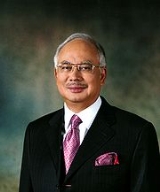
Dato' SriThe Malay language has a complex system of titles and honorifics, which are still used extensively in Malaysia and Brunei. Singapore, whose Malay royalty was abolished by the British colonial government in 1891, has adopted civic titles for its leaders....
Haji Mohd Najib bin Tun Haji Abdul Razak (born 23 July 1953) is the sixth, and since 2009,
Prime Minister of MalaysiaThe Prime Minister of Malaysia is the indirectly elected head of government of Malaysia. He is officially appointed by the Yang di-Pertuan Agong, the head of state, who in HM's judgment is likely to command the confidence of the majority of the members of that House of Representatives , the...
. He previously held the post of
Deputy Prime MinisterDeputy Prime Minister of Malaysia is the second highest political office in Malaysia. There has been ten deputy prime ministers since the office was created in 1957. Although there has always been a Deputy Prime Minister since independence, there is nothing preventing a Prime Minister from not...
from 7 January 2004 until he succeeded
Tun Abdullah Ahmad BadawiTun Abdullah bin Haji Ahmad Badawi is a Malaysian politician who served as Prime Minister from 2003 to 2009. He was also the President of the United Malays National Organisation , the largest political party in Malaysia, and led the governing Barisan Nasional parliamentary coalition...
as Prime Minister on 3 April 2009. Najib is President of the
United Malays National OrganisationThe United Malays National Organisation, is Malaysia's largest political party; a founding member of the National Front coalition, which has played a dominant role in Malaysian politics since independence....
(UMNO). He is the son of Malaysia's second prime minister, Tun Abdul Razak and the nephew of Malaysia's third prime minister, Tun Hussein Onn.
Najib succeeded Abdullah at a time after his ruling coalition, the
Barisan NasionalBarisan Nasional is a major political coalition in Malaysia, formed in 1973 as the successor to the Alliance . Along with its predecessor, it has been Malaysia's federal ruling political force since independence...
, lost its long held two-thirds majority in parliament to the opposition led by former Deputy Prime Minister
Anwar IbrahimAnwar bin Ibrahim is a Malaysian politician who served as Malaysian Deputy Prime Minister from 1993 to 1998. Early in his career, Anwar was a close ally of Prime Minister Mahathir bin Mohamad but subsequently emerged as the most prominent critic of Mahathir's government.In 1999, he was sentenced...
in the
2008 parliamentary election.The 12th Malaysian general election was held on March 8, 2008, in accordance with Malaysian laws for national elections, which states that a general election must be held no later than five years subsequent to the previous elections; the previous general election was held in 2004...
Since then Najib has tried to build a moderate image for himself and the UMNO through the
1Malaysia1Malaysia is an on-going programme designed by Malaysian Prime Minister Najib Tun Razak on September 16, 2010, calling for the cabinet, government agencies, and civil servants to more strongly emphasize ethnic harmony, national unity, and efficient governance....
campaign.
Early life
Born 23 July 1953, in Kuala Lipis, Pahang, Najib is the eldest of Prime Minister Abdul Razak's six sons, and the nephew of Hussein Onn, Malaysia’s third Prime Minister. His younger brother, Dato' Seri Mohd Nazir Abdul Razak, runs the country's second-largest lender,
Bumiputra-Commerce Holdings Bhd.Bumiputra-Commerce Holdings Berhad is the listed vehicle for CIMB Group, Malaysia’s second largest financial services group. It has been listed on the Main Board of Bursa Malaysia, the nation’s stock exchange since 1987...
Najib is also one of the Four Noblemen of the Pahang Darul Makmur (Royal Court) by virtue of his inherited title as the Orang Kaya Indera Shahbandar. He received his primary and secondary education at
St. John's Institution, Kuala LumpurSt. John's Institution is a secondary school for boys and one of the oldest schools in Kuala Lumpur, Malaysia...
. He later attended
Malvern CollegeMalvern College is a coeducational independent school located on a 250 acre campus near the town centre of Malvern, Worcestershire in England. Founded on 25 January 1865, until 1992, the College was a secondary school for boys aged 13 to 18...
in
WorcestershireWorcestershire is a non-metropolitan county, established in antiquity, located in the West Midlands region of England. For Eurostat purposes it is a NUTS 3 region and is one of three counties that comprise the "Herefordshire, Worcestershire and Warwickshire" NUTS 2 region...
,
EnglandEngland is a country that is part of the United Kingdom. It shares land borders with Scotland to the north and Wales to the west; the Irish Sea is to the north west, the Celtic Sea to the south west, with the North Sea to the east and the English Channel to the south separating it from continental...
, and subsequently went to the
University of NottinghamThe University of Nottingham is a public research university based in Nottingham, United Kingdom, with further campuses in Ningbo, China and Kuala Lumpur, Malaysia...
, where he received a
bachelor's degreeA bachelor's degree is usually an academic degree awarded for an undergraduate course or major that generally lasts for three or four years, but can range anywhere from two to six years depending on the region of the world...
in
industrial economicsIndustrial organization is the field of economics that builds on the theory of the firm in examining the structure of, and boundaries between, firms and markets....
in 1974. Najib Razak returned to Malaysia in 1974 and entered the business world, serving briefly in Bank Negara (Central Bank)and later with Petronas (Malaysia's national oil company)) as a public affairs manager.
In 1976 Najib married Tengku Puteri Zainah Tengku Eskandar ('Kui Yie') with whom he has three children: Mohd Nizar Najib (born 1978), Mohd Nazifuddin Najib and Puteri Norlisa Najib. In 1987 he divorced Ku Yie and married
Datin Seri Rosmah MansorDatin Paduka Seri Rosmah Mansor is the current wife of the 6th Prime Minister of Malaysia, Dato' Seri Najib Tun Razak.-Early life:Rosmah Mansor was brought up in Seremban, Negeri Sembilan. She had secondary education in Tunku Kurshiah College , Seremban, Negeri Sembilan. She was touted to have...
with whom he has two children: Mohd Norashman Najib and Nooryana Najwa Najib. This is Rosmah's second marriage as well. She has two children from her previous marriage to Farid Ismeth Emir who was a former TV news presenter and currently a general manager in a trading company.
Appointment as Prime Minister
Najib, became the Prime Minister of Malaysia. Najib entered office with a focus on domestic economic issues and political reform. On his first day as Prime Minister, Najib announced as his first actions the removal of bans on two opposition newspapers, Suara Keadilan and Harakahdaily, run by the opposition leader Datuk Seri Anwar Ibrahim-led People's Justice Party and the Pan Islamic Party, respectively, and the release of 13 people held under the Internal Security Act. Among the released detainees were two ethnic Indian activists who were arrested in December 2007 for leading an anti-government campaign, three foreigners and eight suspected Islamic militants. Najib also pledged to conduct a comprehensive review of the much-criticized law which allows for indefinite detention without trial. In the speech, he emphasized his commitment to tackling poverty, restructuring Malaysian society, expanding access to quality education for all, and promoting renewed “passion for public service.” He also deferred and abandoned the
digital television transitionThe digital television transition is the process in which analog television broadcasting is converted to and replaced by digital television. This primarily involves both TV stations and over-the-air viewers; however it also involves content providers like TV networks, and cable television...
plan of all free-to-air broadcasters such as
Radio Televisyen MalaysiaThe Department of Broadcasting, Malaysia, DBA Radio Televisyen Malaysia , is a Malaysian state-owned public broadcaster. It owns and operates a number of radio and television stations in Malaysia, based in Kuala Lumpur...
.
1Malaysia
1Malaysia is an on-going campaign announced by Prime Minister Najib Razak on 16 September 2008, calling for the cabinet, government agencies, and civil servants to emphasize ethnic harmony, national unity, and efficient governance. The eight values of 1Malaysia as articulated by Najib Razak are perseverance, a culture of excellence, acceptance, loyalty, education, humility, integrity, and meritocracy.
On 17 September 2008, Najib launched
1Malaysia.com.my in an effort to communicate with the citizens of Malaysia more efficiently and support the broader 1Malaysia campaign, He has used the site to highlight his policy initiatives and to provide a forum for Malaysians to their government. The 1Malaysia campaign makes extensive use of social media platforms such as Facebook and Twitter.
Yet when his deputy Muhyiddin Yassin declared that he is "Malay first and Malaysian second" thus going head-on against his "1Malaysia" ideals, Najib did not hesitate to go to Muhyiddin's defence.
Government Transformation Programme
Najib's government is in the process of implementing its Government Transformation Programme in order to improve the quality of public services, increase efficiency, and make government more transparent. Specific measures include the use of Key Performance Indicators to measure the performance of officials and agencies and National Key Result Areas to define goals for specific areas of public policy.
Under Najib the Malaysian government has implemented many measures to increase transparency and government accountability. These measures include the use of Key Performance Indicators (KPI) to hold ministers accountable for their work, using new media such as Twitter and Facebook to communicate with citizens about happenings in the government, opening previously closed government tenders to increased public participation and scrutiny, and soliciting public feedback on government spending.
In order to keep his promise to make government smaller and more efficient Prime Minister Najib has abolished two ministries while creating the Ministry of Energy, Green Technology and Water. Najib has appointed a total of 28 ministers. This is four fewer than the last government. Najib also named
Tan Sri Dr. Koh Tsu KoonTan Sri Dr. Koh Tsu Koon is a Malaysian politician. He was the Chief Minister of Penang from 1990 to 2008 and is currently a member of the Dewan Negara, the upper house of the Malaysian Parliament...
, an ethnic Chinese and leader of a minority party in the ruling coalition, to be the Minister of Unity and Performance.
New Economic Model
On 2 May 2009, Prime Minister Najib Tun Razak announced the government’s plan to develop a
New Economic ModelThe New Economic Model is an economic plan in Malaysia unveiled on 30 March, 2010 by Malaysian Prime Minister Najib Tun Razak which is intended to more than double the per capita income in Malaysia by 2020...
that will speed Malaysia's transition to a high income country. The plan will emphasise ways to increase the income and productivity of workers by encouraging knowledge industries and increasing investment from overseas.
Reform of government subsidies
Prime Minister Najib has started to implement comprehensive reform of government subsidies. On 16 July 2010 subsidies for petrol, diesel and LPG were cut as part of Malaysia's general programme of reducing and rationalising subsidies per the 10th Malaysia Plan and the New Economic Model. The government believes it will save RM750 million by the end of 2010 through these measures with little negative impact on most citizens. Sugar and fuel subsidies were selected for reform due to the fact that they disproportionately benefit the wealthy and foreigners, encourage over-consumption and create opportunities for fraud and smuggling. The Prime Minister expressed his hope that Malaysians would adopt a healthier lifestyle. He said, “there is no logic in the government allocating subsidies worth almost RM1 billion on a commodity that could endanger the people’s health.” Responding to concerns about how these reforms might affect the poor the Prime Minister's Office pointed out that Malaysia will still be spending RM7.82 billion per year on fuel and sugar subsidies and that prices for these commodities would remain the lowest in Southeast Asia. The government also stated that education and healthcare would continue receiving state support.
Economic liberalization
Malaysia has implemented substantial measures to attract foreign investment including a moderation of preferences designed to benefit ethnic Malays. Specifically these reforms include allowing foreign investors to hold majority stakes in most enterprises excluding "strategic" industries such as banking, telecommunications, and energy, easing insurance regulation, curtailing powers of the Foreign Investment Committee and lowering the minimum quota for Malay ownership in publicly traded companies from 30 percent to 12.5 percent. As he introduced the reforms Najib stated, "The world is changing quickly and we must be ready to change with it or risk being left behind.”
Since these reforms have been implemented the American banking firms
Goldman SachsThe Goldman Sachs Group, Inc. is an American multinational bulge bracket investment banking and securities firm that engages in global investment banking, securities, investment management, and other financial services primarily with institutional clients...
and
CitigroupCitigroup Inc. or Citi is an American multinational financial services corporation headquartered in Manhattan, New York City, New York, United States. Citigroup was formed from one of the world's largest mergers in history by combining the banking giant Citicorp and financial conglomerate...
have been granted permission to expand their operations in Malaysia, Goldman Sachs, received licenses to set up fund management and advisory operations. Citigroup has obtained a permit to offer brokerage services. The approval of these licenses is a sharp break from Malaysia's historiy of domestically dominated and tightly regulated markets for financial services.
The
International Institute for Management DevelopmentIMD - International Institute for Management Development is a non profit business school located in Lausanne, Switzerland.- History & Mission :...
responded to these and other reforms by increasing Malaysia's ranking to the 10th most competitive economy in the world in 2010 from 18th in 2009. Malaysia, which is now ranked fifth in the Asia Pacific region, scored well in business and government efficiency. Economists attributed the rise of Malaysia's ranking to the efforts of the Malaysian government to improve the country's business environment such as the
New Economic ModelThe New Economic Model is an economic plan in Malaysia unveiled on 30 March, 2010 by Malaysian Prime Minister Najib Tun Razak which is intended to more than double the per capita income in Malaysia by 2020...
, the Government Transformation Programme and the Economic Transformation Programme
Stimulus packages
The Malaysian government passed two stimulus packages to mitigate the effects of the global economic downturn. The first stimulus package, worth RM7 billion, was announced on 4 November 2008. The second package, worth RM60 billion, was announced on 10 March 2009. Since assuming office as Prime Minister, Najib has been monitoring the progress of the stimulus packages on a weekly basis. Government economists believe that the stimulus packages have successfully generated increased economic activity, especially in the construction sector. Malaysia's central bank reported that Malaysia's economy grew at an annualized rate of 9.5% during the first half of 2010. Prime Minister Najib says the country is on track to meet the 6% average annual growth to reach its goal of becoming a developed country by 2020. Commenting on this same economic data Najib says that as of August 2010 there are no plans for further economic stimulus. Rather he says the government would focus on improving Malaysia's economic fundamentals and increasing investment.
United States
Prime Minister Najib and President Barack Obama met just before the Nuclear Security Summit in Washington on 12 April 2010. This meeting was thought by many to represent a significant improvement in relations. This was their first one-on-one meeting. During their talk Obama sought further assistance from Malaysia in stemming nuclear proliferation which Obama described as the greatest threat to world security. During the summit Najib stressed that Malaysia only supported nuclear programmes designed for peaceful purposes. Najib's attendance at the summit was part of a week-long official visit to the United States.
India
Prime Minister Najib traveled to India on a five-day state visit in January 2010. His 200-strong entourage included cabinet ministers, deputy ministers, state government officials, members of parliament, and prominent business leaders. During his visit Najib pushed for a free-trade agreement and cooperation across a wide range of fields. Najib and Indian Prime Minister
Manmohan SinghManmohan Singh is the 13th and current Prime Minister of India. He is the only Prime Minister since Jawaharlal Nehru to return to power after completing a full five-year term. A Sikh, he is the first non-Hindu to occupy the office. Singh is also the 7th Prime Minister belonging to the Indian...
signed an extradition treaty and agreements to cooperate in the areas of higher education and finance. The two countries have agreed to sign a free-trade agreement before the end of 2010 and Najib called for signing a "Comprehensive Economic Cooperation Agreement" by the same date. These economic agreements have resulted in plans for RM1.6 trillion in investment for Malaysia. In January 2010 Najib announced plans to develop a new visa regime for Indian nationals, specifically for managers and knowledge workers to visit Malaysia.
Singapore
Najib made a two-day visit to Singapore, from 21–22 May 2009. During the visit, both Najib and Singaporean Prime Minister
Lee Hsien LoongLee Hsien Loong is the third and current Prime Minister of Singapore. He is married to Ho Ching, who is the Executive Director and Chief Executive Officer of Temasek Holdings. He is the eldest son of Singapore's first Prime Minister Lee Kuan Yew....
agreed to move bilateral relations forward in a more productive manner and will either set aside or resolve the “legacy” problems between the two countries. During a speech in Singapore Najib said he hoped his visit would signal “the beginning of a new era” between the two countries.
in 2010 Najib resolved a key diplomatic problem between the two countries by ending the impasse over transportation links and Singaporean investment in Iskandar Malaysia. Prime Minister Najib and Lee Hsien Loong, Prime Minister of Singapore have agreed to modify the Points of Agreement signed in 1990. Specifically, the two sides have promised to move the KTM railway station from Tanjung Pagar to Woodlands, set up a joint venture to be called M-S Pte Ltd to develop six parcels of land in Singapore, develop a rapid transit link between Tanjung Pateri in Johor Bahru, and allow Temasek and Khazanah to set up a joint venture for the purpose of developing a town in Iskandar Malaysia.
South Korea
Najib attended the ASEAN-South Korea Summit on 1 June 2009 hosted by South Korean President Lee Myung Bak. During the summit, the ASEAN-Korea Investment Agreement was signed to boost economic and trade relations between ASEAN and South Korea After the summit, Najib said Malaysia is keen on emulating South Korea in developing a small-scale nuclear reactor for power generation, as well as South Korea’s other low-carbon green technology.
China
Najib made a four-day visit to China from 2–5 June 2009. During the visit, Najib mentioned his family’s special relationship with China, noting that his father, and Malaysia’s second Prime Minister, first established diplomatic relations with China in 1974. During the visit, several substantive issues were discussed in meetings between Najib and Chinese President
Hu JintaoHu Jintao is the current Paramount Leader of the People's Republic of China. He has held the titles of General Secretary of the Communist Party of China since 2002, President of the People's Republic of China since 2003, and Chairman of the Central Military Commission since 2004, succeeding Jiang...
and Chinese Premier
Wen JiabaoWen Jiabao is the sixth and current Premier and Party secretary of the State Council of the People's Republic of China, serving as China's head of government and leading its cabinet. In his capacity as Premier, Wen is regarded as the leading figure behind China's economic policy...
. The two sides signed an endorsed strategic action plan covering 13 major areas, which will serve as the guideline for relations between Malaysia and China. Najib described the trip as most fruitful. Najib also received an honourary doctorate in international relations from the Beijing Foreign Studies University.
Indonesia
Najib made a visit to Indonesia on 22–24 April 2009. Several issues were discussed, including cooperation in the tourism, oil and gas, and high-technology industries, as well as electricity supply from the Bakun dam to Kalimantan. Najib and his entourage also attended an official dinner hosted by Indonesian President
Susilo Bambang YudhoyonoSusilo Bambang Yudhoyono AC , is an Indonesian politician and retired Army general officer who has been President of Indonesia since 2004....
and his wife Ani Yudhoyono.
New Zealand
Under Najib's government Malaysia signed a free-trade agreement (FTA) with New Zealand on 26 October 2009 to take effect 1 August 2010. The agreement will reduce or eliminate tariffs on thousands of industrial and agricultural products. The two countries have also agreed to reciprocal Most Favoured Nation status in private education, engineering services, environmental protection, mining services and information technology.
Ministerial portfolios
Najib has held a variety of ministerial portfolios (the first at the age of 32), culminating in the post of Minister of Defence before being chosen as the Deputy Prime Minister by
Tun Abdullah Ahmad BadawiTun Abdullah bin Haji Ahmad Badawi is a Malaysian politician who served as Prime Minister from 2003 to 2009. He was also the President of the United Malays National Organisation , the largest political party in Malaysia, and led the governing Barisan Nasional parliamentary coalition...
in 2004. Najib was first assigned into the
Cabinet of MalaysiaThe Cabinet of Malaysia is the executive branch of Malaysia's government. Led by the Prime Minister, the cabinet is a council of ministers who are accountable collectively to the Parliament. According to the Article 43 of the Constitution, members of the Cabinet can only be selected from members...
at the age of 25 when he was appointed Deputy Minister of Energy, Telecommunications and Post in 1978, becoming the youngest deputy minister in the country. Najib would go on to assume myriad posts in the cabinet, including the
Deputy Minister of EducationThe Ministry of Education is a Government ministry responsible for Malaysian educational matters...
, the Deputy Minister of Finance, the Minister of Culture, Youth and Sports (and its split successor, the Minister of Youth and Sports), the
Minister of EducationThe Ministry of Education is a Government ministry responsible for Malaysian educational matters...
, the Minister of Defense, and the Minister of Finance beginning 17 September 2008.
In addition to positions held in the federal government, Najib served as the Menteri Besar (Chief Minister) of Pahang between 1982 and 1986, becoming the youngest Menteri Besar in the state to enter office when he was sworn in at the age of 29. Najib was also appointed chairman of the Livestock Development Institute (Lembaga Kemajuan Penternakan, Majuternak). During the 1986 general elections, Najib was returned as the Member of Parliament for Pekan, and was appointed as Minister of Culture, Youth and Sports. He immediately focused on improving Malaysian sports and introduced the National Sports Policy in 1988. In 1989 Malaysia achieved its best-ever performance at the South East Asia (SEA) Games, which were held that year in Kuala Lumpur.
Minister of Defence
In 1991, Najib was appointed Minister of Defence. Under his direction, Malaysian troops were deployed to assist the UN peacekeeping forces in Bosnia in 1993. Malaysian forces were greeted warmly by Bosnians as well as Serbs and Croats. Malaysia also assisted peacekeeping operations in Somalia in 1993, losing one soldier in an effort to aid U.S. soldiers during the Battle of Mogadishu. Najib later criticized the UN’s Somalia operation as putting too much emphasis on military action. Since then Malaysia has stated a preference for participating in Chapter 6 “peace enforcement” missions, rather than Chapter 7 “peacekeeping” missions. After four years at the Ministry of Defense, Najib assumed control of the Education Ministry in 1995. He returned to the Ministry of Defense in 2000.
During his second tenure as Minister of Defense Najib coordinated Malaysia’s relief efforts following the Indian Ocean Tsunami of 2004, and provided support to Indonesia in arresting those responsible for the 2004 Bali bombings. Najib also oversaw the deployment of Malaysian troops as a part of a UN peacekeeping force in 2006, when Malaysia volunteered to help stabilize Lebanon following the 2006 Lebanon War.
As Defense Minister, Najib instituted compulsory military service in December 2003, stating that it would encourage interaction and friendship between youth of different ethnic groups and religions. During its first five years of operation, over 339,000 Malaysian youth participated in the PLKN (the Bahasa Malaysian acronym for "Malaysian National Service"), which is intended to promote tolerance, team work, and community engagement. The programme, however, has faced challenges. Safety issues in the program have been reported and several people died during or shortly after their terms of service during the program's first few years. In response, Najib strengthened the PLKN's health screening requirements and reinforced the government’s commitment to punish negligent PLKN officials.
Minister of Education
In 1995, Najib left the Defense Ministry for the first time when he was appointed Minister of Education. His challenge was to respond to Malaysia's newly proclaimed aspiration to become a fully developed nation by the year 2020. During his five-year tenure, Najib restructured the Ministry, created an independent corporate structure for public universities, and encouraged collaboration with foreign universities and institutions. The 1996 Private Higher Education Institutions Act, allowed foreign universities to establish degree-conferring schools in Malaysia, providing greater educational opportunities for Malaysians and positioning Malaysia as a regional learning hub. Najib also upgraded teaching certificates to the status of diplomas, so that teachers in that category would receive a higher monthly starting salary.
Minister of Finance
In September 2008, Najib traded portfolios with Abdullah Badawi, the Prime Minister, and assumed control of the Ministry of Finance. During the global financial crisis, Malaysia faced a strong recession and reduced levels of trade throughout the South Asian region. In response, Najib announced a series of stimulus packages to be implemented over a two-year period with the intention of acting as a
countercyclicalCountercyclical is a term used in economics to describe how an economic quantity is related to economic fluctuations. It is the opposite of procyclical. However, it has more than one meaning.-Meaning in policy making:...
response that might otherwise protect Malaysia’s economy. He also pressed for the country to move beyond existing manufacturing capabilities through education, research and development to develop greater strength as a provider of sophisticated business services.
Deputy Prime Minister
Upon his appointment in 2004 as Deputy Prime Minister, Najib was given a broad portfolio of responsibilities, including oversight of FELDA, the Human Rights Commission (SUHAKAM), and the Election Commission. Najib also chaired more than 28 cabinet committees, which preside over a wide range of issues.
Minister of Culture, Youth and Sports
After the 1986 general elections Najib was appointed Minister of Culture, Youth and Sports. During his time in this position Malaysia made its best ever showing in the Sea Games. Najib was also the architect of Malaysia's National Sports Policy which promotes the development of sport in general and provides monetary incentives for athletes that win medals at the Olympics.
Election to Parliament
In 1976 Najib was selected to run for the seat in parliament left vacant by his father's death. The national outpouring of grief following Tun Razak's death and the respect for his father helped Najib win election unopposed as Member of Parliament at the very young age of 23. In 1986 Najib won re-election to the same seat. During the 1999 general elections Najib suffered a major setback when he barely won-re-election by a margin of 241 compared to a margin of over 10,000 in the previous election. Although a surprise to political observers it was understandable given the political upheavals of 1999. The 2004 general elections, which came a few months after Najib's appointment as Deputy Prime Minister, saw him win re-election with a by a very large margin of 22,922 votes. In the 2008 general election, Najib won with a majority of 26,464 votes. It was the largest majority for any Barisan Nasional candidate. Najib won handily despite a poor showing by the government.
UMNO
Najib was appointed head of UMNO Youth's Pekan branch and became a member of UMNO Youth's Executive Council (Exco) in 1976. In 1981, he was selected as a member of UMNO's Supreme Council, before winning the post of Vice President of UMNO Youth in 1982.
In 1987, Najib was selected as the acting head of the Movement of UMNO Youth by
Dato' Seri Anwar IbrahimAnwar bin Ibrahim is a Malaysian politician who served as Malaysian Deputy Prime Minister from 1993 to 1998. Early in his career, Anwar was a close ally of Prime Minister Mahathir bin Mohamad but subsequently emerged as the most prominent critic of Mahathir's government.In 1999, he was sentenced...
after Anwar was asked to contest the post of UMNO Vice President. Following mounting ethnic tensions anti-Chinese sentiments were expressed at a UMNO Youth rally held in Kampung Baru, Kuala Lumpur the same year where Najib spoke. Rising tensions soon lead to fears of ethnic violence and eventually resulted in a security operation known as Operasi Lalang, that included numerous
administrative detentionAdministrative detention is arrest and detention of individuals by the state without trial, usually for security reasons. A large number of countries, both democratic and undemocratic, resort to administrative detention as a means to combat terrorism, control illegal immigration, or to protect the...
s. In June 2009 Najib overturned a rule that required 30% Malay ownership in corporations, and allowed non-ethnic Malays, like the Chinese and the Indians to exercise more financial control in Malaysia. Najib has also worked to improve relations with Singapore, which is seen by many as Chinese-dominated, to encourage it to invest more heavily in the Malaysian economy.
Following the complete reorganisation and founding of the "New" UMNO by
Tun Dr. Mahathir MohamadTun Dr. Mahathir bin Mohamad . is a Malaysian politician who was the fourth Prime Minister of Malaysia. He held the post for 22 years from 1981 to 2003, making him Malaysia's longest serving Prime Minister. His political career spanned almost 40 years.Born and raised in Alor Setar, Kedah, Mahathir...
in the aftermath of the
1988 Malaysian constitutional crisisThe 1988 Malaysian constitutional crisis was a series of events that began with United Malays National Organisation general election in 1987 and ended with the suspension and the eventual removal of the Lord President of the Supreme Court, Tun Salleh Abas, from his seat...
, Najib was appointed president of UMNO Youth in 1988.
By 1993, Najib was elected as one of six
vice presidentA vice president is an officer in government or business who is below a president in rank. The name comes from the Latin vice meaning 'in place of'. In some countries, the vice president is called the deputy president...
s of UMNO in response to Anwar's decision to contest as the deputy president of UMNO. Najib continued to defend his post in party elections held in 1993, 1996, and 2004.
After a poor showing by the ruling UMNO coalition in the elections of 8 March 2008 in which opposition parties gained control of five of thirteen Malaysian state governments, Prime Minister Abdullah Badawi identified Deputy Prime Minister Najib as his intended successor. On 8 October 2008, Prime Minister Badawi announced he would step down in March 2009, paving the way for Deputy Prime Minister Najib Razak to succeed him. However he said the onus was on Najib to win party elections set for March before he could take over. Najib ran for the presidency of UMNO and went on to win on 2 November 2008, without contest.
On 26 March 2009, Najib won the UMNO presidency unopposed.
Controversy
The Malaysian opposition has accused Najib of involvement in the receipt of large commissions for the purchases of two Scorpene submarines, 18 Sukhoi fighter jets, 12 Eurocopters helicopters and military bomb involved in the murder of Shaariibuugiin Altantuyaa. The French judiciary are currently investigating claims of alleged corruption in the submarine deal.
External links
|-