
Home      Discussion      Topics      Dictionary      Almanac
Signup       Login
Nail disease

Nail disease

Overview
Nail diseases are distinct from diseases of the skin
Skin
The skin is the outer covering of the body. In humans, it is the largest organ of the integumentary system made up of multiple layers of mesodermal tissue, and guards the underlying muscles, bones, ligaments and internal organs. Skin of a different nature exists in amphibians, reptiles, birds...

. Although nail
Nail (anatomy)
A nail is a horn-like structure at the end of a person's finger or toe. See also claw.-Parts of the nail:Fingernails and toenails are made of a tough protein called keratin, as are animals' hooves and horns. Along with hair and teeth they are an appendage of the skin. The parts of the nail...

s are a skin appendage
Skin appendage
Skin appendages are appendages that are associated with the skin and serve a particular function. In humans some of the more common skin appendages are hairs , arrector pilli , sebaceous glands , sweat glands Skin appendages are appendages that are associated with the skin and serve a particular...

, they have their own signs and symptoms which may relate to other medical conditions. Nail conditions that show signs of infection
Infection
An infection is the detrimental colonization of a host organism by a foreign species. In an infection, the infecting organism seeks to utilize the host's resources to multiply, usually at the expense of the host. The infecting organism, or pathogen, interferes with the normal functioning of the...

 or inflammation
Inflammation
Inflammation is the complex biological response of vascular tissues to harmful stimuli, such as pathogens, damaged cells, or irritants. Inflammation is a protective attempt by the organism to remove the injurious stimuli as well as initiate the healing process for the tissue. Inflammation is not a...

 require medical assistance and cannot be treated at a beauty parlor. Deformity
Deformity
A deformity, dysmorphism, or dysmorphic feature is a major difference in the shape of body part or organ compared to the average shape of that part.Deformity may arise from numerous causes:*A genetic mutation*Damage to the fetus or uterus...

 or disease
Disease
A disease or medical condition isan abnormal condition of an organism that impairs bodily functions, associated with specific symptoms and signs...

 of the nails may be referred to as onychosis.
  • Onychia is an inflammation of the matrix (surrounding tissue) of the nail with formation of pus
    Pus
    Pus is a whitish-yellow, yellow or yellow-brown exudate produced by vertebrates during inflammatory pyogenic bacterial infections. An accumulation of pus in an enclosed tissue space is known as an abscess, while a visible collection of pus within or beneath the epidermis is known as a pustule or...

     and shedding of the nail.
Discussion
Ask a question about 'Nail disease'
Start a new discussion about 'Nail disease'
Answer questions from other users
Full Discussion Forum
 
Unanswered Questions
Encyclopedia
Nail diseases are distinct from diseases of the skin
Skin
The skin is the outer covering of the body. In humans, it is the largest organ of the integumentary system made up of multiple layers of mesodermal tissue, and guards the underlying muscles, bones, ligaments and internal organs. Skin of a different nature exists in amphibians, reptiles, birds...

. Although nail
Nail (anatomy)
A nail is a horn-like structure at the end of a person's finger or toe. See also claw.-Parts of the nail:Fingernails and toenails are made of a tough protein called keratin, as are animals' hooves and horns. Along with hair and teeth they are an appendage of the skin. The parts of the nail...

s are a skin appendage
Skin appendage
Skin appendages are appendages that are associated with the skin and serve a particular function. In humans some of the more common skin appendages are hairs , arrector pilli , sebaceous glands , sweat glands Skin appendages are appendages that are associated with the skin and serve a particular...

, they have their own signs and symptoms which may relate to other medical conditions. Nail conditions that show signs of infection
Infection
An infection is the detrimental colonization of a host organism by a foreign species. In an infection, the infecting organism seeks to utilize the host's resources to multiply, usually at the expense of the host. The infecting organism, or pathogen, interferes with the normal functioning of the...

 or inflammation
Inflammation
Inflammation is the complex biological response of vascular tissues to harmful stimuli, such as pathogens, damaged cells, or irritants. Inflammation is a protective attempt by the organism to remove the injurious stimuli as well as initiate the healing process for the tissue. Inflammation is not a...

 require medical assistance and cannot be treated at a beauty parlor. Deformity
Deformity
A deformity, dysmorphism, or dysmorphic feature is a major difference in the shape of body part or organ compared to the average shape of that part.Deformity may arise from numerous causes:*A genetic mutation*Damage to the fetus or uterus...

 or disease
Disease
A disease or medical condition isan abnormal condition of an organism that impairs bodily functions, associated with specific symptoms and signs...

 of the nails may be referred to as onychosis.

Diseases

  • Onychia is an inflammation of the matrix (surrounding tissue) of the nail with formation of pus
    Pus
    Pus is a whitish-yellow, yellow or yellow-brown exudate produced by vertebrates during inflammatory pyogenic bacterial infections. An accumulation of pus in an enclosed tissue space is known as an abscess, while a visible collection of pus within or beneath the epidermis is known as a pustule or...

     and shedding of the nail. Onychia results from the introduction of microscopic pathogen
    Pathogen
    A pathogen , infectious agent, or germ, is a biological agent that causes disease or illness to its host....

    s through small wounds.

  • Onychocryptosis
    Ingrown nail
    Onychocryptosis is a common form of nail disease. It is an often painful condition in which the nail grows so that it cuts into one or both sides of the nail bed...

    , commonly known as "ingrown nails" (unguis incarnatus), can affect either the fingers or the toes. In this condition, the nail cuts into one or both sides of the nail bed, resulting in inflammation and possibly infection. The relative rarity of this condition in the fingers suggests that pressure from the ground or shoe against the toe is a prime factor. The movements involved in walking
    Walking
    Walking is the main form of animal locomotion on land, distinguished from running and crawling. When carried out in shallow waters, it is usually described as wading and when performed over a steeply rising object or an obstacle it becomes scrambling or climbing...

     or other physical disturbances can contribute to the problem. Mild onychocryptosis, particularly in the absence of infection, can be treated by trimming and rounding the nail. More advanced cases, which usually include infection, are treated by surgically excising the ingrowing portion of the nail down to its bony origin and thermally or chemically cauterizing the matrix, or 'root', to prevent recurrence. This surgery is called matrixectomy. The best results are achieved by cauterizing the matrix with phenol
    Phenol
    Phenol, also known as carbolic acid, is a toxic, white crystalline solid. Its chemical formula is C6H5OH and its structure is that of a hydroxyl group bonded to a phenyl ring, making it an aromatic compound.-Phenols:...

    . Another, much less effective, treatment is excision
    Excision
    Excision means "to remove by cutting".* In surgery, an excision is the complete removal of an organ, tissue, or tumor from a body, as opposed to a biopsy. An "excisional biopsy" is the removal of a tumor with a minimum of healthy tissue...

     of the matrix, sometimes called a 'cold steel procedure'.

  • Onychodystrophy is a deformation of the nails that can result from cancer chemotherapy which includes bleomycin, hydroxyurea, or 5-fluorouracil. It can include discoloration of the nail, or dyschromia
    Dyschromia
    Dyschromia refers to an alteration of the color of the skin or nails."Hyperchromia" can refer to hyperpigmentation, and "hypochromia" can refer to hypopigmentation....

    .

  • Onychogryposis, also called "ram's-horn nail", is a thickening and increase in curvature of the nail. It is usually the result of injury to the matrix. It may be partially hereditary and can also occur as a result of long-term neglect. It is most commonly seen in the great toe but may be seen in other toes as well as the fingernails. An affected nail has many grooves and ridges, is brownish in color, and grows more quickly on one side than on the other. The thick curved nail is difficult to cut, and often remains untrimmed, exacerbating the problem.


  • Onycholysis
    Onycholysis
    Onycholysis refers to the detachment of the nail from the nail bed, starting at its distal and/or lateral attachment. It is said to occur particularly on the ring finger but can occur on any of the fingernails. It can occur in thyrotoxicosis and is thought to be due to sympathetic overactivity....

    is a loosening of the exposed portion of the nail from the nail bed, usually beginning at the free edge and continuing to the lunula
    Lunula (anatomy)
    The lunula, or lunulae , is the crescent-shaped whitish area of the bed of a fingernail or toenail. The lunula is the visible part of the nail matrix The lunula, or lunulae (pl.) (nail moon), is the crescent-shaped whitish area of the bed of a fingernail or toenail. The lunula is the visible part...

    . It is frequently associated with an internal disorder, trauma, infection, nail fungi, allergy to nail enhancement products, or side effects of drugs.
  • Onychomadesis
    Onychomadesis
    Onychomadesis is a periodic idiopathic shedding of the nails beginning at its proximal end, possibly caused by the temporary arrest of the function of the nail matrix....

    is the separation and falling off of a nail from the nail bed. Common causes include localized infection, minor injury to the matrix bed, or severe systemic illness. It is sometimes a side effect of chemotherapy
    Chemotherapy
    Chemotherapy, in its most general sense, is the treatment of disease by chemicals especially by killing micro-organisms or cancerous cells. In popular usage, it refers to antineoplastic drugs used to treat cancer or the combination of these drugs into a cytotoxic standardized treatment regimen...

     or x-ray
    X-ray
    X-radiation is a form of electromagnetic radiation. X-rays have a wavelength in the range of 10 to 0.01 nanometers, corresponding to frequencies in the range 30 petahertz to 30 exahertz and energies in the range 120 eV to 120 keV. They are shorter in wavelength than UV rays...

     treatments for cancer
    Cancer
    Cancer is a class of diseases in which a group of cells display uncontrolled growth , invasion , and sometimes metastasis...

    . A new nail plate will form once the cause of the disease is removed.
  • Onychomycosis
    Onychomycosis
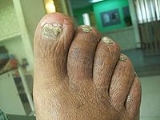
    Onychomycosis means fungal infection of the nail. It is the most common disease of the nails and constitutes about a half of all nail abnormalities....

    , also known as tinea unguium
    Tinea
    Tinea is a general term used to describe skin mycoses. The term ringworm is even less precise, but is usually considered a synonym.It is sometimes equated with dermatophytosis, and it is true that most conditions identified as "tinea" are members of the imperfect fungi that make up the dermatophytes...

    , is a contagious infection of the nail caused by the same fungal organisms which cause ringworm
    Ringworm
    Ringworm is a fungal infection of the skin in humans and domestic animals such as sheep and cattle. Fungi are organisms that survive by eating plant or animal material. Those that cause parasitic infection feed on keratin, the material found in the outer layer of skin, hair, and nails...

     of the skin (Trichophyton rubrum or T. mentagrophytes, rarely other trichophyton species or Epidermophyton floccosum ). It can result in discoloration, thickening, chalkiness, or crumbling of the nails and is often treated by powerful oral medications which, rarely, can cause severe side effects including liver failure. Mild onychomycosis sometimes responds to a combination of topical antifungal medication, sometimes applied as special medicinal nail lacquer, and periodic filing of the nail surface. For advanced onychomycosis, especially if more than one nail is infected, systemic medication (pills) is preferred. Home remedies are often used, although their effectiveness is disputed. In a study at the University of Rochester tea tree oil
    Tea tree oil
    Tea tree oil or melaleuca oil is a clear to very pale golden hydrophobic essential oil with a fresh camphoraceous odor. It is taken from the leaves of the Melaleuca alternifolia which is native to the northeast coast of New South Wales, Australia...

     applied twice daily in conjunction with debridement
    Debridement
    Debridement is the medical removal of a patient's dead, damaged, or infected tissue to improve the healing potential of the remaining healthy tissue...

     was found to be an appropriate initial treatment strategy, equally effective to topical use of clotrimazole
    Clotrimazole
    Clotrimazole is an antifungal medication commonly used in the treatment of fungal infections of both humans and animals such as vaginal yeast infections, oral thrush, and ringworm...

    .


  • Onychophosis
    Onychophosis
    Onychophosis is a localized or diffuse hyperkeratotic tissue that develops on the lateral or proximal nailfolds, within the space between the nailfolds and the nail plate, and is a common finding in the elderly. Onychophosis may involve the subungual area, as a direct result of repeated minor...

    is a growth of horny
    Horn (anatomy)
    A horn is a pointed projection of the skin on the head of various animals, consisting of a covering of horn surrounding a core of living bone. True horns are found mainly among the ruminant artiodactyls, in the families Antilocapridae and Bovidae...

     epithelium
    Epithelium
    In biology and medicine, an epithelium is a tissue composed of cells that line the cavities and surfaces of structures throughout the body. Many glands are also formed from epithelial tissue...

     in the nail.
  • Onychoptosis is the periodic shedding of one or more nails, in whole or part. This condition may follow certain diseases such as syphilis
    Syphilis
    Syphilis is a sexually transmitted disease caused by the spirochetal bacterium Treponema pallidum subspecies pallidum. The route of transmission of syphilis is almost always through sexual contact, although there are examples of congenital syphilis via transmission from mother to child in utero.The...

    , or can result from fever
    Fever
    Fever is a frequent medical sign that describes an increase in internal body temperature to levels above normal...

    , trauma
    Physical trauma
    Physical trauma refers to a physical injury, generally of a considerably severe degree. A trauma patient is someone who has suffered serious and life-threatening physical injury with the potential for secondary complications such as shock, respiratory failure and death.-Common causes:Comprehensive...

    , systemic upsets or adverse reaction to drugs.
  • Paronychia
    Paronychia
    The nail disease paronychia [par'onikeea] is an often-tender bacterial or fungal hand infection or foot infection where the nail and skin meet at the side or the base of a finger or toenail...

    is a bacterial or fungal infection where the nail and skin meet.
  • Koilonychia
    Koilonychia
    Koilonychia is a nail disease that can be a sign of hypochromic anemia, especially iron-deficiency anemia. Koilonychia literally means "spoon nails." It refers to abnormally thin nails which have lost their convexity, becoming flat or even concave in shape...

    is when the nail curves upwards (becomes spoon-shaped) due to an iron deficiency
    Iron deficiency
    Iron deficiency may refer to:*Iron deficiency *Iron deficiency...

    . The normal process of change is: brittle nails, straight nails, spoon-shaped nails.

  • Subungual hematoma
    Subungual hematoma
    A subungual hematoma is a collection of blood underneath a toenail or fingernail. It can be extremely painful, although otherwise it is not a serious medical condition.-Causes:...

    occurs when trauma to the nail results in a collection of blood, or hematoma
    Hematoma
    A haematoma, or hematoma, is a collection of blood outside the blood vessels, generally the result of hemorrhage, or more specifically, internal bleeding....

    , under the nail. It may result from an acute injury or from repeated minor trauma such as running in undersized shoes. Acute subungual hematomas are quite painful, and are usually treated by releasing the blood by creating a small hole in the nail. Drilling and thermal cautery (melting) are common methods for creating the hole. Thermal cautery is not used on acrylic nails because they are flammable.

Nail changes and conditions associated with them


Nail inspection can give a great deal of information about the internal working of the body as well, and like tongue or iris
Iris (anatomy)
The iris is a membrane in the eye, responsible for controlling the diameter and size of the pupil and the amount of light reaching the retina. "Eye color" is the color of the iris, which can be green, blue, or brown. In some cases it can be hazel...

 inspection, has a long history of diagnostic use in traditional medical practices such as Chinese medicine.

Pliability

  • Brittleness is associated with iron deficiency, thyroid problems, impaired kidney function, circulation problems, and biotin deficiency.
  • Splitting and fraying are associated with psoriasis
    Psoriatic nails
    Psoriatic nails is a nail disease. It is common in those suffering from psoriasis, with reported incidences varying from 10% to 78%. Elderly patients and those with psoriatic arthritis are more likely to have psoriatic nails.-Symptoms:...

     and deficiencies of folic acid, protein and Vitamin C.
  • Unusual thickness is associated with circulation problems.
  • Thinning nails and itchy skin are associated with lichen planus
    Lichen planus
    Lichen planus is a chronic mucocutaneous disease that affects the skin and the oral mucosa, and presents itself in the form of papules, lesions or rashes...

    .

Shape and texture

  • Clubbing, or nails that curve down around the fingertips with nailbeds that bulge is associated with oxygen deprivation and lung, heart, or liver disease.
  • Spooning, or nails that grow upwards is associated with iron or B12 deficiency.
  • Flatness can indicate a B12 vitamin deficiency or Raynaud's disease
    Raynaud's disease
    Raynaud's disease is a vascular disorder that affects blood flow to the extremities when exposed to cold temperatures or in response to psychological stress...

    .
  • Pitting of the nails is associated with Psoriasis
    Psoriatic nails
    Psoriatic nails is a nail disease. It is common in those suffering from psoriasis, with reported incidences varying from 10% to 78%. Elderly patients and those with psoriatic arthritis are more likely to have psoriatic nails.-Symptoms:...

    .
  • Ridges across the nail indicate stress.
  • Beau's lines
    Beau's lines
    Beau's lines are deep grooved lines that run from side to side on the fingernail. They may look like indentations or ridges in the nail plate. This condition of the nail was named by a French physician, Joseph Honoré Simon Beau , who first described it in 1846.Beau's lines are horizontal, going...

     are ridges in the nail
  • Ridges along the nail are associated with arthritis.
  • Grooves along the nail are associated with kidney disorders, aging, and iron deficiency.
  • Beading is associated with rheumatoid arthritis
    Rheumatoid arthritis
    Rheumatoid arthritis is a chronic, systemic inflammatory disorder that may affect many tissues and organs, but principally attacks the joints producing an inflammatory synovitis that often progresses to destruction of the articular cartilage and ankylosis of the joints...

    .
  • Nails that resemble hammered brass are associated with (or portend) hair loss.
  • Short small beds are associated with heart disease.

Discoloration of entire nail bed

  • Paleness or whitening is associated with liver or kidney disease or anemia.
  • Yellowing of the nail bed is associated with chronic bronchitis, lymphatic problems, diabetes, and liver disorders.
  • Brown or copper nail beds are associated with arsenic or copper poisoning, and local fungal infection
    Onychomycosis
    Onychomycosis means fungal infection of the nail. It is the most common disease of the nails and constitutes about a half of all nail abnormalities....

    .
  • Grey nail beds are associated with arthritis
    Arthritis
    Arthritis is a group of conditions involving damage to the joints of the body....

    , edema
    Edema
    Edema or oedema , formerly known as dropsy or hydropsy, is an abnormal accumulation of fluid beneath the skin, or in one or more cavities of the body...

    , malnutrition
    Malnutrition
    Malnutrition is the insufficient, excessive or imbalanced consumption of nutrients.A number of different nutrition disorders may arise, depending on which nutrients are under or overabundant in the diet....

    , post-operative
    Surgery
    Surgery is a medical specialty that uses operative manual and instrumental techniques on a patient to investigate and/or treat a pathological condition such as disease or injury, to help improve bodily function or appearance, or sometimes for some other reason...

     effects, glaucoma
    Glaucoma
    Glaucoma is a group of diseases that affect the optic nerve and involves a loss of retinal ganglion cells in a characteristic pattern. It is a type of optic neuropathy. Raised intraocular pressure is a significant risk factor for developing glaucoma...

     and cardio-pulmonary disease.
  • Blue nail beds are (much like blue skin) associated with poor oxygenation of the blood (asthma
    Asthma
    Asthma is a predisposition to chronic inflammation of the lungs in which the airways are reversibly narrowed. Asthma affects 7% of the population of the United States, and 300 million worldwide...

    , emphysema
    Emphysema
    Emphysema is a lung disease, characterized by an abnormal, permanent enlargement of air spaces distal to the terminal bronchioles. The disease is coupled with the destruction of walls, but without obvious fibrosis...

    , etc).
  • Redness is associated with heart conditions.

Changes in lunulae

  • Blue lunulae are associated with silver poisoning or lung disorder.
  • Receded lunulae (fewer than 8) are associated with poor circulation, shallow breathing habits or thyroid mysfunction.
  • Large lunulae (more than 25% of the thumb nail) are associated with high blood pressure.

Other color changes and markings

  • Melanonychia
    Melanonychia
    Melanonychia is a black or brown pigmentation of the normal nail plate, and may be present as a normal finding on many digits in black patients, as a result of trauma, systemic disease, or medications, or as a postinflammatory event from such localized events as lichen planus or fixed drug...

     (longitudinal streaking that darkens or does not grow out), especially on the thumb or big toe, may indicate subungual melanoma.
  • White lines across the nail (leukonychia
    Leukonychia
    Leukonychia is a medical term for white discoloration appearing on nails. It is derived from the Greek words Leuko white and Onyx nail. The most common cause is injury to the base of the nail where the nail is formed.-Leukonychia Totalis:This condition is a whitening of the entire nail...

     striata, or transverse leukonychia) may be Mees' lines
    Mees' lines
    Mees' lines or Aldrich-Mees' lines are lines of discoloration across the nails of the fingers and toes.- Causes :Mees' lines appear after an episode of poisoning with arsenic, thallium or other heavy metals, and can also appear if the subject is suffering from renal failure.- Presentation :They are...

     or Muehrcke's lines
    Muehrcke's lines
    Muehrcke's lines, or leukonychia striata, are changes in the fingernail that may be a sign of an underlying medical disorder or condition. Muehrcke's lines are white lines that extend all the way across the nail and lie parallel to the lunula . In contrast to Beau's lines, they are not grooved...

    .
  • Small white patches are known as leukonychia
    Leukonychia
    Leukonychia is a medical term for white discoloration appearing on nails. It is derived from the Greek words Leuko white and Onyx nail. The most common cause is injury to the base of the nail where the nail is formed.-Leukonychia Totalis:This condition is a whitening of the entire nail...

     punctata.
  • Terry's nails
    Terry's nails
    Terry's nails is a physical finding in which fingernails and/or toenails appear white with a characteristic "ground glass" appearance, with no lunula. The condition is thought to be due to a decrease in vascularity and an increase in connective tissue within the nail bed...

     are opaque white nails with a dark band at the fingertip, and are associated with cancer, cirrhosis, congestive heart failure, diabetes and aging.
  • Dark nails are associated with B12 deficiency.
  • Red skin at the base of the nail is associated with connective tissue disorders.
  • Stains of the nail plate (not the nail bed) are associated with nail polish, smoking, and henna use.

See also

  • Leukonychia
    Leukonychia
    Leukonychia is a medical term for white discoloration appearing on nails. It is derived from the Greek words Leuko white and Onyx nail. The most common cause is injury to the base of the nail where the nail is formed.-Leukonychia Totalis:This condition is a whitening of the entire nail...

  • Mee's lines
  • Beau's lines
    Beau's lines
    Beau's lines are deep grooved lines that run from side to side on the fingernail. They may look like indentations or ridges in the nail plate. This condition of the nail was named by a French physician, Joseph Honoré Simon Beau , who first described it in 1846.Beau's lines are horizontal, going...

  • Occupational hazards associated with exposure to human nail dust
    Occupational hazards associated with exposure to human nail dust
    The use of podiatry drills, in the absence of engineering controls and personal protective equipment, is an occupational hazard to the healthcare provider...


External links