

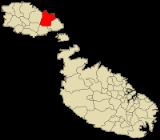
Nadur

Encyclopedia
History
The word "Nadur" which in MalteseMaltese language
Maltese is the national language of Malta, and a co-official language of the country alongside English,while also serving as an official language of the European Union, the only Semitic language so distinguished. Maltese is descended from Siculo-Arabic...
means "lookout", is derived from the Arabic
Arabic language
Arabic is a name applied to the descendants of the Classical Arabic language of the 6th century AD, used most prominently in the Quran, the Islamic Holy Book...
word nadara. The town's motto means much the same. Ajwa.
There are no documents or archaeological
Archaeology
Archaeology, or archeology , is the study of human society, primarily through the recovery and analysis of the material culture and environmental data that they have left behind, which includes artifacts, architecture, biofacts and cultural landscapes...
evidence which could shed light on the colonization of Nadur by its first inhabitants. Nevertheless, the plateau and its surroundings, with a few farmhouses scattered here and there, were in existence for many years well before the area became a parish . The only trace of archaeological evidence were a number of large flat stones found in a field between San Blas Bay and Daħlet Qorrot. According to the Gozitan historian G. P. F. Agius de Soldanis these roofed structures, which are not in existence anymore, once used to serve as a sort of temple to the gods. He also imagined that these slabs of stone couldn't have been placed there by normal people but by very strong people or giants. He also wrote that Nadur may have been founded during the time of the Greeks
Ancient Greece
Ancient Greece is a civilization belonging to a period of Greek history that lasted from the Archaic period of the 8th to 6th centuries BC to the end of antiquity. Immediately following this period was the beginning of the Early Middle Ages and the Byzantine era. Included in Ancient Greece is the...
. One proof of this connection is a bronze statue of Apollo
Apollo
Apollo is one of the most important and complex of the Olympian deities in Greek and Roman mythology...
said to be found in Nadur in 1744.
Throughout history Nadur played a very important role in the defense of the island from corsairs, hence the name. During the reign of the Knights of St. John, a watch tower was built by Grand Master Nicholas Cotoner which has been referred to by Dahlet Qorrot Tower or San Blas Tower for the two bays lying on either side of it. The tower is locally known as Ta' Sopu Tower.
Another watchtower found in Nadur is Ta' Kenuna Tower
Ta' Kenuna Tower
Ta' Kenuna Tower is one of three semaphore towers built by the British in 1848 on the cliffs near Nadur in Gozo, Malta.Sited on a hill 130 metres above sea level, its purpose was to pass on signals to ships and other posts via a telegraphy link between the two main Maltese islands.In 2005 the Nadur...
built by the British
British Empire
The British Empire comprised the dominions, colonies, protectorates, mandates and other territories ruled or administered by the United Kingdom. It originated with the overseas colonies and trading posts established by England in the late 16th and early 17th centuries. At its height, it was the...
towards the middle of the 19th century. It served as a telegraph link between Malta
Malta
Malta , officially known as the Republic of Malta , is a Southern European country consisting of an archipelago situated in the centre of the Mediterranean, south of Sicily, east of Tunisia and north of Libya, with Gibraltar to the west and Alexandria to the east.Malta covers just over in...
and Gozo. From the top of this semaphore tower, one can see most of the island, Comino
Comino
Comino is an island of the Maltese archipelago between the islands of Malta and Gozo in the Mediterranean Sea, measuring in area. Named after the cumin seed that once flourished in the Maltese islands, Comino is noted for its tranquility and isolation. It has a permanent population of only four...
and the northern part of Malta with a wonderful view in Winter of the green fields and the blue sea. The area near the tower was constructed into a beautiful garden in which one can find many local plants and trees. One can also rest on benches while looking at the panoramic view of nearly the whole islands and the Malta and Gozo channel.
Nadur Today
Today, Nadur has a population which nears 5000 people, which makes it the second most populated Gozitan town after Victoria. A substantial number of Nadurin emigrated to the United States of America, CanadaCanada
Canada is a North American country consisting of ten provinces and three territories. Located in the northern part of the continent, it extends from the Atlantic Ocean in the east to the Pacific Ocean in the west, and northward into the Arctic Ocean...
, Australia
Australia
Australia , officially the Commonwealth of Australia, is a country in the Southern Hemisphere comprising the mainland of the Australian continent, the island of Tasmania, and numerous smaller islands in the Indian and Pacific Oceans. It is the world's sixth-largest country by total area...
, and the United Kingdom
United Kingdom
The United Kingdom of Great Britain and Northern IrelandIn the United Kingdom and Dependencies, other languages have been officially recognised as legitimate autochthonous languages under the European Charter for Regional or Minority Languages...
particularly in the 1960s.
There are a significant number of farmers in Nadur, the majority of whom work their fields on part-time basis. From the orchards of Nadur come most of the local fruits such as plums, peaches, apples, oranges and lemons. This produce maintained commercial contacts with Malta for over 3000 years. Today this commerce is still ongoing and a great amount of Maltese citrus is produced from Nadur. More specifically, it was recently put on record that 70% of all Maltese citrus originates from Nadur. Presently, the local council is promoting the planting of olive trees imported from Italy
Italy
Italy , officially the Italian Republic languages]] under the European Charter for Regional or Minority Languages. In each of these, Italy's official name is as follows:;;;;;;;;), is a unitary parliamentary republic in South-Central Europe. To the north it borders France, Switzerland, Austria and...
as these trees have consistently decreased in number over a period of years.
A good number of others earn their living from the sea as fishermen or sailors. This trade has been popular with the Nadurin at a period when the fishing methods were still primitive in our islands. As a matter of fact a number of fishermen from Nadur have lost their lives in rough seas.
Nearby is San Blas, a tiny, sandy bay on the north-eastern coast. It is a favourite spot for snorkelling, picnics, and slumber parties.
Regions in Nadur
Although Nadur is spread out, it can be split in various regions, namely: a) main square area, b) Ta' Hida, c) San BlasSan Blas
San Blas, the Spanish name for Saint Blaise, can refer to:*San Blas, La Rioja*San Blas Department*San Blas, Costa Rica*San Blas, Quito*San Blas, El Salvador* San Blas, Nadur* San Blas, Nayarit* San Blas, Sinaloa* San Blas Atempa, Oaxaca...
, and d) Ta' Kenuna area.
Main square area centers basically around the parish church, with a host of shops, eateries, snack bars, and mostly residential housing. Important places of interest in the center are: Sacred Heart (Ta' Karkanja) church, Local Council office, police station, parish office, primary school, Mnarja Band Club, Nadur Youngsters football club, Museum branches (male and female), Franciscan Sisters convent & chapel, playing field (whose pitch was recently covered with artificial turf), etc.
Ta' Hida's main artery surrounds Ramla Bay
Ramla Bay
Ramla Bay is located at the bottom of a rich and fertile valley on the northern side of the island of Gozo. Gozo is one of the Maltese islands. The village of Xagħra, located on one of the hills of Gozo, overlooks this valley. It is about a forty minute walk from Xagħra to the bay. The bay can also...
's main road, which is particularly busy in the summertime. Ta' Hida's new extension, along Ramla Bay road, comprises a housing estate built in the 1970s, a very popular playing field, etc. A new, albeit controversial, cemetery is being constructed on the way to Ramla, but building permits are still pending ( though it being built permits still not sorted) its huge and will be an eysore( has its own web page).
San Blas has both residential areas, relatively old and new, very fertile land and picturesque valleys, full of mainly citrus trees. San Blas takes the name after the little secluded red-sandy bay, called after bishop Blaise, whose veneration still exists in the Catholic Church up to today. A nearby beach is Dahlet Qorrot
Dahlet Qorrot
Daħlet Qorrot Bay is a small bay found in the north of Gozo, in Nadur, Malta. The beach is rocky in Summer but in winter it's always covered with algae....
(an 'inland beach'), with many locals owning caves and garages where many keep their fishing boats. Close to San Blas, one finds also a bushy arid area called il-Qortin. Gozo's AFM
Armed Forces of Malta
The Armed Forces of Malta is the name given to the combined armed services of Malta. The AFM is a brigade sized organisation consisting of a headquarters and three separate battalions, with minimal air and naval forces.- Headquarters, AFM :...
base is located here, together with Ta' Sopu Tower, which was recently restored.
The Ta' Kenuna area was developed in the early 1980s. Previously, the area was barren, except for the Ta' Kenuna Tower
Ta' Kenuna Tower
Ta' Kenuna Tower is one of three semaphore towers built by the British in 1848 on the cliffs near Nadur in Gozo, Malta.Sited on a hill 130 metres above sea level, its purpose was to pass on signals to ships and other posts via a telegraphy link between the two main Maltese islands.In 2005 the Nadur...
, a telegraph structure built under the British era, Nadur cemetery and some vinyards. Although in the past the cemetery seemed to scare off people, and no one dared to live next to it, today the cemetery has become literally a traffic island, surrounded by busy roads and residential areas.
Nadur Parish
The religious feast of Nadur – Mnarja – is celebrated on June 29 (http://www.june29th.com). The feast was very popular with honeymooners and its name seems to suggest that there is a possible connection with the beginning of Summer. It is derived from luminaria (illumination), and in fact it is a festival rooted in Maltese seasonal rituals and customs.The beloved titular statue, that of St. Peter and St. Paul
Paul of Tarsus
Paul the Apostle , also known as Saul of Tarsus, is described in the Christian New Testament as one of the most influential early Christian missionaries, with the writings ascribed to him by the church forming a considerable portion of the New Testament...
, was made in Marseilles in 1882. It is one of the many masterpieces that grace the grand church. On Good Friday
Good Friday
Good Friday , is a religious holiday observed primarily by Christians commemorating the crucifixion of Jesus Christ and his death at Calvary. The holiday is observed during Holy Week as part of the Paschal Triduum on the Friday preceding Easter Sunday, and may coincide with the Jewish observance of...
a beautifully-made set of statues are taken out for the holy procession depicting the passion and crucifixion of Jesus
Jesus
Jesus of Nazareth , commonly referred to as Jesus Christ or simply as Jesus or Christ, is the central figure of Christianity...
. On the morning of Easter
Easter
Easter is the central feast in the Christian liturgical year. According to the Canonical gospels, Jesus rose from the dead on the third day after his crucifixion. His resurrection is celebrated on Easter Day or Easter Sunday...
a statue of The Risen Lord is also joyfully paraded.
The parish church, dedicated to St. Peter and Paul, is a very artistic monument of both architecture and painting, rich in marble works and decorations, erected on the site of a former smaller church and which is also the highest point in town.
St. Peter & Paul Basilica
The construction of the present temple was begun on September 28, 1760 on the design of the Maltese architect Giuseppe Bonnici (1707–1779).In 1907 refurbishment took place to construct the aisles, dome and façade, on the Italian
Italy
Italy , officially the Italian Republic languages]] under the European Charter for Regional or Minority Languages. In each of these, Italy's official name is as follows:;;;;;;;;), is a unitary parliamentary republic in South-Central Europe. To the north it borders France, Switzerland, Austria and...
Renaissance
Renaissance
The Renaissance was a cultural movement that spanned roughly the 14th to the 17th century, beginning in Italy in the Late Middle Ages and later spreading to the rest of Europe. The term is also used more loosely to refer to the historical era, but since the changes of the Renaissance were not...
design of Prof. F.S. Sciortino. The ceiling, depicting episodes connected with St. Peter and Paul, was painted by Lazzaro Pisani (both painters hailing from Ħaż-Żebbuġ
Zebbug, Malta
Ħaż-Żebbuġ or Città Rohan is one of the oldest towns in Malta. Its population is 12,892 as of 2010 making it the 12th largest town in Malta.-History and origins:...
), while the architectural decorations are the work of the Italian Pio Cellini. Principal force behind all these new projects was Archpriest Martin Camilleri (1910–1921).
The parish has its own community radio station: Radju Luminarja, built more than 10 years ago.
Zones in Nadur
- Ta' Ħida
- Ta' Kenuna
- Ta' Ġebel
- Ta' Zejtun
- Ta' Sardina
- Ta' Spilotti
- Ta' Venuta
- Ta' Wistin
- Tad-Duru
- Tal-Ħawli
- Tal-Laċċa
- Tal-Weraq
- Tat-Tiġrija
- Tax-Xewka
- Tax-Xini
- (Wied)San Blas
- Ta' Xurdin
Nadur Main Roads
- Pjazza San Pietru u San Pawl (St Peter and St Paul Square)
- Triq Daħlet Qorrot (Daħlet Qorrot Cove Road)
- Triq Għajn Qasab (Ghajn Qasab Street)
- Triq il-Ħanaq
- Triq il-Knisja (Church Street)
- Triq ir-Rabat (Victoria Road)
- Triq ir-Ramla (Ramla Road)
- Triq it-13 ta' Diċembru (13 December Street)
- Triq it-Tiġrija (Tigrija Road)
- Triq l-Imġarr (Mgarr Road)
- Triq San Blas (San Blas Bay Road)
- Triq San Ġwann (St John Street)
- Triq Xandriku (Xandriku Street)