
Home      Discussion      Topics      Dictionary      Almanac
Signup       Login
NSU Prinz

NSU Prinz

Overview
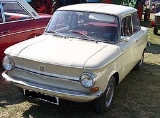
The NSU Prinz is an automobile
Automobile
An automobile, motor car or car is a wheeled motor vehicle used for transporting passengers, which also carries its own engine or motor...

 produced in West Germany
West Germany
West Germany is a common English name for the period of the Federal Republic of Germany between its' formation in May 1949 to German reunification in October 1990, when the German Democratic Republic was dissolved and the five states on its territory joined the Federal Republic of Germany,...

 by the NSU Motorenwerke AG
NSU Motorenwerke AG
NSU Motorenwerke AG, , was a German manufacturer of cars and motorcycles, which was founded in 1873. It was acquired by Volkswagen Group in 1969...

. The car was built from 1957 to 1973, and received a model change in 1961 (the old model was continued until 1962).

The first generation Prinz was available in a saloon body with an upright roof line and seating for four people. The noisy twin cylinder engine was located at the back
RR layout
In automotive design, a RR, or Rear-engine, Rear-wheel drive layout is one which places both the engine and drive wheels at the rear of the vehicle. In contrast to the RMR layout, however, the center of mass of the engine itself is actually past the rear axle...

 where it drove the rear wheels via a "crash" gearbox (later versions gained synchromesh).
Discussion
Ask a question about 'NSU Prinz'
Start a new discussion about 'NSU Prinz'
Answer questions from other users
Full Discussion Forum
 
Encyclopedia
The NSU Prinz is an automobile
Automobile
An automobile, motor car or car is a wheeled motor vehicle used for transporting passengers, which also carries its own engine or motor...

 produced in West Germany
West Germany
West Germany is a common English name for the period of the Federal Republic of Germany between its' formation in May 1949 to German reunification in October 1990, when the German Democratic Republic was dissolved and the five states on its territory joined the Federal Republic of Germany,...

 by the NSU Motorenwerke AG
NSU Motorenwerke AG
NSU Motorenwerke AG, , was a German manufacturer of cars and motorcycles, which was founded in 1873. It was acquired by Volkswagen Group in 1969...

. The car was built from 1957 to 1973, and received a model change in 1961 (the old model was continued until 1962).

History


The first generation Prinz was available in a saloon body with an upright roof line and seating for four people. The noisy twin cylinder engine was located at the back
RR layout
In automotive design, a RR, or Rear-engine, Rear-wheel drive layout is one which places both the engine and drive wheels at the rear of the vehicle. In contrast to the RMR layout, however, the center of mass of the engine itself is actually past the rear axle...

 where it drove the rear wheels via a "crash" gearbox (later versions gained synchromesh). In 1958 a little coupé was added, the Sport Prinz.

The Sport Prinz was designed by Franco Scaglione
Franco Scaglione
Franco Scaglione was an automobile coachwork designer.-Biography:Franco Scaglione was born in Florence to Vittorio Scaglione, a chief army doctor, and to Giovanna Fabbri, captain of the Italian Red Cross service. His was a well-to-do family of noble ancestry...

 at Bertone studios
Bertone
Gruppo Bertone is an Italian automobile company, which has specialized in car styling, coachbuilding and manufacturing. Bertone styling is distinctive, with most cars having a strong "family resemblance" even if badged by different manufacturers...

 in Turin. Approximately 20,831 were manufactured between 1959 and 1967. The first 250 bodies were built by Bertone
Bertone
Gruppo Bertone is an Italian automobile company, which has specialized in car styling, coachbuilding and manufacturing. Bertone styling is distinctive, with most cars having a strong "family resemblance" even if badged by different manufacturers...

 in Turin. The rest were built in Neckarsulm
Neckarsulm
Neckarsulm is a city in northern Baden-Württemberg, Germany, near Stuttgart, and part of the district Heilbronn. As of 2004, Neckarsulm had 27,296 inhabitants....

 at a company called Drautz which was later bought by NSU
NSU Motorenwerke AG
NSU Motorenwerke AG, , was a German manufacturer of cars and motorcycles, which was founded in 1873. It was acquired by Volkswagen Group in 1969...

.

First models had the Prinz 30 straight-2 engine (583 cc), later ones had the 598 cc of the Prinz 4.

NSU Prinz 4

The NSU Prinz 4 replaced the original Prinz in 1961. It got a new body, very similar to the Chevrolet Corvair
Chevrolet Corvair
The Chevrolet Corvair was an automobile produced by the Chevrolet division of General Motors from 1959 to 1969, for the 1960–1969 model years. The Corvair was offered in a wide range of body styles, including four-door sedans, two-door coupes, convertibles, and station wagons...

, but of course much smaller. Like the original Prinz, it was powered by a 2-cylinder, air-cooled engine in the rear. The Prinz 4 was much improved and continued to be a well-engineered car, like its predecessors. The engine carried on the tradition of eccentric rod driven camshaft inherited from NSU motorcycle engines and interestingly had a dynastart  combined starter/generator built into the crankcase. Later four cylinder engines adopted the more conventional (pre-engaged) separate starter motor and alternator.

In 1968, Britain's Autocar
Autocar
Autocar is a weekly British automobile magazine published by Haymarket Motoring Publications Ltd. It is the oldest surviving car magazine in the world.-History:...

 magazine road tested an NSU Super Prinz. They had previously tested a Prinz 4 in 1962, and in commenting on how little the car had changed in the intervening six years quipped that some of their road testers appeared to have gained more weight than the commendably light-weight Prinz in that period. The tested car achieved a top speed of 70 mph (113 km/h) and accelerated to 60 mph (97 km/h) in 35.7 seconds. The home grown Mini 850
Mini
The Mini is a small car that was produced by the British Motor Corporation and its successors from 1959 until 2000. The original is considered an icon of the 1960s, and its space-saving front-wheel-drive layout influenced a generation of car-makers...

 made it to 60 mph in 29.5 seconds in an equivalent recent test and also managed to beat the NSU's top speed, albeit only by about 3%. At this time the UK car market was heavily protected by tarriffs, and the NSU Prinz was retailing in the UK for a manufacturer's recommended retail price of £597, which was more than the (possibly below cost amount of) £561 asked for the 850 cc Mini, but certainly not completely out of touch with it. The testers concluded their report that the car was competitively priced in its class and performed adequately. They opined, cautiously, that it offered 'no more than the rest' but that neither did it 'lack anything important'.

NSU Derivatives


The NSU Prinz evolved into the somewhat larger bodied NSU 1000, NSU 1000TT, NSU 1200TT and NSU TTS models, introduced in 1963. All had the same body with straight-4 aircooled OHC engines and were frequently driven as sports cars, but also as economical family cars as well. The engines were very lively, and highly reliable. Paired with the low total weight, excellent handling and cornering, both the NSU 1000 and the much higher powered NSU 1200 TT/TTS outperformed many sportscars. Even today more than thirty years later, it remains difficult finding an economical car for seating four to five adults with such high levels of performance, handling, reliability and robustness.

In 1965, an even larger model was added, first called Typ 110
NSU Typ 110
The NSU Typ 110 was first presented at the 1965 Frankfurt Motor Show, widening NSU’s range in the process. It was based on the NSU Prinz 1000 but with a longer wheelbase and a front overhang which increased available space both in the passenger cabin and in the luggage compartment...

, and from from 1967 on as the NSU 1200
NSU Typ 110
The NSU Typ 110 was first presented at the 1965 Frankfurt Motor Show, widening NSU’s range in the process. It was based on the NSU Prinz 1000 but with a longer wheelbase and a front overhang which increased available space both in the passenger cabin and in the luggage compartment...

. It offered more space, so it was a better family car, but it was not as sporty as the smaller models. Therefore, the NSU 1200TT used the 1200 cc engine of the 1200, but in the smaller body of the NSU 1000.

When NSU was acquired by Volkswagen
Volkswagen
The Volkswagen Aktiengesellschaft , also known as Volkswagen Group or as VW, is an automobile manufacturer and mobility organisation based in Wolfsburg, Lower Saxony, Germany and is the pioneer brand within the Volkswagen Group, which contains the car brands Audi AG, Bentley Motors Ltd.,...

 in 1969, it was merged with Auto Union
Auto Union
Auto Union was an amalgamation of four German automobile manufacturers, established in 1932 in Chemnitz, Saxony, during the Great Depression. The company has evolved into present day Audi, as a subsidiary of Volkswagen Group....

 AG. Auto Union was already taken over by VW in 1964 and produced mid-sized cars under Audi
Audi
AUDI AG, is a German company which produces luxury cars under the Audi brand, . It is part of the Volkswagen Group. The name Audi is based on a Latin translation of the surname of the founder August Horch, itself the German word for “listen!"Audi is headquartered in Ingolstadt, Bavaria, Germany.It...

 label. The name of the new company changed to Audi NSU Auto Union AG. The small, rear-engined NSU models were phased out in 1973, as they were far too competitive against Volkswagen's own Beetle and production capacity was needed for larger and more profitable Audi models. The successor of the NSU Prinz became the front-wheel driven Audi 50
Audi 50
The Audi 50 is a supermini produced by German automaker Audi from 1974 to 1978 and sold only in Europe.Audi 50 was built by Volkswagen in Wolfsburg....

, later rebadged and continued as Volkswagen Polo
Volkswagen Polo
The Volkswagen Polo is a supermini car manufactured by Volkswagen. It is sold in Europe and other markets worldwide in hatchback, saloon, coupé and estate variants.-History:...

. It was only after acquisition of NSU that the VW organisation became known for making affordable modern front-engine cars.

Russian Derivative


According to some sources, in 1967, the Soviet
Soviet Union
The Union of Soviet Socialist Republics was a constitutionally socialist state that existed in Eurasia from 1922 to 1991. The name is a translation of the , tr. Soyuz Sovetskikh Sotsialisticheskikh Respublik, abbreviated СССР, SSSR. The common short name is Soviet Union, from , Sovetskiy Soyuz...

 manufacturer ZAZ
ZAZ
ZAZ or Zaporizhia Automobile Building Plant is the main automobile-manufacturer of Ukraine, based in the south-eastern city of Zaporizhia. It is also known for its former mother company name, AvtoZAZ...

 created a virtual copy of the NSU Prinz - the ZAZ-966, but the chassis was totally different from the NSU; the engine was an air-cooled 900 cc V4
V4 engine
A V4 engine is a V form engine with four cylinders.-Automobile use:Lancia produced several narrow-angle V4 engines from the 1920s through 1960s for cars like the Lambda, Augusta, Artena, Aprilia, Ardea, Appia, and Fulvia...

 producing 30 hp (later a 1200 cc 40-45 hp). However, another version is that the ZAZ was heavily influenced by the Chevrolet Corvair
Chevrolet Corvair
The Chevrolet Corvair was an automobile produced by the Chevrolet division of General Motors from 1959 to 1969, for the 1960–1969 model years. The Corvair was offered in a wide range of body styles, including four-door sedans, two-door coupes, convertibles, and station wagons...

 itself, which was intensively tested on the plant just prior to the 966's development in early 1960s.

Under license, the Prinz was manufactured in Sarajevo
Sarajevo
Sarajevo is the capital and largest city of Bosnia and Herzegovina, with a population of 304,614 people in the four municipalities that make up the city proper, and an estimated urban area population of 421,289 people in the Sarajevo Canton . It is also the capital of the Federation of Bosnia and...

, Bosnia
Bosnia and Herzegovina
Bosnia and Herzegovina Bosnia and Herzegovina Bosnia and Herzegovina ( or (Bosnian, Croatian, Serbian Latin: Bosna i Hercegovina; Serbian Cyrillic: Босна и Херцеговина) is a country in Southeast Europe, on the Balkan Peninsula...

, by PRETIS (Preduzece Tito Sarajevo) factories.

The NSU Prinz was also manufactured in Argentina by Autoar, making mainly models Prinz II and Prinz III / 30. It is told that only 40 - 45 Sportprinz were imported and a few Prinz IV (less than 10).

The NSU Ramses Utilica was the first car produced in Egypt, and was the result of a coorporation between the new Egyptian car firm Egyptian Automotive Co., and the German NSU. The factory was located right next to the Great Pyramids. Plans were to produce around 10.000 cars a year, most of the work being manual labor.

External links


  • http://www.nsu-ig.de/
  • http://www.nsuprinz.de/