


NMDA receptor

Encyclopedia
Synaptic plasticity
In neuroscience, synaptic plasticity is the ability of the connection, or synapse, between two neurons to change in strength in response to either use or disuse of transmission over synaptic pathways. Plastic change also results from the alteration of the number of receptors located on a synapse...
and memory
Memory
In psychology, memory is an organism's ability to store, retain, and recall information and experiences. Traditional studies of memory began in the fields of philosophy, including techniques of artificially enhancing memory....
function.
The NMDAR is a specific type of ionotropic glutamate receptor
Glutamate receptor
Glutamate receptors are synaptic receptors located primarily on the membranes of neuronal cells. Glutamate is one of the 20 amino acids used to assemble proteins and as a result is abundant in many areas of the body, but it also functions as a neurotransmitter and is particularly abundant in the...
. NMDA
NMDA
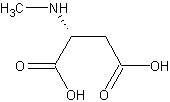
N-Methyl-D-aspartic acid or N-Methyl-D-aspartate is an amino acid derivative which acts as a specific agonist at the NMDA receptor mimicking the action of glutamate, the neurotransmitter which normally acts at that receptor...
(N-methyl D-aspartate) is the name of a selective agonist that binds to NMDA receptors but not to other glutamate receptors. Activation of NMDA receptors results in the opening of an ion channel
Ion channel
Ion channels are pore-forming proteins that help establish and control the small voltage gradient across the plasma membrane of cells by allowing the flow of ions down their electrochemical gradient. They are present in the membranes that surround all biological cells...
that is nonselective to cations
Ion
An ion is an atom or molecule in which the total number of electrons is not equal to the total number of protons, giving it a net positive or negative electrical charge. The name was given by physicist Michael Faraday for the substances that allow a current to pass between electrodes in a...
with an equilibrium potential near 0 mV. A unique property of the NMDA receptor is its voltage-dependent activation, a result of ion channel block by extracellular Mg2+ ions. This allows the flow of Na+ and small amounts of Ca2+ ions into the cell and K+ out of the cell to be voltage-dependent.
Calcium flux through NMDARs is thought to play a critical role in synaptic plasticity
Synaptic plasticity
In neuroscience, synaptic plasticity is the ability of the connection, or synapse, between two neurons to change in strength in response to either use or disuse of transmission over synaptic pathways. Plastic change also results from the alteration of the number of receptors located on a synapse...
, a cellular mechanism for learning
Learning
Learning is acquiring new or modifying existing knowledge, behaviors, skills, values, or preferences and may involve synthesizing different types of information. The ability to learn is possessed by humans, animals and some machines. Progress over time tends to follow learning curves.Human learning...
and memory
Memory
In psychology, memory is an organism's ability to store, retain, and recall information and experiences. Traditional studies of memory began in the fields of philosophy, including techniques of artificially enhancing memory....
. The NMDA receptor is distinct in two ways: First, it is both ligand-gated
Ligand-gated ion channel
Ligand-gated ion channels are one type of ionotropic receptor or channel-linked receptor. They are a group of transmembrane ion channels that are opened or closed in response to the binding of a chemical messenger , such as a neurotransmitter.The binding site of endogenous ligands on LGICs...
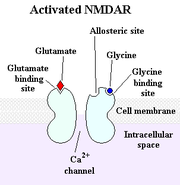
and voltage-dependent; second, it requires co-activation by two ligands - glutamate and glycine
Glycine
Glycine is an organic compound with the formula NH2CH2COOH. Having a hydrogen substituent as its 'side chain', glycine is the smallest of the 20 amino acids commonly found in proteins. Its codons are GGU, GGC, GGA, GGG cf. the genetic code.Glycine is a colourless, sweet-tasting crystalline solid...
.
Structure
The NMDA receptor forms a heterotetramerHeterotetramer
A heterotetramer is protein containing four non-covalently bound subunits, wherein the subunits are not all identical. A homotetramer contains four identical subunits....
between two NR1 and two NR2 subunits (the subunits are also called glutamate-binding NMDA receptor subunits or GluN for short); two obligatory NR1 subunits and two regionally localized NR2 subunits. A related gene
Gene
A gene is a molecular unit of heredity of a living organism. It is a name given to some stretches of DNA and RNA that code for a type of protein or for an RNA chain that has a function in the organism. Living beings depend on genes, as they specify all proteins and functional RNA chains...
family of NR3 A and B subunits have an inhibitory effect on receptor activity. Multiple receptor isoforms with distinct brain distributions and functional properties arise by selective splicing of the NR1 transcripts and differential expression of the NR2 subunits.
Each receptor subunit has modular design and each structural module also represents a functional unit:
- The extracellularExtracellularIn cell biology, molecular biology and related fields, the word extracellular means "outside the cell". This space is usually taken to be outside the plasma membranes, and occupied by fluid...
domainDomain (biology)In biological taxonomy, a domain is the highest taxonomic rank of organisms, higher than a kingdom. According to the three-domain system of Carl Woese, introduced in 1990, the Tree of Life consists of three domains: Archaea, Bacteria and Eukarya...
contains two globular structures: a modulatory domain and a ligandLigandIn coordination chemistry, a ligand is an ion or molecule that binds to a central metal atom to form a coordination complex. The bonding between metal and ligand generally involves formal donation of one or more of the ligand's electron pairs. The nature of metal-ligand bonding can range from...
-binding domain. NR1 subunits bind the co-agonist glycine and NR2 subunits bind the neurotransmitter glutamate.
- The agonist-binding module links to a membrane domain, which consists of three trans-membrane segments and a re-entrant loop reminiscent of the selectivity filter of potassium channels.
- The membrane domain contributes residues to the channel pore and is responsible for the receptor's high-unitary conductance, high-calcium permeability, and voltage-dependent magnesium block.
- Each subunit has an extensive cytoplasmic domain, which contain residues that can be directly modified by a series of protein kinases and protein phosphatases, as well as residues that interact with a large number of structural, adaptor, and scaffolding proteins.
The glycine-binding modules of the NR1 and NR3 subunits and the glutamate-binding module of the NR2A subunit have been expressed as soluble proteins, and their three-dimensional structure has been solved at atomic resolution by x-ray crystallography
X-ray crystallography
X-ray crystallography is a method of determining the arrangement of atoms within a crystal, in which a beam of X-rays strikes a crystal and causes the beam of light to spread into many specific directions. From the angles and intensities of these diffracted beams, a crystallographer can produce a...
. This has revealed a common fold with amino acid-binding bacterial proteins and with the glutamate-binding module of AMPA-receptors and kainate-receptors.
NR1
There are eight variants of the NR1GRIN1
Glutamate [NMDA] receptor subunit zeta-1 is a protein that in humans is encoded by the GRIN1 gene.-Further reading:...
subunit produced by alternative splicing of :
- NR1-1a, NR1-1b; NR1-1a is the most abundantly expressed form.
- NR1-2a, NR1-2b;
- NR1-3a, NR1-3b;
- NR1-4a, NR1-4b;
NR2
While a single NR2 subunit is found in invertebrate organisms, four distinct isoforms of the NR2 subunit are expressed in vertebrates and are referred to with the nomenclature NR2A through D(coded by GRIN2AGRIN2A
Glutamate [NMDA] receptor subunit epsilon-1 is a protein that in humans is encoded by the GRIN2A gene.-Interactions:GRIN2A has been shown to interact with FYN, DLG4, DLG3, DLG1, Src, PTK2B and Interleukin 16.-Further reading:...
, GRIN2B
GRIN2B
Glutamate [NMDA] receptor subunit epsilon-2 also known as N-methyl D-aspartate receptor subtype 2B is a protein that in humans is encoded by the GRIN2B gene.- Function :...
, GRIN2C
GRIN2C
Glutamate [NMDA] receptor subunit epsilon-3 is a protein that in humans is encoded by the GRIN2C gene.-Interactions:GRIN2C has been shown to interact with DLG4 and DLG3....
, GRIN2D
GRIN2D
Glutamate [NMDA] receptor subunit epsilon-4 is a protein that in humans is encoded by the GRIN2D gene.-Interactions:GRIN2D has been shown to interact with Interleukin 16....
). Strong evidence shows that the genes coding the NR2 subunits in vertebrates have undergone at least two rounds of gene duplication. They contain the binding-site for the neurotransmitter
Neurotransmitter
Neurotransmitters are endogenous chemicals that transmit signals from a neuron to a target cell across a synapse. Neurotransmitters are packaged into synaptic vesicles clustered beneath the membrane on the presynaptic side of a synapse, and are released into the synaptic cleft, where they bind to...
glutamate. More importantly, each NR2 subunit has a different intracellular C-terminal domain that can interact with different sets signaling messengers. Unlike NR1 subunits, NR2 subunits are expressed differentially across various cell types and control the electrophysiological properties of the NMDA receptor. One particular subunit, NR2B, is mainly present in immature neurons and in extrasynaptic locations, and contains the binding-site for the selective inhibitor ifenprodil
Ifenprodil
Ifenprodil is a selective inhibitor of the NMDA receptor. Its effect is specific to receptors composed of the NR1 and NR2B subunits....
.
Whereas NR2B
GRIN2B
Glutamate [NMDA] receptor subunit epsilon-2 also known as N-methyl D-aspartate receptor subtype 2B is a protein that in humans is encoded by the GRIN2B gene.- Function :...
is predominant in the early postnatal brain, the number of NR2A subunits grows, and eventually NR2A subunits outnumber NR2B. This is called NR2B-NR2A developmental switch, and is notable because of the different kinetics each NR2 subunit lends to the receptor.
There are three hypothetical models to describe this switch mechanism:
- Dramatic increase in synaptic NR2A along with decrease in NR2B
- Extrasynaptic displacement of NR2B away from the synapse with increase in NR2A
- Increase of NR2A diluting the number of NR2B without the decrease of the latter.
The NR2B and NR2A subunits also have differential roles in mediating excitotoxic
Excitotoxicity
Excitotoxicity is the pathological process by which nerve cells are damaged and killed by excessive stimulation by neurotransmitters such as glutamate and similar substances. This occurs when receptors for the excitatory neurotransmitter glutamate such as the NMDA receptor and AMPA receptor are...
neuronal death. The developmental switch in subunit composition is thought to explain the developmental changes in NMDA neurotoxicity. Disruption of the gene for NR2B in mice causes perinatal lethality
Lethality
Lethality is a term designating the ability of a weapon to kill. Most often this term is used when referring to chemical weapons, biological weapons, or their chemical components. The use of this term denotes the ability of these weapons to kill, but also the possibility that they may not kill...
, whereas the disruption of NR2A gene produces viable mice, although with impaired hippocampal plasticity. One study suggests that reelin
Reelin
Reelin is a large secreted extracellular matrix protein that helps regulate processes of neuronal migration and positioning in the developing brain by controlling cell–cell interactions. Besides this important role in early development, reelin continues to work in the adult brain. It modulates the...
may play a role in the NMDA receptor maturation by increasing the NR2B
GRIN2B
Glutamate [NMDA] receptor subunit epsilon-2 also known as N-methyl D-aspartate receptor subtype 2B is a protein that in humans is encoded by the GRIN2B gene.- Function :...
subunit mobility.
NR2B to NR2C switch
Granule cell precursors (GCPs) of the cerebellum, after undergoing symmetric cell division in the external granule-cell layer (EGL), migrate into the internal granule-cell layer (IGL) where they downregulate NR2B and activate NR2C, a process that is independent of neuregulin beta signaling through ErbB2 and ErbB4 receptors.Agonists
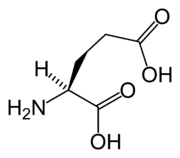
Activation of NMDA receptors requires binding of glutamateGlutamic acid
Glutamic acid is one of the 20 proteinogenic amino acids, and its codons are GAA and GAG. It is a non-essential amino acid. The carboxylate anions and salts of glutamic acid are known as glutamates...
or aspartate
Aspartic acid
Aspartic acid is an α-amino acid with the chemical formula HOOCCHCH2COOH. The carboxylate anion, salt, or ester of aspartic acid is known as aspartate. The L-isomer of aspartate is one of the 20 proteinogenic amino acids, i.e., the building blocks of proteins...
(aspartate does not stimulate the receptors as strongly). In addition, NMDARs also require the binding of the co-
Agonist
An agonist is a chemical that binds to a receptor of a cell and triggers a response by that cell. Agonists often mimic the action of a naturally occurring substance...
glycine
Glycine
Glycine is an organic compound with the formula NH2CH2COOH. Having a hydrogen substituent as its 'side chain', glycine is the smallest of the 20 amino acids commonly found in proteins. Its codons are GGU, GGC, GGA, GGG cf. the genetic code.Glycine is a colourless, sweet-tasting crystalline solid...
for the efficient opening of the ion channel, which is a part of this receptor.
D-serine has also been found to co-agonize the NMDA receptor with even greater potency than glycine. D-serine is produced by serine racemase
Serine racemase
Serine racemase is an enzyme which generates D-serine from L-serine. D-serine acts as a neuronal signaling molecule by activating NMDA receptors in the brain...
, and is enriched in the same areas as NMDA receptors. Removal of D-serine can block NMDA-mediated excitatory neurotransmission in many areas. Recently, it has been shown that D-serine can be released both by neurons and astrocytes to regulate NMDA receptors.
In addition, a third requirement is membrane depolarization. A positive change in transmembrane potential will make it more likely that the ion channel in the NMDA receptor will open by expelling the Mg2+ ion that blocks the channel from the outside. This property is fundamental to the role of the NMDA receptor in memory
Memory
In psychology, memory is an organism's ability to store, retain, and recall information and experiences. Traditional studies of memory began in the fields of philosophy, including techniques of artificially enhancing memory....
and learning
Learning
Learning is acquiring new or modifying existing knowledge, behaviors, skills, values, or preferences and may involve synthesizing different types of information. The ability to learn is possessed by humans, animals and some machines. Progress over time tends to follow learning curves.Human learning...
, and it has been suggested that this channel is a biochemical substrate of Hebbian learning, where it can act as a coincidence detector for membrane depolarization and synaptic transmission.
Known NMDA receptor agonists include:
- Aminocyclopropanecarboxylic acid
- D-Cycloserine
- cis-2,3-Piperidinedicarboxylic acid
- L- aspartate
- Quinolinate
- Homocysterate
- D-serine
- ACPL
- L-alanine
Antagonists
Antagonists of the NMDA receptor are used as anesthetics for animals and sometimes humans, and are often used as recreational drugs due to their hallucinogenic properties, in addition to their unique effects at elevated dosages such as dissociationDissociation
Dissociation is an altered state of consciousness characterized by partial or complete disruption of the normal integration of a person’s normal conscious or psychological functioning. Dissociation is most commonly experienced as a subjective perception of one's consciousness being detached from...
. When NMDA receptor antagonists are given to rodents in large doses, they can cause a form of brain damage
Brain damage
"Brain damage" or "brain injury" is the destruction or degeneration of brain cells. Brain injuries occur due to a wide range of internal and external factors...
called Olney's Lesions
Olney's lesions
Olney's lesions, also known as NMDA receptor antagonist neurotoxicity , are a potential form of brain damage. They are named after John Olney, who conducted a study investigating neurotoxicity caused by PCP and related drugs in 1989.-History:...
. So far, the published research on Olney's Lesions is inconclusive in its occurrence upon human or monkey brain tissues with respect to an increase in the presence of NMDA receptor antagonists.
Common NMDA receptor antagonists include:
- AmantadineAmantadineAmantadine is the organic compound known formally as 1-adamantylamine or 1-aminoadamantane. The molecule consists of adamantane backbone that has an amino group substituted at one of the four methyne positions. This pharmaceutical is sold under the name Symmetrel for use both as an antiviral and an...
- KetamineKetamineKetamine is a drug used in human and veterinary medicine. Its hydrochloride salt is sold as Ketanest, Ketaset, and Ketalar. Pharmacologically, ketamine is classified as an NMDA receptor antagonist...
- PhencyclidinePhencyclidinePhencyclidine , commonly initialized as PCP and known colloquially as angel dust, is a recreational dissociative drug...
(PCP) - Nitrous oxideNitrous oxideNitrous oxide, commonly known as laughing gas or sweet air, is a chemical compound with the formula . It is an oxide of nitrogen. At room temperature, it is a colorless non-flammable gas, with a slightly sweet odor and taste. It is used in surgery and dentistry for its anesthetic and analgesic...
- DextromethorphanDextromethorphanDextromethorphan is an antitussive drug. It is one of the active ingredients in many over-the-counter cold and cough medicines, such as Robitussin, NyQuil, Dimetapp, Vicks, Coricidin, Delsym, and others, including generic labels. Dextromethorphan has also found other uses in medicine, ranging...
and dextrorphanDextrorphanDextrorphan is a psychoactive drug of the morphinan chemical class which acts as an antitussive or cough suppressant and dissociative hallucinogen. It is the dextro-stereoisomer of racemorphan, the levo-half being levorphanol. Dextrorphan is produced by O-demethylation of dextromethorphan by CYP2D6... - Memantine
- EthanolEthanolEthanol, also called ethyl alcohol, pure alcohol, grain alcohol, or drinking alcohol, is a volatile, flammable, colorless liquid. It is a psychoactive drug and one of the oldest recreational drugs. Best known as the type of alcohol found in alcoholic beverages, it is also used in thermometers, as a...
- RiluzoleRiluzoleRiluzole is a drug used to treat amyotrophic lateral sclerosis. It delays the onset of ventilator-dependence or tracheostomy in selected patients and may increase survival by approximately 3–5 months....
(used in ALS) - XenonXenonXenon is a chemical element with the symbol Xe and atomic number 54. The element name is pronounced or . A colorless, heavy, odorless noble gas, xenon occurs in the Earth's atmosphere in trace amounts...
- HU-211 (also a cannabinoid)
- LeadLeadLead is a main-group element in the carbon group with the symbol Pb and atomic number 82. Lead is a soft, malleable poor metal. It is also counted as one of the heavy metals. Metallic lead has a bluish-white color after being freshly cut, but it soon tarnishes to a dull grayish color when exposed...
(Pb2+) - ConantokinsConantokinsConantokins are a small family of helical peptides, rich in γ-carboxyglutamate amino acid residues. They are derived from the venom of predatory marine snails of the genus Conus. Conantokins act as potent and specific antagonists of the N-methyl-D-aspartate receptor . They are the only...
Dual opioids and NMDA-Antagonists:
- KetobemidoneKetobemidoneKetobemidone is a powerful opioid analgesic. Its effectiveness against pain is in the same range as morphine, and it also has some NMDA-antagonist properties imparted by it's metabolite norketobemidone. This makes it useful for some types of pain that don't respond well to other opioids...
- MethadoneMethadoneMethadone is a synthetic opioid, used medically as an analgesic and a maintenance anti-addictive for use in patients with opioid dependency. It was developed in Germany in 1937...
- DextropropoxypheneDextropropoxypheneDextropropoxyphene, manufactured by Eli Lilly and Company, is an analgesic in the opioid category. It is intended to treat mild pain and has, in addition, anti-tussive and local anesthetic effects. It has been taken off the market in Europe and the US due to concerns of fatal overdoses and...
- TramadolTramadolTramadol hydrochloride is a centrally acting synthetic opioid analgesic used in treating moderate pain. The drug has a wide range of applications, including treatment for restless legs syndrome and fibromyalgia...
- KratomKratomKratom , Mitragyna speciosa, is a medicinal leaf harvested from a large tree in the Rubiaceae family native to Southeast Asia in the Indochina and Malesia floristic regions. The plant has been traditionally used for its medicinal properties.It was first formally documented by the Dutch colonial...
alkaloids - IbogaineIbogaineIbogaine is a naturally occurring psychoactive substance found in a number of plants, principally in a member of the Apocynaceae family known as Iboga . A hallucinogen with both psychedelic and dissociative properties, the substance is banned in some countries; in other countries it is being used...
Modulators
The NMDA receptor is modulated by a number of endogenousEndogenous
Endogenous substances are those that originate from within an organism, tissue, or cell. Endogenous retroviruses are caused by ancient infections of germ cells in humans, mammals and other vertebrates...
and exogenous
Exogenous
Exogenous refers to an action or object coming from outside a system. It is the opposite of endogenous, something generated from within the system....
compounds:
- Mg2+ not only blocks the NMDA channel in a voltage-dependent manner but also potentiates NMDA-induced responses at positive membrane potentialMembrane potentialMembrane potential is the difference in electrical potential between the interior and exterior of a biological cell. All animal cells are surrounded by a plasma membrane composed of a lipid bilayer with a variety of types of proteins embedded in it...
s. Magnesium glycinate and magnesium taurinate treatment has been used to produce rapid recovery from depression.
- Na+SodiumSodium is a chemical element with the symbol Na and atomic number 11. It is a soft, silvery-white, highly reactive metal and is a member of the alkali metals; its only stable isotope is 23Na. It is an abundant element that exists in numerous minerals, most commonly as sodium chloride...
, K+ and Ca2+ not only pass through the NMDA receptor channel but also modulate the activity of NMDA receptors.
- Zn2+ and Cu2+ generally block NMDA current activity in a noncompetitive and a voltage-independent manner. However zinc may potentiate or inhibit the current depending on the neural activity. (Zinc and Copper Influence Excitability of Rat Olfactory Bulb Neurons by Multiple Mechanisms|http://jn.physiology.org/content/86/4/1652.short)
- Pb2+ lead is a potent NMDAR antagonist. Presynaptic deficits resulting from Pb2+ exposure during synaptogenesis are mediated by disruption of NMDAR-dependent BDNF signaling.
- It has been demonstrated that polyaminePolyamineA polyamine is an organic compound having two or more primary amino groups .This class of compounds includes several synthetic substances that are important feedstocks for the chemical industry, such as ethylene diamine , 1,3-diaminopropane , and hexamethylenediamine...
s do not directly activate NMDA receptors, but instead act to potentiate or inhibit glutamate-mediated responses.
- Aminoglycosides have been shown to have a similar effect to polyamines, and this may explain their neurotoxic effect.
- The activity of NMDA receptors is also strikingly sensitive to the changes in H+ concentrationPHIn chemistry, pH is a measure of the acidity or basicity of an aqueous solution. Pure water is said to be neutral, with a pH close to 7.0 at . Solutions with a pH less than 7 are said to be acidic and solutions with a pH greater than 7 are basic or alkaline...
, and partially inhibited by the ambient concentration of H+ under physiological conditions. The level of inhibition by H+ is greatly reduced in receptors containing the NR1a subtype, which contains the positively-charged insert Exon 5. The effect of this insert may be mimicked by positively-charged polyamines and aminoglycosides, explaining their mode of action.
- NMDA receptor function is also strongly regulated by chemical reduction and oxidation, via the so-called "redox modulatory site." Through this site, reductants dramatically enhance NMDA channel activity, whereas oxidants either reverse the effects of reductants or depress native responses. It is generally believed that NMDA receptors are modulated by endogenous redox agents such as glutathioneGlutathioneGlutathione is a tripeptide that contains an unusual peptide linkage between the amine group of cysteine and the carboxyl group of the glutamate side-chain...
, lipoic acidLipoic acidLipoic acid , also known as α-lipoic acid and Alpha Lipoic Acid is an organosulfur compound derived from octanoic acid. LA contains two vicinal sulfur atoms attached via a disulfide bond and is thus considered to be oxidized...
, and the essential nutrient pyrroloquinoline quinonePyrroloquinoline quinonePyrroloquinoline quinone was discovered by J.G. Hauge as the third redox cofactor after nicotinamide and flavin in bacteria . Anthony and Zatman also found the unknown redox cofactor in alcohol dehydrogenase and named it methoxatin...
.
- SrcSrc (gene)Proto-oncogene tyrosine-protein kinase Src is an enzyme that in humans is encoded by the SRC gene.Src is a proto-oncogene encoding a tyrosine kinase originally discovered by J. Michael Bishop and Harold E. Varmus, for which they won the 1989 Nobel Prize in Physiology or Medicine. It belongs to a...
kinase enhances NMDA receptor currents. - ReelinReelinReelin is a large secreted extracellular matrix protein that helps regulate processes of neuronal migration and positioning in the developing brain by controlling cell–cell interactions. Besides this important role in early development, reelin continues to work in the adult brain. It modulates the...
modulates NMDA function through Src family kinases and DAB1DAB1The Disabled-1 gene encodes a key regulator of Reelin signaling. Reelin is a large glycoprotein secreted by neurons of the developing brain, particularly Cajal-Retzius cells. DAB1 functions downstream of Reln in a signaling pathway...
. significantly enhancing LTPLong-term potentiationIn neuroscience, long-term potentiation is a long-lasting enhancement in signal transmission between two neurons that results from stimulating them synchronously. It is one of several phenomena underlying synaptic plasticity, the ability of chemical synapses to change their strength...
in the hippocampusHippocampusThe hippocampus is a major component of the brains of humans and other vertebrates. It belongs to the limbic system and plays important roles in the consolidation of information from short-term memory to long-term memory and spatial navigation. Humans and other mammals have two hippocampi, one in...
. - CDK5 regulates the amount of NR2B-containing NMDA receptors on the synaptic membrane, thus affecting synaptic plasticitySynaptic plasticityIn neuroscience, synaptic plasticity is the ability of the connection, or synapse, between two neurons to change in strength in response to either use or disuse of transmission over synaptic pathways. Plastic change also results from the alteration of the number of receptors located on a synapse...
.
Functional role
The NMDA receptor is a non-specific cation channel which can allow Ca2+, Na+, and K+ to pass into the cell. The excitatory postsynaptic potentialExcitatory postsynaptic potential
In neuroscience, an excitatory postsynaptic potential is a temporary depolarization of postsynaptic membrane potential caused by the flow of positively charged ions into the postsynaptic cell as a result of opening of ligand-sensitive channels...
(EPSP) produced by activation of an NMDA receptor increases the concentration of Ca2+ in the cell. The Ca2+ can in turn function as a second messenger in various signaling pathways. However, the NMDA receptor cation channel is blocked by Mg2+ at resting membrane potential. To unblock the channel, the postsynaptic cell must be depolarized.
The NMDA receptor therefore functions as a "molecular coincidence detector". Its ion channel only opens when the following two conditions are met simultaneously: glutamate is bound to the receptor, and the postsynaptic cell is depolarized (which removes the Mg2+ blocking the channel). This property of the NMDA receptor explains many aspects of long term potentiation (LTP) and synaptic plasticity
Synaptic plasticity
In neuroscience, synaptic plasticity is the ability of the connection, or synapse, between two neurons to change in strength in response to either use or disuse of transmission over synaptic pathways. Plastic change also results from the alteration of the number of receptors located on a synapse...
.
NMDA receptors are modulated by a number of endogenous and exogenous compounds and play a key role in a wide range of physiological
Physiology
Physiology is the science of the function of living systems. This includes how organisms, organ systems, organs, cells, and bio-molecules carry out the chemical or physical functions that exist in a living system. The highest honor awarded in physiology is the Nobel Prize in Physiology or...
(e.g. memory
Memory
In psychology, memory is an organism's ability to store, retain, and recall information and experiences. Traditional studies of memory began in the fields of philosophy, including techniques of artificially enhancing memory....
) and pathological
Pathology
Pathology is the precise study and diagnosis of disease. The word pathology is from Ancient Greek , pathos, "feeling, suffering"; and , -logia, "the study of". Pathologization, to pathologize, refers to the process of defining a condition or behavior as pathological, e.g. pathological gambling....
processes (e.g. excitotoxicity
Excitotoxicity
Excitotoxicity is the pathological process by which nerve cells are damaged and killed by excessive stimulation by neurotransmitters such as glutamate and similar substances. This occurs when receptors for the excitatory neurotransmitter glutamate such as the NMDA receptor and AMPA receptor are...
).
Clinical significance
Recently, NMDARs were associated with a rare autoimmune disease, Anti-NMDAR encephalitisAnti-NMDA receptor encephalitis
Anti-NMDA receptor encephalitis is an acute form of encephalitis, potentially lethal but with high probability for recovery, caused by autoimmune reaction against NR1- and NR2-subunits of the glutamate NMDA receptor...
, that usually occurs due to cross reactivity of antibodies produced by the immune system against ectopic brain tissues, such as those found in teratoma
Teratoma
A teratoma is an encapsulated tumor with tissue or organ components resembling normal derivatives of all three germ layers. There are rare occasions when not all three germ layers are identifiable...
.
See also
- Long-term potentiationLong-term potentiationIn neuroscience, long-term potentiation is a long-lasting enhancement in signal transmission between two neurons that results from stimulating them synchronously. It is one of several phenomena underlying synaptic plasticity, the ability of chemical synapses to change their strength...
and depressionLong-term depressionLong-term depression , in neurophysiology, is an activity-dependent reduction in the efficacy of neuronal synapses lasting hours or longer. LTD occurs in many areas of the CNS with varying mechanisms depending upon brain region and developmental progress... - Category: NMDA receptor antagonists
- NMDANMDAN-Methyl-D-aspartic acid or N-Methyl-D-aspartate is an amino acid derivative which acts as a specific agonist at the NMDA receptor mimicking the action of glutamate, the neurotransmitter which normally acts at that receptor...
- AMPAAMPAAMPA is a compound that is a specific agonist for the AMPA receptor, where it mimics the effects of the neurotransmitter glutamate....
- AMPA receptorAMPA receptorThe α-amino-3-hydroxy-5-methyl-4-isoxazolepropionic acid receptor is a non-NMDA-type ionotropic transmembrane receptor for glutamate that mediates fast synaptic transmission in the central nervous system . Its name is derived from its ability to be activated by the artificial glutamate analog AMPA...
- Calcium/calmodulin-dependent protein kinasesCa2+/calmodulin-dependent protein kinase/calmodulin-dependent protein kinases II or CaM kinases II are serine/threonine-specific protein kinases that are regulated by the /calmodulin complex...
- Anti-glutamate receptor antibodiesAnti-glutamate receptor antibodiesAnti-glutamate receptor antibodies are autoantibodies detected in serum and/or cerebrospinal fluid samples of a variety of disorders such as encephalitis, epilepsy and ataxia...
External links
- NMDA receptor pharmacology
- Motor Discoordination Results from Combined Gene Disruption of the NMDA Receptor NR2A and NR2C Subunits, But Not from Single Disruption of the NR2A or NR2C Subunit
- A schematic diagram summarizes three potential models for the switching of NR2A and NR2B subunits at developing synapses. - a figure from Liu et al., 2004
- Drosophila NMDA receptor 1 - The Interactive Fly