


NMDA

Encyclopedia
N-Methyl-D-aspartic acid or N-Methyl-D-aspartate (NMDA) is an amino acid
derivative which acts as a specific agonist
at the NMDA receptor
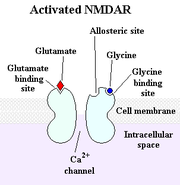
mimicking the action of glutamate, the neurotransmitter
which normally acts at that receptor. Unlike glutamate, NMDA only binds to and regulates the NMDA receptor and has no effect on other glutamate receptors (such as those for AMPA
and kainate). NMDA receptors are particularly important when they become overactive during withdrawal
from alcohol
as this causes symptoms such as agitation
and, sometimes, epileptiform seizures.
. If the behavior is compromised, it suggests the destroyed tissue was part of a brain region that made an important contribution to the normal expression of that behavior.
However, in lower quantities NMDA is not neurotoxic. In fact, normal operation of the NMDA receptor allows individuals to respond to excitatory stimuli through the interrelated functioning of NMDA receptors, glutamate, and dopamine.
Therefore the action of glutamate specifically through NMDA receptors can be investigated by injecting small quantities of NMDA into a certain region in the brain: for example, injection of NMDA in a brainstem region induces involuntary locomotion
in cats and rats.
of the NMDA receptor are APV
, Amantadine
, dextromethorphan
, ketamine
, phencyclidine
(PCP), riluzole
, memantine, and kynurenic acid
; the latter is the only known endogenous antagonist. They are commonly referred to as NMDA receptor antagonist
s.
Amino acid
Amino acids are molecules containing an amine group, a carboxylic acid group and a side-chain that varies between different amino acids. The key elements of an amino acid are carbon, hydrogen, oxygen, and nitrogen...
derivative which acts as a specific agonist
Agonist
An agonist is a chemical that binds to a receptor of a cell and triggers a response by that cell. Agonists often mimic the action of a naturally occurring substance...
at the NMDA receptor
NMDA receptor
The NMDA receptor , a glutamate receptor, is the predominant molecular device for controlling synaptic plasticity and memory function....
mimicking the action of glutamate, the neurotransmitter
Neurotransmitter
Neurotransmitters are endogenous chemicals that transmit signals from a neuron to a target cell across a synapse. Neurotransmitters are packaged into synaptic vesicles clustered beneath the membrane on the presynaptic side of a synapse, and are released into the synaptic cleft, where they bind to...
which normally acts at that receptor. Unlike glutamate, NMDA only binds to and regulates the NMDA receptor and has no effect on other glutamate receptors (such as those for AMPA
AMPA
AMPA is a compound that is a specific agonist for the AMPA receptor, where it mimics the effects of the neurotransmitter glutamate....
and kainate). NMDA receptors are particularly important when they become overactive during withdrawal
Withdrawal
Withdrawal can refer to any sort of separation, but is most commonly used to describe the group of symptoms that occurs upon the abrupt discontinuation/separation or a decrease in dosage of the intake of medications, recreational drugs, and alcohol...
from alcohol
Alcohol
In chemistry, an alcohol is an organic compound in which the hydroxy functional group is bound to a carbon atom. In particular, this carbon center should be saturated, having single bonds to three other atoms....
as this causes symptoms such as agitation
Psychomotor agitation
Psychomotor agitation is a series of unintentional and purposeless motions that stem from mental tension and anxiety of an individual. This includes pacing around a room, wringing one's hands, pulling off clothing and putting it back on and other similar actions...
and, sometimes, epileptiform seizures.
Biological function
NMDA is a water-soluble synthetic substance that is not normally found in biological tissue. It was first synthesized in 1960s. NMDA is an excitotoxin (it kills nerve cells by over-exciting them); this trait has applications in behavioral neuroscience research. The body of work utilizing this technique falls under the term "lesion studies." Researchers apply NMDA to specific regions of an (animal) subject's brain or spinal cord and subsequently test for the behavior of interest, such as operant behaviorOperant conditioning
Operant conditioning is a form of psychological learning during which an individual modifies the occurrence and form of its own behavior due to the association of the behavior with a stimulus...
. If the behavior is compromised, it suggests the destroyed tissue was part of a brain region that made an important contribution to the normal expression of that behavior.
However, in lower quantities NMDA is not neurotoxic. In fact, normal operation of the NMDA receptor allows individuals to respond to excitatory stimuli through the interrelated functioning of NMDA receptors, glutamate, and dopamine.
Therefore the action of glutamate specifically through NMDA receptors can be investigated by injecting small quantities of NMDA into a certain region in the brain: for example, injection of NMDA in a brainstem region induces involuntary locomotion
Animal locomotion
Animal locomotion, which is the act of self-propulsion by an animal, has many manifestations, including running, swimming, jumping and flying. Animals move for a variety of reasons, such as to find food, a mate, or a suitable microhabitat, and to escape predators...
in cats and rats.
Antagonists
Examples of antagonistsReceptor antagonist
A receptor antagonist is a type of receptor ligand or drug that does not provoke a biological response itself upon binding to a receptor, but blocks or dampens agonist-mediated responses...
of the NMDA receptor are APV
APV (NMDAR antagonist)
AP5 or APV is a selective NMDA receptor antagonist that competitively inhibits the ligand binding site of NMDA receptors....
, Amantadine
Amantadine
Amantadine is the organic compound known formally as 1-adamantylamine or 1-aminoadamantane. The molecule consists of adamantane backbone that has an amino group substituted at one of the four methyne positions. This pharmaceutical is sold under the name Symmetrel for use both as an antiviral and an...
, dextromethorphan
Dextromethorphan
Dextromethorphan is an antitussive drug. It is one of the active ingredients in many over-the-counter cold and cough medicines, such as Robitussin, NyQuil, Dimetapp, Vicks, Coricidin, Delsym, and others, including generic labels. Dextromethorphan has also found other uses in medicine, ranging...
, ketamine
Ketamine
Ketamine is a drug used in human and veterinary medicine. Its hydrochloride salt is sold as Ketanest, Ketaset, and Ketalar. Pharmacologically, ketamine is classified as an NMDA receptor antagonist...
, phencyclidine
Phencyclidine
Phencyclidine , commonly initialized as PCP and known colloquially as angel dust, is a recreational dissociative drug...
(PCP), riluzole
Riluzole
Riluzole is a drug used to treat amyotrophic lateral sclerosis. It delays the onset of ventilator-dependence or tracheostomy in selected patients and may increase survival by approximately 3–5 months....
, memantine, and kynurenic acid
Kynurenic acid
Kynurenic acid is a product of the normal metabolism of amino acid L-tryptophan. It has been shown that kynurenic acid possesses neuroactive activity. It acts as an antiexcitotoxic and anticonvulsant, most likely through acting as an antagonist at excitatory amino acid receptors...
; the latter is the only known endogenous antagonist. They are commonly referred to as NMDA receptor antagonist
NMDA receptor antagonist
NMDA receptor antagonists are a class of anesthetics that work to antagonize, or inhibit the action of, the N-methyl d-aspartate receptor . They are used as anesthesia for animals and, less commonly, for humans; the state of anesthesia they induce is referred to as dissociative anesthesia...
s.