
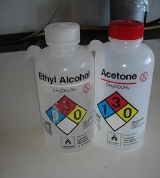
NFPA 704 is a standard maintained by the
U.S.The United States of America is a federal constitutional republic comprising fifty states and a federal district...
-based
National Fire Protection AssociationThe National Fire Protection Association is a U.S. organization charged with creating and maintaining minimum standards and requirements for fire prevention and suppression activities, training, and equipment, as well as other life-safety codes and standards...
. It defines the colloquial "
fire diamond" used by emergency personnel to quickly and easily identify the risks posed by nearby hazardous materials. This is necessary to help determine what, if any, specialty equipment should be used, procedures followed, or precautions taken during the first moments of an emergency response.
The four divisions are typically color-coded, with blue indicating level of
healthAt the of the creation of the World Health Organization , in 1948, Health was defined as being "a state of complete physical, mental, and social well-being and not merely the absence of disease or infirmity"....
hazardA hazard is a situation that poses a level of threat to life, health, property, or environment. Most hazards are dormant or potential, with only a theoretical risk of harm; however, once a hazard becomes 'active', it can create an emergency situation....
, red indicating flammability, yellow (chemical) reactivity, and white containing special codes for unique hazards.
Discussion
Ask a question about 'NFPA 704'
Start a new discussion about 'NFPA 704'
Answer questions from other users
|
NFPA 704 is a standard maintained by the
U.S.The United States of America is a federal constitutional republic comprising fifty states and a federal district...
-based
National Fire Protection AssociationThe National Fire Protection Association is a U.S. organization charged with creating and maintaining minimum standards and requirements for fire prevention and suppression activities, training, and equipment, as well as other life-safety codes and standards...
. It defines the colloquial "
fire diamond" used by emergency personnel to quickly and easily identify the risks posed by nearby hazardous materials. This is necessary to help determine what, if any, specialty equipment should be used, procedures followed, or precautions taken during the first moments of an emergency response.
Symbolism
The four divisions are typically color-coded, with blue indicating level of
healthAt the of the creation of the World Health Organization , in 1948, Health was defined as being "a state of complete physical, mental, and social well-being and not merely the absence of disease or infirmity"....
hazardA hazard is a situation that poses a level of threat to life, health, property, or environment. Most hazards are dormant or potential, with only a theoretical risk of harm; however, once a hazard becomes 'active', it can create an emergency situation....
, red indicating flammability, yellow (chemical) reactivity, and white containing special codes for unique hazards. Each of health, flammability and reactivity is rated on a scale from 0 (no hazard; normal substance) to 4 (severe risk).
| Health (blue) |
| 4 |
Very short exposure could cause death or major residual injury (e.g., hydrogen cyanide Hydrogen cyanide is a chemical compound with chemical formula HCN. A solution of hydrogen cyanide in water is called hydrocyanic acid. Hydrogen cyanide is a colorless, extremely poisonous, and highly volatile liquid that boils slightly above room temperature at 26 °C... , phosphinePhosphine is the common name for phosphorus trihydride , also known by the IUPAC name phosphane and, occasionally, phosphamine. It is a colorless, flammable gas with a boiling point of −88 °C at standard pressure... ) |
| 3 |
Short exposure could cause serious temporary or moderate residual injury (e.g., chlorine gas) |
| 2 |
Intense or continued but not chronic exposure could cause temporary incapacitation or possible residual injury (e.g., ethyl ether) |
| 1 |
Exposure would cause irritation with only minor residual injury (e.g., ethanolEthanol, also called ethyl alcohol, pure alcohol, grain alcohol, or drinking alcohol, is a volatile, flammable, colorless liquid. It is a psychoactive drug, best known as the type of alcohol found in alcoholic beverages and in modern thermometers. Ethanol is one of the oldest recreational drugs... , acetoneAcetone is the organic compound with the formula OC2. This colorless, mobile, flammable liquid is the simplest example of the ketones. Owing to the fact that acetone is miscible with water it serves as an important solvent in its own right, typically as the solvent of choice for... ) |
| 0 |
Poses no health hazard, no precautions necessary. (e.g., lanolinLanolin [German : from Latin lāna=wool + Latin oleum=oil] also called Adeps Lanae, wool wax, wool fat, anhydrous wool fat or wool grease, is a greasy yellow substance secreted by the sebaceous glands of wool-bearing animals, with the vast majority of it used by humans coming from domestic sheep... ) |
| Flammability (red) |
| 4 |
Will rapidly or completely vaporize at normal atmospheric pressure and temperature, or is readily dispersed in air and will burn readily (e.g., propanePropane is a three-carbon alkane, normally a gas, but compressible to a transportable liquid. It is derived from other petroleum products during oil or natural gas processing... ). Flash pointThe flash point of a volatile liquid is the lowest temperature at which it can vaporize to form an ignitable mixture in air. Measuring a liquid's flashpoint requires an ignition source. This is not to be confused with the auto-ignition temperature, which requires no ignition source. At the flash... below 23°C (73°F) |
| 3 |
Liquids and solids that can be ignited under almost all ambient temperature conditions (e.g., gasolineGasoline or petrol is a petroleum-derived liquid mixture, primarily used as fuel in internal combustion engines... ). Flash point between 23°C (73°F) and 38°C (100°F) |
| 2 |
Must be moderately heated or exposed to relatively high ambient temperature before ignition can occur (e.g., diesel fuel). Flash point between 38°C (100°F) and 93°C (200°F) |
| 1 |
Must be heated before ignition can occur (e.g., soybean oil In processing soybeans for oil extraction and subsequent soy flour production, selection of high quality, sound, clean, dehulled yellow soybeans is very important. Soybeans having a dark colored seed coat, or even beans with a dark hilum will inadvertently leave dark specks in the flour, and are... ). Flash point over 93°C (200°F) |
| 0 |
Will not burn (e.g., waterWater is an ubiquitous chemical substance that is composed of hydrogen and oxygen and is essential for all known forms of life.In typical usage, water refers only to its liquid form or state, but the substance also has a solid state, ice, and a gaseous state, water vapor or steam. Water covers 71%... ) |
| Instability/Reactivity (yellow) |
| 4 |
Readily capable of detonation Detonation is a process of combustion in which a supersonic shock wave is propagated through a fluid due to an energy release in a reaction zone. It is the more powerful of the two general classes of combustion, the other one being deflagration. In a detonation, the shock compresses the material... or explosive decomposition at normal temperatures and pressures (e.g., nitroglycerine, RDXCyclotrimethylenetrinitramine, also known as RDX, cyclonite, hexogen, and T4, is an explosive nitroamine widely used in military and industrial applications. Nomenclature variants include cyclotrimethylene-trinitramine and cyclotrimethylene trinitramine.In its pure, synthesized state RDX is a... ) |
| 3 |
Capable of detonation or explosive decomposition but requires a strong initiating source, must be heated under confinement before initiation, reacts explosively with water, or will detonate if severely shocked (e.g. ammonium nitrate The chemical compound ammonium nitrate, the nitrate of ammonia with the chemical formula NH4NO3, is a white crystalline solid at room temperature and standard pressure... ) |
| 2 |
Undergoes violent chemical change at elevated temperatures and pressures, reacts violently with water, or may form explosive mixtures with water (e.g., phosphorusPhosphorus is the chemical element that has the symbol P and atomic number 15. A multivalent nonmetal of the nitrogen group, phosphorus is commonly found in inorganic phosphate rocks. Elemental phosphorus exists in two major forms - white phosphorus and red phosphorus... , potassiumPotassium is the chemical element with the symbol K , atomic number 19, and atomic mass 39.0983. Potassium was first isolated from potash... , sodiumSodium is a metallic element with a symbol Na and atomic number 11. It is a soft, silvery-white, highly reactive metal and is a member of the alkali metals within "group 1"... ) |
| 1 |
Normally stable, but can become unstable at elevated temperatures and pressures (e.g. propene) |
| 0 |
Normally stable, even under fire exposure conditions, and is not reactive with water (e.g. heliumHelium is the chemical element with atomic number 2, and is represented by the symbol He. It is a colorless, odorless, tasteless, non-toxic, inert monatomic gas that heads the noble gas group in the periodic table... ) |
White - Special
The white "special notice" area can contain several symbols. The following symbols are defined by the NFPA 704 standard:
-
W: reacts with WaterWater is an ubiquitous chemical substance that is composed of hydrogen and oxygen and is essential for all known forms of life.In typical usage, water refers only to its liquid form or state, but the substance also has a solid state, ice, and a gaseous state, water vapor or steam. Water covers 71%...
in an unusual or dangerous manner (e.g., caesiumCaesium or cesium is the chemical element with the symbol Cs and atomic number 55. It is a soft, silvery-gold alkali metal with a melting point of , which makes it one of only five metals that are liquid at or near room temperature...
, sodiumSodium is a metallic element with a symbol Na and atomic number 11. It is a soft, silvery-white, highly reactive metal and is a member of the alkali metals within "group 1"...
)
- OX or OXY: Oxidizer (e.g., potassium perchlorate
Potassium perchlorate is the inorganic salt with the chemical formula KClO4. Like other perchlorates, this salt is a strong oxidizer and reacts with many organic substances. It is usually obtained as a colorless, crystalline powder...
, ammonium nitrateThe chemical compound ammonium nitrate, the nitrate of ammonia with the chemical formula NH4NO3, is a white crystalline solid at room temperature and standard pressure...
, hydrogen peroxideHydrogen peroxide is a very pale blue liquid, slightly more viscous than water, that appears colorless in dilute solution. It is a weak acid, has strong oxidizing properties, and is a powerful bleaching agent. It is used as a disinfectant, antiseptic, oxidizer, and in rocketry as a propellant...
)
- SA: Simple asphyxiant gas
An asphyxiant gas is a non-toxic or minimally toxic gas which dilutes or displaces the oxygen containing atmosphere, leading to death by asphyxiation if breathed long enough...
(includes nitrogenNitrogen is a chemical element that has the symbol N and atomic number 7 and atomic mass 14.00674 u. Elemental nitrogen is a colorless, odorless, tasteless and mostly inert diatomic gas at standard conditions, constituting 78% by volume of Earth's atmosphere.Many industrially important...
, heliumHelium is the chemical element with atomic number 2, and is represented by the symbol He. It is a colorless, odorless, tasteless, non-toxic, inert monatomic gas that heads the noble gas group in the periodic table...
, neonNeon is the chemical element that has the symbol Ne and atomic number 10. Although a very common element in the universe, it is rare on Earth. A colorless, inert noble gas under standard conditions, neon gives a distinct reddish-orange glow when used in discharge tubes and neon lamps...
, argonArgon is a chemical element designated by the symbol Ar. Argon has atomic number 18 and is the third element in group 18 of the periodic table . Argon is present in the Earth's atmosphere at 0.94%. Terrestrially, it is the most abundant and most frequently used of the noble gases...
, kryptonKrypton is a chemical element with the symbol Kr and atomic number 36. It is a member of Group 18 and Period 4 elements. A colorless, odorless, tasteless noble gas, krypton occurs in trace amounts in the atmosphere, is isolated by fractionally distilling liquified air, and is often used with other...
, or xenonXenon is a chemical element represented by the symbol Xe. Its atomic number is 54. A colorless, heavy, odorless noble gas, xenon occurs in the Earth's atmosphere in trace amounts...
)
Non-standard symbols
Note: These symbols are not part of the NFPA 704 standard, but occasionally used in an unofficial manner. The use of non-standard symbols or text may be permitted, required or disallowed by the authority having jurisdiction
(e.g., fire department).
- COR: Corrosive
A corrosive substance is one that will destroy or irreversibly damage another substance in which it comes in contact with. The main hazards to people include damage to eyes, skin and tissue under the skin, but inhalation or ingestion of a corrosive substance can damage the respiratory and...
; strong acidAn acid is traditionally considered any chemical compound that, when dissolved in water, gives a solution with a hydrogen ion activity greater than in pure water, i.e. a pH less than 7.0...
or baseIn chemistry, a base is most commonly thought of as an aqueous substance that can accept hydrogen ions. Bases are also the oxides or hydroxides of metals. A soluble base is also often referred to as an alkali if hydroxide ions are involved. This refers to the Brønsted-Lowry theory of acids and bases...
(e.g. sulfuric acidSulfuric acid, , is a strong mineral acid. It is soluble in water at all concentrations. Sulfuric acid has many applications, and is one of the top products of the chemical industry. World production in 2001 was 165 million tonnes, with an approximate value of US$8 billion...
, potassium hydroxidePotassium hydroxide is an inorganic compound with the formula KOH. Along with sodium hydroxide, this colourless solid is a prototypical "strong base". It has many industrial and niche applications. Most applications exploit its reactivity toward acids and its corrosive nature. In 2005, an...
)
- ACID and ALK to be more specific.
- BIO: Biological hazard
A biological hazard or biohazard is an organism, or substance derived from an organism, that poses a threat to human health. This can include medical waste or samples of a microorganism, virus or toxin that can impact human health. It can also include substances harmful to animals...
(e.g., smallpox virusSmallpox is an infectious disease unique to humans, caused by either of two virus variants, Variola major and Variola minor. The disease is also known by the Latin names Variola or Variola vera, which is a derivative of the Latin varius, meaning spotted, or varus, meaning "pimple"...
)
- POI: Poisonous
In the context of biology, poisons are substances that can cause disturbances to organisms, usually by chemical reaction or other activity on the molecular scale, when a sufficient quantity is absorbed by an organism...
(e.g. Spider VenomVenom is any of a variety of toxins used by certain types of animals. Generally, venom is injected by such means as a bite or a sting.-The distinction between venom and poison:...
),
-
(the Radioactive trefoil): is radioactive (e.g., plutoniumPlutonium is a rare transuranic radioactive element. It is an actinide metal of silvery-white appearance that tarnishes when exposed to air, forming a dull coating when oxidized. The element normally exhibits six allotropes and four oxidation states. It reacts with carbon, halogens, nitrogen and...
, uraniumUranium is a silvery-white metallic chemical element in the actinide series of the periodic table that has the symbol U and atomic number 92. Besides its 92 protons, a uranium nucleus can have between 141 and 146 neutrons. The most common uranium isotopes are U-238 and U-235 . A uranium atom has...
)
- CRY or CRYO: Cryogenic (e.g. Liquid Nitrogen
Liquid nitrogen is nitrogen in a liquid state at a very low temperature. It is produced industrially by fractional distillation of liquid air. Liquid nitrogen is a colourless clear liquid with density at its boiling point of 0.807 g/mL and a dielectric constant of 1.4...
)
External links