

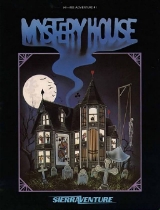
Mystery House

Encyclopedia
Mystery House is an adventure
computer game released in 1980 by Roberta
and Ken Williams
for the Apple II. The game is remembered as one of the first adventure games to feature computer graphics
and the first game produced by On-Line Systems, the company which would evolve into Sierra On-Line. Because of its use of graphics, GamePro
named Mystery House the 51st most important game of all time in 2007.
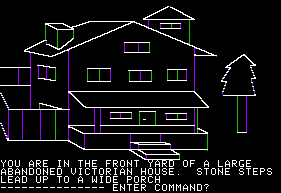 The game starts near an abandoned Victorian
mansion. The player is soon locked inside the house with no other option than to explore. The mansion contains many interesting rooms and seven other people: Tom, a plumber; Sam, a mechanic; Sally, a seamstress; Dr. Green, a surgeon; Joe, a gravedigger; Bill, a butcher; and Daisy, a cook.
Initially, the player has to search the house in order to find a hidden cache of jewels. However, terrible events start happening and dead bodies (of the other people) begin appearing. It becomes obvious that there is a murderer on the loose in the house, and the player must discover who it is or become the next victim.
. He and his wife Roberta both played it all the way through and their encounter with this game would have a strong influence on video-gaming history.
Having finished Colossal Cave Adventure, they began to search for something similar, but found the market underdeveloped. Roberta Williams liked the concept of a textual adventure very much, but she thought that the player would have a more satisfying experience with images and began to think of her own game. She thus conceived Mystery House, the first graphical adventure game, a detective story inspired by Agatha Christie's
And Then There Were None
.
Ken spent a few nights developing the game on his Apple II using 70 simple two-dimensional
drawings done by Roberta. The software was packaged in Ziploc
bags containing a 5¼-inch disk and a photocopied paper describing the game and was sold in local software shops in Los Angeles County. To their great surprise, Mystery House was an enormous success, quickly becoming a best-seller at a first-release price of USD$24.95. Eventually, it sold more than 10,000 copies, which was a record-breaking phenomenon for the time.
Though Ken believed that the gaming market would be less of a growth market than the professional software market, he persevered with games. In 1980, the Williams founded On-Line Systems, which would become Sierra On-Line in 1982.
Mystery House was re-released in 1982 through the SierraVenture line, which produced a number of early Sierra games until 1983.
In Japan, several different adventure game
s under the title Mystery House were released. In 1982, MicroCabin released Mystery House, which was unrelated to (but inspired by) the On-Line Systems game of the same name. The following year, the Japanese company Starcraft released an enhanced remake of On-Line Systems' Mystery House with more realistic art work and depiction of blood
, while Mystery House II for the MSX
was released as a sequel to MicroCabin's Mystery House.
Mystery House was satirized in the 1982 adventure game Prisoner 2. One location from the game was a spooky house, whereupon his arrival the player is told, "He's killed Ken!" -- that is Ken Williams -- and must seek absolution for murder. Elements from the game were later reintroduced in the Sierra On-Line game The Colonel's Bequest
in 1989.
Adventure game
An adventure game is a video game in which the player assumes the role of protagonist in an interactive story driven by exploration and puzzle-solving instead of physical challenge. The genre's focus on story allows it to draw heavily from other narrative-based media such as literature and film,...
computer game released in 1980 by Roberta
Roberta Williams
Roberta Williams is an American video game designer. She is most famous for her pioneering work in graphical adventure games, particularly the King's Quest series.-Career:...
and Ken Williams
Ken Williams (gaming)
Ken Williams is an American game programmer and co-founded On-Line Systems, which later became Sierra On-Line, together with his wife Roberta Williams. Roberta and Ken married at the age of 19 and have two children...
for the Apple II. The game is remembered as one of the first adventure games to feature computer graphics
Computer graphics
Computer graphics are graphics created using computers and, more generally, the representation and manipulation of image data by a computer with help from specialized software and hardware....
and the first game produced by On-Line Systems, the company which would evolve into Sierra On-Line. Because of its use of graphics, GamePro
GamePro
GamePro Media was a United States gaming media company publishing online and print content on the video game industry, video game hardware, and video game software developed for a video game console , a computer, and/or a mobile device . GamePro Media properties include GamePro magazine and...
named Mystery House the 51st most important game of all time in 2007.
Story
Victorian architecture
The term Victorian architecture refers collectively to several architectural styles employed predominantly during the middle and late 19th century. The period that it indicates may slightly overlap the actual reign, 20 June 1837 – 22 January 1901, of Queen Victoria. This represents the British and...
mansion. The player is soon locked inside the house with no other option than to explore. The mansion contains many interesting rooms and seven other people: Tom, a plumber; Sam, a mechanic; Sally, a seamstress; Dr. Green, a surgeon; Joe, a gravedigger; Bill, a butcher; and Daisy, a cook.
Initially, the player has to search the house in order to find a hidden cache of jewels. However, terrible events start happening and dead bodies (of the other people) begin appearing. It becomes obvious that there is a murderer on the loose in the house, and the player must discover who it is or become the next victim.
Development
At the end of the 1970s, Ken Williams sought to set up a company for enterprise software for the market-dominating Apple II computer. One day, he took a teletype terminal to his residence to work on the development of an accounting program. Rummaging through a catalogue, he found a program called Colossal Cave AdventureColossal Cave Adventure
Colossal Cave Adventure gave its name to the computer adventure game genre . It was originally designed by Will Crowther, a programmer and caving enthusiast who based the layout on part of the Mammoth Cave system in Kentucky...
. He and his wife Roberta both played it all the way through and their encounter with this game would have a strong influence on video-gaming history.
Having finished Colossal Cave Adventure, they began to search for something similar, but found the market underdeveloped. Roberta Williams liked the concept of a textual adventure very much, but she thought that the player would have a more satisfying experience with images and began to think of her own game. She thus conceived Mystery House, the first graphical adventure game, a detective story inspired by Agatha Christie's
Agatha Christie
Dame Agatha Christie DBE was a British crime writer of novels, short stories, and plays. She also wrote romances under the name Mary Westmacott, but she is best remembered for her 66 detective novels and 14 short story collections , and her successful West End plays.According to...
And Then There Were None
And Then There Were None
And Then There Were None is a detective fiction novel by Agatha Christie, first published in the United Kingdom by the Collins Crime Club on 6 November 1939 under the title Ten Little Niggers which was changed by Dodd, Mead and Company in January 1940 because of the presence of a racial...
.
Ken spent a few nights developing the game on his Apple II using 70 simple two-dimensional
2D computer graphics
2D computer graphics is the computer-based generation of digital images—mostly from two-dimensional models and by techniques specific to them...
drawings done by Roberta. The software was packaged in Ziploc
Ziploc
Ziploc is a brand of reusable, re-sealable zipper storage bags and containers originally developed by Dow Chemical Company, and now produced by S. C. Johnson & Son. According to Dow's website, the bags were originally test marketed in 1968....
bags containing a 5¼-inch disk and a photocopied paper describing the game and was sold in local software shops in Los Angeles County. To their great surprise, Mystery House was an enormous success, quickly becoming a best-seller at a first-release price of USD$24.95. Eventually, it sold more than 10,000 copies, which was a record-breaking phenomenon for the time.
Though Ken believed that the gaming market would be less of a growth market than the professional software market, he persevered with games. In 1980, the Williams founded On-Line Systems, which would become Sierra On-Line in 1982.
Mystery House was re-released in 1982 through the SierraVenture line, which produced a number of early Sierra games until 1983.
Legacy
Though the game is often considered the first to use graphics, role playing games had already been using graphics for several years at the time of release. Applying graphics to an adventure game, however, was unprecedented as previous story-based adventure games were entirely text-based.In Japan, several different adventure game
Adventure game
An adventure game is a video game in which the player assumes the role of protagonist in an interactive story driven by exploration and puzzle-solving instead of physical challenge. The genre's focus on story allows it to draw heavily from other narrative-based media such as literature and film,...
s under the title Mystery House were released. In 1982, MicroCabin released Mystery House, which was unrelated to (but inspired by) the On-Line Systems game of the same name. The following year, the Japanese company Starcraft released an enhanced remake of On-Line Systems' Mystery House with more realistic art work and depiction of blood
Video game controversy
Violent video game debates often center on topics such as video game graphic violence, sex and sexism, violent and gory scenes, partial or full nudity, portrayal of criminal behavior, racism, and other provocative and objectionable material. Video games have been studied for links to addiction and...
, while Mystery House II for the MSX
MSX
MSX was the name of a standardized home computer architecture in the 1980s conceived by Kazuhiko Nishi, then Vice-president at Microsoft Japan and Director at ASCII Corporation...
was released as a sequel to MicroCabin's Mystery House.
Mystery House was satirized in the 1982 adventure game Prisoner 2. One location from the game was a spooky house, whereupon his arrival the player is told, "He's killed Ken!" -- that is Ken Williams -- and must seek absolution for murder. Elements from the game were later reintroduced in the Sierra On-Line game The Colonel's Bequest
The Colonel's Bequest
The Colonel's Bequest is a computer game published by Sierra On-Line in 1989. This graphic adventure game was the first of the short-lived Laura Bow Mysteries series created by Roberta Williams and used many elements from the original Mystery House. It was created with SCI0. It uses 4-bit color ...
in 1989.
External links
- The Dot Eaters entry profiling Mystery House and an early history of Sierra
- Mystery House Taken Over: remixes and parodies of the game by interactive fictionInteractive fictionInteractive fiction, often abbreviated IF, describes software simulating environments in which players use text commands to control characters and influence the environment. Works in this form can be understood as literary narratives and as video games. In common usage, the term refers to text...
writers. - Humorous review from a 2006 perspective.