
Home      Discussion      Topics      Dictionary      Almanac
Signup       Login
Mutarotation

Mutarotation

Overview
Mutarotation is the change in the optical rotation
Optical rotation
Optical rotation is the turning of the plane of linearly polarized light about the direction of motion as the light travels through certain materials. It occurs in solutions of chiral molecules such as sucrose , solids with rotated crystal planes such as quartz, and spin-polarized gases of atoms...

 that occurs by epimerization (that is the change in the equilibrium between two epimer
Epimer
In chemistry, epimers are diastereomers that differ in configuration of only one stereogenic center. Diastereomers are a class of stereoisomers that are non-superposable, non-mirror images of one another....

s, when the corresponding stereocenter
Stereocenter
A stereocenter or stereogenic center is an atom, bearing groups such that an interchanging of any two groups leads to a stereoisomer.A chirality center is a stereocenter consisting of an atom holding a set of ligands in a spatial arrangement which is not superposable on its mirror image...

s interconvert). Cyclic sugar
Sugar
Sugar is a class of edible crystalline carbohydrates, mainly sucrose, lactose, and fructose, characterized by a sweet flavor.Sucrose in its refined form primarily comes from sugar cane and sugar beet...

s show mutarotation as α and β anomeric forms interconvert.
Discussion
Ask a question about 'Mutarotation'
Start a new discussion about 'Mutarotation'
Answer questions from other users
Full Discussion Forum
 
Unanswered Questions
Encyclopedia
Mutarotation is the change in the optical rotation
Optical rotation
Optical rotation is the turning of the plane of linearly polarized light about the direction of motion as the light travels through certain materials. It occurs in solutions of chiral molecules such as sucrose , solids with rotated crystal planes such as quartz, and spin-polarized gases of atoms...

 that occurs by epimerization (that is the change in the equilibrium between two epimer
Epimer
In chemistry, epimers are diastereomers that differ in configuration of only one stereogenic center. Diastereomers are a class of stereoisomers that are non-superposable, non-mirror images of one another....

s, when the corresponding stereocenter
Stereocenter
A stereocenter or stereogenic center is an atom, bearing groups such that an interchanging of any two groups leads to a stereoisomer.A chirality center is a stereocenter consisting of an atom holding a set of ligands in a spatial arrangement which is not superposable on its mirror image...

s interconvert). Cyclic sugar
Sugar
Sugar is a class of edible crystalline carbohydrates, mainly sucrose, lactose, and fructose, characterized by a sweet flavor.Sucrose in its refined form primarily comes from sugar cane and sugar beet...

s show mutarotation as α and β anomeric forms interconvert.
The optical rotation of the solution depends on the optical rotation of each anomer and their ratio in the solution.

Mutarotation was discovered by French chemist Dubrunfaut
Augustin-Pierre Dubrunfaut
Augustin-Pierre Dubrunfaut was a French chemist.Mutarotation was discovered by Dubrunfaut in 1846, when he noticed that the specific rotation of aqueous sugar solution changes with time. The organic fructose molecule was first discovered by Dubrunfaut in 1847.-Works:* Art de fabriquer le sucre de...

 in 1846, when he noticed that the specific rotation of aqueous sugar solution changes with time.

Measurement


The α and β anomers are diastereomer
Diastereomer
Diastereomers are stereoisomers that are not enantiomers.Diastereomerism occurs when two or more stereoisomers of a compound have different configurations at one or more of the equivalent stereocenters and are not mirror images of each other.When two diastereoisomers differ from each other at...

s of each other and usually have different specific rotation
Specific rotation
In stereochemistry, the specific rotation of a chemical compound [α] is defined as the observed angle of optical rotation α when plane-polarized light is passed through a sample with a path length of 1 decimeter and a sample concentration of 1 gram per 1 millilitre. It is the main property used to...

s. A solution or liquid sample of a pure α anomer will rotate plane polarised light by a different amount and/or in the opposite direction than the pure β anomer
Anomer
In carbohydrate chemistry, an anomer is a special type of epimer. It is one of two stereoisomers of a cyclic saccharide that differs only in its configuration at the hemiacetal or hemiketal carbon, also called the anomeric carbon. Anomerization is the process of conversion of one anomer to the other...

 of that compound. The optical rotation of the solution depends on the optical rotation of each anomer and their ratio in the solution.

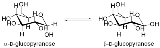
For example if a solution of β-D-glucopyranose is dissolved in water, its specific optical rotation will be +18.7. Over time, some of the β-D-glucopyranose will undergo mutarotation to become α-D-glucopyranose, which has an optical rotation of +112.2. Thus the rotation of the solution will increase from +18.7 to an equilibrium value of +52.5 as some of the β form is converted to the α form. The equilibrium mixture is actually about 64% of β-D-glucopyranose and about 36% of α-D-glucopyranose, though there are also with traces of the other forms including furanoses and open chained form.


The observed optical rotation of the sample is the weighted sum of the optical rotation of each anomer weighted by the amount of that anomer present. Therefore one can use a polarimeter
Polarimeter
A polarimeter is a scientific instrument used to measure the angle of rotation caused by passing polarized light through an optically active substance....

 to measure the rotation of a sample and then calculate the ratio of the two anomers present from the enantiomeric excess
Enantiomeric excess
The enantiomeric excess of a substance is a measure of how pure it is. In this case, the impurity is the undesired enantiomer .-Definition:...

, as long as one knows the rotation of each pure anomer. One can monitor the mutarotation process over time or determine the equilibrium mixture by observing the optical rotation and how it changes.

Reaction mechanism


See also

  • Anomer
    Anomer
    In carbohydrate chemistry, an anomer is a special type of epimer. It is one of two stereoisomers of a cyclic saccharide that differs only in its configuration at the hemiacetal or hemiketal carbon, also called the anomeric carbon. Anomerization is the process of conversion of one anomer to the other...

  • Monosaccharide
    Monosaccharide
    Monosaccharides are the most basic units of biologically important carbohydrates. They are the simplest form of sugar and are usually colorless, water-soluble, crystalline solids. Some monosaccharides have a sweet taste. Examples of monosaccharides include glucose , fructose , galactose, xylose...

  • Carbohydrate
    Carbohydrate
    A carbohydrate is an organic compound with the empirical formula ; that is, consists only of carbon, hydrogen, and oxygen, with a hydrogen:oxygen atom ratio of 2:1 . However, there are exceptions to this. One common example would be deoxyribose, a component of DNA, which has the empirical...

  • Polysaccharide
    Polysaccharide
    Polysaccharides are long carbohydrate molecules, of repeated monomer units joined together by glycosidic bonds. They range in structure from linear to highly branched. Polysaccharides are often quite heterogeneous, containing slight modifications of the repeating unit. Depending on the structure,...

  • Stereochemistry
    Stereochemistry
    Stereochemistry, a subdiscipline of chemistry, involves the study of the relative spatial arrangement of atoms within molecules. An important branch of stereochemistry is the study of chiral molecules....